
Smith R., Minton R. Calculus
Подождите немного. Документ загружается.


P1: OSO/OVY P2: OSO/OVY QC: OSO/OVY T1: OSO
MHDQ256-Ch16 MHDQ256-Smith-v1.cls January 7, 2011 11:30
LT (Late Transcendental)
CONFIRMING PAGES
16-11 SECTION 16.2
..
Nonhomogeneous Equations: Undetermined Coefficients 1083
so that r =−3orr =−1. The general solution of the homogeneous equation is then
c
1
e
−3t
+ c
2
e
−t
, so that the general solution of the nonhomogeneous equation is
u(t) = c
1
e
−3t
+ c
2
e
−t
+ 2e
2t
.
WhileTheorem2.1 showsus howto piece togetherthesolutionof a nonhomogeneous equa-
tion from a particular solution and the general solution of the corresponding homogeneous
equation, we still do not know how to find a particular solution. Themethod presented next,
called the method of undetermined coefficients, works for equations with constant coef-
ficients where the nonhomogeneous term is not too complicated and relies on our ability
to make an educated guess about the form of a particular solution. We begin by illustrating
this technique for example 2.1.
If u
+ 4u
+ 3u = 30e
2t
, then the most likely candidate for the form of u(t)isa
constant multiple of e
2t
. (How else would u
, 4u
and 3u all add up to 30e
2t
?) Be sure that
you understand the logic here, because we will be using it in the examples to come. So, an
educated guess is u
p
(t) = Ae
2t
, for some constant A. Substituting this into the differential
equation, we try to solve for A. (If it turns out to be impossible to solve for A, then we have
simply made a bad guess.) Here, we have u
p
= 2Ae
2t
and u
p
= 4Ae
2t
and so, requiring u
p
to be a solution of the nonhomogeneous equation gives as
30e
2t
= u
p
+ 4u
p
+ 3u
p
= 4Ae
2t
+ 4(2Ae
2t
) + 3(Ae
2t
)
= 15Ae
2t
.
So, 15A = 30 or A = 2. A particular solution is then u
p
(t) = 2e
2t
, as desired.
We learn more about making good guesses in examples 2.2 through 2.4.
EXAMPLE 2.2 Solving a Nonhomogeneous Equation
Find the general solution of u
+ 2u
− 3u =−30sin3t.
Solution First, we solve the corresponding homogeneous equation:
u
+ 2u
− 3u = 0. The characteristic equation here is
0 = r
2
+ 2r − 3 = (r +3)(r −1),
so that r =−3orr = 1. This gives us u = c
1
e
−3t
+ c
2
e
t
as the general solution of the
homogeneous equation. Next, we guess the form of a particular solution. Since the
right-hand side is a constant multiple of sin 3t, a reasonable guess might seem to
be u
p
= A sin3t. However, it turns out that this is too specific a guess, since when we
compute derivatives to substitute into the equation, we will also get cos3t terms. This
suggests the slightly more general guess u
p
= A sin3t + B cos3t. Substituting this into
the equation, we get
u
p
= A sin 3t + B cos3t
u
p
= 3A cos3t − 3B sin3t
u
p
=−9A sin3t − 9B cos3t
−30sin 3t =−9A sin 3t − 9B cos3t + 2(3A cos3t − 3B sin3t)
−3(A sin 3t + B cos3t)
= (−12A −6B)sin3t +(6A −12B)cos3t.
Equating the corresponding coefficients of the sine and cosine terms (imagine the
additional term 0cos 3t on the left-hand side), we have
−12A − 6B =−30
or 2A + B = 5
and 6A − 12B = 0
or A = 2B.
Substituting into the first equation, we get 2(2B) + B = 5orB = 1. Then, A = 2B = 2
and a particular solution is u
p
= 2sin3t + cos 3t. We now put together all of the pieces

P1: OSO/OVY P2: OSO/OVY QC: OSO/OVY T1: OSO
MHDQ256-Ch16 MHDQ256-Smith-v1.cls January 7, 2011 11:30
LT (Late Transcendental)
CONFIRMING PAGES
1084 CHAPTER 16
..
Second-Order Differential Equations 16-12
to obtain the general solution of the original equation:
u(t) = c
1
e
−3t
+ c
2
e
t
+ 2 sin3t + cos 3t.
Observe that while the calculations get a bit messy, the process of making a guess is
not exceptionally challenging. To keep the details of calculation from getting in the way of
the ideas, we next focus on making good guesses. In general, you start with the function
F(t) and then add terms corresponding to each derivative. For instance, in example 2.2, we
started with A sin3t and then added a term corresponding to its derivative: B cos3t.Wedo
not need to add other terms, because all other derivatives are simply constant multiples of
either sin3t or cos3t. However, suppose that F(t) = 7t
5
. The initial guess would include
At
5
and the derivatives Bt
4
, Ct
3
and so on. To save letters, you can use subscripts and write
the initial guess as
A
5
t
5
+ A
4
t
4
+ A
3
t
3
+ A
2
t
2
+ A
1
t + A
0
.
There is one exception to the preceding rule. If any term in the initial guess is also a
solution of the homogeneous equation, you must multiply the initial guess by a sufficiently
high power of t so that nothing in the modified guess is a solution of the homogeneous
equation. (In the case of second-order equations, this meansmultiplying the initial guess by
either t or t
2
.) To see why, consider u
+ 2u
− 3u = 4e
−3t
. The initial guess Ae
−3t
won’t
work, as seen in example 2.3.
EXAMPLE 2.3 Modifying an Initial Guess
Show that u(t) = Ae
−3t
is not a solution of u
+ 2u
− 3u = 4e
−3t
, for any value of A,
but that there is a solution of the form u(t) = Ate
−3t
.
Solution For u(t) = Ae
−3t
,wehaveu
(t) =−3Ae
−3t
and u
(t) = 9Ae
−3t
and so,
u
+ 2u
− 3u = 9Ae
−3t
+ 2(−3Ae
−3t
) − 3Ae
−3t
= 0 = 4e
−3t
.
That is, u(t) = Ae
−3t
is a solution of the homogeneous equation for every choice of A.
As a result, Ae
−3t
is not a solution of the nonhomogeneous equation for any choice of
A. However, if we multiply our initial guess by t,wehaveu(t) = Ate
−3t
,
u
(t) = Ae
−3t
+ At(−3e
−3t
) and
u
(t) =−3Ae
−3t
− 3Ae
−3t
+ At(9e
−3t
) =−6Ae
−3t
+ 9Ate
−3t
. Substituting into the
equation, we have
4e
−3t
= u
+ 2u
− 3u =−6Ae
−3t
+ 9Ate
−3t
+ 2(Ae
−3t
− 3Ate
−3t
) − 3Ate
−3t
=−4Ae
−3t
.
So, −4A = 4 and A =−1. A particular solution of the nonhomogeneous equation is
then u
p
(t) =−te
−3t
.
A summary of rules for making good guesses is given in the accompanying table.
Notice that sine and cosine terms always go together, and all polynomials are complete
with terms from t
n
all the way down to t and a constant.
The form of u
p
for au
+ bu
+ cu = F(t)
Modify Initial Guess if
F(t) Initial Guess ar
2
br c 0 for
e
r
1
t
Ae
r
1
t
r = r
1
coskt or sinkt A cos kt + B sinkt r =±ki
t
n
C
n
t
n
+C
n−1
t
n−1
+···+C
1
t +C
0
r = 0
e
ut
cosvt or e
ut
(A cos vt + B sin vt) r = u ± vi
e
ut
sinvt
t
n
e
r
1
t
(C
n
t
n
+C
n−1
t
n−1
+···+C
1
t +C
0
)e
r
1
t
r = r
1

P1: OSO/OVY P2: OSO/OVY QC: OSO/OVY T1: OSO
MHDQ256-Ch16 MHDQ256-Smith-v1.cls January 7, 2011 11:30
LT (Late Transcendental)
CONFIRMING PAGES
16-13 SECTION 16.2
..
Nonhomogeneous Equations: Undetermined Coefficients 1085
We illustrate the process of making good guesses in example 2.4.
EXAMPLE 2.4 Finding the Form of Particular Solutions
Determine the form for a particular solution of the following equations:
(a) y
+ 4y
= t
4
+ 3t
2
+ 2e
−4t
sint + 3e
−4t
and (b) y
+ 4y = 3t
2
sin2t + 3te
2t
.
Solution For part (a), the characteristic equation is 0 = r
2
+ 4r = r(r + 4), so
that r = 0 and r =−4. The solution of the homogeneous equation is then
y = c
1
+ c
2
e
−4t
. Looking at the right-hand side, we have a sum of three types of terms:
a polynomial, an exponential/sine combination and an exponential. From the table, our
initial guess is
y
p
= (C
4
t
4
+C
3
t
3
+C
2
t
2
+C
1
t +C
0
) + e
−4t
(A cos t + B sint) + De
−4t
.
However, referring back to the solution of the homogeneous equation, note that the
constant C
0
and the exponential De
−4t
are solutions of the homogeneous equation.
(Also note that the exponential/sine term is not a solution of the homogeneous
equation.) Multiplying the first and third terms by t, the correct form of a solution to the
nonhomogeneous equation is
y
p
= t(C
4
t
4
+C
3
t
3
+C
2
t
2
+C
1
t +C
0
) + e
−4t
(A cos t + B sint) + Dte
−4t
.
Now that we have the correct form of a solution, it’s a straightforward (though tedious)
matter to find the value of all the constants.
For part (b), the characteristic equation is r
2
+ 4 = 0, so that r =±2i and the
solution of the homogeneous equation is then y = c
1
cos2t + c
2
sin2t. Here, the
right-hand side consists of two terms: the product of a polynomial and a sine function
and the product of a polynomial and an exponential function. Multiplying guesses from
the table, we make our initial guess
y
p
= (A
2
t
2
+ A
1
t + A
0
)sin 2t + (B
2
t
2
+ B
1
t + B
0
)cos 2t + (C
1
t +C
0
)e
2t
.
Observe that both A
0
sin2t and B
0
cos2t are solutions of the homogeneous
equation. So, we must multiply the first two terms by t to obtain the modified
guess:
y
p
= t(A
2
t
2
+ A
1
t + A
0
)sin 2t + t(B
2
t
2
+ B
1
t + B
0
)cos 2t + (C
1
t +C
0
)e
2t
.
NOTES
The letters used in writing the
forms of the solutions are
completely arbitrary.
We now return to the study of mechanical vibrations. Recall that the movement of a
spring-mass system with an external force F(t) is modeled by mu
+ cu
+ ku = F(t).
EXAMPLE 2.5 The Motion of a Spring Subject to an External Force
A mass of 0.2kg stretches a spring by 10cm. The damping constant is c = 0.4. External
vibrations create a force of F(t) = 0.2 sin4t newtons, setting the spring in motion from
its equilibrium position. Find an equation for the position of the spring at any time t.
Solution We are given m = 0.2 and c = 0.4. Recall that the spring constant k satisfies
the equation mg = kl, where l = 10cm = 0.1m. (Notice that since the mass is given
in kg, g = 9.8 m/s
2
and we need the value of l in meters.) This enables us to solve for
k, as follows:
k =
mg
l
=
(0.2)(9.8)
0.1
= 19.6.
The equation of motion is then
0.2u
+ 0.4u
+ 19.6u = 0.2sin4t
or u
+ 2u
+ 98u = sin4t.

P1: OSO/OVY P2: OSO/OVY QC: OSO/OVY T1: OSO
MHDQ256-Ch16 MHDQ256-Smith-v1.cls January 7, 2011 11:30
LT (Late Transcendental)
CONFIRMING PAGES
1086 CHAPTER 16
..
Second-Order Differential Equations 16-14
This gives us the characteristic equation r
2
+ 2r + 98 = 0, which has solutions
r =
−2 ±
√
4 − 392
2
=−1 ±
√
97i. The solution of the homogeneous equation is then
u(t) = c
1
e
−t
cos
√
97t +c
2
e
−t
sin
√
97t. A particular solution has the form
u
p
= A sin4t + B cos4t. Substituting this into the equation, we get
sin4t = u
+ 2u
+ 98u
=−16A sin4t − 16B cos4t +2(4A cos4t − 4B sin4t)
+ 98(A sin4t + B cos4t)
= (82A −8B)sin4t +(8A +82B)cos4t.
Then, 82A − 8B = 1 and 8A + 82B = 0. The solution is A =
41
3394
and B =
−2
1697
and
so, the general solution of the nonhomogeneous equation is
u(t) = c
1
e
−t
cos
√
97t +c
2
e
−t
sin
√
97t +
41
3394
sin4t −
2
1697
cos4t.
The initial conditions are u(0) = 0 and u
(0) = 0. With t = 0 and u = 0, we get
0 = c
1
−
2
1697
or c
1
=
2
1697
. Computing the derivative u
(t) and substituting in t = 0 and
u
= 0, we get 0 =−c
1
+
√
97c
2
+
82
1697
or c
2
=
−80
1697
√
97
. The solution of the initial
value problem is then
u(t) =
2
1697
e
−t
cos
√
97t −
80
1697
√
97
e
−t
sin
√
97t
+
41
3394
sin4t −
2
1697
cos4t.
A graph is shown in Figure 16.6.
0.5 1 1.5 2 2.5 3
0.02
0.01
0.02
0.01
FIGURE 16.6
Spring motion with an external force
Notice in Figure 16.6 that after a very brief time, the motion appears to be simple
harmonic motion. We can verify this by a quick analysis of our solution in example 2.5.
Recall that the solution comes in two pieces, a particular solution
u
p
(t) =
41
3394
sin4t −
2
1697
cos4t
and the solution of the homogeneous equation
c
1
e
−t
cos
√
97t +c
2
e
−t
sin
√
97t.
As t increases, the presence of the exponential e
−t
causes the homogeneous solution to
approach 0, regardless of the value of the constants c
1
and c
2
. So, for any initial con-
ditions, the solution will eventually be dominated by the particular solution, which is a
simple oscillation. For this reason, the solution of the homogeneous equation is called
the transient solution and the particular solution is called the steady-state solution. This
is true of many, but not all equations. (Can you think of cases where the homogeneous
solution does not tend to 0 as t increases?) If we are interested only in the steady-state
solution, we can avoid much of the work in example 2.5 and simply solve for a particular
solution.
EXAMPLE 2.6 Finding a Steady-State Solution
For u
+ 3u
+ 2u = 20cos 2t, find the steady-state solution.
Solution For the homogeneous solution, the characteristic equation is
0 = r
2
+ 3r + 2 = (r +1)(r +2) and so, the solutions are r =−2 and r =−1. The
solution of the homogeneous equation is then u(t) = c
1
e
−2t
+ c
2
e
−t
. Since this tends to
P1: OSO/OVY P2: OSO/OVY QC: OSO/OVY T1: OSO
MHDQ256-Ch16 MHDQ256-Smith-v1.cls January 7, 2011 11:30
LT (Late Transcendental)
CONFIRMING PAGES
16-15 SECTION 16.2
..
Nonhomogeneous Equations: Undetermined Coefficients 1087
0ast →∞, we ignore it. A particular solution has the form u
p
(t) = A cos2t + B sin2t.
Substituting into the equation, we have
20cos 2t = u
+ 3u
+ 2u
=−4A cos2t − 4B sin2t +3(−2A sin2t + 2B cos2t)
+ 2(A cos2t + B sin2t)
= (−2A +6B)cos2t +(−6A −2B)sin2t.
So, we must have
−2A + 6B = 20
and −6A − 2B = 0.
From the second equation, B =−3A. Substituting into the first equation, we have
−2A − 18A = 20 or A =−1. Then, B =−3A = 3 and the steady-state solution is
u
p
(t) =−cos 2t + 3 sin2t.
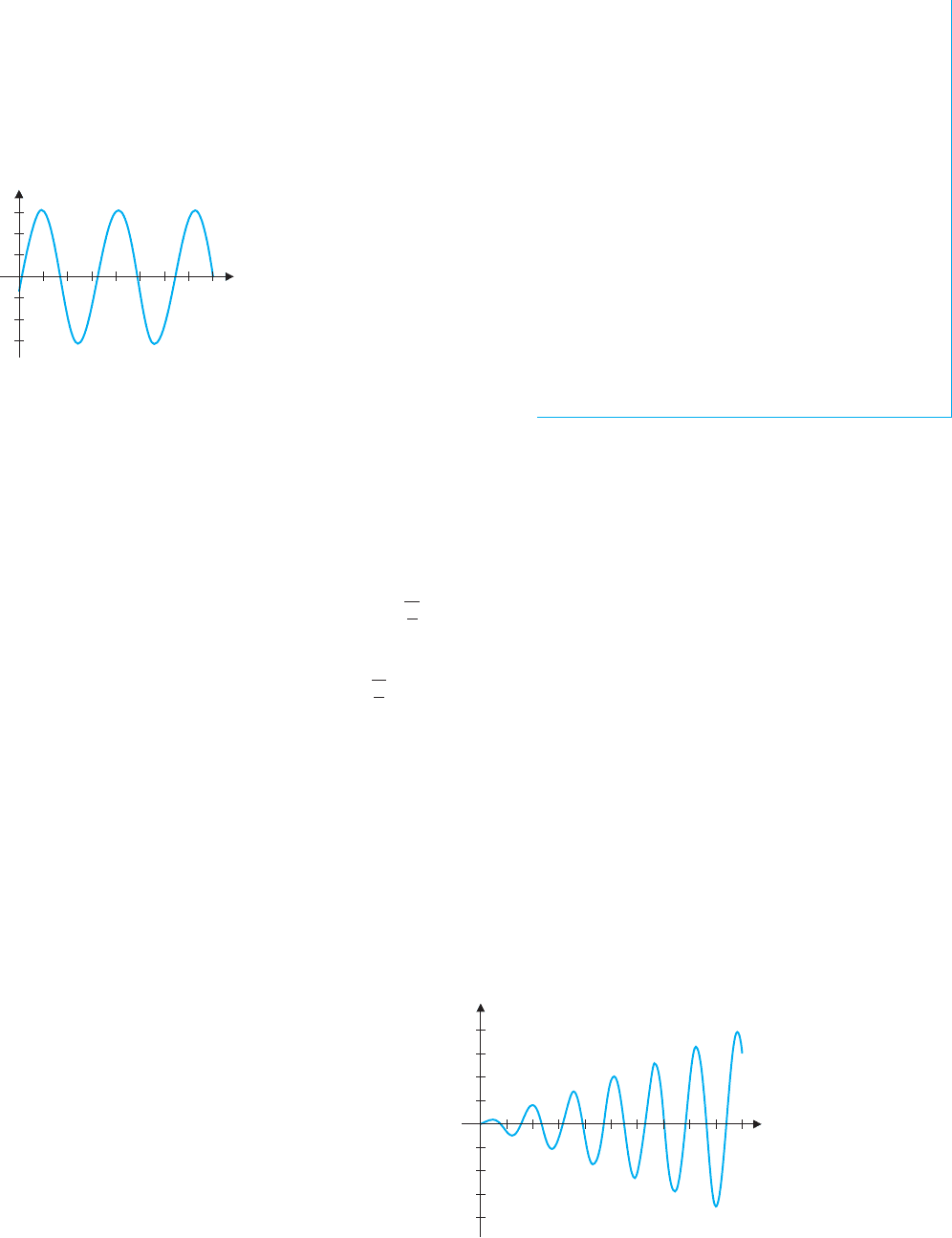
A graph is shown in Figure 16.7.
12345678
1
2
3
2
1
3
t
y
FIGURE 16.7
Steady-state solution
There are several possibilities for the steady-state motion of a mechanical system. Two
interesting cases, called resonance and beats, are introduced here. In their pure forms, both
occur only when there is no damping and the external force is a sine or cosine. In these
cases, then, the equation of motion is
mu
+ ku = F(t).
The characteristic equation for the homogeneous equation is mr
2
+ k = 0, which has
solutions r =±
k
m
i and the solution of the homogeneous equation is
u(t) = c
1
cosωt +c
2
sinωt,
where ω =
k
m
is called the natural frequency of the system.
Resonance occurs in a mechanical system when the external force is a sine or cosine
whose frequency exactly matches the natural frequency of the system. For example, sup-
pose that F(t) = sinωt. Then our initial guess u
p
(t) = A sinωt + B cosωt matches the
homogeneous solution and must be modified to the guess u
p
(t) = t(A sinωt + B cosωt).
The graph of such a function would oscillate, but the presence of the factor t would cause
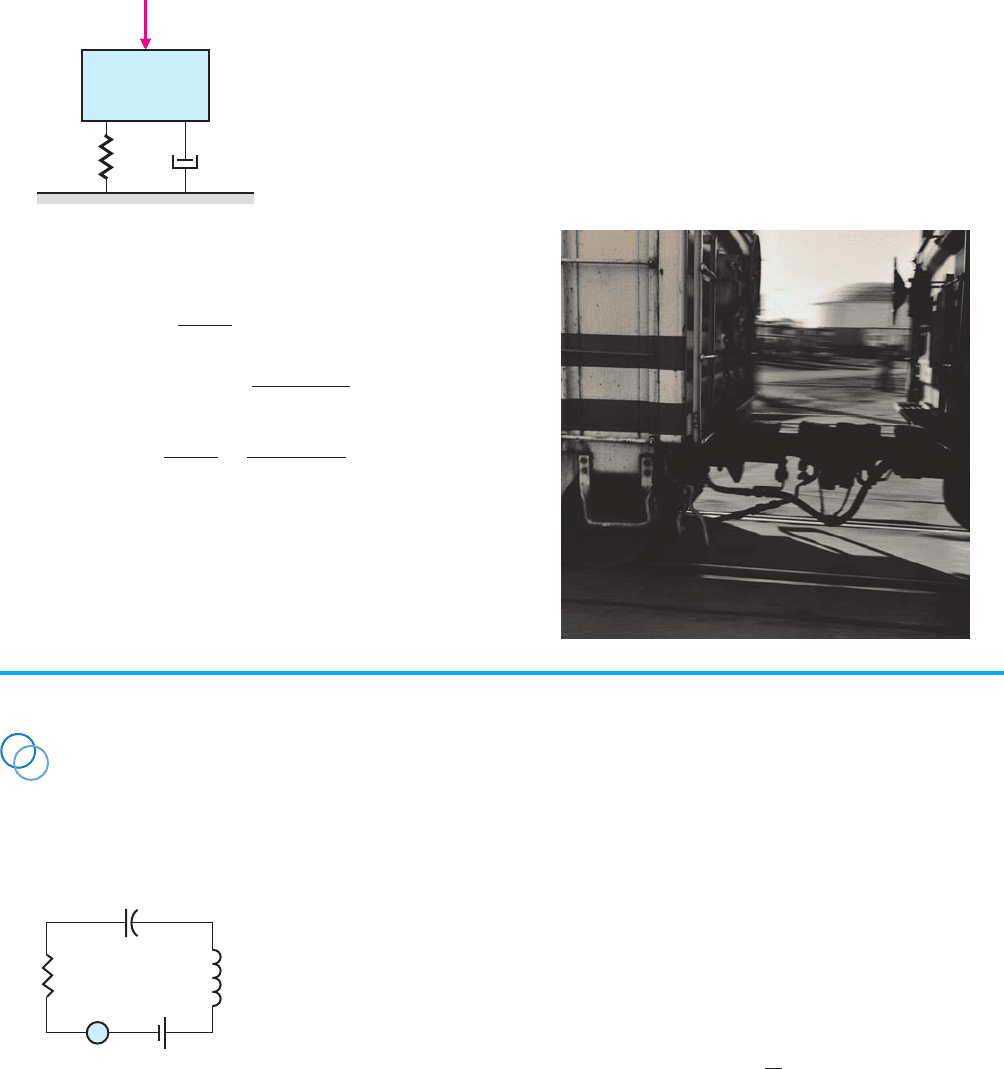
the oscillations to grow larger and larger without bound. The graph of u = 2t sin4t in
Figure 16.8 illustrates this behavior.
Physically, resonance can cause impressive disasters. A singer hitting a note (thus
producing an external force) at exactly the natural frequency of a wineglass can shatter it.
Soldiers marching in step across a bridge at exactly the natural frequency of the bridge can
create large oscillations in the bridge that can cause it to collapse.
10123456789
⫺10
⫺5
⫺20
⫺15
10
15
5
20
t
u
FIGURE 16.8
Resonance: u = 2t sin4t

P1: OSO/OVY P2: OSO/OVY QC: OSO/OVY T1: OSO
MHDQ256-Ch16 MHDQ256-Smith-v1.cls January 7, 2011 11:30
LT (Late Transcendental)
CONFIRMING PAGES
1088 CHAPTER 16
..
Second-Order Differential Equations 16-16
The phenomenon of beats occurs when the forcing frequency is close to (but not equal
to)the natural frequency. Forexample,foru
+ 4u = 2sin(2.1t)with u(0) = u
(0) = 0,the
homogeneous solution is u(t) = c
1
sin2t + c
2
cos2t and so, the forcing frequency of 2.1 is
close to the natural frequency of 2. We leave it as an exercise to show that the solution is
u(t) = 5.1219sin(2t) − 4.878 sin(2.1t)
The graph in Figure 16.9 illustrates the beats phenomenon of periodically increasing and
decreasing amplitudes.
This can be heard when tuning a piano. If a note is slightly off, its frequency is close to
thefrequencyof the externaltuningforkandyou willheartheamplitude variationillustrated
in Figure 16.9.
EXAMPLE 2.7 Resonance and Beats
For the system u
+ 5u = 3sin ωt, find the natural frequency, the value of ω that
produces resonance and a value of ω that produces beats.
10
5
5
10
t
y
50 100 150 200
FIGURE 16.9
Beats
Solution The characteristic equation for the homogeneous equation is r
2
+ 5 = 0,
with solutions r =±
√
5i. The natural frequency is then
√
5 and this is the value of ω
that produces resonance. Values close to
√
5 (such as ω = 2) produce beats.
BEYOND FORMULAS
Be sure that you understand the difference between the equations solved in sec-
tion 16.2 and those solved in section 16.1. For the nonhomogeneous equations ex-
plored in this section, you must first find the homogeneous solution c
1
y
1
(t) +c
2
y
2
(t)
as in section 16.1 and then find a particular solution y
p
(t). Always keep in mind
that the overall structure of the general solution of a nonhomogeneous equation is
y(t) = c
1
y
1
(t) +c
2
y
2
(t) + y
p
(t). Your task is then to fill in the details one at a time.
EXERCISES 16.2
WRITING EXERCISES
1. In many cases, a guess for the form of a particular solution
may seem logical but turn out to be a bad guess. Identify the
criterion for whether a guess is ultimately good or bad. (See
example 2.3.)
2. In example 2.4 part (a), the initial guess e
−4t
is multiplied by
t but e
−4t
cost is not. Explain why these terms are treated dif-
ferently by comparing the r-values in a characteristic equation
with solution e
−4t
to one with solution e
−4t
cost.
3. Soldiers are taught to break step when marching across a
bridge. Briefly explain why this is a good idea.
4. Is there any danger to a party of people dancing on a strong
balcony? Would it help if some of the people had a bad sense
of rhythm?
In exercises 1–4, find the general solution of the equation, given
a particular solution u
p
.
1. u
+ 2u
+ 5u = 15e
−2t
, u
p
(t) = 3e
−2t
2. u
+ 2u
− 8u = 14e
3t
, u
p
(t) = 2e
3t
3. u
+ 4u
+ 4u = 4t
2
, u
p
(t) = t
2
− 2t +
3
2
4. u
+ 4u = 6 sin t, u
p
(t) = 2 sin t
............................................................
In exercises 5–10, find the general solution of the equation.
5. u
+ 2u
+ 10u = 26e
−3t
6. u
− 2u
+ 5u = 10e
2t
7. u
+ 2u
+ u = 25 sin t
8. u
+ 4u = 24 cos 4t
9. u
− 4u = 2t
3
10. u
+ u
− 6u = 18t
2
............................................................
In exercises 11–18, determine the form of a particular solution
of the equation.
11. u
+ 2u
+ 10u = 2e
−t
+ 3e
−t
cos3t + 2sin3t
12. u
− 2u
+ 5u = e
t
sin2t − t
2
e
t
13. u
+ 2u
= 5t
3
− 2t + 4e
2t

P1: OSO/OVY P2: OSO/OVY QC: OSO/OVY T1: OSO
MHDQ256-Ch16 MHDQ256-Smith-v1.cls January 7, 2011 11:30
LT (Late Transcendental)
CONFIRMING PAGES
16-17 SECTION 16.2
..
Nonhomogeneous Equations: Undetermined Coefficients 1089
14. u
+ 4u = 2t cos2t − t
2
sint
15. u
+ 9u = e
t
cos3t − 2t sin3t
16. u
− 4u = t
3
e
2t
+ t
2
e
−2t
17. u
+ 4u
+ 4u = t
2
e
−2t
+ 2te
−2t
sint
18. u
+ 2u
+ u = t
2
− 4 + 2e
−t
............................................................
19. A mass of 0.1 kg stretches a spring by 2 mm. The damp-
ing constant is c = 0.2. External vibrations create a force of
F(t) = 0.1cos4t newtons,settingthespringinmotionfromits
equilibriumpositionwithzeroinitial velocity.Find an equation
for the position of the spring at any time t.
20. A mass of 0.4 kg stretches a spring by 2 mm. The damp-
ing constant is c = 0.4. External vibrations create a force of
F(t) = 0.8sin3t newtons,setting the spring inmotion from its
equilibriumpositionwithzeroinitial velocity.Find an equation
for the position of the spring at any time t.
21. A mass weighing 0.4 lb stretches a spring by 3 inches. The
damping constant is c = 0.4. External vibrations create a force
of F(t) = 0.2e
−t/2
lb. The spring is set in motion from its equi-
librium position with a downward velocity of 1 ft/s. Find an
equation for the position of the spring at any time t.
22. A mass weighing 0.1 lb stretches a spring by 2 inches. The
damping constant is c = 0.2. External vibrations create a force
of F(t) = 0.2e
−t/4
lb. The spring is set in motion by pulling it
down4inchesandreleasingit.Findanequationfortheposition
of the spring at any time t.
............................................................
Exercises 23–28 refer to amplitude and phase shift. (See exercise
21 in section 16.1.)
23. For u
+ 2u
+ 6u = 15 cos 3t, find the steady-state solution
and identify its amplitude and phase shift.
24. For u
+ 3u
+ u = 5 sin 2t, find the steady-state solution and
identify its amplitude and phase shift.
25. For u
+ 4u
+ 8u = 15 cos t + 10 sin t, find the steady-state
solution and identify its amplitude and phase shift.
26. For u
+ u
+ 6u = 12 cos t + 8 sin t, find the steady-state
solution and identify its amplitude and phase shift.
27. Amassweighing 2 lbstretches a spring by6 inches. The damp-
ing constant is c = 0.4. External vibrations create a force of
F(t) = 2sin2t lb. Find the steady-state solution and identify
its amplitude and phase shift.
28. A mass of 0.5 kg stretches a spring by 20 cm. The damp-
ing constant is c = 1. External vibrations create a force of
F(t) = 3cos2t N. Find the steady-state solution and identify
its amplitude and phase shift.
............................................................
29. For the system u
+ 3u = 4 sin ωt, find the natural frequency,
the value of ω that produces resonance and a value of ω that
produces beats.
30. Forthesystemu
+ 10u = 2 cos ωt,findthenaturalfrequency,
the value of ω that produces resonance and a value of ω that
produces beats.
31. A mass weighing 0.4 lb stretches a spring by 3 inches.
Ignore damping. External vibrations create a force of
F(t) = 2sinωt lb. Find the natural frequency, the value of ω
that produces resonance and a value of ω that produces beats.
32. A mass of 0.4 kg stretches a spring by 3 cm. Ignore damping.
External vibrations create a force of F(t) = 2sinωt N. Find
the natural frequency, the value of ω that produces resonance
and a value of ω that produces beats.
33. In this exercise, we compare solutions where resonance
is present and solutions of the same system with a
small amount of damping. Start by finding the solution
of y
+ 9y = 12cos3t, y(0) = 1, y
(0) = 0. Then solve the
initial value problem y
+ 0.1y
+ 9y = 12cos3t, y(0) = 1,
y
(0) = 0. Graph both solutions on the same set of axes, and
estimate a range of t-values for which the solutions stay close.
34. Repeat exercise 33 for y
+ 0.01y
+ 9y = 12cos3t,
y(0) = 1, y
(0) = 0.
35. For u
+ 4u = sin ωt, explain why the form of a particular
solution is simply A sinωt, for ω
2
= 4.
36. For u
+ 4u = 2t
3
, identify a simplified form of a particular
solution.
37. (a) Find the solution of u
+ 4u = 2 sin(2.1t), with
u(0) = u
(0) = 0. (b) Find the solution of u
+ 4u = 2 sin 2t
withu(0) = u
(0) = 0. (c)Comparethegraphsofthesolutions
to parts (a) and (b).
38. (a) For u
+ 4u = sin ωt, u(0) = u
(0) = 0, find the solution
as a function of ω. Compare the graphs of the solutions for
ω = 0.5,ω = 0.9 and ω = 1. (b) For u
+ 4u = sin ωt,
u(0) = u
(0) = 1, find the solution as a function of ω.
(c) Compare the graphs of the solutions for ω = 0.5,ω= 0.9
and ω = 1. (d) Discuss the effects of the initial conditions by
comparing the graphs in parts (a) and (c).
APPLICATIONS
39. Foru
+ 0.1u
+ 4u = sin ωt,findtheamplitudeofthesteady-
state solution as a function of ω.
40. For the spring problem in exercise 39, what happens to the
steady-state amplitude as ω approaches 0? Explain why this
makes sense.
41. An object falls under the forces of gravity and air drag. Ex-
plain the significance of each term in the equation of motion
−mg − ky
= my
. If the object has mass 5 kg, the air drag
coefficient is k = 0.5 kg/s, the initial velocity is 1 m/s and
initial height is 60 m, find the height at time t.
42. Estimate when the object of exercise 41 hits the ground, and
estimate its impact velocity.
EXPLORATORY EXERCISES
1. A washing machine whose tub spins with rotational speed ω
generates a downward force of f
0
sinωt for some constant
f
0
. If the machine rests on a spring and damping mechanism
P1: OSO/OVY P2: OSO/OVY QC: OSO/OVY T1: OSO
MHDQ256-Ch16 MHDQ256-Smith-v1.cls January 7, 2011 11:30
LT (Late Transcendental)
CONFIRMING PAGES
1090 CHAPTER 16
..
Second-Order Differential Equations 16-18
(see diagram), the vertical motion of the machine satisfies the
familiar equation u
+ cu
+ ku = f
0
sinωt. Explain what
happens to the motion as c and k are increased. We now add
one layer to the design problem for the machine. The forces
absorbed by the spring and damper are transmitted to thefloor.
That is, F(t) = cu
+ ku is the force of the machine on the
floor. We would like this to be small.Explain in physical terms
why this force increases if c and k increase. So the design
of the machine must balance vertical movement versus force
transmitted to the floor. Consider the following argument for
an equation for F(t).
F
kb
Machine schematic
Let the symbol D stand for derivative. Then
we can write F = cu
+ ku = (cD + k)u. Solving for
u, we get u =
F
cD + k
. Now, writing the equation
u
+ cu
+ ku = f
0
sinωt as (D
2
+ cD + k)u = f
0
sinωt,
we solve for u and get u =
f
0
sinωt
D
2
+ cD + k
. Setting the two
expressions for u equal to each other, we have
F
cD + k
=
f
0
sinωt
D
2
+ cD + k
.
Multiplying this out, we have
(D
2
+ cD + k)F = (cD +k) f
0
sinωt.
Show that this gives the correct answer: that is, F(t)
satisfies the equation
F
+ cF
+ kF = c( f
0
sinωt)
+ k( f
0
sinωt).
2. Spring devices are used in a variety of mechanisms, includ-
ing the railroad car coupler shown in the photo. The coupler
allows the railroad cars a certain amount of slack but applies
a restoring force if the cars get too close or too far apart. If y
measures the displacement of the coupler back and forth, then
y
= F(y), where F(y) is the force produced by the coupler.
A simple model is F(y) =
⎧
⎨
⎩
−y − d if y < −d
0if−d ≤ y ≤ d.
−y + d if y ≥ d
This models a restoring force with a dead zone in the mid-
dle. Suppose the initial conditions are y(0) = 0 and y
(0) = 1.
That is, the coupler is centered at y = 0 and has a positive
velocity. At y = 0, the coupler is in the dead zone with no
forces. Solve y
= 0 with the initial conditions and show that
y(t) = t for 0 ≤ t ≤ d. At this point, the coupler leaves the
dead zone and we now have y
=−y +d. Explain why ini-
tial conditions for this part of the solution are y(d) = d and
y
(d) = 1.Solve this problem and determine the time at which
the coupler reenters the dead zone. Continue in this fashion to
construct the solution piece by piece. Describe in words the
pattern that emerges. Then, explain in which sense this model
ignoresdamping.Revisethefunction F(y)toincludedamping.
~
Capacitance C
Resistance R
Voltage E(t)
Inductance L
RLC circuit
16.3 APPLICATIONS OF SECOND-ORDER EQUATIONS
In sections 16.1 and 16.2, we developed models of spring-mass systems with and without
external forces. It turns out that the charge in a simple electrical circuit can be modeled with
the same equation as for the motion of a spring-mass system. For an RLC-circuit (consisting
of resistors, capacitors, inductors and a voltage source), the net resistance R (measured in
ohms), the capacitance C (in farads) and the inductance L (in henrys) are all positive. For
now, we will assume that there is no impressed voltage. If Q(t) (coulombs) is the total
charge on the capacitor at time t and I (t) is the current, then I = Q
(t). The basic laws of
electricity tell us that
the voltage drop across the resistors is IR,
the voltage drop across the capacitor is
Q
C
,
the voltage drop across the inductor is LI
(t)
P1: OSO/OVY P2: OSO/OVY QC: OSO/OVY T1: OSO
MHDQ256-Ch16 MHDQ256-Smith-v1.cls January 7, 2011 11:30
LT (Late Transcendental)
CONFIRMING PAGES
16-19 SECTION 16.3
..
Applications of Second-Order Equations 1091
and the voltage drops must sum to the impressed voltage. If there is none, then
LI
(t) +RI(t) +
1
C
Q(t) = 0
or LQ
(t) +RQ
(t) +
1
C
Q(t) = 0. (3.1)
Observe that this is the same as equation (1.2), except for the names of the constants.
Example 3.1 works the same as the examples from section 16.1.
EXAMPLE 3.1 Finding the Charge in an Electrical Circuit
A series circuit has an inductor of 0.2 henry, a resistor of 300 ohms and a capacitor of
10
−5
farad. The initial charge on the capacitor is 10
−6
coulomb and there is no initial
current. Find the charge on the capacitor and the current at any time t.
t
y
0.014
0.012
0.010
0.008
0.006
0.004
0.002
10
−6
10
−5
10
−4
10
−3
10
−2
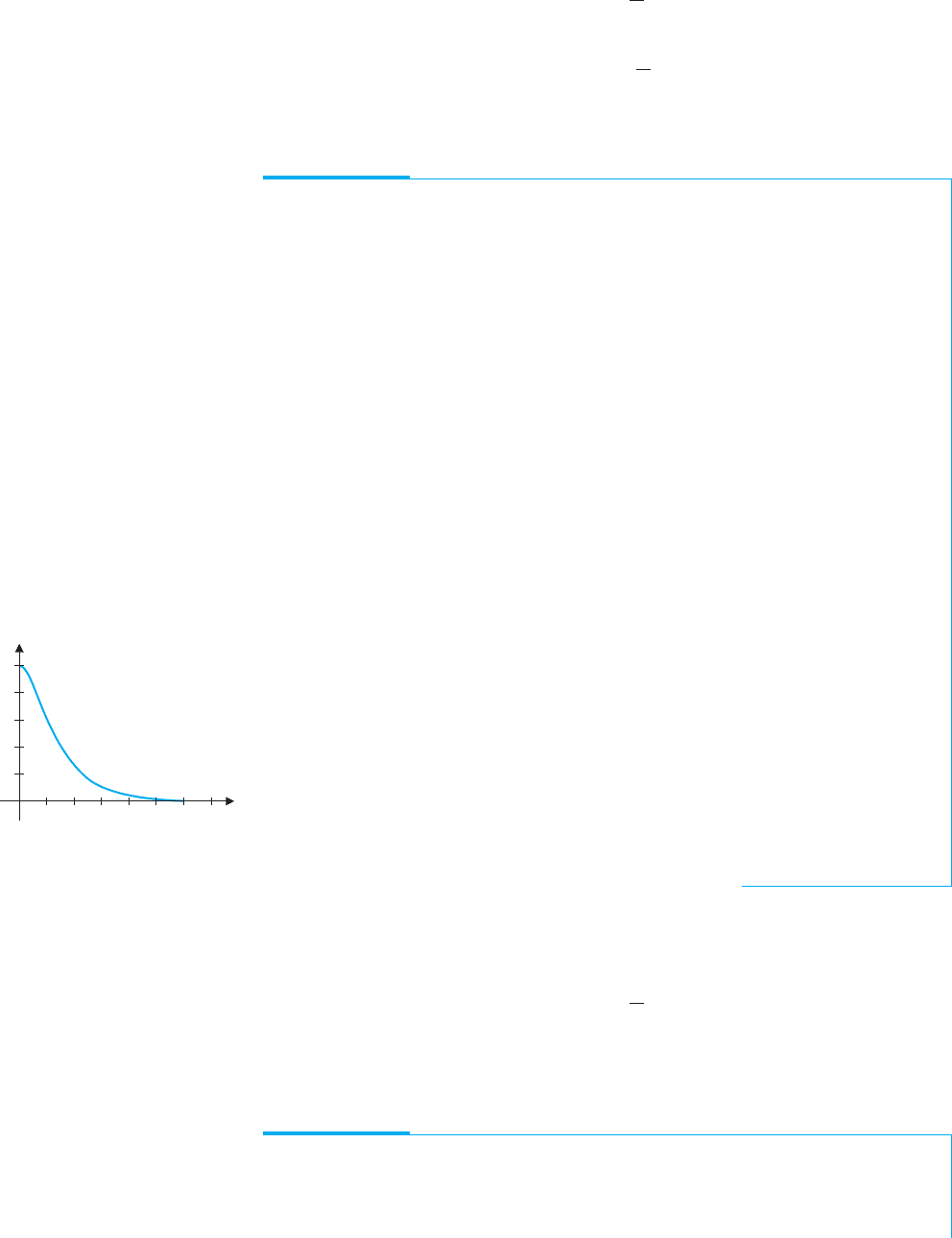
FIGURE 16.10
Q(t) = 10
−6
(2e
−500t
− e
−1000t
)
Solution From (3.1), with L = 0.2, R = 300 and C = 10
−5
, the equation for the
charge is
0.2Q
(t) +300Q
(t) +100,000Q(t) = 0
or Q
(t) +1500Q
(t) +500,000Q(t) = 0.
The characteristic equation is then
0 = r
2
+ 1500r + 500,000 = (r +500)(r +1000),
so that the roots are r =−500 and r =−1000. The general solution is then
Q(t) = c
1
e
−500t
+ c
2
e
−1000t
. (3.2)
The initial conditions are Q(0) = 10
−6
and Q
(0) = 0 [since Q
(t) gives the current].
This gives us
10
−6
= Q(0) = c
1
+ c
2
and 0 = Q
(0) =−500c
1
− 1000c
2
,
from which we obtain c
1
=−2c
2
. The first equation now gives us c
2
=−10
−6
and so,
c
1
= 2 × 10
−6
. The charge function is then
Q(t) = 10
−6
(2e
−500t
− e
−1000t
).
The graph in Figure 16.10 shows a rapidly declining charge. The current function is
simply the derivative of the charge function. That is,
I(t) =−10
−3
(e
−500t
− e
−1000t
).
If an impressed voltage E(t) from a power supply is added to the circuit of ex-
ample 3.1, equation (3.1) is replaced by the nonhomogeneous equation
LQ
(t) + RQ
(t) +
1
C
Q(t) = E(t). (3.3)
Notice that here, the impressed voltage plays a role equivalent to the external force in a
spring-mass system. We can use the techniques of section 16.2 to solve such an equation,
as we illustrate in example 3.2.
EXAMPLE 3.2 Finding the Charge in a Circuit with an Impressed Voltage
Suppose that the circuit of example 3.1 is attached to an alternating current power
supply with the impressed voltage E(t) = 170sin(120π t) volts. Find the steady-state
charge on the capacitor and the steady-state current.

P1: OSO/OVY P2: OSO/OVY QC: OSO/OVY T1: OSO
MHDQ256-Ch16 MHDQ256-Smith-v1.cls January 7, 2011 11:30
LT (Late Transcendental)
CONFIRMING PAGES
1092 CHAPTER 16
..
Second-Order Differential Equations 16-20
Solution From (3.3) using the values of example 3.1, we obtain the equation for the
charge:
0.2Q
(t) +300Q
(t) +100,000Q(t) = 170sin(120π t)
or Q
(t) +1500Q
(t) +500,000Q(t) = 850sin(120π t). (3.4)
As in example 3.1, the roots of the characteristic equation are r =−500 and
r =−1000, so that the solution of the homogeneous equation is c
1
e
−500t
+ c
2
e
−1000t
.
Since this part of the solution tends to 0 as t increases, the steady-state solution is
simply the particular solution, which here has the form
Q
p
(t) = A sin(120πt) + B cos(120π t).
This gives us
Q
p
(t) = 120π A cos(120πt) − 120π B sin(120πt)
and Q
p
(t) =−14,400π
2
A sin(120πt) −14,400π
2
B cos(120πt).
Substituting these into (3.4) gives us
850sin(120π t) = [−14,400π
2
A sin(120πt) −14,400π
2
B cos(120πt)]
+1500 [120π A cos(120π t) − 120π B sin(120πt)]
+500,000 [A sin(120πt) + B cos(120πt)]
= [(500,000 −14,400π
2
)A − 180,000π B]sin(120πt)
+[(500,000 −14,400π
2
)B + 180,000A]cos(120π t).
Matching up the coefficients of sin(120πt) and cos(120πt) gives us
(500,000 − 14,400π
2
)A − 180,000π B = 850
and (500,000 − 14,400π
2
)B + 180,000π A = 0.
Solving for A and B, we get the approximate values A ≈ 0.000679 and
B ≈−0.00107. The steady-state charge is then approximately
Q
p
(t) ≈ 0.000679sin(120πt) −0.00107cos(120π t),
which gives us a steady-state current of
Q
p
(t) ≈ 0.2561cos(120πt) +0.4046sin(120π t).
We show a graph of this in Figure 16.11.
0.5
0.25
0.25
0.5
t
Q'
p
(t)
0.025
0.05
0.075
0.1
FIGURE 16.11
Steady-state current
Noticethat thisisan alternating currentwithapproximate amplitude
(0.2561)
2
+ (0.4046)
2
≈ 0.4788 and the same 60 hertz (cycles per second) as the
power supply. The large resistance in this circuit has greatly reduced the current.
The properties of electrical circuits are sometimes summarized in a frequency response
curve, as constructed in example 3.3. The numbers are simplified so that we can illustrate
a basic principle behind radio reception. For convenience, we use the fact that the solution
of the system of equations
c
1
A +c
2
B = d
1
c
3
A +c
4
B = d
2
can be written in the form
A =
c
4
d
1
− c
2
d
2
c
1
c
4
− c
2
c
3
and B =
c
1
d
2
− c
3
d
1
c
1
c
4
− c
2
c
3
, (3.5)
provided c
1
c
4
− c
2
c
3
= 0.
EXAMPLE 3.3 A Frequency Response Curve
For a circuit whose charge satisfies u
+ 8u
+ 2532u = sinωt, find the amplitude of
the steady-state solution as a function f of the external frequency ω and plot the