
Smith R., Minton R. Calculus
Подождите немного. Документ загружается.

P1: PIC/OVY P2: OSO/OVY QC: OSO/OVY T1: OSO
MHDQ256-Ch06 MHDQ256-Smith-v1.cls December 15, 2010 19:5
LT (Late Transcendental)
CONFIRMING PAGES
6-39 SECTION 6.6
..
The Hyperbolic Functions 413
We illustrate a simple integral in example 6.2.
EXAMPLE 6.2 An Integral Involving a Hyperbolic Function
Evaluate
x cosh(x
2
)dx.
Solution Noticethatyoucanevaluatethis integralusing asubstitution.Ifweletu = x
2
,
we get du = 2xdxand so,
x cosh(x
2
)dx =
1
2
cosh(x
2
)
coshu
(2x)dx
du
=
1
2
coshudu=
1
2
sinhu + c
=
1
2
sinh(x
2
) + c.
For f (x) = sinh x, note that
f (x) = sinh x =
e
x
− e
−x
2
> 0ifx > 0
< 0ifx < 0
.
This is left as an exercise. Further, since f
(x) = cosh x > 0, sinh x is increasing for all x.
Next, note that f
(x) = sinh x. Thus, the graph is concave down for x < 0 and concave up
for x > 0. Finally, you can easily verify that
lim
x→∞
sinh x =∞ and lim
x→−∞
sinh x =−∞.
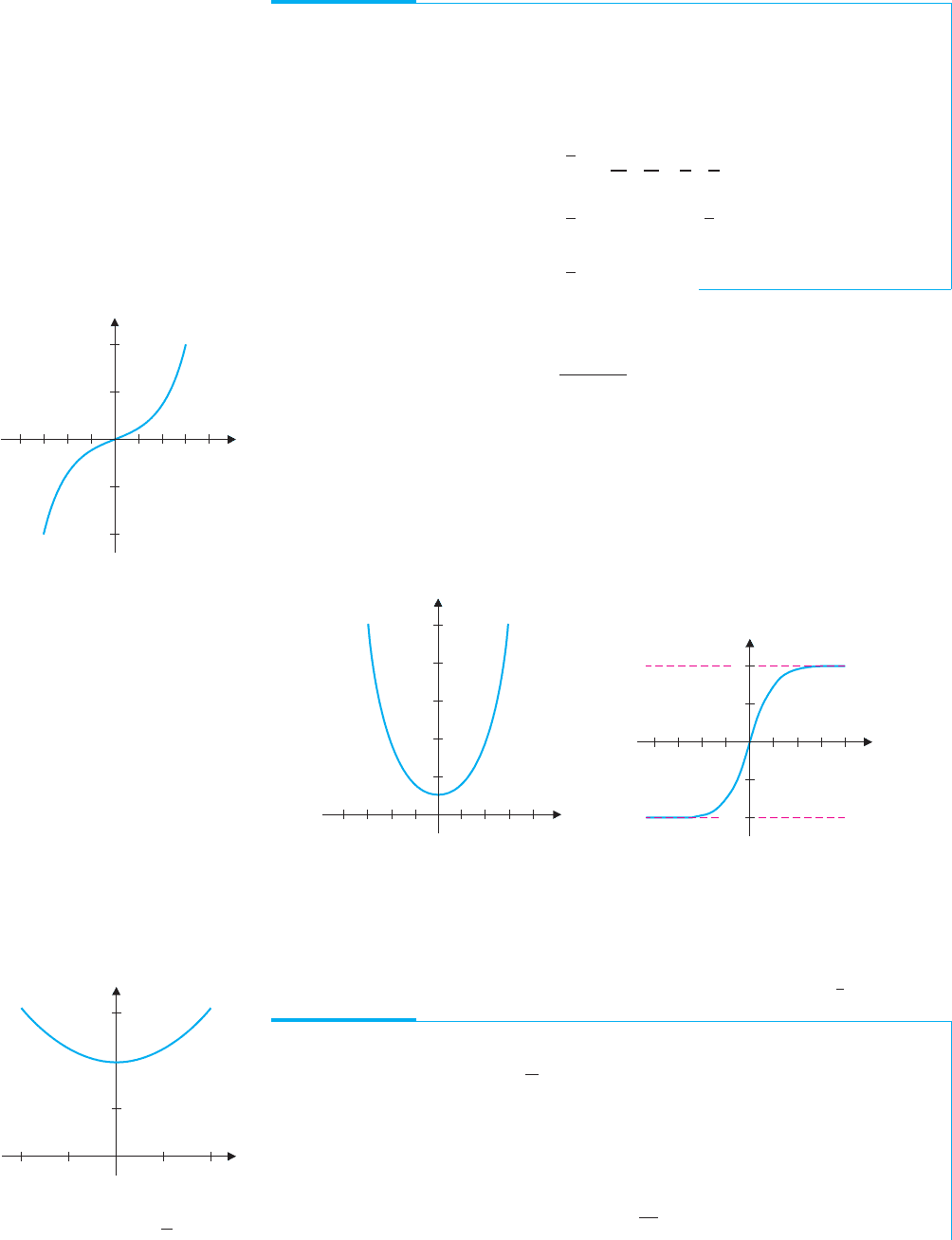
We show a graph of y = sinh x in Figure 6.30. Graphs of cosh x and tanh x are shown in
Figures 6.31a and 6.31b, respectively.
y
x
10
5
5
10
4224
FIGURE 6.30
y = sinh x
y
x
2 424
2
4
6
8
10
1
1
y
x
244 2
FIGURE 6.31a
y = cosh x
FIGURE 6.31b
y = tanh x
y
x
10 201020
10
30
FIGURE 6.32
y = 20 cosh
x
20
If a flexible cable or wire (such as a power line or telephone line) hangs between two
towers, it will assume the shape of a catenary curve (derived from the Latin word catena
meaning “chain”). As we will show at the end of this section, this naturally occurring curve
corresponds to the graph of the hyperbolic cosine function f (x) = a cosh
x
a
.
EXAMPLE 6.3 Finding the Amount of Sag in a Hanging Cable
For the catenary f (x) = 20cosh(
x
20
), for −20 ≤ x ≤ 20, find the amount of sag in the
cable and the arc length.
Solution From the graph of the function in Figure 6.32, it appears that the minimum
value of the function is at the midpoint x = 0, with the maximum at x =−20 and
x = 20. To verify this observation, note that
f
(x) = sinh
x
20
P1: PIC/OVY P2: OSO/OVY QC: OSO/OVY T1: OSO
MHDQ256-Ch06 MHDQ256-Smith-v1.cls December 15, 2010 19:5
LT (Late Transcendental)
CONFIRMING PAGES
414 CHAPTER 6
..
Exponentials, Logarithms and Other Transcendental Functions 6-40
and hence, f
(0) = 0, while f
(x) < 0 for x < 0 and f
(x) > 0, for x > 0. Thus, f
decreases to a minimum at x = 0. Further, f (−20) = f (20) ≈ 30.86 is the maximum
for −20 ≤ x ≤ 20 and f (0) = 20, so that the cable sags approximately 10.86 feet. From
the usual formula for arc length, developed in section 5.4, the length of the cable is
L =
20
−20
1 + [ f
(x)]
2
dx =
20
−20
1 + sinh
2
x
20
dx.
Notice that from (6.1), we have
1 + sinh
2
x = cosh
2
x.
Using this identity, the arc length integral simplifies to
L =
20
−20
1 + sinh
2
x
20
dx =
20
−20
cosh
x
20
dx
= 20 sinh
x
20
20
−20
= 20[sinh(1) − sinh(−1)]
= 40 sinh(1) ≈ 47 feet.
The Inverse Hyperbolic Functions
You should note from the graphs of sinh x and tanh x that these functions are one-to-one (by
the horizontal line test). Also, coshx is one-to-one for x ≥ 0. Thus, we can define inverses
for these functions, as follows. For any x ∈ (−∞, ∞), we define the inverse hyperbolic
sine by
y = sinh
−1
x if and only if sinh y = x.
For any x ≥ 1, we define the inverse hyperbolic cosine by
y = cosh
−1
x if and only if cosh y = x, and y ≥ 0.
Finally, for any x ∈ (−1, 1), we define the inverse hyperbolic tangent by
y = tanh
−1
x if and only if tanh y = x.
Inverses for the remaining three hyperbolic functions can be defined similarly and are left
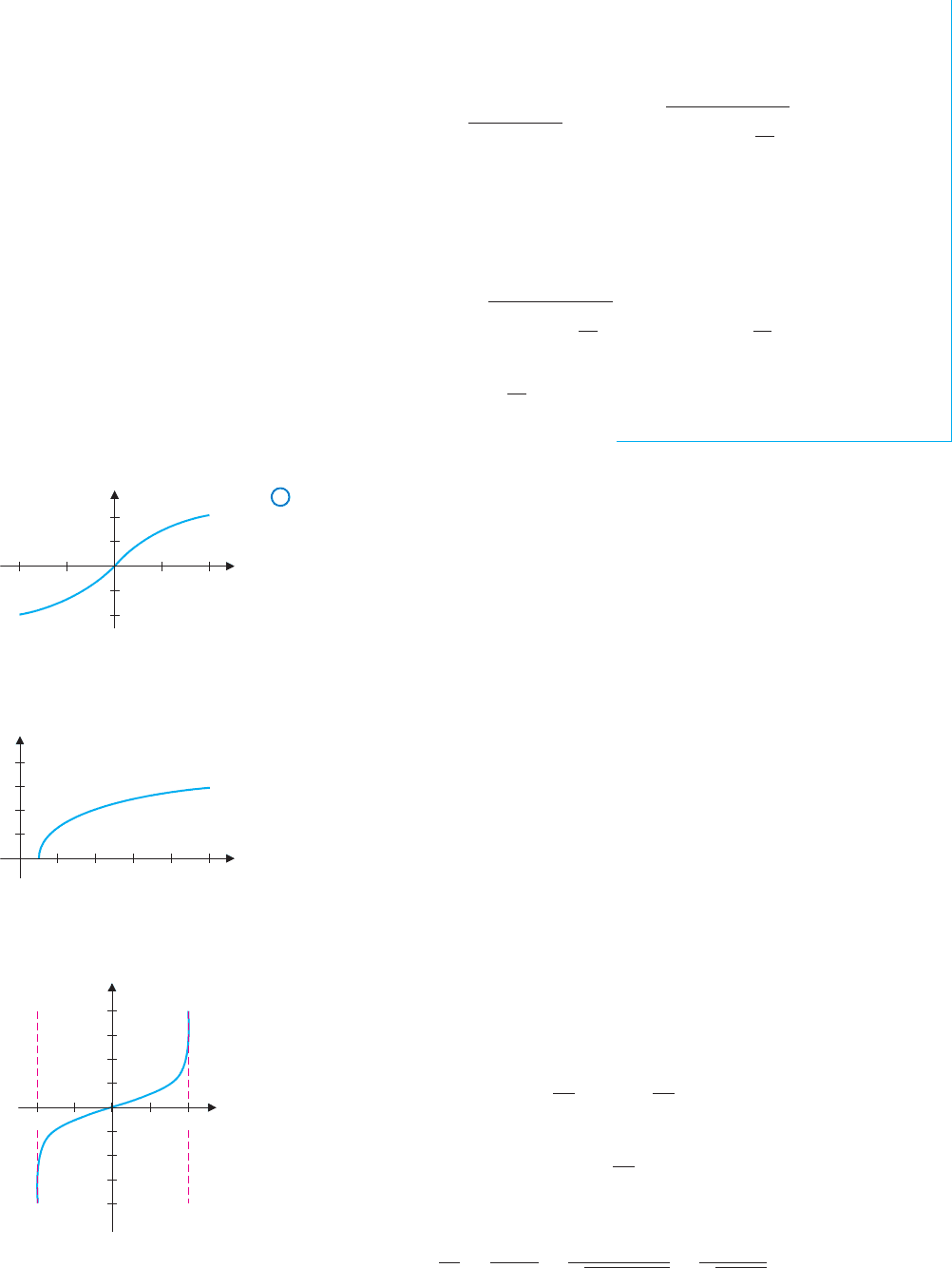
to the exercises. We show the graphs of y = sinh
−1
x, y = cosh
−1
x and y = tanh
−1
x in
Figures 6.33a, 6.33b and 6.33c, respectively. (As usual, you can obtain these by reflecting
the graph of the original function through the line y = x.)
y
x
2 424
2
2
FIGURE 6.33a
y = sinh
−1
x
x
2610
y
4
2
FIGURE 6.33b
y = cosh
−1
x
2
2
11
4
4
y
x
FIGURE 6.33c
y = tanh
−1
x
We can find derivatives for the inverse hyperbolic functions using implicit differentia-
tion, just as we have for the inverse trigonometric functions. Since
y = sinh
−1
x if and only if sinh y = x, (6.2)
differentiating both sides of this last equation with respect to x yields
d
dx
sinh y =
d
dx
x
or cosh y
dy
dx
= 1.
Solving for the derivative, we find
dy
dx
=
1
cosh y
=
1
1 + sinh
2
y
=
1
√
1 + x
2
,

P1: PIC/OVY P2: OSO/OVY QC: OSO/OVY T1: OSO
MHDQ256-Ch06 MHDQ256-Smith-v1.cls December 15, 2010 19:5
LT (Late Transcendental)
CONFIRMING PAGES
6-41 SECTION 6.6
..
The Hyperbolic Functions 415
since we know that
cosh
2
y − sinh
2
y = 1,
from (6.1). That is, we have shown that
d
dx
sinh
−1
x =
1
√
1 + x
2
.
Note the similarity with the derivative formula for sin
−1
x. Wecan likewiseestablish deriva-
tive formulas for the other five inverse hyperbolic functions. We list these here for the sake
of completeness.
d
dx
sinh
−1
x =
1
√
1 + x
2
d
dx
cosh
−1
x =
1
√
x
2
− 1
d
dx
tanh
−1
x =
1
1 − x
2
d
dx
coth
−1
x =
1
1 − x
2
d
dx
sech
−1
x =
−1
x
√
1 − x
2
d
dx
csch
−1
x =
−1
|x|
√
1 + x
2
Before closing this section, we wish to point out that the inverse hyperbolic functions
have a significant advantage over earlier inverse functions we have discussed. It turns out
that we can solve for the inverse functions explicitly in termsof more elementary functions.
EXAMPLE 6.4 Finding a Formula for an Inverse Hyperbolic Function
Find an explicit formula for sinh
−1
x.
Solution Recall from (6.2) that
y = sinh
−1
x if and only if sinh y = x.
Using this definition, we have
x = sinh y =
e
y
− e
−y
2
. (6.3)
We can solve this equation for y, as follows. First, recall also that
cosh y =
e
y
+ e
−y
2
.
Now, notice that adding these last two equations and using the identity (6.1), we have
e
y
= sinh y + cosh y = sinh y +
cosh
2
y since cosh y > 0
= sinh y +
sinh
2
y + 1
= x +
x
2
+ 1,
from (6.3). Finally, taking the natural logarithm of both sides, we get
y = ln(e
y
) = ln(x +
x
2
+ 1).
That is, we have found a formula for the inverse hyperbolic sine function:
sinh
−1
x = ln(x +
x
2
+ 1).
Similarly, we can show that for x ≥ 1,
cosh
−1
x = ln(x +
x
2
− 1)
and for −1 < x < 1,
tanh
−1
x =
1
2
ln
1 + x
1 − x
.
P1: PIC/OVY P2: OSO/OVY QC: OSO/OVY T1: OSO
MHDQ256-Ch06 MHDQ256-Smith-v1.cls December 16, 2010 20:17
LT (Late Transcendental)
CONFIRMING PAGES
416 CHAPTER 6
..
Exponentials, Logarithms and Other Transcendental Functions 6-42
We leave it to the exercises to derive these formulas and corresponding formulas for the
remaining inverse hyperbolic functions. There is little point in memorizing any of these for-
mulas.Youneedonlyrealizethatthesearealwaysavailablebyperformingsomeelementary
algebra.
Derivation of the Catenary
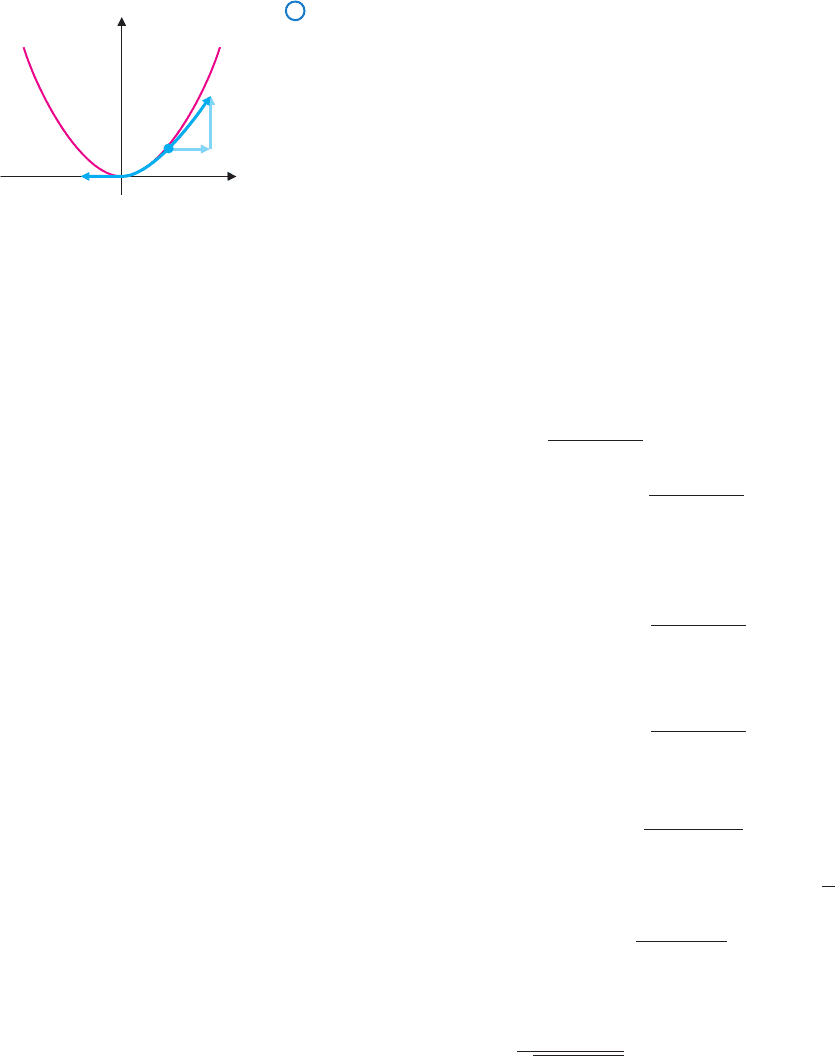
We close this section by deriving a formula for the catenary. As you follow the steps, pay
special attention to the variety of calculus results that we use.
y f (x)
(x, y)
T cos u
T sin
u
x
H
T
y
u
FIGURE 6.34
Forces acting on a section of
hanging cable
In Figure 6.34, we assume that the lowest point of the catenary curve is located at the
origin. We further assume that the cable has constant linear density ρ (measured in units of
weight per unit length) and that the function y = f (x) is twice continuously differentiable.
We focus on the portion of the cable from the origin to the general point (x, y) indicated
in the figure. Since this section is not moving, the horizontal and vertical forces must be
balanced. Horizontally, this section of cable is pulled to the left by the tension H at the
origin and is pulled to the right by the horizontal component T cosθ of the tension T at the
point (x, y). Notice that these forces are balanced if
H = T cos θ. (6.4)
Vertically, the section of cable is pulled up by the vertical component T sinθ of the tension.
The section of cable is pulled down by the weight of the section. Notice that the weight of
the section is given by the product of the density ρ (weight per unit length) and the length
of the section. Recall from your study of arc length in Chapter 5 that the arc length of this
section of cable is given by
x
0
1 + [ f
(t)]
2
dt. So, the vertical forces will balance if
T sinθ = ρ
x
0
1 + [ f
(t)]
2
dt. (6.5)
We can combine equations (6.4) and (6.5) by multiplying (6.4) by tanθ to get
H tanθ = T sinθ, and then using (6.5) to conclude that
H tanθ = ρ
x
0
1 + [ f
(t)]
2
dt.
Notice from Figure 6.34 that tanθ = f
(x), so that we have
Hf
(x) = ρ
x
0
1 + [ f
(t)]
2
dt.
Differentiating both sides of this equation, the Fundamental Theorem of Calculus gives us
Hf
(x) = ρ
1 + [ f
(x)]
2
. (6.6)
Now, divide both sides of the equation by H and name b =
ρ
H
. Further, substitute
u(x) = f
(x). Equation (6.6) then becomes
u
(x) = b
1 + [u(x)]
2
.
Putting together all of the u terms and integrating with respect to x gives us
1
1 + [u(x)]
2
u
(x)dx =
bdx.
You should recognize the integral on the left-hand side as sinh
−1
[u(x)],so that we now have
sinh
−1
[u(x)] = bx + c.
Notice that since f (x) has a minimum at x = 0, we must have that u(0) = f
(0) = 0.
So, taking x = 0, we get c = sinh
−1
(0) = 0. From sinh
−1
[u(x)] = bx, we obtain

P1: PIC/OVY P2: OSO/OVY QC: OSO/OVY T1: OSO
MHDQ256-Ch06 MHDQ256-Smith-v1.cls December 15, 2010 19:5
LT (Late Transcendental)
CONFIRMING PAGES
6-43 SECTION 6.6
..
The Hyperbolic Functions 417
u(x) = sinh(bx). Now, recall that u(x) = f
(x), so that f
(x) = sinh(bx). Integrating this
gives us
f (x) =
sinh(bx)dx
=
1
b
cosh(bx) +c.
Recall that f (0) = 0 and so, we must havec =
−1
b
. This leaves us with f (x) =
1
b
cosh(bx) −
1
b
.
Finally, writing a =
1
b
, we obtain the catenary equation f (x) = a cosh
x
a
− a.
EXERCISES 6.6
WRITING EXERCISES
1. Compare the derivatives and integrals of the trigonomet-
ric functions to the derivatives and integrals of the hyper-
bolic functions. Also note that the trigonometric identity
cos
2
x + sin
2
x = 1 differs only by a minus sign from the cor-
responding hyperbolic identity cosh
2
x − sinh
2
x = 1.
2. As noted in the text, the hyperbolic functions are not really
newfunctions. They provide names for useful combinations of
exponential functions. Explain why it is advantageous to as-
sign special names to these functions instead of leaving them
as exponentials.
3. Briefly describe the graphs of sinh x, cosh x and tanh x.
Which simple polynomials do the graphs of sinh x and cosh x
resemble?
4. The catenary (hyperbolic cosine) is the shape assumed by a
hanging cable because this distributes the weight of the cable
most evenly throughout the cable. Knowing this, why was it
smart to build the Gateway Arch in this shape? Why would
you suspect that the profile of an egg has this same shape?
In exercises 1–4, sketch the graph of each function.
1. f (x) = cosh2x 2. f (x) = cosh3x
3. f (x) = tanh4x 4. f (x) = sinh3x
............................................................
In exercises 5–12, find the derivative of each function.
5. (a) f (x) = cosh4x (b) f (x) = cosh
4
x
6. (a) f (x) = sinh
√
x (b) f (x) =
√
sinh x
7. (a) f (x) = tanh x
2
(b) f (x) = (tanhx)
2
8. (a) f (x) = sech3x (b) f (x) = csch
3
x
9. (a) f (x) = x
2
sinh5x (b) f (x) =
x
2
+1
csch
3
x
10. (a) f (x) =
cosh4x
x+2
(b) f (x) = tanh
4x
x+2
11. (a) f (x) = cosh
−1
2x (b) f (x) = sinh
−1
x
2
12. (a) f (x) = tanh
−1
3x (b) f (x) = x
2
cosh
−1
4x
............................................................
In exercises 13–22, evaluate each integral.
13.
cosh6xdx 14.
sinh2xdx
15.
tanh3xdx 16.
sech
2
xdx
17.
1
0
e
4x
− e
−4x
2
dx 18.
2x
√
1 + x
4
dx
19.
cos x sinh(sin x) dx 20.
x cosh(x
2
)dx
21.
1
0
cosh xe
sinh x
dx 22.
1
0
cosh2x
3 + sinh 2x
dx
............................................................
23. Suppose that a hanging cable has the shape 10cosh(x/10) for
−20 ≤ x ≤ 20. Find the amount of sag in the cable. Find the
length of the cable.
24. Suppose that a hanging cable has the shape 15cosh(x/15) for
−25 ≤ x ≤ 25. Find the amount of sag in the cable. Find the
length of the cable.
25. Suppose that a hanging cable has the shape a cosh(x/a)
for −b ≤ x ≤ b. Show that the amount of sag is given by
a cosh(b/a) −a and the length of the cable is 2a sinh(b/a).
26. Show that cosh(−x) = cosh x (i.e., cosh x is an even function)
and sinh(−x) =−sinh x (i.e., sinh x is an odd function).
27. Derive the formulas
d
dx
cosh x = sinh x and
d
dx
tanh x = sech
2
x.
28. Derive the formulas for the derivatives of coth x, sech x and
csch x.
29. Using the properties of exponential functions, prove that
sinh x > 0ifx > 0 and sinh x < 0ifx < 0.
30. Use the first and second derivatives to explain the properties
of the graph of tanh x.
31. Use the first and second derivatives to explain the properties
of the graph of cosh x.
32. Prove that cosh
2
x − sinh
2
x = 1.
33. Find an explicit formula, as in example 6.4, for cosh
−1
x.
34. Find an explicit formula, as in example 6.4, for tanh
−1
x.
35. Show that e
x
= cosh x + sinh x. In fact, we will show that
this is the only way to write e
x
as the sum of even and odd
functions. To see this, assume that e
x
= f (x) + g(x), where
f is even and g is odd. Show that e
−x
= f (x) − g(x). Adding
equations and dividing by two, conclude that f (x) = coshx.
Then conclude that g(x) = sinhx.

P1: PIC/OVY P2: OSO/OVY QC: OSO/OVY T1: OSO
MHDQ256-Ch06 MHDQ256-Smith-v1.cls December 15, 2010 19:5
LT (Late Transcendental)
CONFIRMING PAGES
418 CHAPTER 6
..
Exponentials, Logarithms and Other Transcendental Functions 6-44
36. Show that both cosh x and sinh x are solutions of the differen-
tial equation y
− y = 0. By comparison, showthat both cos x
and sin x are solutions of the differential equation y
+ y = 0.
37. Show that lim
x→∞
tanh x = 1 and lim
x→−∞
tanh x =−1.
38. Show that tanhx =
e
2x
− 1
e
2x
+ 1
.
APPLICATIONS
39. In this exercise, we solve the initial value problem for the
vertical velocity v(t) of a falling object subject to gravity and
air drag. Assume that mv
(t) =−mg + kv
2
for some positive
constant k.
(a) Rewrite the equation as
1
v
2
− mg/k
v
(t) =
k
m
.
(b) Use the identity
1
v
2
− a
2
=
1
2a
1
v −a
−
1
v +a
with
a =
mg
k
to solve the equation in part (a).
(c) Show that v(t) =−
mg
k
ce
2
√
kg/mt
− 1
ce
2
√
kg/mt
+ 1
.
(d) Use the initial condition v(0) = 0 to show that c = 1.
(e) Use the result of exercise 38 to conclude that
v(t) =−
mg
k
tanh
kg
m
t
.
(f) Find the terminal velocity by computing lim
t→∞
v(t).
(g) Integrate the velocity function in part (e) to find the dis-
tance fallen in t seconds.
40. Two sky divers of weight 800 N drop from a height of 1000 m.
The first sky diver dives head-first with a drag coefficient of
k =
1
8
. The second sky diver is in a spread-eagle position
with k =
1
2
. Compare the terminal velocities and the distances
fallen in 2 seconds; 4 seconds.
41. Long and Weiss derive the following equation for the horizon-
talvelocityofthe space shuttle during reentry(see section 4.1):
v(t) = 7901 tanh(−0.00124t + tanh
−1
(v
0
/7901)) m/s, where
v
0
isthe velocity at time t = 0. Find the maximum acceleration
experienced by the shuttle from this horizontal motion (i.e.,
maximize|v
(t)|). Graphthe velocity function with v
0
= 2000.
Estimate the time t at which v(t) = 0.
42. A sky diver with an open parachute has terminal velocity
5 m/s. If the weight is 800 N, determine the value of k.
EXPLORATORY EXERCISE
1. The Saint Louis Gateway Arch is both 630 feet wide and
630 feet tall. Its shape looks very much like a parabola, but
is actually a catenary. You will explore the difference be-
tween the two shapes in this exercise. First, consider the
model y = 757.7 − 127.7 cosh(x/127.7) for y ≥ 0. Find the
x- and y-intercepts and show that this model (approximately)
matchesthe arch’smeasurements of 630 feet wide and 630 feet
tall. What would the 127.7 in the model have to be to match
the measurements exactly? Now, consider a parabolic model.
To have x-intercepts x =−315 and x = 315, explain why
the model must have the form y =−c(x + 315)(x − 315) for
some positive constant c. Then find c to match the desired
y-intercept of 630. Graph the parabola and the catenary on the
same axes for −315 ≤ x ≤ 315. How much difference is there
between the graphs? Estimate the maximum distance between
the curves. The authors have seen mathematics books where
the arch is modeled by a parabola. How wrong is it to do this?
Review Exercises
WRITING EXERCISES
The following list includes terms that are defined and theorems that
arestatedinthis chapter.Foreachterm or theorem, (1)givea precise
definition or statement, (2) state in general terms what it means and
(3) describe the types of problems with which it is associated.
Natural logarithm Logarithmic Inverse function
differentiation
One-to-one Exponential Inverse sine
function function function
Inverse cosine Inverse tangent Hyperbolic sine
function function function
Hyperbolic cosine Hyperbolic tangent
function function
TRUE OR FALSE
State whether each statement is true or false and briefly explain
why. If the statement is false, try to “fix it” by modifying the given
statement to a new statement that is true.
1. Thefunctionsln x =
x
1
1
u
du andlog
e
x havemanyproperties
in common but are not exactly the same.
2. The derivative of the inverse function f
−1
(x) is the inverse of
the derivative of f (x).
3. If f has a derivative that exists for all x, then f has an inverse.
4. If f (x) has a term of the form e
g(x)
for some function g(x),
then f
−1
(x) also has a term of the form e
g(x)
.

P1: PIC/OVY P2: OSO/OVY QC: OSO/OVY T1: OSO
MHDQ256-Ch06 MHDQ256-Smith-v1.cls December 15, 2010 19:5
LT (Late Transcendental)
CONFIRMING PAGES
6-45 CHAPTER 6
..
Review Exercises 419
Review Exercises
5. The function f (x) = sin
−1
(x) is not the inverse of sin x.
6. Wecoulddefinethefunction f (x) = cos
−1
(x)tohavetherange
−π ≤ cos
−1
(x) ≤ 0.
7. Because the derivative of cos
−1
(x)is the negative of the deriva-
tive of sin
−1
(x), we can conclude that cos
−1
(x) =−sin
−1
(x).
8. The properties of the functions sinh x and cosh x are identical
tothepropertiesofthecorrespondingfunctionssin x and cos x.
In exercises 1–16, find the derivative of the function.
1. ln(x
3
+ 5) 2. ln(1 −sin x)
3. ln
√
x
4
+ x 4. ln
x
2
− 1
x
3
+ 2x + 1
5. e
−x
2
6. e
tan x
7. 4
x
3
8. 3
1−2x
9. sin
−1
2x 10. cos
−1
x
2
11. tan
−1
(cos2x) 12. sec
−1
(3x
2
)
13. cosh
√
x 14. sinh(e
2x
)
15. sinh
−1
3x 16. tanh
−1
(3x + 1)
............................................................
In exercises 17–40, evaluate the integral.
17.
x
2
x
3
+ 4
dx 18.
e
2x
e
2x
+ 4
dx
19.
1
0
x
x
2
+ 1
dx 20.
π/4
π/12
cos2x
sin2x
dx
21.
sin(ln x)
x
dx 22.
ln x + 1
x
dx
23.
e
−4x
dx 24.
e
2x
cos(e
2x
)dx
25.
e
√
x
√
x
dx 26.
xe
−x
2
dx
27.
2
0
e
3x
dx 28.
0
−2
e
−3x
dx
29.
3
4x
dx 30.
2
−5x
dx
31.
3
x
2
+ 4
dx 32.
6
√
4 − x
2
dx
33.
x
2
√
1 − x
6
dx 34.
e
−x
1 + e
−2x
dx
35.
9x
x
2
√
x
4
− 1
dx 36.
9x
3
√
x
4
− 1
dx
37.
4
√
1 + x
2
dx 38.
4
x
2
− 1
dx
39.
cosh4xdx 40.
tanh3xdx
............................................................
In exercises 41–44, determine if the function is one-to-one. If so,
find its inverse.
41. x
3
− 1 42. e
−4x
43. e
2x
2
44. x
3
− 2x + 1
............................................................
In exercises 45–48, do both parts without solving for the inverse:
(a) find the derivative of the inverse at x a and (b) graph the
inverse.
45. x
5
+ 2x
3
− 1, a = 2 46. x
3
+ 5x + 2, a = 2
47.
√
x
3
+ 4x, a = 4 48. e
x
3
+2x
, a = 1
............................................................
In exercises 49–52, evaluate the quantity using the unit circle.
49. sin
−1
1 50. cos
−1
(−
1
2
)
51. tan
−1
(−1) 52. csc
−1
(−2)
............................................................
In exercises 53–56, simplify the expression using a triangle.
53. sin(sec
−1
2) 54. tan(cos
−1
(4/5))
55. sin
−1
(sin(3π/4)) 56. cos
−1
(sin(−π/4))
............................................................
In exercises 57 and 58, find all solutions of the equation.
57. sin2x = 1 58. cos 3x =
1
2
............................................................
In exercises 59–64, sketch a graph.
59. y = cosh2x 60. y = tanh
−1
3x
61. y = sin
−1
2x 62. y = tan
−1
3x
63. y = e
−x
2
64. y = ln2x
............................................................
65. A hanging cable assumes the shape of y = 20cosh
x
20
for
−25 ≤ x ≤ 25. Find the amount of sag in the cable.
66. Find the arc length of the cable in exercise 65.
............................................................
In exercises 67 and 68, determine which function “dominates,”
where we say that the function f (x) dominates the func-
tion g(x)asx → ∞ if lim
x→∞
f (x) lim
x→∞
g(x) ∞ and either
lim
x→∞
f (x)
g(x)
∞ or lim
x→∞
g(x)
f (x)
0.
67. e
x
or x
n
(n = any positive integer)
68. ln x or x
p
(for any number p > 0)
............................................................
69. The diagram shows a football field with hash marks H feet
apart and goalposts P feet apart. If a field goal is to be tried
from a (horizontal) distance of x feet from the goalposts, the
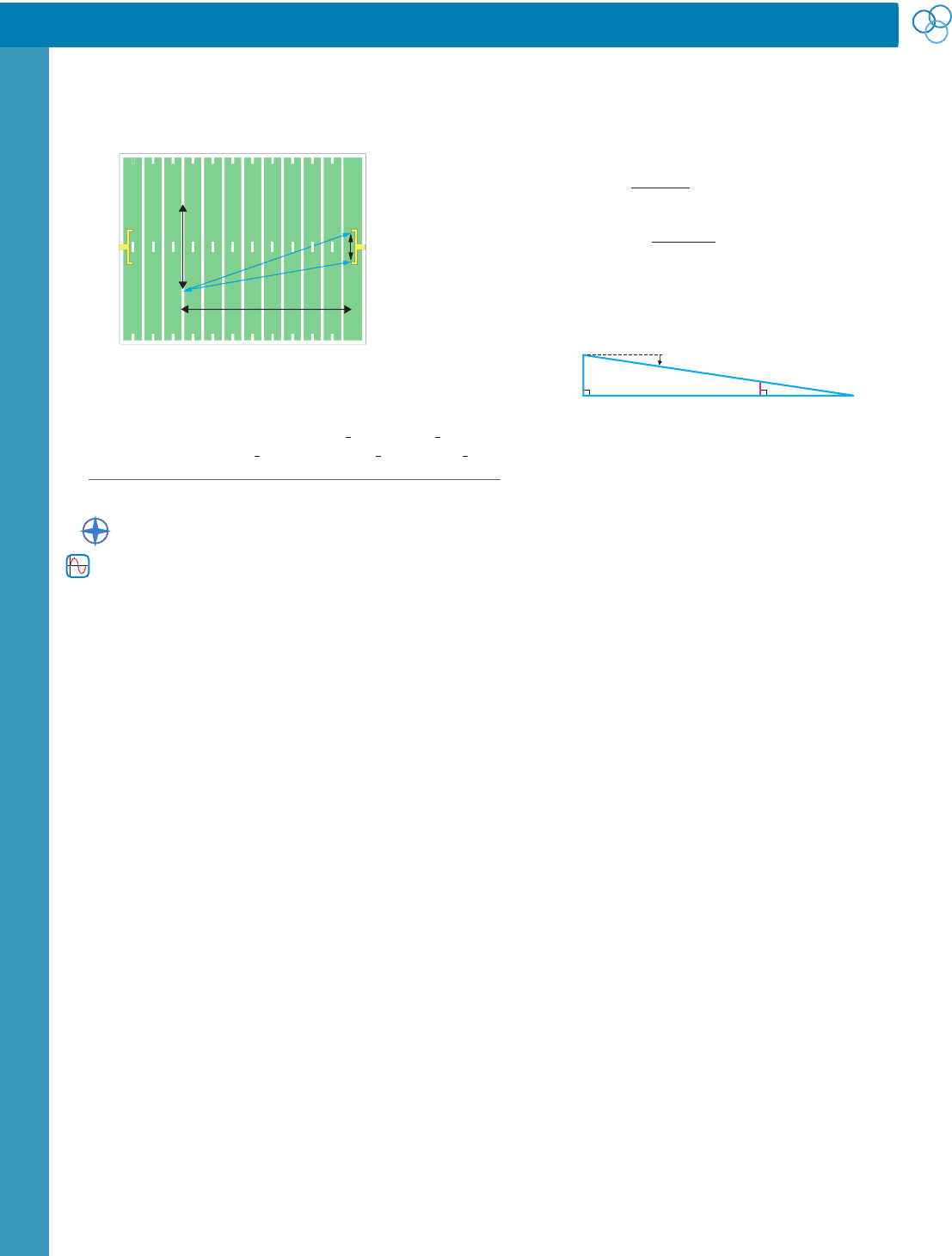
P1: PIC/OVY P2: OSO/OVY QC: OSO/OVY T1: OSO
MHDQ256-Ch06 MHDQ256-Smith-v1.cls December 15, 2010 19:5
LT (Late Transcendental)
CONFIRMING PAGES
420 CHAPTER 6
..
Exponentials, Logarithms and Other Transcendental Functions 6-46
Review Exercises
angle θ gives the margin of error for that direction. Find x to
maximize θ.
P
x
H
70. In the situation of exercise 69, sportsannouncers often say that
for a short field goal (50 ≤ x ≤ 60), a team can improve the
angle by backing up 5 yards with a penalty. Determine whether
this is true for high school (H = 53
1
3
and P = 23
1
3
), college
(H = 40 and P = 18
1
2
) or pros (H = 18
1
2
and P = 18
1
2
).
EXPLORATORY EXERCISES
1. In tennis, a serve must clear the net and then land inside of a
box drawn on the other side of the net. In this exercise, you
will explore the margin of error for successfully serving. First,
consider a straight serve (this essentially means a serve hit
infinitely hard) struck 9 feet above the ground. Call the start-
ing point (0, 9). The back of the service box is 60 feet away,
at (60, 0). The top of the net is 3 feet above the ground and
39 feet from the server, at (39, 3). Find the service angle θ
(i.e., the angle as measured from the horizontal) for the trian-
gle formed by the points (0, 9), (0, 0) and (60, 0). Of course,
most serves curve down due to gravity. Ignoring air resistance,
the path of the ball struck at angle θ and initial speed v ft/s
is y =−
16
(v cosθ )
2
x
2
− (tanθ)x + 9. To hit the back of the
service line, you need y = 0 when x = 60. Substitute in these
values along with v = 120. Multiply by cos
2
θ and replace
sinθ with
√
1 − cos
2
θ. Replacing cosθ with z gives you an
algebraic equation in z. Numerically estimate z. Similarly, sub-
stitute x = 39 and y = 3 and find an equation for w = cosθ .
Numerically estimate w. The margin of error for the serve is
given by cos
−1
z <θ<cos
−1
w.
9
60
u
3
2. Baseball players often say that an unusually fast pitch rises or
even hops up as it reaches the plate. One explanation of this il-
lusioninvolvestheplayers’inabilitytotracktheballalltheway
to the plate. The player must compensate by predicting where
the ball will be when it reaches the plate. Suppose the height of
a pitch when it reaches home plate is h =−(240/v)
2
+ 6 feet
for a pitch with velocity v ft/s. (This equation takes into con-
sideration gravity but not air resistance.) Halfway to the plate,
the height would be h =−(120/v)
2
+ 6 feet. Compare the
halfway heights for pitches with v = 132 and v = 139 (about
90 and 95 mph, respectively). Would a batter be able to tell
much difference between them? Now compare the heights
at the plate. Why might the batter think that the faster pitch
hopped up right at the plate? How many inches did the faster
pitch hop?
P1: OSO/OVY P2: OSO/OVY QC: OSO/OVY T1: OSO
MHDQ256-Ch07 MHDQ256-Smith-v1.cls December 23, 2010 21:26
LT (Late Transcendental)
CONFIRMING PAGES
CHAPTER
7
Integration Techniques
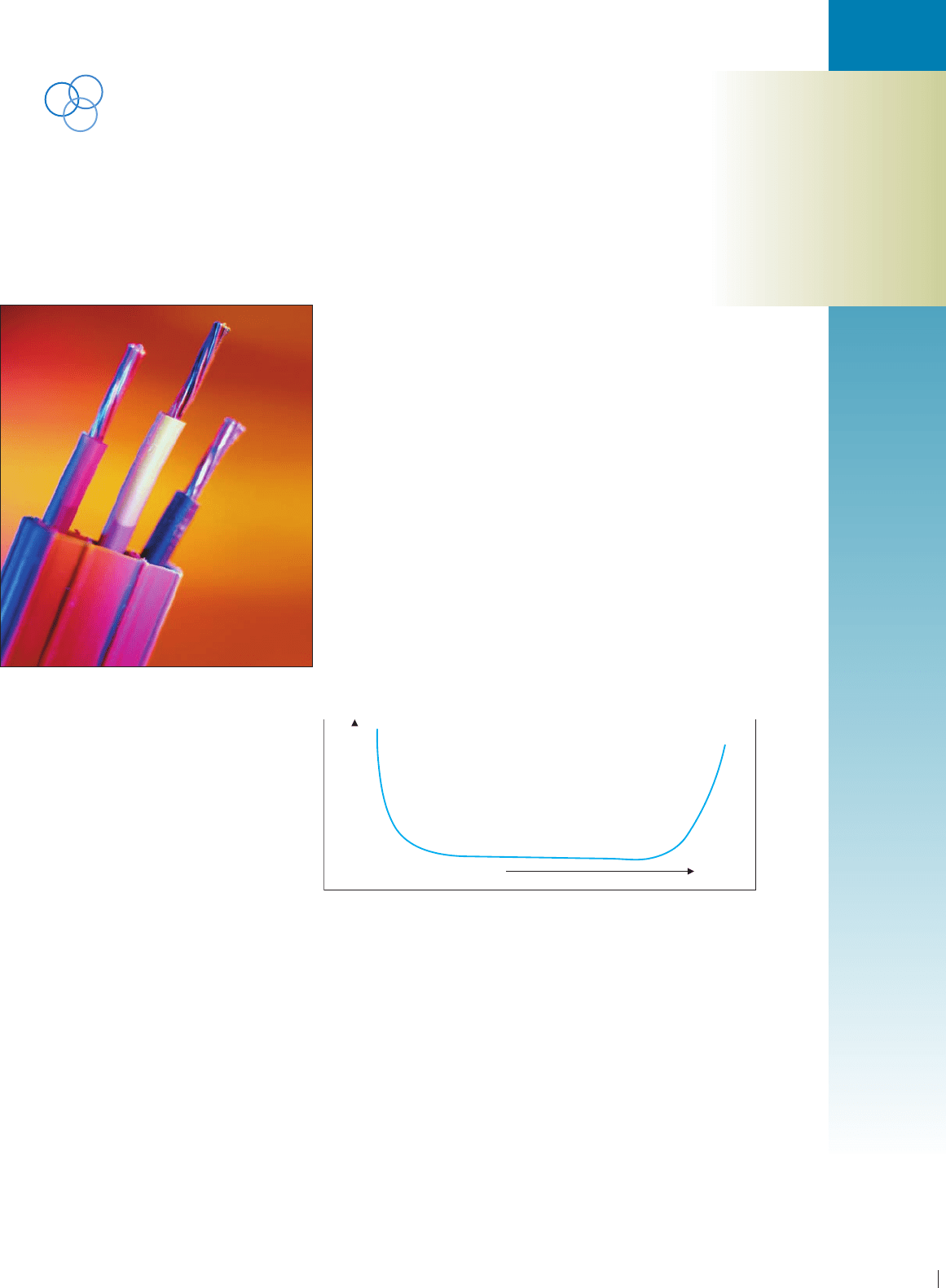
Electronics companies constantly test their products for reliability. The
lifetime of an electronics component is often viewed as having three
stages, as illustrated by the so-called bathtub curve shown in the figure.
This curveindicates the average failure rate of a product as a function
ofage.Inthefirststage(calledtheinfant mortality phase),thefailurerate
drops rapidly as faulty components quickly fail. Components that survive
this initial phase enter a lengthy second phase (the useful life phase)of
constant failure rate. The third phase shows an increase in failure rate as
the components reach the physical limit of their life span.
Theconstantfailurerateoftheusefullifephasehasseveralinteresting
consequences. First, the failures are “memoryless,” in the sense that the
probability that the component lasts another hour is independent of the
age of the component. A component that is 40 hours old may be as likely
to last another hour as a component that is only 10 hours old. This unusual
property holds for electronics components such as lightbulbs, during the
useful life phase.
Increased Failure Rate —
Time
Infant mortality
Decreasing failure rate
End-of-life wear-out
Increasing failure rate
Normal life (useful life)
Low “constant” failure rate
A constant failure rate also implies that component failures follow what is
called an exponential distribution. (See exercise 89 in the Review Exercises at the
end of this chapter.) The computation of statistics for the exponential distribution
requires more sophisticated integration techniques than those discussed so far. For
instance, the mean (average) lifetime of certain electronics components is given
by an integral of the form
∞
0
cxe
−cx
dx,for some constant c > 0.Toevaluatethis,
we will first need to extend our notion of integral to include improper integrals
such as this, where one or both of the limits of integration are infinite. We do this in
section7.7.Anotherchallengeisthatwedonotpresentlyknowanantiderivativefor
f (x) = xe
−cx
.Insection7.2, weintroducea powerfultechniquecalled integration
by parts that can be used to find antiderivatives of many such functions.
421
P1: OSO/OVY P2: OSO/OVY QC: OSO/OVY T1: OSO
MHDQ256-Ch07 MHDQ256-Smith-v1.cls December 23, 2010 21:26
LT (Late Transcendental)
CONFIRMING PAGES
422 CHAPTER 7
..
Integration Techniques 7-2
The new techniques of integration introduced in this chapter provide us with a broad
range of tools used to solve countless problems of interest to engineers, mathematicians
and scientists.
7.1 REVIEW OF FORMULAS AND TECHNIQUES
In this brief section, we draw together all of the integration formulas and the one integration
technique (integration by substitution) that we have developed so far. We use these to
develop some more general formulas, as well as to solve more complicated integration
problems. First, look overthe followingtable of the basic integration formulas developedin
Chapter 4.
x
r
dx =
x
r+1
r + 1
+ c, forr =−1 (power rule)
1
x
dx = ln |x|+c, for x = 0
sin xdx=−cos x + c
cos xdx= sin x + c
sec
2
xdx= tan x + c
sec x tan xdx= sec x + c
csc
2
xdx=−cot x + c
csc x cot xdx=−csc x + c
e
x
dx = e
x
+ c
e
−x
dx =−e
−x
+ c
tan xdx=−ln|cosx|+c
1
√
1 − x
2
dx = sin
−1
x +c
1
1 + x
2
dx = tan
−1
x +c
1
|x|
√
x
2
− 1
dx = sec
−1
x +c
Recall that each of these follows from a corresponding differentiation rule. So far, we
have expanded this list slightly by using the method of substitution, as in example 1.1.
EXAMPLE 1.1 A Simple Substitution
Evaluate
sin(ax)dx, for a = 0.
Solution The obvious choice here is to let u = ax, so that du = adx. This gives us
sin(ax)dx =
1
a
sin(ax)
sinu
adx
du
=
1
a
sinudu
=−
1
a
cosu + c =−
1
a
cos(ax) + c.
There is no need to memorize general rules like the ones given in examples 1.1 and
1.2, although it is often convenient to do so. You can reproduce such general rules any time
you need them using substitution.