
Smith R., Minton R. Calculus
Подождите немного. Документ загружается.

P1: PIC/OVY P2: OSO/OVY QC: OSO/OVY T1: OSO
MHDQ256-Ch06 MHDQ256-Smith-v1.cls December 15, 2010 19:5
LT (Late Transcendental)
CONFIRMING PAGES
6-9 SECTION 6.1
..
The Natural Logarithm 383
In exercises 41–46, determine intervals on which the function is
increasing and decreasing, concave up and down and graph the
function.
41. f (x) = ln(x − 2) 42. f (x) = ln(3x + 5)
43. f (x) = ln(x
2
+ 1) 44. f (x) = ln(x
3
+ 1)
45. f (x) = x ln x 46. f (x) = x
2
ln x
............................................................
47. There are often multiple ways of computing an antideriva-
tive. For
1
x ln
√
x
dx, first use the substitution u = ln
√
x
to find the indefinite integral 2 ln |ln
√
x|+c. Then rewrite
ln
√
x and use the substitution u = ln x to find the indefinite
integral 2 ln |ln x|+c. Show that these two answers are
equivalent.
48. As in exercise 47, use different substitutions to find two
equivalent forms for
1
x ln x
2
dx, for x > 0. Repeat this
for x < 0.
49. If n > 1 is an integer, sketch a graph of y =
1
x
for 1 ≤ x ≤ n
and shade in the area representing ln(n). Then construct a Rie-
mann sum with a regular partition of width x = 1 and right-
endpoint evaluation. On your graph, draw in the rectangles
for this Riemann sum and show that ln(n) >
1
2
+
1
3
+···+
1
n
.
Given that lim
n→∞
1
2
+
1
3
+···+
1
n
=∞, what can you con-
clude about lim
n→∞
ln(n)?
50. As in exercise 49, use a Riemann sum to show that for an
integer n > 1, ln(n) < 1 +
1
2
+
1
3
+···+
1
n−1
.
APPLICATIONS
51. A telegraph cable is made of an outer winding around an
inner core. If x is defined as the core radius divided by
the outer radius, the transmission speed is proportional to
s(x) = x
2
ln(1/x). Estimate the value of x that maximizes the
transmission speed.
52. Define the function π(x) to be the number of prime num-
bers less than x. For example, π(6) = 3 since 2, 3 and 5 are
prime. It has been shown that for large x,π(x) ≈
x
ln x
. Show
that for f (x) =
x
ln x
and x > 10, f
(x) > 0 and f
(x) < 0.
Interpret these results in terms of the distribution of prime
numbers.
53. A ball is thrown from s = b to s = a (where a < b) with
initial speed v
0
. Assuming that air resistance is proportional to
speed, the time it takes the ball to reach s = a is
T =−
1
c
ln
1 − c
b −a
v
0
,
where c is a constant of proportionality. A baseball player is
300 ft from home plate and throws a ball directly toward home
plate with an initial speed of 125 ft/s. Suppose that c = 0.1.
How long does it take the ball to reach home plate? Another
player standing x feet from home plate has the option of catch-
ing the ball and then, after a delay of 0.1 s, relaying the ball
toward home plate with an initial speed of 125 ft/s. Find x to
minimize the total time for the ball to reach home plate. Is the
straight throw or the relay faster? What, if anything, changes
if the delay is 0.2 s instead of 0.1 s?
54. For the situation in exercise 53, for what length delay is it
equally fast to have a relay and not have a relay? Do you think
that you could catch and throw a ball in such a short time?
Why do you think it is considered important to have a relay
option in baseball?
55. Repeat exercises 53 and 54 ifthe second player throws the ball
with initial speed 100 ft/s.
56. For a delay of 0.1 s in exercise 53, find the value of the initial
speed of the second player’s throw for which it is equally fast
to have a relay and not have a relay.
57. In the titration of a weak acid and strong base, the pH is given
by c + ln
f
1− f
where c is a constant (closely related to the acid
dissociation constant) and f is the fraction (0 < f < 1) of
converted acid. (See Harris’ Quantitative Chemical Anal-
ysis for more details.) Find the value of f at which the
rate of change of pH is the smallest. What happens as f
approaches 1?
58. In exercise 57, you found the significance of one inflection
point of a titration curve. A second inflection point, called
the equivalence point, corresponds to f = 1. In the gen-
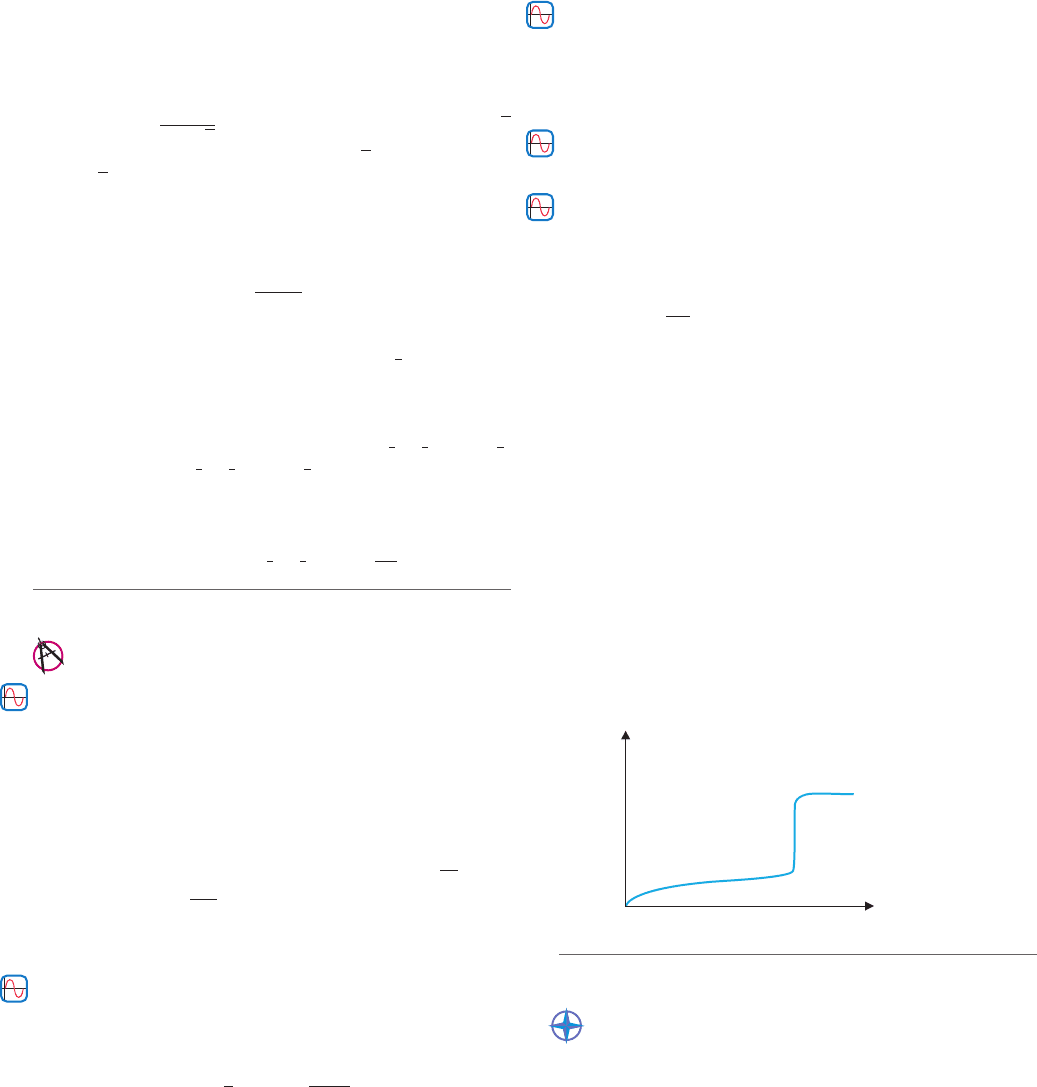
eralized titration curve shown, identify on the graph both
inflection points and briefly explain why chemists prefer to
measure the equivalence point and not the inflection point of
exercise 57. (Note: The horizontal axis of a titration curve
indicates the amount of base added to the mixture. This is
directly proportional to the amount of converted acid in the
region where 0 < f < 1.)
ml of base added
pH
EXPLORATORY EXERCISES
1. Verify that
sec xdx= ln|sec x + tan x|+c.
(Hint: Differentiate the suspected antiderivative and show
that you get the integrand.) This integral appears in the
P1: PIC/OVY P2: OSO/OVY QC: OSO/OVY T1: OSO
MHDQ256-Ch06 MHDQ256-Smith-v1.cls December 15, 2010 19:5
LT (Late Transcendental)
CONFIRMING PAGES
384 CHAPTER 6
..
Exponentials, Logarithms and Other Transcendental Functions 6-10
constructionofaspecialtypeofmapcalledaMercatormap.On
this map, the latitude lines are not equally spaced. Instead, they
are placed so that straight lines on a Mercator map correspond
to paths of constant heading. (If you travel due northeast, your
path on a map with equally spaced latitude will appear to curve
due to the curvatureof the Earth.) Let R be the (average) radius
of the Earth. Assuming the Earth is a sphere, the actual dis-
tance from the equator to a place at latitude b
◦
is
π
180
Rb.Ona
Mercator map, this distance is scaled to
π
180
R
b
0
sec xdx.
Tampa, Florida, has latitude 28
◦
north. Moscow, Russia,
is twice as far from the equator at 56
◦
north. What is the
relative spacing for Tampa and Moscow on a Mercator
map?
2. Definethelog integral function Li(x) =
x
0
1
lnt
dt forx > 1.
For x = 4 and n = 4, explain why Simpson’s Rule does not
give an estimate of Li(4). Sketch a picture of the area rep-
resented by Li(4). It turns out that Li(x) = 0 for x ≈ 1.45.
Explain why Li(4) ≈
4
1.45
1
lnt
dt and estimate this with Simp-
son’s Ruleusing n = 4.Thisfunctionisused to estimateπ(N),
the number of prime numbers less than N. Another common
estimate of π(N)is
N
ln N
. Estimate
N
ln N
,π(N) and Li(N)
for (a) N = 20, (b) N = 40 and (c) N = 100, 000, 000, where
we’ll give you π (N) = 5, 761, 455. Discuss any patterns that
you find. (See Prime Obsession by John Derbyshire for more
about this area of number theory.)
6.2 INVERSE FUNCTIONS
The notion of an inverse relationship is common in many areas of science. For instance,
in an electrocardiogram (EKG), measurements of electrical activity on the surface of the
body are used to infer something about the electrical activity on the surface of the heart.
This is considered an inverse problem, since physicians are attempting to determine what
inputs (i.e., the electrical activity on the surface of the heart) cause an observed output (the
measured electrical activity on the surface of the chest).
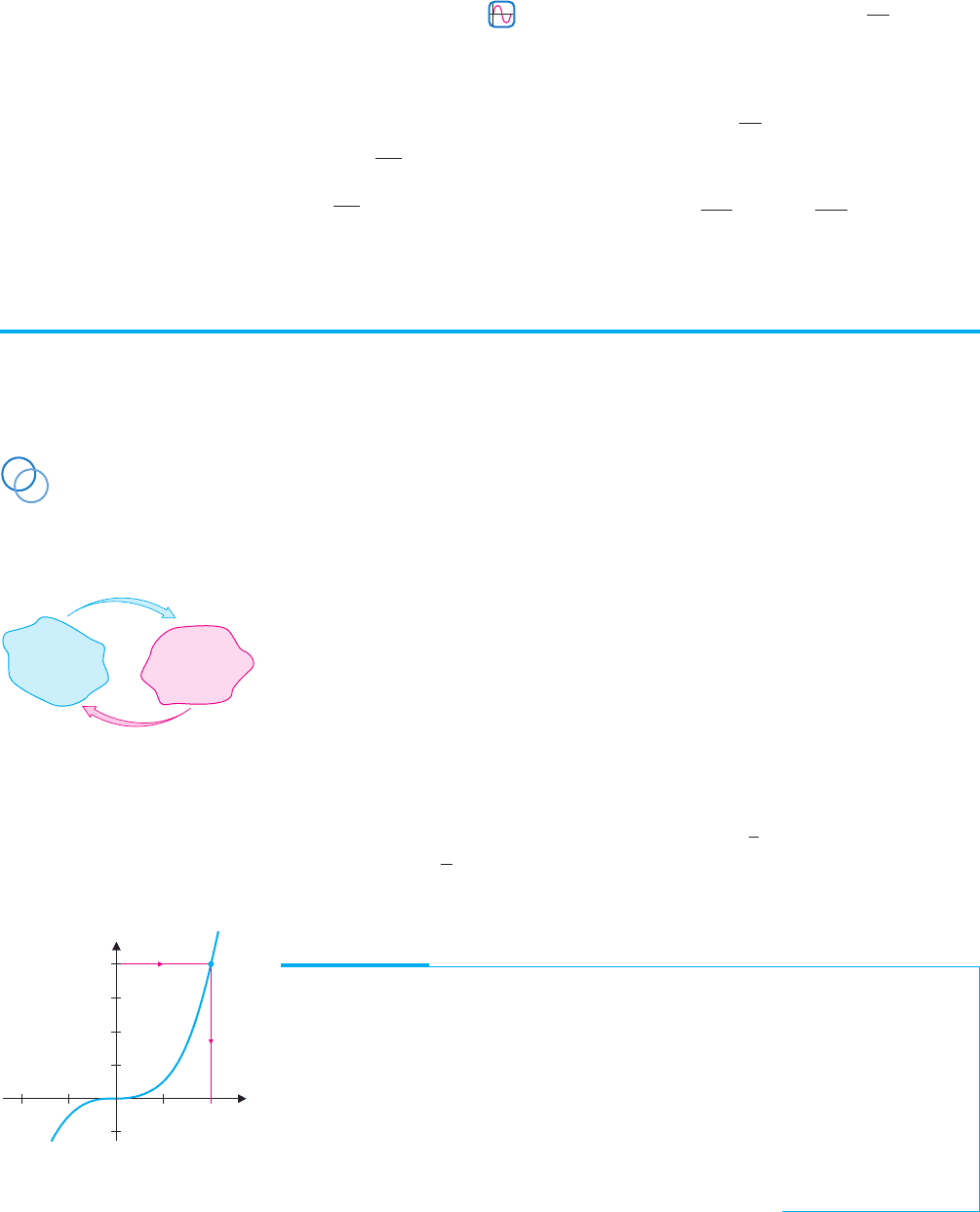
f (x)
g(x)
x
Domain {f }
y
Range {f }
FIGURE 6.3
g = f
−1
In this section, we introduce the notion of an inverse function. The basic idea is simple
enough. Given an output (that is, a value in the range of a given function), we wish to
find the input (the value in the domain) that produces the observed output. That is, given a
y ∈ Range{ f }, find the x ∈ Domain{f } for which y = f (x). (See the illustration of the
inverse function g(x) shown in Figure 6.3.)
For instance, suppose that f (x) = x
3
and y = 8. Can you find an x such that x
3
= 8?
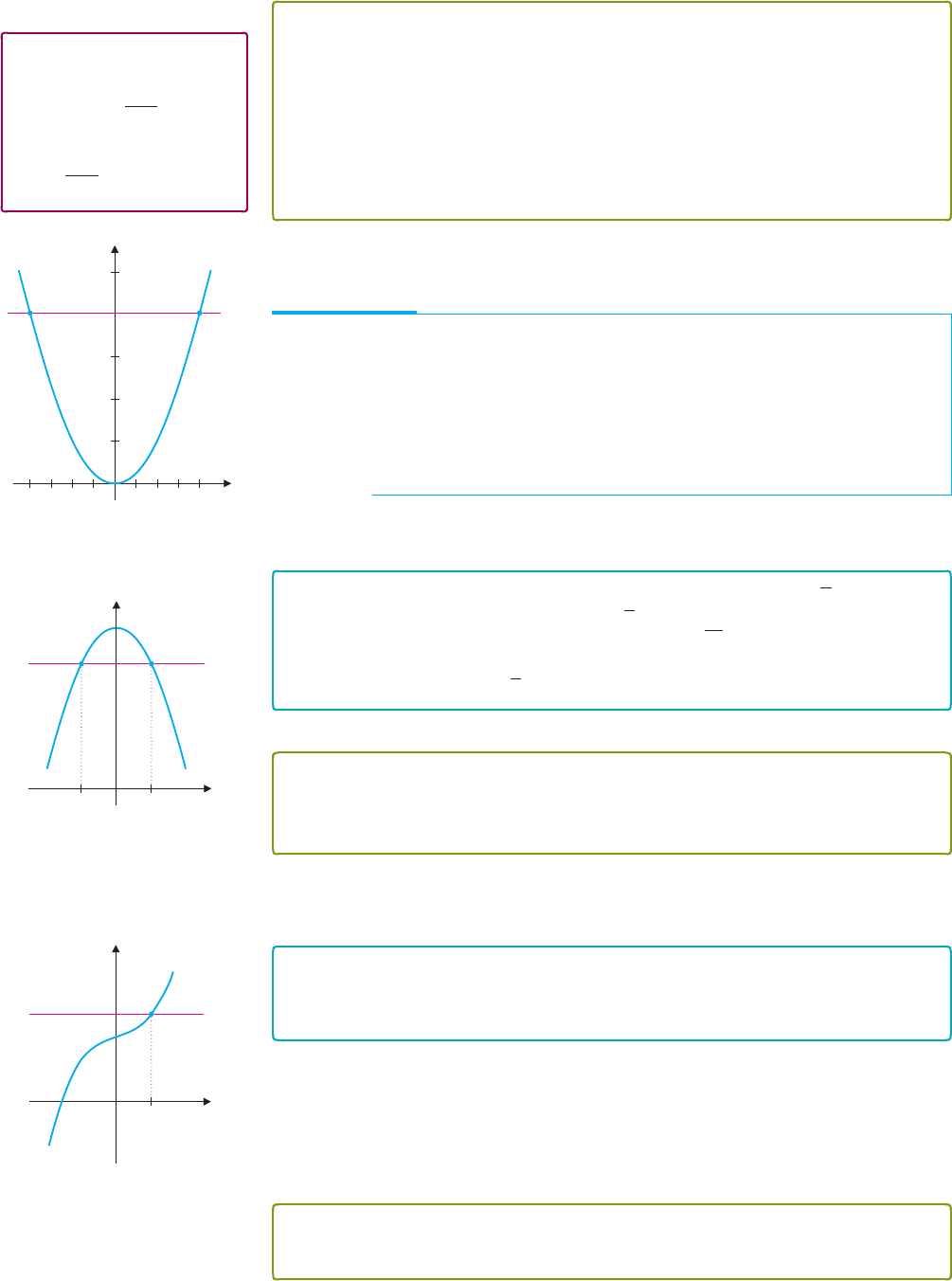
That is, can you find the x-value corresponding to y = 8? (See Figure 6.4.) Of course,
you know the solution of this particular equation: x =
3
√
8 = 2. In fact, in general, if
x
3
= y, then x =
3
√
y. In light of this, we say that the cube root function is the inverse
of f (x) = x
3
.
y
y x
3
x
2
2
21
4
6
2
8
FIGURE 6.4
Finding the x-value corresponding
to y = 8
EXAMPLE 2.1 Two Functions That Reverse the Action of Each Other
If f (x) = x
3
and g(x) = x
1/3
, show that
f (g(x)) = x and g( f (x)) = x,
for all x.
Solution For all real numbers x,wehave
f (g(x)) = f (x
1/3
) = (x
1/3
)
3
= x
and g( f (x)) = g(x
3
) = (x
3
)
1/3
= x.
Notice in example 2.1 that the action of f undoes the action of g and vice versa. We
take this as our definition of an inverse function in Definition 2.1.
P1: PIC/OVY P2: OSO/OVY QC: OSO/OVY T1: OSO
MHDQ256-Ch06 MHDQ256-Smith-v1.cls December 15, 2010 19:5
LT (Late Transcendental)
CONFIRMING PAGES
6-11 SECTION 6.2
..
Inverse Functions 385
CAUTION
Pay close attention to the
notation. Notice that f
−1
(x)
does not mean
1
f (x)
. We write
the reciprocal of f (x) as:
1
f (x)
= [ f (x)]
−1
.
DEFINITION 2.1
Assume that f and g have domains A and B, respectively, and that f (g(x)) is defined
for all x ∈ B and g( f (x)) is defined for all x ∈ A.If
f (g(x)) = x, for all x ∈ B and
g( f (x)) = x, for all x ∈ A,
we say that g is the inverse of f, written g = f
−1
. Equivalently, f is the inverse of
g, f = g
−1
.
Observe that many familiar functions have no inverse.
EXAMPLE 2.2 A Function with No Inverse
Show that f (x) = x
2
has no inverse on the interval (−∞, ∞).
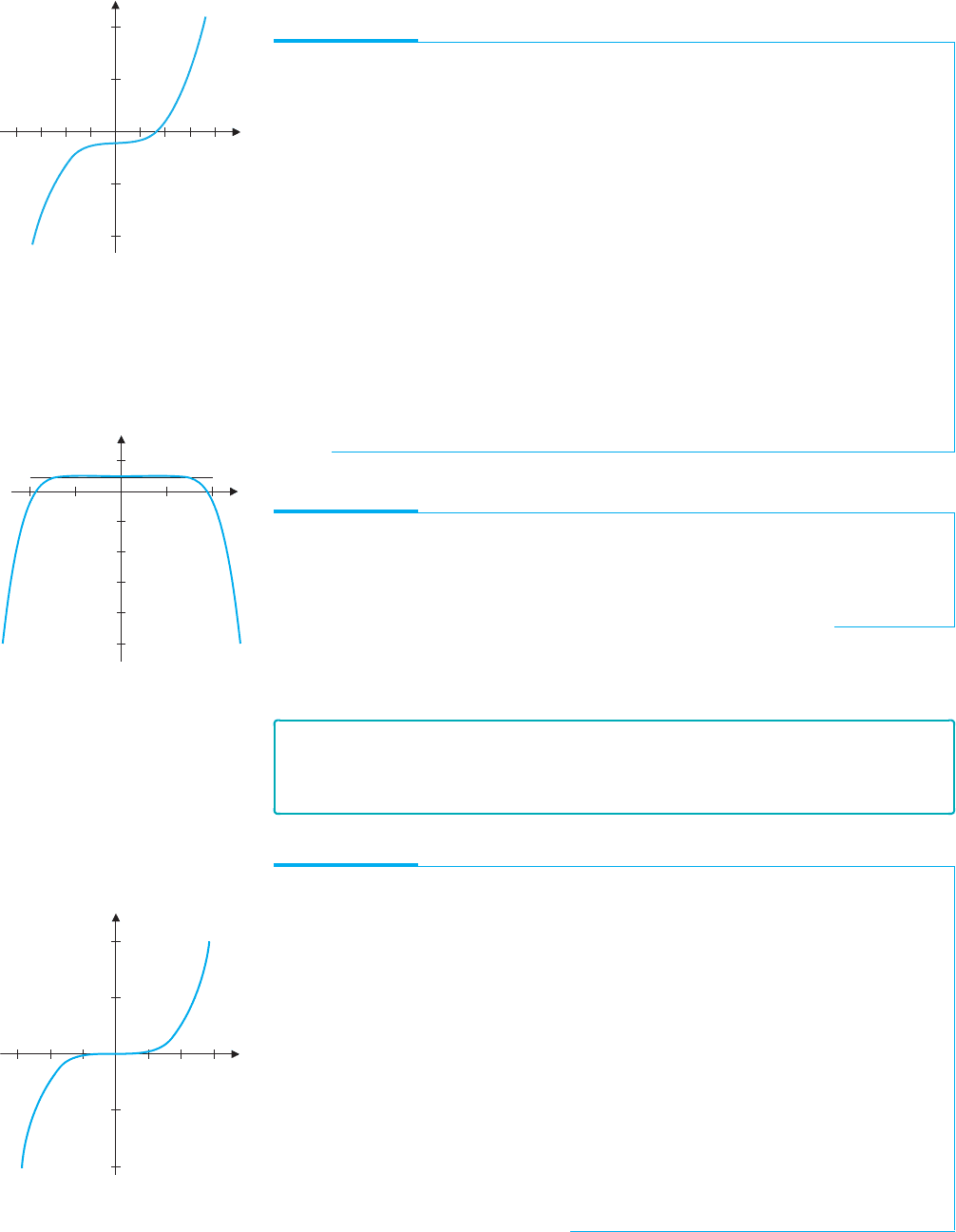
Solution Notice that f (4) = 16 and f (−4) = 16. That is, there are two x-values that
produce the same y-value. So, if we were to try to define an inverse of f, how would we
define f
−1
(16)? Look at the graph of y = x
2
(see Figure 6.5) to see what the problem
is. For each y > 0, there are two x-values for which y = x
2
. Such functions do not have
an inverse.
REMARK 2.1
For f (x) = x
2
, it is tempting to jump to the conclusion that g(x) =
√
x is the inverse
of f (x). Notice that although f (g(x)) = (
√
x)
2
= x for all x ≥ 0 (i.e., for all x in the
domain of g), it is not generally true that g( f (x)) =
√
x
2
= x. In fact, this last
equality holds only for x ≥ 0. However, for f (x) = x
2
restricted to the domain x ≥ 0,
we do have that f
−1
(x) =
√
x.
y
x
4 2
42
8
4
12
20
FIGURE 6.5
y = x
2
DEFINITION 2.2
A function f is called one-to-one when for every y ∈ Range{f }, there is exactly one
x ∈ Domain{f } for which y = f (x).
REMARK 2.2
Observe that it is equivalent to say that a function f is one-to-one if and only if the
equality f (a) = f (b) implies a = b. This version of the definition is often useful for
proofs involving one-to-one functions.
y
x
ab
y f(x)
FIGURE 6.6a
f (a) = f (b), for a = b.
So, f does not pass the horizontal
line test and is not one-to-one.
y
a
x
y f(x)
FIGURE 6.6b
Every horizontal line intersects the
curve in at most one point. So, f
passes the horizontal line test and is
one-to-one.
It is also most helpful to think of the concept of one-to-one in graphical terms. Notice
that a function is one-to-one if and only if every horizontal line intersects its graph in at
most one point. This is usually referred to as the horizontal line test. We illustrate this in
Figures 6.6a and 6.6b and state the following result.
THEOREM 2.1
A function f has an inverse if and only if it is one-to-one.
P1: PIC/OVY P2: OSO/OVY QC: OSO/OVY T1: OSO
MHDQ256-Ch06 MHDQ256-Smith-v1.cls December 15, 2010 19:5
LT (Late Transcendental)
CONFIRMING PAGES
386 CHAPTER 6
..
Exponentials, Logarithms and Other Transcendental Functions 6-12
Theorem 2.1 simply says that one-to-one functions have an inverse, but says nothing
abouthowtofindthem.Forverysimplefunctions,wecanfindinversesbysolvingequations.
y
x
4 2
42
40
20
20
40
FIGURE 6.7
y = x
3
− 5
EXAMPLE 2.3 Finding an Inverse Function
Find the inverse of f (x) = x
3
− 5.
Solution You will show in the exercises that f is one-to-one and therefore has an
inverse. Note that it is not entirely clear from the graph (see Figure 6.7) whether or not f
passes the horizontal line test. To find the inverse function, write y = f (x) and solve for
x (i.e., solve for the input x that produced the observed output y). We have
y = x
3
− 5.
Adding 5 to both sides and taking the cube root gives us
(y + 5)
1/3
= (x
3
)
1/3
= x.
So, we have that x = f
−1
(y) = (y +5)
1/3
. Reversing the variables x and y (think about
why this makes sense), we have
f
−1
(x) = (x +5)
1/3
.
We leave it to the reader to show that f ( f
−1
(x)) = x for all x and f
−1
( f (x)) = x for
all x.
EXAMPLE 2.4 A Function That Is Not One-to-One
Show that f (x) = 10 − x
4
does not have an inverse.
Solution You can see from a graph (see Figure 6.8) that f is not one-to-one; for
instance, f (1) = f (−1) = 9. Consequently, f does not have an inverse.
REMARK 2.3
Most often, we cannot find a formula for an inverse function and must be satisfied
with simply knowing that the inverse function exists. Example 2.5 is typical of this
situation.
y
x
40
60
20
20
80
100
2
2
FIGURE 6.8
y = 10 − x
4
EXAMPLE 2.5 Showing That a Function Has an Inverse
Show that f (x) = x
5
+ 8x
3
+ x +1 has an inverse. Also, find f
−1
(1) and f
−1
(11).
Solution From the graph shown in Figure 6.9, the function looks like it might be
one-to-one. Note that
f
(x) = 5x
4
+ 24x
2
+ 1 > 0, for all x.
So, f is increasing for all x and consequently, is one-to-one and so, must have an
inverse. To find the inverse function, we need to solve the equation
y = x
5
+ 8x
3
+ x +1
for x. However, you should quickly realize that you cannot do this.
Turning to the problem of finding f
−1
(1) and f
−1
(11), you might wonder if this is
possible. While it’s certainly true that we have no such formula for f
−1
(x), you might
observe that f (0) = 1, so that f
−1
(1) = 0. By trial and error, you might also discover
that f (1) = 11 and so, f
−1
(11) = 1.
y
x
3 12
321
400
200
200
400
FIGURE 6.9
y = x
5
+ 8x
3
+ x + 1
P1: PIC/OVY P2: OSO/OVY QC: OSO/OVY T1: OSO
MHDQ256-Ch06 MHDQ256-Smith-v1.cls December 15, 2010 19:5
LT (Late Transcendental)
CONFIRMING PAGES
6-13 SECTION 6.2
..
Inverse Functions 387
Even when we can’t find an inverse function explicitly, we can say something graph-
ically. Notice that if (a, b) is a point on the graph of y = f (x) and f has an inverse, f
−1
,
then since
b = f (a),
wehavethat f
−1
(b) = f
−1
( f (a)) = a.
Thatis,(b, a)isapointonthegraphof y = f
−1
(x).Thistellsusagreatdealabouttheinverse
function. In particular, we can immediately obtain any number of points on the graph of
y = f
−1
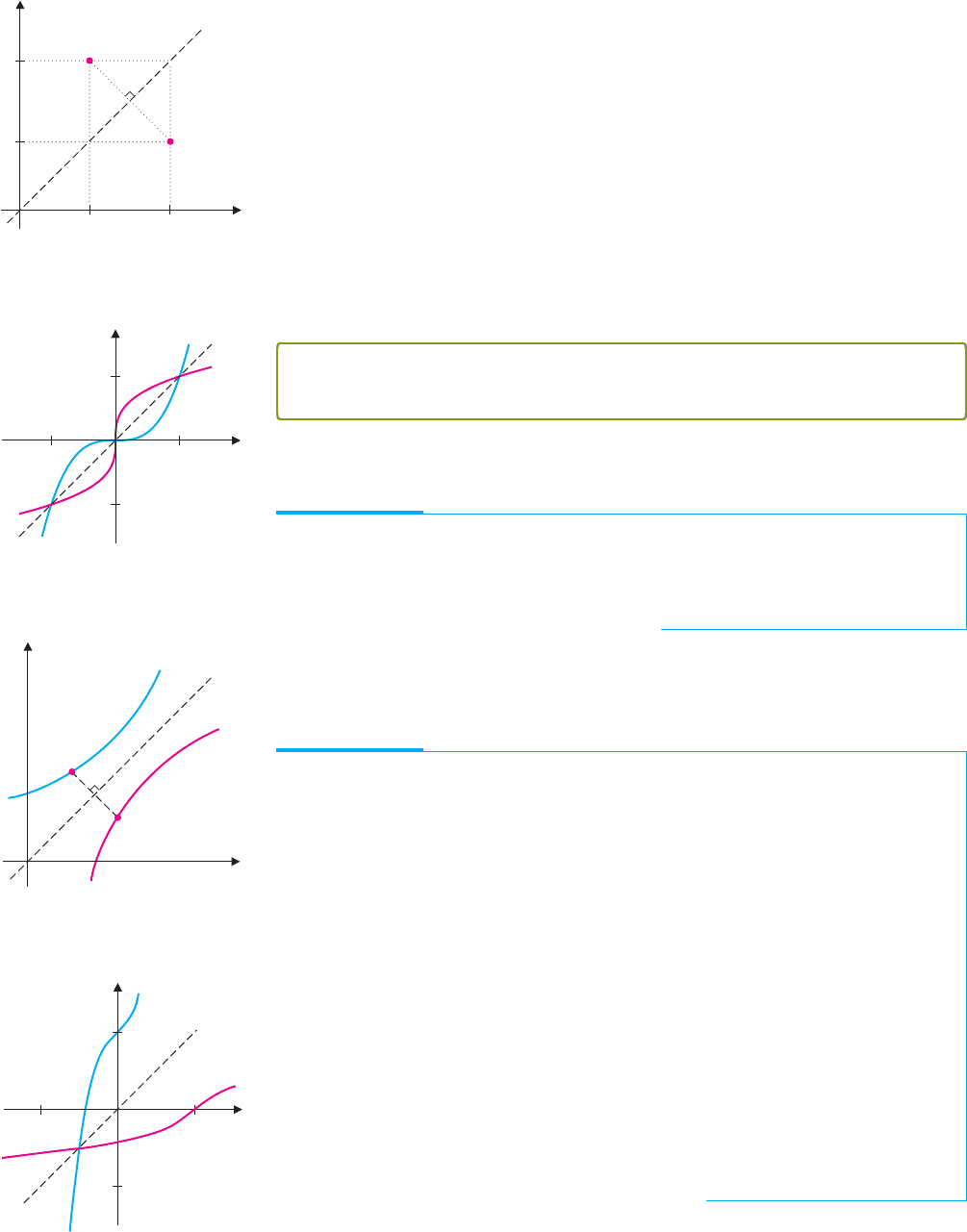
(x), simply by inspection. Further,notice that the point (b, a)is the reflection of the
point (a, b) through the line y = x. (See Figure 6.10.) It nowfollowsthat given the graph of
anyone-to-one function, you candrawthe graph ofits inversesimply byreflecting the entire
graph through the line y = x. One consequence of this symmetry is the following result.
y
x
ab
a
b
y x
(b, a)
(a, b)
FIGURE 6.10
Reflection through y = x
THEOREM 2.2
Suppose that f is a one-to-one and continuous function. Then, f
−1
is also continuous.
In example 2.6, we illustrate the symmetry of a function and its inverse.
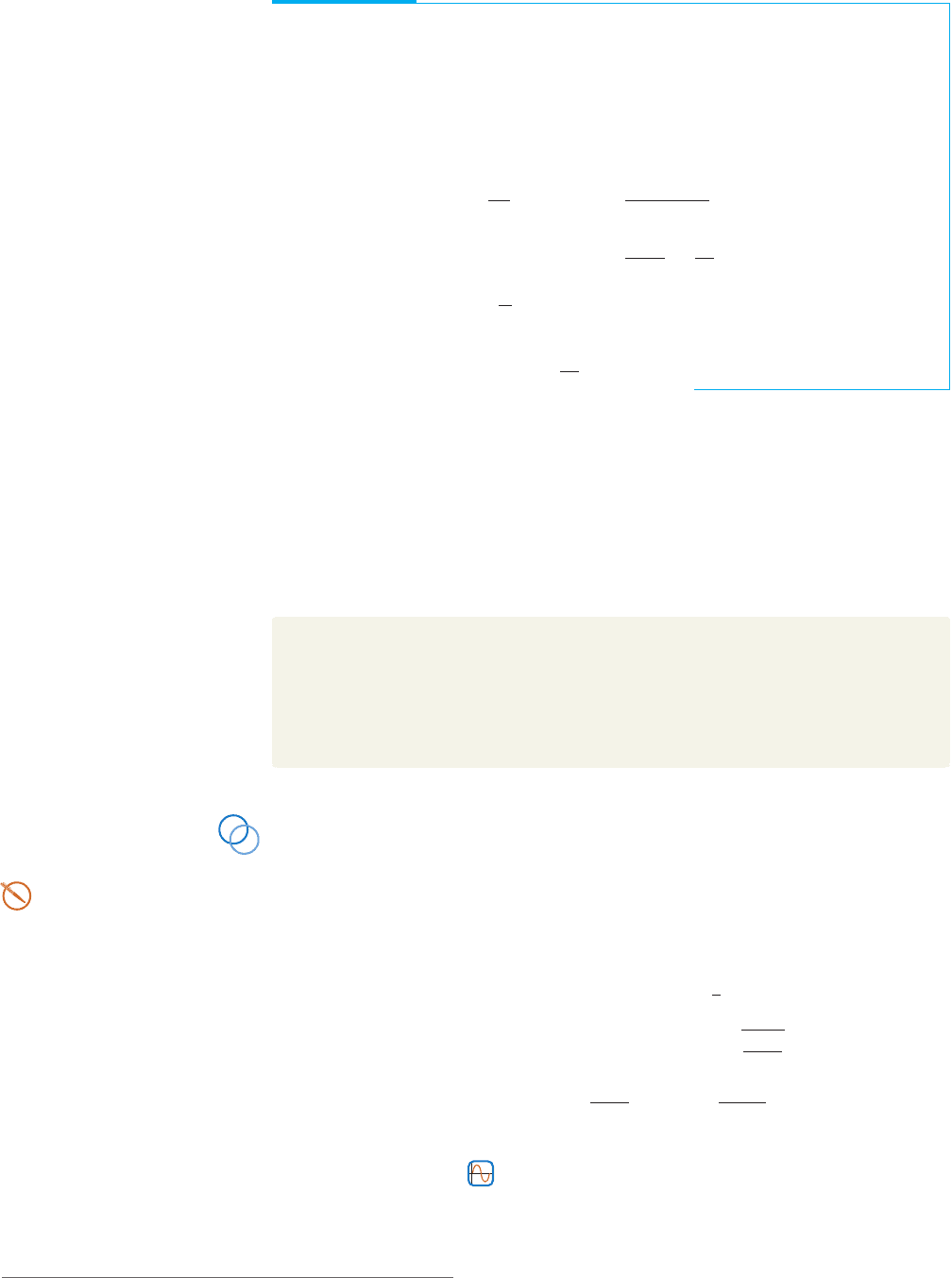
EXAMPLE 2.6 The Graph of a Function and Its Inverse
Draw a graph of f (x) = x
3
and its inverse.
Solution From example 2.1, the inverse of f (x) = x
3
is f
−1
(x) = x
1/3
. Notice the
symmetry of their graphs shown in Figure 6.11.
Observe that we can use this symmetry principle to draw the graph of an inverse
function, even when we don’t have a formula for that function. (See Figure 6.12.)
EXAMPLE 2.7 Drawing the Graph of an Unknown Inverse Function
Draw a graph of f (x) = x
5
+ 8x
3
+ x +1 and its inverse.
Solution In example 2.5, we showed that f is increasing for all x and hence, is
one-to-one, but we were unable to find a formula for the inverse function. Despite this,
we can draw a graph of f
−1
with ease. One way to do this would be to plot a few points
on the graph of y = f
−1
(x) by hand, but we suggest that you use the parametric
plotting feature of your graphing utility. To write down parametric equations for the
curve y = f (x), we introduce the parameter t and observe that
x = t and y = f (t) (2.1)
are parametric equations for y = f (x). Notice that parametric equations for y = f
−1
(x)
are then simply
x = f (t) and y = t. (2.2)
We used the two pairs of parametric equations (2.1) and (2.2) to produce the graphs of
y = f (x) and y = f
−1
(x) shown in Figure 6.13. We also added a dashed line for the
line y = x, entered parametrically as
x = t and y = t.
y
x
1
1
11
y x
y x
3
y x
1/3
FIGURE 6.11
y = x
3
and y = x
1/3
y
x
y f(x)
(a, f(a))
( f(a), a)
y f
1
(x)
y x
FIGURE 6.12
Graph of f and f
−1
y
x
11
1
1
y x
y f (x)
y f
1
(x)
FIGURE 6.13
Graph of f and f
−1
We make one final observation regarding inverse functions. Suppose that f is a one-to-
one and differentiable function. Then, as a consequence of the symmetry of the function and
its inverse, notice that, as long as f
( f
−1
(a)) = 0 (i.e., the tangent line is not horizontal),

P1: PIC/OVY P2: OSO/OVY QC: OSO/OVY T1: OSO
MHDQ256-Ch06 MHDQ256-Smith-v1.cls December 15, 2010 19:5
LT (Late Transcendental)
CONFIRMING PAGES
388 CHAPTER 6
..
Exponentials, Logarithms and Other Transcendental Functions 6-14
then f
−1
(x) should be differentiableat x = a (i.e., the tangent line to f
−1
(x) is not vertical).
We express this notion carefully in Theorem 2.3.
THEOREM 2.3
Suppose that f is one-to-one and differentiable everywhere on its domain. Then,
d
dx
f
−1
(x) =
1
f
( f
−1
(x))
,
for all x in the domain of f
−1
, provided f
( f
−1
(x)) = 0.
PROOF
Let g(x) = f
−1
(x). Then for any fixed x = a, we have from the alternative definition of
derivative that
g
(a) = lim
x→a
g(x) − g(a)
x −a
. (2.3)
Since g = f
−1
, we have that y = g(x) if and only if f (y) = x and b = g(a) if and only
if f (b) = a. Further, since f is differentiable, it is continuous and so, from Theorem 2.2,
g must be continuous, also. In particular, this says that as x → a, we must also have
g(x) → g(a), so that y → b. From (2.3), we now have
g
(a) = lim
x→a
g(x) − g(a)
x −a
= lim
y→b
y − b
f (y) − f (b)
= lim
y→b
1
f (y) − f (b)
y − b
=
1
lim
y→b
f (y) − f (b)
y − b
=
1
f
(b)
=
1
f
( f
−1
(a))
,
as desired, since the limit in the denominator is nonzero.
NOTES
Notice that Theorem 2.3 says that
the slope of the tangent line to
y = f
−1
(x) at a point (a, b)is
simply the reciprocal of the slope
of the tangent line to y = f (x)at
the mirror image point (b, a).
TODAY IN
MATHEMATICS
Kim Rossmo (1955– ) A
Canadian criminologist who
developed the Criminal
Geographic Targeting algorithm
that indicates the most probable
area of residence for serial
murderers, rapists and other
criminals. Rossmo served 21 years
with the Vancouver Police
Department. His mentors were
Professors Paul and Patricia
Brantingham of Simon Fraser
University. The Brantinghams
developed Crime Pattern Theory
which predicts crime locations
from where criminals live, work
and play. Rossmo inverted their
model and used the crime sites to
determine where the criminal
most likely lives. The premiere
episode of the television drama
Numb3rs was based on Rossmo’s
work.
As an alternative to the proof of Theorem 2.3, if we know that an inverse function
is differentiable, we can find its derivative using implicit differentiation, as follows. If
y = f
−1
(x), then
f (y) = x. (2.4)
Differentiating both sides of (2.4) with respect to x, we find that
d
dx
f (y) =
d
dx
x,
so that f
(y)
dy
dx
= 1,
from the chain rule. (Notice that in this last step, we needed to assume that
dy
dx
exists.)
Thus, so long as f
(y) = 0, we have
dy
dx
=
1
f
(y)
or
d
dx
f
−1
(x) =
1
f
( f
−1
(x))
,
as we had previously determined.
P1: PIC/OVY P2: OSO/OVY QC: OSO/OVY T1: OSO
MHDQ256-Ch06 MHDQ256-Smith-v1.cls December 15, 2010 19:5
LT (Late Transcendental)
CONFIRMING PAGES
6-15 SECTION 6.2
..
Inverse Functions 389
EXAMPLE 2.8 Finding a Tangent Line to the Graph of an Inverse
Function
Find an equation of the tangent line to the graph of y = f
−1
(x)atx = 3, where
f (x) = x
3
− 5.
Solution First, note that f
(x) = 3x
2
and f (2) = 3, so that f
−1
(3) = 2. From
Theorem 2.3, we have
d
dx
f
−1
(x)
x=3
=
1
f
( f
−1
(3))
=
1
f
(2)
=
1
12
.
So, the tangent line has slope
1
12
and passes through the point with coordinates x = 3
and y = f
−1
(3) = 2. An equation of the tangent line is then
y =
1
12
(x − 3) + 2.
Recall that for the function in example 2.8, we had found (in example 2.3) a formula
for the inverse function,
f
−1
(x) = (x +5)
1/3
You should differentiate this directly and verify that the value of the derivative at x = 3is
the same either way we compute it. Of course, the primary value of Theorem 2.3 is for the
most common case where we cannot find a formula for the inverse function.
BEYOND FORMULAS
The examples in this section should remind you somewhat of a mystery movie. There
are just enough clues available to solve the problem. The basic idea is that every fact
about an inverse function f
−1
corresponds to a fact about the original function f. The
trick is to ask the right questions about f to reveal the desired information about f
−1
.
EXERCISES 6.2
WRITING EXERCISES
1. Explain in words (and a picture) why the following is true: if
f (x) is increasing for all x, then f has an inverse.
2. Suppose the graph of a function passes the horizontal line test.
Explainwhyyouknowthat the functionhasaninverse(defined
on the range of the function).
3. Radar works by bouncing a high-frequency electromagnetic
pulse off of a moving object, and then measuring the distur-
bance in the pulse as it is bounced back. Explain why this is an
inverse problem by identifying the input and output.
4. Each human disease has a set of symptoms associated with
it. Physicians attempt to solve an inverse problem: given the
symptoms, they try to identify the disease causing the symp-
toms. Explain why this is not a well-defined inverse problem
(i.e., logically it is not always possible to correctly identify
diseases from symptoms alone).
In exercises 1–4, show that f (g(x)) x and g( f (x)) x for
all x.
1. f (x) = x
5
and g(x) = x
1/5
2. f (x) = 4x
3
and g(x) =
1
4
x
1/3
3. f (x) = 2x
3
+ 1 and g(x) =
3
x − 1
2
4. f (x) =
1
x + 2
and g(x) =
1 − 2x
x
(x = 0, x =−2)
............................................................
In exercises 5–12, determine whether or not the function is one-
to-one. If it is, find the inverse and graph both the function and
its inverse.
5. f (x) = x
3
− 2 6. f (x) = x
3
+ 4
7. f (x) = x
5
− 1 8. f (x) = x
5
+ 4
P1: PIC/OVY P2: OSO/OVY QC: OSO/OVY T1: OSO
MHDQ256-Ch06 MHDQ256-Smith-v1.cls December 15, 2010 19:5
LT (Late Transcendental)
CONFIRMING PAGES
390 CHAPTER 6
..
Exponentials, Logarithms and Other Transcendental Functions 6-16
9. f (x) = x
4
+ 2 10. f (x) = x
4
− 2x − 1
11. f (x) =
√
x
3
+ 1 12. f (x) =
√
x
2
+ 1
............................................................
In exercises 13–18, assume that the function has an inverse.
Without solving for the inverse, find the values of the inverse
function and its derivative at x a, find an equation of the
tangent line at x a and graph the inverse function.
13. f (x) = x
3
+ 4x − 1, (a) a =−1, (b) a = 4
14. f (x) = x
3
+ 2x + 1, (a) a = 1, (b) a = 13
15. f (x) = x
5
+ 3x
3
+ x, (a) a =−5, (b) a = 5
16. f (x) = x
5
+ 4x − 2, (a) a = 38, (b) a = 3
17. f (x) =
√
x
3
+ 2x + 4, (a) a = 4, (b) a = 2
18. f (x) =
√
x
5
+ 4x
3
+ 3x + 1, (a) a = 3, (b) a = 1
............................................................
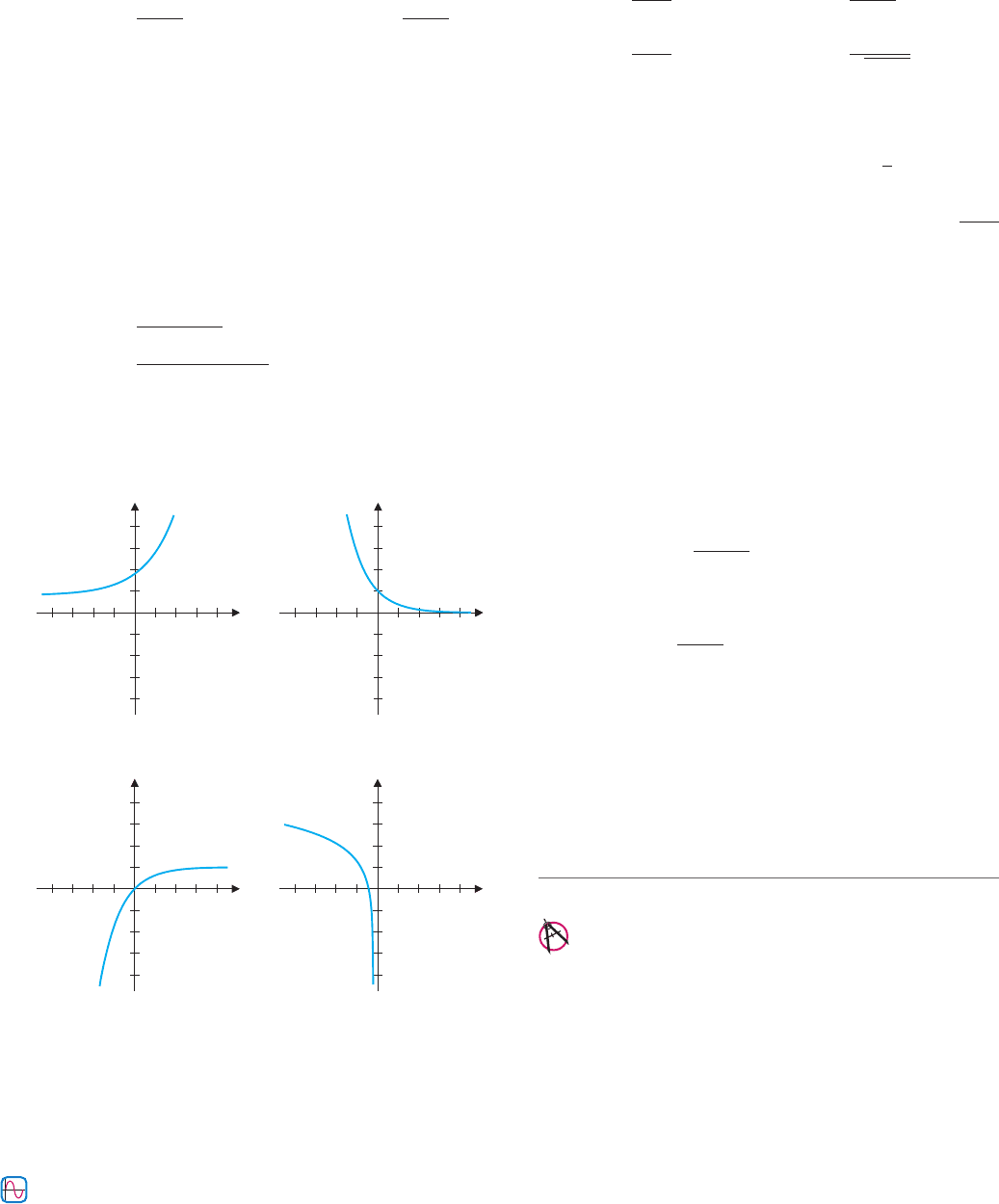
In exercises 19–22, use the given graph to graph the inverse
function.
19.
y
x
2424
4
2
2
4
20.
y
x
2424
4
2
2
4
21.
y
x
2424
4
2
2
4
22.
y
x
2424
4
2
2
4
............................................................
23. Find all values of k such that f (x) = x
3
+ kx + 1 is one-to-
one.
24. Find all values of k such that f (x) = x
3
+ 2x
2
+ kx − 1is
one-to-one.
............................................................
In exercises 25–32, use a graph to determine if the function is
one-to-one. If it is, graph the inverse function.
25. f (x) = x
3
+ 2x − 1 26. f (x) = x
3
− 2x − 1
27. f (x) = x
5
− 3x
3
− 1 28. f (x) = x
5
+ 4x
3
− 2
29. f (x) =
1
x + 1
30. f (x) =
4
x
2
+ 1
31. f (x) =
x
x + 4
32. f (x) =
x
√
x
2
+ 4
............................................................
Exercises 33–42 involve inverse functions on restricted domains.
33. Show that f (x) = x
2
(x ≥ 0) and g(x) =
√
x (x ≥ 0) are in-
verse functions. Graph both functions.
34. Show that f (x) = x
2
− 1(x ≥ 0) and g(x) =
√
x − 1
(x ≥−1) are inverse functions. Graph both functions.
35. Graph f (x) = x
2
for x ≤ 0 and verify that it is one-to-one.
Find its inverse. Graph both functions.
36. Graph f (x) = x
2
+ 2for x ≤ 0 andverifythatit is one-to-one.
Find its inverse. Graph both functions.
37. Graph f (x) = (x − 2)
2
and find an interval on which it is one-
to-one. Find the inverse of the function restricted to that inter-
val. Graph both functions.
38. Graph f (x) = (x + 1)
4
and find an interval on which it is one-
to-one. Find the inverse of the function restricted to that inter-
val. Graph both functions.
39. Graph f (x) =
√
x
2
− 2x and find an interval on which it is
one-to-one. Find the inverse of the function restricted to that
interval. Graph both functions.
40. Graph f (x) =
x
x
2
− 4
andfindanintervalonwhichitisone-to-
one. Find the inverse of the function restricted to that interval.
Graph both functions.
41. Graph f (x) = sin x and find an interval on which it is one-to-
one. Find the inverse of the function restricted to that interval.
Graph both functions.
42. Graph f (x) = cos x and find an interval on which it is one-to-
one. Find the inverse of the function restricted to that interval.
Graph both functions.
APPLICATIONS
Inexercises 43–48, discuss whetheror notthe function described
has an inverse.
43. The income of a company varies with time.
44. The height of a person varies with time.
45. For a dropped ball, its height varies with time.
46. For a ball thrown upward, its height varies with time.
47. The shadow made by an object depends on its three-
dimensional shape.
48. The number of calories burned depends on how fast a person
runs.
............................................................
P1: PIC/OVY P2: OSO/OVY QC: OSO/OVY T1: OSO
MHDQ256-Ch06 MHDQ256-Smith-v1.cls December 15, 2010 19:5
LT (Late Transcendental)
CONFIRMING PAGES
6-17 SECTION 6.3
..
The Exponential Function 391
49. Supposethatyourbossinformsyouthatyouhavebeenawarded
a 10% raise. The next week, your boss announces that due to
circumstancesbeyondhercontrol,allemployeeswillhavetheir
salaries cut by 10%. Are you as well off now as you were two
weeks ago? Show that increasing by 10% and decreasing by
10%arenotinverseprocesses.Findtheinverseforadding10%.
(Hint: To add 10% to a quantity you can multiply by 1.10.)
50. The question of whether adding 10% to speed and subtracting
10% from speed are inverses is not well posed; that is, more
information is needed. Determine whether they are inverses
if they have (a) equal driving times and (b) equal driving
distances.
EXPLORATORY EXERCISES
1. The idea of an inverse can be extended from functions to
operators. That is, suppose there is an operator D such that
if f is a function of a certain type, Df is another function of
the same type. The operator D would have an inverse D
−1
if D
−1
Df = DD
−1
f = f for all functions f of the right
type. Define Df = f
(x) for all functions for which deriva-
tives of all orders exist. Show that the operator I defined by
If =
x
0
f (t)dt is not the inverse operator of D. However,
if you only consider functions for which f (0) = 0, the two
operators are inverses of each other.
6.3 THE EXPONENTIAL FUNCTION
You no doubt already have some familiarity with the natural exponential function, e
x
.As
we did with the natural logarithm in section 6.1, we will now carefully define this function
and develop its properties. First, recall that in section 6.1, we gave the (usual) mysterious
description of e as an irrational number e ≈ 2.71828..., without attempting to explain
why this number is significant. Now that we have carefully defined ln x (independent of the
definition of e), we can clearly define e, as well as calculate its approximate value.
1
1
123
e
4
y
x
y ln x
FIGURE 6.14
Definition of e
DEFINITION 3.1
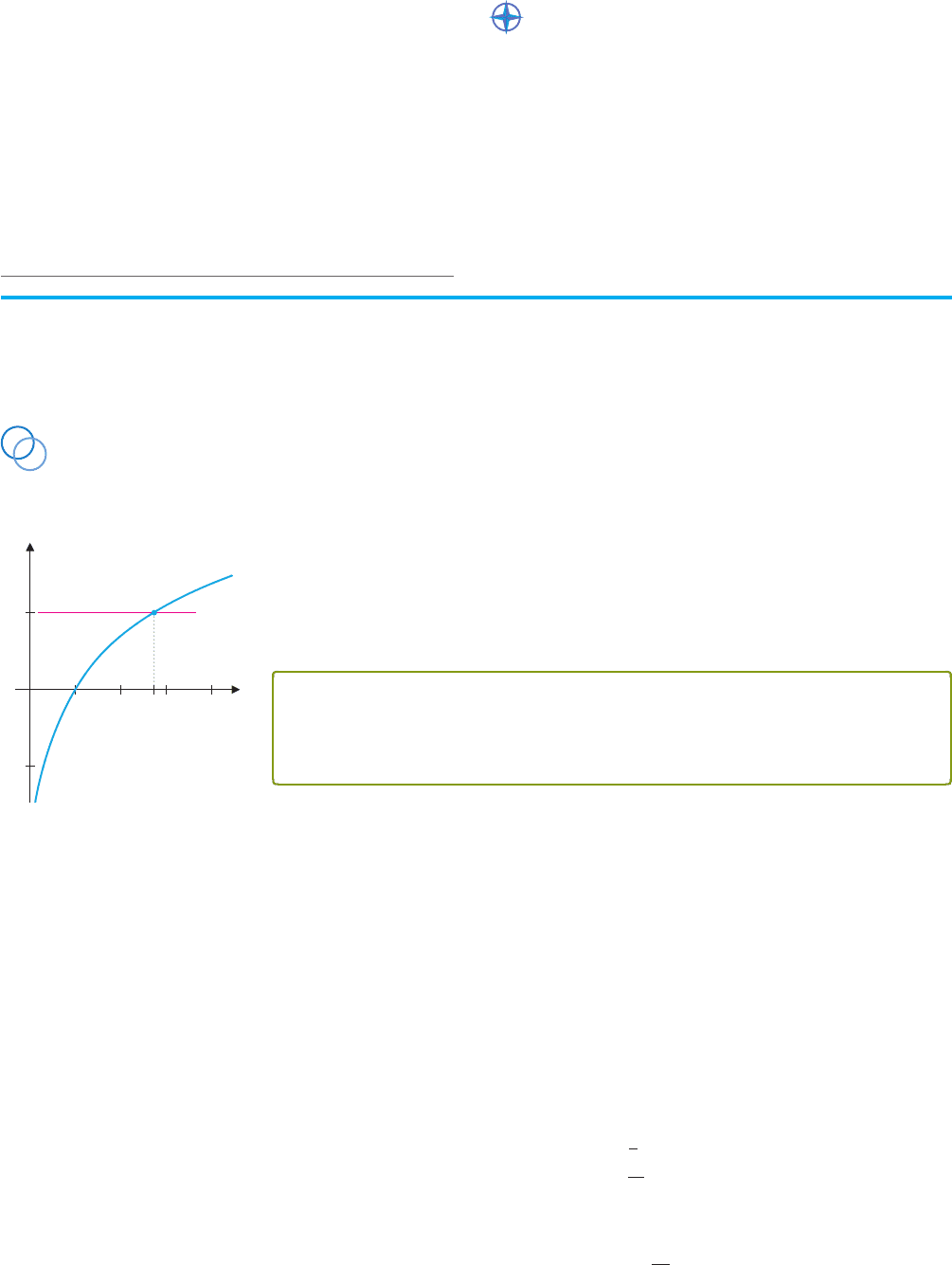
We define e to be that number for which
lne = 1.
That is, e is the x-coordinate of the point of intersection of the graphs of y = ln x and y = 1.
(See Figure 6.14.) In other words, e is the solution of the equation
ln x − 1 = 0.
You can solve this approximately (e.g., using Newton’s method) to obtain
e ≈ 2.71828182846.
So, having defined the irrational number e, you might wonder what the big deal is with
defining the function e
x
? Of course, there’s no problem at all, when x is rational. For
instance, we have
e
2
= e · e
e
3
= e · e ·e
e
1/2
=
√
e
e
5/7
=
7
√
e
5
and so on. In fact, for any rational power, x = p/q (where p and q are integers), we have
e
x
= e
p/q
=
q
√
e
p
.

P1: PIC/OVY P2: OSO/OVY QC: OSO/OVY T1: OSO
MHDQ256-Ch06 MHDQ256-Smith-v1.cls December 15, 2010 19:5
LT (Late Transcendental)
CONFIRMING PAGES
392 CHAPTER 6
..
Exponentials, Logarithms and Other Transcendental Functions 6-18
On the other hand, if x is irrational, what could we mean by e
x
? What does it mean to raise
a number to an irrational power? For instance, could you give any meaning to e
π
?
First, observe that for f (x) = ln x(x > 0), f
(x) = 1/x > 0. So, f is an increasing
function and consequently, must be one-to-one and therefore, has an inverse, f
−1
.Asis
often the case, there is no algebraic method of solving for the inverse function. However,
from Theorem 1.2 (iv), we have that for any rational power x,
ln(e
x
) = x ln e = x,
since we have defined e so that ln e = 1. Observe that this says that
f
−1
(x) = e
x
, for x rational.
That is, the (otherwise unknown) inverse function, f
−1
(x), agrees with e
x
at every rational
number x. Since e
x
so far has no meaning when x is irrational, we now define it to be the
value of f
−1
(x), as follows.
DEFINITION 3.2
For x irrational, we define y = e
x
to be that number for which
ln y = ln(e
x
) = x.
According to this definition, notice that for any x > 0, e
ln x
is that real number for which
ln(e
ln x
) = ln x. (3.1)
Since ln x is a one-to-one function, (3.1) says that
e
ln x
= x, for x > 0. (3.2)
Notice that (3.2) says that for x > 0,
ln x = log
e
x.
That is, the integral definition of ln x given in section 6.1 is consistent with your earlier
definition of ln x as log
e
x. Observe also that with this definition of the exponential function,
we also have
ln(e
x
) = x, for all x ∈ (−∞, ∞).
Thus, we have that e
x
and ln x are inverse functions. Keep in mind that for x irrational, e
x
is
defined only through the inverse function relationship given in Definition 3.2. We now state
some familiar laws of exponents and prove that they hold even for the case of irrational
exponents.
THEOREM 3.1
For r, s any real numbers and t any rational number,
(i) e
r
e
s
= e
r+s
(ii)
e
r
e
s
= e
r−s
and
(iii) (e
r
)
t
= e
rt
.