
Smith R., Minton R. Calculus
Подождите немного. Документ загружается.

P1: OSO/OVY P2: OSO/OVY QC: OSO/OVY T1: OSO
MHDQ256-Ch07 MHDQ256-Smith-v1.cls December 23, 2010 21:26
LT (Late Transcendental)
CONFIRMING PAGES
7-13 SECTION 7.3
..
Trigonometric Techniques of Integration 433
Compare the graphs of y = x and y = f (x) on the interval
[−π, π]. From writing out a
1
through a
4
, you should notice a
nice pattern. Use it to form the function
g(x) = f (x) +a
5
sin5x +a
6
sin6x +a
7
sin7x +a
8
sin8x.
Compare the graphs of y = x and y = g(x) on the inter-
val [−π, π]. Is it surprising that you can add sine func-
tions together and get something close to a straight line? It
turns out that Fourier series can be used to find cosine and
sine approximations to any continuous function on a closed
interval.
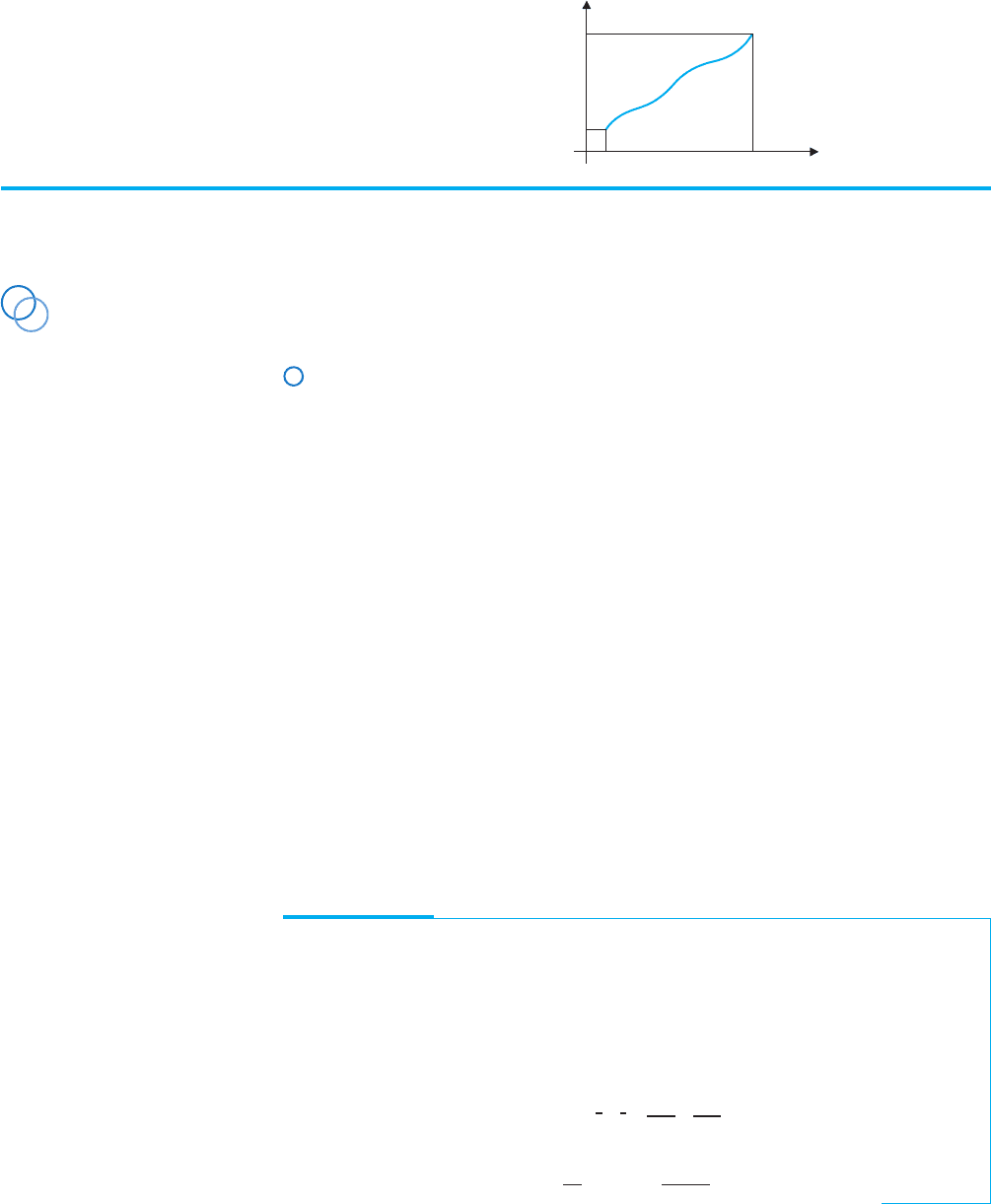
2. Assume that f is an increasing continuous function on [a, b]
with 0 ≤ a < b and f (x) ≥ 0. Let A
1
be the area under
y = f (x) from x = a to x = b and let A
2
be the area to the left
of y = f (x) from f (a)to f (b).Showthat A
1
+ A
2
= bf(b) −
af(a) and
b
a
f (x) dx = bf(b) − af(a) −
f (b)
f (a)
f
−1
(y)dy.
Use this result to evaluate
π/4
0
tan
−1
xdx.
y
x
a
f(b)
f(a)
A
2
A
1
b
7.3 TRIGONOMETRIC TECHNIQUES OF INTEGRATION
Integrals Involving Powers of Trigonometric Functions
Evaluatingan integral whose integrand contains powers of one or more trigonometric func-
tions often involves making a clever substitution. These integrals are sufficiently common
that we present them here as a group.
We first consider integrals of the form
sin
m
x cos
n
xdx,
where m and n are positive integers.
Case 1: m or n Is an Odd Positive Integer
If m is odd, first isolate one factor of sin x. (You’ll need this for du.) Then, replace any
factors of sin
2
x with 1 −cos
2
x and make the substitution u = cos x. Likewise, if n is odd,
first isolate one factor of cos x. (You’ll need this for du.) Then, replace any factors of cos
2
x
with 1 − sin
2
x and make the substitution u = sin x.
We illustrate this for the case where m is odd in example 3.1.
EXAMPLE 3.1 A Typical Substitution
Evaluate
cos
4
x sin xdx.
Solution Since you cannot evaluate this integral as it stands, you should consider
substitution. (Hint: Look for terms that are derivatives of other terms.) Here, letting
u = cos x, so that du =−sin xdx, gives us
cos
4
x sin xdx=−
cos
4
x
u
4
(−sin x)dx
du
=−
u
4
du
=−
u
5
5
+ c =−
cos
5
x
5
+ c.
Since u = cos x.

P1: OSO/OVY P2: OSO/OVY QC: OSO/OVY T1: OSO
MHDQ256-Ch07 MHDQ256-Smith-v1.cls December 23, 2010 21:26
LT (Late Transcendental)
CONFIRMING PAGES
434 CHAPTER 7
..
Integration Techniques 7-14
While this first example was not particularly challenging, it should give you an idea of
what to do with example 3.2.
EXAMPLE 3.2 An Integrand with an Odd Power of Sine
Evaluate
cos
4
x sin
3
xdx.
Solution Here, with u = cos x,wehavedu =−sin xdx, so that
cos
4
x sin
3
xdx=
cos
4
x sin
2
x sin xdx=−
cos
4
x sin
2
x(−sin x)dx
=−
cos
4
x(1 −cos
2
x)
u
4
(1 −u
2
)
(−sin x)dx
du
=−
u
4
(1 − u
2
)du
Since sin
2
x + cos
2
x = 1,
sin
2
x = 1 −cos
2
x
=−
(u
4
− u
6
)du =−
u
5
5
−
u
7
7
+ c
=−
cos
5
x
5
+
cos
7
x
7
+ c.
Since u = cos x.
The ideas used in example 3.2 can be applied to any integral of the specified form.
EXAMPLE 3.3 An Integrand with an Odd Power of Cosine
Evaluate
√
sin x cos
5
xdx.
Solution Observe that we can rewrite this as
√
sin x cos
5
xdx=
√
sin x cos
4
x cos xdx=
√
sin x (1 − sin
2
x)
2
cos xdx.
Substituting u = sin x, so that du = cos xdx,wehave
√
sin x cos
5
xdx=
√
sin x (1 − sin
2
x)
2
√
u(1 −u
2
)
2
cos xdx
du
=
√
u(1 −u
2
)
2
du =
u
1/2
(1 − 2u
2
+ u
4
) du
=
(u
1/2
− 2u
5/2
+ u
9/2
) du
=
2
3
u
3/2
− 2
2
7
u
7/2
+
2
11
u
11/2
+ c
=
2
3
sin
3/2
x −
4
7
sin
7/2
x +
2
11
sin
11/2
x +c. Since u = sin x.
Looking beyond the details of calculation here, you should see the main point: that all
integrals of this form are calculated in essentially the same way.
Case 2: m and n Are Both Even Positive Integers
In this case, we can use the half-angle formulas for sine and cosine (shown in the margin)
to reduce the powers in the integrand.
We illustrate this case in example 3.4.
NOTES
Half-angle formulas
sin
2
x =
1
2
(1 −cos 2x)
cos
2
x =
1
2
(1 +cos 2x)

P1: OSO/OVY P2: OSO/OVY QC: OSO/OVY T1: OSO
MHDQ256-Ch07 MHDQ256-Smith-v1.cls December 23, 2010 21:26
LT (Late Transcendental)
CONFIRMING PAGES
7-15 SECTION 7.3
..
Trigonometric Techniques of Integration 435
EXAMPLE 3.4 An Integrand with an Even Power of Sine
Evaluate
sin
2
xdx.
Solution Using the half-angle formula, we can rewrite the integral as
sin
2
xdx=
1
2
(1 − cos2x)dx.
We can evaluate this last integral by using the substitution u = 2x, so that du = 2 dx.
This gives us
sin
2
xdx=
1
2
1
2
(1 − cos2x)
1 −cos u
2dx
du
=
1
4
(1 − cosu)du
=
1
4
(u − sinu) +c =
1
4
(2x − sin2x) + c.
Since u = 2x.
With some integrals, you may need to apply the half-angle formulas several times, as
in example 3.5.
EXAMPLE 3.5 An Integrand with an Even Power of Cosine
Evaluate
cos
4
xdx.
Solution Using the half-angle formula for cosine, we have
cos
4
xdx=
(cos
2
x)
2
dx =
1
4
(1 + cos2x)
2
dx
=
1
4
(1 + 2cos 2x +cos
2
2x)dx.
Using the half-angle formula again, on the last term in the integrand, we get
cos
4
xdx=
1
4
1 + 2cos 2x +
1
2
(1 + cos4x)
dx
=
3
8
x +
1
4
sin2x +
1
32
sin4x + c,
where we leave the details of the final integration as an exercise.
Our next aim is to devise a strategy for evaluating integrals of the form
tan
m
x sec
n
xdx,
where m and n are integers.
Case 1: m Is an Odd Positive Integer
First, isolate one factor of sec x tan x. (You’ll need this for du.) Then, replace any factors
of tan
2
x with sec
2
x −1 and make the substitution u = sec x.
We illustrate this in example 3.6.

P1: OSO/OVY P2: OSO/OVY QC: OSO/OVY T1: OSO
MHDQ256-Ch07 MHDQ256-Smith-v1.cls December 23, 2010 21:26
LT (Late Transcendental)
CONFIRMING PAGES
436 CHAPTER 7
..
Integration Techniques 7-16
EXAMPLE 3.6 An Integrand with an Odd Power of Tangent
Evaluate
tan
3
x sec
3
xdx.
Solution Looking for terms that are derivatives of other terms, we rewrite the
integral as
tan
3
x sec
3
xdx=
tan
2
x sec
2
x (sec x tan x)dx
=
(sec
2
x −1)sec
2
x (sec x tan x) dx,
where we have used the Pythagorean identity
tan
2
x = sec
2
x −1.
You should see the substitution now. We let u = sec x, so that du = sec x tan xdxand
hence,
tan
3
x sec
3
xdx=
(sec
2
x −1)sec
2
x
(u
2
− 1)u
2
(sec x tan x)dx
du
=
(u
2
− 1)u
2
du =
(u
4
− u
2
) du
=
1
5
u
5
−
1
3
u
3
+ c =
1
5
sec
5
x −
1
3
sec
3
x +c. Since u = sec x.
Case 2: n Is an Even Positive Integer
First, isolate one factor of sec
2
x. (You’ll need this for du.) Then, replace any remaining
factors of sec
2
x with 1 +tan
2
x and make the substitution u = tan x.
We illustrate this in example 3.7.
EXAMPLE 3.7 An Integrand with an Even Power of Secant
Evaluate
tan
2
x sec
4
xdx.
Solution Since
d
dx
tan x = sec
2
x, we rewrite the integral as
tan
2
x sec
4
xdx=
tan
2
x sec
2
x sec
2
xdx=
tan
2
x(1 +tan
2
x) sec
2
xdx.
Now, we let u = tan x, so that du = sec
2
xdxand
tan
2
x sec
4
xdx=
tan
2
x(1 +tan
2
x)
u
2
(1 +u
2
)
sec
2
xdx
du
=
u
2
(1 + u
2
)du =
(u
2
+ u
4
) du
=
1
3
u
3
+
1
5
u
5
+ c
=
1
3
tan
3
x +
1
5
tan
5
x +c. Since u = tan x.

P1: OSO/OVY P2: OSO/OVY QC: OSO/OVY T1: OSO
MHDQ256-Ch07 MHDQ256-Smith-v1.cls December 23, 2010 21:26
LT (Late Transcendental)
CONFIRMING PAGES
7-17 SECTION 7.3
..
Trigonometric Techniques of Integration 437
Case 3: m Is an Even Positive Integer and n Is an Odd Positive Integer
Replaceanyfactors oftan
2
x withsec
2
x −1andthen use aspecialreduction formula (given
in the exercises) to evaluate integrals of the form
sec
n
xdx. This complicated case will
be covered briefly in the exercises. Much of this depends on example 3.8.
EXAMPLE 3.8 An Unusual Integral
Evaluate the integral
sec xdx.
Solution Finding an antiderivative here depends on an unusual observation. Notice
that if we multiply the integrand by the fraction
sec x + tanx
sec x + tanx
(which is of course equal
to 1), we get
sec xdx=
sec x
sec x + tanx
sec x + tanx
dx
=
sec
2
x +sec x tan x
sec x + tanx
dx.
Now, observe that the numerator is exactly the derivative of the denominator. That is,
d
dx
(sec x + tanx) = sec x tan x + sec
2
x,
so that taking u = sec x +tan x gives us
sec xdx =
sec
2
x +sec x tan x
sec x + tanx
dx
=
1
u
du = ln|u|+c
= ln |sec x +tan x|+c.
Since u = sec x +tan x.
Trigonometric Substitution
If an integral contains a term of the form
√
a
2
− x
2
,
√
a
2
+ x
2
or
√
x
2
− a
2
, for some
a > 0, you can often evaluate the integral by making a substitution involving a trig function
(hence, the name trigonometric substitution).
First, suppose that an integrand contains a term of the form
√
a
2
− x
2
, for some a > 0.
Letting x = a sin θ, where −
π
2
≤ θ ≤
π
2
, we can eliminate the square root, as follows:
a
2
− x
2
=
a
2
− (a sinθ)
2
=
a
2
− a
2
sin
2
θ
= a
1 − sin
2
θ = a
√
cos
2
θ = a cosθ,
since for −
π
2
≤ θ ≤
π
2
, cos θ ≥ 0. Example 3.9 is typical of how these substitutions are
used.
NOTE
Terms of the form
√
a
2
− x
2
can
also be simplified using the
substitution x = a cosθ, using a
different restriction for θ.
EXAMPLE 3.9 An Integral Involving
√
a
2
− x
2
Evaluate
1
x
2
√
4 − x
2
dx.
Solution You should always first consider whether an integral can be done directly,
by substitution or by parts. Since none of these methods help here, we consider
P1: OSO/OVY P2: OSO/OVY QC: OSO/OVY T1: OSO
MHDQ256-Ch07 MHDQ256-Smith-v1.cls December 23, 2010 21:26
LT (Late Transcendental)
CONFIRMING PAGES
438 CHAPTER 7
..
Integration Techniques 7-18
trigonometric substitution. Keep in mind that the immediate objective here is to
eliminate the square root. A substitution that will accomplish this is
x = 2sinθ, for −
π
2
<θ<
π
2
.
(Why do we need strict inequalities here?) This gives us
dx = 2 cosθ dθ
and hence,
1
x
2
√
4 − x
2
dx =
1
(2sin θ)
2
4 − (2sinθ)
2
2cos θ dθ
=
2cos θ
4sin
2
θ
4 − 4sin
2
θ
dθ
=
cosθ
(2sin
2
θ)2
1 − sin
2
θ
dθ
=
cosθ
4sin
2
θ cos θ
dθ
Since 1 −sin
2
θ = cos
2
θ.
=
1
4
csc
2
θ dθ =−
1
4
cotθ + c.
Since
1
sin
2
θ
= csc
2
θ.
The only remaining problem is that the antiderivative is presently written in terms of the
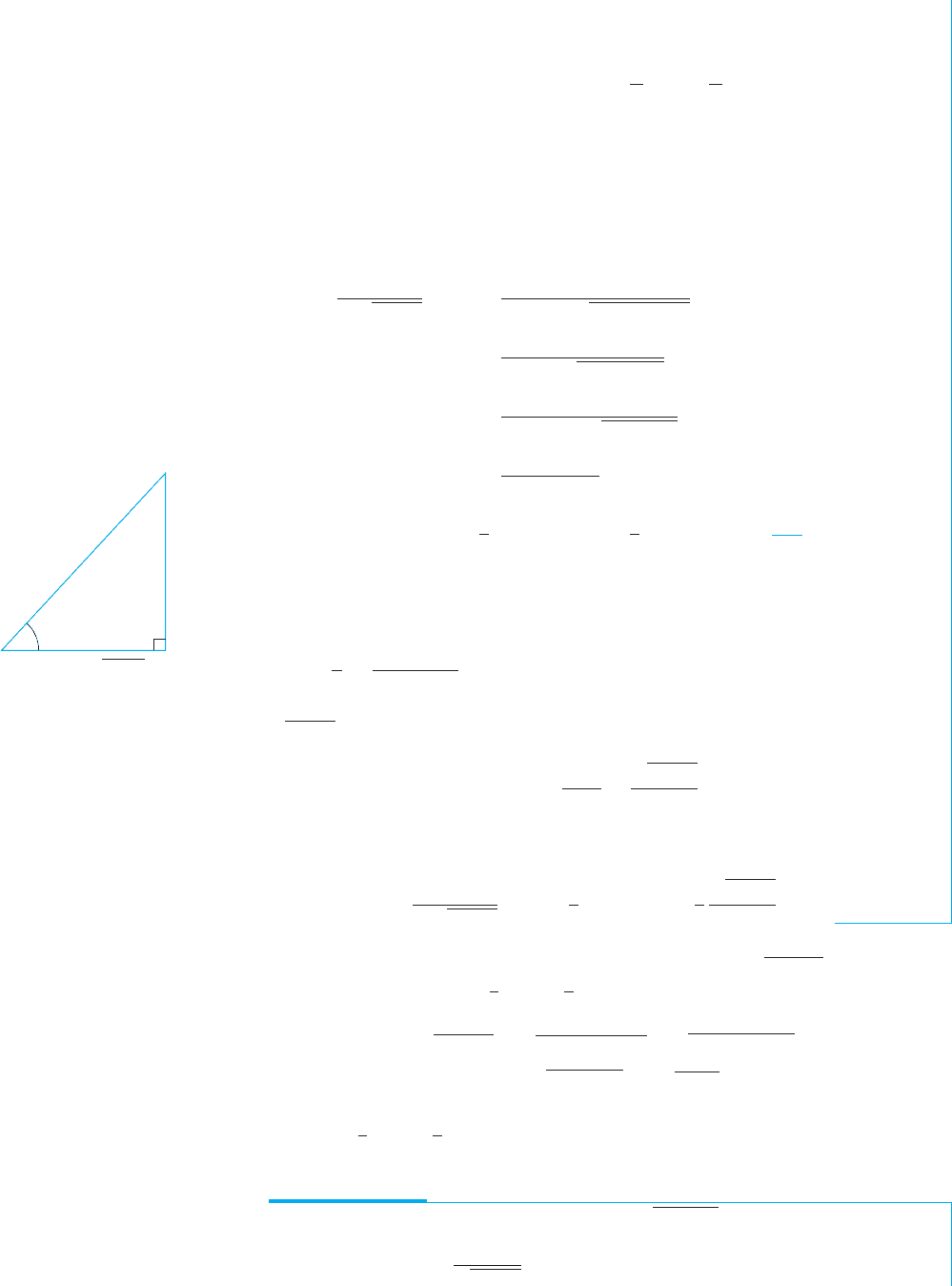
variable θ. When converting back to the original variable x = 2 sinθ,weurgeyouto
draw a diagram, as in Figure 7.1. Since the substitution was x = 2 sinθ,wehave
sinθ =
x
2
=
opposite
hypotenuse
and so we label the hypotenuse as 2. The side opposite the
angle θ is then 2 sinθ. By the Pythagorean Theorem, we get that the adjacent side is
√
4 − x
2
, as indicated. So, we have
cotθ =
cosθ
sinθ
=
√
4 − x
2
x
.
It now follows that
1
x
2
√
4 − x
2
dx =−
1
4
cotθ + c =−
1
4
√
4 − x
2
x
+ c.
Next, suppose that an integrand contains a term of the form
√
a
2
+ x
2
, for some a > 0.
Taking x = a tanθ, where −
π
2
<θ<
π
2
, we eliminate the square root, as follows:
a
2
+ x
2
=
a
2
+ (a tanθ)
2
=
a
2
+ a
2
tan
2
θ
= a
1 + tan
2
θ = a
√
sec
2
θ = a secθ,
since for −
π
2
<θ<
π
2
, sec θ>0. Example 3.10 is typical of how these substitutions are
used.
u
2 cos u
兹
4 x
2
2
2 sin u
x
FIGURE 7.1
EXAMPLE 3.10 An Integral Involving
√
a
2
+ x
2
Evaluate the integral
1
√
9 + x
2
dx.

P1: OSO/OVY P2: OSO/OVY QC: OSO/OVY T1: OSO
MHDQ256-Ch07 MHDQ256-Smith-v1.cls December 23, 2010 21:26
LT (Late Transcendental)
CONFIRMING PAGES
7-19 SECTION 7.3
..
Trigonometric Techniques of Integration 439
Solution You can eliminate the square root by letting x = 3tanθ , for −
π
2
<θ<
π
2
.
This gives us dx = 3 sec
2
θdθ , so that
1
√
9 + x
2
dx =
1
9 + (3tanθ)
2
3sec
2
θ dθ
=
3sec
2
θ
√
9 + 9tan
2
θ
dθ
=
3sec
2
θ
3
√
1 + tan
2
θ
dθ
=
sec
2
θ
secθ
dθ
Since 1 +tan
2
θ = sec
2
θ.
=
secθ dθ
= ln |secθ +tanθ|+c,
from example 3.8. We’re not done here, though, since we must still express the integral
in terms of the original variable x. Observe that we had x = 3tanθ, so that tanθ =
x
3
.It
remains only to solve for secθ. Although you can do this with a triangle, as in example
3.9, the simplest way to do this is to recognize that for −
π
2
<θ<
π
2
,
secθ =
1 + tan
2
θ =
1 +
x
3
2
.
This leaves us with
1
√
9 + x
2
dx = ln |sec θ + tan θ|+c
= ln
1 +
x
3
2
+
x
3
+ c.
Finally, suppose that an integrand contains a term of the form
√
x
2
− a
2
, for some
a > 0. Taking x = a secθ, where θ ∈
0,
π
2
∪
π
2
,π
, we eliminate the square root,
as follows:
x
2
− a
2
=
(a secθ)
2
− a
2
=
a
2
sec
2
θ −a
2
= a
sec
2
θ −1 = a
tan
2
θ = a |tanθ |.
Notice that the absolute values are needed, as tanθ can be both positive and negative on
0,
π
2
∪
π
2
,π
. Example 3.11 is typical of how these substitutions are used.
EXAMPLE 3.11 An Integral Involving
√
x
2
− a
2
Evaluate the integral
√
x
2
− 25
x
dx, for x ≥ 5.
Solution Here, we let x = 5secθ , for θ ∈
0,
π
2
, where we chose the first half of the
domain
0,
π
2
∪
π
2
,π
, so that x = 5secθ>5. (If we had x < −5, we would have
P1: OSO/OVY P2: OSO/OVY QC: OSO/OVY T1: OSO
MHDQ256-Ch07 MHDQ256-Smith-v1.cls December 23, 2010 21:26
LT (Late Transcendental)
CONFIRMING PAGES
440 CHAPTER 7
..
Integration Techniques 7-20
chosen θ ∈ (
π
2
,π].) This gives us dx = 5secθ tanθ dθ and the integral then becomes:
√
x
2
− 25
x
dx =
(5sec θ)
2
− 25
5sec θ
(5sec θ tanθ) dθ
=
25sec
2
θ −25 tan θ dθ
=
5
sec
2
θ −1 tan θ dθ
= 5
tan
2
θ dθ Since sec
2
θ −1 = tan
2
θ.
= 5
(sec
2
θ −1)dθ
= 5(tan θ − θ ) +c.
Finally, observe that since x = 5sec θ, for θ ∈ [0,
π
2
), we have that
tanθ =
sec
2
θ −1 =
x
5
2
− 1 =
1
5
x
2
− 25
and θ = sec
−1
x
5
.Wenowhave
√
x
2
− 25
x
dx = 5(tan θ − θ) +c
=
x
2
− 25 −5sec
−1
x
5
+ c.
You will find a number of additional integrals requiring trigonometric substitution in
the exercises. The principal idea here is to see that you can eliminate certain square root
terms in an integrand by making use of a carefully chosen trigonometric substitution.
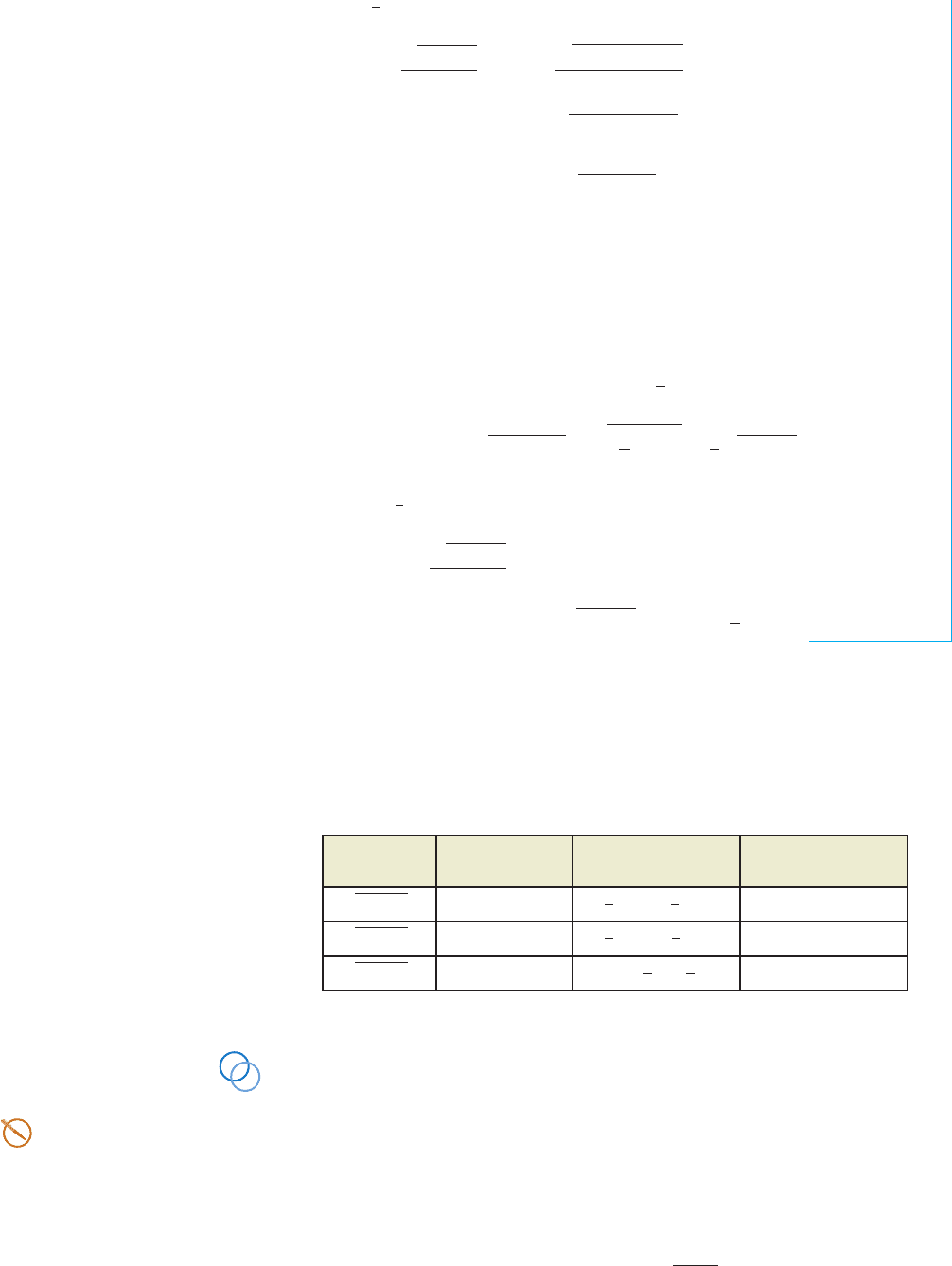
We summarize the three trigonometric substitutions presented here in the following
table.
Trigonometric
Expression Substitution Interval Identity
√
a
2
− x
2
x = a sinθ −
π
2
≤ θ ≤
π
2
1 − sin
2
θ = cos
2
θ
√
a
2
+ x
2
x = a tanθ −
π
2
<θ<
π
2
1 + tan
2
θ = sec
2
θ
√
x
2
− a
2
x = a secθ θ ∈ [0,
π
2
) ∪ (
π
2
,π] sec
2
θ −1 = tan
2
θ
EXERCISES 7.3
WRITING EXERCISES
1. Suppose a friend in your calculus class tells you that this sec-
tion just has too many rules to memorize. Help your friend
out by making it clear that each rule indicates when certain
substitutions will work. In turn, a substitution u(x) works if
the expression u
(x) appears in the integrand and the resulting
integral is easier to integrate. For each of the rules covered in
the text, identify u
(x) and point out why n has to be odd (or
whatever the rule says) for the remaining integrand to be work-
able. Without memorizing rules, you can remember a small
number of potential substitutions and see which one works for
a given problem.
2. In the text, we suggested that when the integrand contains a
term of the form
√
4 − x
2
, you might try the trigonometric

P1: OSO/OVY P2: OSO/OVY QC: OSO/OVY T1: OSO
MHDQ256-Ch07 MHDQ256-Smith-v1.cls December 23, 2010 21:26
LT (Late Transcendental)
CONFIRMING PAGES
7-21 SECTION 7.3
..
Trigonometric Techniques of Integration 441
substitution x = 2sinθ. We should admit now that this does
notalwayswork.Aftera substitution, howcanyou tell whether
the substitution worked?
In exercises 1–44, evaluate the integrals.
1.
cos x sin
4
xdx 2.
cos
3
x sin
4
xdx
3.
π/4
0
cos2x sin
3
2xdx 4.
π/3
π/4
cos
3
3x sin
3
3xdx
5.
π/2
0
cos
2
x sin xdx 6.
0
−π/2
cos
3
x sin xdx
7.
cos
2
(x + 1) dx 8.
sin
4
(x − 3) dx
9.
tan x sec
3
xdx 10.
cot x csc
4
xdx
11.
x tan
3
(x
2
+1) sec (x
2
+1)dx
12.
tan(2x +1) sec
3
(2x +1)dx
13.
cot
2
x csc
4
xdx 14.
cot
2
x csc
2
xdx
15.
π/4
0
tan
4
x sec
4
xdx 16.
π/4
−π/4
tan
4
x sec
2
xdx
17.
cos
2
x sin
2
xdx 18.
(cos
2
x + sin
2
x) dx
19.
0
−π/3
√
cos x sin
3
xdx 20.
π/2
π/4
cot
2
x csc
4
xdx
21.
1
x
2
√
9 − x
2
dx 22.
1
x
2
√
16 − x
2
dx
23.
x
2
√
16 − x
2
dx 24.
x
3
√
9 − x
2
dx
25.
2
0
4 − x
2
dx 26.
1
0
x
√
4 − x
2
dx
27.
x
2
√
x
2
− 9
dx 28.
x
3
x
2
− 1 dx
29.
2
√
x
2
− 4
dx 30.
x
√
x
2
− 4
dx
31.
√
4x
2
− 9
x
dx 32.
√
x
2
− 4
x
2
dx
33.
x
2
√
9 + x
2
dx 34.
x
3
8 + x
2
dx
35.
16 + x
2
dx 36.
1
√
4 + x
2
dx
37.
1
0
x
x
2
+ 8 dx 38.
2
0
x
2
x
2
+ 9 dx
39.
x
3
√
1 + x
2
dx 40.
x + 1
√
4 + x
2
dx
41.
x
√
x
2
+ 4x
dx 42.
2
√
x
2
− 6x
dx
43.
x
√
10 + 2x + x
2
dx 44.
2
√
4x − x
2
dx
............................................................
In exercises 45 and 46, evaluate the integral using both substi-
tutions u tan x and u sec x and compare the results.
45.
tan x sec
4
xdx 46.
tan
3
x sec
4
xdx
............................................................
47. (a) Show that for any integer n > 1, we have the reduction
formula
sec
n
xdx=
1
n − 1
sec
n−2
x tan x +
n − 2
n − 1
sec
n−2
xdx.
Evaluate (b)
sec
3
xdx, (c)
sec
4
xdxand (d)
sec
5
xdx.
48. The area of the ellipse
x
2
a
2
+
y
2
b
2
= 1isgivenby
4b
a
a
0
a
2
− x
2
dx. Compute this integral.
49. Show that
cscxdx= ln|csc x − cot x|+c and evaluate
csc
3
xdx.
50. Show that
1
cos x − 1
dx = csc x + cot x + c and
1
cos x + 1
dx = csc x − cot x + c.
51. Evaluate the antiderivatives in examples 3.2, 3.3, 3.5, 3.6
and 3.7 using your CAS. Based on these examples, specu-
late whether or not your CAS uses the same techniques that
we do. In the cases where your CAS gives a different an-
tiderivativethanwe do, comment onwhichantiderivativelooks
simpler.
52. (a) One CAS produces −
1
7
sin
2
x cos
5
x −
2
35
cos
5
x as an anti-
derivative in example 3.2. Find c such that this equals our
antiderivative of −
1
5
cos
5
x +
1
7
cos
7
x + c.
(b) One CAS produces −
2
15
tan x −
1
15
sec
2
x tan x +
1
5
sec
4
x tan x as an antiderivative in example 3.7. Find
c such that this equals our antiderivative of
1
3
tan
3
x +
1
5
tan
5
x + c.
53. In an AC circuit, the current has the form i(t) = I cos(ωt) for
constants I and ω. The power is defined as Ri
2
for a constant
R. Find the average value of the power by integrating over the
interval [0, 2π/ω].
EXPLORATORY EXERCISES
1. In section 7.2, you were asked to show that for positive
integers m and n with m = n,
π
−π
cos(mx)cos(nx) dx =
0 and
π
−π
sin(mx)sin(nx) dx = 0. Also,
π
−π
cos
2
(nx) dx =
π
−π
sin
2
(nx) dx = π . Finally,
π
−π
cos(mx)sin(nx) dx = 0,
for any positive integers m and n. We will use these formu-
las to explain how a radio can tune in an AM station.
Amplitude modulation (or AM) radio sends a signal (e.g.,
music)thatmodulatesthecarrierfrequency.Forexample,ifthe
signal is 2sin t and the carrier frequency is 16, then the radio
sends out the modulated signal 2sin t sin16t. The graphs of
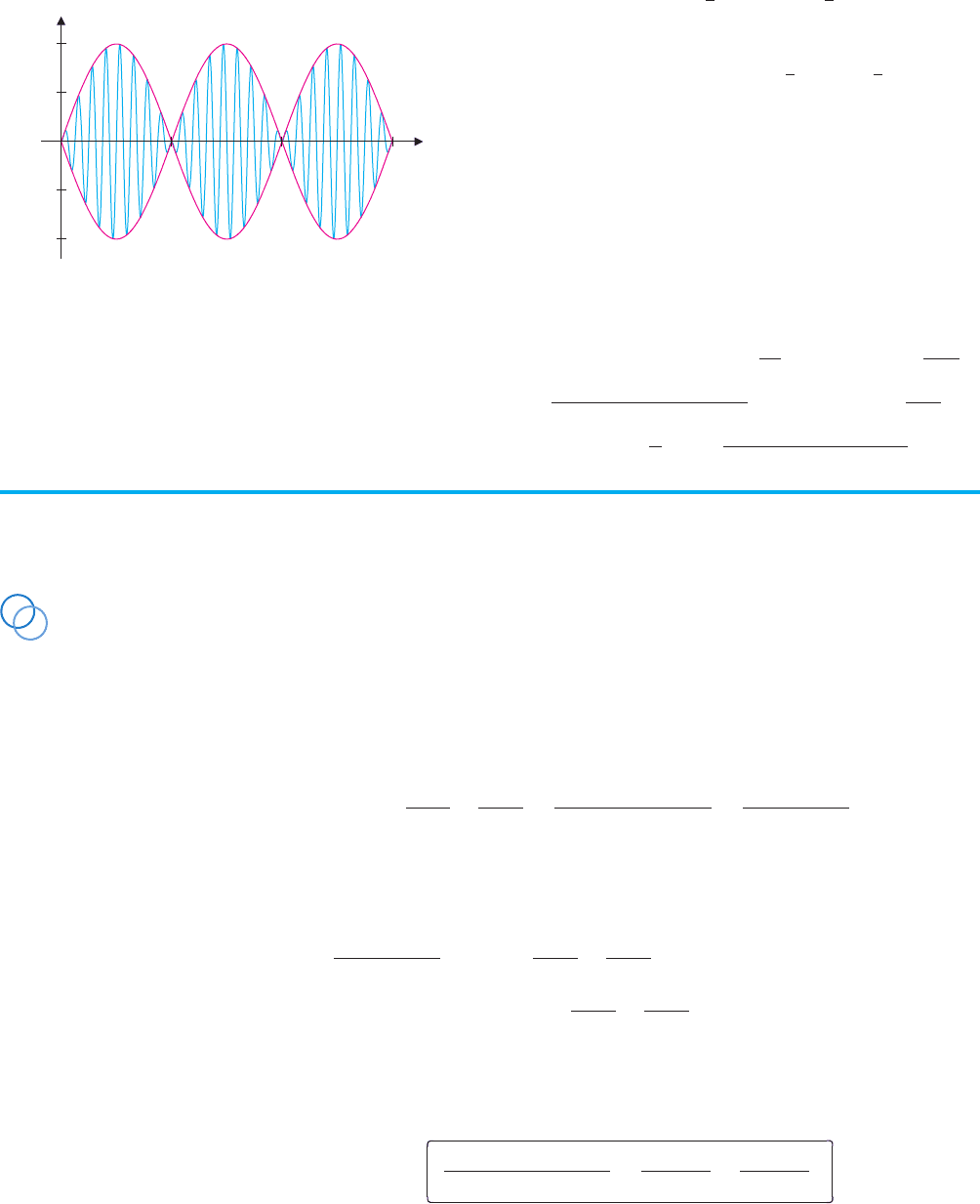
P1: OSO/OVY P2: OSO/OVY QC: OSO/OVY T1: OSO
MHDQ256-Ch07 MHDQ256-Smith-v1.cls December 23, 2010 21:26
LT (Late Transcendental)
CONFIRMING PAGES
442 CHAPTER 7
..
Integration Techniques 7-22
y = 2 sin t, y =−2 sin t and y = 2 sint sin16t are shown in
the figure.
y
t
2
1
1
2
3
The graph of y = 2 sin t sin 16t oscillates as rapidly as the car-
riersin16t,buttheamplitudevariesbetween2sint and−2sin t
(hence the term amplitude modulation). The radio’s problem
is to tune in the frequency 16 and recover the signal 2sint.
The difficulty is that other radio stations are broadcasting si-
multaneously. A radio receives all the signals mixed together.
To see howthis works, suppose a second station broadcasts the
signal 3sint at frequency 32. The combined signal that the
radioreceivesis2sint sin 16t + 3 sin t sin 32t.Wewilldecom-
pose this signal. The first step is to rewrite the signal using the
identity
sin A sin B =
1
2
cos(B − A) −
1
2
cos(B + A).
The signal then equals
f (t) = cos15t − cos17t +
3
2
cos31t −
3
2
cos33t.
If the radio “knows” that the signal has the form c sin t,
for some constant c, it can determine the constant c at fre-
quency 16 by computing the integral
π
−π
f (t)cos15tdt and
multiplyingby2/π.Showthat
π
−π
f (t)cos15tdt= π,sothat
the correct constant is c = π(2/π) = 2. The signal is then
2sint. To recover the signal sent out by the second station,
compute
π
−π
f (t)cos31tdtand multiply by 2/π. Show that
you correctly recover the signal 3sin t.
2. In this exercise, we derive an important result called Wallis’
product. Define the integral I
n
=
π/2
0
sin
n
xdxfor a positive
integer n. (a) Show that I
n
=
n
n−1
I
n−2
. (b) Show that
I
2n+1
I
2n
=
2
2
4
2
···(2n)
2
2
3
2
5
2
···(2n − 1)
2
(2n + 1)π
. (c) Given that lim
n→∞
I
2n+1
I
2n
= 1,
conclude that
π
2
= lim
n→∞
2
2
4
2
···(2n)
2
3
2
5
2
···(2n − 1)
2
(2n + 1)
.
7.4 INTEGRATION OF RATIONAL FUNCTIONS
USING PARTIAL FRACTIONS
In this section, we introduce a method for rewriting certain rational functions that is very
useful in integration as well as in other applications. We begin with a simple observation.
Note that
3
x +2
−
2
x −5
=
3(x − 5) − 2(x + 2)
(x + 2)(x − 5)
=
x −19
x
2
− 3x − 10
. (4.1)
So, suppose that you wanted to evaluate the integral of the function on the right-hand side
of (4.1). While it’s not clear how to evaluate this integral, the integral of the (equivalent)
function on the left-hand side of (4.1) is easy to evaluate. From (4.1), we have
x −19
x
2
− 3x − 10
dx =
3
x +2
−
2
x −5
dx = 3ln|x + 2|−2ln|x −5|+c.
The second integrand,
3
x +2
−
2
x −5
iscalledapartial fractions decomposition ofthefirstintegrand.Moregenerally,ifthethree
factors a
1
x +b
1
, a
2
x +b
2
and a
3
x +b
3
are all distinct (i.e., none is a constant multiple of
another), then we can write
a
1
x +b
1
(a
2
x +b
2
)(a
3
x +b
3
)
=
A
a
2
x +b
2
+
B
a
3
x +b
3
,
forsomechoice of constants A and B tobedetermined. Notice that if you wanted to integrate
this expression, the partial fractions on the right-hand side are very easy to integrate.