
Smith R., Minton R. Calculus
Подождите немного. Документ загружается.


P1: PIC/OVY P2: OSO/OVY QC: OSO/OVY T1: OSO
MHDQ256-Ch06 MHDQ256-Smith-v1.cls December 15, 2010 19:5
LT (Late Transcendental)
CONFIRMING PAGES
6-29 SECTION 6.4
..
The Inverse Trigonometric Functions 403
hypotenuse 5, by the Pythagorean Theorem. Using the picture as a guide, we can read
off the desired value.
sinθ = sin
tan
−1
4
3
=
4
5
.
While we’re at it, we should also observe that we have found that
cosθ = cos
tan
−1
4
3
=
3
5
.
BEYOND FORMULAS
There is a subtle device we have used throughout this section. Since the function sin x
is not one-to-one, it clearly does not have an inverse. However, inverse functions are
so useful that in cases such as this, mathematicians don’t like to take this as the final
answer and so, restrict the domain of the function, effectively defining a new function
that does have an inverse. In the case of sin x, we restricted the domain to the interval
[−π/2,π/2], thus defining a new function that equals sin x on this interval and yet,
does have an inverse. The general idea of manipulating various features of a function
to produce a desired result is common in mathematics. The alternative would mean
meekly accepting the existing limitations of a given function, which is not part of the
culture of mathematics.
EXERCISES 6.4
WRITING EXERCISES
1. Discuss how to compute sec
−1
x, csc
−1
x and cot
−1
x on a cal-
culator that only has built-in functions for sin
−1
x, cos
−1
x and
tan
−1
x.
2. Give a different range for sec
−1
x than that given in the text.
For which x’s would the value of sec
−1
x change? Using the
calculator discussion in exercise 1, give one reason why we
might have chosen the range that we did.
3. Inverse functions are necessary for solving equations. The re-
strictedrangewehadtousetodefineinversesofthetrigonomet-
ric functions also restricts their usefulness in equation solving.
Explain how to use sin
−1
x to find all solutions of the equation
sinu = x.
4. The idea of restricting ranges can be used to define inverses
for a variety of functions. Explain how to define an inverse for
f (x) = x
2
.
In exercises 1–6, evaluate the inverse function by sketching a
unit circle and locating the correct angle on the circle.
1. (a) sin
−1
(0) (b) sin
−1
(−
1
2
) (c) sin
−1
(−1)
2. (a) cos
−1
(0) (b) cos
−1
(1) (c) cos
−1
(
1
2
)
3. (a) tan
−1
(1) (b) tan
−1
(0) (c) tan
−1
(−1)
4. (a) cot
−1
(0) (b) cot
−1
(1) (c) cot
−1
(
√
3)
5. (a) sec
−1
(1) (b) sec
−1
(2) (c) sec
−1
(
√
2)
6. (a) csc
−1
(1) (b) csc
−1
(−1) (c) csc
−1
(−2)
............................................................
In exercises 7–18, use a triangle to simplify each expression.
Where applicable, state the range of x’s for which the simplifi-
cation holds.
7. cos(sin
−1
x) 8. cos(tan
−1
x)
9. tan(sec
−1
x) 10. cot(cos
−1
x)
11. sin
cos
−1
1
2
12. cos
sin
−1
1
2
13. tan
cos
−1
3
5
14. csc
sin
−1
2
3
15. cos
−1
(cos(−π/8)) 16. sin
−1
(sin3π/4)
17. sin(2sin
−1
x/3) 18. cos(2sin
−1
2x)
............................................................
In exercises 19–24, sketch a graph of the function.
19. cos
−1
(2x) 20. cos
−1
(x
3
)
21. sin
−1
(3x) 22. sin
−1
(x/4)
23. tan
−1
1
x
2
− 1
24. sin
−1
1 −
1
x
2
............................................................
In exercises 25–32, find all solutions.
25. cos(2x) = 0 26. cos(3x) = 1
27. sin(3x) = 0 28. sin(x/4) = 1
P1: PIC/OVY P2: OSO/OVY QC: OSO/OVY T1: OSO
MHDQ256-Ch06 MHDQ256-Smith-v1.cls December 15, 2010 19:5
LT (Late Transcendental)
CONFIRMING PAGES
404 CHAPTER 6
..
Exponentials, Logarithms and Other Transcendental Functions 6-30
29. tan(5x) = 1 30. sin(x/4) =−
1
2
31. sec(2x) = 2 32. csc(2x) =−2
............................................................
33. Give precise definitions of csc
−1
x and cot
−1
x.
APPLICATIONS
34. In baseball, outfielders are able to easily track down and catch
fly balls that have very long and high trajectories. Physicists
have argued for years about how this is done. A recent expla-
nation involves the following geometry.
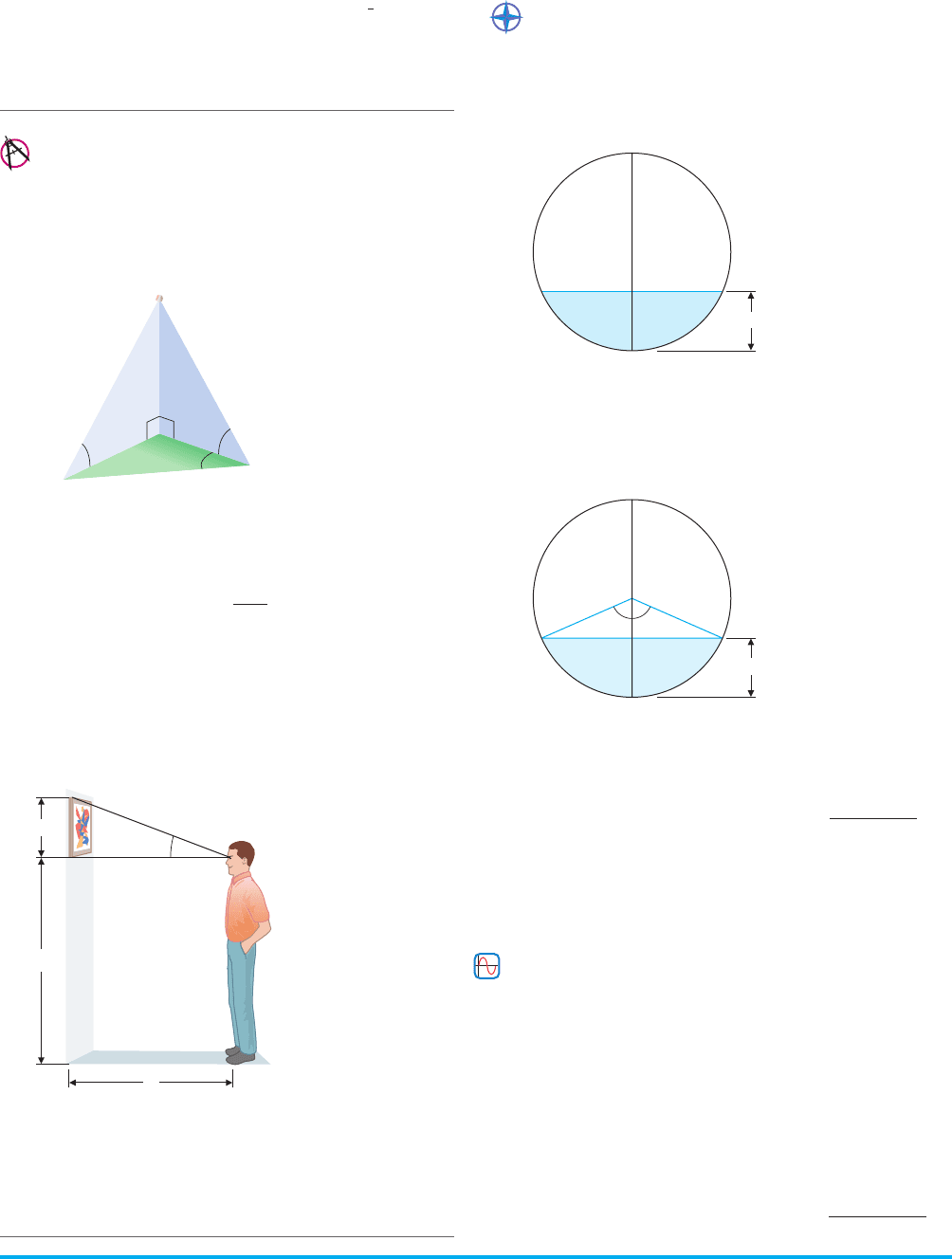
Outfielde
r
Ball
Home
plate
c
b
a
The player can catch the ball by running to keep the angle
ψ constant (this makes it appear that the ball is moving in
a straight line). Assuming that all triangles shown are right
triangles, show that tanψ =
tanα
tanβ
and then solve for ψ.
35. A picture hanging in an art gallery has a frame 20 inches high
and the bottom of the frame is 6 feet above the floor. A person
whose eye is 6 feet above the floor stands x feet from the wall.
Let A be the angle formed by the ray from the person’s eye
to the bottom of the frame and the ray from the person’s eye
to the top of the frame. Write A as a function of x and graph
y = A(x).
x
20"
6'
A
36. In golf, the goal is to hit a ball into a hole of diameter
4.5 inches. Suppose a golfer stands x feet from the hole trying
to putt the ball into the hole. A first approximation of the mar-
gin of error in a putt is to measure the angle A formed by the
ray from the ball to the right edge of the hole and the ray from
the ball to the left edge of the hole. Find A as a function of x.
EXPLORATORY EXERCISES
1. An oil tank with circular cross sections lies on its side. A stick
is inserted in a hole at the top and used to measure the depth
d of oil in the tank. Based on this measurement, the goal is to
compute the percentage of oil left in the tank.
d
To simplify calculations, suppose the circle is a unit circle with
center at (0, 0). Sketch radii extending from the origin to the
top of the oil. The area of oil at the bottom equals the area of
the portion of the circle bounded by the radii minus the area of
the triangle formed above.
d
11
u
Start with the triangle, which has area one-half base times
height. Explain why the height is 1 − d. Find a right triangle
in the figure (there are two of them) with hypotenuse 1 (the
radius of the circle) and one vertical side of length 1 − d. The
horizontal side has length equal to one-half the base of
the larger triangle. Show that this equals
1 − (1 − d)
2
. The
area of the portion of the circle equals πθ/2π = θ/2, where θ
is the angle at the top of the triangle. Find this angle as a func-
tion of d. (Hint: Go back to the right triangle used previously
with upper angle θ/2.) Then find the area filled with oil and
divide by π to get the portion of the tank filled with oil.
2. In this exercise, you will design a movie theater with all seats
havingan equal viewof the screen. Suppose the screen extends
vertically from 10 feet to 30 feet above the floor. The first row
of seats is 15 feet from the screen. Your task is to determine a
function h(x) such thatif seats x feet from thescreen are raised
h(x) feet above floor level, then the angle from the bottom of
the screen to the viewer to the top of the screen will be the
same as for a viewer sitting in the first row. You will be able to
accomplish this only for a limited range of x-values. Beyond
the maximum such x, find the height that maximizes the view-
ing angle.
Hint: Write the angle as a difference of inverse
tangents and use the formula tan(a − b) =
tana − tan b
1 + tan a tanb
.

P1: PIC/OVY P2: OSO/OVY QC: OSO/OVY T1: OSO
MHDQ256-Ch06 MHDQ256-Smith-v1.cls December 15, 2010 19:5
LT (Late Transcendental)
CONFIRMING PAGES
6-31 SECTION 6.5
..
The Calculus of the Inverse Trigonometric Functions 405
6.5 THE CALCULUS OF THE INVERSE
TRIGONOMETRIC FUNCTIONS
Nowthatwehavedefinedtheinversetrigonometricfunctionsinsection6.4,wewillexamine
the calculus of these functions briefly in the present section. First, to find the derivative of
sin
−1
x, we recall the definition of sin
−1
x given in (4.1):
y = sin
−1
x if and only if sin y = x and y ∈
!
−
π
2
,
π
2
"
.
Differentiating the equation sin y = x implicitly, we have
d
dx
sin y =
d
dx
x
and so, cos y
dy
dx
= 1.
Solving this for
dy
dx
, we find (for cos y = 0) that
dy
dx
=
1
cos y
.
This is not entirely satisfactory, though, since this gives us the derivative in terms of y.
Notice that for y ∈
−
π
2
,
π
2
, cos y ≥ 0 and hence,
cos y =
#
1 − sin
2
y =
1 − x
2
.
This leaves us with
dy
dx
=
1
cos y
=
1
√
1 − x
2
.
for −1 < x < 1. That is,
d
dx
sin
−1
x =
1
√
1 − x
2
, for −1 < x < 1.
Alternatively, we can derive this same derivative formula using Theorem 2.3 in section 6.2.
We leave it as an exercise to show that
d
dx
cos
−1
x =
−1
√
1 − x
2
, for −1 < x < 1.
To find
d
dx
tan
−1
x, we rely on its definition in (4.4). Recall that we have
y = tan
−1
x if and only if tan y = x and y ∈
−
π
2
,
π
2
.
Using implicit differentiation, we then have
d
dx
tan y =
d
dx
x
and so, (sec
2
y)
dy
dx
= 1.

P1: PIC/OVY P2: OSO/OVY QC: OSO/OVY T1: OSO
MHDQ256-Ch06 MHDQ256-Smith-v1.cls December 15, 2010 19:5
LT (Late Transcendental)
CONFIRMING PAGES
406 CHAPTER 6
..
Exponentials, Logarithms and Other Transcendental Functions 6-32
We solve this for
dy
dx
, to obtain
dy
dx
=
1
sec
2
y
=
1
1 + tan
2
y
=
1
1 + x
2
.
That is,
d
dx
tan
−1
x =
1
1 + x
2
.
You can likewise show that
d
dx
sec
−1
x =
1
|x|
√
x
2
− 1
, for |x| > 1.
This is left as an exercise. The derivatives of the two remaining inverse trigonometric
functions are not important and are not discussed here.
EXAMPLE 5.1 Finding the Derivative of an Inverse
Trigonometric Function
Compute the derivative of (a) cos
−1
(3x
2
) and (b) (sec
−1
x)
2
.
Solution From the chain rule, we have
(a)
d
dx
cos
−1
(3x
2
) =
−1
1 − (3x
2
)
2
d
dx
(3x
2
)
=
−6x
√
1 − 9x
4
and
(b)
d
dx
(sec
−1
x)
2
= 2(sec
−1
x)
d
dx
(sec
−1
x)
= 2(sec
−1
x)
1
|x|
√
x
2
− 1
.
EXAMPLE 5.2 Modeling the Rate of Change of a Ballplayer’s Gaze
One of the guiding principles of most sports is to “keep your eye on the ball.” In
baseball, a batter stands 2 feet from home plate as a pitch is thrown with a velocity of
130 ft/s (about 90 mph). Assuming that the ball only moves horizontally, at what rate
does the batter’s angle of gaze need to change when the ball crosses home plate?
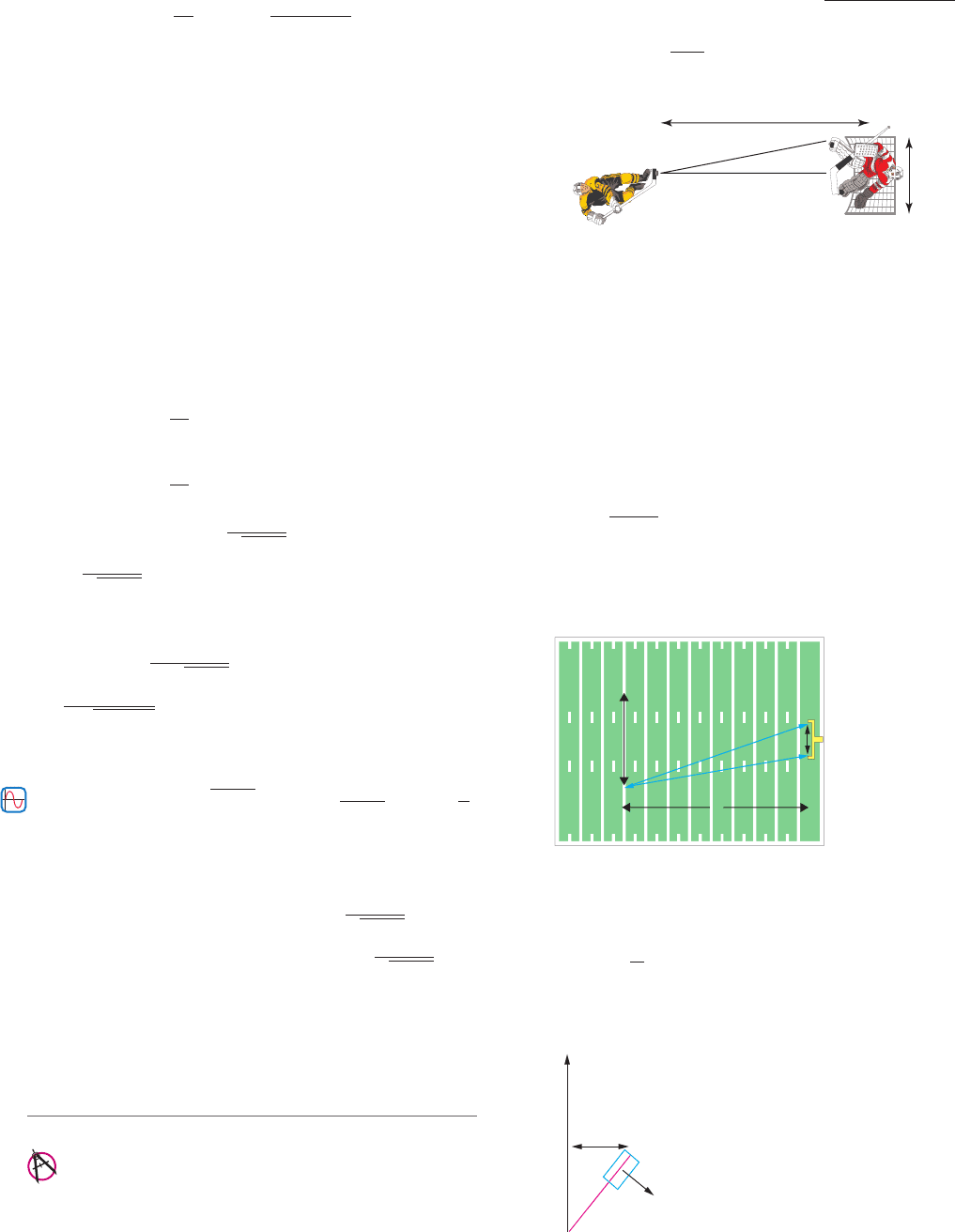
Solution First, look at the triangle shown in Figure 6.29. We denote the distance from
the ball to home plate by d and the angle of gaze by θ. Since the distance is changing
with time, we write d = d(t). The velocity of 130 ft/s means that d
(t) =−130. [Why
would d
(t) be negative?] From Figure 6.29, notice that
θ(t) = tan
−1
d(t)
2
.

P1: PIC/OVY P2: OSO/OVY QC: OSO/OVY T1: OSO
MHDQ256-Ch06 MHDQ256-Smith-v1.cls December 15, 2010 19:5
LT (Late Transcendental)
CONFIRMING PAGES
6-33 SECTION 6.5
..
The Calculus of the Inverse Trigonometric Functions 407
d
u
2
Overhead view
FIGURE 6.29
A ballplayer’s gaze
The rate of change of the angle is then
θ
(t) =
1
1 +
d(t)
2
2
d
(t)
2
=
2d
(t)
4 + [d(t)]
2
radians/second.
When d(t) = 0 (i.e., when the ball is crossing home plate), the rate of change is then
θ
(t) =
2(−130)
4
=−65 radians/second.
One problem with this is that most humans can accurately track objects only at the rate
of about 3 radians/second. Keeping your eye on the ball in this case is thus physically
impossible. How do those ballplayers do it? Research indicates that ballplayers must
anticipate where the ball is going, instead of continuing to track the ball visually. (See
Watts and Bahill, Keep Your Eye on the Ball.)
Integrals Involving the Inverse Trigonometric Functions
You may have already guessed the next step. Each of our newdifferentiationformulas gives
rise to a new integration formula. First, since
d
dx
sin
−1
x =
1
√
1 − x
2
,
we also have that
1
√
1 − x
2
dx = sin
−1
x +c. (5.1)
Likewise, since
d
dx
cos
−1
x =
−1
√
1 − x
2
,
we also have that
1
√
1 − x
2
dx =−cos
−1
x +c. (5.2)
However, since the integral in (5.2) is the same integral as in (5.1), we will ignore (5.2).

P1: PIC/OVY P2: OSO/OVY QC: OSO/OVY T1: OSO
MHDQ256-Ch06 MHDQ256-Smith-v1.cls December 15, 2010 19:5
LT (Late Transcendental)
CONFIRMING PAGES
408 CHAPTER 6
..
Exponentials, Logarithms and Other Transcendental Functions 6-34
In the same way, we obtain
1
1 + x
2
dx = tan
−1
x +c
and
1
|x|
√
x
2
− 1
dx = sec
−1
x +c.
EXAMPLE 5.3 An Integral Related to tan
−1
x
Evaluate
1
9 + x
2
dx.
Solution Notice that the integrand is nearly the derivative of tan
−1
x. However, the
constant in the denominator is 9, instead of the 1 we need. With this in mind, we rewrite
the integral as
1
9 + x
2
dx =
1
9
1
1 +
x
3
2
dx.
If we let u =
x
3
, then du =
1
3
dx and hence,
1
9 + x
2
dx =
1
9
1
1 +
x
3
2
dx
=
1
3
1
1 +
x
3
2
1+u
2
1
3
dx
du
=
1
3
1
1 + u
2
du
=
1
3
tan
−1
u + c
=
1
3
tan
−1
x
3
+ c.
We leave it as an exercise to prove the more general formula:
1
a
2
+ x
2
dx =
1
a
tan
−1
x
a
+ c.
EXAMPLE 5.4 An Integral Requiring a Simple Substitution
Evaluate
e
x
1 + e
2x
dx.
Solution Think about how you might approach this. You probably won’t recognize an
antiderivative immediately. Remember that it often helps to look for terms that are
derivatives of other terms. You should also recognize that e
2x
= (e
x
)
2
. With this in
mind, we let u = e
x
, so that du = e
x
dx. We then have
e
x
1 + e
2x
dx =
1
1 + (e
x
)
2
1+u
2
e
x
dx
du
=
1
1 + u
2
du
= tan
−1
u + c
= tan
−1
(e
x
) + c.

P1: PIC/OVY P2: OSO/OVY QC: OSO/OVY T1: OSO
MHDQ256-Ch06 MHDQ256-Smith-v1.cls December 15, 2010 19:5
LT (Late Transcendental)
CONFIRMING PAGES
6-35 SECTION 6.5
..
The Calculus of the Inverse Trigonometric Functions 409
EXAMPLE 5.5 Another Integral Requiring a Simple Substitution
Evaluate
x
√
1 − x
4
dx.
Solution Look carefully at the integrand and recognize that you don’t know an anti-
derivative. However, you might observe that
x
√
1 − x
4
dx =
x
1 − (x
2
)
2
dx.
Once you’ve recognized this one small step, you can complete the problem with a
simple substitution. Letting u = x
2
,wehavedu = 2xdxand
x
√
1 − x
4
dx =
1
2
2x
1 − (x
2
)
2
dx
=
1
2
1
√
1 − u
2
du
=
1
2
sin
−1
u + c
=
1
2
sin
−1
(x
2
) + c.
You will explore integrals involving the inverse trigonometric functions further in the
exercises. Whenever dealing with these functions, it is easiest if you keep the basic defini-
tions in mind (including the domains and ranges). You will only need to knowthe derivative
formulas for sin
−1
x, tan
−1
x and sec
−1
x. With these basic formulas, you can quickly de-
velop anything else that you need, using elementary techniques (such as substitution).
EXERCISES 6.5
WRITING EXERCISES
1. Explain why, as is indicated in the text, antiderivatives cor-
responding to three of the six inverse trigonometric functions
“can be ignored.”
2. From equations (5.1) and (5.2), explain why it follows that
sin
−1
x =−cos
−1
x + c. From the graphs of y = sin x and
y = cos x, explain why this is plausible and identify the con-
stant c for 0 < x <π/2.
In exercises 1–10, find the derivative of the function.
1. sin
−1
(3x
2
) 2. cos
−1
(x
3
+ 1)
3. sec
−1
(x
2
) 4. csc
−1
(
√
x)
5. x cos
−1
(2x) 6. sin x sin
−1
(2x)
7. cos
−1
(sin x) 8. tan
−1
(cos x)
9. tan
−1
(sec x) 10. sec
−1
(tan x)
............................................................
In exercises 11–26, evaluate the given integral.
11.
6
1 + x
2
dx 12.
2
9 + x
2
dx
13.
2x
1 + x
4
dx 14.
3x
3
1 + x
4
dx
15.
4x
√
1 − x
4
dx 16.
2x
2
√
1 − x
6
dx
17.
2x
x
2
√
x
4
− 1
dx 18.
3
|x|
√
x
6
− 1
dx
19.
2
4 + x
2
dx 20.
2x
4 + x
2
dx
21.
e
x
√
1 − e
2x
dx 22.
cos x
4 + sin
2
x
dx
23.
2
0
6
4 + x
2
dx 24.
√
3
1
1
2 + 2x
2
dx
25.
1/4
0
3
√
1 − 4x
2
dx 26.
1
0
2
√
4 − x
2
dx
............................................................
27. Derive the formula
d
dx
cos
−1
x =
−1
√
1 − x
2
.
28. Derive the formula
d
dx
sec
−1
x =
1
|x|
√
x
2
− 1
.
29. Derive the formula
1
a
2
+ x
2
dx =
1
a
tan
−1
x
a
+ c for
any positive constant a.
P1: PIC/OVY P2: OSO/OVY QC: OSO/OVY T1: OSO
MHDQ256-Ch06 MHDQ256-Smith-v1.cls December 15, 2010 19:5
LT (Late Transcendental)
CONFIRMING PAGES
410 CHAPTER 6
..
Exponentials, Logarithms and Other Transcendental Functions 6-36
30. In this exercise, we give a different derivation from the text
for the derivative of sin
−1
x. Use Theorem 2.3 of section 6.2
to show that
d
dx
sin
−1
x =
1
cos(sin
−1
x)
. Then, evaluate
cos(sin
−1
x).
31. In example 5.2, it was shown that by the time the baseball
reached home plate, the rate of rotation of the player’s gaze
(θ
) was too fast for humans to track. Given a maximum ro-
tational rate of θ
=−3 radians per second, find d such that
θ
=−3. That is, find how close to the plate a player can track
the ball. In a major league setting, the player must start swing-
ing by the time the pitch is halfway (30
) to home plate. How
does this correspond to the distance at which the player loses
track of the ball?
32. Suppose the pitching speed x
in example 5.2 is different. Then
θ
will be different and the value of x for which θ
=−3 will
change. Find x as a function of x
for x
ranging from 30 ft/s
(slowpitch softball) to 140 ft/s (major league fastball) and
sketch the graph.
33. Use Theorem 2.3 of section 6.2 with f (x) = cos x to derive
the formula for
d
dx
cos
−1
x.
34. Use Theorem 2.3 of section 6.2 with f (x) = tan x to derive
the formula for
d
dx
tan
−1
x.
35. Show that
−1
√
1 − x
2
dx = cos
−1
x + c and
−1
√
1 − x
2
dx =−sin
−1
x + c. Explain why this does not
imply that cos
−1
x =−sin
−1
x. Find an equation relating
cos
−1
x and sin
−1
x.
36. Evaluate
1
|x|
√
x
2
− 1
dx by rewriting the integrand as
1
x
2
1 − 1/x
2
and then making the substitution u = 1/x. Use
your answer to derive an identity involving sin
−1
(1/x) and
sec
−1
x.
37. Show that both
1
0
1 − x
2
dx and
1
0
1
1 + x
2
dx equal
π
4
.
UseSimpson’sRuleon each integralwithn = 4 andn = 8 and
compare to the exact value. Which integral provides a better
algorithm for estimating π?
38. Find and simplifythe derivative of sin
−1
x
√
x
2
+ 1
. Use the
result to write out an equation relating sin
−1
x
√
x
2
+ 1
and
tan
−1
x.
39. Use the Mean Value Theorem to show that |tan
−1
a| < |a| for
all a = 0 and use this inequality to find all solutions of the
equation tan
−1
x = x.
40. Prove that |x| < |sin
−1
x| for 0 < |x| < 1.
APPLICATIONS
41. Inthediagram,ahockeyplayerisD feetfromthenetonthecen-
tral axis of the rink. The goalie blocks off a segment of width
w and stands d feet from the net. The shooting angle to the
left of the goalie is given by φ = tan
−1
3(1 − d/D) − w/2
D − d
.
Use a linear approximation of tan
−1
x at x = 0 to show that if
d = 0, then φ ≈
3−w/2
D
. Based on this, describe howφ changes
if there is an increase in (a) w or (b) D.
D
w
φ
Exercise 41
42. The shooter in exercise 41 is assumed to be in the center of the
ice. Suppose that the line from the shooter to the center of the
goal makes an angle of θ with the center line. For the goalie to
completely block the goal, he must stand d feet away from the
net where d = D(1 −w/6cosθ). Show that for small angles,
d ≈ D(1 −w/6).
43. For a college football field with the dimensions shown,
the angle θ for kicking a field goal from a (horizon-
tal) distance of x feet from the goal post is given by
θ(x) = tan
−1
(29.25/x) − tan
−1
(10.75/x). Show that
f (t) =
t
a
2
+ t
2
is increasing for a > t and use this fact to
show that θ(x) is a decreasing function for x ≥ 30. Announc-
ers often say that for a short field goal (50 ≤ x ≤ 60), a team
can improve the angle by backing up 5 yards with a penalty.
Is this true?
x
18.5
'
40'
44. To start skating, you must angle your foot and push off the ice.
Alain Hach´e’s The Physics of Hockey derives the relationship
between the skate angle θ, the sideways stride distance s, the
stroke period T and the forward speed v of the skater, with
θ = tan
−1
(
2s
vT
). For T = 1 second, s = 60 cm and an acceler-
ation of 1 m/s
2
, find the rate of change of the angle θ when the
skater reaches (a) 1 m/s and (b) 2 m/s. Interpret the sign and
size of θ
in terms of skating technique.
u
s
v
push

P1: PIC/OVY P2: OSO/OVY QC: OSO/OVY T1: OSO
MHDQ256-Ch06 MHDQ256-Smith-v1.cls December 15, 2010 19:5
LT (Late Transcendental)
CONFIRMING PAGES
6-37 SECTION 6.6
..
The Hyperbolic Functions 411
45. Suppose a painting hangs on a wall. The frame extends from
6 feet to 8 feet above the floor. A person whose eye is 5 feet
above the floor stands x feet from the wall and views the paint-
ing,withaviewingangle A formedby the ray fromtheperson’s
eye to the top of the frame and the ray from the person’s eye
to the bottom of the frame. Find the value of x that maximizes
the viewing angle A.
46. What changes in exercise 45 if the person’s eye is 6 feet above
the floor?
EXPLORATORY EXERCISES
1. The idea of a homeomorphism helps to identify when super-
ficially different sets are essentially the same. For example,
the intervals (0, 1), (0,π) and (−π/2,π/2) are all finite open
intervals. They are homeomorphic. By definition, intervals I
1
and I
2
are homeomorphic if there is a function f from I
1
onto
I
2
that has an inverse with f and f
−1
both being continuous.
A homeomorphism from (0, 1) to (0,π)is f (x) = π x. Show
that this is a homeomorphism byfinding its inverse and verify-
ing that both are continuous. Find a homeomorphism from
(0,π)to(−π/2,π/2). [Hint: Sketch a picture, and decide
how you could move the interval (0,π) to produce the inter-
val (−π/2,π/2).] Find a homeomorphism for any two finite
open intervals (a, b) and (c, d). It remains to decide whether
the interval (−∞, ∞) is different because it is infinite or the
same because it is open. In fact, (−∞, ∞) is homeomorphic to
(−π/2,π/2) and hence to all other open intervals. Show that
tan
−1
x is a homeomorphism from (−∞, ∞)to(−π/2,π/2).
2. Explore the graphs of e
−x
, xe
−x
, x
2
e
−x
and x
3
e
−x
. Find all lo-
calextremaandgraphicallydeterminethebehavioras x →∞.
You can think of the graph of x
n
e
−x
as showing the results of
a tug-of-war: x
n
→∞as x →∞but e
−x
→ 0asx →∞.
Describe the graph of x
n
e
−x
in terms of this tug-of-war.
3. Suppose that a hockey player is shooting at a 6-foot-wide net
from a distance of d feet away from the goal line and 4 feet to
the side of the center line. (a) Find the distance d that maxi-
mizes the shooting angle. (b) Repeat part (a) with the shooter
2 feet to the side of the center line. Explain why the answer is
so different. (c) Repeat part (a) with the goalie blocking all but
the far 2 feet of the goal.
6.6 THE HYPERBOLIC FUNCTIONS
The Gateway Arch in Saint Louis, Missouri, is one of the most distinctive and recognizable
architectural structures in the United States. Most people think that it is taller than it is
wide, but this is the result of a common optical illusion. In fact, the arch has the same width
as height. A slightly less mysterious misconception is that the arch’s shape is not that of
a parabola. Rather, its shape corresponds to the graph of the hyperbolic cosine function
(called a catenary). This function and the other five hyperbolic functions are introduced in
this section.
Saint Louis Gateway Arch
The hyperbolic functions are not entirely new, as they are simply common combina-
tions of exponentials. We study them because of their usefulness in applications and their
convenience in solving equations (in particular, differential equations).
The hyperbolic sine function is defined by
sinh x =
e
x
− e
−x
2
,
for all x ∈ (−∞, ∞). The hyperbolic cosine function is defined by
cosh x =
e
x
+ e
−x
2
,
again for all x ∈ (−∞, ∞). We leave it as an exercise to use the definitions to verify the
important identity
cosh
2
x −sinh
2
x = 1, (6.1)
for all x. Notice that if we take x = coshu and y = sinhu, then from (6.1) with x replaced
by u,
x
2
− y
2
= cosh
2
u − sinh
2
u = 1,

P1: PIC/OVY P2: OSO/OVY QC: OSO/OVY T1: OSO
MHDQ256-Ch06 MHDQ256-Smith-v1.cls December 15, 2010 19:5
LT (Late Transcendental)
CONFIRMING PAGES
412 CHAPTER 6
..
Exponentials, Logarithms and Other Transcendental Functions 6-38
which you should recognize as the equation of a hyperbola. This identity is the source of
the name “hyperbolic” for these functions. You should also notice some parallel with the
trigonometric functions cos x and sin x.
The remaining four hyperbolic functions are defined in terms of the hyperbolic sine and
hyperboliccosine functions, inamanner analogous totheirtrigonometriccounterparts. That
is, we define the hyperbolic tangent function tanh x, the hyperbolic cotangent function
coth x, the hyperbolic secant function sech x and the hyperbolic cosecant function csch x
as follows:
tanh x =
sinh x
cosh x
, coth x =
cosh x
sinh x
sech x =
1
cosh x
, csch x =
1
sinh x
.
These functions are remarkably easy to deal with, and we can readily determine their
behavior, using what we already know about exponentials. First, note that
d
dx
sinh x =
d
dx
e
x
− e
−x
2
=
e
x
+ e
−x
2
= cosh x.
Similarly, we can establish the remaining derivative formulas:
d
dx
cosh x = sinh x,
d
dx
tanh x = sech
2
x
d
dx
coth x =−csch
2
x,
d
dx
sech x =−sech x tanh x
and
d
dx
csch x =−csch x coth x.
These are all elementary applications of earlier derivative rules and are left as exercises. As
it turns out, only the first three of these are of much significance.
EXAMPLE 6.1 Computing the Derivative of a Hyperbolic Function
Compute the derivative of f (x) = sinh
2
(3x).
Solution From the chain rule, we have
f
(x) =
d
dx
sinh
2
(3x) =
d
dx
[sinh(3x)]
2
= 2 sinh(3x)
d
dx
[sinh(3x)]
= 2 sinh(3x) cosh(3x)
d
dx
(3x)
= 2 sinh(3x) cosh(3x)(3)
= 6 sinh(3x) cosh(3x).
Of course, every new differentiation rule gives us a corresponding integration rule. In
particular, we now have
cosh xdx = sinh x + c,
sinh xdx = cosh x + c
and
sech
2
xdx= tanhx + c.