
Smith R., Minton R. Calculus
Подождите немного. Документ загружается.

P1: OSO/OVY P2: OSO/OVY QC: OSO/OVY T1: OSO
MHDQ256-Ch10 MHDQ256-Smith-v1.cls December 21, 2010 21:17
LT (Late Transcendental)
CONFIRMING PAGES
10-39 SECTION 10.5
..
Calculus and Polar Coordinates 663
y
x
u b
u a
r f(u)
y
x
u b
u a
u u
i
u u
i1
r f(u)
A
i
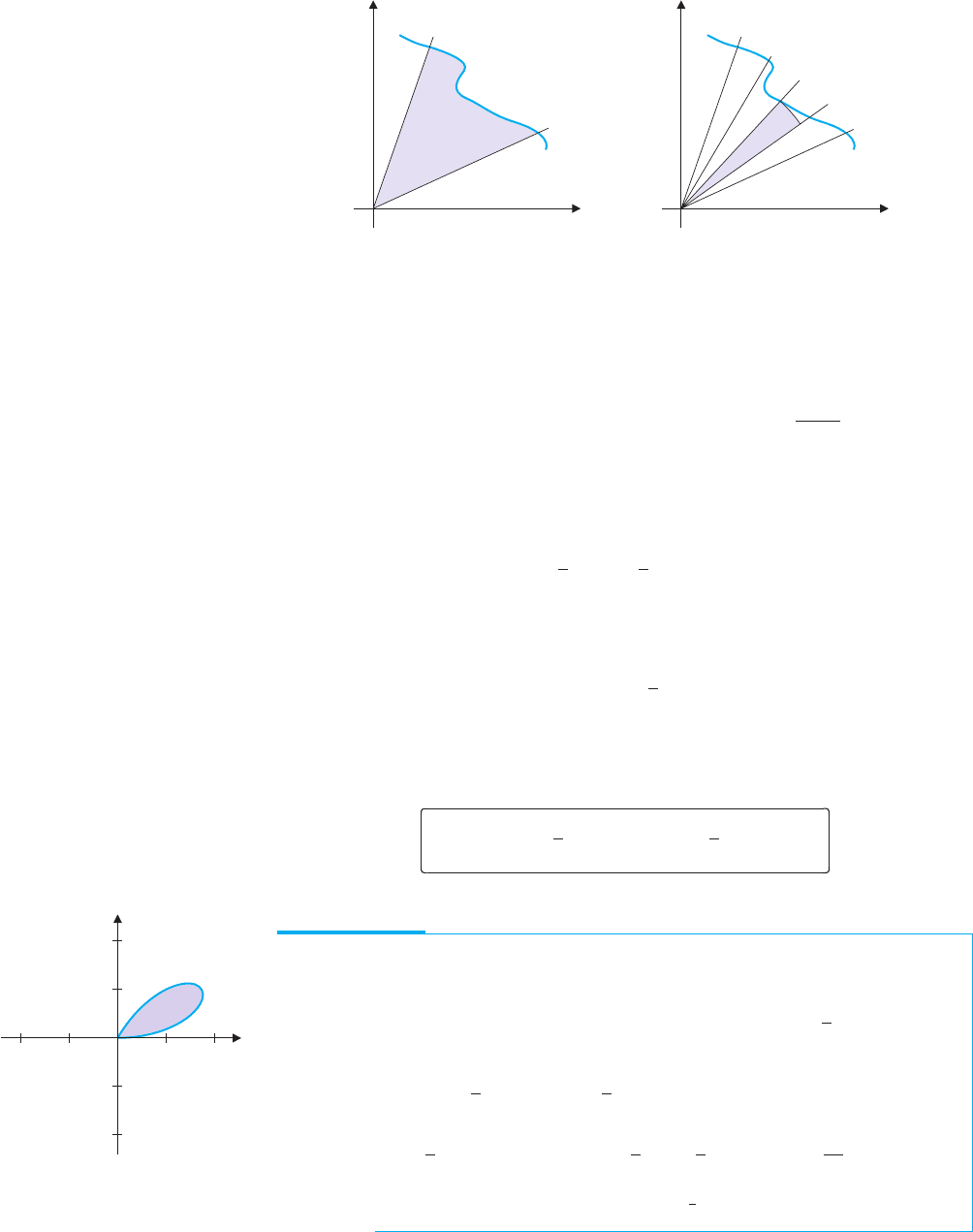
FIGURE 10.43a
Area of a polar region
FIGURE 10.43b
Approximating the area of
a polar region
θ-interval into n equal pieces:
a = θ
0
<θ
1
<θ
2
< ···<θ
n
= b.
The width of each of these subintervals is then θ = θ
i
− θ
i−1
=
b −a
n
. (Does this look
familiar?) On each subinterval [θ
i−1
,θ
i
](i = 1, 2,...,n), we approximate the curve with
the circular arc r = f (θ
i
). (See Figure 10.43b.) The area A
i
enclosed by the curve on this
subinterval is then approximately the same as the area of the circular sector of radius f (θ
i
)
and central angle θ:
A
i
≈
1
2
r
2
θ =
1
2
[ f (θ
i
)]
2
θ.
The total area A enclosed by the curve is then approximately the same as the sum of the
areas of all such circular sectors:
A ≈
n
i=1
A
i
=
n
i=1
1
2
[ f (θ
i
)]
2
θ.
As we have done numerous times now, we can improve the approximation by making n
larger. Taking the limit as n →∞gives us a definite integral:
A = lim
n→∞
n
i=1
1
2
[ f (θ
i
)]
2
θ =
b
a
1
2
[ f (θ)]
2
dθ. (5.5)
Area in polar coordinates
y
x
10.51 0.5
1
1
0.5
0.5
FIGURE 10.44
One leaf of r = sin3θ
EXAMPLE 5.3 The Area of One Leaf of a Three-Leaf Rose
Find the area of one leaf of the rose r = sin3θ .
Solution Notice that one leaf of the rose is traced out with 0 ≤ θ ≤
π
3
. (See
Figure 10.44.) From (5.5), the area is given by
A =
π/3
0
1
2
(sin3θ )
2
dθ =
1
2
π/3
0
sin
2
3θ dθ
=
1
4
π/3
0
(1 − cos6θ)dθ =
1
4
θ −
1
6
sin6θ
π/3
0
=
π
12
,
where we have used the half-angle formula sin
2
α =
1
2
(1 − cos2α) to simplify the
integrand.
Often, the most challenging part of finding the area of a polar region is determining the
limits of integration.
P1: OSO/OVY P2: OSO/OVY QC: OSO/OVY T1: OSO
MHDQ256-Ch10 MHDQ256-Smith-v1.cls December 21, 2010 21:17
LT (Late Transcendental)
CONFIRMING PAGES
664 CHAPTER 10
..
Parametric Equations and Polar Coordinates 10-40
y
x
321123
4
3
2
1
5
1
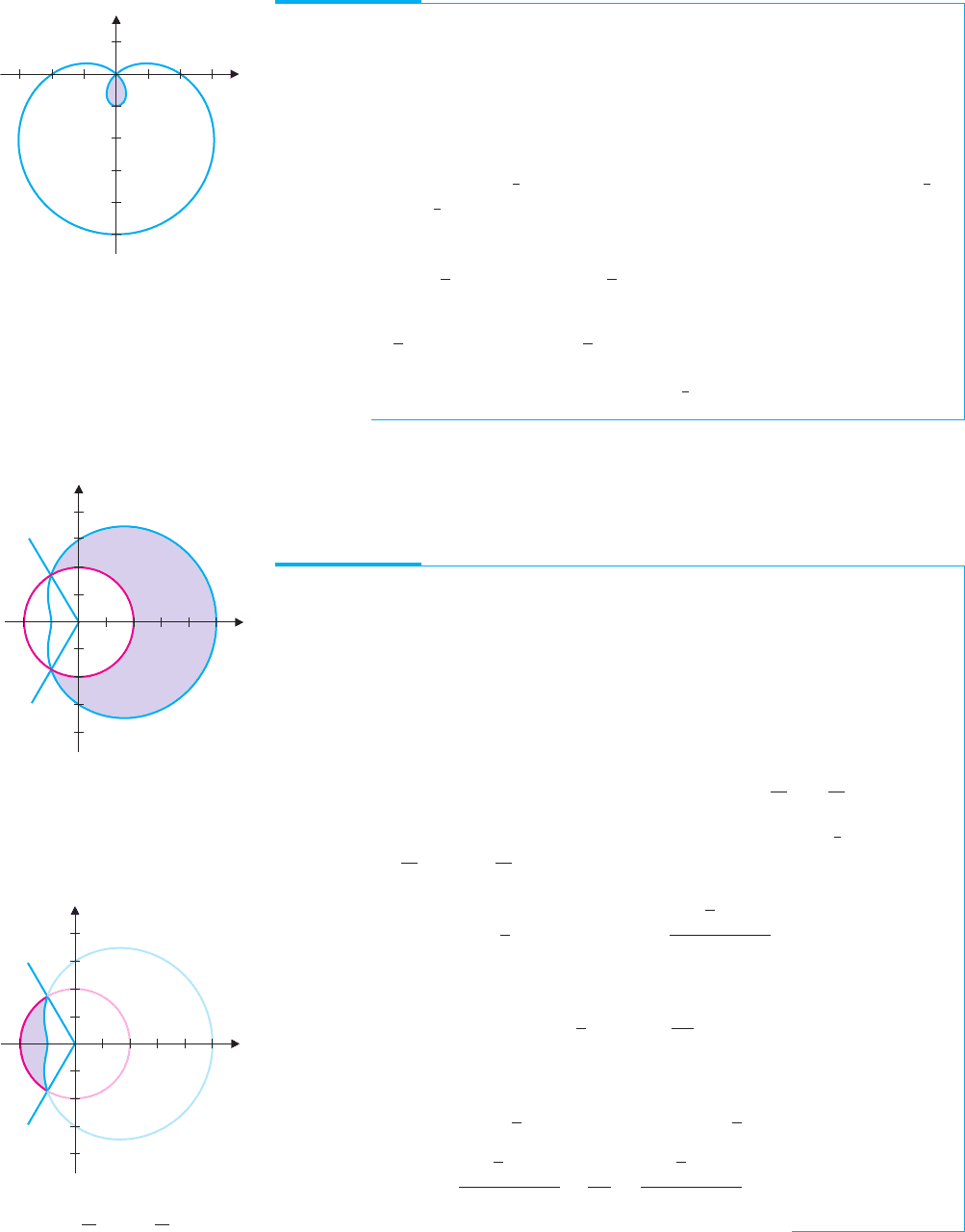
FIGURE 10.45
r = 2 − 3 sinθ
EXAMPLE 5.4 The Area of the Inner Loop of a Limac¸on
Find the area of the inner loop of the lima¸con r = 2 −3sinθ.
Solution A sketch of the lima¸con is shown in Figure 10.45. Starting at θ = 0, the
curve starts at the point (2, 0), passes through the origin, traces out the inner loop,
passes back through the origin and finally traces out the outer loop. Thus, the inner loop
is formed by θ-values between the first and second occurrences of r = 0 with θ>0.
Solving r = 0, we get sinθ =
2
3
. The two smallest positive solutions are θ = sin
−1
2
3
and θ = π −sin
−1
2
3
. Numerically, these are approximately equal to θ = 0.73 and
θ = 2.41. From (5.5), the area is approximately
A ≈
2.41
0.73
1
2
(2 − 3sinθ)
2
dθ =
1
2
2.41
0.73
(4 − 12sinθ + 9 sin
2
θ)dθ
=
1
2
2.41
0.73
!
4 − 12sinθ +
9
2
(1 − cos2θ)
"
dθ ≈ 0.44,
where we have used the half-angle formula sin
2
θ =
1
2
(1 − cos2θ) to simplify the
integrand.
x
1 3 4
4
3
1
1
4
3
y
u i
u
i
FIGURE 10.46a
r = 3 + 2 cosθ and r = 2
u i
u o
x
1 32 45
4
3
1
2
1
2
4
3
y
FIGURE 10.46b
2π
3
≤ θ ≤
4π
3
When finding the area lying between two polar graphs, we use the familiar device
of subtracting one area from another. Although the calculations in example 5.5 aren’t too
messy, finding the points of intersection of two polar curves often provides the greatest
challenge.
EXAMPLE 5.5 Finding the Area Between Two Polar Graphs
Find the area inside the lima¸con r = 3 +2cosθ and outside the circle r = 2.
Solution We show a sketch of the two curves in Figure 10.46a. Notice that the limits
of integration correspond to the values of θ where the two curves intersect. So, we must
first solve the equation 3 + 2cosθ = 2. Notice that since cosθ is periodic, there are
infinitely many solutions of this equation. Consequently, it is essential to consult the
graph to determine which solutions you need. In this case, we want the least negative
and the smallest positive solutions. (Look carefully at Figure 10.46b, where we have
shaded the area between the graphs corresponding to θ between
2π
3
and
4π
3
, the first two
positive solutions. This portion of the graphs corresponds to the area outside the
lima¸con and inside the circle!) With 3 +2cos θ = 2, we have cosθ =−
1
2
, which
occurs at θ =−
2π
3
and θ =
2π
3
. From (5.5), the area enclosed by the portion of the
lima¸con on this interval is given by
2π/3
−2π/3
1
2
(3 + 2cosθ)
2
dθ =
33
√
3 + 44π
6
.
Similarly, the area enclosed by the circle on this interval is given by
2π/3
−2π/3
1
2
(2)
2
dθ =
8π
3
.
The area inside the lima¸con and outside the circle is then given by
A =
2π/3
−2π/3
1
2
(3 + 2cosθ)
2
dθ −
2π/3
−2π/3
1
2
(2)
2
dθ
=
33
√
3 + 44π
6
−
8π
3
=
33
√
3 + 28π
6
≈ 24.2.
Here, we have left the (routine) details of the integrations to you.
In cases where r takes on both positive and negative values, finding the intersection
points of two curves is more complicated.
P1: OSO/OVY P2: OSO/OVY QC: OSO/OVY T1: OSO
MHDQ256-Ch10 MHDQ256-Smith-v1.cls December 21, 2010 21:17
LT (Late Transcendental)
CONFIRMING PAGES
10-41 SECTION 10.5
..
Calculus and Polar Coordinates 665
y
x
123 1
2
1
1
2
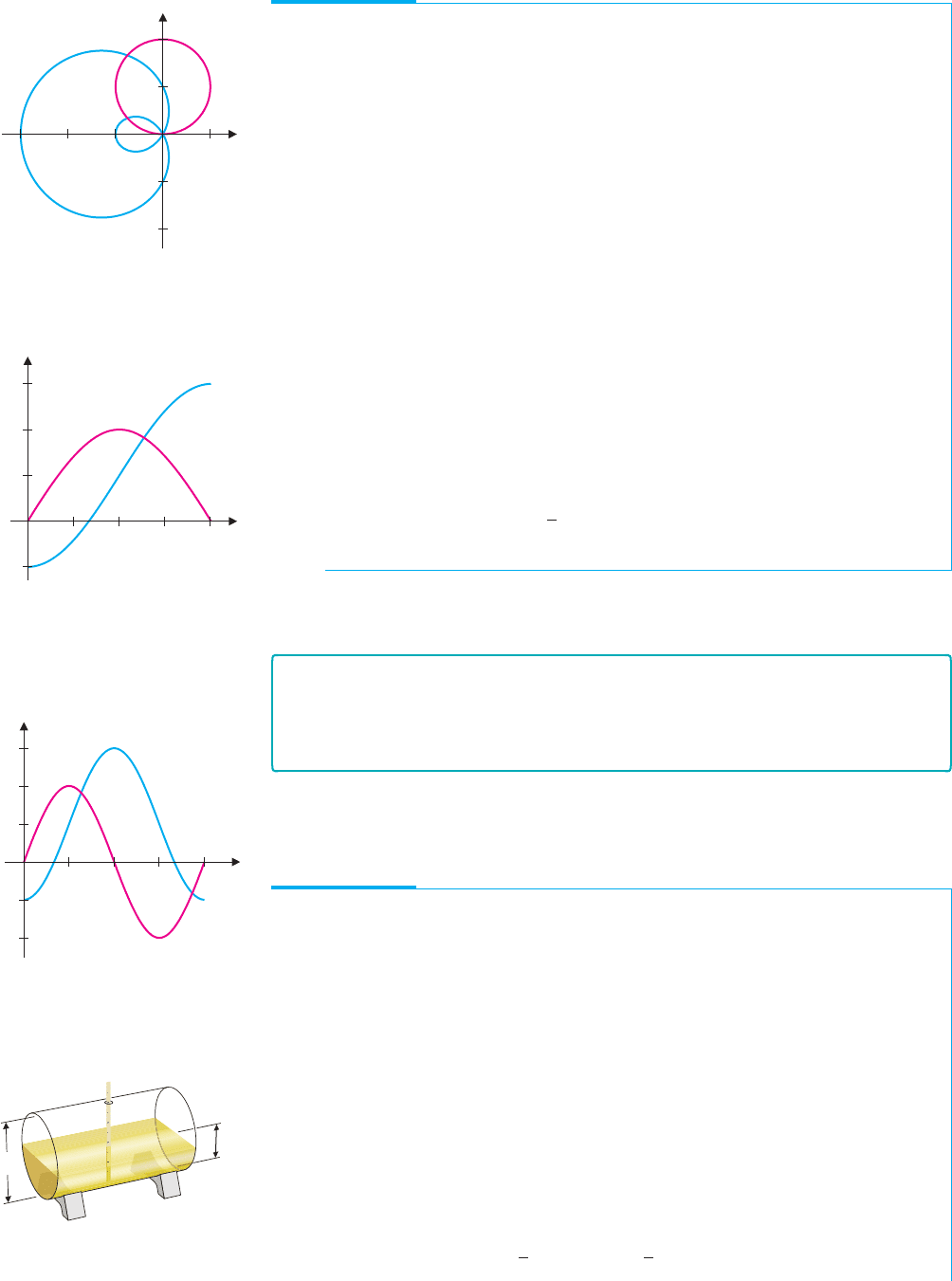
FIGURE 10.47a
r = 1 − 2 cosθ and r = 2 sinθ
y
x
1
2
3
d
fq p
1
FIGURE 10.47b
Rectangular plot:
y = 1 −2 cos x, y = 2sin x,
0 ≤ x ≤ π
y
x
2p
p
1
2
1
2
3
q
w
FIGURE 10.47c
Rectangular plot: y = 1 −2 cos x,
y = 2 sin x, 0 ≤ x ≤ 2π
EXAMPLE 5.6 Finding Intersections of Polar Curves Where r
Can Be Negative
Find all intersections of the lima¸con r = 1 −2cosθ and the circle r = 2sinθ.
Solution We show a sketch of the two curves in Figure 10.47a. Notice from the
sketch that there are three intersections of the two curves. Since r = 2sinθ is
completely traced with 0 ≤ θ ≤ π , you might reasonably expect to find three solutions
of the equation 1 − 2cosθ = 2sin θ on the interval 0 ≤ θ ≤ π.However,ifwedrawa
rectangular plot of the two curves y = 1 −2cos x and y = 2sin x, on the interval
0 ≤ x ≤ π (see Figure 10.47b), we can clearly see that there is only one solution in
this range, at approximately θ ≈ 1.99. (Use Newton’s method or your calculator’s
solver to obtain an accurate approximation.) The corresponding rectangular point is
(r cosθ,r sinθ) ≈ (−0.74, 1.67). Looking at Figure 10.47a, observe that there is
another intersection located below this point. From a rectangular plot of the two curves
corresponding to an expanded range of values of θ, (see Figure 10.47c). Notice that
there is a second solution of the equation 1 − 2cosθ = 2sin θ, near θ = 5.86, which
corresponds to the point (−0.74, 0.34). Note that this point is on the inner loop of
r = 1 − 2cosθ and corresponds to a negative value of r. Finally, there appears to be a
third intersection at or near the origin. Notice that this does not arise from any solution of
the equation 1 − 2cosθ = 2sin θ. This is because, while both curves pass through the
origin (You should verify this!), they each do so for different values of θ. (Keep in mind
that the origin corresponds to the point (0,θ), in polar coordinates, for any angle θ.)
Notice that 1 − 2cosθ = 0 for θ =
π
3
and 2sin θ = 0 for θ = 0. So, although the
curves intersect at the origin, they each pass through the origin for different values
of θ.
REMARK 5.1
To find points of intersection of two polar curves r = f (θ) and r = g(θ ), you must
keep in mind that points have more than one representation in polar coordinates. In
particular, this says that points of intersection need not correspond to solutions of
f (θ) = g(θ ).
In example 5.7, we see an application that is far simpler to set up in polar coordinates
than in rectangular coordinates.
EXAMPLE 5.7 Finding the Volume of a Partially Filled Cylinder
A cylindrical oil tank with a radius of 2 feet is lying on its side. A measuring stick shows
that the oil is 1.8 feet deep. (See Figure 10.48a.) What percentage of a full tank is left?
4
1.8
FIGURE 10.48a
A cylindrical oil tank
Solution Notice that since we wish to find the percentage of oil remaining in the tank,
the length of the tank has no bearing on this problem. (Think about this some.) We need
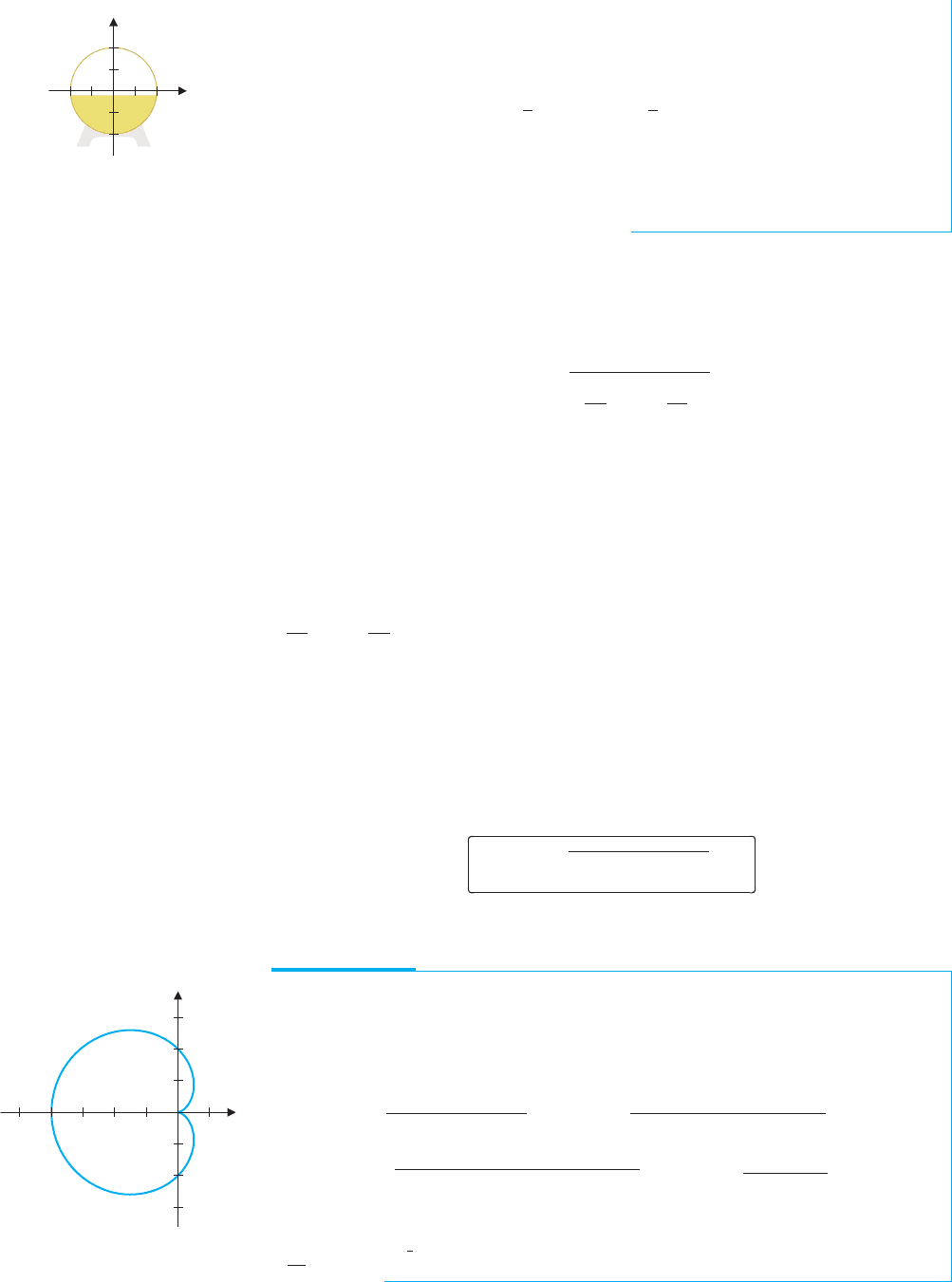
only consider a cross section of the tank, which we represent as a circle of radius 2
centered at the origin. The proportion of oil remaining is given by the area of that
portion of the circle lying beneath the line y =−0.2, divided by the total area of the
circle. The area of the circle is 4π, so we need only find the area of the shaded region in
Figure 10.48b (on the following page). Computing this area in rectangular coordinates
is a mess (try it!), but it is straightforward in polar coordinates. First, notice that the line
y =−0.2 corresponds to r sinθ =−0.2orr =−0.2 csc θ . The area beneath the line
and inside the circle is then given by (5.5) as
Area =
θ
2
θ
1
1
2
(2)
2
dθ −
θ
2
θ
1
1
2
(−0.2csc θ)
2
dθ,
P1: OSO/OVY P2: OSO/OVY QC: OSO/OVY T1: OSO
MHDQ256-Ch10 MHDQ256-Smith-v1.cls December 21, 2010 21:17
LT (Late Transcendental)
CONFIRMING PAGES
666 CHAPTER 10
..
Parametric Equations and Polar Coordinates 10-42
where θ
1
and θ
2
are the appropriate intersections of r = 2 and r =−0.2 csc θ . Using
Newton’s method, the first two positive solutions of 2 =−0.2 csc θ are θ
1
≈ 3.242 and
θ
2
≈ 6.183. The area is then
Area =
θ
2
θ
1
1
2
(2)
2
dθ −
θ
2
θ
1
1
2
(−0.2csc θ)
2
dθ
= (2θ + 0.02cotθ )
θ
2
θ
1
≈ 5.485.
The fraction of oil remaining in the tank is then approximately 5.485/4π ≈ 0.43648 or
about 43.6% of the total capacity of the tank.
y
x
22
2
2
FIGURE 10.48b
Cross section of tank
We close this section with a brief discussion of arc length for polar curves. Recall
that from (3.1), the arc length of a curve defined parametrically by x = x(t), y = y(t), for
a ≤ t ≤ b,isgivenby
s =
b
a
dx
dt
2
+
dy
dt
2
dt. (5.6)
Once again thinking of a polar curve as a parametric representation (where the parameter
is θ), we have that for the polar curve r = f (θ),
x = r cosθ = f (θ)cosθ and y = r sinθ = f (θ) sinθ.
This gives us
dx
dθ
2
+
dy
dθ
2
= [ f
(θ)cosθ − f (θ)sinθ]
2
+ [ f
(θ)sinθ + f (θ)cosθ]
2
= [ f
(θ)]
2
(cos
2
θ +sin
2
θ) + f
(θ) f (θ)(−2cosθ sin θ + 2 sin θ cosθ)
+ [ f (θ)]
2
(cos
2
θ +sin
2
θ)
= [ f
(θ)]
2
+ [ f (θ )]
2
.
From (5.6), the arc length is then
s =
b
a
[ f
(θ)]
2
+ [ f (θ )]
2
dθ. (5.7)
Arc length in polar coordinates
EXAMPLE 5.8 Arc Length of a Polar Curve
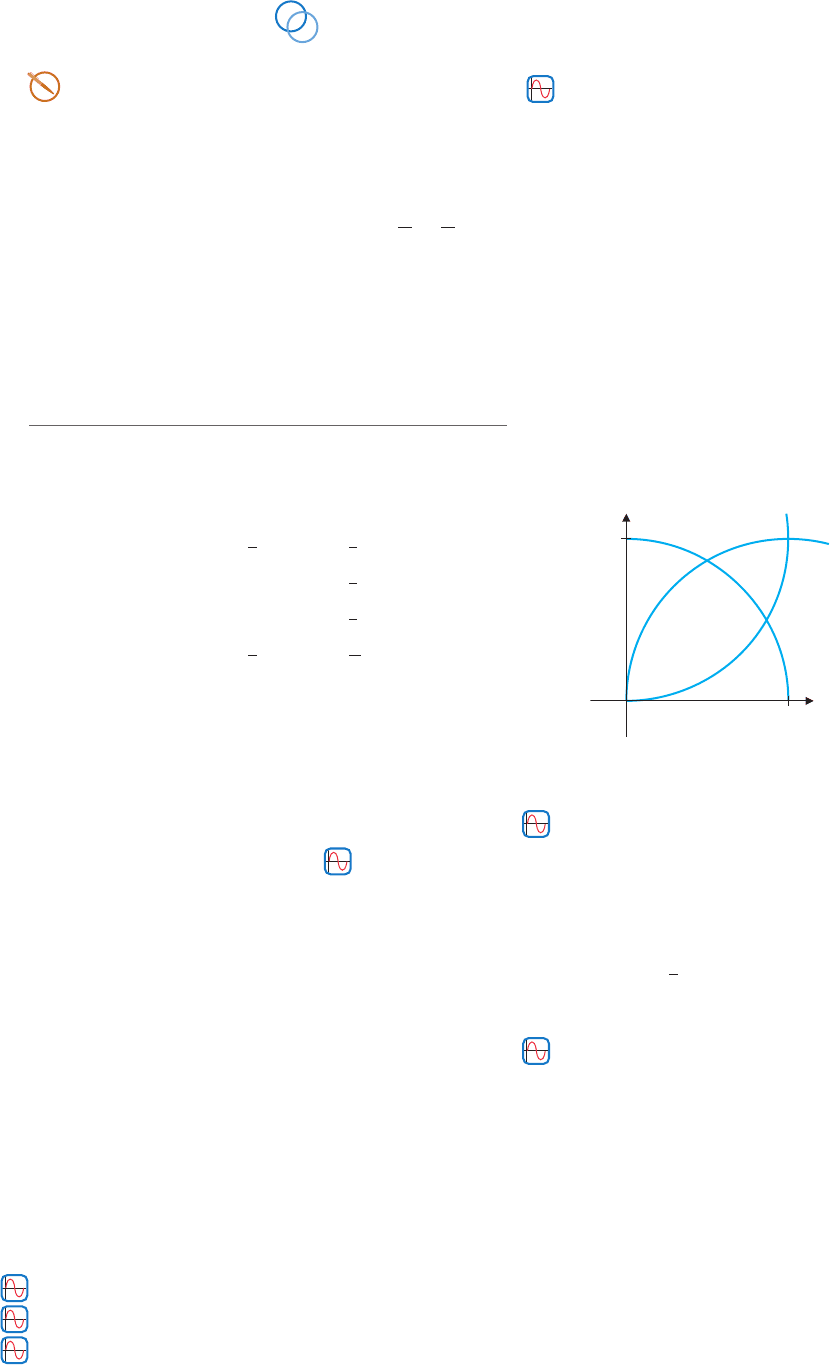
Find the arc length of the cardioid r = 2 −2cos θ.
Solution A sketch of the cardioid is shown in Figure 10.49. First, notice that the
curve is traced out with 0 ≤ θ ≤ 2π. From (5.7), the arc length is given by
s =
b
a
[ f
(θ)]
2
+ [ f (θ )]
2
dθ =
2π
0
(2sin θ)
2
+ (2 −2cosθ )
2
dθ
=
2π
0
4sin
2
θ +4 −8cos θ + 4 cos
2
θ dθ =
2π
0
√
8 − 8cosθ dθ = 16,
where we leave the details of the integration as an exercise. (Hint: Use the half-angle
formula sin
2
x =
1
2
(1 − cos2x) to simplify the integrand. Be careful: remember that
√
x
2
=|x|!)
y
x
112345
3
2
1
1
2
3
FIGURE 10.49
r = 2 − 2 cosθ
P1: OSO/OVY P2: OSO/OVY QC: OSO/OVY T1: OSO
MHDQ256-Ch10 MHDQ256-Smith-v1.cls December 21, 2010 21:17
LT (Late Transcendental)
CONFIRMING PAGES
10-43 SECTION 10.5
..
Calculus and Polar Coordinates 667
EXERCISES 10.5
WRITING EXERCISES
1. Explain why the tangentline is perpendicular to theradius line
at any point at which r is a local maximum. (See example 5.2.)
In particular, if the tangent and radius are not perpendicular at
(r,θ), explain why r is not a local maximum.
2. In example 5.5, explain why integrating from
2π
3
to
4π
3
would
give the area shown in Figure 10.46b and not the desired area.
3. Referring to example 5.6, explain why intersections can oc-
cur in each of the cases f (θ) = g(θ), f (θ ) =−g(θ + π ) and
f (θ
1
) = g(θ
2
) = 0.
4. In example 5.7, explain why the length of the tank doesn’t
matter. If the problem were to compute the amount of oil left,
would the length matter?
In exercises 1–6, find the slope of the tangent line to the polar
curve at the given point.
1. r = sin3θ at (a) θ =
π
3
(b) θ =
π
2
2. r = cos2θ at (a) θ = 0 (b) θ =
π
4
3. r = 3sinθ at (a) θ = 0 (b) θ =
π
2
4. r = sin4θ at (a) θ =
π
4
(b) θ =
π
16
5. r = e
2θ
at (a) θ = 0 (b) θ = 1
6. r = lnθ at (a) θ = e (b) θ = 4
............................................................
In exercises 7–10, (a) find all points at which |r| is a maximum
and show that the tangent line is perpendicular to the radius
connecting the point to the origin.
(b) Find all points
at which there is a horizontal tangent and determine the con-
cavity of the curve at each point.
7. r = sin3θ 8. r = cos 4θ
9. r = 2 −4sin2θ 10. r = 2 +4 sin 2θ
............................................................
In exercises 11–26, find the area of the indicated region.
11. One leaf of r = cos3θ
12. One leaf of r = sin4θ
13. Bounded by r = 2cosθ
14. Bounded by r = 2 −2cosθ
15. Small loop of r = 1 +2sin2θ
16. Large loop of r = 1 +2 sin 2θ
17. Inner loop of r = 3 −4sinθ
18. Inner loop of r = 1 −3cosθ
19. Inner loop of r = 2 +3sin3θ
20. Outer loop of r = 2 +3sin3θ
21. Inside of r = 3 +2sinθ and outside of r = 2
22. Inside of r = 2 and outside of r = 2 −2sin θ
23. Inside of r = 2 and outside of both loops of r = 1 +2sin θ
24. Inside of r = 2sin2θ and outside r = 1
25. Inside of both r = 1 +cosθ and r = 1
26. Inside of both r = 1 +sinθ and r = 1 +cosθ
............................................................
In exercises 27–30, find the area of the indicated region
formed by r 1, r 2 cos θ and r 2 sin θ. (Suggested by
Tim Pennings.)
27. A
1
28. A
2
29. A
3
30. A
4
1
1
A
3
A
1
A
4
A
2
y
x
............................................................
In exercises 31–34, find all points at which the two curves
intersect.
31. r = 1 −2sinθ and r = 2cosθ
32. r = 1 +3cosθ and r =−2 +5sinθ
33. r = 1 +sinθ and r = 1 +cosθ
34. r = 1 +
√
3sinθ and r = 1 + cos θ
............................................................
In exercises 35–40, find the arc length of the given curve.
35. r = 2 −2sinθ 36. r = 3 −3cosθ
37. r = sin3θ 38. r = 2cos 3θ
39. r = 1 +2sin2θ 40. r = 2 +3 sin 3θ
............................................................
41. Repeat example 5.7 for the case where the oil stick shows a
depth of (a) 1.4 (b) 2.4.
42. Repeat example 5.7 for the case where the oil stick shows a
depth of (a) 1.0 (b) 2.6.
43. The problem of finding the slope of r = sin3θ at the point
(0, 0) is not a well-defined problem.
P1: OSO/OVY P2: OSO/OVY QC: OSO/OVY T1: OSO
MHDQ256-Ch10 MHDQ256-Smith-v1.cls December 21, 2010 21:17
LT (Late Transcendental)
CONFIRMING PAGES
668 CHAPTER 10
..
Parametric Equations and Polar Coordinates 10-44
(a) To see what we mean, show that the curve passes through
the origin at θ = 0,θ =
π
3
and θ =
2π
3
, and find the slopes
at these angles.
(b) For each of the three slopes, illustrate with a sketch
of r = sin3θ for θ-values near the given values (e.g.,
−
π
6
≤ θ ≤
π
6
to see the slope at θ = 0).
44. Find and illustrate all slopes of r = 2 −3sinθ at the origin.
45. Ifthe polar curver = f (θ ), a ≤ θ ≤ b,haslength L, showthat
r = cf(θ), a ≤ θ ≤ b, has length |c|L for any constant c.
46. If the polar curve r = f (θ), a ≤ θ ≤ b, encloses area A, show
that for any constant c, r = cf(θ), a ≤ θ ≤ b, encloses area
c
2
A.
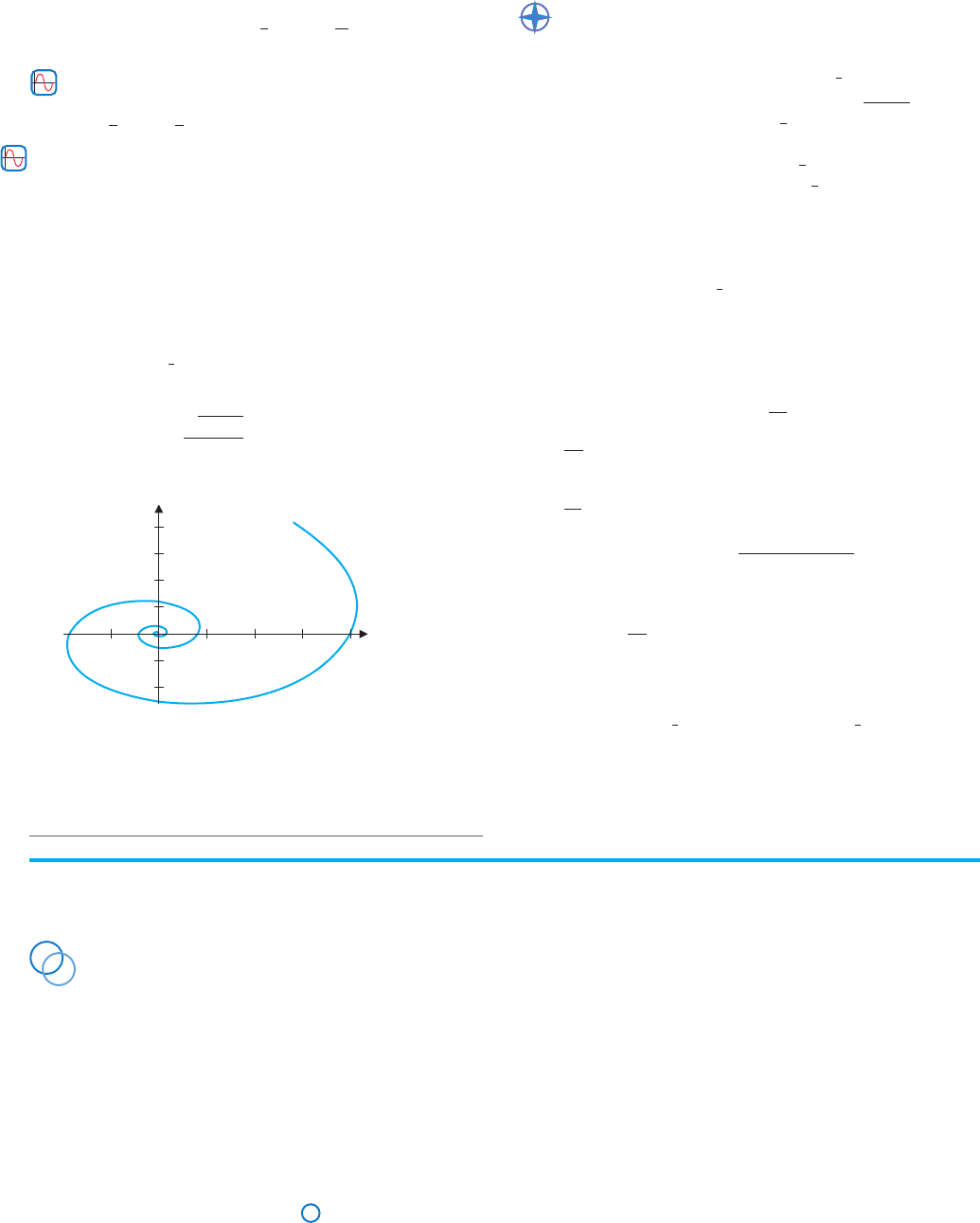
47. A logarithmic spiral is the graph of r = ae
bθ
for positive con-
stants a and b. The accompanying figure shows the case where
a = 2 and b =
1
4
withθ ≤ 1.Althoughthegraphneverreaches
theorigin, thelimitofthearclengthfromθ = d toagivenpoint
with θ = c,asd decreases to −∞, exists. Show that this total
arc length equals
√
b
2
+ 1
b
R, where R is the distance from the
starting point to the origin.
y
210 1.50.5 0.5
1
0.5
1
0.5
1.5
2
x
48. For the logarithmic spiral of exercise 47, if the starting point
P is on the x-axis, show that the total arc length to the origin
equals the distance from P to the y-axis along the tangent line
to the curve at P.
EXPLORATORY EXERCISES
1. In this exercise, you will discover a remarkable property about
the area underneath the graph of y =
1
x
. First, show that a
polar representation of this curve is r
2
=
1
sinθ cos θ
. We will
find the area bounded by y =
1
x
, y = mx and y = 2mx for
x > 0, where m is a positive constant. Sketch graphs for
m = 1 (the area bounded by y =
1
x
, y = x and y = 2x) and
m = 2 (the area bounded by y =
1
x
, y = 2x and y = 4x).
Which area looks larger? To find out, you should integrate.
Explain why this would be a very difficult integration in
rectangular coordinates. Then convert all curves to polar co-
ordinates and compute the polar area. You should discover
that the area equals
1
2
ln2 for any value of m. (Are you
surprised?)
2. In the study of biologicaloscillations (e.g., the beating of heart
cells), an important mathematical term is limit cycle. A sim-
ple example of a limit cycle is produced by the polar coor-
dinates initial value problem
dr
dt
= ar(1 −r), r(0) = r
0
and
dθ
dt
= 2π, θ(0) = θ
0
. Here, a is a positive constant. In section
8.2, we showed that the solution of the initial value problem
dr
dt
= ar(1 −r), r(0) = r
0
is
r(t) =
r
0
r
0
− (r
0
− 1)e
−at
and it is not hard to show that the solution of the initial value
problem
dθ
dt
= 2π, θ(0) = θ
0
is θ (t) = 2πt + θ
0
. In rectan-
gular coordinates, the solution of the combined initial value
problem has parametric equations x(t) = r(t)cosθ(t) and
y(t) = r(t)sinθ(t). Graph the solution in the cases
(a) a = 1, r
0
=
1
2
,θ
0
= 0; (b) a = 1, r
0
=
3
2
,θ
0
= 0; (c) your
choiceofa > 0,your choiceofr
0
with0 < r
0
< 1,yourchoice
of θ
0
; (d) your choice of a > 0, your choice of r
0
with r
0
> 1,
your choice of θ
0
.Ast increases, what is the limiting behav-
ior of the solution? Explain what is meant by saying that this
system has a limit cycle of r = 1.
10.6 CONIC SECTIONS
Among the most important curves you will encounter are the conic sections, which we
explore here. The conic sections include parabolas, ellipses and hyperbolas, which are
undoubtedly already familiar to you. In this section, we focus on geometric properties that
are most easily determined in rectangular coordinates.
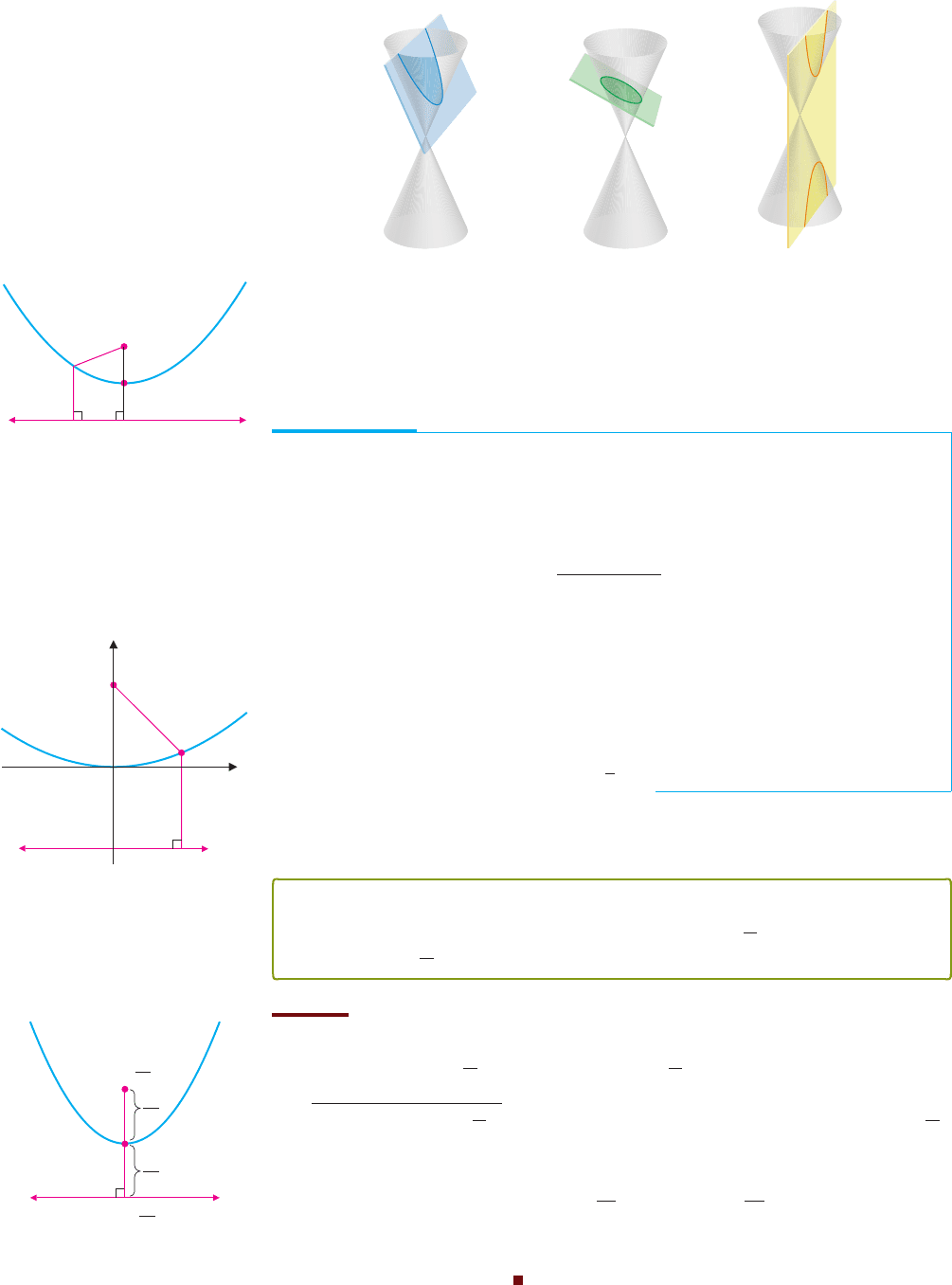
We visualize eachconic section as the intersection of a plane with a right circular cone.
(See Figures 10.50a–10.50c.) Depending on the orientation of theplane, the resulting curve
can be a parabola, an ellipse or a hyperbola.
Parabolas
We define a parabola (see Figure 10.51) to be the set of all points that are equidistant from
a fixed point (called the focus) and a line (called the directrix). A special point on the
P1: OSO/OVY P2: OSO/OVY QC: OSO/OVY T1: OSO
MHDQ256-Ch10 MHDQ256-Smith-v1.cls December 21, 2010 21:17
LT (Late Transcendental)
CONFIRMING PAGES
10-45 SECTION 10.6
..
Conic Sections 669
FIGURE 10.50a
Parabola
FIGURE 10.50b
Ellipse
FIGURE 10.50c
Hyperbola
parabola is the vertex, the midpoint of the perpendicular line segment from the focus to the
directrix.
A parabola whose directrix is a horizontal line has a simple rectangular equation.
Focus
Directrix
Vertex
FIGURE 10.51
Parabola
EXAMPLE 6.1 Finding the Equation of a Parabola
Find an equation of the parabola with focus at the point (0, 2) whose directrix is the line
y =−2.
Solution By definition, any point (x, y) on the parabola must be equidistant from the
focus and the directrix. (See Figure 10.52.) From the distance formula, the distance
from (x, y) to the focus is given by
x
2
+ (y − 2)
2
and the distance to the directrix is
|y − (−2)|.
Setting these equal and squaring both sides, we get
x
2
+ (y − 2)
2
= (y + 2)
2
.
Expanding this out and simplifying, we get
x
2
+ y
2
− 4y + 4 = y
2
+ 4y + 4
or
y =
1
8
x
2
.
y
(0, 2)
(x, y)
y 2
x
FIGURE 10.52
The parabola with focus
at (0, 2) and directrix y =−2
In general, the following relationship holds.
THEOREM 6.1
The parabola with vertex at the point (b, c), focus at (b, c +
1
4a
) and directrix given by
the line y = c −
1
4a
is described by the equation y = a(x −b)
2
+ c.
4a
1
(
b, c
)
4a
1
y c
4a
1
4a
1
(b, c)
FIGURE 10.53
Parabola
PROOF
Given the focus (b, c +
1
4a
) and directrix y = c −
1
4a
, the vertex is the midpoint (b, c).
(See Figure 10.53.) For any point (x, y) on the parabola, its distance to the focus is given
by
(x − b)
2
+ (y − c −
1
4a
)
2
, while its distance to the directrix is given by |y − c +
1
4a
|.
Setting these equal and squaring as in example 6.1, we have
(x − b)
2
+
y − c −
1
4a
2
=
y − c +
1
4a
2
.
Expanding this out and simplifying, we get the more familiar form of the equation:
y = a(x −b)
2
+ c, as desired.
P1: OSO/OVY P2: OSO/OVY QC: OSO/OVY T1: OSO
MHDQ256-Ch10 MHDQ256-Smith-v1.cls December 21, 2010 21:17
LT (Late Transcendental)
CONFIRMING PAGES
670 CHAPTER 10
..
Parametric Equations and Polar Coordinates 10-46
We simply reverse the roles of x and y to obtain the following result, whose proof is
left as an exercise.
THEOREM 6.2
The parabola with vertex at the point (c, b), focus at (c +
1
4a
, b) and directrix given by
the line x = c −
1
4a
is described by the equation x = a(y − b)
2
+ c.
We illustrate Theorem 6.2 in example 6.2.
EXAMPLE 6.2 A Parabola Opening to the Left
For the parabola 4x + 2y
2
+ 8 = 0, find the vertex, focus and directrix.
y
13 245
2
1
1
2
x
FIGURE 10.54
Parabola with focus at (−
5
2
, 0) and
directrix x =−
3
2
Solution Solving for x,wehavex =−
1
2
y
2
− 2. The vertex is then at (−2, 0). The
focus and directrix are shifted left and right, respectively from the vertex by
1
4a
=−
1
2
.
This puts the focus at (−2 −
1
2
, 0) = (−
5
2
, 0) and the directrix at x =−2 −(−
1
2
) =−
3
2
.
We show a sketch of the parabola in Figure 10.54.
EXAMPLE 6.3 Finding the Equation of a Parabola
Find an equation relating all points that are equidistant from the point (3, 2) and the line
y = 6.
y
x
2 4 6 8 102
4
4
8
y 6
(3, 4)
(3, 2)
FIGURE 10.55
Parabola with focus at (3, 2) and
directrix y = 6
Solution Referring to Figure 10.55, notice that the vertex must be at the point (3, 4)
(i.e., the midpoint of the perpendicular line segment connecting the focus to the
directrix) and the parabola opens down. From the vertex, the focus is shifted vertically
by
1
4a
=−2 units, so that a =
1
(−2)4
=−
1
8
. An equation is then
y =−
1
8
(x − 3)
2
+ 4.
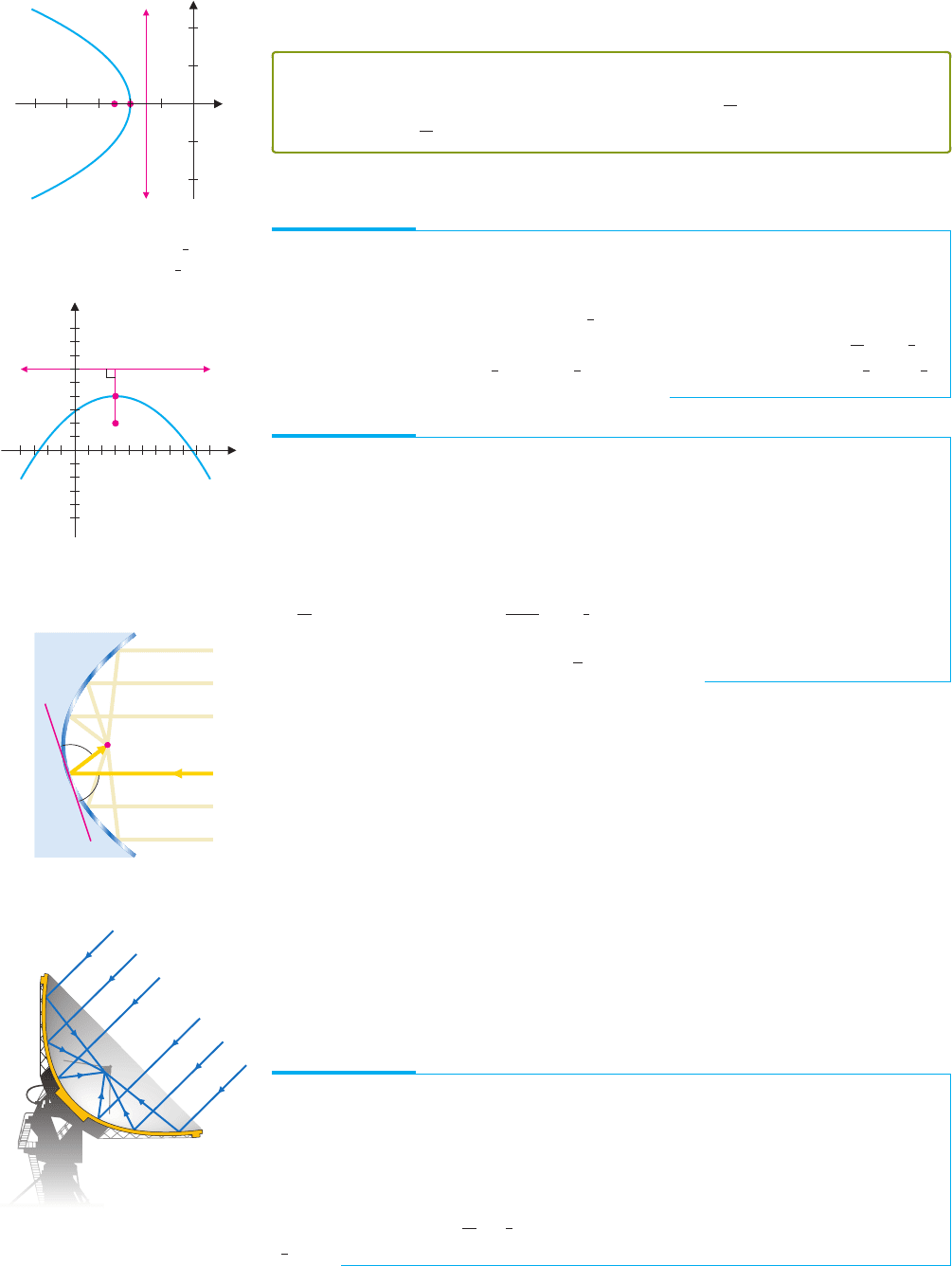
You see parabolas nearly every day. A very useful property of parabolas is their re-
flective property. This can be seen as follows. For the parabola x = ay
2
indicated in
Figure 10.56, draw a horizontal line that intersects the parabola at the point A. Then, one
can show that the acute angle α between the horizontal line and the tangent line at A is
the same as the acute angle β between the tangent line and the line segment joining A to
the focus. You may already have recognized that light rays are reflected from a surface in
exactlythe same fashion (since the angle of incidence must equal the angle of reflection). In
Figure10.56,weindicateanumberofrays(youcanthinkofthemaslightrays,althoughthey
could represent other forms of energy) traveling horizontally until they strike the parabola.
As indicated, all rays striking the parabola are reflected through the focus of the parabola.
Focus
A
a
b
FIGURE 10.56
Reflection of rays
Focus
FIGURE 10.57
The reflective property
Due to this reflective property, satellite dishes are usually built with a parabolic shape
and have a microphone located at the focus to receive all signals. (See Figure 10.57.)
This reflective property works in both directions. That is, energy emitted from the focus
will reflect off the parabola and travel in parallel rays. For this reason, flashlights utilize
parabolic reflectors to direct their light in a beam of parallel rays.
EXAMPLE 6.4 Design of a Flashlight
A parabolic reflector for a flashlight has the shape x = 2y
2
. Where should the
lightbulb be located?
Solution Based on the reflective property of parabolas, the lightbulb should be
located at the focus of the parabola. The vertex is at (0, 0) and the focus is shifted to
the right from the vertex
1
4a
=
1
8
units, so the lightbulb should be located at the point
1
8
, 0
.
P1: OSO/OVY P2: OSO/OVY QC: OSO/OVY T1: OSO
MHDQ256-Ch10 MHDQ256-Smith-v1.cls December 21, 2010 21:17
LT (Late Transcendental)
CONFIRMING PAGES
10-47 SECTION 10.6
..
Conic Sections 671
Ellipses
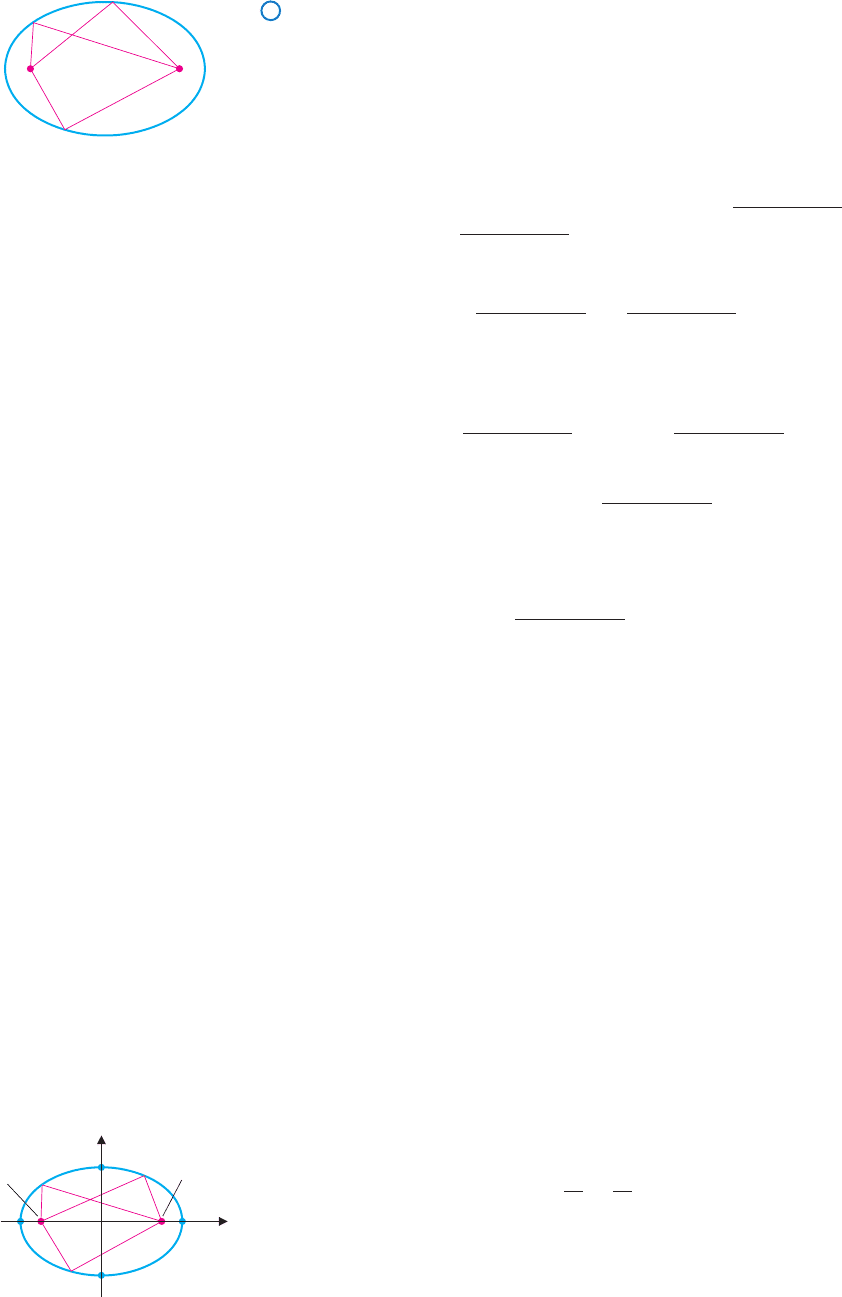
We define an ellipse to be the set of all points for which the sum of the distances to twofixed
points (called foci, the plural of focus) is constant. This definition is illustrated in Figure
10.58a. We define the center of an ellipse to be the midpoint of the line segment connecting
the foci.
FocusFocus
FIGURE 10.58a
Definition of ellipse
Thefamiliarequationof an ellipse can bederived from this definition. Forconvenience,
we assume that the foci lie at the points (c, 0) and (−c, 0), for some positive constant c
(i.e., they lie on the x-axis, at the same distance from the origin). For any point (x, y)on
the ellipse, the distance from (x, y) to the focus (c, 0) is
(x − c)
2
+ y
2
and the distance
to the focus (−c, 0) is
(x + c)
2
+ y
2
. The sum of these distances must equal a constant
that we’ll call k. We then have
(x − c)
2
+ y
2
+
(x + c)
2
+ y
2
= k.
Subtracting the first square root from both sides and then squaring, we get
(x + c)
2
+ y
2
2
=
k −
(x − c)
2
+ y
2
2
or
x
2
+ 2cx +c
2
+ y
2
= k
2
− 2k
(x − c)
2
+ y
2
+ x
2
− 2cx +c
2
+ y
2
.
Now, solving for the remaining term with the radical and squaring gives us
2k
(x − c)
2
+ y
2
2
= (k
2
− 4cx)
2
,
so that
4k
2
x
2
− 8k
2
cx + 4k
2
c
2
+ 4k
2
y
2
= k
4
− 8k
2
cx + 16c
2
x
2
or
(4k
2
− 16c
2
)x
2
+ 4k
2
y
2
= k
4
− 4k
2
c
2
.
Setting k = 2a, we obtain
(16a
2
− 16c
2
)x
2
+ 16a
2
y
2
= 16a
4
− 16a
2
c
2
.
Notice that since 2a is the sum of the distances from (x, y)to(c, 0) and from (x, y)
to (−c, 0) and the distance from (c, 0) to (−c, 0) is 2c, we must have 2a > 2c,so
that a > c > 0. Dividing both sides of the equation by 16 and defining b
2
= a
2
− c
2
,
we get
b
2
x
2
+ a
2
y
2
= a
2
b
2
.
Finally, dividing by a
2
b
2
leaves us with the familiar equation
x
2
a
2
+
y
2
b
2
= 1.
In this equation, notice that x can assume values from −a to a and y can assume values
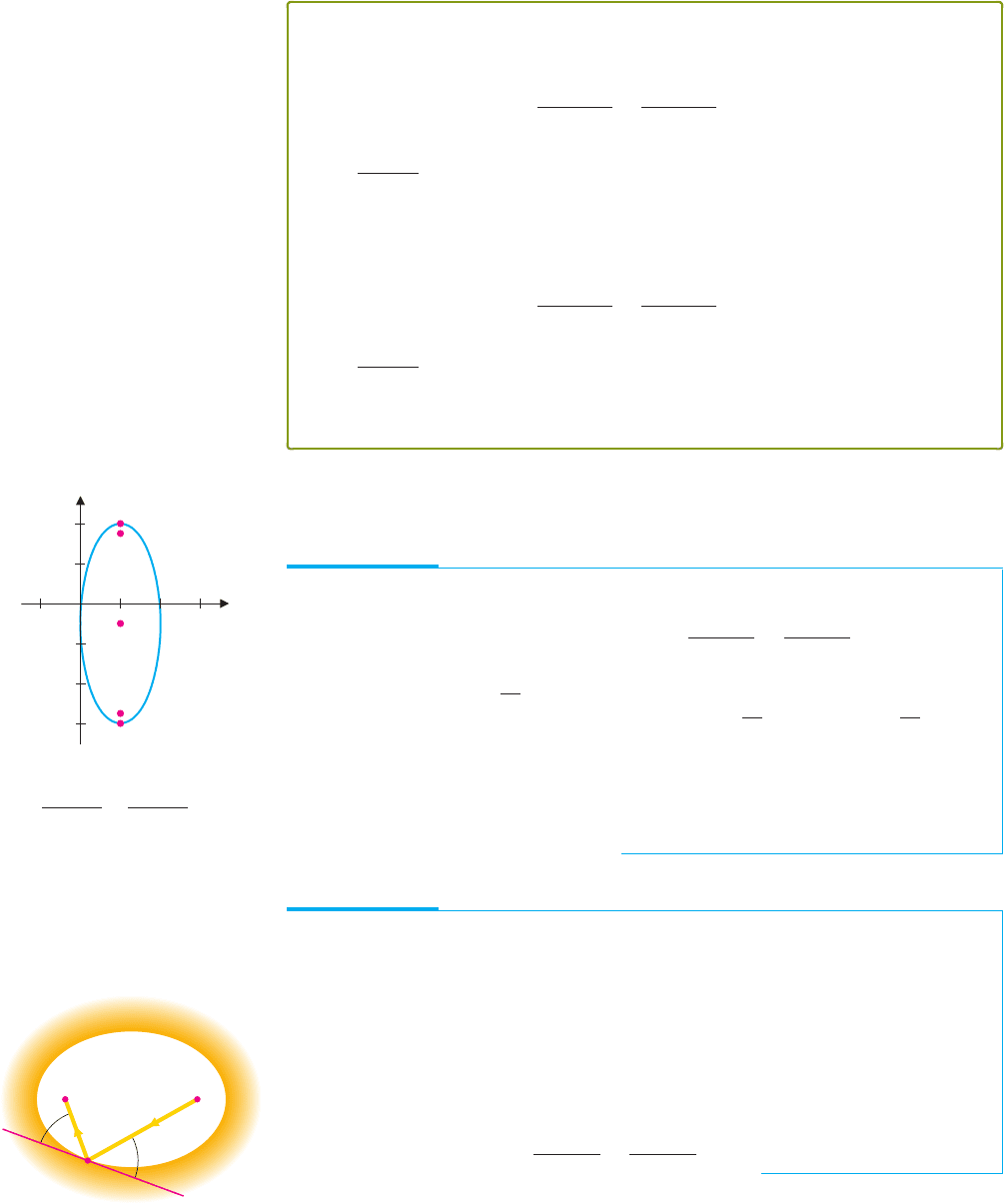
from −b to b. The points (a, 0) and (−a, 0) are called the vertices of the ellipse. (See
Figure 10.58b.) Since a > b, we call the line segment joining the vertices the major axis
and we call the line segment joining the points (0, b) and (0, −b) the minor axis. Notice
that the length of the major axis is 2a and the length of the minor axis is 2b.
(a, 0)
(0, b)
(0, b)
(c, 0)
(c, 0)
(a, 0)
y
x
FIGURE 10.58b
Ellipse with foci at (c, 0) and (−c, 0)
P1: OSO/OVY P2: OSO/OVY QC: OSO/OVY T1: OSO
MHDQ256-Ch10 MHDQ256-Smith-v1.cls December 21, 2010 21:17
LT (Late Transcendental)
CONFIRMING PAGES
672 CHAPTER 10
..
Parametric Equations and Polar Coordinates 10-48
We state the general case in Theorem 6.3.
THEOREM 6.3
The equation
(x − x
0
)
2
a
2
+
(y − y
0
)
2
b
2
= 1 (6.1)
with a > b > 0 describes an ellipse with foci at (x
0
− c, y
0
) and (x
0
+ c, y
0
), where
c =
√
a
2
− b
2
. The center of the ellipse is at the point (x
0
, y
0
) and the vertices are
located at (x
0
± a, y
0
) on the major axis. The endpoints of the minor axis are located
at (x
0
, y
0
± b).
The equation
(x − x
0
)
2
b
2
+
(y − y
0
)
2
a
2
= 1 (6.2)
with a > b > 0 describes an ellipse with foci at (x
0
, y
0
− c) and (x
0
, y
0
+ c) where
c =
√
a
2
− b
2
. The center of the ellipse is at the point (x
0
, y
0
) and the vertices are
located at (x
0
, y
0
± a) on the major axis. The endpoints of the minor axis are located
at (x
0
± b, y
0
).
In example 6.5, we use Theorem 6.3 to identify the features of an ellipse.
y
x
4 62
2
4
6
2
4
FIGURE 10.59
(x − 2)
2
4
+
(y + 1)
2
25
= 1
EXAMPLE 6.5 Identifying the Features of an Ellipse
Identify the center, foci and vertices of the ellipse
(x − 2)
2
4
+
(y + 1)
2
25
= 1.
Solution From (6.2), the center is at (2, −1). The values of a
2
and b
2
are 25 and 4,
respectively, so that c =
√
21. Since the major axis is parallel to the y-axis, the foci are
shifted c units above and below the center, at (2, −1 −
√
21) and (2, −1 +
√
21).
Notice that in this case, the vertices are the intersections of the ellipse with the line
x = 2. With x = 2, we have (y + 1)
2
= 25, so that y =−1 ± 5 and the vertices are
(2, −6) and (2, 4). Finally, the endpoints of the minor axis are found by setting y =−1.
We have (x − 2)
2
= 4, so that x = 2 ±2 and these endpoints are (0, −1) and (4, −1).
The ellipse is sketched in Figure 10.59.
EXAMPLE 6.6 Finding an Equation of an Ellipse
Find an equation of the ellipse with foci at (2, 3) and (2, 5) and vertices (2, 2) and (2, 6).
Solution Here, the center is the midpoint of the foci, (2, 4). You can now see that the
foci are shifted c = 1 unit from the center. The vertices are shifted a = 2 units from the
center. From c
2
= a
2
− b
2
,wegetb
2
= 4 − 1 = 3. Notice that the major axis is parallel
to the y-axis, so that a
2
= 4 is the divisor of the y-term. From (6.2), the ellipse has the
equation
(x − 2)
2
3
+
(y − 4)
2
4
= 1.
Focus
Focus
A
a
a
FIGURE 10.60
The reflective property of ellipses
Much like parabolas, ellipses have some useful reflective properties. As illustrated in
Figure 10.60, a line segment joining one focus to a point A on the ellipse makes the same