
Smith R., Minton R. Calculus
Подождите немного. Документ загружается.

P1: OSO/OVY P2: OSO/OVY QC: OSO/OVY T1: OSO
MHDQ256-Ch10 MHDQ256-Smith-v1.cls December 21, 2010 21:17
LT (Late Transcendental)
CONFIRMING PAGES
10-19 SECTION 10.3
..
Arc Length and Surface Area in Parametric Equations 643
EXAMPLE 3.1 Finding the Arc Length of a Plane Curve
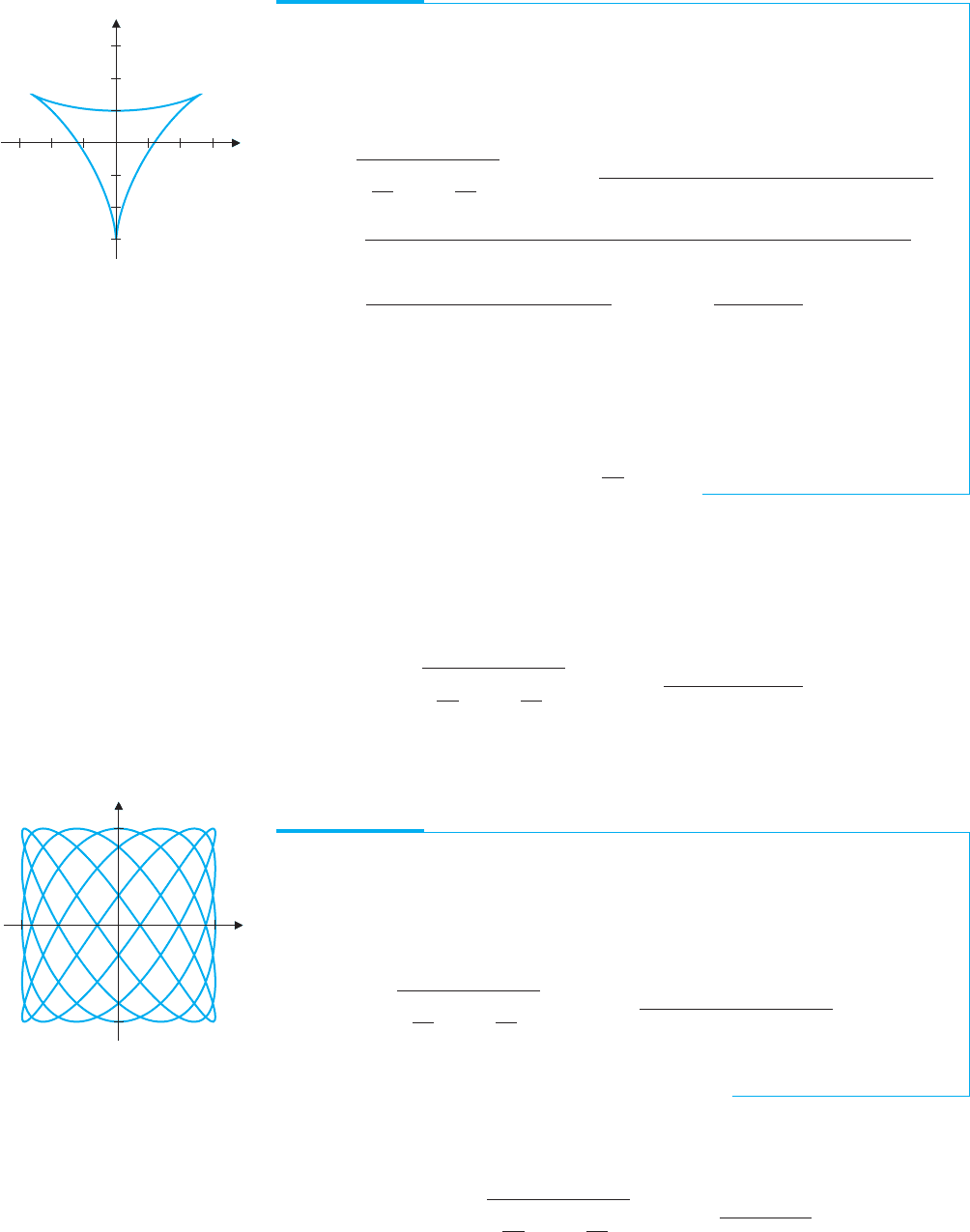
Find the arc length of the Scrambler curve x = 2cost +sin 2t, y = 2sint + cos2t, for
0 ≤ t ≤ 2π. Also, find the average speed of the Scrambler over this interval.
y
x
33
3
3
FIGURE 10.13
x = 2cos t + sin 2t,
y = 2 sin t + cos 2t,
0 ≤ t ≤ 2π
Solution The curve is shown in Figure 10.13. First, note that x, x
, y and y
are all
continuous on the interval [0, 2π ]. From (3.1), we then have
s =
b
a
dx
dt
2
+
dy
dt
2
dt =
2π
0
(−2sin t + 2 cos 2t)
2
+ (2 cost −2 sin2t)
2
dt
=
2π
0
4sin
2
t −8sint cos2t + 4cos
2
2t +4cos
2
t −8cost sin2t + 4sin
2
2tdt
=
2π
0
√
8 − 8sint cos 2t − 8 cost sin2tdt=
2π
0
√
8 − 8sin 3tdt≈ 16,
since sin
2
t +cos
2
t = 1, cos
2
2t +sin
2
2t = 1 and sin t cos 2t + sin 2t cos t = sin3t
and where we have approximated the last integral numerically. To find the average
speed over the given interval, we simply divide the arc length (i.e., the distance
traveled), by the total time, 2π, to obtain
s
ave
≈
16
2π
≈ 2.5.
y
x
11
1
1
FIGURE 10.14
A Lissajous curve
We want to emphasize that Theorem 3.1 allows the curve to intersect itself at a finite
number of points, but not to intersect itself over an entireinterval of values of the parameter
t. To see why this requirement is needed, notice that the parametric equations x = cost,
y = sint, for 0 ≤ t ≤ 4π, describe the circle of radius 1 centered at the origin. However,
the circle is traversed twice as t rangesfrom 0 to 4π. If you were to apply (3.1) to this curve,
you’d obtain
4π
0
dx
dt
2
+
dy
dt
2
dt =
4π
0
(−sin t)
2
+ cos
2
tdt= 4π,
which corresponds to twice the arc length (circumference) of the circle. As you can see, if
a curve intersects itself over an entire interval of values of t, the arc length of such a portion
of the curve is counted twice by (3.1).
EXAMPLE 3.2 Finding the Arc Length of a Complicated Plane Curve
Find the arc length of the plane curve x = cos5t, y = sin7t, for 0 ≤ t ≤ 2π.
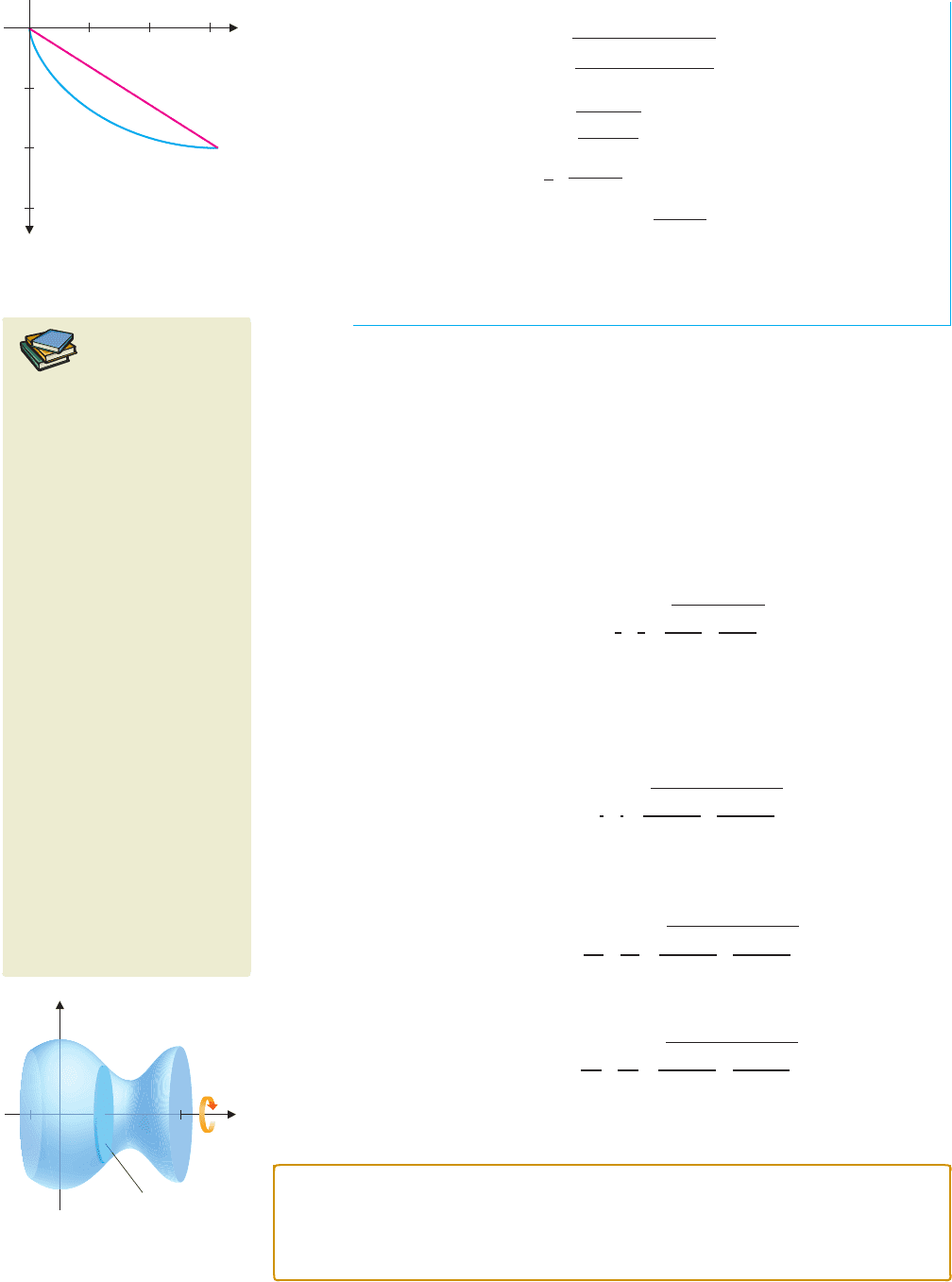
Solution This unusual curve (an example of a Lissajous curve) is sketched in
Figure 10.14. We leave it as an exercise to verify that the hypotheses of Theorem 3.1
are met. From (3.1), we then have that
s =
2π
0
dx
dt
2
+
dy
dt
2
dt =
2π
0
(−5sin 5t)
2
+ (7 cos7t)
2
dt ≈ 36.5,
where we have approximated the integral numerically. This is a long curve to be
confined within the rectangle −1 ≤ x ≤ 1, −1 ≤ y ≤ 1!
The arc length formula (3.1) should seem familiar to you. Parametric equations for
a curve y = f (x) are x = t, y = f (t) and from (3.1), the arc length of this curve for
a ≤ x ≤ b is then
s =
b
a
dx
dt
2
+
dy
dt
2
dt =
b
a
1 + [ f
(t)]
2
dt,
which is the arc length formula derived in section 5.4. Thus, the formula developed in
section 5.4 is a special case of (3.1).

P1: OSO/OVY P2: OSO/OVY QC: OSO/OVY T1: OSO
MHDQ256-Ch10 MHDQ256-Smith-v1.cls December 21, 2010 21:17
LT (Late Transcendental)
CONFIRMING PAGES
644 CHAPTER 10
..
Parametric Equations and Polar Coordinates 10-20
Observe that the speed of the Scrambler calculated in example 2.3 and the
length of the Scrambler curve found in example 3.1 both depend on the same
quantity:
dx
dt
2
+
dy
dt
2
. Observe that if the parameter t represents time, then
dx
dt
2
+
dy
dt
2
represents speed and from Theorem 3.1, the arc length (i.e., the dis-
tance traveled) is the integral of the speed with respect to time.
Arc length is a key ingredient in a famous problem called the brachistochrone prob-
lem. We state this problem in the context of a ski slope consisting of a tilted plane, where a
skier wishes to get from a point A at the top of the slope to a point B down the slope (but not
directly beneath A) in the least time possible. (See Figure 10.15.) Suppose the path taken
by the skier is given by the parametric equations x = x(u) and y = y(u), 0 ≤ u ≤ 1, where
x and y determine the position of the skier in the plane of the ski slope. (For simplicity, we
orient the positive y-axis so that it points down. Also, we name the parameter u since u will,
in general, not represent time.)
A
B
FIGURE 10.15
Downhill skier
To derive a formula for the time required to get from point A to point B, start with the
familiar formula distance = rate · time. As seen in the derivation of the arc length formula
(3.1),for asmallsection of thecurve,thedistanceis approximately
[x
(u)]
2
+ [y
(u)]
2
du.
The rate is harder to identify since we aren’t given position as a function of time. For
simplicity, we assume that the only effect of friction is to keep the skier on the path and that
y(t) ≥ 0. In this case, using the principle of conservation of energy, it can be shown that
the skier’s speed is given by
√
y(u)
k
for some constant k ≥ 0. Putting the pieces together,
the total time from point A to point B is given by
Time =
1
0
k
[x
(u)]
2
+ [y
(u)]
2
y(u)
du. (3.2)
Your first thought might be that the shortest path from point A to point B is along a straight
line. If you’re thinking of short in terms of distance, you’re right, of course. However, if
you think of short in terms of time (how most skiers would think of it), this is not true. In
example 3.3, we show that the fastest path from point A to point B is, in fact, not along a
straight line, by exhibiting a faster path.
EXAMPLE 3.3 Skiing a Curved Path That Is Faster Than Skiing
a Straight Line
If point A in our skiing example is (0, 0) and point B is (π, 2), show that skiing along the
cycloid defined by
x = πu − sinπ u, y = 1 − cosπ u
is faster than skiing along the line segment connecting the points. Explain the result in
physical terms.
Solution First, note that the line segment connecting the points is given by x = πu,
y = 2u, for 0 ≤ u ≤ 1. Further, both curves meet the endpoint requirements that (x(0),
y(0)) = (0, 0) and (x(1), y(1)) = (π, 2). For the cycloid, we have from (3.2) that
Time =
1
0
k
[x
(u)]
2
+ [y
(u)]
2
y(u)
du
= k
1
0
(π −π cosπu)
2
+ (π sinπ u)
2
1 − cosπu
du
= k
√
2π
1
0
1 − cosπu
1 − cosπu
du
= k
√
2π.
P1: OSO/OVY P2: OSO/OVY QC: OSO/OVY T1: OSO
MHDQ256-Ch10 MHDQ256-Smith-v1.cls December 21, 2010 21:17
LT (Late Transcendental)
CONFIRMING PAGES
10-21 SECTION 10.3
..
Arc Length and Surface Area in Parametric Equations 645
Similarly, for the line segment, we have that
Time =
1
0
k
[x
(u)]
2
+ [y
(u)]
2
y(u)
du
= k
1
0
π
2
+ 2
2
2u
du
= k
√
2
π
2
+ 4.
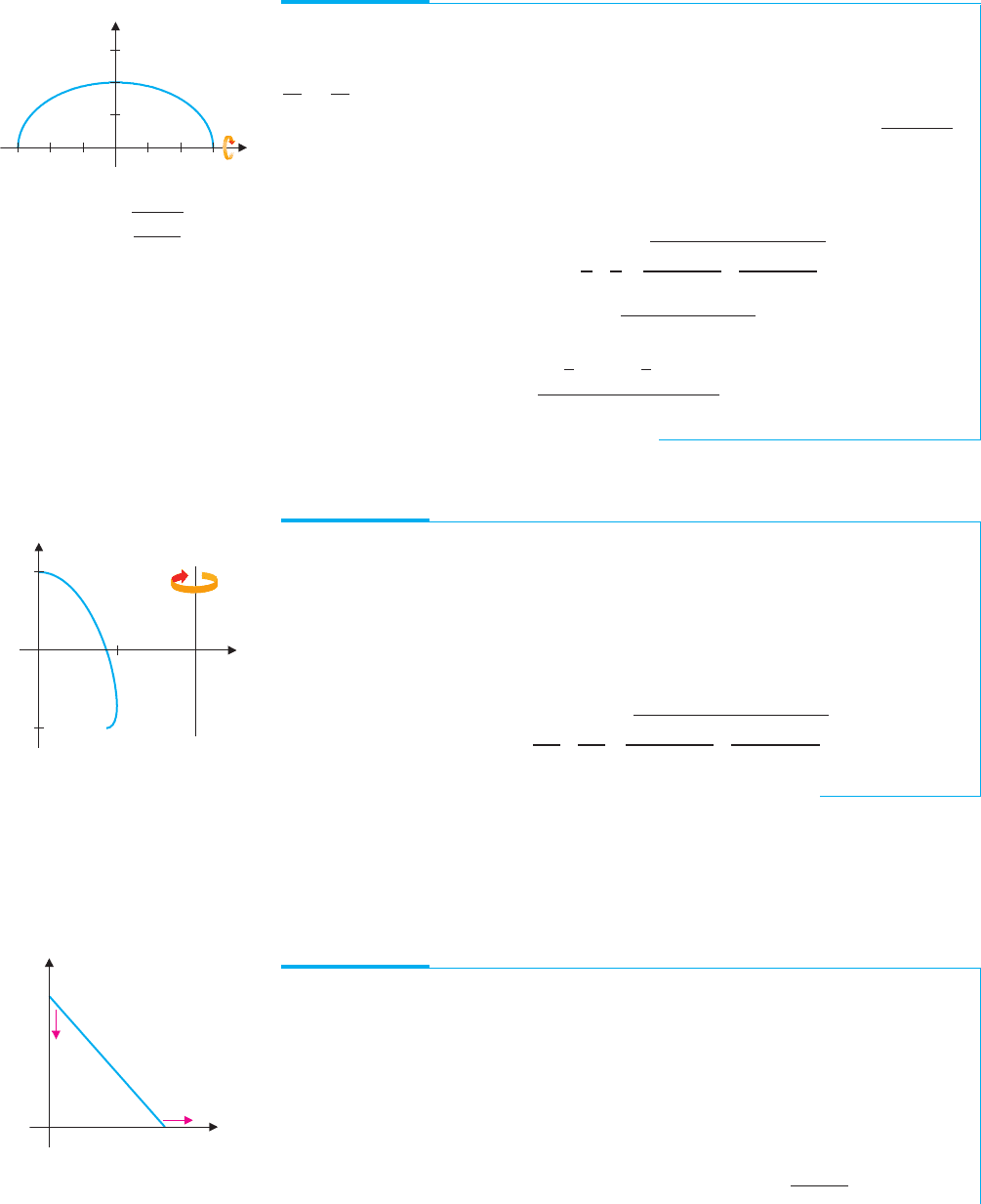
Notice that the cycloid route is faster since π<
√
π
2
+ 4. The two paths are shown in
Figure 10.16. Observe that the cycloid is very steep at the beginning, which would allow
a skier to go faster following the cycloid than following the straight line. As it turns
out, the greater speed of the cycloid more than compensates for the longer distance of
its path.
y
x
1 2 3
3
2
1
FIGURE 10.16
Two skiing paths
HISTORICAL
NOTES
Jacob Bernoulli (1654–1705)
and Johann Bernoulli
(1667–1748) Swiss
mathematicians who were
instrumental in the development
of the calculus. Jacob was the
first of several generations of
Bernoullis to make important
contributions to mathematics. He
was active in probability, series
and the calculus of variations and
introduced the term “integral.”
Johann followed his brother into
mathematics while also earning a
doctorate in medicine. Johann
first stated l’H
ˆ
opital’s Rule, one
of many results over which he
fought bitterly (usually with his
brother, but, after Jacob’s death,
also with his own son Daniel) to
receive credit. Both brothers
were sensitive, irritable,
egotistical (Johann had his
tombstone inscribed, “The
Archimedes of his age”) and
quick to criticize others. Their
competitive spirit accelerated
the development of calculus.
Wewill ask you to construct some skiing paths of your ownin theexercises.However,it
has been proved that the cycloid is the plane curve with the shortest time (which is what the
Greek root words for brachistochrone mean). In addition, we will give you an opportunity
to discover another remarkable property of the cycloid, relating to another famous problem,
the tautochrone problem. Both problems have an interesting history focused on brothers
Jacob and Johann Bernoulli, who solved the problem in 1697 (along with Newton, Leibniz
and l’Hˆopital) and argued incessantly about who deserved credit.
Much as we did in section 5.4, we can use our arc length formula to find a formula for
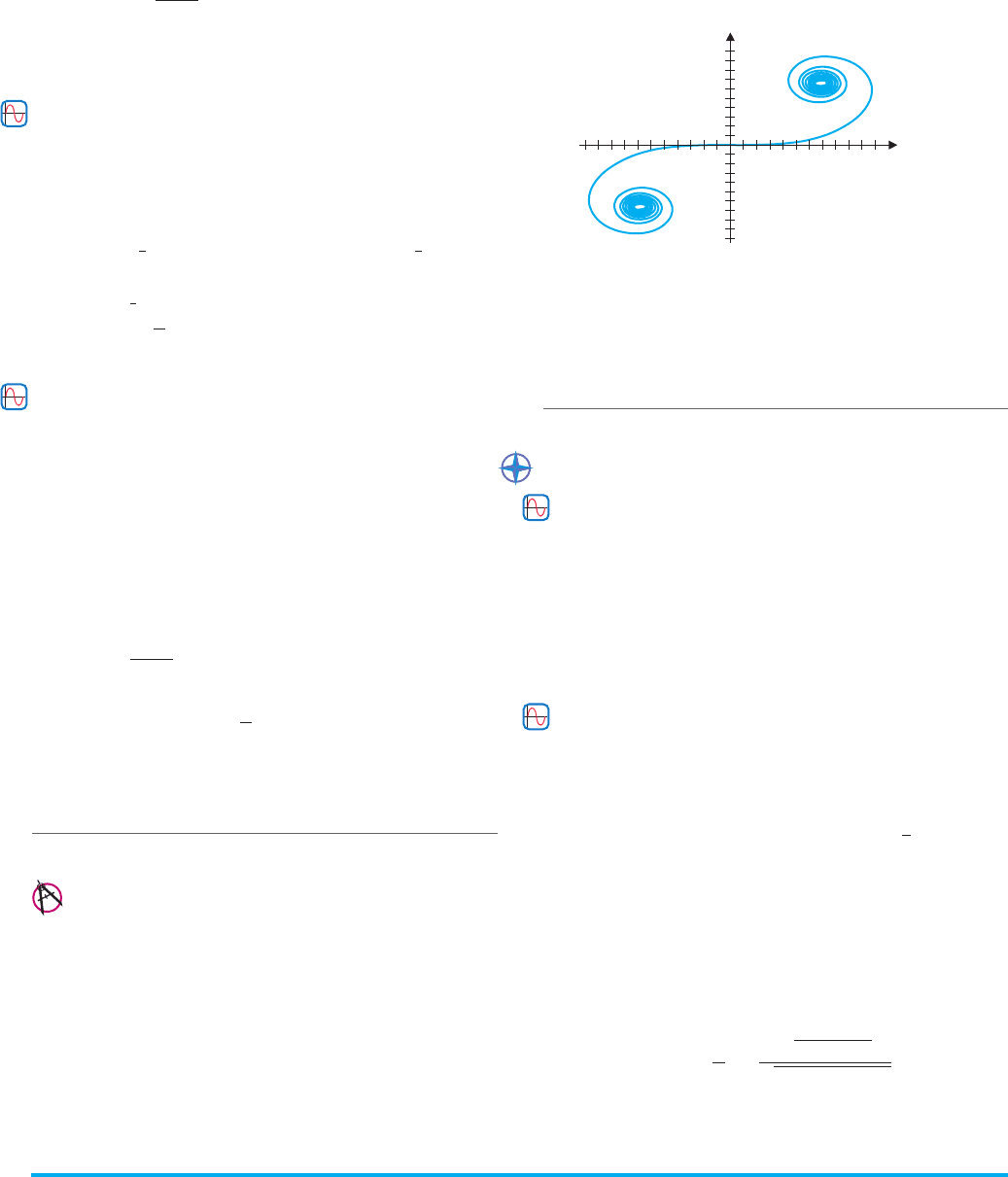
the surface area of a surface of revolution. Recall that if the curve y = f (x) for c ≤ x ≤ d
is revolved about the x-axis (see Figure 10.17), the surface area is given by
Surface Area =
d
c
2π | f (x)|
radius
1 + [ f
(x)]
2
arc length
dx.
Let C be the curve defined by the parametric equations x = x(t) and y = y(t) with
a ≤ t ≤ b, where x, x
, y and y
are continuous and where the curve does not intersect
itself for a ≤ t ≤ b. We leave it as an exercise to derive the corresponding formula for
parametric equations:
Surface Area =
b
a
2π |y(t)|
radius
[x
(t)]
2
+ [y
(t)]
2
arc length
dt.
More generally, we have that if the curve is revolved about the line y = c, the surface area
is given by
Surface Area =
b
a
2π |y(t) −c|
radius
[x
(t)]
2
+ [y
(t)]
2
arc length
dt. (3.3)
Likewise, if we revolve the curve about the line x = d, the surface area is given by
Surface Area =
b
a
2π|x(t) − d|
radius
[x
(t)]
2
+ [y
(t)]
2
arc length
dt. (3.4)
Look carefully at what all of the surface area formulas have in common. That is, in each
case, the surface area is given by
y f(x)
x
y
dc
Circular cross
sections
FIGURE 10.17
Surface of revolution
SURFACE AREA
Surface Area =
b
a
2π(radius)(arc length)dt. (3.5)
P1: OSO/OVY P2: OSO/OVY QC: OSO/OVY T1: OSO
MHDQ256-Ch10 MHDQ256-Smith-v1.cls December 21, 2010 21:17
LT (Late Transcendental)
CONFIRMING PAGES
646 CHAPTER 10
..
Parametric Equations and Polar Coordinates 10-22
Look carefully at the graph of the curve and the axis about which you are revolving, to see
how to fill in the blanks in (3.5). As we observed in section 5.4, it is very important that you
draw a picture here.
y
x
33
3
FIGURE 10.18
y = 2
1 − x
2
9
EXAMPLE 3.4 Finding Surface Area with Parametric Equations
Find the surface area of the surface formed by revolving the half-ellipse
x
2
9
+
y
2
4
= 1, y ≥ 0, about the x-axis. (See Figure 10.18.)
Solution It would truly be a mess to set up the integral for y = f (x) = 2
1 − x
2
/9.
(Think about this!) Instead, notice that you can represent the curve by the parametric
equations x = 3cost, y = 2 sint, for 0 ≤ t ≤ π. From (3.3), the surface area is then
given by
Surface Area =
π
0
2π (2 sint)
radius
(−3sin t)
2
+ (2 cost)
2
arc length
dt
= 4π
π
0
sint
9sin
2
t +4cos
2
tdt
= 4π
9
√
5sin
−1
(
√
5/3) + 10
5
≈ 67.7,
where we used a CAS to evaluate the integral.
y
x
12
1
1
FIGURE 10.19
x = sin2t, y = cos3t
EXAMPLE 3.5 Revolving About a Line Other Than a Coordinate Axis
Find the surface area of the surface formed by revolving the curve x = sin2t,
y = cos3t, for 0 ≤ t ≤ π/3, about the line x = 2.
Solution A sketch of the curve is shown in Figure 10.19. Since the x-values on the
curve are all less than 2, the radius of the solid of revolution is 2 − x = 2 −sin2t and
so, from (3.4), the surface area is given by
Surface Area =
π/3
0
2π (2 −sin2t)
radius
[2cos 2t]
2
+ [−3 sin3t]
2
arc length
dt ≈ 20.1,
where we have approximated the value of the integral numerically.
In example 3.6, we model a physical process with parametric equations. Since the
modeling process is itself of great importance, be sure that you understand all of the steps.
Also, see if you can find an alternative approach to this problem.
EXAMPLE 3.6 Arc Length for a Falling Ladder
An 8-foot-tall ladder stands vertically against a wall. The bottom of the ladder is pulled
along the floor, with the top remaining in contact with the wall, until the ladder rests flat
on the floor. Find the distance traveled by the midpoint of the ladder.
y
x
FIGURE 10.20
Ladder sliding down a wall
Solution We first find parametric equations for the position of the midpoint of the
ladder. We orient the x- and y-axes as shown in Figure 10.20.
Let x denote the distance from the wall to the bottom of the ladder and let y denote
the distance from the floor to the top of the ladder. Since the ladder is 8 feet long, observe
that x
2
+ y
2
= 64. Defining the parameter t = x,wehavey =
√
64 − t
2
. The midpoint

P1: OSO/OVY P2: OSO/OVY QC: OSO/OVY T1: OSO
MHDQ256-Ch10 MHDQ256-Smith-v1.cls December 21, 2010 21:17
LT (Late Transcendental)
CONFIRMING PAGES
10-23 SECTION 10.3
..
Arc Length and Surface Area in Parametric Equations 647
of the ladder has coordinates
x
2
,
y
2
and so, parametric equations for the midpoint are
x(t) =
1
2
t
y(t) =
1
2
√
64 − t
2
.
When the ladder stands vertically against the wall, we have x = 0 and when it lies flat
on the floor, x = 4. So, 0 ≤ t ≤ 8. From (3.1), the arc length is then given by
s =
8
0
1
2
2
+
1
2
−t
√
64 − t
2
2
dt =
8
0
1
4
1 +
t
2
64 − t
2
dt
=
8
0
1
2
64
64 − t
2
dt =
8
0
1
2
1
1 − (t/8)
2
dt.
Substituting u =
t
8
gives us du =
1
8
dt or dt = 8 du. For the limits of integration, note
that when t = 0, u = 0 and when t = 8, u = 1. The arc length is then
s =
8
0
1
2
1
1 − (t/8)
2
dt =
1
0
1
2
1
1 − u
2
8du = 4sin
−1
u
u=1
u=0
= 4
π
2
− 0
= 2π.
Since this is a rare arc length integral that can be evaluated exactly, you might be
suspicious that there is an easier way to find the arc length. We explore this in the
exercises.
EXERCISES 10.3
WRITING EXERCISES
1. In the derivation preceding Theorem 3.1, we justified the
equation
g(t
i
) − g(t
i−1
) = g
(c
i
)t.
Thinking of g(t) as position and g
(t) as velocity, explain why
this makes sense.
2. The curve in example 3.2 was a long curve contained within
a small rectangle. What would you guess would be the maxi-
mum length for a curve contained in such a rectangle? Briefly
explain.
3. In example 3.3, we noted that the steeper initial slope of the
cycloid would allow the skier to build up more speed than
the straight-line path. The cycloid takes this idea to the limit
by having a vertical tangent line at the origin. Explain why,
despite the vertical tangent line, it is still physically possible
for the skier to stay on this slope. (Hint: How do the two di-
mensions of the path relate to the three dimensions of the ski
slope?)
4. The tautochrone problem discussed in exploratory exercise 2
involves starting on the same curve at two different places and
comparing the times required to reach the end. For the cy-
cloid, compare the speed of a skier starting at the origin versus
one starting halfway to the bottom. Explain why it is not clear
whether starting halfway down would get you to the bottom
faster.
In exercises 1–8, find the arc length of each curve; compute one
exactly and approximate the other numerically.
1. (a)
x = 2cos t
y = 4 sin t
(b)
x = 1 −2 cos t
y = 2 +2 sin t
2. (a)
x = t
3
− 4
y = t
2
− 3
, −2 ≤ t ≤ 2
(b)
x = t
3
− 4t
y = t
2
− 3t
, −2 ≤ t ≤ 2
3. (a)
x = cos4t
y = sin 4t
(b)
x = cos7t
y = sin 11t
4. (a)
x = t cost
y = t sint
, −1 ≤ t ≤ 1
(b)
x = t
2
cost
y = t
2
sint
, −1 ≤ t ≤ 1
5. (a)
x = sint cost
y = sin
2
t
, 0 ≤ t ≤ π/2
(b)
x = sin4t cost
y = sin 4t sint
, 0 ≤ t ≤ π/2
6. (a)
x = sint
y = sin πt
, 0 ≤ t ≤ π
(b)
x = sint
y = π sin t
, 0 ≤ t ≤ π
P1: OSO/OVY P2: OSO/OVY QC: OSO/OVY T1: OSO
MHDQ256-Ch10 MHDQ256-Smith-v1.cls December 21, 2010 21:17
LT (Late Transcendental)
CONFIRMING PAGES
648 CHAPTER 10
..
Parametric Equations and Polar Coordinates 10-24
7. (a)
x = e
2t
+ e
−2t
y = 4t
, 0 ≤ t ≤ 4
(b)
x = e
2t
y = t
2
, 0 ≤ t ≤ 4
8. (a)
x = 4t
y =
√
t
2
+ 4
, 1 ≤ t ≤ 2
(b)
x = 36t + 2
y = t
3
+ 3/t
, 1 ≤ t ≤ 2
In exercises 9–12, (a) show that the curve starts at the origin
at t 0 and reaches the point (π, 2) at t 1. (b) Use the time
formula (3.2) to determine how long it would take a skier to take
the given path. (c) Find the slope at the origin and the arc length
for the curve in the indicated exercise.
9.
x = πt
y = 2
√
t
10.
x = πt
y = 2
4
√
t
11.
x =−
1
2
π(cos π t −1)
y = 2t +
7
10
sinπt
12.
x = πt − 0.6 sin π t
y = 2t + 0.4 sin π t
............................................................
In exercises 13–18, compute the surface area of the surface ob-
tained by revolving the given curve about the indicated axis.
13.
x = t
2
− 1
y = t
3
− 4t
, −2 ≤ t ≤ 0 (a) about the x-axis
(b) about x =−1
14.
x = t
2
− 1
y = t
3
− 4t
, 0 ≤ t ≤ 2 (a) about the x-axis
(b) about x = 3
15.
x = t
3
− 4t
y = t
2
− 3
, 0 ≤ t ≤ 2 (a) about the y-axis
(b) about y = 2
16.
x = 4t
y =
√
t
2
+ 4
, 1 ≤ t ≤ 2 (a) about the x-axis
(b) about x = 4
17.
x = 2t
y = 2 cost
, 0 ≤ t ≤
π
2
(a) about the y-axis
(b) about y = 3
18.
x = lnt
y = e
−t
, 1 ≤ t ≤ 2 (a) about the x-axis
(b) about y-axis
APPLICATIONS
19. An 8-foot-tall ladder stands vertically against a wall. The top
of the ladder is pulled directly away from the wall, with the
bottom remaining in contact with the wall, until the ladder
rests on the floor. Find parametric equations for the position
of the midpoint of the ladder. Find the distance traveled by the
midpoint of the ladder.
20. The answer in exercise 19 equals the circumference of a
quarter-circle of radius 4. Discuss whether this is a coinci-
dence or not. Compare this value to the arc length in example
3.6. Discuss whether or not this is a coincidence.
21. The figure shown here is called Cornu’s spiral. It is de-
fined by the parametric equations x =
t
0
cosπs
2
ds and
y =
t
0
sinπs
2
ds. Each of these integrals is important in the
study of Fresnel diffraction. Find the arc length of the spi-
ral for (a) −2π ≤ t ≤ 2π and (b) general a ≤ t ≤ b. Use this
result to discuss the rate at which the spiraling occurs.
y
0.20.2 0.40.4
0.4
0.2
0.4
0.2
x
22. A cycloid is the curve traced out by a point on a circle as the
circle rolls along the x-axis. Suppose the circle has radius 4,
the point we are following starts at (0, 8) and the circle rolls
from left to right. Find parametric equations for the cycloid
and find the arc length as the circle completes one rotation.
EXPLORATORY EXERCISES
1. For the brachistochrone problem, two criteria for the fastest
curve are: (1) steep slope at the origin and (2) concave down
(note in Figure 10.16 that the positive y-axis points down-
ward). Explain why these criteria make sense. Identify other
reasonable criteria. Then find parametric equations for a curve
(differentfromthecycloidorthoseofexercises9–12)thatmeet
all the criteria. Use the formula of example 3.3 to find out how
fast your curve is. You can’t beat the cycloid, but get as close
as you can!
2. The tautochrone problem is another surprising problem that
was studied and solved by the same seventeenth-century
mathematicians as the brachistochrone problem. (See Journey
Through Genius by William Dunham for a description of this
interesting piece of history, featuring the brilliant yet combat-
ive Bernoulli brothers.) Recall that the cycloid of example 3.3
runs from (0, 0) to (π, 2). It takes the skier k
√
2π = π/g sec-
onds to ski the path. How long would it take the skier starting
partway down the path, for instance, at (π/2 −1, 1)? Find the
slope of the cycloid at this point and compare it to the slope at
(0, 0). Explain why the skier would build up less speed start-
ing at this new point. Graph the speed function for the cycloid
with0 ≤ u ≤ 1andexplainwhythefartherdownthe slope you
start, the less speed you’ll have. To see howspeed and distance
balance, use the time formula
T =
π
g
1
a
√
1 − cos πu
√
cosπa − cos π u
du
for the time it takes to ski the cycloid starting at the point
(πa − sin π a, 1 − cos π a), 0 < a < 1. What is the remark-
able property that the cycloid has?
P1: OSO/OVY P2: OSO/OVY QC: OSO/OVY T1: OSO
MHDQ256-Ch10 MHDQ256-Smith-v1.cls December 21, 2010 21:17
LT (Late Transcendental)
CONFIRMING PAGES
10-25 SECTION 10.4
..
Polar Coordinates 649
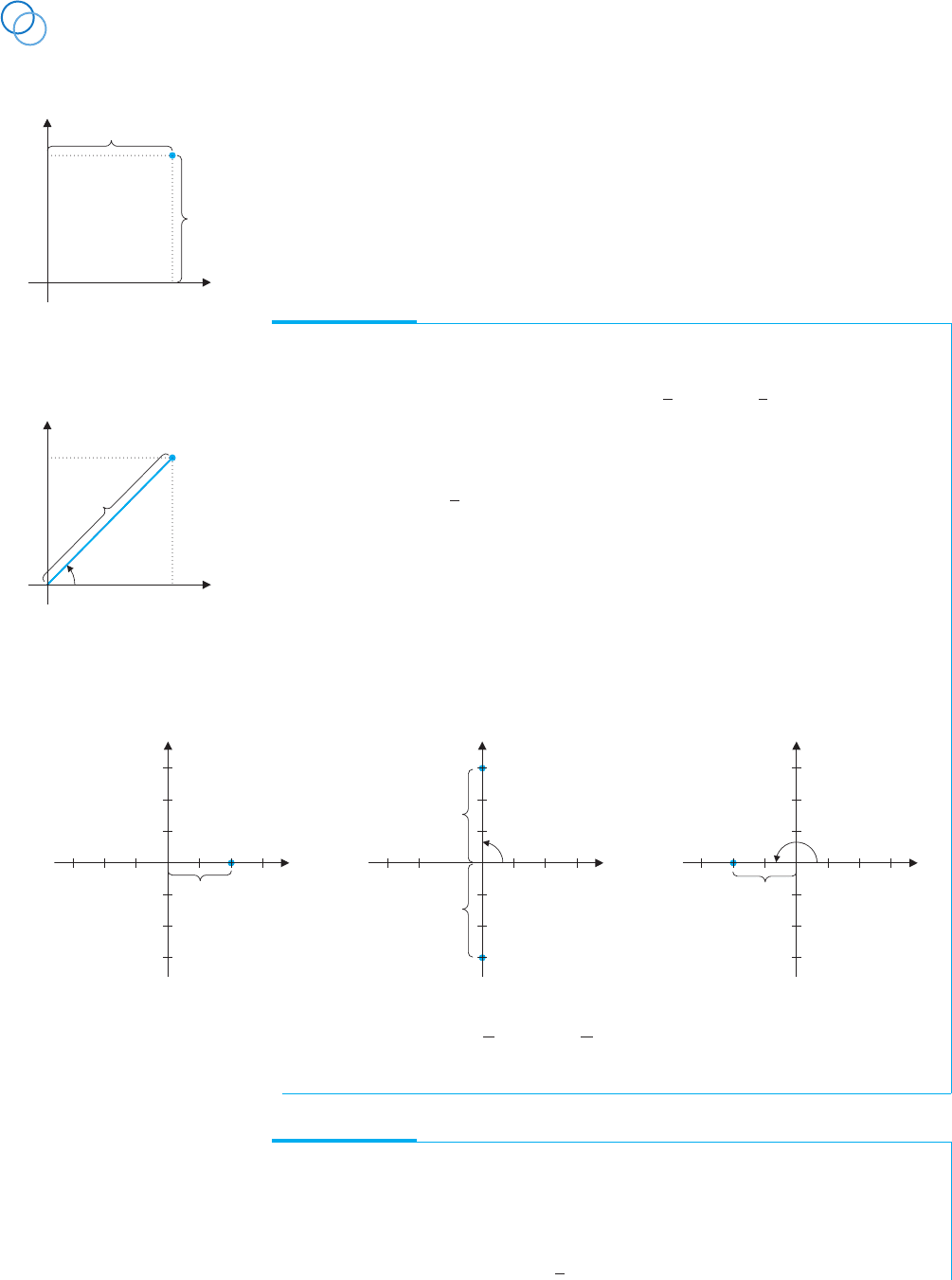
10.4 POLAR COORDINATES
The familiar x-y coordinate system is often referred to as a system of rectangular coordi-
nates, because a point is described in terms of its horizontal and vertical distances from the
origin. (See Figure 10.21.)
y
x
(x, y)
y
x
0
FIGURE 10.21
Rectangular coordinates
y
x
(r, u)
r
u
FIGURE 10.22
Polar coordinates
An alternative description of a point in the xy-plane consists of specifying the distance
r from the point to the origin and an angle θ (in radians) measured from the positive
x-axis counterclockwise to the ray connecting the point and the origin. (See Figure 10.22.)
We describe the point by the ordered pair (r,θ) and refer to r and θ as polar coordinates
for the point. For convenience, we allow r to be negative, with the understanding that in
this case, the point is in the opposite direction from that indicated by the angle θ.
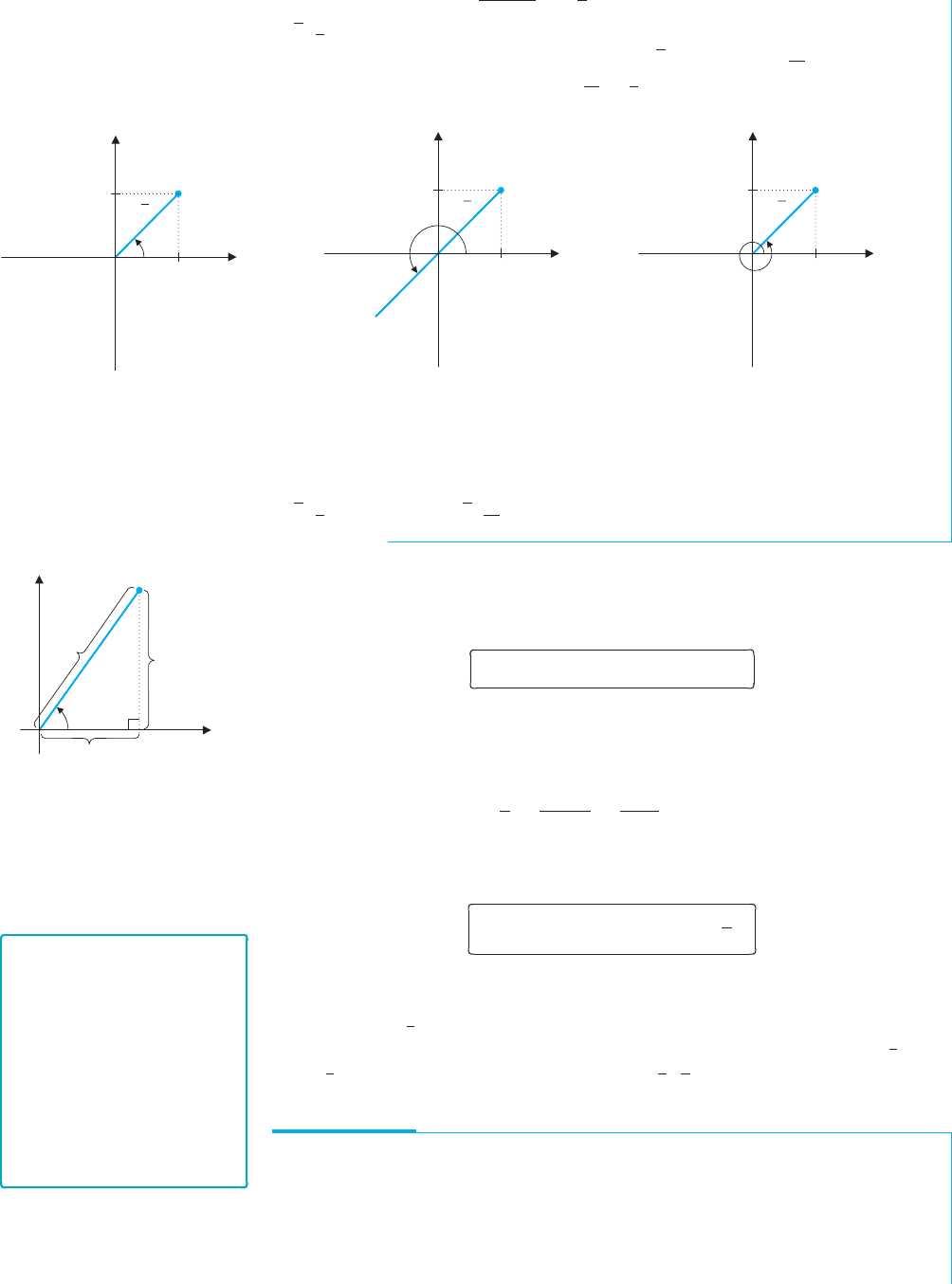
EXAMPLE 4.1 Plotting Points in Polar Coordinates
Plot the points with the indicated polar coordinates (r,θ) and determine the corresponding
rectangular coordinates (x, y) for: (a) (2, 0), (b) (3,
π
2
), (c) (−3,
π
2
) and (d) (2,π).
Solution (a) Notice that the angle θ = 0 locates the point on the positive x-axis.
At a distance of r = 2 units from the origin, this corresponds to the point (2, 0) in
rectangular coordinates. (See Figure 10.23a.)
(b) The angle θ =
π
2
locates points on the positive y-axis. At a distance of r = 3
units from the origin, this corresponds to the point (0, 3) in rectangular coordinates.
(See Figure 10.23b.)
(c) The angle is the same as in (b), but a negative value of r indicates that the point
is located 3 units in the opposite direction, at the point (0, −3) in rectangular
coordinates. (See Figure 10.23b.)
(d) The angle θ = π corresponds to the negative x-axis. The distance of r = 2
units from the origin gives us the point (−2, 0) in rectangular coordinates. (See
Figure 10.23c.)
y
x
(2, 0)
2
y
x
3
3
(
3, q
)
(
3, q
)
q
2
y
x
(2, p)
p
FIGURE 10.23a
The point (2, 0) in polar
coordinates
FIGURE 10.23b
The points
3,
π
2
and
−3,
π
2
in polar coordinates
FIGURE 10.23c
The point (2,π)in
polar coordinates
EXAMPLE 4.2 Converting from Rectangular
to Polar Coordinates
Find a polar coordinate representation of the rectangular point (1, 1).
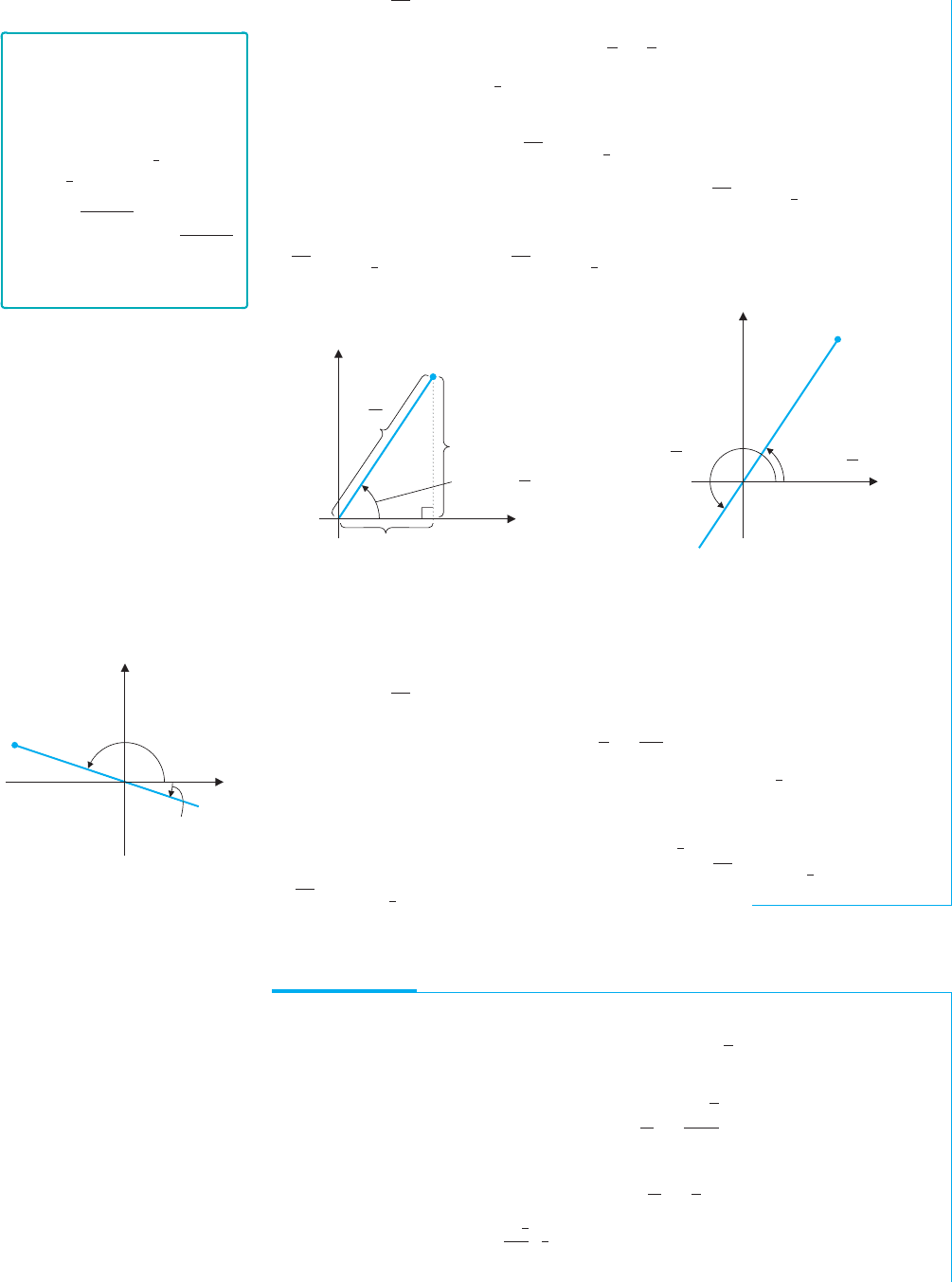
Solution From Figure 10.24a (on the following page), notice that the point lies on the
line y = x, which makes an angle of
π
4
with the positive x-axis. From the distance
P1: OSO/OVY P2: OSO/OVY QC: OSO/OVY T1: OSO
MHDQ256-Ch10 MHDQ256-Smith-v1.cls December 21, 2010 21:17
LT (Late Transcendental)
CONFIRMING PAGES
650 CHAPTER 10
..
Parametric Equations and Polar Coordinates 10-26
formula, we get that r =
√
1
2
+ 1
2
=
√
2. This says that we can write the point as
(
√
2,
π
4
) in polar coordinates. Referring to Figure 10.24b, notice that we can specify the
same point by using a negative value of r, r =−
√
2, with the angle
5π
4
. (Think about
this some.) Notice further, that the angle
9π
4
=
π
4
+ 2π corresponds to the
y
x
1
1
d
兹2
FIGURE 10.24a
Polar coordinates for the point (1, 1)
y
x
1
1
h
兹2
y
x
1
1
, d 2p
兹2
FIGURE 10.24b
An alternative polar
representation of (1, 1)
FIGURE 10.24c
Another polar representation
of the point (1, 1)
same ray shown in Figure 10.24a. (See Figure 10.24c.) In fact, all of the polar points
(
√
2,
π
4
+ 2nπ) and (−
√
2,
5π
4
+ 2nπ) for any integer n correspond to the same point in
the xy-plane.
y
x
(r, u)
r
x r cos u
y r sin u
u
FIGURE 10.25
Converting from polar to
rectangular coordinates
Referring to Figure 10.25, notice that it is a simple matter to find the rectangular coor-
dinates (x, y) of a point specified in polar coordinates as (r,θ). From the usual definitions
for sinθ and cos θ,weget
x = r cosθ and y = r sinθ. (4.1)
From equations (4.1), notice that for a point (x, y) in the plane,
x
2
+ y
2
= r
2
cos
2
θ +r
2
sin
2
θ = r
2
(cos
2
θ +sin
2
θ) = r
2
and for x = 0,
y
x
=
r sin θ
r cos θ
=
sinθ
cosθ
= tanθ.
That is, every polar coordinate representation (r,θ) of the point (x, y), where x = 0 must
satisfy
r
2
= x
2
+ y
2
and tanθ =
y
x
. (4.2)
Notice that since there’s more than one choice of r and θ , we cannot actually solve equa-
tions (4.2) to produce formulas for r and θ. In particular, while you might be tempted to
write θ = tan
−1
y
x
, this is not the only possible choice. Remember that for (r,θ)tobe
a polar representation of the point (x, y),θ can be any angle for which tanθ =
y
x
, while
tan
−1
y
x
gives you an angle θ in the interval
−
π
2
,
π
2
. Finding polar coordinates for a
given point is typically a process involving some graphing and some thought.
REMARK 4.1
As we see in example 4.2, each
point (x, y) in the plane has
infinitely many polar coordinate
representations. For a given
angle θ, the angles θ ± 2π,
θ ±4π and so on, all
correspond to the same ray. For
convenience, we use the
notation θ +2nπ (for any
integer n) to represent all of
these possible angles.
EXAMPLE 4.3 Converting from Rectangular to Polar Coordinates
Find all polar coordinate representations for the rectangular points (a) (2, 3) and
(b) (−3, 1).
Solution (a) With x = 2 and y = 3, we have from (4.2) that
r
2
= x
2
+ y
2
= 2
2
+ 3
2
= 13,
P1: OSO/OVY P2: OSO/OVY QC: OSO/OVY T1: OSO
MHDQ256-Ch10 MHDQ256-Smith-v1.cls December 21, 2010 21:17
LT (Late Transcendental)
CONFIRMING PAGES
10-27 SECTION 10.4
..
Polar Coordinates 651
so that r =±
√
13. Also,
tanθ =
y
x
=
3
2
.
One angle is then θ = tan
−1
3
2
≈ 0.98 radian. To determine which choice of r
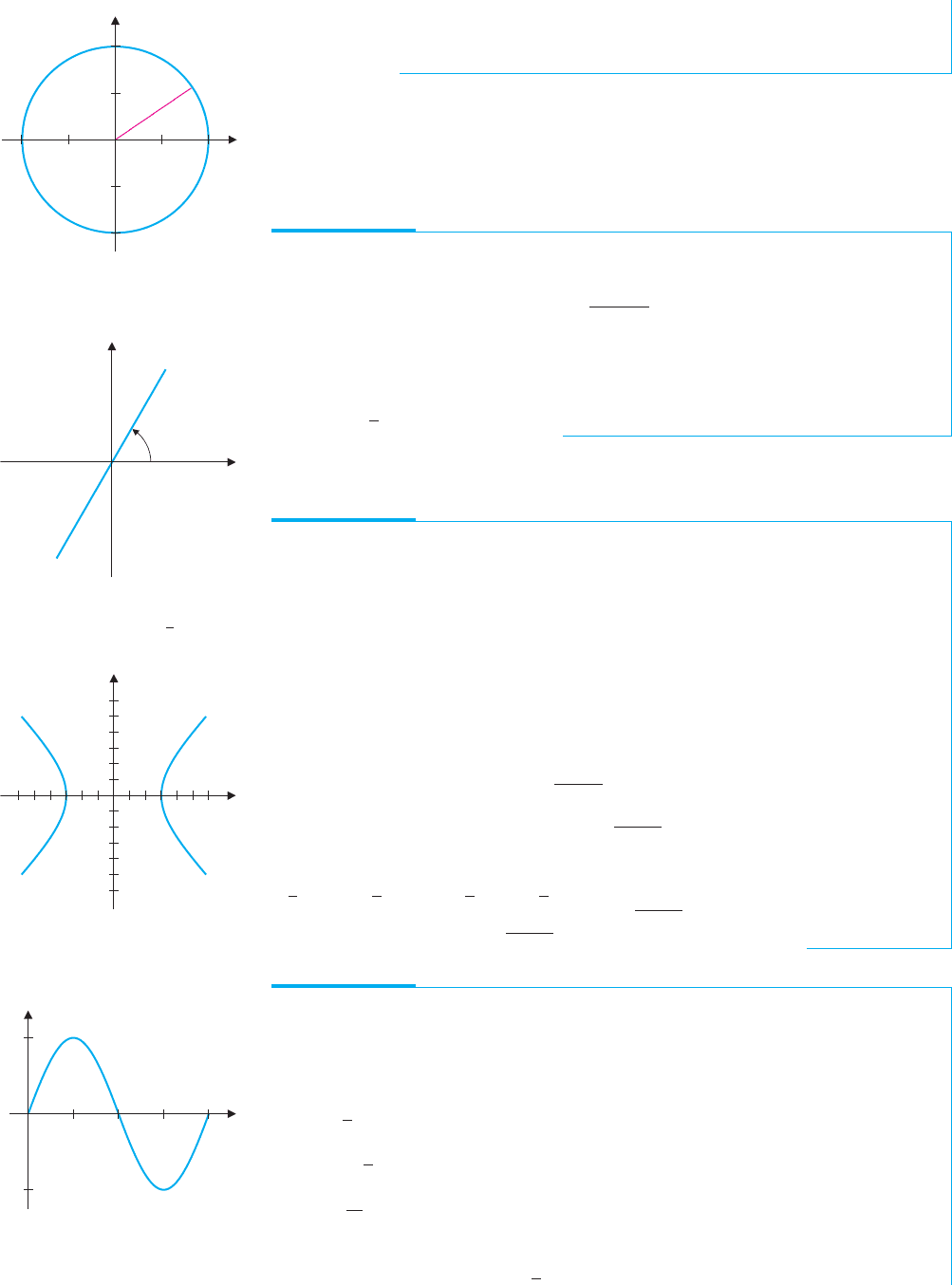
corresponds to this angle, note that (2, 3) is located in the first quadrant. (See Figure
10.26a.) Since 0.98 radian also puts you in the first quadrant, this angle corresponds to
the positive value of r, so that
√
13, tan
−1
3
2
is one polar representation of the point.
The negative choice of r corresponds to an angle one half-circle (i.e., π radians) away
(see Figure 10.26b), so that another representation is
−
√
13, tan
−1
3
2
+ π
. Every
other polar representation is found by adding multiples of 2π to the two angles used
above. That is, every polar representation of the point (2, 3) must have the form
√
13, tan
−1
3
2
+ 2nπ
or
−
√
13, tan
−1
3
2
+ π + 2nπ
, for some integer choice of n.
REMARK 4.2
Notice that for any point (x, y)
specified in rectangular
coordinates (x = 0), we can
always write the point in polar
coordinates using either of the
polar angles tan
−1
y
x
or
tan
−1
y
x
+ π. You can deter-
mine which angle corresponds
to r =
x
2
+ y
2
and which
corresponds to r =−
x
2
+ y
2
by looking at the quadrant in
which the point lies.
y
x
兹13
u tan
1
( )
3
2
(2, 3)
3
2
y
x
p
(2, 3)
u tan
1
( )
3
2
u tan
1
( )
3
2
FIGURE 10.26a
The point (2, 3)
FIGURE 10.26b
Negative value of r
(b) For the point (−3, 1), we have x =−3 and y = 1. From (4.2), we have
r
2
= x
2
+ y
2
= (−3)
2
+ 1
2
= 10,
so that r =±
√
10. Further,
tanθ =
y
x
=
1
−3
,
so that the most obvious choice for the polar angle is θ = tan
−1
−
1
3
≈−0.32, which
lies in the fourth quadrant. Since the point (−3, 1) is in the second quadrant, this choice
of the angle corresponds to the negative value of r. (See Figure 10.27.) The positive
value of r then corresponds to the angle θ = tan
−1
−
1
3
+ π . Observe that all polar
coordinate representations must then be of the form
−
√
10, tan
−1
−
1
3
+ 2nπ
or
√
10, tan
−1
−
1
3
+ π + 2nπ
, for some integer choice of n.
y
x
u tan
1
(
W
)
(3, 1)
u tan
1
(
W
)
p
FIGURE 10.27
The point (−3, 1)
The conversion from polar coordinates to rectangular coordinates is completely
straightforward, as seen in example 4.4.
EXAMPLE 4.4 Converting from Polar to Rectangular Coordinates
Find the rectangular coordinates for the polar points (a)
3,
π
6
and (b) (−2, 3).
Solution For (a), we have from (4.1) that
x = r cosθ = 3cos
π
6
=
3
√
3
2
and y = r sinθ = 3 sin
π
6
=
3
2
.
The rectangular point is then
3
√
3
2
,
3
2
. For (b), we have
x = r cosθ =−2cos3 ≈ 1.98
P1: OSO/OVY P2: OSO/OVY QC: OSO/OVY T1: OSO
MHDQ256-Ch10 MHDQ256-Smith-v1.cls December 21, 2010 21:17
LT (Late Transcendental)
CONFIRMING PAGES
652 CHAPTER 10
..
Parametric Equations and Polar Coordinates 10-28
and y = r sinθ =−2sin 3 ≈−0.28.
The rectangular point is then (−2cos 3, −2sin 3), which is located at approximately
(1.98, −0.28).
The graph of a polar equation r = f (θ) is the set of all points (x, y) for which
x = r cosθ, y = r sinθ and r = f (θ). In other words, the graph of a polar equation is
a graph in the xy-plane of all those points whose polar coordinates satisfy the given equa-
tion. We begin by sketching two very simple (and familiar) graphs. The key to drawing the
graph of a polar equation is to always keep in mind what the polar coordinates represent.
EXAMPLE 4.5 Some Simple Graphs in Polar Coordinates
Sketch the graphs of (a) r = 2 and (b) θ = π/3.
Solution For (a), notice that 2 = r =
x
2
+ y
2
and so, we want all points whose
distance from the origin is 2 (with any polar angle θ). Of course, this is the definition of
a circle of radius 2 with center at the origin. (See Figure 10.28a.) For (b), notice that
θ = π/3 specifies all points with a polar angle of π/3 from the positive x-axis (at any
distance r from the origin). Including negative values for r, this defines a line with slope
tanπ/3 =
√
3. (See Figure 10.28b.)
y
2
2
2
2
x
r 2
FIGURE 10.28a
The circle r = 2
y
x
u
FIGURE 10.28b
The line θ =
π
3
It turns out that many familiar curves have simple polar equations.
EXAMPLE 4.6 Converting an Equation from Rectangular
to Polar Coordinates
Find the polar equation(s) corresponding to the hyperbola x
2
− y
2
= 9. (See Figure
10.29.)
y
x
2 4 6246
2
4
6
2
4
6
FIGURE 10.29
x
2
− y
2
= 9
Solution From (4.1), we have
9 = x
2
− y
2
= r
2
cos
2
θ −r
2
sin
2
θ
= r
2
(cos
2
θ −sin
2
θ) = r
2
cos2θ.
Solving for r,weget
r
2
=
9
cos2θ
= 9sec2θ,
so that
r =±3
√
sec2θ.
Notice that in order to keep sec2θ>0, we can restrict 2θ to lie in the interval
−
π
2
< 2θ<
π
2
, so that −
π
4
<θ<
π
4
. Observe that with this range of values of θ, the
hyperbola is drawn exactly once, where r = 3
√
sec2θ corresponds to the right branch
of the hyperbola and r =−3
√
sec2θ corresponds to the left branch.
EXAMPLE 4.7 A Surprisingly Simple Polar Graph
Sketch the graph of the polar equation r = sinθ.
Solution For reference, we first sketch a graph of the sine function in rectangular
coordinates on the interval [0, 2π ]. (See Figure 10.30a.) Notice that on the interval
0 ≤ θ ≤
π
2
, sin θ increases from 0 to its maximum value of 1. This corresponds to a
polar arc in the first quadrant from the origin (r = 0) to 1 unit up on the y-axis. Then, on
the interval
π
2
≤ θ ≤ π, sinθ decreases from 1 to 0, corresponding to an arc in the
second quadrant, from 1 unit up on the y-axis back to the origin. Next, on the interval
π ≤ θ ≤
3π
2
, sin θ decreases from 0 to its minimum value of −1. Since the values of r
are negative, remember that this means that the points are plotted in the opposite
quadrant (i.e., the first quadrant), tracing out the same curve in the first quadrant as
we’ve already drawn for 0 ≤ θ ≤
π
2
. Likewise, taking θ in the interval
y
x
1
1
q wp
2p
FIGURE 10.30a
y = sin x plotted in rectangular
coordinates