
Smith R., Minton R. Calculus
Подождите немного. Документ загружается.

P1: OSO/OVY P2: OSO/OVY QC: OSO/OVY T1: OSO
MHDQ256-Ch10 MHDQ256-Smith-v1.cls December 21, 2010 21:17
LT (Late Transcendental)
CONFIRMING PAGES
10-29 SECTION 10.4
..
Polar Coordinates 653
y
x
11
1
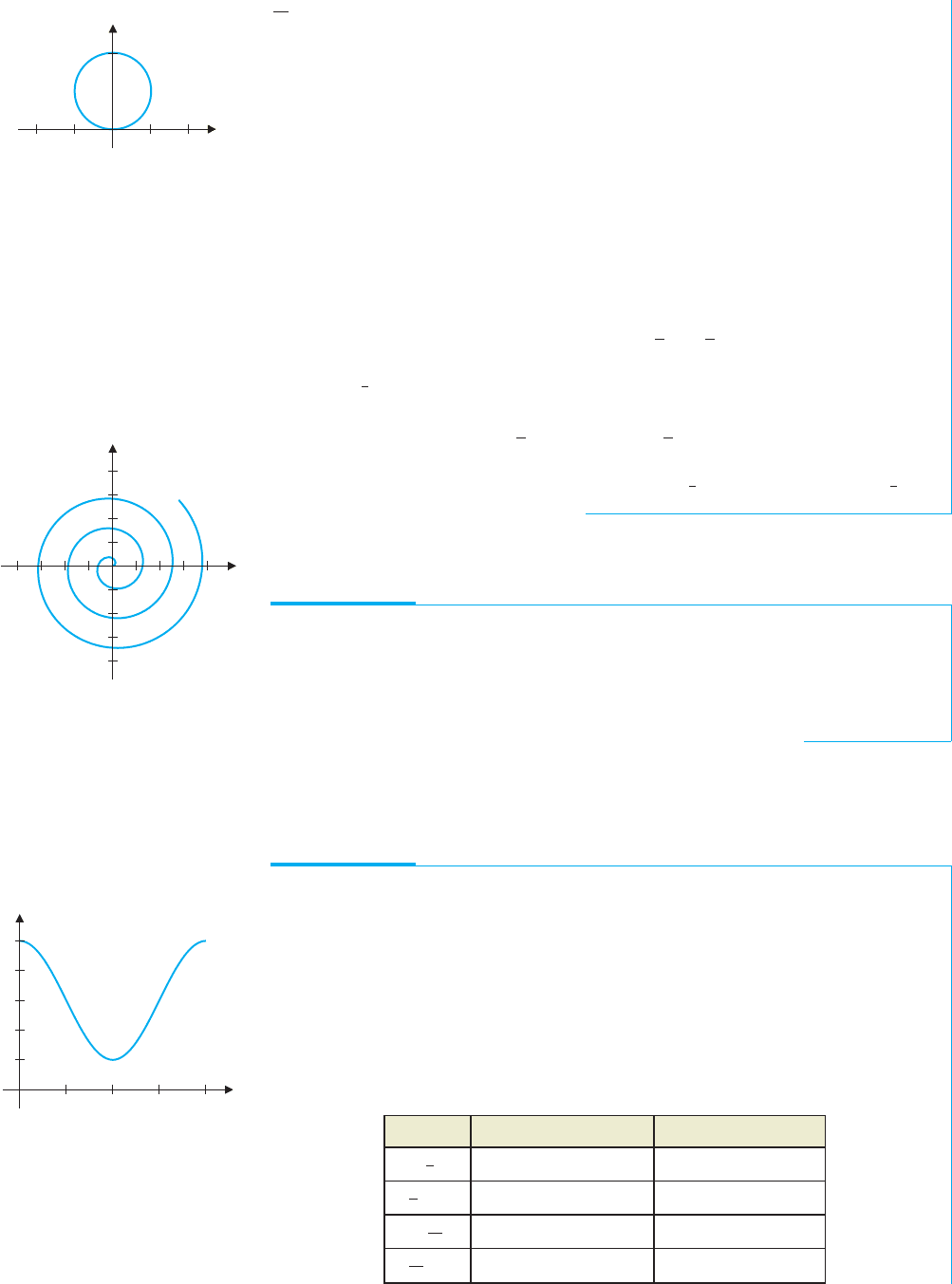
FIGURE 10.30b
The circle r = sinθ
3π
2
≤ θ ≤ 2π retraces the portion of the curve in the second quadrant. Since sinθ is
periodic of period 2π, taking further values of θ simply retraces portions of the curve
that we have already drawn. A sketch of the polar graph is shown in Figure 10.30b. We
now verify that this curve is actually a circle. Multiplying the polar equation through by
r,weget
r
2
= r sinθ.
From (4.1) and (4.2) we have that y = r sinθ and r
2
= x
2
+ y
2
, which gives us the
rectangular equation
x
2
+ y
2
= y
or
0 = x
2
+ y
2
− y.
Completing the square, we get
0 = x
2
+
y
2
− y +
1
4
−
1
4
and adding
1
4
to both sides, we get
1
2
2
= x
2
+
y −
1
2
2
.
This is the rectangular equation for the circle of radius
1
2
centered at the point
0,
1
2
,
which is what we see in Figure 10.30b.
y
x
2020
20
20
FIGURE 10.31
The spiral r = θ,θ ≥ 0
The graphs of many polar equations are not the graphs of any functions of the form
y = f (x), as in example 4.8.
EXAMPLE 4.8 An Archimedian Spiral
Sketch the graph of the polar equation r = θ, for θ ≥ 0.
Solution Notice that here, as θ increases, so too does r. That is, as the polar angle
increases, the distance from the origin also increases accordingly. This produces the
spiral (an example of an Archimedian spiral) seen in Figure 10.31.
The graphs shown in examples 4.9, 4.10 and 4.11 are all in the general class known
as lima¸cons. This class of graphs is defined by r = a ± b sinθ or r = a ± b cosθ,
for positive constants a and b.Ifa = b, the graphs are called cardioids.
EXAMPLE 4.9 A Limac¸on
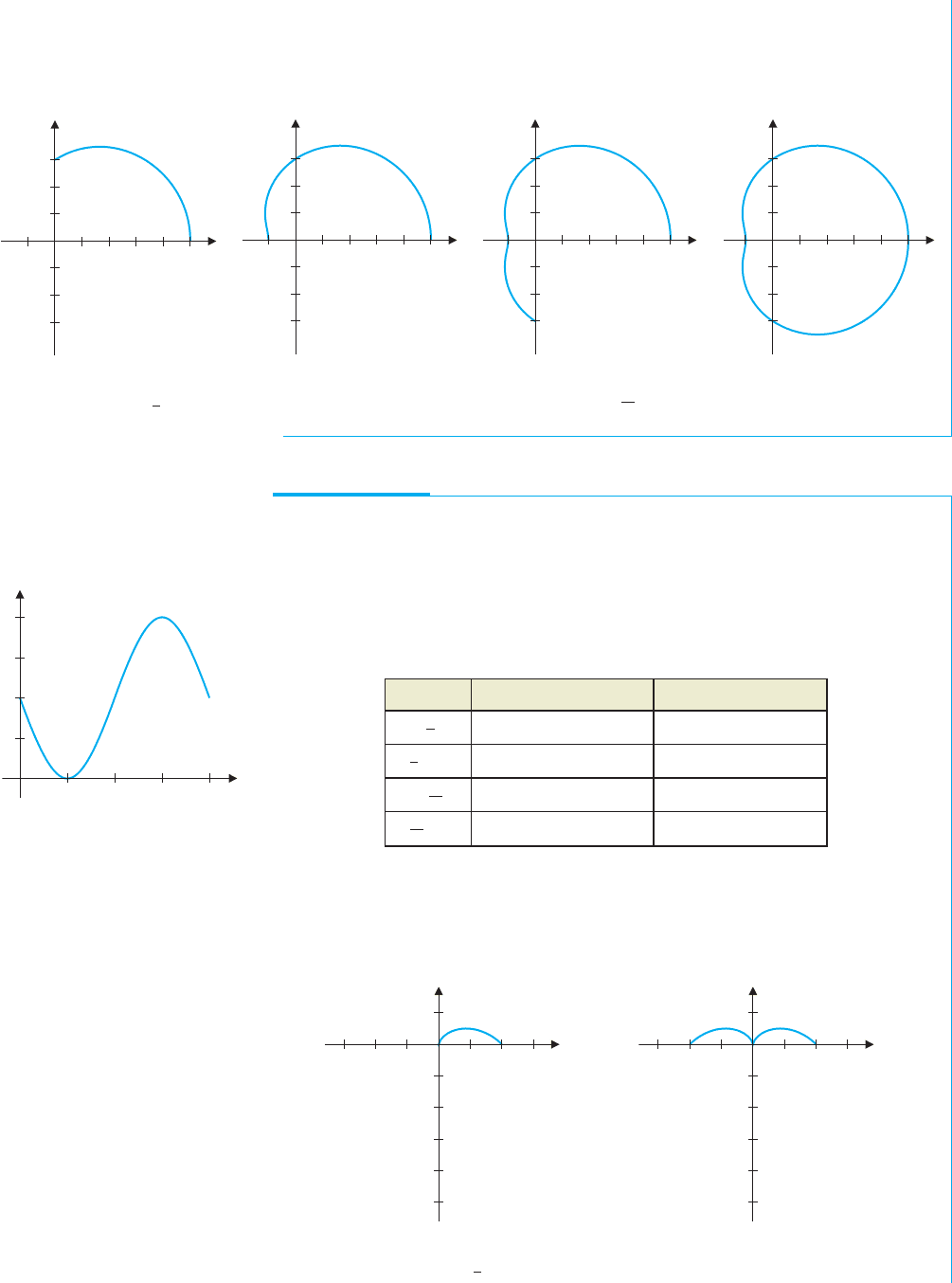
Sketch the graph of the polar equation r = 3 +2cos θ.
Solution We begin by sketching the graph of y = 3 +2cos x in rectangular
coordinates on the interval [0, 2π], to use as a reference. (See Figure 10.32.) Notice that
in this case, we have r = 3 +2cos θ>0 for all values of θ. Further, the maximum
value of r is 5 (corresponding to when cosθ = 1atθ = 0, 2π , etc.) and the minimum
value of r is 1 (corresponding to when cosθ =−1atθ = π, 3π, etc.). In this case, the
polar graph is traced out with 0 ≤ θ ≤ 2π . We summarize the intervals of increase and
decrease for r in the following table.
y
x
1
2
3
4
5
q wp 2p
FIGURE 10.32
y = 3 +2 cos x in rectangular
coordinates
Interval cos θ r 3 2 cos θ
0,
π
2
Decreases from 1 to 0 Decreases from 5 to 3
π
2
,π
Decreases from 0 to −1 Decreases from 3 to 1
π,
3π
2
Increases from −1to0 Increases from 1 to 3
3π
2
, 2π
Increases from 0 to 1 Increases from 3 to 5
P1: OSO/OVY P2: OSO/OVY QC: OSO/OVY T1: OSO
MHDQ256-Ch10 MHDQ256-Smith-v1.cls December 21, 2010 21:17
LT (Late Transcendental)
CONFIRMING PAGES
654 CHAPTER 10
..
Parametric Equations and Polar Coordinates 10-30
In Figures 10.33a–10.33d, we show how the sketch progresses through each interval
indicated in the table, with the completed figure (called a lima¸con) shown in
Figure 10.33d.
1 2 3 451
3
2
1
1
2
3
y
x
1 2 3 45
3
2
1
1
2
3
y
x
1 2 3 4 5
3
2
1
1
2
3
y
x
FIGURE 10.33b
0 ≤ θ ≤ π
FIGURE 10.33c
0 ≤ θ ≤
3π
2
FIGURE 10.33d
0 ≤ θ ≤ 2π
1 2 3 45
3
2
1
1
2
3
y
x
1
FIGURE 10.33a
0 ≤ θ ≤
π
2
EXAMPLE 4.10 The Graph of a Cardioid
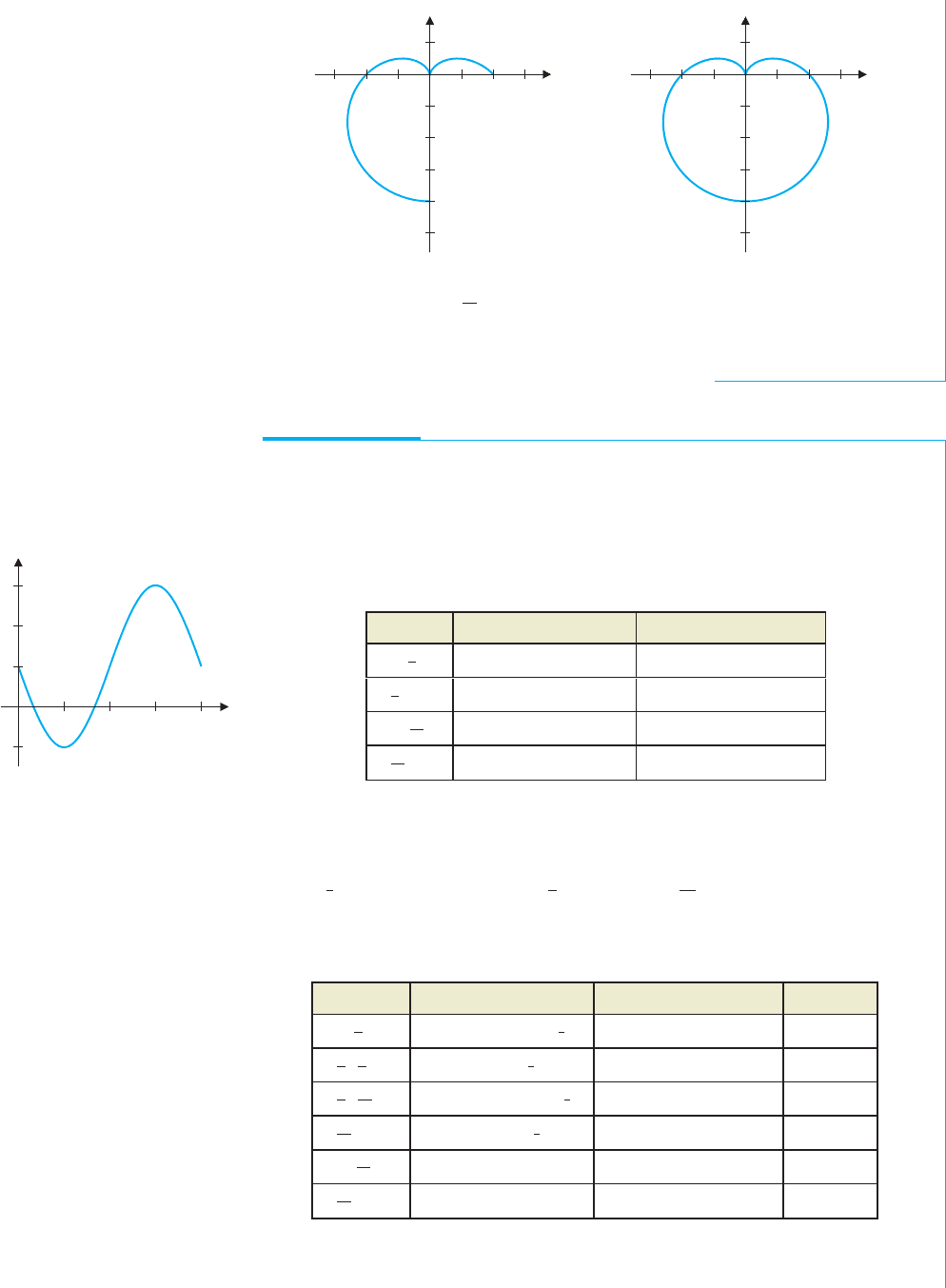
Sketch the graph of the polar equation r = 2 −2sin θ.
Solution As we have done several times now, we first sketch a graph of
y = 2 −2 sin x in rectangular coordinates, on the interval [0, 2π ], as in Figure 10.34.
We summarize the intervals of increase and decrease in the following table.
y
x
1
2
3
4
q wp 2p
FIGURE 10.34
y = 2 −2 sin x in rectangular
coordinates
Interval sin θ r 2− 2 sin θ
0,
π
2
Increases from 0 to 1 Decreases from 2 to 0
π
2
,π
Decreases from 1 to 0 Increases from 0 to 2
π,
3π
2
Decreases from 0 to −1 Increases from 2 to 4
3π
2
, 2π
Increases from −1to0 Decreases from 4 to 2
Again, we sketch the graph in stages, corresponding to each of the intervals indicated in
the table, as seen in Figures 10.35a–10.35d.
y
x
1 2 3123
5
3
4
2
1
1
y
x
1 2 3123
5
3
4
2
1
1
FIGURE 10.35a
0 ≤ θ ≤
π
2
FIGURE 10.35b
0 ≤ θ ≤ π
P1: OSO/OVY P2: OSO/OVY QC: OSO/OVY T1: OSO
MHDQ256-Ch10 MHDQ256-Smith-v1.cls December 21, 2010 21:17
LT (Late Transcendental)
CONFIRMING PAGES
10-31 SECTION 10.4
..
Polar Coordinates 655
y
x
1 2 3123
5
3
4
2
1
1
y
x
1 2 3123
5
3
4
2
1
1
FIGURE 10.35c
0 ≤ θ ≤
3π
2
FIGURE 10.35d
0 ≤ θ ≤ 2π
The completed graph appears in Figure 10.35d and is sketched out for 0 ≤ θ ≤ 2π.You
can see why this figure is called a cardioid (“heartlike”).
EXAMPLE 4.11 The Graph of a Limac¸on with a Loop
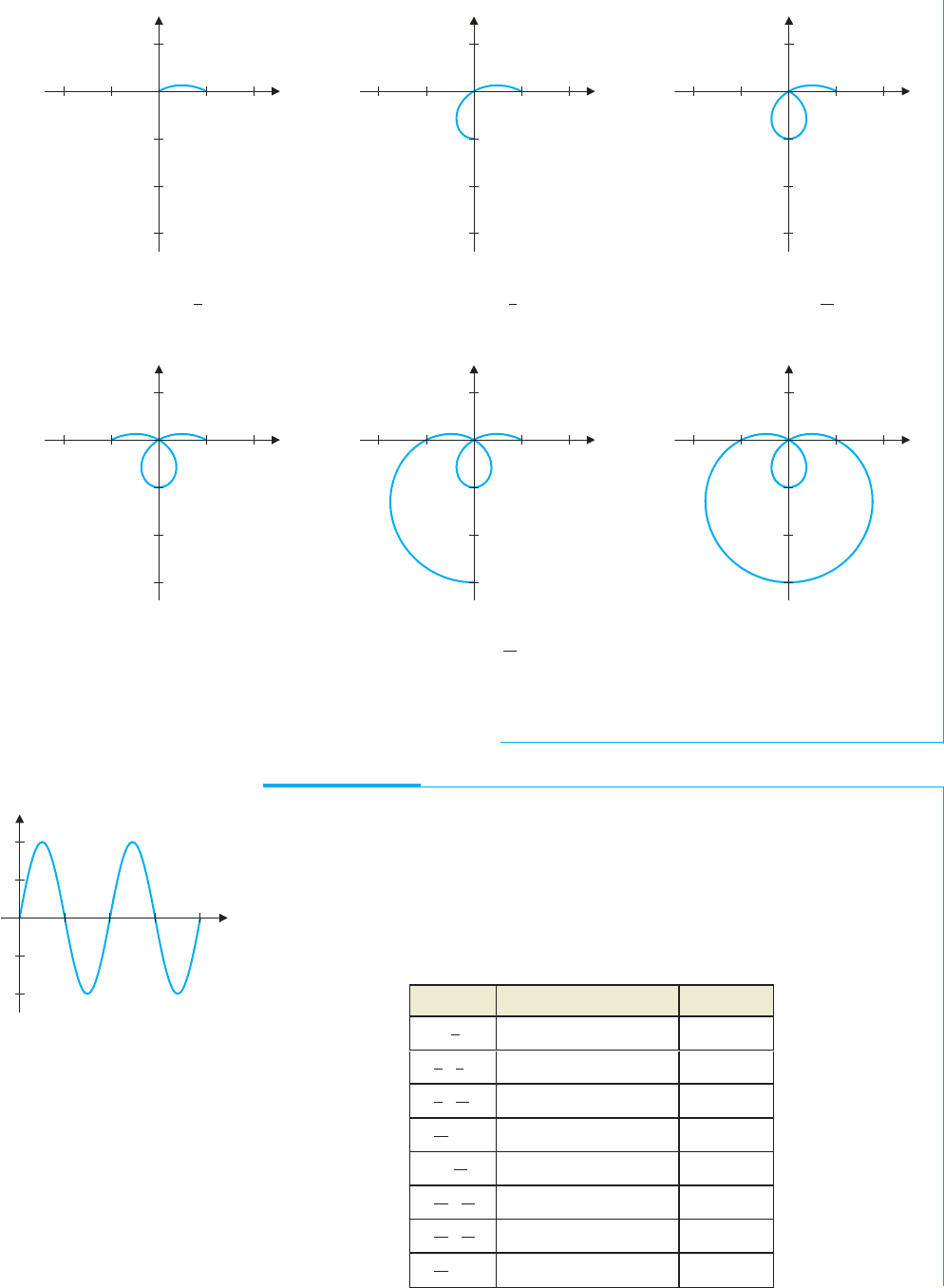
Sketch the graph of the polar equation r = 1 −2sin θ.
Solution We again begin by sketching a graph of y = 1 −2sin x in rectangular
coordinates, as in Figure 10.36. We summarize the intervals of increase and decrease in
the following table.
y
x
1
2
3
q wp 2p
1
FIGURE 10.36
y = 1 −2 sin x in rectangular
coordinates
Interval sin θ r 1 − 2 sin θ
0,
π
2
Increases from 0 to 1 Decreases from 1 to −1
π
2
,π
Decreases from 1 to 0 Increases from −1to1
π,
3π
2
Decreases from 0 to −1 Increases from 1 to 3
3π
2
, 2π
Increases from −1to0 Decreases from 3 to 1
Notice that since r assumes both positive and negative values in this case, we need to
exercise a bit more caution, as negative values for r cause us to draw that portion of the
graph in the opposite quadrant. Observe that r = 0 when 1 −2sin θ = 0, that is, when
sinθ =
1
2
. This will occur when θ =
π
6
and when θ =
5π
6
. For this reason, we expand
the above table, to include more intervals and where we also indicate the quadrant
where the graph is to be drawn, as follows:
Interval sin θ r 1 − 2sin θ Quadrant
0,
π
6
Increases from 0 to
1
2
Decreases from 1 to 0 First
π
6
,
π
2
Increases from
1
2
to 1 Decreases from 0 to −1 Third
π
2
,
5π
6
Decreases from 1 to
1
2
Increases from −1to0 Fourth
5π
6
,π
Decreases from
1
2
to 0 Increases from 0 to 1 Second
π,
3π
2
Decreases from 0 to −1 Increases from 1 to 3 Third
3π
2
, 2π
Increases from −1to0 Decreases from 3 to 1 Fourth
We sketch the graph in stages in Figures 10.37a–10.37f (on the following page),
corresponding to each of the intervals indicated in the table.
P1: OSO/OVY P2: OSO/OVY QC: OSO/OVY T1: OSO
MHDQ256-Ch10 MHDQ256-Smith-v1.cls December 21, 2010 21:17
LT (Late Transcendental)
CONFIRMING PAGES
656 CHAPTER 10
..
Parametric Equations and Polar Coordinates 10-32
y
x
2112
1
3
2
1
y
x
2112
1
3
2
1
y
x
2112
1
3
2
1
FIGURE 10.37a
0 ≤ θ ≤
π
6
FIGURE 10.37b
0 ≤ θ ≤
π
2
FIGURE 10.37c
0 ≤ θ ≤
5π
6
y
x
2112
1
3
2
1
y
x
2112
1
3
2
1
y
x
2112
1
3
2
1
FIGURE 10.37d
0 ≤ θ ≤ π
FIGURE 10.37e
0 ≤ θ ≤
3π
2
FIGURE 10.37f
0 ≤ θ ≤ 2π
The completed graph appears in Figure 10.37f and is sketched out for 0 ≤ θ ≤ 2π.You
should observe from this the importance of determining where r = 0, as well as where r
is increasing and decreasing.
EXAMPLE 4.12 A Four-Leaf Rose
Sketch the graph of the polar equation r = sin2θ.
Solution As usual, we will first draw a graph of y = sin2x in rectangular coordinates
on the interval [0, 2π ], as seen in Figure 10.38. Notice that the period of sin2θ is only
π. We summarize the intervals on which the function is increasing and decreasing in the
following table.
Interval r sin 2θ Quadrant
0,
π
4
Increases from 0 to 1 First
π
4
,
π
2
Decreases from 1 to 0 First
π
2
,
3π
4
Decreases from 0 to −1 Fourth
3π
4
,π
Increases from −1to0 Fourth
π,
5π
4
Increases from 0 to 1 Third
5π
4
,
3π
2
Decreases from 1 to 0 Third
3π
2
,
7π
4
Decreases from 0 to −1 Second
7π
4
, 2π
Increases from −1to0 Second
y
x
1
1
q wp
2p
FIGURE 10.38
y = sin 2x in rectangular
coordinates
P1: OSO/OVY P2: OSO/OVY QC: OSO/OVY T1: OSO
MHDQ256-Ch10 MHDQ256-Smith-v1.cls December 21, 2010 21:17
LT (Late Transcendental)
CONFIRMING PAGES
10-33 SECTION 10.4
..
Polar Coordinates 657
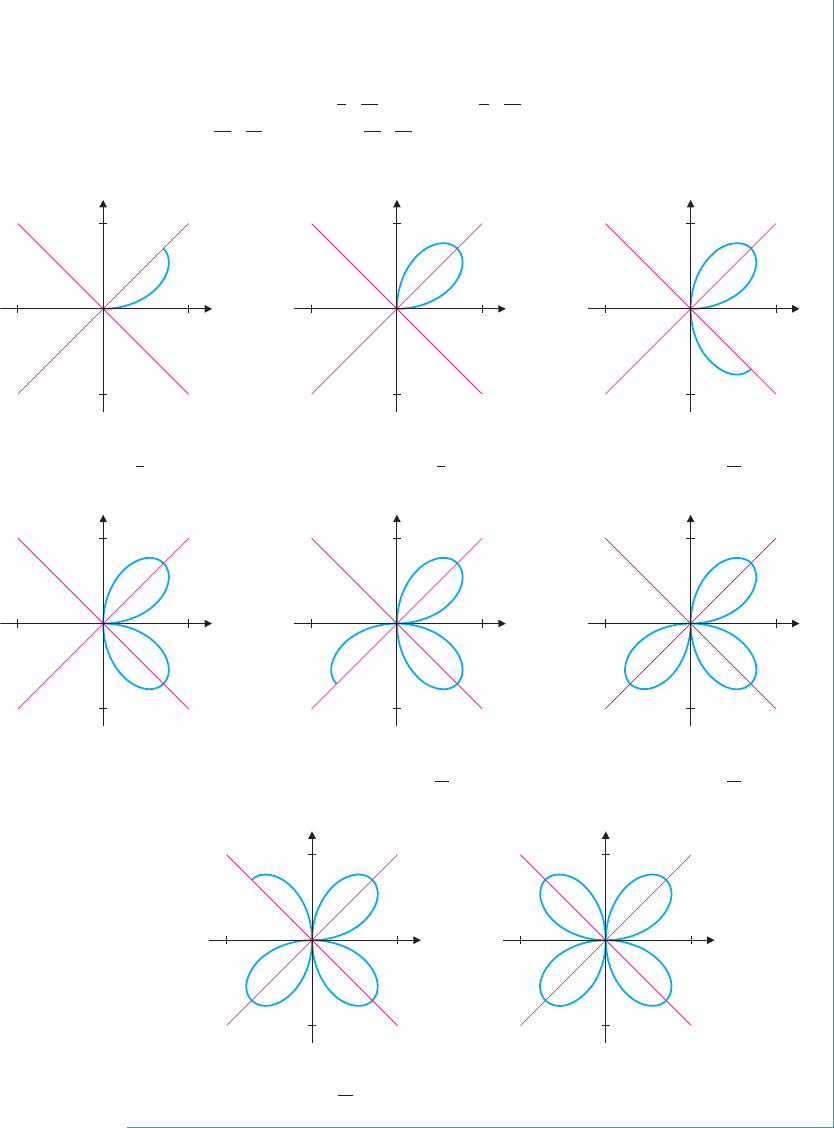
We sketch the graph in stages in Figures 10.39a–10.39h, corresponding to the intervals
indicated in the table, where we have also indicated the lines y =±x, as a guide.
This is an interesting curve known as a four-leaf rose. Notice again the significance
of the points corresponding to r = 0, or sin2θ = 0. Also, notice that r reaches a
maximum of 1 when 2θ =
π
2
,
5π
2
,...or θ =
π
4
,
5π
4
,...and r reaches a minimum of −1
when 2θ =
3π
2
,
7π
2
,...or θ =
3π
4
,
7π
4
,.... Again, you must keep in mind that when r is
negative, we draw the graph in the opposite quadrant.
y
x
11
1
1
y
x
11
1
1
y
x
11
1
1
FIGURE 10.39a
0 ≤ θ ≤
π
4
FIGURE 10.39b
0 ≤ θ ≤
π
2
FIGURE 10.39c
0 ≤ θ ≤
3π
4
y
x
11
1
1
y
x
11
1
1
y
x
11
1
1
FIGURE 10.39d
0 ≤ θ ≤ π
FIGURE 10.39e
0 ≤ θ ≤
5π
4
FIGURE 10.39f
0 ≤ θ ≤
3π
2
y
x
11
1
1
y
x
11
1
1
FIGURE 10.39g
0 ≤ θ ≤
7π
4
FIGURE 10.39h
0 ≤ θ ≤ 2π
Note that in example 4.12, even though the period of the function sin2θ is π , it took
θ-values ranging from 0 to 2π to sketch the entire curve r = sin2θ . By contrast, the period
of the function sinθ is 2π, but the circle r = sinθ in example 4.7 was completed with
0 ≤ θ ≤ π . To determine the range of values of θ that produces a graph, you need to
carefully identify important points as we did in example 4.12. The Trace feature found on
graphing calculators can be very helpful for getting an idea of the θ-range, but remember
that such Trace values are only approximate.
You will explore a variety of other interesting graphs in the exercises.
P1: OSO/OVY P2: OSO/OVY QC: OSO/OVY T1: OSO
MHDQ256-Ch10 MHDQ256-Smith-v1.cls December 21, 2010 21:17
LT (Late Transcendental)
CONFIRMING PAGES
658 CHAPTER 10
..
Parametric Equations and Polar Coordinates 10-34
BEYOND FORMULAS
The graphics in Figures 10.35, 10.37 and 10.39 provide a good visual model of how
to think of polar graphs. Most polar graphs r = f (θ) can be sketched as a sequence
of connected arcs, where the arcs start and stop at places where r = 0 or where a
new quadrant is entered. By breaking the larger graph into small arcs, you can use the
properties of f to determine where each arc starts and stops.
EXERCISES 10.4
WRITING EXERCISES
1. Suppose a point has polar representation (r,θ). Explain why
another polar representation of the same point is (−r,θ + π).
2. Afterworkingwithrectangularcoordinatesforsolong,theidea
ofpolar representations mayseem slightly awkward.However,
polar representations are entirely natural in many settings. For
instance, if you were on a ship at sea and another ship was ap-
proaching you, explain whether you would use a polar repre-
sentation(distanceand bearing) orarectangular representation
(distance east-west and distance north-south).
3. In example 4.7, the graph (a circle) of r = sinθ is completely
traced out with 0 ≤ θ ≤ π . Explain why graphing r = sin θ
with π ≤ θ ≤ 2π would produce the same full circle.
4. Two possible advantages of introducing a new coordinate sys-
tem are making previousproblemseasier to solve and allowing
new problems to be solved. Give two examples of graphs for
which the polar equation is simpler than the rectangular equa-
tion. Give two examples of polar graphs for which you have
not seen a rectangular equation.
In exercises 1–6, plot the given polar points (r,θ) and find their
rectangular representation.
1. (2, 0) 2. (2,π) 3. (−2,π)
4.
−3,
3π
2
5. (3, −π) 6.
5, −
π
2
............................................................
In exercises 7–12, find all polar coordinate representations of
the given rectangular point.
7. (2, −2) 8. (−1, 1) 9. (0, 3)
10. (2, −1) 11. (3, 4) 12. (−2, −
√
5)
............................................................
In exercises 13–18, find rectangular coordinates for the given
polar point.
13.
2, −
π
3
14.
−1,
π
3
15. (0, 3)
16.
3,
π
8
17.
4,
π
10
18. (−3, 1)
............................................................
In exercises 19–26, sketch the graph of the polar equation and
find a corresponding x-y equation.
19. r = 4 20. r =
√
3 21. θ = π/6
22. θ = 3π/4 23. r = cosθ 24. r = 2cosθ
25. r = 3sinθ 26. r = 2 sin θ
............................................................
In exercises 27–40, sketch the graph and identify all values of θ
where r 0 and a range of values of θ that produces one copy
of the graph.
27. r = cos2θ 28. r = cos 3θ
29. r = sin3θ 30. r = sin2θ
31. r = 3 +2sinθ 32. r = 2 − 2 cos θ
33. r = 2 −4sinθ 34. r = 2 + 4 cos θ
35. r = 2 +2sinθ 36. r = 3 − 6 cos θ
37. r =
1
4
θ 38. r = e
θ/4
39. r = 2cos(θ − π/4) 40. r = 2sin(3θ − π)
............................................................
In exercises 41–50, sketch the graph and identify all values of θ
where r 0.
41. r = cosθ + sinθ 42. r = cos θ +sin 2θ
43. r = tan
−1
2θ 44. r = θ/
√
θ
2
+ 1
45. r = 2 +4cos3θ 46. r = 2 − 4 sin4θ
47. r =
2
1 + sin θ
48. r =
3
1 − sin θ
49. r =
2
1 + cos θ
50. r =
3
1 − cos θ
............................................................
In exercises 51–56, find a polar equation corresponding to the
given rectangular equation.
51. y
2
− x
2
= 4 52. x
2
+ y
2
= 9
53. x
2
+ y
2
= 16 54. x
2
+ y
2
= x
55. y = 3 56. x = 2
............................................................
P1: OSO/OVY P2: OSO/OVY QC: OSO/OVY T1: OSO
MHDQ256-Ch10 MHDQ256-Smith-v1.cls December 21, 2010 21:17
LT (Late Transcendental)
CONFIRMING PAGES
10-35 SECTION 10.4
..
Polar Coordinates 659
In exercises 57–62, sketch the graph for several different values
of a and describe the effects of changing a.
57. r = a cosθ 58. r = a sin θ
59. r = cos(aθ) 60. r = sin(aθ)
61. r = 1 +a cosθ 62. r = 1 +a sinθ
............................................................
63. Graph r = 4cos θ sin
2
θ and explain why there is no curve to
the left of the y-axis.
64. Graph r = θ cosθ for −2π ≤ θ ≤ 2π. Explain why this is
called the Garfield curve.
GARFIELD
c
2005 Paws, Inc. Reprinted with permission
of UNIVERSAL PRESS SYNDICATE. All rights reserved.
65. Sketch the graph of r = cos
11
12
θ first for 0 ≤ θ ≤ π, then
for 0 ≤ θ ≤ 2π , then for 0 ≤ θ ≤ 3π,..., and finally for
0 ≤ θ ≤ 24π. Discuss any patterns that you find and predict
what will happen for larger domains.
66. Sketch the graph of r = cos πθ first for 0 ≤ θ ≤ 1, then for
0 ≤ θ ≤ 2, then for 0 ≤ θ ≤ 3,... and finally for 0 ≤ θ ≤ 20.
Discussanypatterns that you find andpredict whatwill happen
for larger domains.
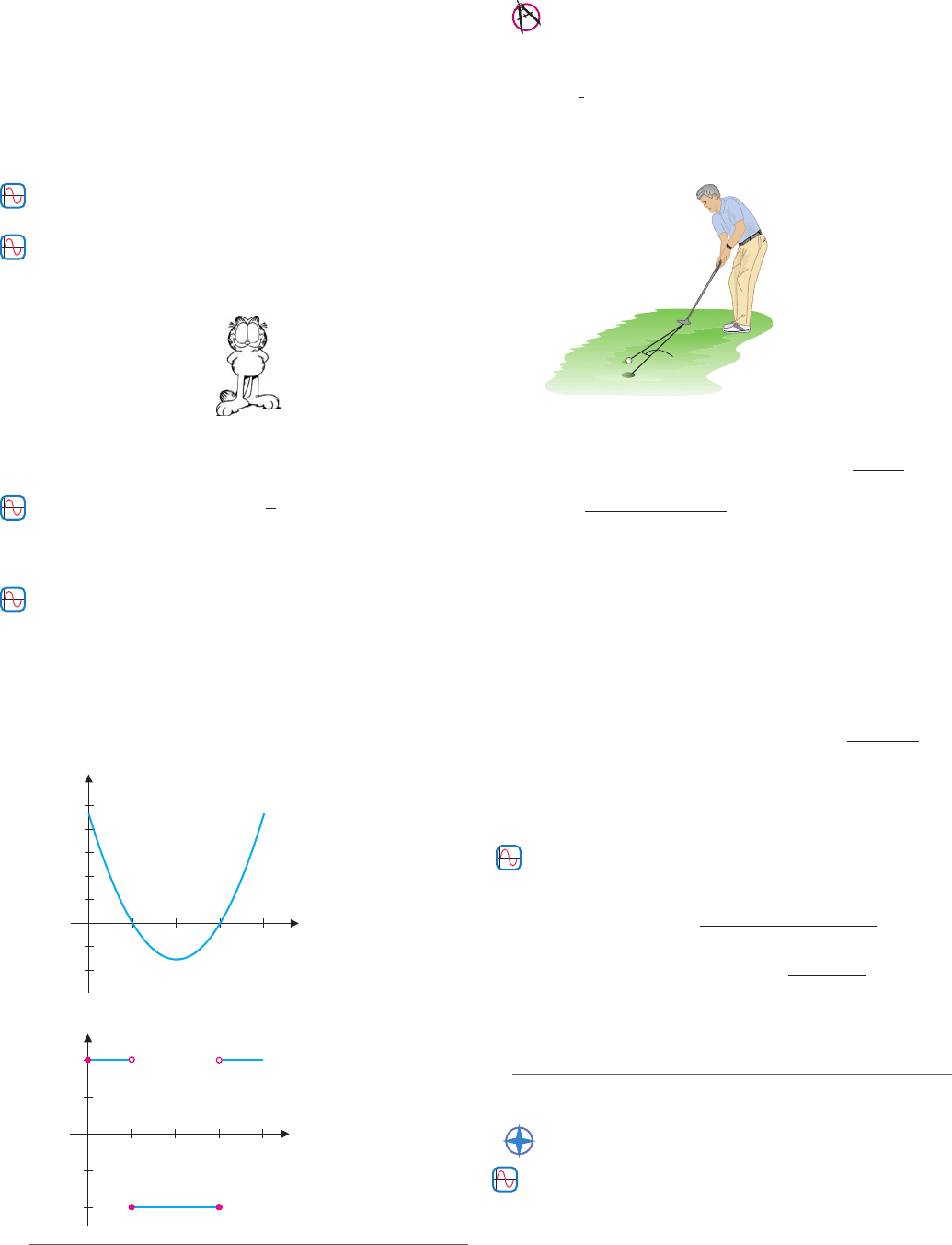
In exercises 67 and 68, use the graph of y f (x) to sketch a
graph of r f (θ).
67.
2p
1
1
2
p
q
w
y
x
68.
y
x
1
1
q wp
2p
APPLICATIONS
69. To make a putt, a golfer tries to control distance and direc-
tion. Suppose a putter is d feet from the hole, which has radius
h =
1
6
.
(a) Show that the path of the ball will intersect the hole if
the angle A in the figure satisfies −sin
−1
(h/d) < A <
sin
−1
(h/d).
A
(0, 0)
(r, A)
(d, 0)
(b) The ball must reach the front of the hole. In rectangu-
lar coordinates, the hole has equation (x − d)
2
+ y
2
= h
2
,
so the left side of the hole is x = d −
h
2
− y
2
. Show
that this converts in polar coordinates to r = d cosθ −
d
2
cos
2
θ −(d
2
− h
2
). (Hint: Substitute for x and y, iso-
late the square root term, square both sides, combine r
2
terms and use the quadratic formula.)
(c) The ball will not go in the hole if it is hit too hard. Sup-
pose that the putt would go r = d +c feet if it did not
go in the hole (c > 0). For a putt hit toward the center of
the hole, define b to be the largest value of c such that the
putt goes in (i.e., if the ball is hit more than b feet past the
hole, it is hit too hard). Experimental evidence (see Dave
Pelz’s Putt Like the Pros) shows that at other angles A, the
distance r must be less than d + b
1 −
!
A
sin
−1
(h/d)
"
2
.
The results of parts (a)–(c) define limits for the angle A and
distance r of a successful putt. Identify the functions r
1
(A)
and r
2
(A) such that r
1
(A) < r < r
2
(A) and constants A
1
and A
2
such that A
1
< A < A
2
.
(d) Take the general result of part (c) and apply it to a putt of
d = 15 feet with a value of b = 4 feet. Visualize this by
graphing the region
15cosθ −
225cos
2
θ −(225 −1/36)
< r < 15 +4
1 −
!
θ
sin
−1
(1/90)
"
2
with −sin
−1
(1/90) <θ<sin
−1
(1/90). A good choice of
graphing windows is 13.8 ≤ x ≤ 19 and −0.5 ≤ y ≤ 0.5.
EXPLORATORY EXERCISES
1. In this exercise, you will explore the roles of the constants
a, b and c in the graph of r = af(bθ + c). To start, sketch
r = sin θ followed by r = 2 sin θ and r = 3 sin θ . What does
the constant a affect? Then sketch r = sin(θ + π/2) and

P1: OSO/OVY P2: OSO/OVY QC: OSO/OVY T1: OSO
MHDQ256-Ch10 MHDQ256-Smith-v1.cls December 21, 2010 21:17
LT (Late Transcendental)
CONFIRMING PAGES
660 CHAPTER 10
..
Parametric Equations and Polar Coordinates 10-36
r = sin(θ − π/4). What does the constant c affect? Now for
the tough one. Sketch r = sin2θ and r = sin 3θ . What does
the constant b seem to affect? Test all of your hypotheses
on the base function r = 1 +2cosθ and several functions of
your choice.
2. The polar curve r = ae
bθ
is an equiangular curve. Sketch the
curve and then show that
dr
dθ
= br. A somewhat complicated
geometric argument shows that
dr
dθ
= r cotα, where α is the
anglebetweenthetangentlineandthelineconnectingthepoint
on the curve to the origin. Comparing equations, conclude that
the angle α is constant (hence“equiangular”). To illustrate this
property, compute α for the points at θ = 0 and θ = π for
r = e
θ
. This type of spiral shows up often in nature, includ-
ing shellfish (shown here is an ammonite fossil from about
350 million years ago) and the florets of the common daisy.
Other examples, including the connection to sunflowers, the
Fibonacci sequence and the musical scale, can be found in
H. E. Huntley’s The Divine Proportion.
10.5 CALCULUS AND POLAR COORDINATES
Having introduced polar coordinates and looked at a variety of polar graphs, our next step
is to extend the techniques of calculus to the case of polar coordinates. In this section,
we focus on tangent lines, area and arc length. Surface area and other applications will be
examined in the exercises.
Noticethat you canthink of the graph of the polar equationr = f (θ)as the graph of the
parametric equations x = f (t)cos t, y(t) = f (t)sin t (where we have used the parameter
t = θ), since from (4.2)
x = r cosθ = f (θ)cosθ (5.1)
and y = r sinθ = f (θ)sinθ. (5.2)
In view of this, we can now take any results already derived for parametric equations and
extend these to the special case of polar coordinates.
In section 10.2, we showed that the slope of the tangent line at the point corresponding
to θ = a is given [from (2.1)] to be
dy
dx
θ=a
=
dy
dθ
(a)
dx
dθ
(a)
, (5.3)
as long as
dx
dθ
(a) = 0. From the product rule, (5.1) and (5.2), we have
dy
dθ
= f
(θ)sinθ + f (θ)cosθ
and
dx
dθ
= f
(θ)cosθ − f (θ)sinθ.
Putting these together with (5.3), we get
dy
dx
θ=a
=
f
(a)sina + f (a) cosa
f
(a)cosa − f (a) sina
, (5.4)
as long as the denominator is nonzero.
P1: OSO/OVY P2: OSO/OVY QC: OSO/OVY T1: OSO
MHDQ256-Ch10 MHDQ256-Smith-v1.cls December 21, 2010 21:17
LT (Late Transcendental)
CONFIRMING PAGES
10-37 SECTION 10.5
..
Calculus and Polar Coordinates 661
EXAMPLE 5.1 Finding the Slope of the Tangent Line
to a Three-Leaf Rose
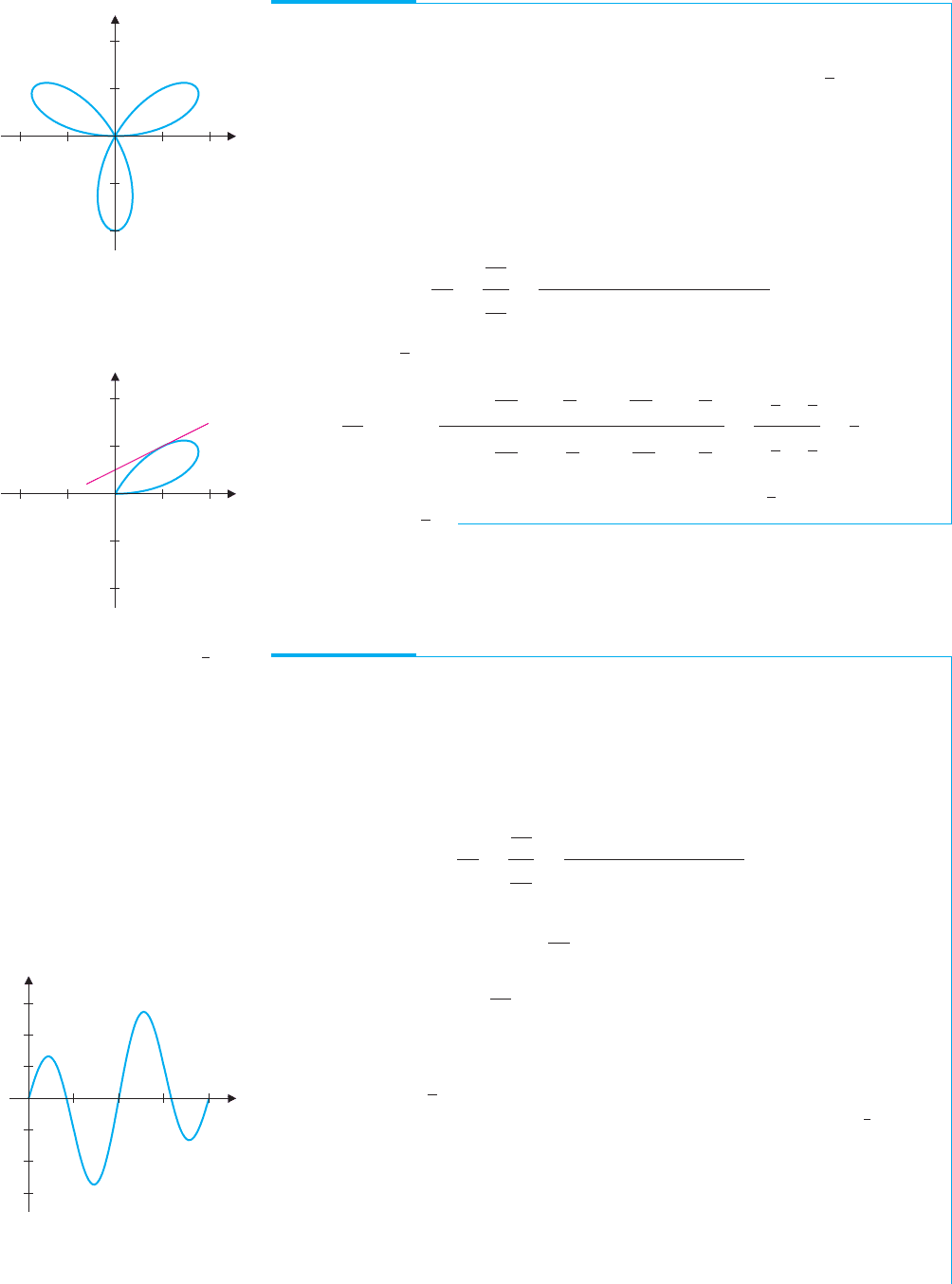
Find the slope of the tangent line to the three-leaf rose r = sin3θ at θ =
π
4
.
y
x
10.51 0.5
1
1
0.5
FIGURE 10.40a
Three-leaf rose
Solution A sketch of the curve is shown in Figure 10.40a. From (4.1), we have
y = r sinθ = sin 3θ sinθ
and x = r cos θ = sin3θ cos θ.
Using (5.3), we have
dy
dx
=
dy
dθ
dx
dθ
=
(3cos 3θ)sinθ +sin3θ(cosθ)
(3cos 3θ)cosθ −sin3θ(sinθ)
.
Taking θ =
π
4
gives us
dy
dx
θ=π/4
=
3cos
3π
4
sin
π
4
+ sin
3π
4
cos
π
4
3cos
3π
4
cos
π
4
− sin
3π
4
sin
π
4
=
−
3
2
+
1
2
−
3
2
−
1
2
=
1
2
.
In Figure 10.40b, we show the section of r = sin3θ for 0 ≤ θ ≤
π
3
, along with the
tangent line at θ =
π
4
.
y
x
11
1
1
0.50.5
0.5
FIGURE 10.40b
The tangent line at θ =
π
4
For polar graphs, it’s important to find places where r has reached a maximum or
minimum, but these may or may not correspond to a horizontal tangent line. We explore
this idea further in example 5.2.
EXAMPLE 5.2 Polar Graphs and Horizontal Tangent Lines
For the three-leaf rose r = sin3θ , find the locations of all horizontal tangent lines. Also,
at the three points where |r| is a maximum, show that the tangent line is perpendicular
to the line segment connecting the point to the origin.
x
2
3
1
2
1
3
d fq
p
y
FIGURE 10.41a
y = 3 cos 3x sin x + sin 3x cos x
Solution From (5.3) and (5.4), we have
dy
dx
=
dy
dθ
dx
dθ
=
f
(θ)sinθ + f (θ)cosθ
f
(θ)cosθ − f (θ)sinθ
.
Here, f (θ) = sin3θ and so, to have
dy
dx
= 0, we must have
0 =
dy
dθ
= 3cos3θ sinθ + sin 3θ cosθ.
From the graph of f (x)=3 cos3x sin x + sin3x cos x with 0 ≤ x ≤ π (in Figure 10.41a),
observe that there appear to be five solutions. Three of the solutions can be found
exactly: θ = 0,θ =
π
2
and θ = π. You can find the remaining two numerically:
θ ≈ 0.659 and θ ≈ 2.48. (You can also use trig identities to arrive at sin
2
θ =
3
8
.) The
corresponding points on the curve r = sin3θ (specified in rectangular coordinates) are
(0, 0), (0.73, 0.56), (0, −1), (−0.73, 0.56) and (0, 0). The point (0, −1) lies at the
bottom of a leaf. This is the familiar situation of a horizontal tangent line at a local (and
in fact, absolute) minimum. The tangent lines at these points are shown in Figure 10.41b
(on the following page). Note that these points correspond to points where the
y-coordinate is a maximum. However, the tips of the leaves represent the extreme points
of most interest. Notice that the tips are where |r| is a maximum. For r = sin3θ, this
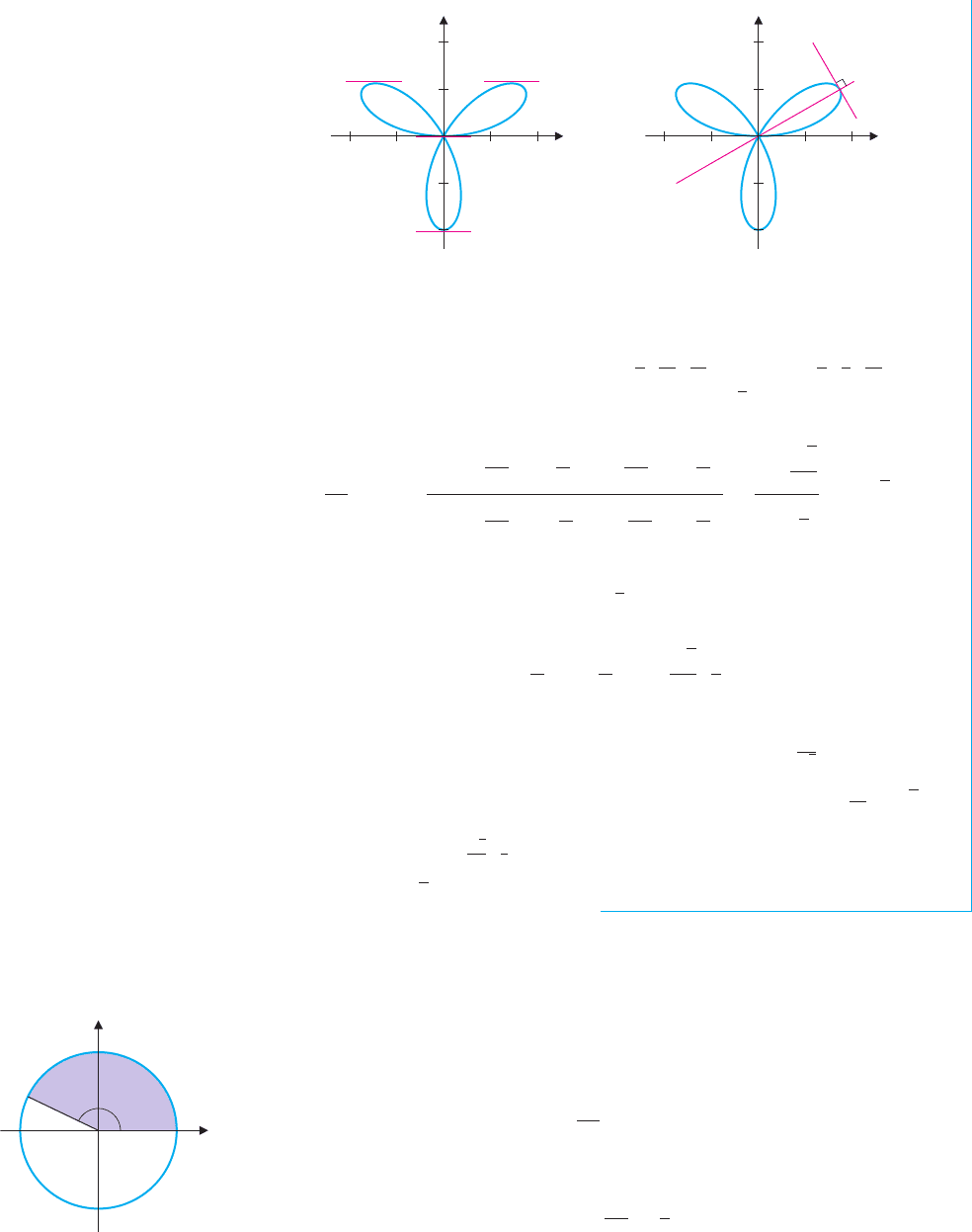
P1: OSO/OVY P2: OSO/OVY QC: OSO/OVY T1: OSO
MHDQ256-Ch10 MHDQ256-Smith-v1.cls December 21, 2010 21:17
LT (Late Transcendental)
CONFIRMING PAGES
662 CHAPTER 10
..
Parametric Equations and Polar Coordinates 10-38
y
x
10.51
1
1
0.5
0.5
y
x
10.50.51
1
1
0.5
FIGURE 10.41b
Horizontal tangent lines
FIGURE 10.41c
The tangent line at the tip of a leaf
occurs when sin3θ =±1, that is, where 3θ =
π
2
,
3π
2
,
5π
2
,...,or θ =
π
6
,
π
2
,
5π
6
,....
From (5.4), the slope of the tangent line to the curve at θ =
π
6
is given by
dy
dx
θ=π/6
=
3cos
3π
6
sin
π
6
+ sin
3π
6
cos
π
6
3cos
3π
6
cos
π
6
− sin
3π
6
sin
π
6
=
0 +
√
3
2
0 −
1
2
=−
√
3.
The rectangular point corresponding to θ =
π
6
is given by
1cos
π
6
, 1 sin
π
6
=
√
3
2
,
1
2
.
The slope of the line segment joining this point to the origin is then
1
√
3
, making this line
segment perpendicular to the tangent line, since the product of the slopes is −1. This is
illustrated in Figure 10.41c. Similarly, the slope of the tangent line at θ =
5π
6
is
√
3,
which again makes the tangent line at that point perpendicular to the line segment from
the origin to the point
−
√
3
2
,
1
2
. Finally, we have already shown that the slope of the
tangent line at θ =
π
2
is 0 and a horizontal tangent line is perpendicular to the vertical
line from the origin to the point (0, −1).
Next, for polar curves like the three-leaf rose seen in Figure 10.40a, we would like to
compute the area enclosed by the curve. Since such a graph is not the graph of a function of
the form y = f (x), we cannot use the usual area formulas developed in Chapter 5. While
we can convert our area formulas for parametric equations (from Theorem 2.2) into polar
coordinates, a simpler approach uses the following geometric argument.
y
x
r
u
FIGURE 10.42
Circular sector
Observe that a sector of a circle of radius r and central angle θ, measured in radians
(see Figure 10.42) contains a fraction
θ
2π
of the area of the entire circle. So, the area of
the sector is given by
A = πr
2
θ
2π
=
1
2
r
2
θ.
Now, consider the areaenclosedbythe polar curvedefined bytheequationr = f (θ )andthe
rays θ = a andθ = b (see Figure 10.43a), where f is continuous and positiveon the interval
a ≤ θ ≤ b. As we did when we defined the definite integral, we begin by partitioning the