
Smith R., Minton R. Calculus
Подождите немного. Документ загружается.

P1: OSO/OVY P2: OSO/OVY QC: OSO/OVY T1: OSO
MHDQ256-Ch10 MHDQ256-Smith-v1.cls December 30, 2010 15:35
LT (Late Transcendental)
CONFIRMING PAGES
10-9 SECTION 10.1
..
Plane Curves and Parametric Equations 633
(c) Suppose that a jet has speed 0.8 unit per second (i.e.,
Mach 0.8) with position function x(t) = 0.8t and y(t) = 0.
To model the position at time t = 5 seconds of various
sound waves emitted by the jet, do the following on one set
of axes. (1) Graph the position after 5 seconds of the sound
wave emitted from (0,0); (2)graph the position after 4sec-
onds of the sound wave emitted from (0.8, 0); (3) graph the
position after 3 seconds of the sound wave emitted from
(1.6, 0); (4) graph the position after 2 seconds of the sound
wave emitted from (2.4, 0); (5) graph the position after
1 second of the sound wave emitted from (3.2, 0); (6) mark
the position of the jet at time t = 5.
(d) Repeat part (c) for a jet with speed 1.0 unit per second
(Mach 1). The sound waves that intersect at the jet’s loca-
tion are the “sound barrier” that must be broken.
(e) Repeat part (c) for a jet with speed 1.4 units per second
(Mach 1.4).
(f) In part (e), the sound waves intersect each other. The in-
tersections form the “shock wave” that we hear as a sonic
boom. Theoretically, the angle θ between the shock wave
and the x-axis satisfies the equation sinθ =
1
m
, where m
is the Mach speed of the jet. Show that for m = 1.4,
the theoretical shock wave is formed by the lines x(t) =
7 −
√
0.96t, y(t) = t and x(t) = 7 −
√
0.96t, y(t) =−t.
Superimpose these lines onto the graph of part (e).
(g) In part (f),the shock waveof a jetat Mach 1.4 ismodeledby
two lines. Argue that in three dimensions, the shock wave
has circular cross sections. Describe the three-dimensional
figure formed by revolving the lines in part (f) about the
x-axis.
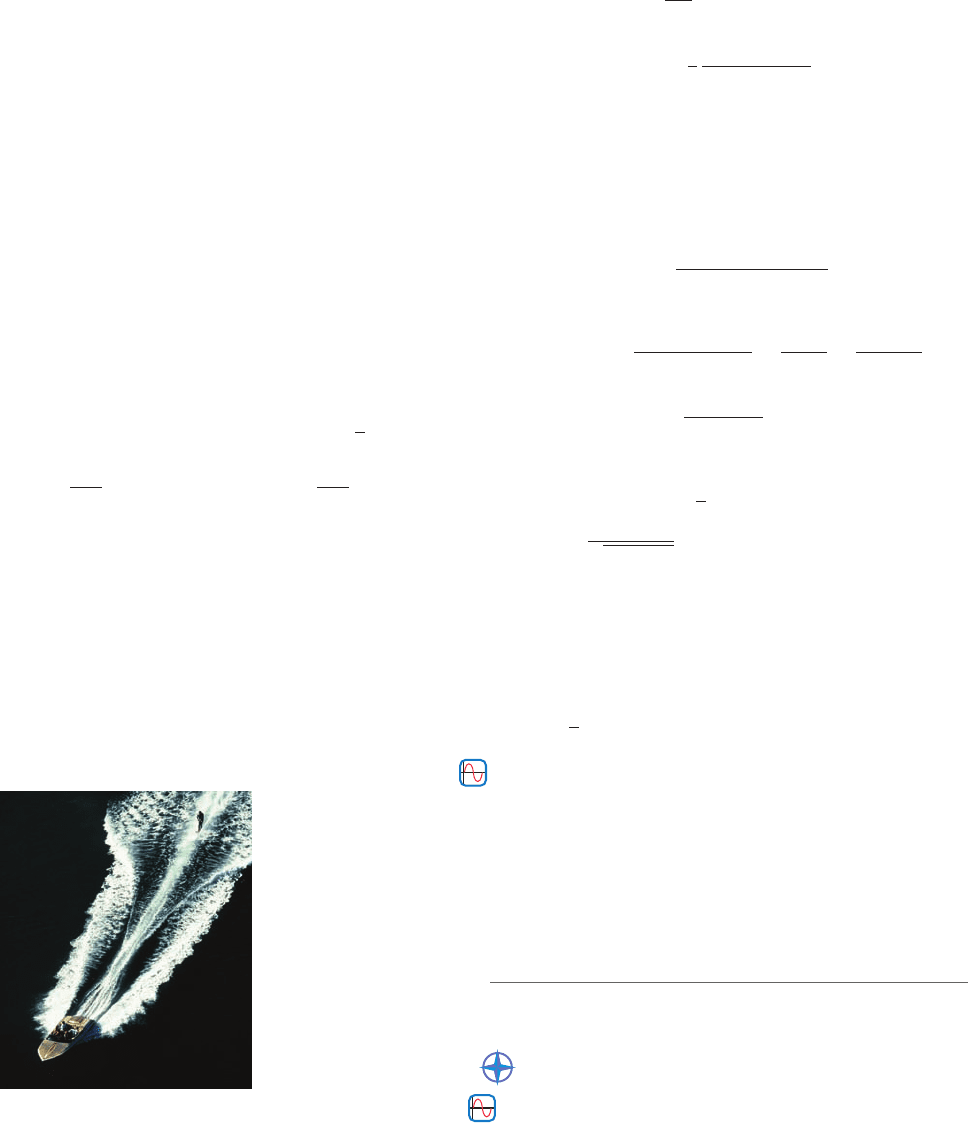
54. If a pebble is dropped into water, a wave spreads out in an
expanding circle. Let v be the speed of the propagation of the
wave.Ifaboatmovesthrough this waterwithspeed 1.4v, argue
that the boat’s wake will be described by the graphs of part (f)
of exercise 53. Graph the wake of a boat with speed 1.6v.
............................................................
Exercise 55 shows that a celestial object can incorrectly appear
to be moving faster than the speed of light
55. (a) A bright object is at position (0, D) at time 0, where D is
a very large positive number. The object moves toward the
positivex-axis with constantspeed v<c at an angleθ from
the vertical. Find parametric equations for the position of
the object at time t.
(b) Let s(t) be the distance from the object to the origin at time
t. Then L(t) =
s(t)
c
gives the amount of time it takes for
light emitted by the object at time t to reach the origin.
Show that L
(t) =
1
c
v
2
t − Dv cosθ
s(t)
.
(c) An observer stands at the origin and tracks the horizontal
movement of the object. Lightreceivedat time T was emit-
ted by the object at time t, where T = t + L(t). Similarly,
light received at time T + T was emitted at time t + dt,
where typically dt = T . The apparent x-coordinate of the
object at time T is x
a
(T ) = x(t). The apparent horizontal
speed of the object at time T as measured by the observer
is h(T ) = lim
T →0
x
a
(T + T ) − x
a
(T )
T
. Tracing back to
time t, show that
h(t) = lim
dt→0
x(t + dt) − x(t)
T
=
v sinθ
T
(t)
=
v sinθ
1 + L
(t)
.
(d) Show that h(0) =
cv sinθ
c −v cosθ
.
(e) Show that for a constant speed v, the maximum apparent
horizontal speed h(0) occurs when the object moves at an
angle with cosθ =
v
c
. Find this speed in terms of v and
γ =
1
1 − v
2
/c
2
.
(f) Show that as v approaches c, the apparent horizontal speed
can exceed c, causing the observer to measure an object
moving faster than the speed of light! As v approaches
c, show that the angle producing the maximum appar-
ent horizontal speed decreases to 0. Discuss why this is
paradoxical.
(g) If
v
c
> 1, show that h(0) has no maximum.
56. Let r
E
and r
M
model the paths of Earth and Mars, re-
spectively, around the Sun, where r
E
=
x = cos2π t
y = sin 2π t
and
r
M
=
x = 1.5cos π t
y = 1.5 sin π t
. According to this model, how do the
radii and periods of the orbits compare? How accurate is this?
The orbit of Mars relative to Earth is modeled by r
M
−r
E
.
Graph this and identify the retrograde motion of Mars as seen
from Earth.
EXPLORATORY EXERCISES
1. Many carnivals have a version of the double Ferris wheel. A
large central arm rotates clockwise. At each end of the central
armisaFerriswheel that rotates clockwise around thearm.As-
sume that the central arm has length 200 feet and rotates about
its center. Also assume that the wheels have radius 40 feet
and rotate at the same speed as the central arm. Find paramet-
ric equations for the position of a rider and graph the rider’s
path. Adjust the speed of rotation of the wheels to improve the
ride.

P1: OSO/OVY P2: OSO/OVY QC: OSO/OVY T1: OSO
MHDQ256-Ch10 MHDQ256-Smith-v1.cls December 30, 2010 15:35
LT (Late Transcendental)
CONFIRMING PAGES
634 CHAPTER 10
..
Parametric Equations and Polar Coordinates 10-10
2. The Flying Zucchini Circus Troupe has a human cannon-
ball act, shooting a performer from a cannon into a spe-
cially padded seat of a turning Ferris wheel. The Ferris
wheel has a radius of 40 feet and rotates counterclockwise at
one revolution per minute. The special seat starts at ground
level. Carefully explain why parametric equations for the
seat are
x = 40cos(
π
30
t −
π
2
)
y = 40 +40 sin(
π
30
t −
π
2
)
. The cannon is located
200 feet left of the Ferris wheel with the muzzle 10 feet
above ground. (a) The performer is launched 35 seconds after
the wheel starts turning with an initial velocity of 100 ft/s
at an angle of
π
5
above the horizontal. Carefully explain
why parametric equations for the human cannonball are
x = (100cos
π
5
)(t − 35) − 200
y =−16(t − 35)
2
+ (100sin
π
5
)(t − 35) + 10
(t ≥ 35).
Determinewhether the act is safeor the Flying Zucchini comes
down squash. (b) Rework part (a) with initial velocity 135 ft/s,
launch angle 30
◦
and a 27-second delay. How close does the
Flying Zucchini get to the special seat? Given that a Ferris
wheel seat actually has height, width and depth, do you think
thatthisisclose enough? (c) Repeat withinitialvelocity75ft/s,
launch angle 47
◦
and 47.25-second delay; (d) initial velocity
118 ft/s, launch angle 35
◦
and 28-second delay. (e) Develop
criteria for a safe and exciting human cannonballact. Consider
each of the following: Should the launch velocity be large or
small? Should the seat be high or low when the cannonball
lands? Should the human have a positive or negative vertical
velocity at landing? How close (vertically and horizontally)
does the human need to get to the center of the seat?
REMARK 2.1
Be careful how you interpret
equation (2.1). The primes on
the right side of the equation
refer to derivatives with respect
to the parameter t. We
recommend that you (at least
initially) use the Leibniz
notation, which also gives you a
simple way to accurately
remember the chain rule.
10.2 CALCULUS AND PARAMETRIC EQUATIONS
Ourinitialaiminthissectionistofindawaytodeterminetheslopesoftangentlinestocurves
that are defined parametrically. First, recall that for a differentiable function y = f (x),
the slope of the tangent line at the point x = a is given by f
(a). Written in Leibniz
notation, the slope is
dy
dx
(a). In the case of a curve defined parametrically, both x and y are
functions of the parameter t. Notice that if x = x(t) and y = y(t) both have derivatives that
are continuous at t = c, the chain rule gives us
dy
dt
=
dy
dx
dx
dt
.
As long as
dx
dt
(c) = 0, we then have
dy
dx
(a) =
dy
dt
(c)
dx
dt
(c)
=
y
(c)
x
(c)
, (2.1)
where a = x(c). In the case where x
(c) = y
(c) = 0, we define
dy
dx
(a) = lim
t→c
dy
dt
dx
dt
= lim
t→c
y
(t)
x
(t)
, (2.2)
provided the limit exists.
P1: OSO/OVY P2: OSO/OVY QC: OSO/OVY T1: OSO
MHDQ256-Ch10 MHDQ256-Smith-v1.cls December 21, 2010 21:17
LT (Late Transcendental)
CONFIRMING PAGES
10-11 SECTION 10.2
..
Calculus and Parametric Equations 635
We can use (2.1) to calculate second (as well as higher order) derivatives. Notice that
if we replace y by
dy
dx
,weget
d
2
y
dx
2
=
d
dx
dy
dx
=
d
dt
dy
dx
dx
dt
. (2.3)
FIGURE 10.8a
The Scrambler
y
x
33
3
3
FIGURE 10.8b
Path of a Scrambler rider
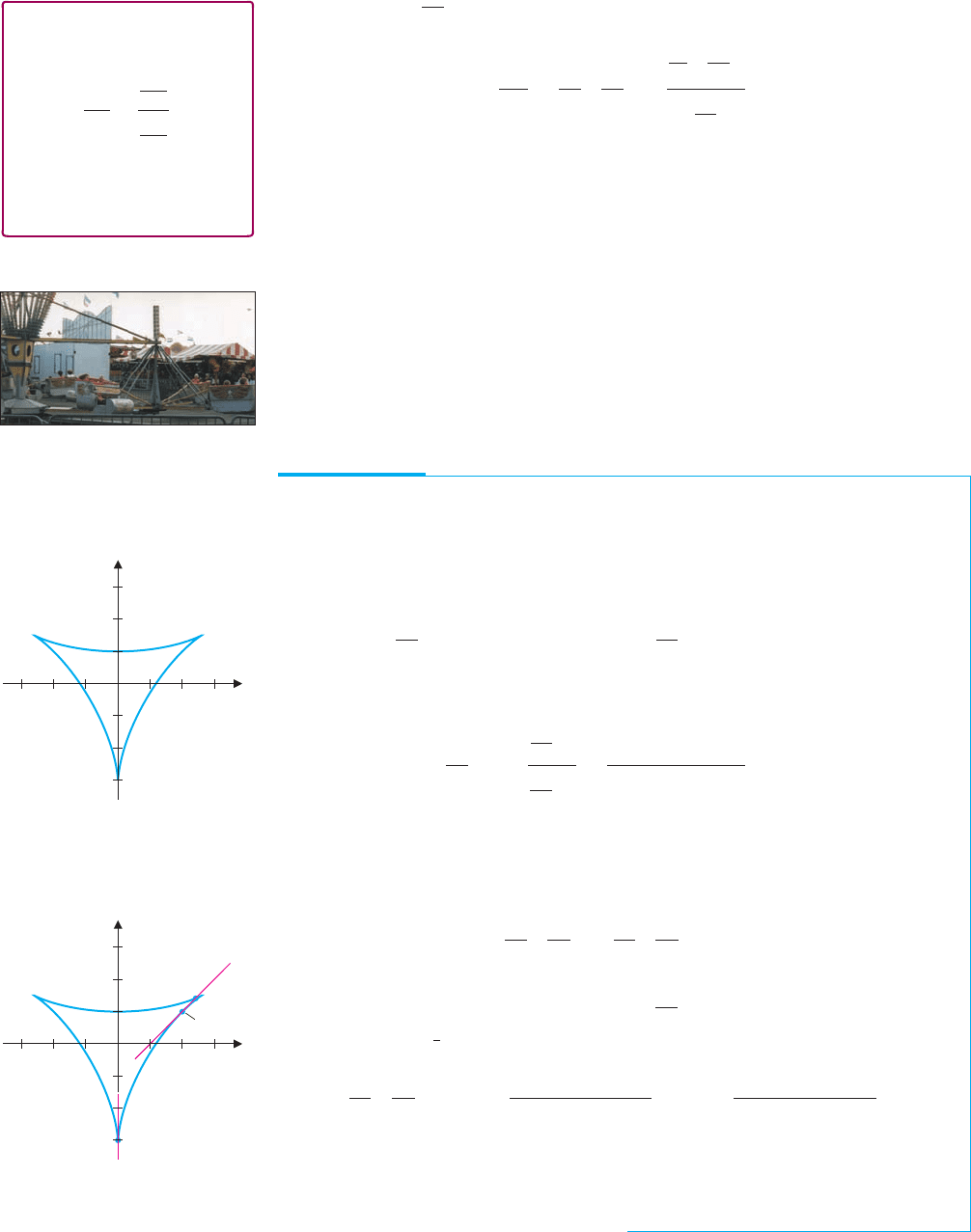
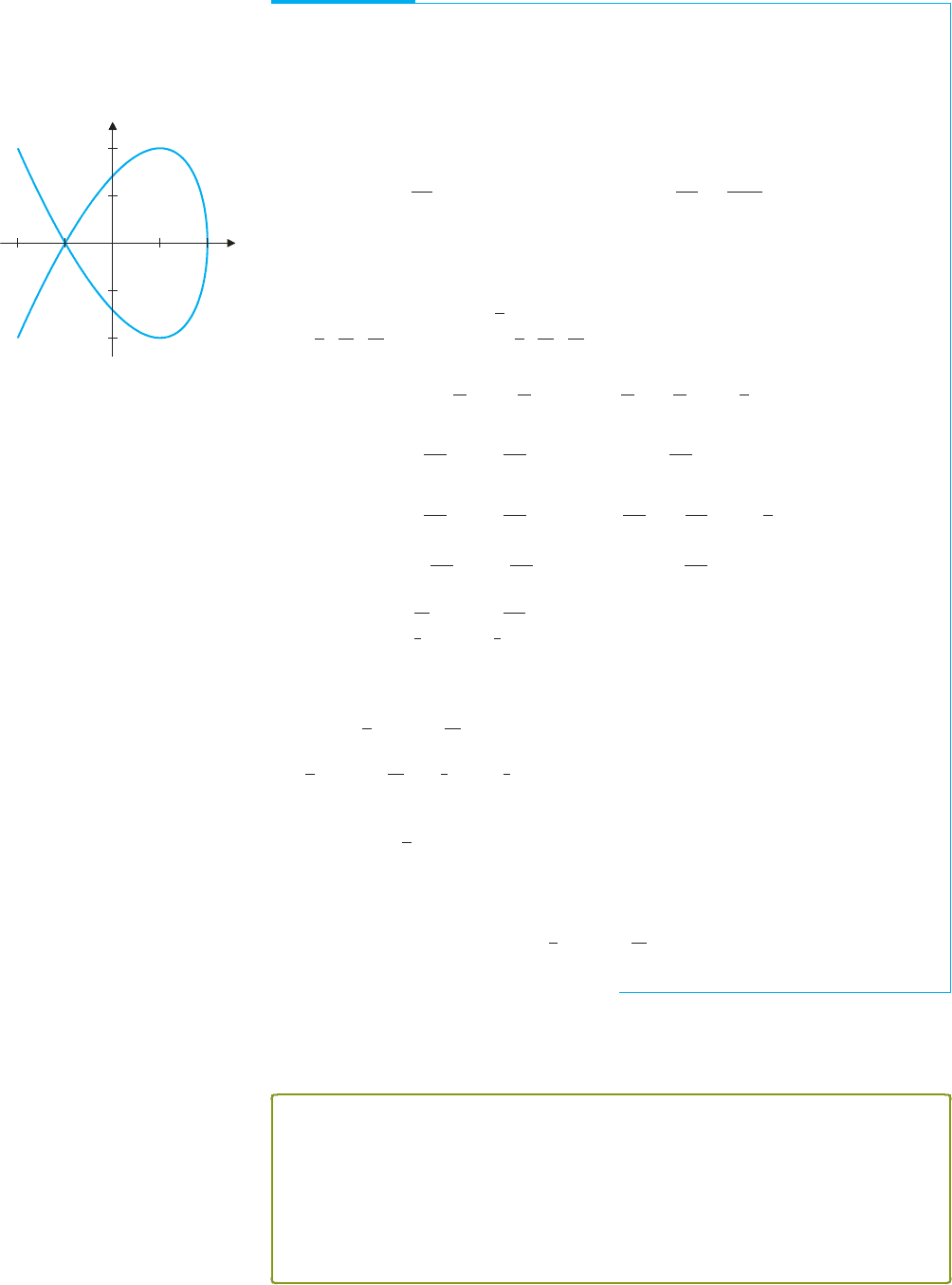
The Scrambler is a popular carnival ride consisting of two sets of rotating arms. (See
Figure 10.8a.) If the inner arms have length 2 and rotate counterclockwise, we can de-
scribe the location (x
i
, y
i
) of the end of one of the inner arms by the parametric equations
x
i
= 2cost, y
i
= 2sint. At the end of each inner arm, a set of outer arms rotate clockwise
at roughly twice the speed. If the outer arms have length 1, parametric equations describing
the outer arm rotation are x
o
= sin2t, y
o
= cos2t. Here, the reversal of sine and cosine
terms indicates that the rotation is clockwise and the factor of 2 inside the sine and cosine
terms indicates that the speed of the rotation is double that of the inner arms. The position
of a person riding the Scrambler is the sum of the two component motions; that is,
x = 2cost +sin2t, y = 2sin t + cos 2t.
The graph of these parametric equations is shown in Figure 10.8b.
CAUTION
Look carefully at (2.3) and
convince yourself that
d
2
y
dx
2
=
d
2
y
dt
2
d
2
x
dt
2
.
Equating these two expressions
is a common error. You should
be careful to avoid this trap.
EXAMPLE 2.1 Slopes of Tangent Lines to a Parametric Curve
Find the slope of the tangent line to the Scrambler path described by
x = 2cost +sin2t, y = 2sint + cos2t at (a) t = 0 and (b) the point (0, −3).
Solution (a) First, note that
dx
dt
=−2sin t + 2cos2t and
dy
dt
= 2cost − 2 sin2t.
From (2.1), the slope of the tangent line at t = 0 is then
dy
dx
t=0
=
dy
dt
(0)
dx
dt
(0)
=
2cos 0 −2sin 0
−2sin 0 +2cos 0
= 1.
(b) To determine the slope at the point (0, −3), we must first determine a value of t that
corresponds to the point. In this case, notice that t = 3π/2givesx = 0 and y =−3.
Here, we have
dx
dt
3π
2
=
dy
dt
3π
2
= 0
and consequently, we must use (2.2) to compute
dy
dx
. Since the limit has the
indeterminate form
0
0
, we use l’Hˆopital’s Rule, to get
dy
dx
3π
2
= lim
t→3π/2
2cos t − 2 sin 2t
−2sin t + 2 cos 2t
= lim
t→3π/2
−2sin t − 4 cos 2t
−2cos t − 4 sin 2t
,
y
x
33
3
3
t 0
t w
FIGURE 10.9
Tangent lines to the
Scrambler path
which does not exist, since the limit in the numerator is 6 and the limit in the
denominator is 0. This says that the slope of the tangent line at t = 3π/2 is undefined.
In Figure 10.9, we have drawn in the tangent lines at t = 0 and 3π/2. Notice that the
tangent line at the point (0, −3) is vertical.
Finding slopes of tangent lines can help us identify many points of interest.
P1: OSO/OVY P2: OSO/OVY QC: OSO/OVY T1: OSO
MHDQ256-Ch10 MHDQ256-Smith-v1.cls December 21, 2010 21:17
LT (Late Transcendental)
CONFIRMING PAGES
636 CHAPTER 10
..
Parametric Equations and Polar Coordinates 10-12
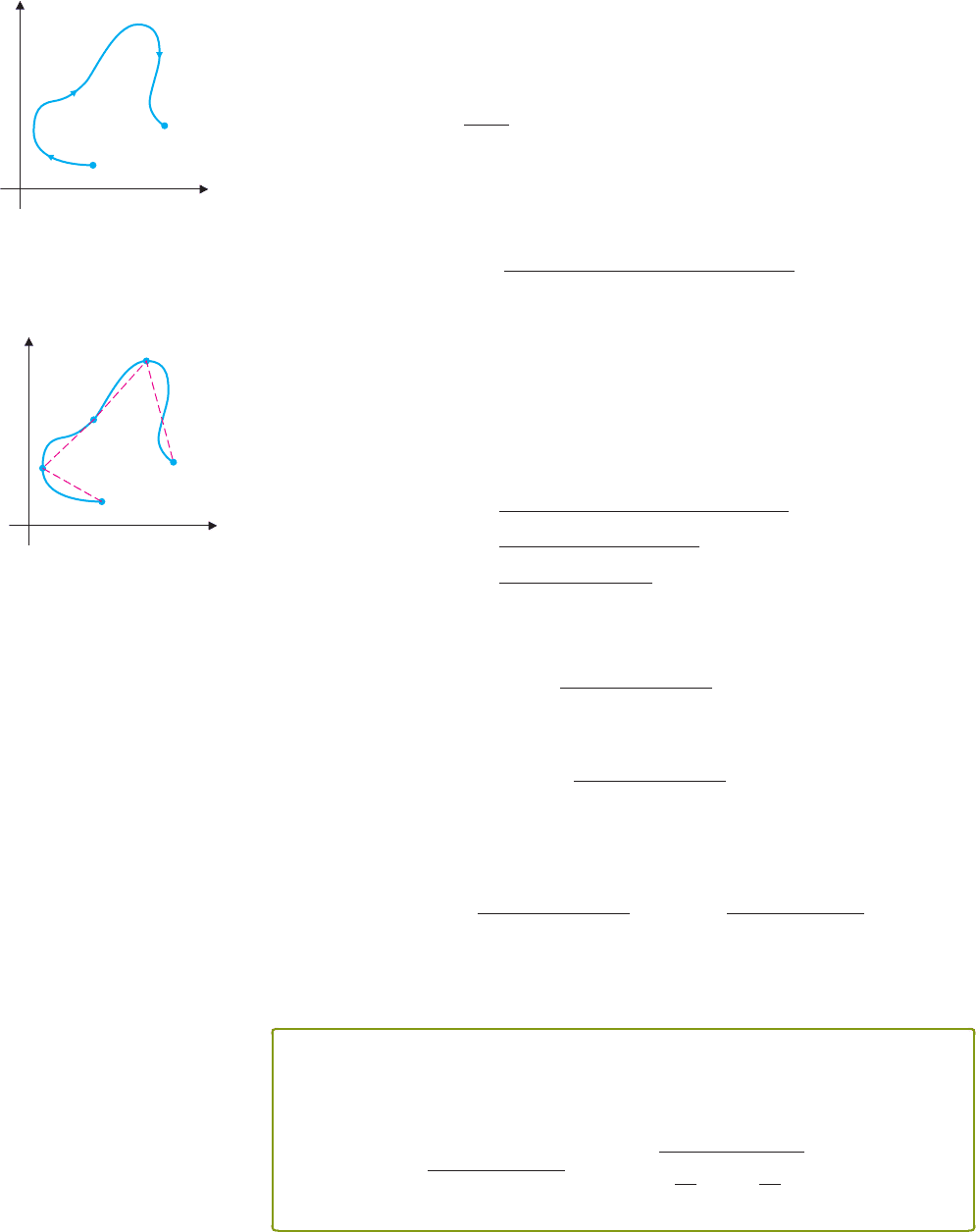
EXAMPLE 2.2 Finding Vertical and Horizontal Tangent Lines
Identify all points at which the plane curve x = cos2t, y = sin3t has a horizontal or
vertical tangent line.
y
x
11
1
1
FIGURE 10.10
x = cos2t, y = sin3t
Solution The sketch of the curve shown in Figure 10.10 suggests that there are two
locations (the top and bottom of the bow) with horizontal tangent lines and one point
(the far right edge of the bow) with a vertical tangent line. Recall that horizontal tangent
lines occur where
dy
dx
= 0. From (2.1), we then have
dy
dx
=
y
(t)
x
(t)
= 0, which can occur
only when
0 = y
(t) = 3cos3t,
provided that x
(t) =−2 sin 2t = 0 for the same value of t. Since cosθ = 0 only
when θ is an odd multiple of
π
2
, we have that y
(t) = 3cos3t = 0, only when
3t =
π
2
,
3π
2
,
5π
2
,...and so, t =
π
6
,
3π
6
,
5π
6
,.... The corresponding points on the curve
are then
x
π
6
, y
π
6
=
cos
π
3
, sin
π
2
=
1
2
, 1
,
x
3π
6
, y
3π
6
=
cosπ, sin
3π
2
= (−1, −1),
x
7π
6
, y
7π
6
=
cos
7π
3
, sin
7π
2
=
1
2
, −1
and
x
9π
6
, y
9π
6
=
cos3π, sin
9π
2
= (−1, 1).
Note that t =
5π
6
and t =
11π
6
reproduce the first and third points, respectively, and
so on. The points (
1
2
, 1) and (
1
2
, −1) are on the top and bottom of the bow, respectively,
where there clearly are horizontal tangents. The points (−1, −1) and (−1, 1) should not
seem quite right, though. These points are on the extreme ends of the bow and certainly
don’t look like they have vertical or horizontal tangents. In fact, they don’t. Notice that
at both t =
π
2
and t =
3π
2
,wehavex
(t) = y
(t) = 0 and so, the slope must be
computed as a limit using (2.2). We leave it as an exercise to show that the slopes at
t =
π
2
and t =
3π
2
are
9
4
and −
9
4
, respectively.
To find points where there is a vertical tangent, we need to see where x
(t) = 0but
y
(t) = 0. Setting 0 = x
(t) =−2 sin 2t, we get sin2t = 0, which occurs if 2t = 0,π,
2π,...or t = 0,
π
2
,π,.... The corresponding points are
(x(0), y(0)) = (cos0, sin 0) = (1, 0),
(x(π), y(π)) = (cos2π, sin3π) = (1, 0)
and the points corresponding to t =
π
2
and t =
3π
2
, which we have already discussed
(where y
(t) = 0, also). Since y
(t) = 3cos3t = 0, for t = 0ort = π, there is a
vertical tangent line only at the point (1, 0).
Theorem 2.1 generalizes what we observed in example 2.2.
THEOREM 2.1
Suppose that x
(t) and y
(t) are continuous. Then for the curve defined by the
parametric equations x = x(t) and y = y(t),
(i) if y
(c) = 0 and x
(c) = 0, there is a horizontal tangent line at the point
(x(c), y(c));
(ii) if x
(c) = 0 and y
(c) = 0, there is a vertical tangent line at the point (x(c), y(c)).

P1: OSO/OVY P2: OSO/OVY QC: OSO/OVY T1: OSO
MHDQ256-Ch10 MHDQ256-Smith-v1.cls December 21, 2010 21:17
LT (Late Transcendental)
CONFIRMING PAGES
10-13 SECTION 10.2
..
Calculus and Parametric Equations 637
x'(t)
兹
[x'(t)]
2
[y'(t)]
2
y'(t)
FIGURE 10.11
Horizontal and vertical components
of velocity and speed
PROOF
The proof depends on the calculation of derivatives for parametric curves and is left as an
exercise.
An interesting question about the Scrambler is whether or not the rider ever comes to
a complete stop. To answer this question, we need to be able to compute velocities. Recall
that if the position of an object moving along a straight line is given by the differentiable
function f (t),theobject’svelocityisgivenby f
(t). The situationwithparametric equations
is completely analogous. If the position is given by (x(t), y(t)), for differentiable functions
x(t) and y(t), then the horizontal component of velocity is given by x
(t) and the vertical
component of velocity is given by y
(t). (See Figure 10.11.) We define the speed to be
[x
(t)]
2
+ [y
(t)]
2
. From this, note that the speed is 0 if and only if x
(t) = y
(t) = 0. In
this event, there is no horizontal or vertical motion.
EXAMPLE 2.3 Velocity of the Scrambler
For the path of the Scrambler x = 2cost +sin 2t, y = 2sint + cos2t, find the
horizontal and vertical components of velocity and speed at times t = 0 and t =
π
2
, and
indicate the direction of motion. Also determine all times at which the speed is zero.
Solution Here, the horizontal component of velocity is
dx
dt
=−2sin t + 2cos2t and
the vertical component is
dy
dt
= 2cost − 2 sin2t.Att = 0, the horizontal and vertical
components of velocity both equal 2 and the speed is
√
4 + 4 =
√
8. The rider is
located at the point (x(0), y(0)) = (2, 1) and is moving to the right [since x
(0) > 0] and
up [since y
(0) > 0]. At t =
π
2
, the velocity has components −4 (horizontal) and 0
(vertical) and the speed is
√
16 + 0 = 4. At this time, the rider is located at the point
(0, 1) and is moving to the left [since x
π
2
< 0].
In general, the speed s(t) of the rider at time t is given by
s(t) =
dx
dt
2
+
dy
dt
2
=
(−2sin t + 2 cos 2t)
2
+ (2 cost −2 sin2t)
2
=
4sin
2
t −8sint cos2t + 4cos
2
2t +4cos
2
t −8cost sin2t + 4sin
2
2t
=
√
8 − 8sint cos 2t − 8 cost sin2t
=
√
8 − 8sin 3t,
using the identities sin
2
t +cos
2
t = 1, cos
2
2t +sin
2
2t = 1 and
sint cos2t + sin 2t cos t = sin3t. So, the speed is 0 whenever sin3t = 1.
This occurs when 3t =
π
2
,
5π
2
,
9π
2
,...,ort =
π
6
,
5π
6
,
9π
6
,.... The corresponding points
on the curve are
x
π
6
, y
π
6
=
3
2
√
3,
3
2
,
x
5π
6
, y
5π
6
=
−
3
2
√
3,
3
2
and
x
9π
6
, y
9π
6
= (0, −3). You can easily verify that these points are the three tips of
the path seen in Figure 10.8b.
We just showed that riders in the Scrambler of Figure 10.8b actually come to a brief
stop at the outside of each loop. As you will explore in the exercises, for similar Scrambler
paths, the riders slow down but have a positive speed at the outside of each loop. This is
true of the Scrambler at most carnivals, for which a more complicated path makes up for
the lack of stopping.
Note that any curve that begins and ends at the same point will enclose an area. Finding
the area enclosed by such a curve is a straightforward extension of our original development
of integration. Recall that for a continuous function f defined on [a, b], where f (x) ≥ 0on

P1: OSO/OVY P2: OSO/OVY QC: OSO/OVY T1: OSO
MHDQ256-Ch10 MHDQ256-Smith-v1.cls December 21, 2010 21:17
LT (Late Transcendental)
CONFIRMING PAGES
638 CHAPTER 10
..
Parametric Equations and Polar Coordinates 10-14
[a, b], the area under the curve y = f (x) for a ≤ x ≤ b is given by
A =
b
a
f (x) dx =
b
a
ydx.
Now, suppose that this same curve is described parametrically by x = x(t) and y = y(t),
where the curve is traversed exactly once for c ≤ t ≤ d. We can then compute the area
by making the substitution x = x(t). It then follows that dx = x
(t) dt and so, the area is
given by
A =
b
a
y
y(t)
dx
x
(t)dt
=
d
c
y(t)x
(t) dt,
where you should notice that we have also changed the limits of integration to match the
new variable of integration. We generalize this result in Theorem 2.2.
THEOREM 2.2 (Area Enclosed by a Curve Defined Parametrically)
Suppose that the parametric equations x = x(t) and y = y(t), with c ≤ t ≤ d,
describe a curve that is traced out clockwise exactly once and where the curve does
not intersect itself, except that the initial and terminal points are the same [i.e.,
x(c) = x(d) and y(c) = y(d)]. Then the enclosed area is given by
A =
d
c
y(t)x
(t) dt =−
d
c
x(t)y
(t) dt. (2.4)
If the curve is traced out counterclockwise, then the enclosed area is given by
A =−
d
c
y(t)x
(t) dt =
d
c
x(t)y
(t) dt. (2.5)
PROOF
This result is a special case of Green’s Theorem, which we will develop in section 15.4.
The new area formulas given in Theorem 2.2 turn out to be quite useful, as we illustrate
in example 2.4.
EXAMPLE 2.4 Finding the Area Enclosed by a Curve
Find the area enclosed by the path of the Scrambler x = 2cost + sin2t,
y = 2sin t + cos2t.
Solution Notice that the curve is traced out counterclockwise once for 0 ≤ t ≤ 2π.
From (2.5), the area is then
A =
2π
0
x(t)y
(t) dt =
2π
0
(2cos t + sin 2t)(2cost − 2sin2t) dt
=
2π
0
(4cos
2
t −2cost sin2t − 2sin
2
2t) dt = 2π,
where we evaluated the integral using a CAS.
In example 2.5, we use Theorem 2.2 to derive a formula for the area enclosed by
anellipse. Payparticularattentionto howmuch easier this istodowithparametricequations
than it is to do with the original x-y equation.

P1: OSO/OVY P2: OSO/OVY QC: OSO/OVY T1: OSO
MHDQ256-Ch10 MHDQ256-Smith-v1.cls December 21, 2010 21:17
LT (Late Transcendental)
CONFIRMING PAGES
10-15 SECTION 10.2
..
Calculus and Parametric Equations 639
EXAMPLE 2.5 Finding the Area Enclosed by an Ellipse
Find the area enclosed by the ellipse
x
2
a
2
+
y
2
b
2
= 1 (for constants a, b > 0).
Solution One way to compute the area is to solve the equation for y to obtain
y =±b
1 −
x
2
a
2
and then integrate:
A =
a
−a
b
1 −
x
2
a
2
−
−b
1 −
x
2
a
2
dx.
You can evaluate this integral by trigonometric substitution or by using a CAS, but a
simpler, more elegant way to compute the area is to use parametric equations. Notice
that the ellipse is described parametrically by x = a cos t, y = b sin t, for 0 ≤ t ≤ 2π.
The ellipse is then traced out counterclockwise exactly once for 0 ≤ t ≤ 2π, so that the
area is given by (2.5) to be
A =−
2π
0
y(t)x
(t) dt =−
2π
0
(b sint)(−a sin t)dt = ab
2π
0
sin
2
tdt= abπ,
where this last integral can be evaluated by using the half-angle formula:
sin
2
t =
1
2
(1 − cos2t).
We leave the details of this calculation as an exercise.
BEYOND FORMULAS
Many of the formulas in this section are not new, but are simply modifications of
the well-established rules for differentiation and integration. If you think of them this
way, they are not complicated memorization exercises, but instead are old standards
expressed in a slightly different way.
EXERCISES 10.2
WRITING EXERCISES
1. In the derivation of parametric equations for the Scrambler,
we used the fact that reversing the sine and cosine functions
to
x = sint
y = cos t
causes the circle to be traced out clockwise.
Explain why this is so by starting at t = 0 and following the
graph as t increases to 2π .
2. Explain why Theorem 2.1 makes sense. (Hint: If y
(c) = 0,
what does that say about the change in y-coordinates on the
graph? Why do you also need x
(c) = 0 to guarantee a hori-
zontal tangent?)
3. Imagine an object with position given by x(t) and y(t). If a
right triangle has a horizontal leg of length x
(t) and a vertical
leg of length y
(t), what would the length of the hypotenuse
represent? Explain why this makes sense.
4. Explain why the sign (±)of
d
c
y(t)x
(t) dt in Theo-
rem 2.2 is different for curves traced out clockwise and
counterclockwise.
In exercises 1–6, find the slopes of the tangent lines to the given
curves at the indicated points.
1.
x = t
2
− 2
y = t
3
− t
(a) t =−1 (b) t = 1 (c) (−2, 0)
2.
x = t
3
− t
y = t
4
− 5t
2
+ 4
(a) t =−1 (b) t = 1 (c) (0, 4)
3.
x = 2cos t
y = 3 sin t
(a) t =
π
4
(b) t =
π
2
(c) (0, 3)
4.
x = cos2t
y = sin 4t
(a) t =
π
4
(b) t =
π
2
(c)
√
2
2
, 1
5.
x = t cos t
y = t sint
(a) t = 0 (b) t =
π
2
(c) (π, 0)
6.
x =
√
t
2
+ 1
y = sin t
(a) t =−π (b) t = π (c) (0, 0)
............................................................

P1: OSO/OVY P2: OSO/OVY QC: OSO/OVY T1: OSO
MHDQ256-Ch10 MHDQ256-Smith-v1.cls December 21, 2010 21:17
LT (Late Transcendental)
CONFIRMING PAGES
640 CHAPTER 10
..
Parametric Equations and Polar Coordinates 10-16
In exercises 7 and 8, sketch the graph and find the slope of the
curve at the given point.
7.
x = t
2
− 2
y = t
3
− t
at (−1, 0)
8.
x = t
3
− t
y = t
4
− 5t
2
+ 4
at (0, 0)
............................................................
In exercises 9–14, identify all points at which the curve has
(a) a horizontal tangent and (b) a vertical tangent.
9.
x = cos2t
y = sin 4t
10.
x = cos2t
y = sin 7t
11.
x = t
2
− 1
y = t
4
− 4t
12.
x = t
2
− 1
y = t
4
− 4t
2
13.
x = 2cos t + sin 2t
y = 2 sin t + cos 2t
14.
x = 2cos 2t + sin t
y = 2 sin 2t + cos t
............................................................
In exercises 15–20, parametric equations for the position of an
object aregiven. Find the object’s velocity and speed at the given
times and describe its motion.
15.
x = 2cos t
y = 3 sin t
(a) t = 0 (b) t =
π
2
16.
x = 2sin 2t
y = 3 cos 2t
(a) t = 0 (b) t =
π
2
17.
x = 20t
y = 30 −2t − 16t
2
(a) t = 0 (b) t = 2
18.
x = 40t + 5
y = 20 +3t − 16t
2
(a) t = 0 (b) t = 2
19.
x = 2cos 2t + sin 5t
y = 2 sin 2t + cos 5t
(a) t = 0 (b) t =
π
2
20.
x = 3cos t + sin 3t
y = 3 sin t + cos 3t
(a) t = 0 (b) t =
π
2
............................................................
In exercises 21–28, find the area enclosed by the given curve.
21.
x = 3cos t
y = 2 sin t
22.
x = 6cos t
y = 2 sin t
23.
x =
1
2
cost −
1
4
cos2t
y =
1
2
sint −
1
4
sin2t
24.
x = 2cos 2t + cos 4t
y = 2 sin 2t + sin 4t
25.
x = cost
y = sin 2t
,
π
2
≤ t ≤
3π
2
26.
x = t sin t
y = t cost
, −
π
2
≤ t ≤
π
2
27.
x = t
3
− 4t
y = t
2
− 3
, −2 ≤ t ≤ 2
28.
x = t
3
− 4t
y = t
4
− 1
, −2 ≤ t ≤ 2
............................................................
In exercises 29 and 30, find the speed and acceleration of the
object each time it crosses the x-axis.
29.
x = 2cos
2
t + 2 cost − 1
y = 2(1 −cos t)sin t
30.
x = 6cos t + 6 cos
3
t
y = 6 sin t − 6 sin
3
t
............................................................
31. Suppose that x = 2cost and y = 2sint. Compare
d
2
y
dx
2
(
√
3)
and
d
2
y
dt
2
(π/6)
d
2
x
dt
2
(π/6)
and show that they are not equal.
32. For x = at
2
and y = bx
2
for nonzero constants a and b,
determine whether there are any values of t such that
d
2
y
dx
2
(x(t)) =
d
2
y
dt
2
(t)
d
2
x
dt
2
(t)
.
33. Suppose you are standing at the origin watching an object
that has position (x(t), y(t)) at time t. Show that, from your
perspective, the object is moving clockwise if
y(t)
x(t)
< 0
and is moving counterclockwise if
y(t)
x(t)
> 0.
34. In the Ptolemaic model of planetary motion, the earth was at
the center of the solar system and the sun and planets orbited
the earth. Circular orbits, which were preferred for aesthetic
reasons, could not account for the actual motion of the plan-
ets as viewed from the earth. Ptolemy modified the circles
into epicycloids, which are circles on circles similar to the
Scrambler of example 2.1. Suppose that a planet’s motion is
given by
x = 10cos 16π t + 20 cos 4πt
y = 10 sin 16π t +20 sin 4π t
. Using the result of
exercise 33, find the intervals in which the planet rotates
clockwise and the intervals in which the planet rotates
counterclockwise.
35. Find parametric equations for the path traced out by a spe-
cific point on a circle of radius r rolling from left to right at a
constant speed v>r. Assume that the point starts at (r, r)at
timet = 0.(Hint:First,findparametric equations forthecenter
of the circle. Then, add on parametric equations for the point
going around the center of the circle.) Find the minimum and
maximum speeds of the point and the locations where each
occurs. Graph the curve for v = 3 and r = 2. This curve is
called a cycloid.
36. Find parametric equations for the path traced out by a specific
pointinside the circle as thecircle rollsfrom left to right. (Hint:
If r is the radius of the circle, let d < r be the distance from the
pointtothecenter.)Findtheminimumandmaximumspeedsof
the point and thelocations where eachoccurs. Graph thecurve
for v = 3, r = 2 and d = 1. This curve is called a trochoid.
37. A hypocycloid is the path traced out by a point on a smaller
circle of radius b that is rolling inside a larger circle of ra-
dius a > b. Find parametric equations for the hypocycloid and
graph it for a = 5 and b = 3. Find an equation in terms of the
parameter t for the slope of the tangent line to the hypocycloid
and determine one point at which the tangent line is vertical.
What interesting simplification occurs if a = 2
b?

P1: OSO/OVY P2: OSO/OVY QC: OSO/OVY T1: OSO
MHDQ256-Ch10 MHDQ256-Smith-v1.cls December 21, 2010 21:17
LT (Late Transcendental)
CONFIRMING PAGES
10-17 SECTION 10.3
..
Arc Length and Surface Area in Parametric Equations 641
Figure for exercise 37 Figure for exercise 38
38. An epicycloid is the path traced out by a point on a smaller
circle of radius b that is rolling outside a larger circle of ra-
dius a > b. Find parametric equations for the epicycloid and
graph it for a = 8 and b = 5. Find an equation in terms of the
parameter t for the slope of the tangent line to the epicycloid
and determine one point at which the slope is vertical. What
interesting simplification occurs if a = 2b?
APPLICATIONS
39. Suppose an object follows the path
x = sin4t
y =−cos4t
. Show that
its speed is constant. Show that, at any time t, the tangent
line is perpendicular to a line connecting the origin and the
object.
40. A Ferris wheel has height 100 feet and completes one revolu-
tion in 3 minutes at a constant speed. Compute the speed of a
rider in the Ferris wheel.
41. A modification of the Scrambler in example 2.1 is
x = 2cos 3t + sin 5t
y = 2 sin 3t + cos 5t
. In example 2.1, the ratio of the speed
of the outer arms to the speed of the inner arms is 2-to-1. What
is the ratio in this version of the Scrambler? Sketch a graph
showing the motion of this new Scrambler.
42. Compute the speed of the Scrambler in exercise 41. Using
trigonometric identities as in example 2.3, show that the speed
is at a minimum when sin8t = 1 but that the speed is never
zero. Show that the minimum speed is reached at the outer
points of the path.
43. Findparametric equations fora Scrambler that is thesame as in
example2.1 except that the outer arms rotatethree times as fast
as the inner arms. Sketch a graph of its motion and determine
its minimum and maximum speeds.
44. Findparametric equations fora Scrambler that is thesame as in
example 2.1 except that the inner arms have length 3. Sketch a
graph of its motion and determine its minimum and maximum
speeds.
EXPLORATORY EXERCISES
1. Byvaryingthe speed of the outer arms, the Scrambler of exam-
ple 2.1 can be generalized to
x = 2cos t + sin kt
y = 2 sin t + cos kt
for some
positive constant k. Showthat the minimum speed for anysuch
Scrambler is reached at the outside of a loop. Show that the
only value of k that actually produces a speed of 0 is k = 2.
By varying the lengths of the arms, you can further generalize
the Scrambler to
x = r cost + sinkt
y = r sin t + cos kt
for positive constants
r > 1 and k. Sketch the paths for several such Scramblers and
determinethe relationship between r andk needed to produce a
speed of 0.Find the “best” Scrambler as judged by complexity
of path and variation in passenger speed.
2. B´ezier curves are essential in almost all areas of modern en-
gineering design. (For instance, B´ezier curves were used for
sketching many of the figures for this book.) One version of a
B´ezier curvestartswith control points at (a, y
a
), (b, y
b
), (c, y
c
)
and (d, y
d
). The B´ezier curve passes through the points (a, y
a
)
and (d, y
d
). The tangent line at x = a passes through (b, y
b
)
and the tangent line at x = d passes through (c, y
c
). Show that
these criteria are met, for 0 ≤ t ≤ 1, with
⎧
⎪
⎪
⎪
⎨
⎪
⎪
⎪
⎩
x = (a + b − c −d)t
3
+ (2d − 2b + c − a)t
2
+(b −a)t +a
y = (y
a
+ y
b
− y
c
− y
d
)t
3
+ (2y
d
− 2y
b
+ y
c
− y
a
)t
2
+(y
b
− y
a
)t + y
a
Use this formula to find and graph the B´ezier curve with con-
trol points (0, 0), (1, 2), (2, 3) and (3, 0). Explore the effect of
moving the middle control points, for example, moving them
up to (1, 3) and (2, 4), respectively.
10.3 ARC LENGTH AND SURFACE AREA
IN PARAMETRIC EQUATIONS
In this section, we investigate arc length and surface area for curves defined paramet-
rically. Along the way, we explore one of the most famous and interesting curves in
mathematics.
Let C be the curve defined by the parametric equations x = x(t) and y = y(t), for
a ≤ t ≤ b (see Figure 10.12a), where x, x
, y and y
are continuous on the interval [a, b].
We further assume that the curve does not intersect itself, except possibly at a finite number
P1: OSO/OVY P2: OSO/OVY QC: OSO/OVY T1: OSO
MHDQ256-Ch10 MHDQ256-Smith-v1.cls December 21, 2010 21:17
LT (Late Transcendental)
CONFIRMING PAGES
642 CHAPTER 10
..
Parametric Equations and Polar Coordinates 10-18
of points. Our goal is to compute the length of the curve (the arc length). Once again, we
begin by constructing an approximation and then improve the approximation.
y
x
(x(a), y(a))
(x(b), y(b))
FIGURE 10.12a
The plane curve C
y
x
FIGURE 10.12b
Approximate arc length
First, we divide the t-interval [a, b] into n subintervals of equal length, t:
a = t
0
< t
1
< t
2
< ···< t
n
= b,
where t
i
− t
i−1
= t =
b −a
n
, for each i = 1, 2, 3,...,n. For each subinterval [t
i−1
, t
i
],
weapproximatethearclengths
i
oftheportionofthecurvejoiningthepoint(x(t
i−1
), y(t
i−1
))
to the point (x(t
i
), y(t
i
)) with the length of the line segment joining these points, as shown
in Figure 10.12b for the case where n = 4. We have
s
i
≈ d{(x(t
i−1
), y(t
i−1
)), (x(t
i
), y(t
i
))}
=
[x(t
i
) − x(t
i−1
)]
2
+ [y(t
i
) − y(t
i−1
)]
2
.
Recall that from the Mean Value Theorem (see section 2.8 and make sure you know why
we can apply it here), we have that
x(t
i
) − x(t
i−1
) = x
(c
i
)(t
i
− t
i−1
) = x
(c
i
)t
and y(t
i
) − y(t
i−1
) = y
(d
i
)(t
i
− t
i−1
) = y
(d
i
)t,
where c
i
and d
i
are some points in the interval (t
i−1
, t
i
). This gives us
s
i
≈
[x(t
i
) − x(t
i−1
)]
2
+ [y(t
i
) − y(t
i−1
)]
2
=
[x
(c
i
)t]
2
+ [y
(d
i
)t]
2
=
[x
(c
i
)]
2
+ [y
(d
i
)]
2
t.
Notice that if t is small, then c
i
and d
i
are close together. So, we can make the further
approximation
s
i
≈
[x
(c
i
)]
2
+ [y
(c
i
)]
2
t,
for each i = 1, 2,...,n. The total arc length is then approximately
s ≈
n
i=1
[x
(c
i
)]
2
+ [y
(c
i
)]
2
t.
Taking the limit as n →∞then gives us the exact arc length, which you should recognize
as an integral:
s = lim
n→∞
n
i=1
[x
(c
i
)]
2
+ [y
(c
i
)]
2
t =
b
a
[x
(t)]
2
+ [y
(t)]
2
dt.
We summarize this discussion in Theorem 3.1.
THEOREM 3.1 (Arc Length for a Curve Defined Parametrically)
For the curve defined parametrically by x = x(t), y = y(t), a ≤ t ≤ b,ifx
and y
are continuous on [a, b] and the curve does not intersect itself (except possibly at a
finite number of points), then the arc length s of the curve is given by
s =
b
a
[x
(t)]
2
+ [y
(t)]
2
dt =
b
a
dx
dt
2
+
dy
dt
2
dt. (3.1)
In example 3.1, we illustrate the use of (3.1) to find the arc length of the Scrambler
curve from example 2.1.