
The J.P. Morgan guide to credit derivatives
Подождите немного. Документ загружается.


Predictive or theoretical pricing models of Credit Swaps
A common question when considering the use of Credit Swaps as an investment or a risk
management tool is how they should correctly be priced. Credit risk has for many years
been thought of as a form of deep out-of-the-money put option on the assets of a firm. To
the extent that this approach to pricing could be applied to a Credit Swap, it could also be
applied to pricing of any traditional credit instrument. In fact, option pricing models have
already been applied to credit derivatives for the purpose of proprietary “predictive” or
“forecasting” modeling of the term structure of credit spreads.
A model that prices default risk as an option will require, directly or implicitly, as parameter
inputs both default probability and severity of loss given default, net of recovery rates, in
each period in order to compute both an expected value and a standard deviation or
“volatility” of value. These are the analogues of the forward price and implied volatility in a
standard Black-Scholes model.
However, in a practical environment, irrespective of the computational or theoretical
characteristics of a pricing model, that model must be parameterized using either market data
or proprietary assumptions. A predictive model using a sophisticated option-like approach
might postulate that loss given default is 50% and default probability is 1% and derive that
the Credit Swap price should be, say, 20 b.p. A less sophisticated model might value a credit
derivative based on comparison with pricing observed in other credit markets (e.g., if the
undrawn loan pays 20 b.p. and bonds trade at LIBOR + 15 b.p., then, adjusting for liquidity
and balance sheet impact, the Credit Swap should trade at around 25 b.p.). Yet the more
sophisticated model will be no more powerful than the simpler model if it uses as its source
data the same market information. Ultimately, the only rigorous independent check of the
assumptions made in the sophisticated predictive model can be market data. Yet, in a
sense, market credit spread data presents a classic example of a joint observation problem.
Credit spreads imply loss severity given default, but this can only be derived if one is
prepared to make an assumption as to what they are simultaneously implying about default
likelihoods (or vice versa). Thus, rather than encouraging more sophisticated theoretical
analysis of credit risk, the most important contribution that credit derivatives will make to the
pricing of credit will be in improving liquidity and transferability of credit risk and hence in
making market pricing more transparent, more readily available, and more reliable.
4. Pricing Considerations
Mark-to-market and valuation methodologies for Credit Swaps
Another question that often arises is whether Credit Swaps require the development of
sophisticated risk modeling techniques in order to be marked-to-market. It is important in
this context to stress the distinction between a user’s ability to mark a position to market
(its “valuation” methodology) and its ability to formulate a proprietary view on the correct
theoretical value of a position, based on a sophisticated risk model (its “predictive” or
“forecasting” methodology). Interestingly, this distinction is recognized in the existing
bank regulatory capital framework: while eligibility for trading book treatment of, for
example, interest rate swaps depends on a bank’s ability to demonstrate a credible
valuation methodology, it does not require any predictive modeling expertise.
Fortunately, given that today a number of institutions make markets in Credit Swaps,
valuation may be directly derived from dealer bids, offers or mid market prices (as
appropriate depending on the direction of the position and the purpose of the valuation).
Absent the availability of dealer prices, valuation of Credit Swaps by proxy to other credit
instruments is relatively straightforward, and related to an assessment of the market credit
spreads prevailing for obligations of the Reference Entity that are pari passu with the
Reference Obligation, or similar credits, with tenor matching that of the Credit Swap, rather
than that of the Reference Obligation itself. For example, a five-year Credit Swap on XYZ
Corp. in a predictive modeling framework might be evaluated on the basis of a postulated
default probability and recovery rate, but should be marked-to-market based upon prevailing
market credit spreads (which as discussed above provide a joint observation of implied
market default probabilities and recovery rates) for five-year XYZ Corp. obligations
substantially similar to the Reference Obligation (whose maturity could exceed five years).
If there are no such five-year obligations, a market spread can be interpolated or extrapolated
from longer and/or shorter term assets. If there is no prevailing market price for pari passu
obligations to the Reference Obligation, adjustments for relative seniority can be made to
market prices of assets with different priority in a liquidation. Even if there are no currently
traded assets issued by the Reference Entity, then comparable instruments issued by similar
credit types may be used, with appropriately conservative adjustments. Hence, it should be
possible, based on available market data, to derive or bootstrap a credit curve for any
reference entity.
Constructing a Credit Curve from Bond Prices
In order to price any financial instrument, it is important to model the underlying risks on
the instrument in a realistic manner. In any credit linked product the primary risk lies in
the potential default of the reference entity: absent any default in the reference entity, the
expected cashflows will be received in full, whereas if a default event occurs the investor
will receive some recovery amount. It is therefore natural to model a risky cashflow as a
portfolio of contingent cashflows corresponding to these different default scenarios
weighted by the probability of these scenarios.

Example: Risky zero coupon bond with one year to maturity.
At the end of the year there are two possible scenarios:
1. The bond redeems at par; or
2. The bond defaults, paying some recovery value, RV.
The decomposition of the zero coupon bond into a portfolio of contingent cashflows is
therefore clear
1
.
PV
(1 - P
D
)
P
D
)
RV
100
PV = [(1 - P
D
) X 100 + P
D
X RV]
Recovery Value
(1 + r risk free)
1
This approach was first presented by R. Jarrow and S. Turnbull (1992): “Pricing Options
on Financial Securities Subject to Default Risk”, Working Paper, Graduate School of
Management, Cornell University.
This approach to pricing risky cashflows can be extended to give a consistent valuation
framework for the pricing of many different risky products. The idea is the same as that
applied in fixed income markets, i.e. to value the product by decomposing it into its
component cashflows, price these individual cashflows using the method described above
and then sum up the values to get a price for the product.

This framework will be used to value more than just risky instruments. It enables the
pricing of any combination of risky and risk free cashflows, such as capital guaranteed
notes - we shall return to the capital guaranteed note later in this section, as an example of
pricing a more complex product. This pricing framework can also be used to highlight
relative value opportunities in the market. For a given set of probabilities, it is possible to
see which products are trading above or below their theoretical value and hence use this
framework for relative value position taking.
Calibrating the Probability of Default
The pricing approach described above hinges on us being able to provide a value for the
probability of default on the reference credit. In theory, we could simply enter
probabilities based on our appreciation of the reference name’s creditworthiness and
price the product using these numbers. This would value the product based on our view
of the credit and would give a good basis for proprietary positioning. However, this
approach would give no guarantee that the price thus obtained could not be arbitraged
against other traded instruments holding the same credit risk and it would make it
impossible to risk manage the position using other credit instruments.
In practice, the probability of default is backed out from the market prices of traded
market instruments. The idea is simple: given a probability of default and recovery value,
it is possible to price a risky cashflow. Therefore, the (risk neutral) probability of default
for the reference credit can be derived from the price and recovery value of this risky
cashflow. For example, suppose that a one year risky zero coupon bond trades at 92.46
and the risk free rate is 5%. This represents a multiplicative spread of 3% over the risk
free rate, since:
100
(1 + 0.05)(1 + 0.03)
= 92.46
If the bond had a recovery value of zero, from our pricing equation we have that:
1
(1.05)
92.46 =
[(1 - P
D
) x 100 + P
D
x 0]
and so:
P
D
= 1 —
(1.03)
1

So the implied probability of default on the bond is 2.91%. Notice that under the zero
recovery assumption there is a direct link between the spread on the bond and the probability
of default. Indeed, the two numbers are the same to the first order. If we have a non-zero
recovery the equations are not as straightforward, but there is still a strong link between the
spread and the default probability:
100
(1 + s)
1
1 —
=P
D
(100 — RV)
≈
(1 — RV / 100)
s
This simple formula provides a “back-of-the-envelope” value for the probability of default
on an asset given its spread over the risk free rate. Such approximation must, of course, be
used with the appropriate caution, as there may be term structure effects or convexity
effects causing inaccuracies, however it is still useful for rough calculations.
This link between credit spread and probability of default is a fundamental one, and is
analogous to the link between interest rates and discount factors in fixed income markets.
Indeed, most credit market participants think in terms of spreads rather than in terms of
default probabilities, and analyze the shape and movements of the spread curve rather than
the change in default probabilities. However, it is important to remember that the spreads
quoted in the market need to be adjusted for the effects of recovery before default
probabilities can be computed. Extra care must be taken when dealing with Emerging
Market debt where bonds often have guaranteed principals or rolling guaranteed coupons.
The effect of these features needs to be stripped out before the spread is computed as
otherwise, an artificially low spread will be derived.
Problems Encountered in Practice
In practice it is rare to find risky zero coupon bonds from which to extract default
probabilities and so one has to work with coupon bonds. Also the bonds linked to a
particular name will typically not have evenly spaced maturities. As a result, it becomes
necessary to make interpolation assumptions for the spread curve, in the same manner as
zero rates are bootstrapped from bond prices. Naturally, the spread curve and hence the
default probabilities will be sensitive to the interpolation method selected and this will
affect the pricing of any subsequent products.
Assumptions need to be made with respect to the recovery value as it is impossible, in
practice, to have an accurate recovery value for the assets. It is clear from the equations
above that the default probability will depend substantially on the assumed recovery
value, and so this parameter will also affect any future prices taken from our spread
curve.

A more theoretical problem worth mentioning relates to the meaning of the recovery
assumption itself. In the equations above, we have assumed that each individual cashflow
has some recovery value, RV, which will be paid in the event of default. This allowed us
to price a risky asset as a portfolio of risky cashflows without worrying about when the
default event occurred. If this assumption held, we should expect to see higher coupon
bonds trading higher than lower coupon bonds in the event of default (since they would be
expected to recover a greater amount). The reason this does not occur in practice is that,
while accrued interest up until the default is generally a valid claim, interest due post
default is generally not a viable claim in work-out. As a result, when defaults do occur,
assets tend to trade like commodities and the prices of different assets are only
distinguished based on perceived seniority rather than coupon rate. One alternative
recovery assumption is to assume that a bond recovers a fixed percentage of outstanding
notional plus accrued interest at the time of default. Whilst this is more consistent with
the observed clustering of asset prices during default it makes splitting a bond into a
portfolio of risky zeros much harder. This is because the recovery on a cashflow coming
from a coupon payment will now depend on when the default event occurred, whereas the
recovery on a cash flow coming from a principal repayment will not.
Using Default Swaps to make a Credit Curve
For many credits, an active credit default swap (CDS) market has been established. The
spreads quoted in the CDS market make it possible to construct a credit curve in the same
way that swap rates make it possible to construct a zero coupon curve. Like swap rates, CDS
spreads have the advantage that quotes are available at evenly spaced maturities, thus
avoiding many of the concerns about interpolation. The recovery rate remains the unknown
and has to be estimated based on experience and market knowledge.
Strictly speaking, in order to extract a credit curve from CDS spreads, the cashflows in
the default and no-default states should be diligently modeled and bootstrapped to obtain
the credit spreads. However, for relatively flat spread curves, approximations exist. To
convert market CDS spreads into default probabilities, the first step is to strip out the
effect of recovery. A standard CDS will pay out par minus recovery on the occurrence of
a default event. This effectively means that the protection seller is only risking (100-
recovery). So the real question is how much does an investor risking 100 expect to be
paid. To compute this, the following approximation can be used:
(1 - RV/100)
≈
S
Market
S
RV
= O
Notice the similarity between this equation and the earlier one derived for risky zero
coupon bonds. Here the resulting zero recovery CDS spread is still a running spread.
However, as an approximation it can be treated as a credit spread, and therefore:

Default probability ≈
1
(1 + S
RV=0
)
—
1
t
This approximation is analogous to using a swap rate as a proxy for a zero coupon rate.
Although it is really only suitable for flat curves, it is still useful for providing a quick
indication of what the default probability is. Combining the two equations above:
Default probability ≈
1
1 RV/100
S
Market
1 +
1
t
Linking the Credit Default Swap and Cash markets
An interesting area for discussion is that of the link between the bond market and the CDS
market. To the extent that both markets are trading the same credit risk we should expect
the prices of assets in the two markets to be related. This idea is re-enforced by the
observation that selling protection via a CDS exactly replicates the cash position of being
long a risky floater paying libor plus spread and being short a riskless floater paying libor
flat
1
. Because of this it would be natural to expect a CDS to trade at the same level as an
asset swap of similar maturity on the same credit.
However, in practice we observe a basis between the CDS market and the asset swap
market, with the CDS market typically – but not always - trading at a higher spread than the
equivalent asset swap. The normal explanations given for this basis are liquidity premia
and market segmentation. Currently the bond market holds more liquidity than the CDS
market and investors are prepared to pay a premium for this liquidity and accept a lower
spread. Market segmentation often occurs because of regulatory constraints which prevent
certain institutions from participating in the default swap market even though they are
allowed to source similar risk via bonds. However, there are also participants who are
more inclined to use the CDS market. For example, banks with high funding costs can
effectively achieve Libor funding by sourcing risk through a CDS when they may pay
above Libor to use their own balance sheet.
Another more technical reason for a difference in the spreads on bonds and default swaps
lies in the definition of the CDS
contract. In a default swap contract there is a list of
obligations which may trigger a credit event and a list of deliverable obligations which
can be delivered against the swap in the case of such an event. In Latin American
markets the obligations are typically all public external debt, whereas outside of Latin
America the obligations are normally all borrowed money. If the obligations are all
borrowed money this means that if the reference entity defaults on any outstanding bond
or loan a default event is triggered. In this case the CDS spread will be based on the
spread of the widest obligation. Since less liquid deliverable instruments will often trade
at a different level to the bond market this can result in a CDS spread that differs from the
spreads in the bond market.
For contracts where the obligations are public external debt there is an arbitrage relation
which ties the two markets and ought to keep the basis within certain limits.
Unfortunately it is not a cheap arbitrage to perform which explains why the basis can
sometimes be substantial. Arbitraging a high CDS spread involves selling protection via
the CDS and then selling short the bond in the cash market. Locking in the difference in
spreads involves running this short position until the maturity of the bond. If this is done
through the repo market the cost of funding this position is uncertain and so the position
has risk, including the risk of a short squeeze if the cash paper is in short supply.
However, obtaining funding for term at a good rate is not always easy. Even if the
funding is achieved, the counterparty on the CDS still has a credit exposure to the
arbitrageur. It will clearly cost money to hedge out this risk and so the basis has to be big
enough to cover this additional cost. Once both of these things are done the arbitrage is
complete and the basis has been locked in. However, even then, on a mark-to-market
basis the position could still lose money over the short term if the basis widens further. So
ideally, it is better to account for this position on an accrual basis if possible.
Using the Credit Curve
As an example of pricing a more complex structure off the credit curve, we shall now
work through the pricing of a 5 year fixed coupon capital guaranteed credit-linked note.
This is a structure where the notional on the note is guaranteed to be repaid at maturity
(i.e. is not subject to credit risk) but all coupon payments will terminate in the event of a
default of the reference credit. The note is typically issued at par and the unknown is the
coupon paid to the investor. For our example we shall assume that the credit default
spreads and risk free rates are as given in Table 1:

Table 1: Cumulative Default Probabilities
Year Risk Free CDS Spread
Cumulative default prob
1
1 5.00% 7.00% 7.22%
2 5.00% 7.00% 13.91%
3 5.00% 7.00% 20.13%
4 5.00% 7.00% 25.89%
5 5.00% 7.00% 31.24%
The capital guaranteed note can be decomposed into a risk-free zero coupon bond and a
zero recovery risky annuity, with the zero coupon bond representing the notional on the
note and the annuity representing the coupon stream. As the zero coupon bond carries no
credit risk it is priced off the risk free curve. In our case:
100
Zero Price =
(1.05)
5
= 78.35
So all that remains is to price the risky annuity. As the note is to be issued at par, the
annuity component must be worth 100 - 78.35 = 21.65. But what coupon rate does this
correspond to? Suppose the fixed payment on the annuity is some amount, C. Each
coupon payment can be thought of as a risky zero coupon bond with zero recovery. So we
can value each payment as a probability-weighted average of its value in the default and no
default states as illustrated in Table 2:
Table 2: Coupon paid under a capital-protected structure
Year Discount Factor Forward Value PV
1 0.9524 C*0.9278 + 0*0.0722 C*0.8837
2 0.9070 C*0.8609 + 0*0.1391 C*0.7808
3 0.8638 C* 0.7988 + 0*0.2013 C*0.6900
4 0.8227 C*0.7411 + 0*0.2589 C*0.6097
5 0.7835 C*0.6876 + 0*0.3124 C*0.5388
So the payment on the annuity should be:
C = 21.65 / (0.8837 + 0.7808 + 0.6900 + 0.6097 + 0.5388)
C = 6.18
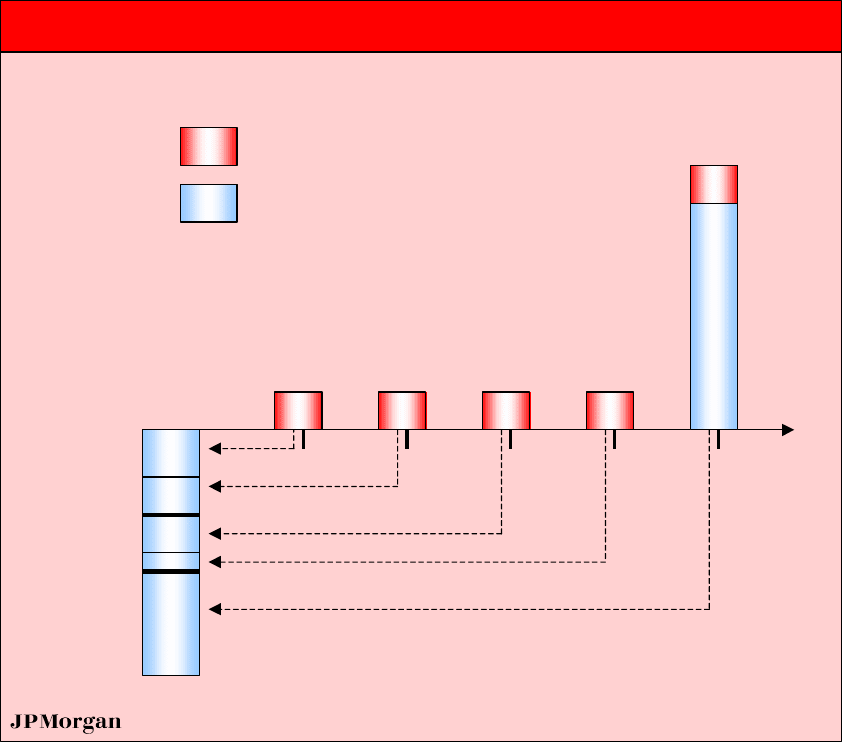
81.68
(78.35 + 3.33)
Valuing a fixed coupon capital guaranteed note
6.186.18 6.18 6.18
1 2 3 4
5.46
4.83
4.26
3.77
Risky
Risk Free
6.18
100
5