
The J.P. Morgan guide to credit derivatives
Подождите немного. Документ загружается.


Counterparty considerations: pricing the two-name exposure in a credit
default swap
In a credit swap the Protection Buyer has credit exposure to the Protection Seller
contingent on the performance of the Reference Entity. If the Protection Seller defaults,
the Buyer must find alternative protection and will be exposed to changes in
replacement cost due to changes in credit spreads since the inception of the original
swap. More seriously, if the Protection Seller defaults and the Reference Entity
defaults, the Buyer is unlikely to recover the full default payment due, although the final
recovery rate on the position will benefit from any positive recovery rate on obligations
of both the Reference Entity and the Protection Seller.
Counterparty risk consequently affects the pricing of credit derivative transactions.
Protection bought from higher-rated-counterparties will command a higher premium.
Furthermore, a higher credit quality premium; protection purchased from a counterparty
against a Reference Entity is less valuable if a simultaneous default on the two names
has a higher probability.
The problem of how to compute and charge for counterparty credit exposure is in large
part an empirical one, since it depends on computing the joint likelihood of arriving in
different credit states, which will in turn depend on an estimate of credit quality
correlation between the Protection Seller and Reference Entity, which cannot be directly
observed. Fortunately, significant efforts have been undertaken in the area of default
correlation estimation in connection with the development of credit portfolio models such
as CreditMetrics.
The following expression describes a simple methodology for computing a “counterparty
credit charge” (CCC), as the sum of expected losses due to counterparty (CP) default
across N different time periods, t, and states of credit quality (R) of the Reference Entity
(RE) from default through to AAA. Given an estimate of credit quality correlation, it is
possible to estimate the joint likelihood of the Reference Entity being in each state,
given a counterparty default, from the respective individual likelihoods or arriving in
each state of credit quality. Since loss can only occur given a default of the
counterparty, we are interested only in the default likelihood of the counterparty.
However, since loss can occur due to changes in the mark-to-market (MTM) of the
Credit Swap caused by credit spread fluctuations across different states of the
Reference Entity, we are interested in the full matrix of credit quality migration
likelihoods of the Reference Entity.
Typically, the counterparty credit charge is subtracted from the premium paid to the
Protection Seller and accounted for by the Protection Buyer as a reserve against
counterparty credit losses.
CCC = (100% - Recovery Rate
CP
)* Σ Σ Prob
Joint
{CP
In default
RE
Rating = R
} * Op
Rating = R
CP = Counterparty
RE = Reference Entity
N = Number of time periods, t
R = Rating of the Reference Entity in time t
Op = Price of an option to replace a risky exposure to RE instate R at time t with a
riskless exposure, ie. When RE has defaulted, value is (100% - Recovery Rate RE)
ie. When RE has not defauled , value is (100% - MTM of Credit Swap, based on credit
spreads)
tN AAA
t=t
0
R=Def

The evolution of the credit derivatives has not been an isolated event. The facility afforded
by credit derivatives to more actively manage credit risk is certainly notable in its own right.
However, this facility to manage risk would be incomplete without methods to identify
contributors to portfolio risk. Not surprisingly, the advent of public portfolio credit risk
models has coincided with the growth of the credit derivatives markets. The models now
allow market participants to recognize sources of risk, while credit derivatives provide
flexibility to manage these sources.
In this chapter, we will survey the various publicly available credit models, and describe
the CreditMetrics model in greater detail. We will then describe a number of practical uses
of the CreditMetrics model.
Credit portfolio models – a survey
The year 1997 was an important one for the analysis of credit portfolios, with the
publication of three models for portfolio credit risk. In order of publication, the models
were:
•
CreditMetrics, published as a technical document by J.P.Morgan, and now further
developed by the RiskMetrics Group,k LLC, who also markets a software
implementation, CreditManager,
CreditRisk + published as a technical document by CreditSuisse, Finanacial
Products, and
Credit Portfolio View, published as two articles in Risk magazine by Thomas
Wilson of McKinsey and Company.
Thus, in the span of just over six months, the number of publicly documented models
for assessing portfolio risk grew from zero to three. That there were three differing
approaches to the same problem might have led to an emphasis on modeling
discrepancies, but it led instead to a greater emphasis that the problem – credit risk in
a portfolio context – was crucial to address.
5. CreditMetrics – A portfolio approach to credit risk
managemen
The three models above, and indeed any conceivable model of portfolio credit risk,
share two features. The first is the treatment of default as a significant downward
jump in exposure value, which necessitates default probabilities and loss
severities
as inputs; the second is the development of some structure to describe the
dependency between defaults of individual names.
It is important to realize that none of the three models above provide the default
probabilities of individual names as output, and so all three must rely on external sources
for this parameter. In fact, the default probability for a given issuer or counterparty is
analogous to the volatility of an asset when considering market risk; that is, it is the
foremost (though not necessarily only) descriptor of the stand alone risk of the exposure in
question. However, the situation in credit risk is more complicated. For an exposure to a
foreign currency, it is possible to observe that currency’s exchange rate over time and
arrive at a reasonable estimate of the rate’s volatility. For an exposure to a particular
counterparty, looking at the counterparty’s
history tells us nothing about its likelihood of
defaulting in the future; in fact, that we have an exposure at all is a likely indication that
the counterparty has not defaulted before, though it certainly could default in the future.
Since the examination of individual default histories is not helpful, a number of
methods have been developed to estimate default probabilities. The first is to score or
rank individual names, categorize names historically according to their credit score,
and then measure the proportion of similar names that have defaulted over time. This
is the approach taken by the rating agencies, wherein they have credit ratings (scores)
for a vast array of names and over a long history, and report, for example, the
proportion of A-rated names that default within one year. For portfolio models, it is
possible to extrapolate from this information, and assign A-rated names the historical
default probability for that rating. For names large enough to carry ratings, the results
provided by the agencies are most commonly used because of the widespread
acceptance of their ratings and the large coverage and history of their databases. For
smaller, non-rated names, other credit scoring systems can be utilized in a similar
vein. Additionally, this approach can be extended to one where the fluctuation of
default rates over time is explained by factors such as interest rates, inflation, and
growth in productivity.
Clearly, the approach mentioned above involves a tradeoff: historical default information
becomes useful, but at the expense of granularity. That is, it is necessary to sacrifice name
specific information, and use default probabilities that are only particular to a given credit
rating or score. In order to ascertain the default probability for a particular name, the two
most common methods utilize, where possible, current market information rather than
history. One approach is to observe the price of a name’s traded debt, and to suppose that
the discrepancy between this price and the price of a comparable government security is
attributable to the possibility that the name may default on its debt. A second approach is
to utilize the equity markets, and extract a firm’s default probability from its equity price,
the structure of its liabilities, and the observation that equity is essentially a call option on
the assets of the firm
.2
While the three models each treat the value changes resulting from defaults, and thus
require default probabilities as inputs, the CreditMetrics model also treats value changes
arising from significant changes in credit quality, such as a ratings downgrade, short of
default. This additional capacity of the model necessitates additional data, namely the
probabilities of such quality changes. The probabilities are available also from the
agency approaches mentioned above. We will discuss this data further in the next
section.
The most significant structural difference between the three models is in how they
construct dependencies between defaults. The CreditRisk+ model builds dependencies by
stipulating that all names are subject to one or more systemic and volatile default rates. In
the simplest case, all names depend on one default rate. In some scenarios, the rate is high
and all the names have a greater chance of defaulting, while in others the rate is lower, and
the names all have a lesser chance of defaulting. The default probabilities discussed earlier
represent the average default rate in this context. The dependence of many names on a
mutual default rate essentially creates a correlation between the names, and the volatility of
the default rate, which is an input to the model, determines the level of correlation. The
Credit Portfolio View model also treats the variation in default rates (and more generally,
in rating change probabilities) but rather than simply assigning a volatility to the rate, the
model explains the fluctuations in the default rate through fluctuations in macroeconomic
variables. In the CreditMetrics model, rather than explaining a systemic factor like the
default rate, we model each name’s default as contingent on fluctuations in the assets of the
individual firm. The dependency between individual defaults is then built by modeling the
correlations between firm asset values.
Although there appear to be fundamental differences in the three approaches; in fact
the frameworks are quite similar. Naturally, the publication of so many approaches
was followed by efforts to compare them. The consensus of the comparisons has been
that if the model inputs are set consistently, the models will give very similar results.
Empirical comparisons have shown some discrepancies, though due to inconsistent
model inputs rather than disparities in the model frameworks. Thus, the burden has
passed from developing frameworks to identifying good data.
We move now to a more detailed discussion of the CreditMetrics model and its
required imputs.
An overview of the CreditMetrics model
As we have already discussed, CreditMetrics models the changes in portfolio value
that result from significant credit quality moves, that is, defaults or rating changes.
The model takes information on the individual obligors in the portfolio as inputs, and
produces as output the distribution of portfolio values at some fixed horizon in the
future. From this distribution, it is possible to produce statistics which quantify the
portfolio’s absolute risk level, such as the standard deviation of value changes, or the
worst case loss at a given level of confidence. While this gives a picture of the total
risk of the portfolio, we may also analyze our risks at a finer level, examining the risk
contribution of each exposure in the portfolio, identifying concentration risks or
diversification opportunities, or evaluating the impact of a potential new exposure.
Examples and applications of these outputs will be provided in the next section.
Here, we describe the model itself in more detail.
The model is best described in three parts:
1. The definition of the possible “states” for each obligor’s credit
quality, and a description of how likely obligors are to be in any
of these states at the horizon date.
2.
The interaction and correlation between credit migrations of
different obligors.
3. The revaluation of exposures in all possible credit states.
Step 1 – the states of the world
The definition of an obligor’s possible credit states typically amounts to selecting a
rating system, whether an agency system or an internal one, whether a coarse system
with seven states, or a fine one with plus or minus states added. The crucial element
here is that we know the probabilities that the obligor migrates to any of the states
between now and the horizon date. That the user provides this information to the
model is what differentiates CreditMetrics from a credit scoring model. The most
straightforward way to present the probabilities is through a transition matrix; an
example appears in Table 1. A transition matrix characterizes a rating system by
providing the probabilities of migration (within a specified horizon) for all of the
system’s states.

Table 1: Example one-year transition matrix - Moody’s rating system
Aaa Aa A Baa Ba B Caa D
Aaa 93.38% 5.94% 0.64% 0.00% 0.02% 0.00% 0.00% 0.02%
Aa 1.61% 90.53% 7.46% 0.26% 0.09% 0.01% 0.00% 0.04%
A 0.07% 2.28% 92.35% 4.63% 0.45% 0.12% 0.01% 0.09%
Baa 0.05% 0.26% 5.51% 88.48% 4.76% 0.71% 0.08% 0.15%
Ba 0.02% 0.05% 0.42% 5.16% 86.91% 5.91% 0.24% 1.29%
B 0.00% 0.04% 0.13% 0.54% 6.35% 84.22% 1.91% 6.81%
Caa 0.00% 0.00% 0.00% 0.62% 2.05% 4.08% 69.19% 24.06%
Among the most widely available transition matrices are those produced by the major
rating agencies, which reflect the average annual transition rates over a long history
(typically 20 years or more) for a particular class of issuers (e.g. corporate bonds or
commercial paper). While this information is useful, and the agency default rates have
become benchmarks for describing the individual categories, the use of average transition
matrices for credit portfolio modeling is often criticized for its failure to capture the credit
cycle. In other words, since the matrices only represent averages over many years, they
cannot account for the current year’s credit transitions being relatively benign or severe.
A number of methods are now available to address this. One is to select smaller periods
of the agency history, and create matrices based, for example, only on the transitions in
1988 to 1991. A second is to explicitly model the relationship between transitions and
defaults and macroeconomic variables, such as spread levels or industrial production.
Regardless of the transition matrix ultimately chosen as the “best”, because of the
difficulties inherent in default rate estimation, it is prudent to examine the portfolio under
a variety of transition assumptions.
Step 2 – revaluation
While the first step concerns the description of migrations of individual credits, to
complete the picture, we need a notion of the value impact of these moves. This brings
up the issue of revaluation. In short, we assume a particular instrument’s value today is
known, and wish to estimate its value, at our risk horizon, conditional on any of the
possible credit migrations that the instrument’s issuer might undergo.
Consider a Baa-rated, three year, fixed 6% coupon bond, currently valued at par. With a
one year horizon, the revaluation step consists of estimating the bond’s value in one year
under each possible transition. For the transition to default, we value the bond through an
estimate of the likely recovery value. Many institutions use their own recovery
assumptions here, although public information is available. For the non-default states, we
obtain an estimate of the bond’s horizon value by utilizing the term structure of bond
spreads and risk-free interest rates. In the end, we arrive at the values in Table 2. With the
information in Table 2, we have all of the stand-alone information for this bond;
consequently, we can calculate the expectation and standard deviation of the bond’s value
at the horizon.
Rating at
horizon
Probability Accrued
Coupon
Bond
value
Bond plus
coupon
Aaa 0.05% 6.0 100.4 106.4
Aa 0.26% 6.0 100.3 106.3
A 5.51% 6.0 100.1 106.1
Baa 88.48% 6.0 100.0 106.0
Ba 4.76% 6.0 98.5 104.5
B 0.71% 6.0 96.2 102.2
Caa 0.08% 6.0 93.3 99.3
D 0.15% 6.0 40.1 46.1
Mean 99.8 105.8
St. dev. 2.36 2.36
Table 2: Values at Horizon for three year 6% Baa bond
To incorporate other types of exposures only involves defining the values in each
possible future rating state of the underlying credit. Essentially, this amounts to
building something like Table 2. For some exposure types (for example, bonds and
loans), all that is necessary to build this table are recovery assumptions and spreads,
while for others (commitment lines or derivative contracts), further information is
required. Assuming a riskless derivative counterparty
, the simple credit derivatives of
the previous chapter can be incorporated in the same way. To account for
counterparty risk as well involves some slight enhancements, but is not complicated.
1
Step 3 – building correlations
The final step is to construct correlations between exposures. To do this, we posit an
unseen "driver" of credit migrations, which we think of as changes in asset value. Our
approach is conceptually similar to, and certainly inspired by, the equity based models
mentioned previously. The intuition behind these models is that default occurs when
the value of a firm’s assets drops below the market value of its liabilities. In our case,
we do not seek to observe asset levels, nor to use asset information to predict defaults;
the stand-alone information for each name (in particular the name's probability of
default) is provided as a model input through the specification of the transition matrix.
Rather, assets are used only to build the interaction between obligors.
To begin our construction of correlations, we assume that asset value changes are
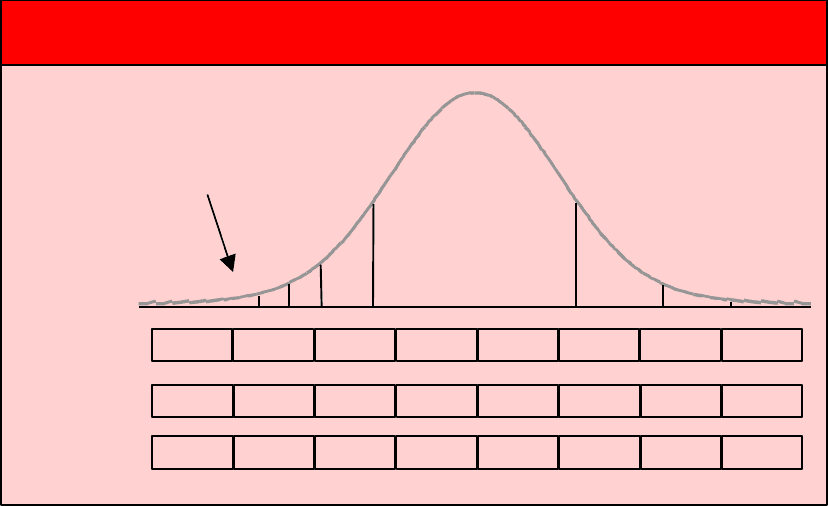
normally distributed. We then partition the asset change distribution for each name
according to the name's transition probabilities. For the Baa-rated obligor above (with
default probability equal to 0.15%), the default partition (which conceptually can be
thought of as the obligor’s liability level) is chosen as the point beyond which lies 0.15%
probability; the CCC partition is then chosen to match the obligor's probability of
migrating to CCC, and so on. The result is illustrated in Figure 1.
Figure 1: Partition of asset change distribution for a Baa obliger
>3.32.7
→
3.31.5
→
2.
7
-
1
.6
→
1.5
-2
.
4
→
-1
.6-
2
.
8
→
-2.4-
3.0
→
-2.8
<-
3.0
AaaAaABaaBaBCaaDefault
100.4100.3
100.1100.098.596.293.340.1
Obliger
defaults
Obliger
remains Baa
Asset return
New rating
Value
A common misinterpretation of this step is that by using a normal distribution for asset
value changes, we are somehow not accounting for the well documented non-normality in
the returns of credit driven assets. This is not the case, as it is only the driver of credit
changes for which we assume a normal distribution, but not the changes in asset values
themselves. In fact, if we consider the values (from Table 2) with the partition in Figure
1
, we see that a two standard deviation increase in asset value produces an appreciation of
0.1, whereas an equally likely two standard deviation decrease produces a depreciation of
1.5; similarly, a three standard deviation asset value increase yields an appreciation of 0.3,
but an equivalent decrease yields a depreciation of 59.9. This is the type of skew that is
expected in credit distributions.
In the portfolio framework, once the partitions are defined for every obligor, it only
remains to describe the correlation between asset value changes. Rather than attempting to
observe these changes directly, we take correlations in equity returns as a proxy for the
asset value correlations. This is primarily a practical decision, and allows us to then
estimate correlations using reliable data. As in the prior two steps, however, it is crucial to
examine the sensitivity of the model to uncertainties in the data. While the correlation
estimates are designed to be stable and applicable over long horizons such as one year,
market events may rapidly change correlation structures; to evaluate the impact of these
changes, it is recommended to analyze the portfolio under both normal and "stressed"
correlation conditions.
1
With the correlations defined, the model is completely specified. In principle, it is
possible to explicitly calculate the probabilities of all joint rating transitions (e.g.
obligor 1 defaults, obligor 2 downgrades, obligor 3 stays the same rating, etc.). In
practice, it is faster to obtain the portfolio distribution through a Monte Carlo
approach. Thus, for a single scenario, we draw from a multivariate normal
distribution to produce asset value changes, read from the partitions to identify the
changes with new rating states and exposure values, and aggregate the individual
exposures to arrive at a portfolio value for the scenario. Examples of this process for
strongly and weakly correlated two obligor portfolios are illustrated in Figures 2 and
3. Repeating this process over a large number of scenarios, we accumulate a large
number of equally likely portfolio values, and are able to estimate the Value at Risk,
and other descriptive statistics, of the portfolio.
Figure 2: Two Baa bonds, strong correlation. Mean=199.6, St.Dev.=4.13.
Applications
Estimation of economic capital
The first application of the approach outlined above is to evaluate the absolute risk of
a portfolio. To do so, it has become common to report the portfolio’s Value at Risk
(VaR) – the maximum amount the portfolio might lose over a given time horizon,
with a given level of confidence. For trading portfolios, it is common to report the
VaR for a one day horizon with a 95% confidence level, corresponding roughly to the
maximum portfolio daily loss over one month, or a ten day horizon with a 99%
confidence level, corresponding to the maximum two week loss over a five year
period. In these cases, VaR is used mostly as a communication tool; traders and
managers have intuition for the worst loss over these timeframes, and so VaR is
informative. For credit portfolios, with a horizon such as one year, even VaR at a low
confidence level like 90% gives a worst case one year loss over a ten year period.
Beyond its use as a communication tool, VaR for credit portfolios is more appropriate
to assess economic capital. For a bank investing in a portfolio on a funded basis, a key
question is how much capital needs to be allocated to cover worst case portfolio losses.
At an institutional level, the question is how much capital the institution needs to protect
against major downturns and guarantee solvency. In both cases, it is easy to frame the
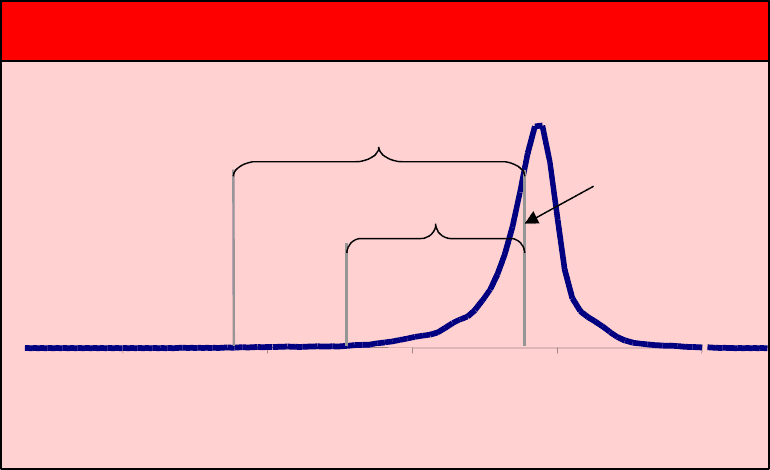
problem in terms of VaR. Figure 4 presents a portfolio distribution that might result
from an application of CreditMetrics. The left-most vertical bar represents the value
below which the portfolio will fall with 0.1% probability; the second bar from the left
represents the level below which the portfolio will fall with 1% probability. Thus, with
capital equal to the distance from the mean value to the left-most bar, there is a 99.9%
chance that the capital will be sufficient to absorb the portfolio loss, and thus only a
0.1% chance of insolvency.
Figure 4: Portfolio distribution and economic capital
42 44 46 48 50
Portfolio value ($US Millions)
Mean value
99% worst case loss
99.9% worst case loss
.