
Thomas M. Cover, Joy A. Thomas. Elements of information theory
Подождите немного. Документ загружается.

4.5 FUNCTIONS OF MARKOV CHAINS 85
It would be useful computationally to have upper and lower bounds con-
verging to the limit from above and below. We can halt the computation
when the difference between upper and lower bounds is small, and we
will then have a good estimate of the limit.
We already know that H(Y
n
|Y
n−1
,...,Y
1
) converges monoton-
ically to H(
Y) from above. For a lower bound, we will use
H(Y
n
|Y
n−1
,...,Y
1
,X
1
). This is a neat trick based on the idea that X
1
contains as much information about Y
n
as Y
1
,Y
0
,Y
−1
,....
Lemma 4.5.1
H(Y
n
|Y
n−1
,...,Y
2
,X
1
) ≤ H(Y). (4.57)
Proof: We have for k = 1, 2,...,
H(Y
n
|Y
n−1
,...,Y
2
,X
1
)
(a)
= H(Y
n
|Y
n−1
,...,Y
2
,Y
1
,X
1
) (4.58)
(b)
= H(Y
n
|Y
n−1
,...,Y
1
,X
1
,X
0
,X
−1
,...,X
−k
)
(4.59)
(c)
= H(Y
n
|Y
n−1
,...,Y
1
,X
1
,X
0
,X
−1
,...,
X
−k
,Y
0
,...,Y
−k
) (4.60)
(d)
≤ H(Y
n
|Y
n−1
,...,Y
1
,Y
0
,...,Y
−k
) (4.61)
(e)
= H(Y
n+k+1
|Y
n+k
,...,Y
1
), (4.62)
where (a) follows from that fact that Y
1
is a function of X
1
, and (b) follows
from the Markovity of X, (c) follows from the fact that Y
i
is a function
of X
i
, (d) follows from the fact that conditioning reduces entropy, and (e)
follows by stationarity. Since the inequality is true for all k,itistruein
the limit. Thus,
H(Y
n
|Y
n−1
,...,Y
1
,X
1
) ≤ lim
k
H(Y
n+k+1
|Y
n+k
,...,Y
1
) (4.63)
= H(
Y). (4.64)
The next lemma shows that the interval between the upper and the
lower bounds decreases in length.
Lemma 4.5.2
H(Y
n
|Y
n−1
,...,Y
1
) − H(Y
n
|Y
n−1
,...,Y
1
,X
1
) → 0. (4.65)
86 ENTROPY RATES OF A STOCHASTIC PROCESS
Proof: The interval length can be rewritten as
H(Y
n
|Y
n−1
,...,Y
1
) − H(Y
n
|Y
n−1
,...,Y
1
,X
1
)
= I(X
1
;Y
n
|Y
n−1
,...,Y
1
). (4.66)
By the properties of mutual information,
I(X
1
;Y
1
,Y
2
,...,Y
n
) ≤ H(X
1
), (4.67)
and I(X
1
;Y
1
,Y
2
,...,Y
n
) increases with n. Thus, lim I(X
1
;Y
1
,Y
2
,...,
Y
n
) exists and
lim
n→∞
I(X
1
;Y
1
,Y
2
,...,Y
n
) ≤ H(X
1
). (4.68)
By the chain rule,
H(X) ≥ lim
n→∞
I(X
1
;Y
1
,Y
2
,...,Y
n
) (4.69)
= lim
n→∞
n
i=1
I(X
1
;Y
i
|Y
i−1
,...,Y
1
) (4.70)
=
∞
i=1
I(X
1
;Y
i
|Y
i−1
,...,Y
1
). (4.71)
Since this infinite sum is finite and the terms are nonnegative, the terms
must tend to 0; that is,
lim I(X
1
;Y
n
|Y
n−1
,...,Y
1
) = 0, (4.72)
which proves the lemma.
Combining Lemmas 4.5.1 and 4.5.2, we have the following theorem.
Theorem 4.5.1 If X
1
,X
2
,...,X
n
form a stationary Markov chain, and
Y
i
= φ(X
i
),then
H(Y
n
|Y
n−1
,...,Y
1
,X
1
) ≤ H(Y) ≤ H(Y
n
|Y
n−1
,...,Y
1
) (4.73)
and
lim H(Y
n
|Y
n−1
,...,Y
1
,X
1
) = H(Y) = lim H(Y
n
|Y
n−1
,...,Y
1
). (4.74)
In general, we could also consider the case where Y
i
is a stochastic
function (as opposed to a deterministic function) of X
i
. Consider a Markov

SUMMARY 87
process X
1
,X
2
,...,X
n
, and define a new process Y
1
,Y
2
,...,Y
n
,where
each Y
i
is drawn according to p(y
i
|x
i
), conditionally independent of all
the other X
j
,j = i;thatis,
p(x
n
,y
n
) = p(x
1
)
n−1
i=1
p(x
i+1
|x
i
)
n
i=1
p(y
i
|x
i
). (4.75)
Such a process, called a hidden Markov model (HMM), is used extensively
in speech recognition, handwriting recognition, and so on. The same argu-
ment as that used above for functions of a Markov chain carry over to
hidden Markov models, and we can lower bound the entropy rate of a
hidden Markov model by conditioning it on the underlying Markov state.
The details of the argument are left to the reader.
SUMMARY
Entropy rate. Two definitions of entropy rate for a stochastic process
are
H(
X) = lim
n→∞
1
n
H(X
1
,X
2
,...,X
n
), (4.76)
H
(X) = lim
n→∞
H(X
n
|X
n−1
,X
n−2
,...,X
1
). (4.77)
For a stationary stochastic process,
H(
X) = H
(X). (4.78)
Entropy rate of a stationary Markov chain
H(
X) =−
ij
µ
i
P
ij
log P
ij
. (4.79)
Second law of thermodynamics. For a Markov chain:
1. Relative entropy D(µ
n
||µ
n
) decreases with time
2. Relative entropy D(µ
n
||µ) between a distribution and the stationary
distribution decreases with time.
3. Entropy H(X
n
) increases if the stationary distribution is uniform.

88 ENTROPY RATES OF A STOCHASTIC PROCESS
4. The conditional entropy H(X
n
|X
1
) increases with time for a sta-
tionary Markov chain.
5. The conditional entropy H(X
0
|X
n
) of the initial condition X
0
in-
creases for any Markov chain.
Functions of a Markov chain. If X
1
,X
2
,...,X
n
form a stationary
Markov chain and Y
i
= φ(X
i
),then
H(Y
n
|Y
n−1
,...,Y
1
,X
1
) ≤ H(Y) ≤ H(Y
n
|Y
n−1
,...,Y
1
) (4.80)
and
lim
n→∞
H(Y
n
|Y
n−1
,...,Y
1
,X
1
) = H(Y) = lim
n→∞
H(Y
n
|Y
n−1
,...,Y
1
).
(4.81)
PROBLEMS
4.1 Doubly stochastic matrices.Ann × n matrix P = [P
ij
]issaid
to be doubly stochastic if P
ij
≥ 0and
j
P
ij
= 1foralli and
i
P
ij
= 1forallj .Ann × n matrix P is said to be a permu-
tation matrix if it is doubly stochastic and there is precisely one
P
ij
= 1 in each row and each column. It can be shown that every
doubly stochastic matrix can be written as the convex combination
of permutation matrices.
(a) Let a
t
= (a
1
,a
2
,...,a
n
), a
i
≥ 0,
a
i
= 1, be a probability
vector. Let b = aP ,whereP is doubly stochastic. Show that b
is a probability vector and that H(b
1
,b
2
,...,b
n
) ≥ H(a
1
,a
2
,
...,a
n
). Thus, stochastic mixing increases entropy.
(b) Show that a stationary distribution µ for a doubly stochastic
matrix P is the uniform distribution.
(c) Conversely, prove that if the uniform distribution is a stationary
distribution for a Markov transition matrix P ,thenP is doubly
stochastic.
4.2 Time’s arrow .Let{X
i
}
∞
i=−∞
be a stationary stochastic process.
Prove that
H(X
0
|X
−1
,X
−2
,...,X
−n
) = H(X
0
|X
1
,X
2
,...,X
n
).
PROBLEMS 89
In other words, the present has a conditional entropy given the past
equal to the conditional entropy given the future. This is true even
though it is quite easy to concoct stationary random processes for
which the flow into the future looks quite different from the flow
into the past. That is, one can determine the direction of time by
looking at a sample function of the process. Nonetheless, given
the present state, the conditional uncertainty of the next symbol in
the future is equal to the conditional uncertainty of the previous
symbol in the past.
4.3 Shuffles increase entropy . Argue that for any distribution on shuf-
fles T and any distribution on card positions X that
H(TX) ≥ H(TX|T) (4.82)
= H(T
−1
TX|T) (4.83)
= H(X|T) (4.84)
= H(X) (4.85)
if X and T are independent.
4.4 Second law of thermodynamics.LetX
1
,X
2
,X
3
,...be a station-
ary first-order Markov chain. In Section 4.4 it was shown that
H(X
n
| X
1
) ≥ H(X
n−1
| X
1
) for n = 2, 3,.... Thus, conditional
uncertainty about the future grows with time. This is true although
the unconditional uncertainty H(X
n
) remains constant. However,
show by example that H(X
n
|X
1
= x
1
) does not necessarily grow
with n for every x
1
.
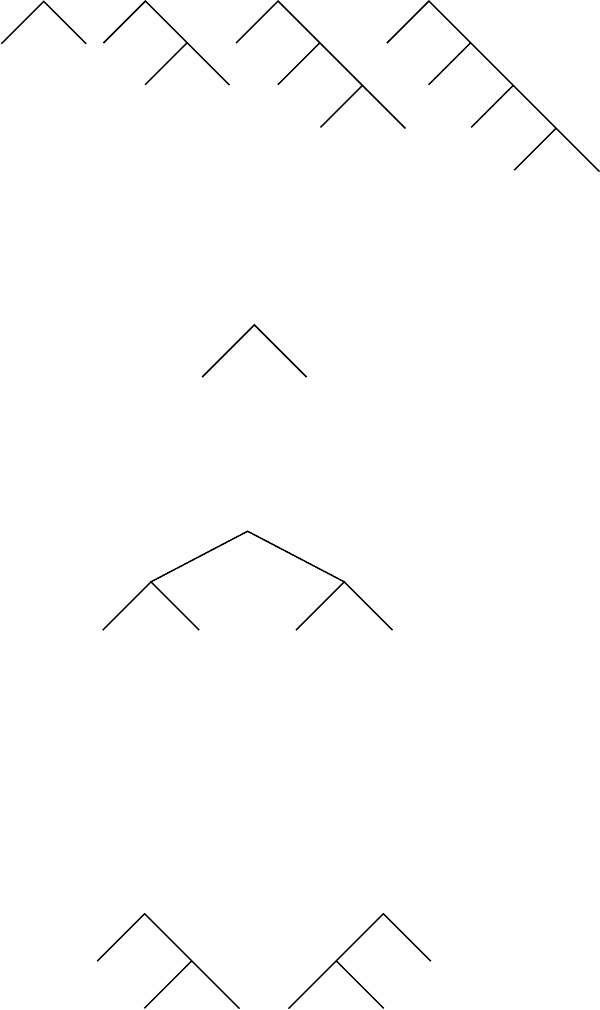
4.5 Entropy of a random tree. Consider the following method of gen-
erating a random tree with n nodes. First expand the root node:
Then expand one of the two terminal nodes at random:
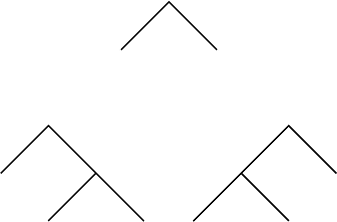
At time k, choose one of the k − 1 terminal nodes according to a
uniform distribution and expand it. Continue until n terminal nodes
90 ENTROPY RATES OF A STOCHASTIC PROCESS
have been generated. Thus, a sequence leading to a five-node tree
might look like this:
Surprisingly, the following method of generating random trees
yields the same probability distribution on trees with n termi-
nal nodes. First choose an integer N
1
uniformly distributed on
{1, 2,...,n− 1}. We then have the picture
N
1
n
−
N
1
Then choose an integer N
2
uniformly distributed over
{1, 2,...,N
1
− 1}, and independently choose another integer N
3
uniformly over {1, 2,...,(n− N
1
) − 1}. The picture is now
N
2
N
3
n
−
N
1
−
N
3
N
1
−
N
2
Continue the process until no further subdivision can be made.
(The equivalence of these two tree generation schemes follows, for
example, from Polya’s urn model.)
Now let T
n
denote a random n-node tree generated as described. The
probability distribution on such trees seems difficult to describe, but
we can find the entropy of this distribution in recursive form.
First some examples. For n = 2, we have only one tree. Thus,
H(T
2
) = 0. For n = 3, we have two equally probable trees:

PROBLEMS 91
Thus, H(T
3
) = log 2. For n = 4, we have five possible trees, with
probabilities
1
3
,
1
6
,
1
6
,
1
6
,
1
6
.
Now for the recurrence relation. Let N
1
(T
n
) denote the number of
terminal nodes of T
n
in the right half of the tree. Justify each of
the steps in the following:
H(T
n
)
(a)
= H(N
1
,T
n
) (4.86)
(b)
= H(N
1
) + H(T
n
|N
1
) (4.87)
(c)
= log(n − 1) + H(T
n
|N
1
) (4.88)
(d)
= log(n − 1) +
1
n − 1
n−1
k=1
(
H(T
k
) + H(T
n−k
)
)
(4.89)
(e)
= log(n − 1) +
2
n − 1
n−1
k=1
H(T
k
) (4.90)
=log(n − 1) +
2
n − 1
n−1
k=1
H
k
. (4.91)
(f) Use this to show that
(n − 1)H
n
= nH
n−1
+ (n − 1) log(n − 1) − (n − 2) log(n − 2)
(4.92)
or
H
n
n
=
H
n−1
n − 1
+ c
n
(4.93)
for appropriately defined c
n
.Since
c
n
= c<∞, you have proved
that
1
n
H(T
n
) converges to a constant. Thus, the expected number of
bits necessary to describe the random tree T
n
grows linearly with n.
4.6 Monotonicity of entropy per element . For a stationary stochastic
process X
1
,X
2
,...,X
n
, show that
(a)
H(X
1
,X
2
,...,X
n
)
n
≤
H(X
1
,X
2
,...,X
n−1
)
n − 1
. (4.94)
(b)
H(X
1
,X
2
,...,X
n
)
n
≥ H(X
n
|X
n−1
,...,X
1
). (4.95)

92 ENTROPY RATES OF A STOCHASTIC PROCESS
4.7 Entropy rates of Markov chains
(a) Find the entropy rate of the two-state Markov chain with tran-
sition matrix
P =
1 − p
01
p
01
p
10
1 − p
10
.
(b) What values of p
01
,p
10
maximize the entropy rate?
(c) Find the entropy rate of the two-state Markov chain with tran-
sition matrix
P =
1 − pp
10
.
(d) Find the maximum value of the entropy rate of the Markov
chain of part (c). We expect that the maximizing value of p
should be less than
1
2
, since the 0 state permits more informa-
tion to be generated than the 1 state.
(e) Let N(t) be the number of allowable state sequences of length t
for the Markov chain of part (c). Find N(t) and calculate
H
0
= lim
t→∞
1
t
log N(t).
[Hint: Find a linear recurrence that expresses N(t) in terms
of N(t − 1) and N(t − 2).WhyisH
0
an upper bound on the
entropy rate of the Markov chain? Compare H
0
with the max-
imum entropy found in part (d).]
4.8 Maximum entropy process. A discrete memoryless source has the
alphabet {1, 2}, where the symbol 1 has duration 1 and the sym-
bol 2 has duration 2. The probabilities of 1 and 2 are p
1
and p
2
,
respectively. Find the value of p
1
that maximizes the source entropy
per unit time H(
X) =
H(X)
ET
. What is the maximum value H(X)?
4.9 Initial conditions. Show, for a Markov chain, that
H(X
0
|X
n
) ≥ H(X
0
|X
n−1
).
Thus, initial conditions X
0
become more difficult to recover as the
future X
n
unfolds.
4.10 Pairwise independence.LetX
1
,X
2
,...,X
n−1
be i.i.d. random
variables taking values in {0, 1}, with Pr{X
i
= 1}=
1
2
.LetX
n
= 1
if
n−1
i=1
X
i
is odd and X
n
= 0 otherwise. Let n ≥ 3.

PROBLEMS 93
(a) Show that X
i
and X
j
are independent for i = j , i, j ∈{1, 2,
...,n}.
(b) Find H(X
i
,X
j
) for i = j .
(c) Find H(X
1
,X
2
,...,X
n
). Is this equal to nH (X
1
)?
4.11 Stationary processes.Let...,X
−1
,X
0
,X
1
,...be a stationary
(not necessarily Markov) stochastic process. Which of the follow-
ing statements are true? Prove or provide a counterexample.
(a) H(X
n
|X
0
) = H(X
−n
|X
0
).
(b) H(X
n
|X
0
) ≥ H(X
n−1
|X
0
).
(c) H(X
n
|X
1
,X
2
,...,X
n−1
,X
n+1
) is nonincreasing in n.
(d) H(X
n
|X
1
,...,X
n−1
,X
n+1
,...,X
2n
) is nonincreasing in n.
4.12 Entropy rate of a dog looking for a bone. A dog walks on the
integers, possibly reversing direction at each step with probability
p = 0.1. Let X
0
= 0. The first step is equally likely to be positive
or negative. A typical walk might look like this:
(X
0
,X
1
,...) = (0, −1, −2, −3, −4, −3, −2, −1, 0, 1,...).
(a) Find H(X
1
,X
2
,...,X
n
).
(b) Find the entropy rate of the dog.
(c) What is the expected number of steps that the dog takes before
reversing direction?
4.13 The past has little to say about the future. For a stationary stochas-
tic process X
1
,X
2
,...,X
n
,..., show that
lim
n→∞
1
2n
I(X
1
,X
2
,...,X
n
;X
n+1
,X
n+2
,...,X
2n
) = 0. (4.96)
Thus, the dependence between adjacent n-blocks of a stationary
process does not grow linearly with n.
4.14 Functions of a stochastic process
(a) Consider a stationary stochastic process X
1
,X
2
,...,X
n
,and
let Y
1
,Y
2
,...,Y
n
be defined by
Y
i
= φ(X
i
), i = 1, 2,... (4.97)
for some function φ. Prove that
H(
Y) ≤ H(X). (4.98)
94 ENTROPY RATES OF A STOCHASTIC PROCESS
(b) What is the relationship between the entropy rates H(Z) and
H(
X) if
Z
i
= ψ(X
i
,X
i+1
), i = 1, 2,... (4.99)
for some function ψ ?
4.15 Entropy rate.Let{X
i
} be a discrete stationary stochastic process
with entropy rate H(
X). Show that
1
n
H(X
n
,...,X
1
| X
0
,X
−1
,...,X
−k
) → H(X) (4.100)
for k = 1, 2,....
4.16 Entropy rate of constrained sequences. In magnetic recording, the
mechanism of recording and reading the bits imposes constraints
on the sequences of bits that can be recorded. For example, to
ensure proper synchronization, it is often necessary to limit the
length of runs of 0’s between two 1’s. Also, to reduce intersymbol
interference, it may be necessary to require at least one 0 between
any two 1’s. We consider a simple example of such a constraint.
Suppose that we are required to have at least one 0 and at most
two 0’s between any pair of 1’s in a sequences. Thus, sequences
like 101001 and 0101001 are valid sequences, but 0110010 and
0000101 are not. We wish to calculate the number of valid se-
quences of length n.
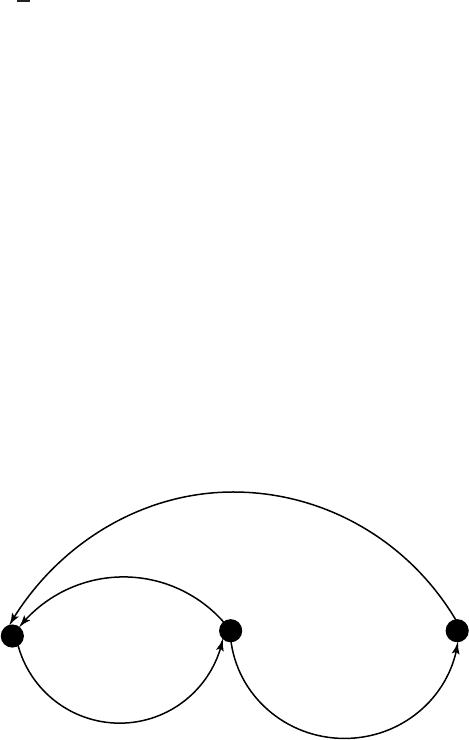
(a) Show that the set of constrained sequences is the same as the
set of allowed paths on the following state diagram:
(b) Let X
i
(n) be the number of valid paths of length n ending at
state i. Argue that X(n) = [X
1
(n) X
2
(n) X
3
(n)]
t
satisfies the