
Thomas M. Cover, Joy A. Thomas. Elements of information theory
Подождите немного. Документ загружается.

5.5 KRAFT INEQUALITY FOR UNIQUELY DECODABLE CODES 115
This theorem provides another justification for the definition of entropy
rate—it is the expected number of bits per symbol required to describe
the process.
Finally, we ask what happens to the expected description length if the
code is designed for the wrong distribution. For example, the wrong dis-
tribution may be the best estimate that we can make of the unknown true
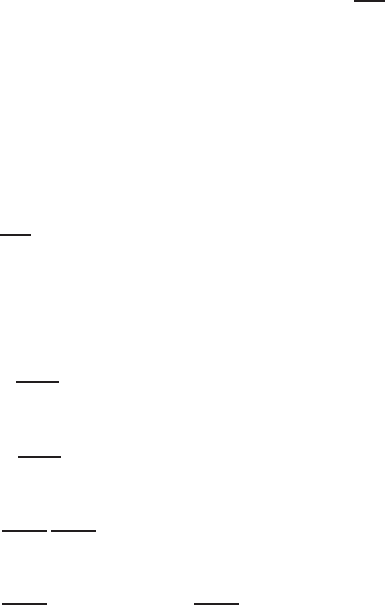
distribution. We consider the Shannon code assignment l(x) =
log
1
q(x)
designed for the probability mass function q(x). Suppose that the true
probability mass function is p(x). Thus, we will not achieve expected
length L ≈ H(p) =−
p(x) log p(x). We now show that the increase
in expected description length due to the incorrect distribution is the rel-
ative entropy D(p||q). Thus, D(p||q) has a concrete interpretation as the
increase in descriptive complexity due to incorrect information.
Theorem 5.4.3 (Wrong code) The expected length under p(x) of the
code assignment l(x) =
log
1
q(x)
satisfies
H(p) + D(p||q) ≤ E
p
l(X) < H(p) + D(p||q) + 1. (5.42)
Proof: The expected codelength is
El(X) =
x
p(x)
log
1
q(x)
(5.43)
<
x
p(x)
log
1
q(x)
+ 1
(5.44)
=
x
p(x) log
p(x)
q(x)
1
p(x)
+ 1 (5.45)
=
x
p(x) log
p(x)
q(x)
+
x
p(x) log
1
p(x)
+ 1 (5.46)
= D(p||q) + H(p)+ 1. (5.47)
The lower bound can be derived similarly.
Thus, believing that the distribution is q(x) when the true distribution
is p(x) incurs a penalty of D(p||q) in the average description length.
5.5 KRAFT INEQUALITY FOR UNIQUELY DECODABLE CODES
We have proved that any instantaneous code must satisfy the Kraft inequal-
ity. The class of uniquely decodable codes is larger than the class of
116 DATA COMPRESSION
instantaneous codes, so one expects to achieve a lower expected codeword
length if L is minimized over all uniquely decodable codes. In this section
we prove that the class of uniquely decodable codes does not offer any
further possibilities for the set of codeword lengths than do instantaneous
codes. We now give Karush’s elegant proof of the following theorem.
Theorem 5.5.1 (McMillan) The codeword lengths of any uniquely
decodable D-ary code must satisfy the Kraft inequality
D
−l
i
≤ 1. (5.48)
Conversely, given a set of codeword lengths that satisfy this inequality, it
is possible to construct a uniquely decodable code with these codeword
lengths.
Proof: Consider C
k
,thekth extension of the code (i.e., the code formed
by the concatenation of k repetitions of the given uniquely decodable code
C). By the definition of unique decodability, the kth extension of the code
is nonsingular. Since there are only D
n
different D-ary strings of length n,
unique decodability implies that the number of code sequences of length
n in the kth extension of the code must be no greater than D
n
. We now
use this observation to prove the Kraft inequality.
Let the codeword lengths of the symbols x ∈
X be denoted by l(x).
For the extension code, the length of the code sequence is
l(x
1
,x
2
,...,x
k
) =
k
i=1
l(x
i
). (5.49)
The inequality that we wish to prove is
x∈X
D
−l(x)
≤ 1. (5.50)
The trick is to consider the kth power of this quantity. Thus,
x∈X
D
−l(x)
k
=
x
1
∈X
x
2
∈X
···
x
k
∈X
D
−l(x
1
)
D
−l(x
2
)
···D
−l(x
k
)
(5.51)
=
x
1
,x
2
,...,x
k
∈X
k
D
−l(x
1
)
D
−l(x
2
)
···D
−l(x
k
)
(5.52)
=
x
k
∈X
k
D
−l(x
k
)
, (5.53)
5.5 KRAFT INEQUALITY FOR UNIQUELY DECODABLE CODES 117
by (5.49). We now gather the terms by word lengths to obtain
x
k
∈X
k
D
−l(x
k
)
=
kl
max
m=1
a(m)D
−m
, (5.54)
where l
max
is the maximum codeword length and a(m) is the number
of source sequences x
k
mapping into codewords of length m.Butthe
code is uniquely decodable, so there is at most one sequence mapping
into each code m-sequence and there are at most D
m
code m-sequences.
Thus, a(m) ≤ D
m
, and we have
x∈X
D
−l(x)
k
=
kl
max
m=1
a(m)D
−m
(5.55)
≤
kl
max
m=1
D
m
D
−m
(5.56)
= kl
max
(5.57)
and hence
j
D
−l
j
≤
(
kl
max
)
1/k
. (5.58)
Since this inequality is true for all k, it is true in the limit as k →∞.
Since (kl
max
)
1/k
→ 1, we have
j
D
−l
j
≤ 1, (5.59)
which is the Kraft inequality.
Conversely, given any set of l
1
,l
2
,...,l
m
satisfying the Kraft inequal-
ity, we can construct an instantaneous code as proved in Section 5.2. Since
every instantaneous code is uniquely decodable, we have also constructed
a uniquely decodable code.
Corollary A uniquely decodable code for an infinite source alphabet X
also satisfies the Kraft inequality.
Proof: The point at which the preceding proof breaks down for infinite
|
X| is at (5.58), since for an infinite code l
max
is infinite. But there is a
118 DATA COMPRESSION
simple fix to the proof. Any subset of a uniquely decodable code is also
uniquely decodable; thus, any finite subset of the infinite set of codewords
satisfies the Kraft inequality. Hence,
∞
i=1
D
−l
i
= lim
N→∞
N
i=1
D
−l
i
≤ 1. (5.60)
Given a set of word lengths l
1
,l
2
,... that satisfy the Kraft inequality, we
can construct an instantaneous code as in Section 5.4. Since instantaneous
codes are uniquely decodable, we have constructed a uniquely decodable
code with an infinite number of codewords. So the McMillan theorem
also applies to infinite alphabets.
The theorem implies a rather surprising result—that the class of
uniquely decodable codes does not offer any further choices for the set
of codeword lengths than the class of prefix codes. The set of achievable
codeword lengths is the same for uniquely decodable and instantaneous
codes. Hence, the bounds derived on the optimal codeword lengths con-
tinue to hold even when we expand the class of allowed codes to the class
of all uniquely decodable codes.
5.6 HUFFMAN CODES
An optimal (shortest expected length) prefix code for a given distribution
can be constructed by a simple algorithm discovered by Huffman [283].
We will prove that any other code for the same alphabet cannot have a
lower expected length than the code constructed by the algorithm. Before
we give any formal proofs, let us introduce Huffman codes with some
examples.
Example 5.6.1 Consider a random variable X taking values in the set
X ={1, 2, 3, 4, 5} with probabilities 0.25, 0.25, 0.2, 0.15, 0.15, respec-
tively. We expect the optimal binary code for X to have the longest
codewords assigned to the symbols 4 and 5. These two lengths must be
equal, since otherwise we can delete a bit from the longer codeword and
still have a prefix code, but with a shorter expected length. In general,
we can construct a code in which the two longest codewords differ only
in the last bit. For this code, we can combine the symbols 4 and 5 into
a single source symbol, with a probability assignment 0.30. Proceeding
this way, combining the two least likely symbols into one symbol until
we are finally left with only one symbol, and then assigning codewords
to the symbols, we obtain the following table:
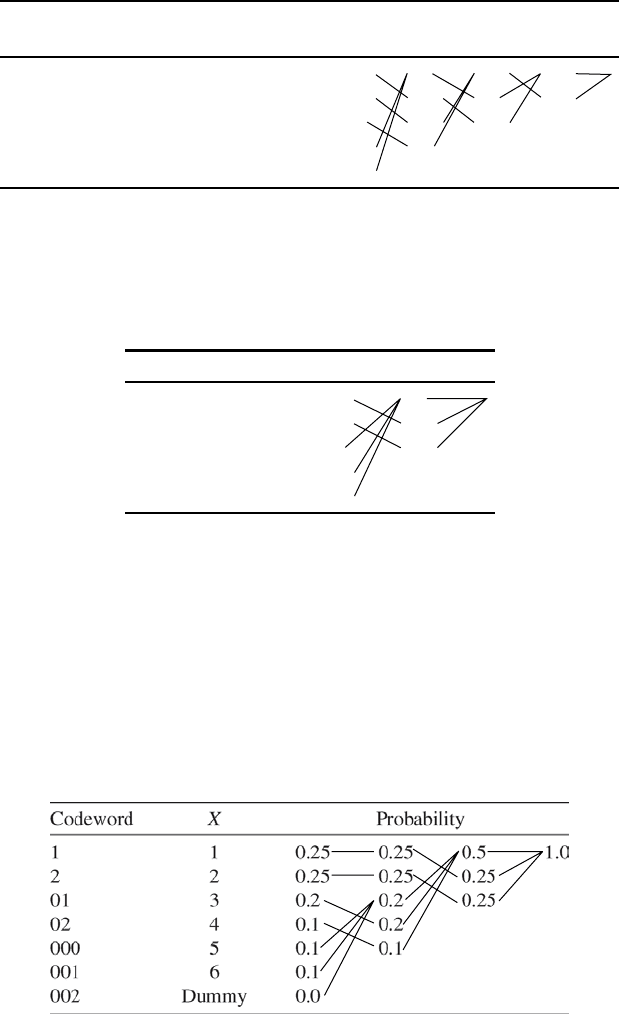
5.6 HUFFMAN CODES 119
Codeword
Length Codeword X Probability
2 01 1 0.25 0.3 0.45 0.55 1
2 10 2 0.25 0.25 0.3 0.45
2 11 3 0.2 0.25 0.25
3 000 4 0.15 0.2
3 001 5 0.15
This code has average length 2.3 bits.
Example 5.6.2 Consider a ternary code for the same random variable.
Now we combine the three least likely symbols into one supersymbol and
obtain the following table:
Codeword X Probability
1 1 0.25 0.5 1
2 2 0.25 0.25
00 3 0.2 0.25
01 4 0.15
02 5 0.15
This code has an average length of 1.5 ternary digits.
Example 5.6.3 If D ≥ 3, we may not have a sufficient number of sym-
bols so that we can combine them D at a time. In such a case, we add
dummy symbols to the end of the set of symbols. The dummy symbols
have probability 0 and are inserted to fill the tree. Since at each stage of
the reduction, the number of symbols is reduced by D − 1, we want the
total number of symbols to be 1 + k(D − 1),wherek is the number of
merges. Hence, we add enough dummy symbols so that the total number
of symbols is of this form. For example:
This code has an average length of 1.7 ternary digits.
120 DATA COMPRESSION
A proof of the optimality of Huffman coding is given in Section 5.8.
5.7 SOME COMMENTS ON HUFFMAN CODES
1. Equivalence of source coding and 20 questions. We now digress
to show the equivalence of coding and the game “20 questions”.
Suppose that we wish to find the most efficient series of yes–no
questions to determine an object from a class of objects. Assuming
that we know the probability distribution on the objects, can we find
the most efficient sequence of questions? (To determine an object,
we need to ensure that the responses to the sequence of questions
uniquely identifies the object from the set of possible objects; it is
not necessary that the last question have a “yes” answer.)
We first show that a sequence of questions is equivalent to a code
for the object. Any question depends only on the answers to the
questions before it. Since the sequence of answers uniquely deter-
mines the object, each object has a different sequence of answers,
and if we represent the yes–no answers by 0’s and 1’s, we have a
binary code for the set of objects. The average length of this code
is the average number of questions for the questioning scheme.
Also, from a binary code for the set of objects, we can find a
sequence of questions that correspond to the code, with the average
number of questions equal to the expected codeword length of the
code. The first question in this scheme becomes: Is the first bit equal
to 1 in the object’s codeword?
Since the Huffman code is the best source code for a random
variable, the optimal series of questions is that determined by the
Huffman code. In Example 5.6.1 the optimal first question is: Is
X equal to 2 or 3? The answer to this determines the first bit of
the Huffman code. Assuming that the answer to the first question
is “yes,” the next question should be “Is X equal to 3?”, which
determines the second bit. However, we need not wait for the answer
to the first question to ask the second. We can ask as our second
question “Is X equal to 1 or 3?”, determining the second bit of the
Huffman code independent of the first.
The expected number of questions EQ in this optimal scheme
satisfies
H(X) ≤ EQ < H(X) + 1. (5.61)
5.7 SOME COMMENTS ON HUFFMAN CODES 121
2. Huffman coding for weighted codewords. Huffman’s algorithm for
minimizing
p
i
l
i
can be applied to any set of numbers p
i
≥ 0,
regardless of
p
i
. In this case, the Huffman code minimizes the
sum of weighted code lengths
w
i
l
i
rather than the average code
length.
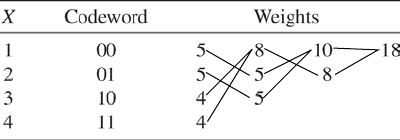
Example 5.7.1 We perform the weighted minimization using the
same algorithm.
In this case the code minimizes the weighted sum of the codeword
lengths, and the minimum weighted sum is 36.
3. Huffman coding and “slice” questions (Alphabetic codes). We have
described the equivalence of source coding with the game of 20
questions. The optimal sequence of questions corresponds to an
optimal source code for the random variable. However, Huffman
codes ask arbitrary questions of the form “Is X ∈ A?” for any set
A ⊆{1, 2,...,m}.
Now we consider the game “20 questions” with a restricted set
of questions. Specifically, we assume that the elements of
X =
{1, 2,...,m} are ordered so that p
1
≥ p
2
≥···≥p
m
and that the
only questions allowed are of the form “Is X>a?” for some a.The
Huffman code constructed by the Huffman algorithm may not cor-
respond to slices (sets of the form {x : x<a}). If we take the code-
word lengths (l
1
≤ l
2
≤···≤l
m
, by Lemma 5.8.1) derived from the
Huffman code and use them to assign the symbols to the code tree
by taking the first available node at the corresponding level, we
will construct another optimal code. However, unlike the Huffman
code itself, this code is a slice code, since each question (each bit
of the code) splits the tree into sets of the form {x : x>a} and
{x : x<a}.
We illustrate this with an example.
Example 5.7.2 Consider the first example of Section 5.6. The
code that was constructed by the Huffman coding procedure is not a
122 DATA COMPRESSION
slice code. But using the codeword lengths from the Huffman pro-
cedure, namely, {2, 2, 2, 3, 3}, and assigning the symbols to the first
available node on the tree, we obtain the following code for this
random variable:
1 → 00, 2 → 01, 3 → 10, 4 → 110, 5 → 111
It can be verified that this code is a slice code, codes known as
alphabetic codes because the codewords are ordered alphabetically.
4. Huffman codes and Shannon codes. Using codeword lengths of
log
1
p
i
(which is called Shannon coding) may be much worse than
the optimal code for some particular symbol. For example, con-
sider two symbols, one of which occurs with probability 0.9999 and
the other with probability 0.0001. Then using codeword lengths of
log
1
p
i
gives codeword lengths of 1 bit and 14 bits, respectively.
The optimal codeword length is obviously 1 bit for both symbols.
Hence, the codeword for the infrequent symbol is much longer in
the Shannon code than in the optimal code.
Is it true that the codeword lengths for an optimal code are always
less than log
1
p
i
? The following example illustrates that this is not
always true.
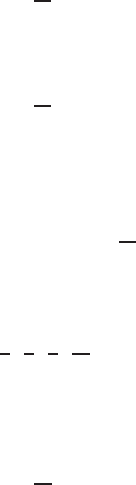
Example 5.7.3 Consider a random variable X with a distribution
1
3
,
1
3
,
1
4
,
1
12
. The Huffman coding procedure results in codeword
lengths of (2, 2, 2, 2) or (1, 2, 3, 3) [depending on where one puts
the merged probabilities, as the reader can verify (Problem 5.5.12)].
Both these codes achieve the same expected codeword length. In the
second code, the third symbol has length 3, which is greater than
log
1
p
3
. Thus, the codeword length for a Shannon code could be
less than the codeword length of the corresponding symbol of an
optimal (Huffman) code. This example also illustrates the fact that
the set of codeword lengths for an optimal code is not unique (there
may be more than one set of lengths with the same expected value).
Although either the Shannon code or the Huffman code can be
shorter for individual symbols, the Huffman code is shorter on aver-
age. Also, the Shannon code and the Huffman code differ by less
than 1 bit in expected codelength (since both lie between H and
H + 1.)
5.8 OPTIMALITY OF HUFFMAN CODES 123
5. Fano codes. Fano proposed a suboptimal procedure for constructing
a source code, which is similar to the idea of slice codes. In his
method we first order the probabilities in decreasing order. Then we
choose k such that
k
i=1
p
i
−
m
i=k+1
p
i
is minimized. This point
divides the source symbols into two sets of almost equal probability.
Assign 0 for the first bit of the upper set and 1 for the lower set.
Repeat this process for each subset. By this recursive procedure, we
obtain a code for each source symbol. This scheme, although not
optimal in general, achieves L(C) ≤ H(X)+ 2. (See [282].)
5.8 OPTIMALITY OF HUFFMAN CODES
We prove by induction that the binary Huffman code is optimal. It is
important to remember that there are many optimal codes: inverting all
the bits or exchanging two codewords of the same length will give another
optimal code. The Huffman procedure constructs one such optimal code.
To prove the optimality of Huffman codes, we first prove some properties
of a particular optimal code.
Without loss of generality, we will assume that the probability masses
are ordered, so that p
1
≥ p
2
≥···≥p
m
. Recall that a code is optimal if
p
i
l
i
is minimal.
Lemma 5.8.1 For any distribution, there exists an optimal instantaneous
code (with minimum expected length) that satisfies the following proper-
ties:
1. The lengths are ordered inversely with the probabilities (i.e., if p
j
>
p
k
,thenl
j
≤ l
k
).
2. The two longest codewords have the same length.
3. Two of the longest codewords differ only in the last bit and corre-
spond to the two least likely symbols.
Proof: The proof amounts to swapping, trimming, and rearranging, as
shown in Figure 5.3. Consider an optimal code C
m
:
•
If p
j
>p
k
,thenl
j
≤ l
k
. Here we swap codewords.
Consider C
m
, with the codewords j and k of C
m
interchanged. Then
L(C
m
) − L(C
m
) =
p
i
l
i
−
p
i
l
i
(5.62)
= p
j
l
k
+ p
k
l
j
− p
j
l
j
− p
k
l
k
(5.63)
= (p
j
− p
k
)(l
k
− l
j
). (5.64)
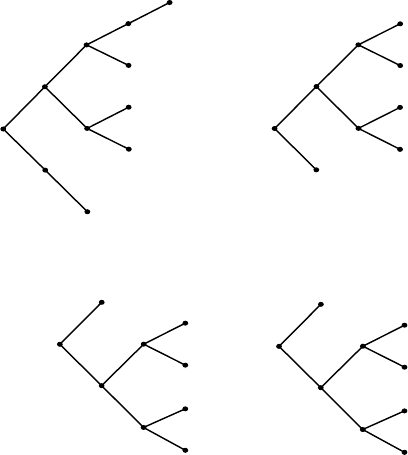
124 DATA COMPRESSION
0
0
1
1
1
1
1
0
0
0
p
1
p
3
p
4
p
2
p
5
(
a
)
(
b
)
0
1
1
1
1
0
0
0
p
1
p
3
p
4
p
2
p
5
(
c
)(
d
)
1
1
1
0
0
1
0
0
p
5
p
2
p
1
p
3
p
4
1
1
1
0
0
1
0
0
p
2
p
2
p
3
p
4
p
5
FIGURE 5.3. Properties of optimal codes. We assume that p
1
≥ p
2
≥···≥p
m
. A possible
instantaneous code is given in (a). By trimming branches without siblings, we improve the
code to (b). We now rearrange the tree as shown in (c), so that the word lengths are ordered
by increasing length from top to bottom. Finally, we swap probability assignments to improve
the expected depth of the tree, as shown in (d). Every optimal code can be rearranged and
swapped into canonical form as in ( d ), where l
1
≤ l
2
≤···≤l
m
and l
m−1
= l
m
,andthelast
two codewords differ only in the last bit.
But p
j
− p
k
> 0, and since C
m
is optimal, L(C
m
) − L(C
m
) ≥ 0.
Hence, we must have l
k
≥ l
j
. Thus, C
m
itself satisfies property 1.
•
The two longest codewords are of the same length. Here we trim the
codewords. If the two longest codewords are not of the same length,
one can delete the last bit of the longer one, preserving the prefix
property and achieving lower expected codeword length. Hence, the
two longest codewords must have the same length. By property 1, the
longest codewords must belong to the least probable source symbols.
•
The two longest codewords differ only in the last bit and correspond
to the two least likely symbols. Not all optimal codes satisfy this
property, but by rearranging, we can find an optimal code that does.
If there is a maximal-length codeword without a sibling, we can delete
the last bit of the codeword and still satisfy the prefix property. This
reduces the average codeword length and contradicts the optimality