
Thomas M. Cover, Joy A. Thomas. Elements of information theory
Подождите немного. Документ загружается.


PROBLEMS 95
following recursion:
X
1
(n)
X
2
(n)
X
3
(n)
=
011
100
010
X
1
(n − 1)
X
2
(n − 1)
X
3
(n − 1)
, (4.101)
with initial conditions X(1) = [1 1 0]
t
.
(c) Let
A =
011
100
010
. (4.102)
Then we have by induction
X(n) = AX(n − 1) = A
2
X(n − 2) =···=A
n−1
X(1).
(4.103)
Using the eigenvalue decomposition of A for the case of distinct
eigenvalues, we can write A = U
−1
U ,where is the diag-
onal matrix of eigenvalues. Then A
n−1
= U
−1
n−1
U . Show
that we can write
X(n) = λ
n−1
1
Y
1
+ λ
n−1
2
Y
2
+ λ
n−1
3
Y
3
, (4.104)
where Y
1
, Y
2
, Y
3
do not depend on n.Forlargen, this sum
is dominated by the largest term. Therefore, argue that for i =
1, 2, 3, we have
1
n
log X
i
(n) → log λ, (4.105)
where λ is the largest (positive) eigenvalue. Thus, the number
of sequences of length n grows as λ
n
for large n. Calculate λ
for the matrix A above. (The case when the eigenvalues are
not distinct can be handled in a similar manner.)
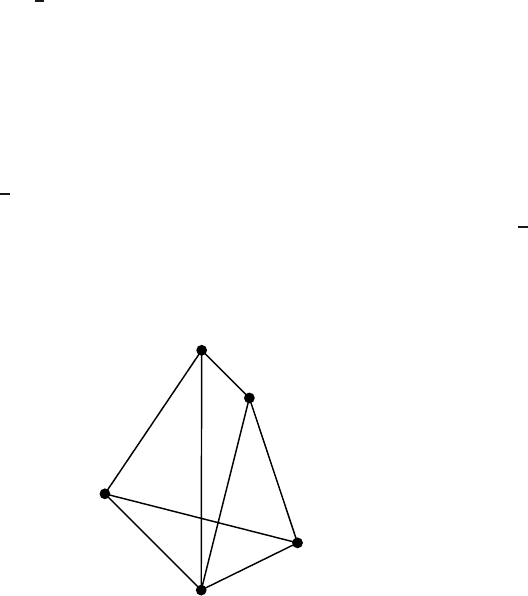
(d) We now take a different approach. Consider a Markov chain
whose state diagram is the one given in part (a), but with
arbitrary transition probabilities. Therefore, the probability tran-
sition matrix of this Markov chain is
P =
01 0
α 01− α
10 0
. (4.106)
Show that the stationary distribution of this Markov chain is
µ =
1
3 − α
,
1
3 − α
,
1 − α
3 − α
. (4.107)
96 ENTROPY RATES OF A STOCHASTIC PROCESS
(e) Maximize the entropy rate of the Markov chain over choices
of α. What is the maximum entropy rate of the chain?
(f) Compare the maximum entropy rate in part (e) with log λ in
part (c). Why are the two answers the same?
4.17 Recurrence times are insensitive to distributions.LetX
0
,X
1
,X
2
,
...be drawn i.i.d. ∼ p(x), x ∈
X ={1, 2,...,m},andletN be the
waiting time to the next occurrence of X
0
. Thus N = min
n
{X
n
=
X
0
}.
(a) Show that EN = m.
(b) Show that E log N ≤ H(X).
(c) (Optional) Prove part (a) for {X
i
} stationary and ergodic.
4.18 Stationary but not ergodic process. Abinhastwobiasedcoins,
one with probability of heads p and the other with probability of
heads 1 − p. One of these coins is chosen at random (i.e., with
probability
1
2
) and is then tossed n times. Let X denote the identity
of the coin that is picked, and let Y
1
and Y
2
denote the results of
the first two tosses.
(a) Calculate I(Y
1
;Y
2
|X).
(b) Calculate I(X;Y
1
,Y
2
).
(c) Let
H(Y) be the entropy rate of the Y process (the se-
quence of coin tosses). Calculate
H(Y).[Hint: Relate this to
lim
1
n
H(X,Y
1
,Y
2
,...,Y
n
).]
You can check the answer by considering the behavior as p →
1
2
.
4.19 Random walk on graph. Consider a random walk on the following
graph:
1
5
4
3
2
(a) Calculate the stationary distribution.

PROBLEMS 97
(b) What is the entropy rate?
(c) Find the mutual information I(X
n+1
;X
n
) assuming that the
process is stationary.
4.20 Random walk on chessboard. Find the entropy rate of the Markov
chain associated with a random walk of a king on the 3 × 3 chess-
board
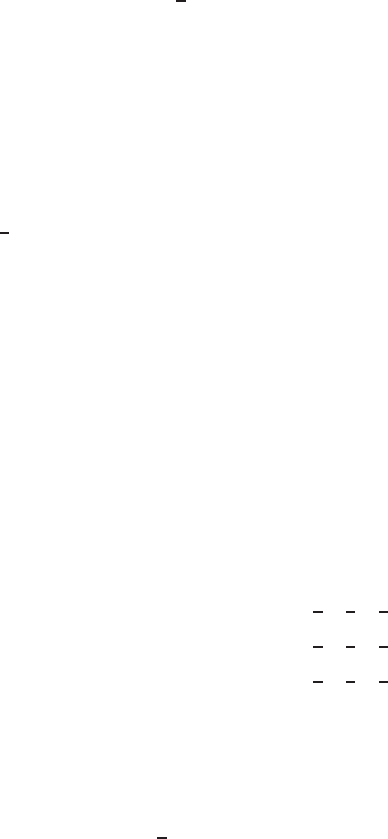
1 2 3
4 5 6
7 8 9
What about the entropy rate of rooks, bishops, and queens? There
are two types of bishops.
4.21 Maximal entropy graphs. Consider a random walk on a connected
graph with four edges.
(a) Which graph has the highest entropy rate?
(b) Which graph has the lowest?
4.22 Three-dimensional maze. A bird is lost in a 3 × 3 × 3 cubical
maze. The bird flies from room to room going to adjoining rooms
with equal probability through each of the walls. For example, the
corner rooms have three exits.
(a) What is the stationary distribution?
(b) What is the entropy rate of this random walk?
4.23 Entropy rate.Let{X
i
} be a stationary stochastic process with
entropy rate H(
X).
(a) Argue that H(
X) ≤ H(X
1
).
(b) What are the conditions for equality?
4.24 Entropy rates.Let{X
i
} be a stationary process. Let Y
i
= (X
i
,
X
i+1
).LetZ
i
= (X
2i
,X
2i+1
).LetV
i
= X
2i
. Consider the entropy
rates H(
X), H(Y), H(Z),andH(V) of the processes {X
i
},{Y
i
},
{Z
i
},and{V
i
}. What is the inequality relationship ≤,=,or≥
between each of the pairs listed below?
(a) H(
X)
<
H(
Y).
(b) H(
X)
<
H(
Z).
(c) H(
X)
<
H(
V).
(d) H(
Z)
<
H(
X).
4.25 Monotonicity
(a) Show that I(X;Y
1
,Y
2
,...,Y
n
) is nondecreasing in n.

98 ENTROPY RATES OF A STOCHASTIC PROCESS
(b) Under what conditions is the mutual information constant for
all n?
4.26 Transitions in Markov chains. Suppose that {X
i
} forms an irre-
ducible Markov chain with transition matrix P and stationary distri-
bution µ. Form the associated “edge process” {Y
i
} by keeping track
only of the transitions. Thus, the new process {Y
i
} takes values in
X × X,andY
i
= (X
i−1
,X
i
). For example,
X
n
= 3, 2, 8, 5, 7,...
becomes
Y
n
= (∅, 3), (3, 2), (2, 8), (8, 5), (5, 7),....
Find the entropy rate of the edge process {Y
i
}.
4.27 Entropy rate.Let{X
i
} be a stationary {0, 1}-valued stochastic
process obeying
X
k+1
= X
k
⊕ X
k−1
⊕ Z
k+1
,
where {Z
i
} is Bernoulli(p)and ⊕ denotes mod 2 addition. What is
the entropy rate H(
X)?
4.28 Mixture of processes. Suppose that we observe one of two
stochastic processes but don’t know which. What is the entropy
rate? Specifically, let X
11
,X
12
,X
13
,...be a Bernoulli process with
parameter p
1
,andletX
21
,X
22
,X
23
,...be Bernoulli(p
2
).Let
θ =
1 with probability
1
2
2 with probability
1
2
and let Y
i
= X
θi
,i = 1, 2,..., be the stochastic process observed.
Thus, Y observes the process {X
1i
} or {X
2i
}. Eventually, Y will
know which.
(a) Is {Y
i
} stationary?
(b) Is {Y
i
} an i.i.d. process?
(c) What is the entropy rate H of {Y
i
}?
(d) Does
−
1
n
log p(Y
1
,Y
2
,...Y
n
) −→ H ?
(e) Is there a code that achieves an expected per-symbol description
length
1
n
EL
n
−→ H ?
PROBLEMS 99
Now let θ
i
be Bern(
1
2
). Observe that
Z
i
= X
θ
i
i
,i= 1, 2,....
Thus, θ is not fixed for all time, as it was in the first part, but is
chosen i.i.d. each time. Answer parts (a), (b), (c), (d), (e) for the
process {Z
i
}, labeling the answers (a
), (b
), (c
), (d
), (e
).
4.29 Waiting times.LetX be the waiting time for the first heads to
appear in successive flips of a fair coin. For example, Pr{X = 3}=
(
1
2
)
3
.LetS
n
be the waiting time for the nth head to appear. Thus,
S
0
= 0
S
n+1
= S
n
+ X
n+1
,
where X
1
,X
2
,X
3
,...are i.i.d according to the distribution above.
(a) Is the process {S
n
} stationary?
(b) Calculate H(S
1
,S
2
,...,S
n
).
(c) Does the process {S
n
} have an entropy rate? If so, what is it?
If not, why not?
(d) What is the expected number of fair coin flips required to
generate a random variable having the same distribution as S
n
?
4.30 Markov chain transitions
P = [P
ij
] =
1
2
1
4
1
4
1
4
1
2
1
4
1
4
1
4
1
2
.
Let X
1
be distributed uniformly over the states {0, 1, 2}. Let {X
i
}
∞
1
be a Markov chain with transition matrix P ; thus, P(X
n+1
=
j|X
n
= i) = P
ij
,i,j ∈{0, 1, 2}.
(a) Is {X
n
} stationary?
(b) Find lim
n→∞
1
n
H(X
1
,...,X
n
).
Now consider the derived process Z
1
,Z
2
,...,Z
n
, where
Z
1
= X
1
Z
i
= X
i
− X
i−1
(mod 3), i = 2,...,n.
Thus, Z
n
encodes the transitions, not the states.
(c) Find H(Z
1
,Z
2
,...,Z
n
).
(d) Find H(Z
n
) and H(X
n
) for n ≥ 2.
100 ENTROPY RATES OF A STOCHASTIC PROCESS
(e) Find H(Z
n
|Z
n−1
) for n ≥ 2.
(f) Are Z
n−1
and Z
n
independent for n ≥ 2?
4.31 Markov.Let{X
i
}∼Bernoulli(p). Consider the associated
Markov chain {Y
i
}
n
i=1
,where
Y
i
= (the number of 1’s in the current run of 1’s). For example, if
X
n
= 101110 ...,wehaveY
n
= 101230 ....
(a) Find the entropy rate of X
n
.
(b) Find the entropy rate of Y
n
.
4.32 Time symmetry.Let{X
n
} be a stationary Markov process. We
condition on (X
0
,X
1
) and look into the past and future. For what
index k is
H(X
−n
|X
0
,X
1
) = H(X
k
|X
0
,X
1
)?
Give the argument.
4.33 Chain inequality.LetX
1
→ X
2
→ X
3
→ X
4
form a Markov
chain. Show that
I(X
1
;X
3
) + I(X
2
;X
4
) ≤ I(X
1
;X
4
) + I(X
2
;X
3
). (4.108)
4.34 Broadcast channel.LetX → Y → (Z, W ) form a Markov chain
[i.e., p(x, y, z, w) = p(x)p(y|x)p(z,w|y) for all x, y, z, w]. Show
that
I(X;Z) + I(X;W) ≤ I(X;Y)+ I(Z;W). (4.109)
4.35 Concavity of second law .Let{X
n
}
∞
−∞
be a stationary Markov
process. Show that H(X
n
|X
0
) is concave in n. Specifically, show
that
H(X
n
|X
0
) − H(X
n−1
|X
0
) − (H (X
n−1
|X
0
) − H(X
n−2
|X
0
))
=−I(X
1
;X
n−1
|X
0
,X
n
) ≤ 0. (4.110)
Thus, the second difference is negative, establishing that H(X
n
|X
0
)
is a concave function of n.
HISTORICAL NOTES
The entropy rate of a stochastic process was introduced by Shannon [472],
who also explored some of the connections between the entropy rate of the
process and the number of possible sequences generated by the process.
Since Shannon, there have been a number of results extending the basic
HISTORICAL NOTES 101
theorems of information theory to general stochastic processes. The AEP
for a general stationary stochastic process is proved in Chapter 16.
Hidden Markov models are used for a number of applications, such
as speech recognition [432]. The calculation of the entropy rate for con-
strained sequences was introduced by Shannon [472]. These sequences
are used for coding for magnetic and optical channels [288].

CHAPTER 5
DATA COMPRESSION
We now put content in the definition of entropy by establishing the funda-
mental limit for the compression of information. Data compression can be
achieved by assigning short descriptions to the most frequent outcomes
of the data source, and necessarily longer descriptions to the less fre-
quent outcomes. For example, in Morse code, the most frequent symbol
is represented by a single dot. In this chapter we find the shortest average
description length of a random variable.
We first define the notion of an instantaneous code and then prove the
important Kraft inequality, which asserts that the exponentiated codeword
length assignments must look like a probability mass function. Elemen-
tary calculus then shows that the expected description length must be
greater than or equal to the entropy, the first main result. Then Shan-
non’s simple construction shows that the expected description length can
achieve this bound asymptotically for repeated descriptions. This estab-
lishes the entropy as a natural measure of efficient description length.
The famous Huffman coding procedure for finding minimum expected
description length assignments is provided. Finally, we show that Huff-
man codes are competitively optimal and that it requires roughly H fair
coin flips to generate a sample of a random variable having entropy H .
Thus, the entropy is the data compression limit as well as the number of
bits needed in random number generation, and codes achieving H turn
out to be optimal from many points of view.
5.1 EXAMPLES OF CODES
Definition A source code C for a random variable X is a mapping from
X, the range of X,toD
∗
, the set of finite-length strings of symbols from
a D-ary alphabet. Let C(x) denote the codeword corresponding to x and
let l(x) denote the length of C(x).
Elements of Information Theory, Second Edition, By Thomas M. Cover and Joy A. Thomas
Copyright 2006 John Wiley & Sons, Inc.
103

104 DATA COMPRESSION
For example, C(red) = 00, C(blue) = 11 is a source code for X ={red,
blue} with alphabet
D ={0, 1}.
Definition The expected length L(C) of a source code C(x) for a ran-
dom variable X with probability mass function p(x) is given by
L(C) =
x∈X
p(x)l(x), (5.1)
where l(x) is the length of the codeword associated with x.
Without loss of generality, we can assume that the D-ary alphabet is
D ={0, 1,...,D− 1}.
Some examples of codes follow.
Example 5.1.1 Let X be a random variable with the following distri-
bution and codeword assignment:
Pr(X = 1) =
1
2
, codeword C(1) = 0
Pr(X = 2) =
1
4
, codeword C(2) = 10
Pr(X = 3) =
1
8
, codeword C(3) = 110
Pr(X = 4) =
1
8
, codeword C(4) = 111.
(5.2)
The entropy H(X) of X is 1.75 bits, and the expected length L(C) =
El(X) of this code is also 1.75 bits. Here we have a code that has the
same average length as the entropy. We note that any sequence of bits
can be uniquely decoded into a sequence of symbols of X. For example,
the bit string 0110111100110 is decoded as 134213.
Example 5.1.2 Consider another simple example of a code for a random
variable:
Pr(X = 1) =
1
3
, codeword C(1) = 0
Pr(X = 2) =
1
3
, codeword C(2) = 10
Pr(X = 3) =
1
3
, codeword C(3) = 11.
(5.3)
Just as in Example 5.1.1, the code is uniquely decodable. However, in
this case the entropy is log 3 = 1.58 bits and the average length of the
encoding is 1.66 bits. Here El(X) > H(X).
Example 5.1.3 (Morse code) The Morse code is a reasonably efficient
code for the English alphabet using an alphabet of four symbols: a dot,