
Thomas M. Cover, Joy A. Thomas. Elements of information theory
Подождите немного. Документ загружается.

5.1 EXAMPLES OF CODES 105
a dash, a letter space, and a word space. Short sequences represent fre-
quent letters (e.g., a single dot represents E) and long sequences represent
infrequent letters (e.g., Q is represented by “dash,dash,dot,dash”). This is
not the optimal representation for the alphabet in four symbols—in fact,
many possible codewords are not utilized because the codewords for let-
ters do not contain spaces except for a letter space at the end of every
codeword, and no space can follow another space. It is an interesting prob-
lem to calculate the number of sequences that can be constructed under
these constraints. The problem was solved by Shannon in his original
1948 paper. The problem is also related to coding for magnetic recording,
where long strings of 0’s are prohibited [5], [370].
We now define increasingly more stringent conditions on codes. Let x
n
denote (x
1
,x
2
,...,x
n
).
Definition A code is said to be nonsingular if every element of the
range of X maps into a different string in
D
∗
;thatis,
x = x
⇒ C(x) = C(x
). (5.4)
Nonsingularity suffices for an unambiguous description of a single
value of X. But we usually wish to send a sequence of values of X.
In such cases we can ensure decodability by adding a special symbol
(a “comma”) between any two codewords. But this is an inefficient use
of the special symbol; we can do better by developing the idea of self-
punctuating or instantaneous codes. Motivated by the necessity to send
sequences of symbols X, we define the extension of a code as follows:
Definition The extension C
∗
of a code C is the mapping from finite-
length strings of
X to finite-length strings of D,definedby
C(x
1
x
2
···x
n
) = C(x
1
)C(x
2
) ···C(x
n
), (5.5)
where C(x
1
)C(x
2
) ···C(x
n
) indicates concatenation of the corresponding
codewords.
Example 5.1.4 If C(x
1
) = 00 and C(x
2
) = 11, then C(x
1
x
2
) = 0011.
Definition A code is called uniquely decodable if its extension is non-
singular.
In other words, any encoded string in a uniquely decodable code has
only one possible source string producing it. However, one may have
to look at the entire string to determine even the first symbol in the
corresponding source string.
106 DATA COMPRESSION
Definition A code is called a prefix code or an instantaneous code if
no codeword is a prefix of any other codeword.
An instantaneous code can be decoded without reference to future code-
words since the end of a codeword is immediately recognizable. Hence,
for an instantaneous code, the symbol x
i
can be decoded as soon as we
come to the end of the codeword corresponding to it. We need not wait
to see the codewords that come later. An instantaneous code is a self-
punctuating code; we can look down the sequence of code symbols and
add the commas to separate the codewords without looking at later sym-
bols. For example, the binary string 01011111010 produced by the code
of Example 5.1.1 is parsed as 0,10,111,110,10.
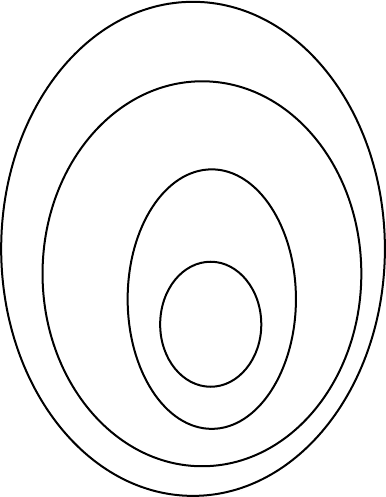
The nesting of these definitions is shown in Figure 5.1. To illustrate the
differences between the various kinds of codes, consider the examples of
codeword assignments C(x) to x ∈
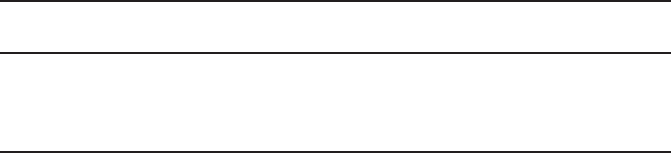
X in Table 5.1. For the nonsingular
code, the code string 010 has three possible source sequences: 2 or 14 or
31, and hence the code is not uniquely decodable. The uniquely decodable
code is not prefix-free and hence is not instantaneous. To see that it is
uniquely decodable, take any code string and start from the beginning.
If the first two bits are 00 or 10, they can be decoded immediately. If
All
codes
Nonsingular
codes
Uniquely
decodable
codes
Instantaneous
codes
FIGURE 5.1. Classes of codes.
5.2 KRAFT INEQUALITY 107
TABLE 5.1 Classes of Codes
Nonsingular, But Not Uniquely Decodable,
X Singular Uniquely Decodable But Not Instantaneous Instantaneous
10 0 10 0
2 0 010 00 10
3 0 01 11 110
4 0 10 110 111
the first two bits are 11, we must look at the following bits. If the next
bit is a 1, the first source symbol is a 3. If the length of the string of
0’s immediately following the 11 is odd, the first codeword must be 110
and the first source symbol must be 4; if the length of the string of 0’s is
even, the first source symbol is a 3. By repeating this argument, we can see
that this code is uniquely decodable. Sardinas and Patterson [455] have
devised a finite test for unique decodability, which involves forming sets
of possible suffixes to the codewords and eliminating them systematically.
The test is described more fully in Problem 5.5.27. The fact that the last
code in Table 5.1 is instantaneous is obvious since no codeword is a prefix
of any other.
5.2 KRAFT INEQUALITY
We wish to construct instantaneous codes of minimum expected length to
describe a given source. It is clear that we cannot assign short codewords
to all source symbols and still be prefix-free. The set of codeword lengths
possible for instantaneous codes is limited by the following inequality.
Theorem 5.2.1 (Kraft inequality) For any instantaneous code (prefix
code) over an alphabet of size D, the codeword lengths l
1
,l
2
,...,l
m
must
satisfy the inequality
i
D
−l
i
≤ 1. (5.6)
Conversely, given a set of codeword lengths that satisfy this inequality,
there exists an instantaneous code with these word lengths.
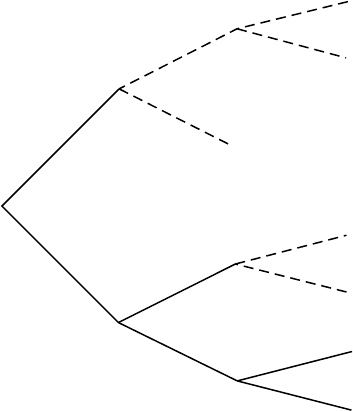
Proof: Consider a D-ary tree in which each node has D children. Let the
branches of the tree represent the symbols of the codeword. For example,
the D branches arising from the root node represent the D possible values
of the first symbol of the codeword. Then each codeword is represented
108 DATA COMPRESSION
Root
0
10
110
111
FIGURE 5.2. Code tree for the Kraft inequality.
by a leaf on the tree. The path from the root traces out the symbols of the
codeword. A binary example of such a tree is shown in Figure 5.2. The
prefix condition on the codewords implies that no codeword is an ancestor
of any other codeword on the tree. Hence, each codeword eliminates its
descendants as possible codewords.
Let l
max
be the length of the longest codeword of the set of codewords.
Consider all nodes of the tree at level l
max
. Some of them are codewords,
some are descendants of codewords, and some are neither. A codeword
at level l
i
has D
l
max
−l
i
descendants at level l
max
. Each of these descendant
sets must be disjoint. Also, the total number of nodes in these sets must
be less than or equal to D
l
max
. Hence, summing over all the codewords,
we have
D
l
max
−l
i
≤ D
l
max
(5.7)
or
D
−l
i
≤ 1, (5.8)
which is the Kraft inequality.
Conversely, given any set of codeword lengths l
1
,l
2
,...,l
m
that sat-
isfy the Kraft inequality, we can always construct a tree like the one in

5.2 KRAFT INEQUALITY 109
Figure 5.2. Label the first node (lexicographically) of depth l
1
as code-
word 1, and remove its descendants from the tree. Then label the first
remaining node of depth l
2
as codeword 2, and so on. Proceeding this
way, we construct a prefix code with the specified l
1
,l
2
,...,l
m
.
We now show that an infinite prefix code also satisfies the Kraft inequal-
ity.
Theorem 5.2.2 (Extended Kraft Inequality) For any countably infi-
nite set of codewords that form a prefix code, the codeword lengths satisfy
the extended Kraft inequality,
∞
i=1
D
−l
i
≤ 1. (5.9)
Conversely, given any l
1
,l
2
,... satisfying the extended Kraft inequality,
we can construct a prefix code with these codeword lengths.
Proof: Let the D-ary alphabet be {0, 1,...,D− 1}. Consider the ith
codeword y
1
y
2
···y
l
i
.Let0.y
1
y
2
···y
l
i
be the real number given by the
D-ary expansion
0.y
1
y
2
···y
l
i
=
l
i
j=1
y
j
D
−j
. (5.10)
This codeword corresponds to the interval
0.y
1
y
2
···y
l
i
, 0.y
1
y
2
···y
l
i
+
1
D
l
i
, (5.11)
the set of all real numbers whose D-ary expansion begins with
0.y
1
y
2
···y
l
i
. This is a subinterval of the unit interval [0, 1]. By the prefix
condition, these intervals are disjoint. Hence, the sum of their lengths has
to be less than or equal to 1. This proves that
∞
i=1
D
−l
i
≤ 1. (5.12)
Just as in the finite case, we can reverse the proof to construct the
code for a given l
1
,l
2
,... that satisfies the Kraft inequality. First, reorder
the indexing so that l
1
≤ l
2
≤ .... Then simply assign the intervals in
110 DATA COMPRESSION
order from the low end of the unit interval. For example, if we wish to
construct a binary code with l
1
= 1,l
2
= 2,..., we assign the intervals
[0,
1
2
), [
1
2
,
1
4
), . . . to the symbols, with corresponding codewords 0, 10,
....
In Section 5.5 we show that the lengths of codewords for a uniquely
decodable code also satisfy the Kraft inequality. Before we do that, we
consider the problem of finding the shortest instantaneous code.
5.3 OPTIMAL CODES
In Section 5.2 we proved that any codeword set that satisfies the prefix
condition has to satisfy the Kraft inequality and that the Kraft inequality
is a sufficient condition for the existence of a codeword set with the
specified set of codeword lengths. We now consider the problem of finding
the prefix code with the minimum expected length. From the results of
Section 5.2, this is equivalent to finding the set of lengths l
1
,l
2
,...,l
m
satisfying the Kraft inequality and whose expected length L =
p
i
l
i
is
less than the expected length of any other prefix code. This is a standard
optimization problem: Minimize
L =
p
i
l
i
(5.13)
over all integers l
1
,l
2
,...,l
m
satisfying
D
−l
i
≤ 1. (5.14)
A simple analysis by calculus suggests the form of the minimizing l
∗
i
.
We neglect the integer constraint on l
i
and assume equality in the con-
straint. Hence, we can write the constrained minimization using Lagrange
multipliers as the minimization of
J =
p
i
l
i
+ λ
D
−l
i
. (5.15)
Differentiating with respect to l
i
, we obtain
∂J
∂l
i
= p
i
− λD
−l
i
log
e
D. (5.16)
Setting the derivative to 0, we obtain
D
−l
i
=
p
i
λ log
e
D
. (5.17)

5.3 OPTIMAL CODES 111
Substituting this in the constraint to find λ,wefindλ = 1/ log
e
D,and
hence
p
i
= D
−l
i
, (5.18)
yielding optimal code lengths,
l
∗
i
=−log
D
p
i
. (5.19)
This noninteger choice of codeword lengths yields expected codeword
length
L
∗
=
p
i
l
∗
i
=−
p
i
log
D
p
i
= H
D
(X). (5.20)
But since the l
i
must be integers, we will not always be able to set
the codeword lengths as in (5.19). Instead, we should choose a set of
codeword lengths l
i
“close” to the optimal set. Rather than demonstrate
by calculus that l
∗
i
=−log
D
p
i
is a global minimum, we verify optimality
directly in the proof of the following theorem.
Theorem 5.3.1 The expected length L of any instantaneous D-ary code
for a random variable X is greater than or equal to the entropy H
D
(X);
that is,
L ≥ H
D
(X), (5.21)
with equality if and only if D
−l
i
= p
i
.
Proof: We can write the difference between the expected length and the
entropy as
L − H
D
(X) =
p
i
l
i
−
p
i
log
D
1
p
i
(5.22)
=−
p
i
log
D
D
−l
i
+
p
i
log
D
p
i
. (5.23)
Letting r
i
= D
−l
i
/
j
D
−l
j
and c =
D
−l
i
, we obtain
L − H =
p
i
log
D
p
i
r
i
− log
D
c (5.24)
= D(p||r) + log
D
1
c
(5.25)
≥ 0 (5.26)

112 DATA COMPRESSION
by the nonnegativity of relative entropy and the fact (Kraft inequality)
that c ≤ 1. Hence, L ≥ H with equality if and only if p
i
= D
−l
i
(i.e., if
and only if −log
D
p
i
is an integer for all i).
Definition A probability distribution is called D-adic if each of the
probabilities is equal to D
−n
for some n. Thus, we have equality in the
theorem if and only if the distribution of X is D-adic.
The preceding proof also indicates a procedure for finding an optimal
code: Find the D-adic distribution that is closest (in the relative entropy
sense) to the distribution of X. This distribution provides the set of code-
word lengths. Construct the code by choosing the first available node as
in the proof of the Kraft inequality. We then have an optimal code for X.
However, this procedure is not easy, since the search for the closest
D-adic distribution is not obvious. In the next section we give a good
suboptimal procedure (Shannon–F ano coding). In Section 5.6 we describe
a simple procedure (Huffman coding) for actually finding the optimal
code.
5.4 BOUNDS ON THE OPTIMAL CODE LENGTH
We now demonstrate a code that achieves an expected description length
L within 1 bit of the lower bound; that is,
H(X) ≤ L<H(X)+ 1. (5.27)
Recall the setup of Section 5.3: We wish to minimize L =
p
i
l
i
sub-
ject to the constraint that l
1
,l
2
,...,l
m
are integers and
D
−l
i
≤ 1. We
proved that the optimal codeword lengths can be found by finding the
D-adic probability distribution closest to the distribution of X in relative
entropy, that is, by finding the D-adic r (r
i
= D
−l
i
/
j
D
−l
j
) minimizing
L − H
D
= D(p||r) − log
D
−l
i
≥ 0. (5.28)
The choice of word lengths l
i
= log
D
1
p
i
yields L = H . Since log
D
1
p
i
may not equal an integer, we round it up to give integer word-length
assignments,
l
i
=
log
D
1
p
i
, (5.29)
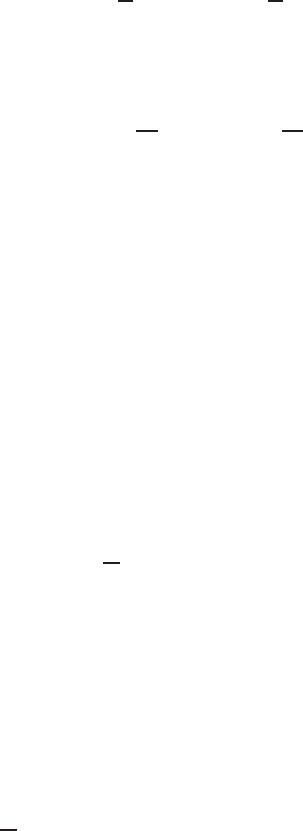
5.4 BOUNDS ON THE OPTIMAL CODE LENGTH 113
where x is the smallest integer ≥ x. These lengths satisfy the Kraft
inequality since
D
−log
1
p
i
≤
D
−log
1
p
i
=
p
i
= 1. (5.30)
This choice of codeword lengths satisfies
log
D
1
p
i
≤ l
i
< log
D
1
p
i
+ 1. (5.31)
Multiplying by p
i
and summing over i, we obtain
H
D
(X) ≤ L<H
D
(X) + 1. (5.32)
Since an optimal code can only be better than this code, we have the
following theorem.
Theorem 5.4.1 Let l
∗
1
,l
∗
2
,...,l
∗
m
be optimal codeword lengths for a
source distribution p and a D-ary alphabet, and let L
∗
be the associated
expected length of an optimal code (L
∗
=
p
i
l
∗
i
). Then
H
D
(X) ≤ L
∗
<H
D
(X) + 1. (5.33)
Proof: Let l
i
=log
D
1
p
i
.Thenl
i
satisfies the Kraft inequality and from
(5.32) we have
H
D
(X) ≤ L =
p
i
l
i
<H
D
(X) + 1. (5.34)
But since L
∗
, the expected length of the optimal code, is less than L =
p
i
l
i
, and since L
∗
≥ H
D
from Theorem 5.3.1, we have the
theorem.
In Theorem 5.4.1 there is an overhead that is at most 1 bit, due to the
fact that log
1
p
i
is not always an integer. We can reduce the overhead per
symbol by spreading it out over many symbols. With this in mind, let us
consider a system in which we send a sequence of n symbols from X.
The symbols are assumed to be drawn i.i.d. according to p(x). We can
consider these n symbols to be a supersymbol from the alphabet
X
n
.
Define L
n
to be the expected codeword length per input symbol, that
is, if l(x
1
,x
2
,...,x
n
) is the length of the binary codeword associated

114 DATA COMPRESSION
with (x
1
,x
2
,...,x
n
) (for the rest of this section, we assume that D = 2,
for simplicity), then
L
n
=
1
n
p(x
1
,x
2
,...,x
n
)l(x
1
,x
2
,...,x
n
) =
1
n
El(X
1
,X
2
,...,X
n
).
(5.35)
We can now apply the bounds derived above to the code:
H(X
1
,X
2
,...,X
n
) ≤ El(X
1
,X
2
,...,X
n
)<H(X
1
,X
2
,...,X
n
) + 1.
(5.36)
Since X
1
,X
2
,...,X
n
are i.i.d., H(X
1
,X
2
,...,X
n
) =
H(X
i
) =
nH (X). Dividing (5.36) by n, we obtain
H(X) ≤ L
n
<H(X)+
1
n
. (5.37)
Hence, by using large block lengths we can achieve an expected code-
length per symbol arbitrarily close to the entropy.
We can use the same argument for a sequence of symbols from a
stochastic process that is not necessarily i.i.d. In this case, we still have
the bound
H(X
1
,X
2
,...,X
n
) ≤ El(X
1
,X
2
,...,X
n
)<H(X
1
,X
2
,...,X
n
) + 1.
(5.38)
Dividing by n again and defining L
n
to be the expected description length
per symbol, we obtain
H(X
1
,X
2
,...,X
n
)
n
≤ L
n
<
H(X
1
,X
2
,...,X
n
)
n
+
1
n
. (5.39)
If the stochastic process is stationary, then H(X
1
,X
2
,...,X
n
)/n →
H(
X), and the expected description length tends to the entropy rate as
n →∞. Thus, we have the following theorem:
Theorem 5.4.2 The minimum expected codeword length per symbol sat-
isfies
H(X
1
,X
2
,...,X
n
)
n
≤ L
∗
n
<
H(X
1
,X
2
,...,X
n
)
n
+
1
n
. (5.40)
Moreover, if X
1
,X
2
,...,X
n
is a stationary stochastic process,
L
∗
n
→ H(X), (5.41)
where H(X) is the entropy rate of the process.