
Thomas M. Cover, Joy A. Thomas. Elements of information theory
Подождите немного. Документ загружается.

7.11 HAMMING CODES 215
decoding algorithms for these codes. With the advent of integrated circuits,
it has become feasible to implement fairly complex codes in hardware and
realize some of the error-correcting performance promised by Shannon’s
channel capacity theorem. For example, all compact disc players include
error-correction circuitry based on two interleaved (32, 28, 5) and (28, 24,
5) Reed–Solomon codes that allow the decoder to correct bursts of up to
4000 errors.
All the codes described above are block codes —they map a block of
information bits onto a channel codeword and there is no dependence on
past information bits. It is also possible to design codes where each output
block depends not only on the current input block, but also on some of
the past inputs as well. A highly structured form of such a code is called
a convolutional code. The theory of convolutional codes has developed
considerably over the last 40 years. We will not go into the details, but
refer the interested reader to textbooks on coding theory [69, 356].
For many years, none of the known coding algorithms came close
to achieving the promise of Shannon’s channel capacity theorem. For a
binary symmetric channel with crossover probability p, we would need a
code that could correct up to np errors in a block of length n and have
n(1 − H(p)) information bits. For example, the repetition code suggested
earlier corrects up to n/2 errors in a block of length n, but its rate goes
to 0 with n. Until 1972, all known codes that could correct nα errors for
block length n had asymptotic rate 0. In 1972, Justesen [301] described
a class of codes with positive asymptotic rate and positive asymptotic
minimum distance as a fraction of the block length.
In 1993, a paper by Berrou et al. [57] introduced the notion that the
combination of two interleaved convolution codes with a parallel cooper-
ative decoder achieved much better performance than any of the earlier
codes. Each decoder feeds its “opinion” of the value of each bit to the
other decoder and uses the opinion of the other decoder to help it decide
the value of the bit. This iterative process is repeated until both decoders
agree on the value of the bit. The surprising fact is that this iterative
procedure allows for efficient decoding at rates close to capacity for a
variety of channels. There has also been a renewed interest in the theory
of low-density parity check (LDPC) codes that were introduced by Robert
Gallager in his thesis [231, 232]. In 1997, MacKay and Neal [368] showed
that an iterative message-passing algorithm similar to the algorithm used
for decoding turbo codes could achieve rates close to capacity with high
probability for LDPC codes. Both Turbo codes and LDPC codes remain
active areas of research and have been applied to wireless and satellite
communication channels.

216 CHANNEL CAPACITY
Encoder
Decoder
Channel
p
(
y
|
x
)
W
X
i
(
W
,
Y
i
−1
)
Y
i
Message
W
Estimate
of
Message
^
FIGURE 7.13. Discrete memoryless channel with feedback.
7.12 FEEDBACK CAPACITY
A channel with feedback is illustrated in Figure 7.13. We assume that
all the received symbols are sent back immediately and noiselessly to
the transmitter, which can then use them to decide which symbol to send
next. Can we do better with feedback? The surprising answer is no, which
we shall now prove. We define a (2
nR
,n) feedback code as a sequence
of mappings x
i
(W, Y
i−1
), where each x
i
is a function only of the mes-
sage W ∈ 2
nR
and the previous received values, Y
1
,Y
2
,...,Y
i−1
,anda
sequence of decoding functions g :
Y
n
→{1, 2,...,2
nR
}. Thus,
P
(n)
e
= Pr
g(Y
n
) = W
, (7.119)
when W is uniformly distributed over {1, 2,...,2
nR
}.
Definition The capacity with feedback, C
FB
, of a discrete memoryless
channel is the supremum of all rates achievable by feedback codes.
Theorem 7.12.1 (Feedback capacity)
C
FB
= C = max
p(x)
I(X;Y). (7.120)
Proof: Since a nonfeedback code is a special case of a feedback code,
any rate that can be achieved without feedback can be achieved with
feedback, and hence
C
FB
≥ C. (7.121)
Proving the inequality the other way is slightly more tricky. We cannot
use the same proof that we used for the converse to the coding theorem
without feedback. Lemma 7.9.2 is no longer true, since X
i
depends on
the past received symbols, and it is no longer true that Y
i
depends only
on X
i
and is conditionally independent of the future X’s in (7.93).
7.12 FEEDBACK CAPACITY 217
There is a simple change that will fix the problem with the proof.
Instead of using X
n
, we will use the index W and prove a similar series
of inequalities. Let W be uniformly distributed over {1, 2,...,2
nR
}.Then
Pr(W =
ˆ
W) = P
(n)
e
and
nR = H(W) = H(W|
ˆ
W)+ I(W;
ˆ
W) (7.122)
≤ 1 + P
(n)
e
nR + I(W;
ˆ
W) (7.123)
≤ 1 + P
(n)
e
nR + I(W;Y
n
), (7.124)
by Fano’s inequality and the data-processing inequality. Now we can
bound I(W;Y
n
) as follows:
I(W;Y
n
) = H(Y
n
) − H(Y
n
|W) (7.125)
= H(Y
n
) −
n
i=1
H(Y
i
|Y
1
,Y
2
,...,Y
i−1
,W) (7.126)
= H(Y
n
) −
n
i=1
H(Y
i
|Y
1
,Y
2
,...,Y
i−1
,W,X
i
) (7.127)
= H(Y
n
) −
n
i=1
H(Y
i
|X
i
), (7.128)
since X
i
is a function of Y
1
,...,Y
i−1
and W ; and conditional on X
i
, Y
i
is independent of W and past samples of Y . Continuing, we have
I(W;Y
n
) = H(Y
n
) −
n
i=1
H(Y
i
|X
i
) (7.129)
≤
n
i=1
H(Y
i
) −
n
i=1
H(Y
i
|X
i
) (7.130)
=
n
i=1
I(X
i
;Y
i
) (7.131)
≤ nC (7.132)
from the definition of capacity for a discrete memoryless channel. Putting
these together, we obtain
nR ≤ P
(n)
e
nR + 1 + nC, (7.133)
218 CHANNEL CAPACITY
and dividing by n and letting n →∞, we conclude that
R ≤ C. (7.134)
Thus, we cannot achieve any higher rates with feedback than we can
without feedback, and
C
FB
= C. (7.135)
As we have seen in the example of the binary erasure channel, feedback
can help enormously in simplifying encoding and decoding. However, it
cannot increase the capacity of the channel.
7.13 SOURCE–CHANNEL SEPARATION THEOREM
It is now time to combine the two main results that we have proved so far:
data compression (R>H: Theorem 5.4.2) and data transmission (R<
C: Theorem 7.7.1). Is the condition H<Cnecessary and sufficient for
sending a source over a channel? For example, consider sending digitized
speech or music over a discrete memoryless channel. We could design
a code to map the sequence of speech samples directly into the input
of the channel, or we could compress the speech into its most efficient
representation, then use the appropriate channel code to send it over the
channel. It is not immediately clear that we are not losing something
by using the two-stage method, since data compression does not depend
on the channel and the channel coding does not depend on the source
distribution.
We will prove in this section that the two-stage method is as good as
any other method of transmitting information over a noisy channel. This
result has some important practical implications. It implies that we can
consider the design of a communication system as a combination of two
parts, source coding and channel coding. We can design source codes
for the most efficient representation of the data. We can, separately and
independently, design channel codes appropriate for the channel. The com-
bination will be as efficient as anything we could design by considering
both problems together.
The common representation for all kinds of data uses a binary alphabet.
Most modern communication systems are digital, and data are reduced
to a binary representation for transmission over the common channel.
This offers an enormous reduction in complexity. Networks like, ATM
networks and the Internet use the common binary representation to allow
speech, video, and digital data to use the same communication channel.

7.13 SOURCE–CHANNEL SEPARATION THEOREM 219
The result—that a two-stage process is as good as any one-stage pro-
cess—seems so obvious that it may be appropriate to point out that it
is not always true. There are examples of multiuser channels where the
decomposition breaks down. We also consider two simple situations where
the theorem appears to be misleading. A simple example is that of sending
English text over an erasure channel. We can look for the most efficient
binary representation of the text and send it over the channel. But the
errors will be very difficult to decode. If, however, we send the English
text directly over the channel, we can lose up to about half the letters and
yet be able to make sense out of the message. Similarly, the human ear has
some unusual properties that enable it to distinguish speech under very
high noise levels if the noise is white. In such cases, it may be appropriate
to send the uncompressed speech over the noisy channel rather than the
compressed version. Apparently, the redundancy in the source is suited to
the channel.
Let us define the setup under consideration. We have a source V that
generates symbols from an alphabet
V. We will not make any assumptions
about the kind of stochastic process produced by V other than that it is
from a finite alphabet and satisfies the AEP. Examples of such processes
include a sequence of i.i.d. random variables and the sequence of states
of a stationary irreducible Markov chain. Any stationary ergodic source
satisfies the AEP, as we show in Section 16.8.
We want to send the sequence of symbols V
n
= V
1
,V
2
,...,V
n
over
the channel so that the receiver can reconstruct the sequence. To do this,
we map the sequence onto a codeword X
n
(V
n
) and send the codeword
over the channel. The receiver looks at his received sequence Y
n
and
makes an estimate
ˆ
V
n
of the sequence V
n
that was sent. The receiver
makes an error if V
n
=
ˆ
V
n
. We define the probability of error as
Pr(V
n
=
ˆ
V
n
) =
y
n
v
n
p(v
n
)p(y
n
|x
n
(v
n
))I (g(y
n
) = v
n
), (7.136)
where I is the indicator function and g(y
n
) is the decoding function. The
system is illustrated in Figure 7.14.
We can now state the joint source–channel coding theorem:
Encoder
Decoder
Channel
p
(
y
|
x
)
V
n
X
n
(
V
n
)
Y
n
V
n
^
FIGURE 7.14. Joint source and channel coding.
220 CHANNEL CAPACITY
Theorem 7.13.1 (Source–channel coding theorem) If V
1
,V
2
,...V
n
is a finite alphabet stochastic process that satisfies the AEP and H(V)<
C, there exists a source–channel code with probability of error Pr(
ˆ
V
n
=
V
n
) → 0. Conversely, for any stationary stochastic process, if H(V)>C,
the probability of error is bounded away from zero, and it is not possible
to send the process over the channel with arbitrarily low probability of
error.
Proof: Achievability. The essence of the forward part of the proof is
the two-stage encoding described earlier. Since we have assumed that the
stochastic process satisfies the AEP, it implies that there exists a typical
set A
(n)
of size ≤ 2
n(H (V)+)
which contains most of the probability. We
will encode only the source sequences belonging to the typical set; all
other sequences will result in an error. This will contribute at most to
the probability of error.
We index all the sequences belonging to A
(n)
. Since there are at most
2
n(H +)
such sequences, n(H + ) bits suffice to index them. We can
transmit the desired index to the receiver with probability of error less
than if
H(
V) + = R<C. (7.137)
The receiver can reconstruct V
n
by enumerating the typical set A
(n)
and choosing the sequence corresponding to the estimated index. This
sequence will agree with the transmitted sequence with high probability.
To be precise,
P(V
n
=
ˆ
V
n
) ≤ P(V
n
/∈ A
(n)
) + P(g(Y
n
) = V
n
|V
n
∈ A
(n)
) (7.138)
≤ + = 2 (7.139)
for n sufficiently large. Hence, we can reconstruct the sequence with low
probability of error for n sufficiently large if
H(
V)<C. (7.140)
Converse: We wish to show that Pr(
ˆ
V
n
= V
n
) → 0 implies that H(V)
≤ C for any sequence of source-channel codes
X
n
(V
n
) : V
n
→ X
n
, (7.141)
g
n
(Y
n
) : Y
n
→ V
n
. (7.142)
7.13 SOURCE–CHANNEL SEPARATION THEOREM 221
Thus X
n
(·) is an arbitrary (perhaps random) assignment of codewords
to data sequences V
n
,andg
n
(·) is any decoding function (assignment of
estimates
ˆ
V
n
to output sequences Y
n
. By Fano’s inequality, we must have
H(V
n
|
ˆ
V
n
) ≤ 1 + Pr(
ˆ
V
n
= V
n
) log |V
n
|=1 + Pr(
ˆ
V
n
= V
n
)n log |V|.
(7.143)
Hence for the code,
H(
V)
(a)
≤
H(V
1
,V
2
,...,V
n
)
n
(7.144)
=
H(V
n
)
n
(7.145)
=
1
n
H(V
n
|
ˆ
V
n
) +
1
n
I(V
n
;
ˆ
V
n
) (7.146)
(b)
≤
1
n
(1 + Pr(
ˆ
V
n
= V
n
)n log |V|) +
1
n
I(V
n
;
ˆ
V
n
) (7.147)
(c)
≤
1
n
(1 + Pr(
ˆ
V
n
= V
n
)n log |V|) +
1
n
I(X
n
;Y
n
) (7.148)
(d)
≤
1
n
+ Pr(
ˆ
V
n
= V
n
) log |V|+C, (7.149)
where (a) follows from the definition of entropy rate of a stationary
process, (b) follows from Fano’s inequality, (c) follows from the data-
processing inequality (since V
n
→ X
n
→ Y
n
→
ˆ
V
n
forms a Markov
chain) and (d) follows from the memorylessness of the channel. Now
letting n →∞,wehavePr(
ˆ
V
n
= V
n
) → 0 and hence
H(
V) ≤ C. (7.150)
Hence, we can transmit a stationary ergodic source over a channel if and
only if its entropy rate is less than the capacity of the channel. The joint
source–channel separation theorem enables us to consider the problem of
source coding separately from the problem of channel coding. The source
coder tries to find the most efficient representation of the source, and
the channel coder encodes the message to combat the noise and errors
introduced by the channel. The separation theorem says that the separate
encoders (Figure 7.15) can achieve the same rates as the joint encoder
(Figure 7.14).
With this result, we have tied together the two basic theorems of
information theory: data compression and data transmission. We will try
to summarize the proofs of the two results in a few words. The data

222 CHANNEL CAPACITY
Source
Encoder
Source
Decoder
Channel
Encoder
Channel
Decoder
Channel
p
(
y
|
x
)
V
n
X
n
(
V
n
)
Y
n
V
n
^
FIGURE 7.15. Separate source and channel coding.
compression theorem is a consequence of the AEP, which shows that
there exists a “small” subset (of size 2
nH
) of all possible source sequences
that contain most of the probability and that we can therefore represent
the source with a small probability of error using H bits per symbol.
The data transmission theorem is based on the joint AEP; it uses the
fact that for long block lengths, the output sequence of the channel is
very likely to be jointly typical with the input codeword, while any other
codeword is jointly typical with probability ≈ 2
−nI
. Hence, we can use
about 2
nI
codewords and still have negligible probability of error. The
source–channel separation theorem shows that we can design the source
code and the channel code separately and combine the results to achieve
optimal performance.
SUMMARY
Channel capacity. The logarithm of the number of distinguishable
inputs is given by
C = max
p(x)
I(X;Y).
Examples
•
Binary symmetric channel: C = 1 − H(p).
•
Binary erasure channel: C = 1 − α.
•
Symmetric channel: C = log |Y|−H(row of transition matrix).
Properties of C
1. 0 ≤ C ≤ min{log |
X|, log |Y|}.
2. I(X;Y) is a continuous concave function of p(x).
Joint typicality. The set A
(n)
of jointly typical sequences {(x
n
,y
n
)}
with respect to the distribution p(x,y) is given by
A
(n)
=
(x
n
,y
n
) ∈ X
n
× Y
n
: (7.151)
−
1
n
log p(x
n
) − H(X)
<, (7.152)

PROBLEMS 223
−
1
n
log p(y
n
) − H(Y)
<, (7.153)
−
1
n
log p(x
n
,y
n
) − H(X,Y)
<
, (7.154)
where p(x
n
,y
n
) =
n
i=1
p(x
i
,y
i
).
Joint AEP. Let (X
n
,Y
n
) be sequences of length n drawn i.i.d. accord-
ing to p(x
n
,y
n
) =
n
i=1
p(x
i
,y
i
). Then:
1. Pr((X
n
,Y
n
) ∈ A
(n)
) → 1asn →∞.
2. |A
(n)
|≤2
n(H (X,Y )+)
.
3. If (
˜
X
n
,
˜
Y
n
) ∼ p(x
n
)p(y
n
),thenPr
(
˜
X
n
,
˜
Y
n
) ∈ A
(n)
≤ 2
−n(I (X;Y)−3)
.
Channel coding theorem. All rates below capacity C are achievable,
and all rates above capacity are not; that is, for all rates R<C,there
exists a sequence of (2
nR
,n) codes with probability of error λ
(n)
→ 0.
Conversely, for rates R>C, λ
(n)
is bounded away from 0.
Feedback capacity. Feedback does not increase capacity for discrete
memoryless channels (i.e., C
FB
= C).
Source–channel theorem. A stochastic process with entropy rate H
cannot be sent reliably over a discrete memoryless channel if H>
C. Conversely, if the process satisfies the AEP, the source can be
transmitted reliably if H<C.
PROBLEMS
7.1 Preprocessing the output. One is given a communication chan-
nel with transition probabilities p(y|x) and channel capacity C =
max
p(x)
I(X;Y). A helpful statistician preprocesses the output by
forming
˜
Y = g(Y ). He claims that this will strictly improve the
capacity.
(a) Show that he is wrong.
(b) Under what conditions does he not strictly decrease the
capacity?
224 CHANNEL CAPACITY
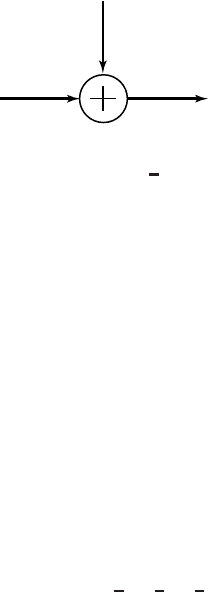
7.2 Additive noise channel. Find the channel capacity of the following
discrete memoryless channel:
Z
YX
where Pr{Z = 0}=Pr{Z = a}=
1
2
. The alphabet for x is X =
{0, 1}. Assume that Z is independent of X. Observe that the channel
capacity depends on the value of a.
7.3 Channels with memory have higher capacity. Consider a binary
symmetric channel with Y
i
= X
i
⊕ Z
i
, where ⊕ is mod 2 addi-
tion, and X
i
, Y
i
∈{0, 1}. Suppose that {Z
i
} has constant marginal
probabilities Pr{Z
i
= 1}=p = 1 − Pr{Z
i
= 0}, but that Z
1
, Z
2
,
..., Z
n
are not necessarily independent. Assume that Z
n
is inde-
pendent of the input X
n
.LetC = 1 −H(p,1 − p). Show that
max
p(x
1
,x
2
,...,x
n
)
I(X
1
,X
2
,...,X
n
;Y
1
,Y
2
,...,
Y
n
) ≥ nC.
7.4 Channel capacity. Consider the discrete memoryless channel Y =
X + Z (mod 11), where
Z =
1, 2, 3
1
3
,
1
3
,
1
3
and X ∈{0, 1,...,10}. Assume that Z is independent of X.
(a) Find the capacity.
(b) What is the maximizing p
∗
(x)?
7.5 Using two channels at once. Consider two discrete memoryless
channels (
X
1
,p(y
1
| x
1
), Y
1
) and (X
2
,p(y
2
| x
2
), Y
2
) with capac-
ities C
1
and C
2
, respectively. A new channel (X
1
× X
2
,p(y
1
|
x
1
) × p(y
2
| x
2
), Y
1
× Y
2
) is formed in which x
1
∈ X
1
and x
2
∈ X
2
are sent simultaneously, resulting in y
1
,y
2
. Find the capacity of this
channel.
7.6 Noisy typewriter. Consider a 26-key typewriter.
(a) If pushing a key results in printing the associated letter, what
is the capacity C in bits?