
Thomas M. Cover, Joy A. Thomas. Elements of information theory
Подождите немного. Документ загружается.

PROBLEMS 235
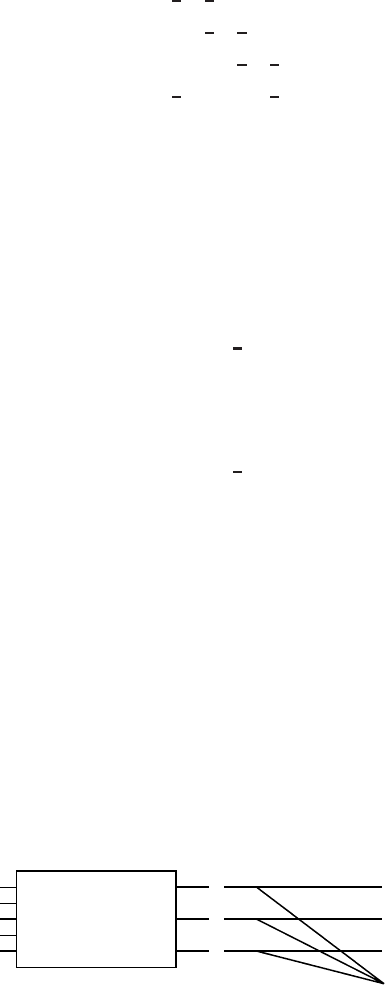
7.26 Noisy typewriter. Consider the channel with x, y ∈{0, 1, 2, 3} and
transition probabilities p(y|x) given by the following matrix:
1
2
1
2
00
0
1
2
1
2
0
00
1
2
1
2
1
2
00
1
2
(a) Find the capacity of this channel.
(b) Define the random variable z = g(y),where
g(y) =
A ify ∈{0, 1}
B ify ∈{2, 3}.
For the following two PMFs for x, compute I(X;Z):
(i)
p(x) =
1
2
ifx ∈{1, 3}
0ifx ∈{0, 2}.
(ii)
p(x) =
0ifx ∈{1, 3}
1
2
ifx ∈{0, 2}.
(c) Find the capacity of the channel between x and z, specifically
where x ∈{0, 1, 2, 3}, z ∈{A, B}, and the transition probabil-
ities P(z|x) are given by
p(Z = z|X = x) =
g(y
0
)=z
P(Y = y
0
|X = x).
(d) For the X distribution of part (i) of (b), does X → Z → Y
form a Markov chain?
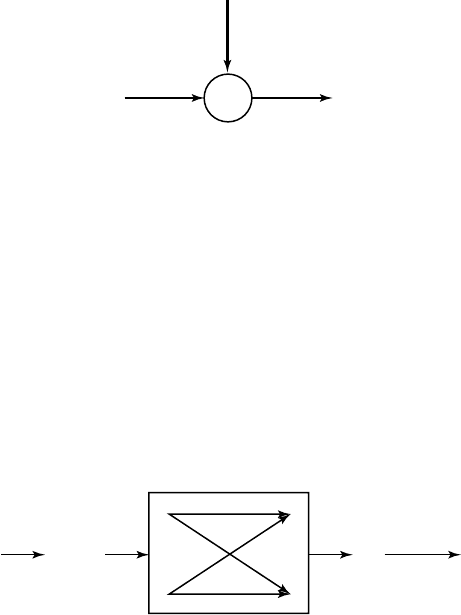
7.27 Erasure channel. Let {
X,p(y|x),Y} be a discrete memoryless chan-
nel with capacity C. Suppose that this channel is cascaded imme-
diately with an erasure channel {
Y,p(s|y),S} that erases α of its
symbols.
Xp
(
y
|
x
)
Y
e
S

236 CHANNEL CAPACITY
Specifically, S ={y
1
,y
2
,...,y
m
,e}, and
Pr{S = y|X = x}=
αp(y|x), y ∈ Y,
Pr{S = e|X = x}=α.
Determine the capacity of this channel.
7.28 Choice of channels. Find the capacity C of the union of two chan-
nels (
X
1
,p
1
(y
1
|x
1
), Y
1
) and (X
2
,p
2
(y
2
|x
2
), Y
2
), where at each
time, one can send a symbol over channel 1 or channel 2 but
not both. Assume that the output alphabets are distinct and do not
intersect.
(a) Show that 2
C
= 2
C
1
+ 2
C
2
. Thus, 2
C
is the effective alphabet
size of a channel with capacity C.
(b) Compare with Problem 2.10 where 2
H
= 2
H
1
+ 2
H
2
, and inter-
pret part (a) in terms of the effective number of noise-free
symbols.
(c) Use the above result to calculate the capacity of the following
channel.
1 −
p
1 −
p
0
1
0
1
22
1
p
p
7.29 Binary multiplier channel
(a) Consider the discrete memoryless channel Y = XZ,whereX
and Z are independent binary random variables that take on
values 0 and 1. Let P(Z = 1) = α. Find the capacity of this
channel and the maximizing distribution on X.
(b) Now suppose that the receiver can observe Z as well as Y .
What is the capacity?
PROBLEMS 237
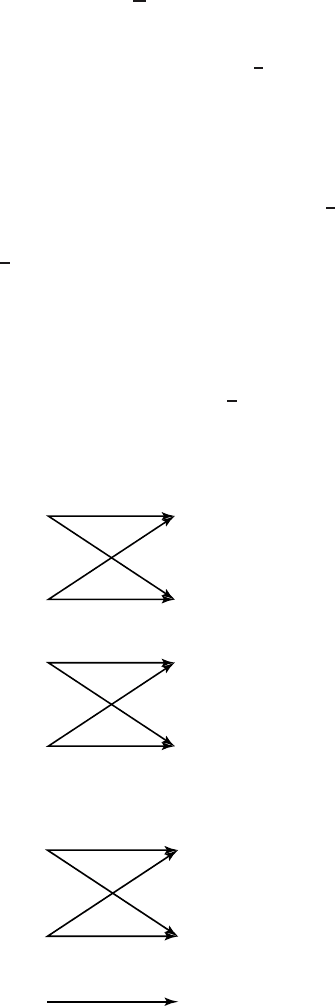
7.30 Noise alphabets. Consider the channel
Z
YX
∑
X ={0, 1, 2, 3},whereY = X + Z,andZ is uniformly distributed
over three distinct integer values
Z ={z
1
,z
2
,z
3
}.
(a) What is the maximum capacity over all choices of the
Z alpha-
bet? Give distinct integer values z
1
,z
2
,z
3
and a distribution on
X achieving this.
(b) What is the minimum capacity over all choices for the
Z alpha-
bet? Give distinct integer values z
1
,z
2
,z
3
and a distribution on
X achieving this.
7.31 Source and channel. We wish to encode a Bernoulli(α) process
V
1
,V
2
,... for transmission over a binary symmetric channel with
crossover probability p.
1 −
p
X
n
(
V
n
)
V
n
V
n
Y
n
1 −
p
p
p
^
Find conditions on α and p so that the probability of error P(
ˆ
V
n
=
V
n
) can be made to go to zero as n −→ ∞ .
7.32 Random 20 questions. Let X be uniformly distributed over {1, 2,
...,m}. Assume that m = 2
n
. We ask random questions: Is X ∈ S
1
?
Is X ∈ S
2
? ... until only one integer remains. All 2
m
subsets S of
{1, 2,...,m} are equally likely.
(a) How many deterministic questions are needed to determine X?
(b) Without loss of generality, suppose that X = 1 is the random
object. What is the probability that object 2 yields the same
answers as object 1 for k questions?
(c) What is the expected number of objects in {2, 3,...,m} that
have the same answers to the questions as those of the correct
object 1?
238 CHANNEL CAPACITY
(d) Suppose that we ask n +
√
n random questions. What is the
expected number of wrong objects agreeing with the answers?
(e) Use Markov’s inequality Pr{X ≥ tµ}≤
1
t
, to show that the
probability of error (one or more wrong object remaining) goes
to zero as n −→ ∞ .
7.33 BSC with feedback. Suppose that feedback is used on a binary
symmetric channel with parameter p. Each time a Y is received,
it becomes the next transmission. Thus, X
1
is Bern(
1
2
), X
2
= Y
1
,
X
3
= Y
2
, ..., X
n
= Y
n−1
.
(a) Find lim
n→∞
1
n
I(X
n
;Y
n
).
(b) Show that for some values of p, this can be higher than capac-
ity.
(c) Using this feedback transmission scheme, X
n
(W, Y
n
) = (X
1
(W ), Y
1
,Y
2
,...,Y
m−1
), what is the asymptotic communication
rate achieved; that is, what is lim
n→∞
1
n
I(W;Y
n
)?
7.34 Capacity. Find the capacity of
(a) Two parallel BSCs:
p
p
1
2
1
2
p
p
3
XY
4
3
4
(b) BSC and a single symbol:
p
p
1
2
1
2
3
XY
3
PROBLEMS 239
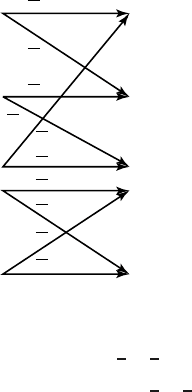
(c) BSC and a ternary channel:
p
p
1
2
1
2
p
4
XY
5
4
33
5
1
2
1
2
1
2
1
2
1
2
1
2
1
2
1
2
1
2
1
2
(d) Ternary channel:
p(y|x) =
2
3
1
3
0
0
1
3
2
3
!
. (7.167)
7.35 Capacity. Suppose that channel P has capacity C, where P is an
m × n channel matrix.
(a) What is the capacity of
˜
P =
P 0
01
?
(b) What about the capacity of
ˆ
P =
P 0
0 I
k
?
where I
k
if the k × k identity matrix.
7.36 Channel with memory. Consider the discrete memoryless channel
Y
i
= Z
i
X
i
with input alphabet X
i
∈{−1, 1}.
(a) What is the capacity of this channel when {Z
i
} is i.i.d. with
Z
i
=
1,p= 0.5
−1,p= 0.5?
(7.168)
240 CHANNEL CAPACITY
Now consider the channel with memory. Before transmission
begins, Z is randomly chosen and fixed for all time. Thus,
Y
i
= ZX
i
.
(b) What is the capacity if
Z =
1,p= 0.5
−1,p= 0.5?
(7.169)
7.37 Joint typicality. Let (X
i
,Y
i
,Z
i
) be i.i.d. according to p(x,y,z). We
will say that (x
n
,y
n
,z
n
) is jointly typical [written (x
n
,y
n
,z
n
) ∈
A
(n)
]if
•
p(x
n
) ∈ 2
−n(H (X)±)
.
•
p(y
n
) ∈ 2
−n(H (Y )±)
.
•
p(z
n
) ∈ 2
−n(H (Z)±)
.
•
p(x
n
,y
n
) ∈ 2
−n(H (X,Y )±)
.
•
p(x
n
,z
n
) ∈ 2
−n(H (X,Z)±)
.
•
p(y
n
,z
n
) ∈ 2
−n(H (Y,Z)±)
.
•
p(x
n
,y
n
,z
n
) ∈ 2
−n(H (X,Y,Z)±)
.
Now suppose that (
˜
X
n
,
˜
Y
n
,
˜
Z
n
) is drawn according to p(x
n
)p(y
n
)
p(z
n
). Thus,
˜
X
n
,
˜
Y
n
,
˜
Z
n
have the same marginals as p(x
n
,y
n
,z
n
)
but are independent. Find (bounds on) Pr{(
˜
X
n
,
˜
Y
n
,
˜
Z
n
) ∈ A
(n)
} in
terms of the entropies H(X),H(Y),H(Z),H(X,Y),H(X,Z),
H(Y,Z),andH(X,Y,Z).
HISTORICAL NOTES
The idea of mutual information and its relationship to channel capacity
was developed by Shannon in his original paper [472]. In this paper, he
stated the channel capacity theorem and outlined the proof using typical
sequences in an argument similar to the one described here. The first
rigorous proof was due to Feinstein [205], who used a painstaking “cookie-
cutting” argument to find the number of codewords that can be sent with a
low probability of error. A simpler proof using a random coding exponent
was developed by Gallager [224]. Our proof is based on Cover [121] and
on Forney’s unpublished course notes [216].
The converse was proved by Fano [201], who used the inequality bear-
ing his name. The strong converse was first proved by Wolfowitz [565],
using techniques that are closely related to typical sequences. An iterative
algorithm to calculate the channel capacity was developed independently
by Arimoto [25] and Blahut [65].
HISTORICAL NOTES 241
The idea of the zero-error capacity was developed by Shannon [474];
in the same paper, he also proved that feedback does not increase the
capacity of a discrete memoryless channel. The problem of finding the
zero-error capacity is essentially combinatorial; the first important result
in this area is due to Lovasz [365]. The general problem of finding the
zero error capacity is still open; see a survey of related results in K
¨
orner
and Orlitsky [327].
Quantum information theory, the quantum mechanical counterpart to
the classical theory in this chapter, is emerging as a large research area in
its own right and is well surveyed in an article by Bennett and Shor [49]
and in the text by Nielsen and Chuang [395].

CHAPTER 8
DIFFERENTIAL ENTROPY
We now introduce the concept of differential entropy, which is the entropy
of a continuous random variable. Differential entropy is also related to the
shortest description length and is similar in many ways to the entropy of
a discrete random variable. But there are some important differences, and
there is need for some care in using the concept.
8.1 DEFINITIONS
Definition Let X be a random variable with cumulative distribution
function F(x) = Pr(X ≤ x).IfF(x) is continuous, the random variable
is said to be continuous. Let f(x) = F
(x) when the derivative is defined.
If
∞
−∞
f(x)= 1, f(x)is called the probability density function for X.The
set where f(x)>0 is called the support set of X.
Definition The differential entropy h(X) of a continuous random vari-
able X with density f(x) is defined as
h(X) =−
S
f(x)log f(x)dx, (8.1)
where S is the support set of the random variable.
As in the discrete case, the differential entropy depends only on the
probability density of the random variable, and therefore the differential
entropy is sometimes written as h(f ) rather than h(X).
Remark As in every example involving an integral, or even a density,
we should include the statement if it exists. It is easy to construct examples
Elements of Information Theory, Second Edition, By Thomas M. Cover and Joy A. Thomas
Copyright 2006 John Wiley & Sons, Inc.
243

244 DIFFERENTIAL ENTROPY
of random variables for which a density function does not exist or for
which the above integral does not exist.
Example 8.1.1 (Uniform distribution) Consider a random variable dis-
tributed uniformly from 0 to a so that its density is 1/a from 0 to a and 0
elsewhere. Then its differential entropy is
h(X) =−
a
0
1
a
log
1
a
dx = log a. (8.2)
Note:Fora<1, log a<0, and the differential entropy is negative. Hence,
unlike discrete entropy, differential entropy can be negative. However,
2
h(X)
= 2
log a
= a is the volume of the support set, which is always non-
negative, as we expect.
Example 8.1.2 (Normal distribution)LetX ∼ φ(x) =
1
√
2πσ
2
e
−x
2
2σ
2
.
Then calculating the differential entropy in nats, we obtain
h(φ) =−
φ ln φ (8.3)
=−
φ(x)
−
x
2
2σ
2
− ln
2πσ
2
(8.4)
=
EX
2
2σ
2
+
1
2
ln 2πσ
2
(8.5)
=
1
2
+
1
2
ln 2πσ
2
(8.6)
=
1
2
ln e +
1
2
ln 2πσ
2
(8.7)
=
1
2
ln 2πeσ
2
nats. (8.8)
Changing the base of the logarithm, we have
h(φ) =
1
2
log 2πeσ
2
bits. (8.9)