
Thomas M. Cover, Joy A. Thomas. Elements of information theory
Подождите немного. Документ загружается.

PROBLEMS 225
(b) Now suppose that pushing a key results in printing that letter or
the next (with equal probability). Thus, A → A or B,...,Z →
Z or A. What is the capacity?
(c) What is the highest rate code with block length one that you
can find that achieves zero probability of error for the channel
in part (b)?
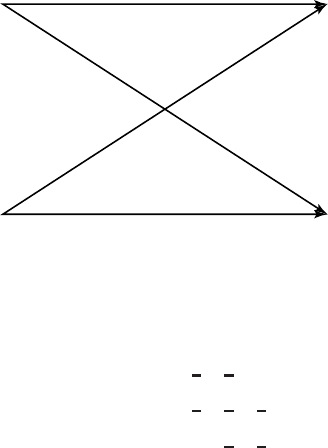
7.7 Cascade of binary symmetric channels. Show that a cascade of n
identical independent binary symmetric channels,
X
0
→ BSC → X
1
→···→X
n−1
→ BSC → X
n
,
each with raw error probability p, is equivalent to a single BSC with
error probability
1
2
1 − (1 −2p)
n
and hence that lim
n→∞
I(X
0
;X
n
)
= 0ifp = 0, 1. No encoding or decoding takes place at the inter-
mediate terminals X
1
,...,X
n−1
. Thus, the capacity of the cascade
tends to zero.
7.8 Z-channel. The Z-channel has binary input and output alphabets
and transition probabilities p(y|x) given by the following matrix:
Q =
10
1/21/2
x,y ∈{0, 1}
Find the capacity of the Z-channel and the maximizing input prob-
ability distribution.
7.9 Suboptimal codes. For the Z-channel of Problem 7.8, assume that
we choose a (2
nR
,n) code at random, where each codeword is a
sequence of fair coin tosses. This will not achieve capacity. Find the
maximum rate R such that the probability of error P
(n)
e
, averaged
over the randomly generated codes, tends to zero as the block length
n tends to infinity.
7.10 Zero-error capacity. A channel with alphabet {0, 1, 2, 3, 4} has tran-
sition probabilities of the form
p(y|x) =
1/2ify = x ± 1mod5
0otherwise.
(a) Compute the capacity of this channel in bits.
226 CHANNEL CAPACITY
(b) The zero-error capacity of a channel is the number of bits per
channel use that can be transmitted with zero probability of
error. Clearly, the zero-error capacity of this pentagonal chan-
nel is at least 1 bit (transmit 0 or 1 with probability 1/2). Find
a block code that shows that the zero-error capacity is greater
than 1 bit. Can you estimate the exact value of the zero-error
capacity? (Hint: Consider codes of length 2 for this channel.)
The zero-error capacity of this channel was finally found by
Lovasz [365].
7.11 Time-varying channels. Consider a time-varying discrete memory-
less channel.
Let Y
1
,Y
2
,...,Y
n
be conditionally independent given X
1
,X
2
,
...,X
n
, with conditional distribution given by p(y | x) =
n
i=1
p
i
(y
i
| x
i
).LetX = (X
1
,X
2
,...,X
n
), Y = (Y
1
,Y
2
,...,Y
n
).Find
max
p(x)
I(X ;Y).
1 −
p
i
1 −
p
i
0
1
0
1
p
i
p
i
7.12 Unused symbols. Show that the capacity of the channel with prob-
ability transition matrix
P
y|x
=
2
3
1
3
0
1
3
1
3
1
3
0
1
3
2
3
(7.155)
is achieved by a distribution that places zero probability on one
of input symbols. What is the capacity of this channel? Give an
intuitive reason why that letter is not used.
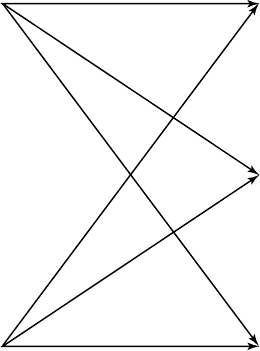
7.13 Erasures and errors in a binary channel. Consider a channel with
binary inputs that has both erasures and errors. Let the probability
PROBLEMS 227
of error be and the probability of erasure be α, so the channel is
follows:
0
1 − a −
0
11
e
∋
1 − a −
∋
∋
∋
a
a
(a) Find the capacity of this channel.
(b) Specialize to the case of the binary symmetric channel (α = 0).
(c) Specialize to the case of the binary erasure channel ( = 0).
7.14 Channels with dependence between the letters. Consider the fol-
lowing channel over a binary alphabet that takes in 2-bit symbols
and produces a 2-bit output, as determined by the following map-
ping: 00 → 01, 01 → 10, 10 → 11, and 11 → 00. Thus, if the
2-bit sequence 01 is the input to the channel, the output is 10 with
probability 1. Let X
1
,X
2
denote the two input symbols and Y
1
,Y
2
denote the corresponding output symbols.
(a) Calculate the mutual information I(X
1
,X
2
;Y
1
,Y
2
) as a func-
tion of the input distribution on the four possible pairs of inputs.
(b) Show that the capacity of a pair of transmissions on this chan-
nel is 2 bits.
(c) Show that under the maximizing input distribution, I(X
1
;Y
1
)
= 0. Thus, the distribution on the input sequences that achieves
capacity does not necessarily maximize the mutual information
between individual symbols and their corresponding outputs.
7.15 Jointly typical sequences. As we did in Problem 3.13 for the typical
set for a single random variable, we will calculate the jointly typical
set for a pair of random variables connected by a binary symmetric
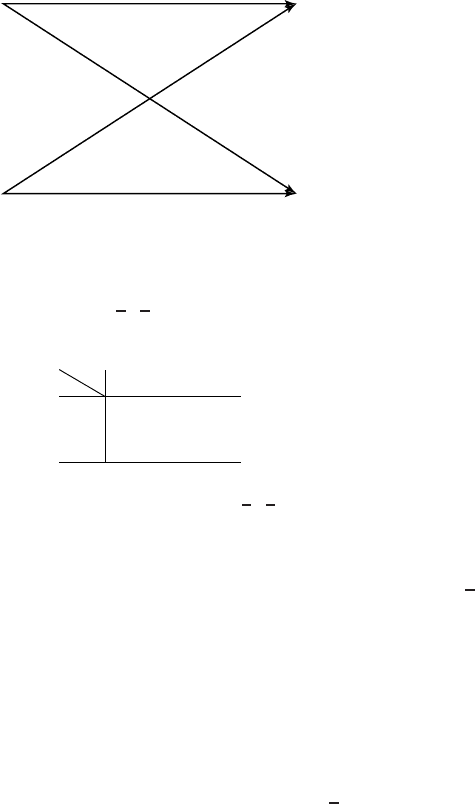
228 CHANNEL CAPACITY
channel, and the probability of error for jointly typical decoding
for such a channel.
0.9
0.9
0
1
0
1
0.1
0.1
We consider a binary symmetric channel with crossover probability
0.1. The input distribution that achieves capacity is the uniform
distribution [i.e., p(x) = (
1
2
,
1
2
)], which yields the joint distribution
p(x, y) for this channel is given by
X
Y
01
0 0.45 0.05
1 0.05 0.45
The marginal distribution of Y is also (
1
2
,
1
2
).
(a) Calculate H(X), H(Y), H(X,Y),andI(X;Y) for the joint
distribution above.
(b) Let X
1
,X
2
,...,X
n
be drawn i.i.d. according the Bernoulli(
1
2
)
distribution. Of the 2
n
possible input sequences of length n,
which of them are typical [i.e., member of A
(n)
(X) for =
0.2]? Which are the typical sequences in A
(n)
(Y )?
(c) The jointly typical set A
(n)
(X, Y ) is defined as the set of
sequences that satisfy equations (7.35-7.37). The first two
equations correspond to the conditions that x
n
and y
n
are in
A
(n)
(X) and A
(n)
(Y ), respectively. Consider the last condi-
tion, which can be rewritten to state that −
1
n
log p(x
n
,y
n
) ∈
(H (X, Y ) − , H (X, Y ) + ).Letk be the number of places
in which the sequence x
n
differs from y
n
(k is a function of
the two sequences). Then we can write
p(x
n
,y
n
) =
n
i=1
p(x
i
,y
i
) (7.156)

PROBLEMS 229
= (0.45)
n−k
(0.05)
k
(7.157)
=
1
2
n
(1 − p)
n−k
p
k
. (7.158)
An alternative way at looking at this probability is to look at the
binary symmetric channel as in additive channel Y = X ⊕ Z,
where Z is a binary random variable that is equal to 1 with
probability p, and is independent of X. In this case,
p(x
n
,y
n
) = p(x
n
)p(y
n
|x
n
) (7.159)
= p(x
n
)p(z
n
|x
n
) (7.160)
= p(x
n
)p(z
n
) (7.161)
=
1
2
n
(1 − p)
n−k
p
k
. (7.162)
Show that the condition that (x
n
,y
n
) being jointly typical is
equivalent to the condition that x
n
is typical and z
n
= y
n
− x
n
is typical.
(d) We now calculate the size of A
(n)
(Z) for n = 25 and = 0.2.
As in Problem 3.13, here is a table of the probabilities and
numbers of sequences with k ones:
k
n
k
n
k
p
k
(1 − p)
n−k
−
1
n
log p(x
n
)
0 1 0.071790 0.152003
1 25 0.199416 0.278800
2 300 0.265888 0.405597
3 2300 0.226497 0.532394
4 12650 0.138415 0.659191
5 53130 0.064594 0.785988
6 177100 0.023924 0.912785
7 480700 0.007215 1.039582
8 1081575 0.001804 1.166379
9 2042975 0.000379 1.293176
10 3268760 0.000067 1.419973
11 4457400 0.000010 1.546770
12 5200300 0.000001 1.673567
[Sequences with more than 12 ones are omitted since their total
probability is negligible (and they are not in the typical set).]
What is the size of the set A
(n)
(Z)?
230 CHANNEL CAPACITY
(e) Now consider random coding for the channel, as in the proof
of the channel coding theorem. Assume that 2
nR
codewords
X
n
(1), X
n
(2),..., X
n
(2
nR
) are chosen uniformly over the 2
n
possible binary sequences of length n. One of these codewords
is chosen and sent over the channel. The receiver looks at
the received sequence and tries to find a codeword in the
code that is jointly typical with the received sequence. As
argued above, this corresponds to finding a codeword X
n
(i)
such that Y
n
− X
n
(i) ∈ A
(n)
(Z). For a fixed codeword x
n
(i),
what is the probability that the received sequence Y
n
is such
that (x
n
(i), Y
n
) is jointly typical?
(f) Now consider a particular received sequence y
n
=
000000 ...0, say. Assume that we choose a sequence
X
n
at random, uniformly distributed among all the 2
n
possible
binary n-sequences. What is the probability that the chosen
sequence is jointly typical with this y
n
?[Hint: This is the
probability of all sequences x
n
such that y
n
− x
n
∈ A
(n)
(Z).]
(g) Now consider a code with 2
9
= 512 codewords of length 12
chosen at random, uniformly distributed among all the 2
n
sequences of length n = 25. One of these codewords, say
the one corresponding to i = 1, is chosen and sent over the
channel. As calculated in part (e), the received sequence, with
high probability, is jointly typical with the codeword that was
sent. What is the probability that one or more of the other
codewords (which were chosen at random, independent of the
sent codeword) is jointly typical with the received sequence?
[Hint: You could use the union bound, but you could also
calculate this probability exactly, using the result of part (f)
and the independence of the codewords.]
(h) Given that a particular codeword was sent, the probability of
error (averaged over the probability distribution of the chan-
nel and over the random choice of other codewords) can be
written as
Pr(Error|x
n
(1) sent) =
y
n
:y
n
causes error
p(y
n
|x
n
(1)). (7.163)
There are two kinds of error: the first occurs if the received
sequence y
n
is not jointly typical with the transmitted code-
word, and the second occurs if there is another codeword
jointly typical with the received sequence. Using the result
of the preceding parts, calculate this probability of error. By
PROBLEMS 231
the symmetry of the random coding argument, this does not
depend on which codeword was sent.
The calculations above show that average probability of error for
a random code with 512 codewords of length 25 over the binary
symmetric channel of crossover probability 0.1 is about 0.34. This
seems quite high, but the reason for this is that the value of that
we have chosen is too large. By choosing a smaller and a larger
n in the definitions of A
(n)
, we can get the probability of error to
be as small as we want as long as the rate of the code is less than
I(X;Y)− 3.
Also note that the decoding procedure described in the problem
is not optimal. The optimal decoding procedure is maximum like-
lihood (i.e., to choose the codeword that is closest to the received
sequence). It is possible to calculate the average probability of
error for a random code for which the decoding is based on an
approximation to maximum likelihood decoding, where we decode
a received sequence to the unique codeword that differs from the
received sequence in ≤ 4 bits, and declare an error otherwise. The
only difference with the jointly typical decoding described above
is that in the case when the codeword is equal to the received
sequence! The average probability of error for this decoding scheme
can be shown to be about 0.285.
7.16 Encoder and decoder as part of the channel. Consider a binary
symmetric channel with crossover probability 0.1. A possible cod-
ing scheme for this channel with two codewords of length 3 is to
encode message a
1
as 000 and a
2
as 111. With this coding scheme,
we can consider the combination of encoder, channel, and decoder
as forming a new BSC, with two inputs a
1
and a
2
and two outputs
a
1
and a
2
.
(a) Calculate the crossover probability of this channel.
(b) What is the capacity of this channel in bits per transmission of
the original channel?
(c) What is the capacity of the original BSC with crossover prob-
ability 0.1?
(d) Prove a general result that for any channel, considering the
encoder, channel, and decoder together as a new channel from
messages to estimated messages will not increase the capacity
in bits per transmission of the original channel.
7.17 Codes of length 3 for a BSC and BEC. In Problem 7.16, the prob-
ability of error was calculated for a code with two codewords of
232 CHANNEL CAPACITY
length 3 (000 and 111) sent over a binary symmetric channel with
crossover probability . For this problem, take = 0.1.
(a) Find the best code of length 3 with four codewords for this
channel. What is the probability of error for this code? (Note
that all possible received sequences should be mapped onto
possible codewords.)
(b) What is the probability of error if we used all eight possible
sequences of length 3 as codewords?
(c) Now consider a binary erasure channel with erasure probability
0.1. Again, if we used the two-codeword code 000 and 111,
received sequences 00E, 0E0, E00, 0EE, E0E, EE0 would all
be decoded as 0, and similarly, we would decode 11E, 1E1,
E11, 1EE, E1E, EE1 as 1. If we received the sequence EEE,
we would not know if it was a 000 or a 111 that was sent—so
we choose one of these two at random, and are wrong half the
time. What is the probability of error for this code over the
erasure channel?
(d) What is the probability of error for the codes of parts (a) and
(b) when used over the binary erasure channel?
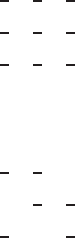
7.18 Channel capacity. Calculate the capacity of the following channels
with probability transition matrices:
(a)
X = Y ={0, 1, 2}
p(y|x) =
1
3
1
3
1
3
1
3
1
3
1
3
1
3
1
3
1
3
(7.164)
(b)
X = Y ={0, 1, 2}
p(y|x) =
1
2
1
2
0
0
1
2
1
2
1
2
0
1
2
(7.165)
(c)
X = Y ={0, 1, 2, 3}
p(y|x) =
p 1 − p 00
1 − pp 00
00q 1 − q
001− qq
(7.166)
PROBLEMS 233
7.19 Capacity of the carrier pigeon channel. Consider a commander of
an army besieged in a fort for whom the only means of commu-
nication to his allies is a set of carrier pigeons. Assume that each
carrier pigeon can carry one letter (8 bits), that pigeons are released
once every 5 minutes, and that each pigeon takes exactly 3 minutes
to reach its destination.
(a) Assuming that all the pigeons reach safely, what is the capacity
of this link in bits/hour?
(b) Now assume that the enemies try to shoot down the pigeons
and that they manage to hit a fraction α of them. Since the
pigeons are sent at a constant rate, the receiver knows when
the pigeons are missing. What is the capacity of this link?
(c) Now assume that the enemy is more cunning and that every
time they shoot down a pigeon, they send out a dummy pigeon
carrying a random letter (chosen uniformly from all 8-bit let-
ters). What is the capacity of this link in bits/hour?
Set up an appropriate model for the channel in each of the above
cases, and indicate how to go about finding the capacity.
7.20 Channel with two independent looks at Y. Let Y
1
and Y
2
be condi-
tionally independent and conditionally identically distributed given
X.
(a) Show that I(X;Y
1
,Y
2
) = 2I(X;Y
1
) − I(Y
1
,Y
2
).
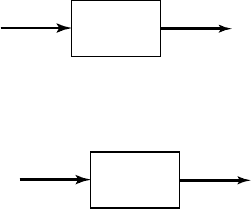
(b) Conclude that the capacity of the channel
X
(
Y
1
,
Y
2
)
is less than twice the capacity of the channel
XY
1
7.21 Tall, fat people. Suppose that the average height of people in a
room is 5 feet. Suppose that the average weight is 100 lb.
(a) Argue that no more than one-third of the population is 15 feet
tall.
(b) Find an upper bound on the fraction of 300-lb 10-footers in
the room.
234 CHANNEL CAPACITY
7.22 Can signal alternatives lower capacity? Show that adding a row to
a channel transition matrix does not decrease capacity.
7.23 Binary multiplier channel
(a) Consider the channel Y = XZ,whereX and Z are independent
binary random variables that take on values 0 and 1. Z is
Bernoulli(α)[i.e.,P(Z = 1) = α]. Find the capacity of this
channel and the maximizing distribution on X.
(b) Now suppose that the receiver can observe Z as well as Y .
What is the capacity?
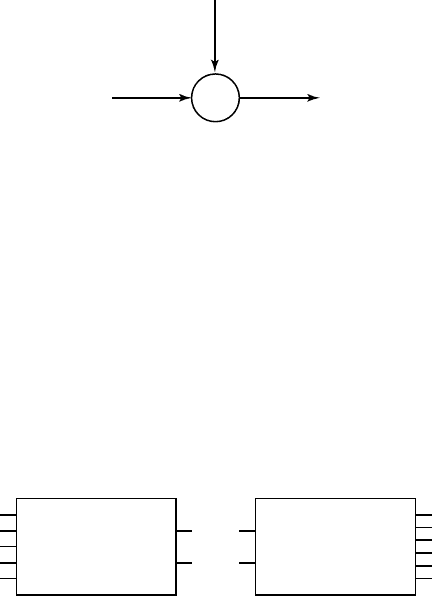
7.24 Noise alphabets. Consider the channel
Z
YX
∑
X ={0, 1, 2, 3},whereY = X + Z,andZ is uniformly distributed
over three distinct integer values
Z ={z
1
,z
2
,z
3
}.
(a) What is the maximum capacity over all choices of the
Z alpha-
bet? Give distinct integer values z
1
,z
2
,z
3
and a distribution on
X achieving this.
(b) What is the minimum capacity over all choices for the
Z alpha-
bet? Give distinct integer values z
1
,z
2
,z
3
and a distribution on
X achieving this.
7.25 Bottleneck channel. Suppose that a signal X ∈
X ={1, 2,...,m}
goes through an intervening transition X −→ V −→ Y :
XVYp
(
v
|
x
)
p
(
y
|
v
)
where x ={1, 2,...,m}, y ={1, 2,...,m},andv ={1, 2,...,k}.
Here p(v|x) and p(y|v) are arbitrary and the channel has transition
probability p(y|x) =
v
p(v|x)p(y|v). Show that C ≤ log k.