
Thomas M. Cover, Joy A. Thomas. Elements of information theory
Подождите немного. Документ загружается.


8.6 DIFFERENTIAL ENTROPY, RELATIVE ENTROPY, AND MUTUAL INFORMATION 255
=−h(g) −
φ
K
log φ
K
(8.75)
=−h(g) + h(φ
K
), (8.76)
where the substitution
g log φ
K
=
φ
K
log φ
K
follows from the fact
that g and φ
K
yield the same moments of the quadratic form log φ
K
(x).
In particular, the Gaussian distribution maximizes the entropy over
all distributions with the same variance. This leads to the estimation
counterpart to Fano’s inequality. Let X be a random variable with differ-
ential entropy h(X).Let
ˆ
X be an estimate of X,andletE(X −
ˆ
X)
2
be
the expected prediction error. Let h(X) be in nats.
Theorem 8.6.6 (Estimation error and differential entropy) For any
random variable X and estimator
ˆ
X,
E(X −
ˆ
X)
2
≥
1
2πe
e
2h(X)
,
with equality if and only if X is Gaussian and
ˆ
X is the mean of X.
Proof: Let
ˆ
X be any estimator of X;then
E(X −
ˆ
X)
2
≥ min
ˆ
X
E(X −
ˆ
X)
2
(8.77)
= E
(
X − E(X)
)
2
(8.78)
= var(X) (8.79)
≥
1
2πe
e
2h(X)
, (8.80)
where (8.78) follows from the fact that the mean of X is the best estimator
for X and the last inequality follows from the fact that the Gaussian
distribution has the maximum entropy for a given variance. We have
equality only in (8.78) only if
ˆ
X is the best estimator (i.e.,
ˆ
X is the mean
of X and equality in (8.80) only if X is Gaussian).
Corollary Given side information Y and estimator
ˆ
X(Y ), it follows that
E(X −
ˆ
X(Y ))
2
≥
1
2πe
e
2h(X|Y)
.

256 DIFFERENTIAL ENTROPY
SUMMARY
h(X) = h(f ) =−
S
f(x)log f(x)dx (8.81)
f(X
n
)
.
=2
−nh(X)
(8.82)
Vo l (A
(n)
)
.
=2
nh(X)
. (8.83)
H
(
[X]
2
−n
)
≈ h(X) + n. (8.84)
h(
N(0,σ
2
)) =
1
2
log 2πeσ
2
. (8.85)
h(
N
n
(µ, K)) =
1
2
log(2πe)
n
|K|. (8.86)
D(f ||g) =
f log
f
g
≥ 0. (8.87)
h(X
1
,X
2
,...,X
n
) =
n
i=1
h(X
i
|X
1
,X
2
,...,X
i−1
). (8.88)
h(X|Y) ≤ h(X). (8.89)
h(aX) = h(X) + log |a|. (8.90)
I(X;Y) =
f (x,y)log
f (x,y)
f(x)f(y)
≥ 0. (8.91)
max
EXX
t
=K
h(X) =
1
2
log(2πe)
n
|K|. (8.92)
E(X −
ˆ
X(Y ))
2
≥
1
2πe
e
2h(X|Y)
.
2
nH (X)
is the effective alphabet size for a discrete random variable.
2
nh(X)
is the effective support set size for a continuous random variable.
2
C
is the effective alphabet size of a channel of capacity C.
PROBLEMS
8.1 Differential entropy. Evaluate the differential entropy h(X) =
−
f ln f for the following:
(a) The exponential density, f(x) = λe
−λx
, x ≥ 0.

PROBLEMS 257
(b) The Laplace density, f(x) =
1
2
λe
−λ|x|
.
(c) The sum of X
1
and X
2
, where X
1
and X
2
are independent
normal random variables with means µ
i
and variances σ
2
i
,i =
1, 2.
8.2 Concavity of determinants.LetK
1
and K
2
be two symmetric non-
negative definite n × n matrices. Prove the result of Ky Fan [199]:
| λK
1
+ λK
2
|≥| K
1
|
λ
| K
2
|
λ
for 0 ≤ λ ≤ 1, λ = 1 − λ,
where | K | denotes the determinant of K.[Hint:LetZ = X
θ
,
where X
1
∼ N(0,K
1
), X
2
∼ N(0,K
2
) and θ = Bernoulli(λ).Then
use h(Z | θ) ≤ h(Z).]
8.3 Uniformly distributed noise. Let the input random variable X to
a channel be uniformly distributed over the interval −
1
2
≤ x ≤+
1
2
.
Let the output of the channel be Y = X + Z, where the noise ran-
dom variable is uniformly distributed over the interval −a/2 ≤ z ≤
+a/2.
(a) Find I(X;Y) as a function of a.
(b) For a = 1 find the capacity of the channel when the input X
is peak-limited; that is, the range of X is limited to −
1
2
≤ x ≤
+
1
2
. What probability distribution on X maximizes the mutual
information I(X;Y)?
(c) (Optional) Find the capacity of the channel for all values of a,
again assuming that the range of X is limited to −
1
2
≤ x ≤+
1
2
.
8.4 Quantized random variables. Roughly how many bits are required
on the average to describe to three-digit accuracy the decay time
(in years) of a radium atom if the half-life of radium is 80 years?
Note that half-life is the median of the distribution.
8.5 Scaling.Leth(X) =−
f(x) log f(x)dx. Show
h(AX) = log | det(A) |+h(X).
8.6 Variational inequality. Verify for positive random variables X
that
log E
P
(X) = sup
Q
E
Q
(log X) − D(Q||P)
, (8.93)
where E
P
(X) =
x
xP(x) and D(Q||P) =
x
Q(x) log
Q(x)
P(x)
,
and the supremum is over all Q(x)≥0,
Q(x) =1. It is enough
to extremize J(Q)=E
Q
ln X−D(Q||P)+λ(
Q(x)−1).

258 DIFFERENTIAL ENTROPY
8.7 Differential entropy bound on discrete entropy.LetX beadis-
crete random variable on the set
X ={a
1
,a
2
,...} with Pr(X =
a
i
) = p
i
. Show that
H(p
1
,p
2
,...) ≤
1
2
log(2πe)
∞
i=1
p
i
i
2
−
∞
i=1
ip
i
2
+
1
12
.
(8.94)
Moreover, for every permutation σ ,
H(p
1
,p
2
,...) ≤
1
2
log(2πe)
∞
i=1
p
σ(i)
i
2
−
∞
i=1
ip
σ(i)
2
+
1
12
.
(8.95)
[Hint: Construct a random variable X
such that Pr(X
= i) = p
i
.
Let U be a uniform (0,1] random variable and let Y = X
+ U ,
where X
and U are independent. Use the maximum entropy bound
on Y to obtain the bounds in the problem. This bound is due to
Massey (unpublished) and Willems (unpublished).]
8.8 Channel with uniformly distributed noise. Consider a additive
channel whose input alphabet
X ={0,±1,±2} and whose output
Y = X+Z,whereZ is distributed uniformly over the interval
[−1, 1]. Thus, the input of the channel is a discrete random vari-
able, whereas the output is continuous. Calculate the capacity C =
max
p(x)
I(X;Y) of this channel.
8.9 Gaussian mutual information. Suppose that (X,Y,Z) are jointly
Gaussian and that X → Y → Z forms a Markov chain. Let X and
Y have correlation coefficient ρ
1
and let Y and Z have correlation
coefficient ρ
2
.FindI(X;Z).
8.10 Shape of the typical set.LetX
i
be i.i.d. ∼ f(x),where
f(x)= ce
−x
4
.
Let h =−
f ln f . Describe the shape (or form) or the typical set
A
(n)
={x
n
∈ R
n
: f(x
n
) ∈ 2
−n(h±)
}.
8.11 Nonergodic Gaussian process. Consider a constant signal V in
the presence of iid observational noise {Z
i
}. Thus, X
i
= V + Z
i
,
where V ∼ N(0,S) and Z
i
are iid ∼ N(0,N). Assume that V and
{Z
i
} are independent.
(a) Is {X
i
} stationary?

HISTORICAL NOTES 259
(b) Find lim
n−→ ∞
1
n
n
i=1
X
i
. Is the limit random?
(c) What is the entropy rate h of {X
i
}?
(d) Find the least-mean-squared error predictor
ˆ
X
n+1
(X
n
),andfind
σ
2
∞
= lim
n−→ ∞
E(
ˆ
X
n
− X
n
)
2
.
(e) Does {X
i
} have an AEP? That is, does −
1
n
log f(X
n
) −→ h?
HISTORICAL NOTES
Differential entropy and discrete entropy were introduced in Shannon’s
original paper [472]. The general rigorous definition of relative entropy
and mutual information for arbitrary random variables was developed by
Kolmogorov [319] and Pinsker [425], who defined mutual information as
sup
P,Q
I([X]
P
;[Y ]
Q
), where the supremum is over all finite partitions P
and Q.

CHAPTER 9
GAUSSIAN CHANNEL
The most important continuous alphabet channel is the Gaussian channel
depicted in Figure 9.1. This is a time-discrete channel with output Y
i
at
time i,whereY
i
is the sum of the input X
i
and the noise Z
i
. The noise
Z
i
is drawn i.i.d. from a Gaussian distribution with variance N. Thus,
Y
i
= X
i
+ Z
i
,Z
i
∼ N(0,N). (9.1)
The noise Z
i
is assumed to be independent of the signal X
i
. This channel
is a model for some common communication channels, such as wired and
wireless telephone channels and satellite links. Without further conditions,
the capacity of this channel may be infinite. If the noise variance is zero,
the receiver receives the transmitted symbol perfectly. Since X can take
on any real value, the channel can transmit an arbitrary real number with
no error.
If the noise variance is nonzero and there is no constraint on the input,
we can choose an infinite subset of inputs arbitrarily far apart, so that
they are distinguishable at the output with arbitrarily small probability of
error. Such a scheme has an infinite capacity as well. Thus if the noise
variance is zero or the input is unconstrained, the capacity of the channel
is infinite.
The most common limitation on the input is an energy or power constraint.
We assume an average power constraint. For any codeword (x
1
,x
2
,...,x
n
)
transmitted over the channel, we require that
1
n
n
i=1
x
2
i
≤ P. (9.2)
This communication channel models many practical channels, includ-
ing radio and satellite links. The additive noise in such channels may be
due to a variety of causes. However, by the central limit theorem, the
Elements of Information Theory, Second Edition, By Thomas M. Cover and Joy A. Thomas
Copyright 2006 John Wiley & Sons, Inc.
261
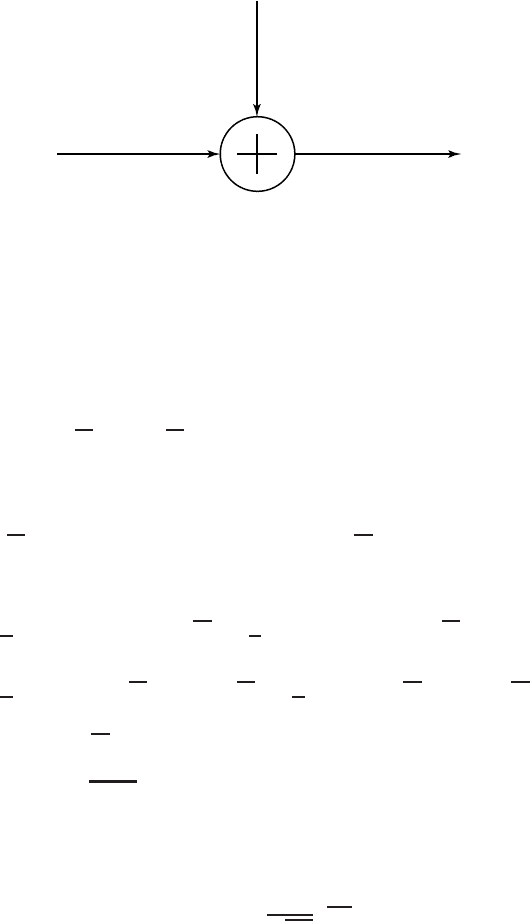
262 GAUSSIAN CHANNEL
Z
i
Y
i
X
i
FIGURE 9.1. Gaussian channel.
cumulative effect of a large number of small random effects will be
approximately normal, so the Gaussian assumption is valid in a large
number of situations.
We first analyze a simple suboptimal way to use this channel. Assume
that we want to send 1 bit over the channel in one use of the channel.
Given the power constraint, the best that we can do is to send one of
two levels, +
√
P or −
√
P . The receiver looks at the corresponding Y
received and tries to decide which of the two levels was sent. Assuming
that both levels are equally likely (this would be the case if we wish to
send exactly 1 bit of information), the optimum decoding rule is to decide
that +
√
P was sent if Y>0 and decide −
√
P was sent if Y<0. The
probability of error with such a decoding scheme is
P
e
=
1
2
Pr(Y < 0|X =+
√
P)+
1
2
Pr(Y > 0|X =−
√
P) (9.3)
=
1
2
Pr(Z < −
√
P |X =+
√
P)+
1
2
Pr(Z >
√
P |X =−
√
P) (9.4)
= Pr(Z >
√
P) (9.5)
= 1 −
P/N
, (9.6)
where (x) is the cumulative normal function
(x) =
x
−∞
1
√
2π
e
−t
2
2
dt. (9.7)
Using such a scheme, we have converted the Gaussian channel into a dis-
crete binary symmetric channel with crossover probability P
e
. Similarly,
by using a four-level input signal, we can convert the Gaussian channel

9.1 GAUSSIAN CHANNEL: DEFINITIONS 263
into a discrete four-input channel. In some practical modulation schemes,
similar ideas are used to convert the continuous channel into a discrete
channel. The main advantage of a discrete channel is ease of processing
of the output signal for error correction, but some information is lost in
the quantization.
9.1 GAUSSIAN CHANNEL: DEFINITIONS
We now define the (information) capacity of the channel as the maxi-
mum of the mutual information between the input and output over all
distributions on the input that satisfy the power constraint.
Definition The information capacity of the Gaussian channel with
power constraint P is
C = max
f(x):EX
2
≤P
I(X;Y). (9.8)
We can calculate the information capacity as follows: Expanding
I(X;Y),wehave
I(X;Y) = h(Y ) − h(Y |X) (9.9)
= h(Y ) − h(X + Z|X) (9.10)
= h(Y ) − h(Z|X) (9.11)
= h(Y ) − h(Z), (9.12)
since Z is independent of X.Now,h(Z) =
1
2
log 2πeN.Also,
EY
2
= E(X + Z)
2
= EX
2
+ 2EXEZ + EZ
2
= P + N, (9.13)
since X and Z are independent and EZ = 0. Given EY
2
= P + N ,the
entropy of Y is bounded by
1
2
log 2πe(P + N) by Theorem 8.6.5 (the
normal maximizes the entropy for a given variance).
Applying this result to bound the mutual information, we obtain
I(X;Y) = h(Y ) − h(Z) (9.14)
≤
1
2
log 2πe(P + N) −
1
2
log 2πeN (9.15)
=
1
2
log
1 +
P
N
. (9.16)

264 GAUSSIAN CHANNEL
Hence, the information capacity of the Gaussian channel is
C = max
EX
2
≤P
I(X;Y) =
1
2
log
1 +
P
N
, (9.17)
and the maximum is attained when X ∼
N(0,P).
We will now show that this capacity is also the supremum of the rates
achievable for the channel. The arguments are similar to the arguments
for a discrete channel. We will begin with the corresponding definitions.
Definition An (M, n) code for the Gaussian channel with power con-
straint P consists of the following:
1. An index set {1, 2,...,M}.
2. An encoding function x : {1, 2,...,M}→
X
n
, yielding codewords
x
n
(1), x
n
(2),...,x
n
(M), satisfying the power constraint P ;thatis,
for every codeword
n
i=1
x
2
i
(w) ≤ nP , w = 1, 2,...,M. (9.18)
3. A decoding function
g :
Y
n
→{1, 2,...,M}. (9.19)
The rate and probability of error of the code are defined as in Chapter 7
for the discrete case. The arithmetic average of the probability of error is
defined by
P
(n)
e
=
1
2
nR
λ
i
. (9.20)
Definition ArateR is said to be achievable for a Gaussian channel
with a power constraint P if there exists a sequence of (2
nR
,n) codes
with codewords satisfying the power constraint such that the maximal
probability of error λ
(n)
tends to zero. The capacity of the channel is the
supremum of the achievable rates.
Theorem 9.1.1 The capacity of a Gaussian channel with power con-
straint P and noise variance N is
C =
1
2
log
1 +
P
N
bits per transmission. (9.21)