
Thomas M. Cover, Joy A. Thomas. Elements of information theory
Подождите немного. Документ загружается.


16.1 THE STOCK MARKET: SOME DEFINITIONS 615
the sum of i.i.d. versions of the random variable. But in the stock market,
one normally reinvests every day, so that the wealth at the end of n days
is the product of factors, one for each day of the market. The behavior of
the product is determined not by the expected value but by the expected
logarithm. This leads us to define the growth rate as follows:
Definition The growth rate of a stock market portfolio b with respect
to a stock distribution F(x) is defined as
W(b,F)=
log b
t
x dF(x) = E
log b
t
X
. (16.1)
If the logarithm is to base 2, the growth rate is also called the doubling
rate.
Definition The optimal growth rate W
∗
(F ) is defined as
W
∗
(F ) = max
b
W(b,F), (16.2)
where the maximum is over all possible portfolios b
i
≥ 0,
i
b
i
= 1.
Definition A portfolio b
∗
that achieves the maximum of W(b,F) is
called a log-optimal portfolio or growth optimal portfolio.
The definition of growth rate is justified by the following theorem,
which shows that wealth grows as 2
nW
∗
.
Theorem 16.1.1 Let X
1
, X
2
,...,X
n
be i.i.d. according to F(x).Let
S
∗
n
=
n
i=1
b
∗t
X
i
(16.3)
be the wealth after n days using the constant rebalanced portfolio b
∗
.Then
1
n
log S
∗
n
→ W
∗
with probability 1. (16.4)
Proof: By the strong law of large numbers,
1
n
log S
∗
n
=
1
n
n
i=1
log b
∗t
X
i
(16.5)
→ W
∗
with probability 1. (16.6)
Hence, S
∗
n
.
= 2
nW
∗
.
616 INFORMATION THEORY AND PORTFOLIO THEORY
We now consider some of the properties of the growth rate.
Lemma 16.1.1 W(b,F) is concave in b and linear in F . W
∗
(F ) is
convex in F .
Proof: Thegrowthrateis
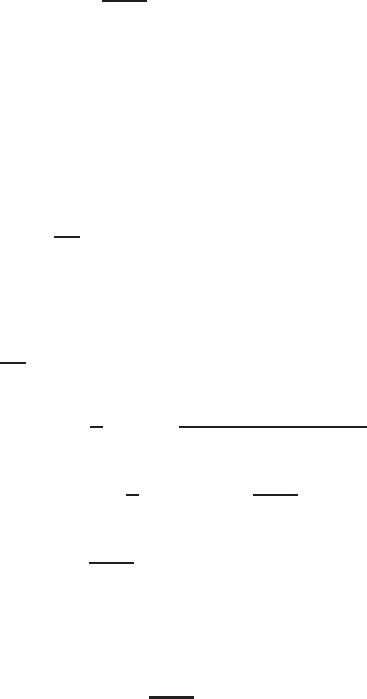
W(b,F)=
log b
t
x dF(x). (16.7)
Since the integral is linear in F ,soisW(b,F).Since
log(λb
1
+ (1 − λ)b
2
)
t
X ≥ λ log b
t
1
X + (1 − λ) log b
t
2
X, (16.8)
by the concavity of the logarithm, it follows, by taking expectations, that
W(b,F) is concave in b. Finally, to prove the convexity of W
∗
(F ) as a
function of F ,letF
1
and F
2
be two distributions on the stock market and
let the corresponding optimal portfolios be b
∗
(F
1
) and b
∗
(F
2
), respec-
tively. Let the log-optimal portfolio corresponding to λF
1
+ (1 − λ)F
2
be
b
∗
(λF
1
+ (1 − λ)F
2
). Then by linearity of W(b,F) with respect to F ,
we have
W
∗
(λF
1
+ (1 − λ)F
2
)
= W(b
∗
(λF
1
+ (1 − λ)F
2
), λF
1
+ (1 − λ)F
2
) (16.9)
= λW (b
∗
(λF
1
+ (1 − λ)F
2
), F
1
)
+ (1 − λ)W (b
∗
(λF
1
+ (1 − λ)F
2
), F
2
)
≤ λW (b
∗
(F
1
), F
1
) + (1 −λ)W
∗
(b
∗
(F
2
), F
2
), (16.10)
since b
∗
(F
1
) maximizes W(b,F
1
) and b
∗
(F
2
) maximizes W(b,F
2
).
Lemma 16.1.2 The set of log-optimal portfolios with respect to a given
distribution is convex.
Proof: Suppose that b
1
and b
2
are log-optimal (i.e., W(b
1
,F) = W(b
2
,F)
= W
∗
(F )). By the concavity of W(b,F)in b,wehave
W(λb
1
+ (1 − λ)b
2
,F) ≥ λW (b
1
,F)+ (1 − λ)W (b
2
,F) = W
∗
(F ).
(16.11)
Thus, λb
1
+ (1 − λ)b
2
is also log-optimal.
In the next section we use these properties to characterize the log-
optimal portfolio.
16.2 KUHN–TUCKER CHARACTERIZATION OF THE LOG-OPTIMAL PORTFOLIO 617
16.2 KUHN–TUCKER CHARACTERIZATION
OF THE LOG-OPTIMAL PORTFOLIO
Let
B ={b ∈ R
m
: b
i
≥ 0,
m
i=1
b
i
= 1} denote the set of allowed port-
folios. The determination of b
∗
that achieves W
∗
(F ) is a problem of
maximization of a concave function W(b,F) over a convex set
B.The
maximum may lie on the boundary. We can use the standard Kuhn–Tucker
conditions to characterize the maximum. Instead, we derive these condi-
tions from first principles.
Theorem 16.2.1 The log-optimal portfolio b
∗
for a stock market X ∼ F
(i.e., the portfolio that maximizes the growth rate W(b,F)) satisfies the
following necessary and sufficient conditions:
E
X
i
b
∗t
X
= 1 if b
∗
i
> 0,
≤ 1 if b
∗
i
= 0. (16.12)
Proof: The growth rate W(b) = E(ln b
t
X) is concave in b,whereb
ranges over the simplex of portfolios. It follows that b
∗
is log-optimum
iff the directional derivative of W(·) in the direction from b
∗
to any
alternative portfolio b is nonpositive. Thus, letting b
λ
= (1 −λ)b
∗
+ λb
for 0 ≤ λ ≤ 1, we have
d
dλ
W(b
λ
)
λ=0+
≤ 0, b ∈ B. (16.13)
These conditions reduce to (16.12) since the one-sided derivative at λ =
0+ of W(b
λ
) is
d
dλ
E(ln(b
t
λ
X))
λ=0+
= lim
λ↓0
1
λ
E
ln
(1 − λ)b
∗t
X + λb
t
X
b
∗t
X
(16.14)
= E
lim
λ↓0
1
λ
ln
1 + λ
b
t
X
b
∗t
X
− 1
(16.15)
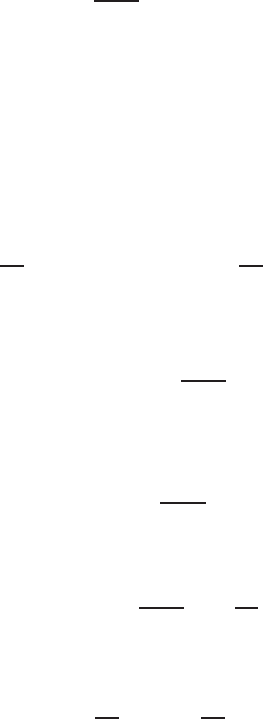
= E
b
t
X
b
∗t
X
− 1, (16.16)
where the interchange of limit and expectation can be justified using the
dominated convergence theorem [39]. Thus, (16.13) reduces to
E
b
t
X
b
∗t
X
− 1 ≤ 0 (16.17)
618 INFORMATION THEORY AND PORTFOLIO THEORY
for all b ∈ B. If the line segment from b to b
∗
can be extended beyond b
∗
in the simplex, the two-sided derivative at λ = 0ofW(b
λ
) vanishes and
(16.17) holds with equality. If the line segment from b to b
∗
cannot be
extended because of the inequality constraint on b, we have an inequality
in (16.17).
The Kuhn–Tucker conditions will hold for all portfolios b ∈
B if they
hold for all extreme points of the simplex
B since E(b
t
X/b
∗t
X) is linear
in b. Furthermore, the line segment from the jth extreme point (b : b
j
=
1,b
i
= 0,i = j )tob
∗
can be extended beyond b
∗
in the simplex iff b
∗
j
>
0. Thus, the Kuhn–Tucker conditions that characterize the log-optimum
b
∗
are equivalent to the following necessary and sufficient conditions:
E
X
i
b
∗t
X
= 1ifb
∗
i
> 0,
≤ 1ifb
∗
i
= 0. (16.18)
This theorem has a few immediate consequences. One useful equiva-
lence is expressed in the following theorem.
Theorem 16.2.2 Let S
∗
= b
∗t
X be the random wealth resulting from
the log-optimal portfolio b
∗
.LetS = b
t
X be the wealth resulting from any
other portfolio b.Then
E ln
S
S
∗
≤ 0 for all S ⇔ E
S
S
∗
≤ 1 for all S. (16.19)
Proof: From Theorem 16.2.1 it follows that for a log-optimal portfolio
b
∗
,
E
X
i
b
∗t
X
≤ 1 (16.20)
for all i. Multiplying this equation by b
i
and summing over i,wehave
m
i=1
b
i
E
X
i
b
∗t
X
≤
m
i=1
b
i
= 1, (16.21)
which is equivalent to
E
b
t
X
b
∗t
X
= E
S
S
∗
≤ 1. (16.22)
The converse follows from Jensen’s inequality, since
E log
S
S
∗
≤ log E
S
S
∗
≤ log 1 = 0. (16.23)

16.3 ASYMPTOTIC OPTIMALITY OF THE LOG-OPTIMAL PORTFOLIO 619
Maximizing the expected logarithm was motivated by the asymptotic
growth rate. But we have just shown that the log-optimal portfolio, in
addition to maximizing the asymptotic growth rate, also “maximizes” the
expected wealth relative E(S/S
∗
) for one day. We shall say more about
the short-term optimality of the log-optimal portfolio when we consider
the game-theoretic optimality of this portfolio.
Another consequence of the Kuhn–Tucker characterization of the log-
optimal portfolio is the fact that the expected proportion of wealth in
each stock under the log-optimal portfolio is unchanged from day to day.
Consider the stocks at the end of the first day. The initial allocation of
wealth is b
∗
. The proportion of the wealth in stock i at the end of the day
is
b
∗
i
X
i
b
∗t
X
, and the expected value of this proportion is
E
b
∗
i
X
i
b
∗t
X
= b
∗
i
E
X
i
b
∗t
X
= b
∗
i
. (16.24)
Hence, the proportion of wealth in stock i expected at the end of the
day is the same as the proportion invested in stock i at the beginning of
the day. This is a counterpart to Kelly proportional gambling, where one
invests in proportions that remain unchanged in expected value after the
investment period.
16.3 ASYMPTOTIC OPTIMALITY OF THE LOG-OPTIMAL
PORTFOLIO
In Section 16.2 we introduced the log-optimal portfolio and explained its
motivation in terms of the long-term behavior of a sequence of investments
in a repeated independent versions of the stock market. In this section we
expand on this idea and prove that with probability 1, the conditionally
log-optimal investor will not do any worse than any other investor who
uses a causal investment strategy.
We first consider an i.i.d. stock market (i.e., X
1
, X
2
,...,X
n
are i.i.d.
according to F(x)). Let
S
n
=
n
i=1
b
t
i
X
i
(16.25)
be the wealth after n days for an investor who uses portfolio b
i
on day i.
Let
W
∗
= max
b
W(b,F)= max
b
E log b
t
X (16.26)
620 INFORMATION THEORY AND PORTFOLIO THEORY
be the maximal growth rate, and let b
∗
be a portfolio that achieves the
maximum growth rate. We only allow alternative portfolios b
i
that depend
causally on the past and are independent of the future values of the stock
market.
Definition A nonanticipating or causal portfolio strategy is a sequence
of mappings b
i
: R
m(i−1)
→ B, with the interpretation that portfolio b
i
(x
1
,
...,x
i−1
) is used on day i.
From the definition of W
∗
, it follows immediately that the log-optimal
portfolio maximizes the expected log of the final wealth. This is stated in
the following lemma.
Lemma 16.3.1 Let S
∗
n
be the wealth after n days using the log-optimal
strategy b
∗
on i.i.d. stocks, and let S
n
be the wealth using a causal portfolio
strategy b
i
.Then
E log S
∗
n
= nW
∗
≥ E log S
n
. (16.27)
Proof
max
b
1
,b
2
,...,b
n
E log S
n
= max
b
1
,b
2
,...,b
n
E
n
i=1
log b
t
i
X
i
(16.28)
=
n
i=1
max
b
i
(X
1
,X
2
,...,X
i−1
)
E log b
t
i
(X
1
, X
2
,...,X
i−1
)X
i
(16.29)
=
n
i=1
E log b
∗t
X
i
(16.30)
= nW
∗
, (16.31)
and the maximum is achieved by a constant portfolio strategy b
∗
.
So far, we have proved two simple consequences of the definition of
log-optimal portfolios: that b
∗
(satisfying (16.12)) maximizes the expected
log wealth, and that the resulting wealth S
∗
n
is equal to 2
nW
∗
to first order
in the exponent, with high probability.
Now we prove a much stronger result, which shows that S
∗
n
exceeds
the wealth (to first order in the exponent) of any other investor for almost
every sequence of outcomes from the stock market.
Theorem 16.3.1 (Asymptotic optimality of the log-optimal portfolio)
Let X
1
, X
2
,...,X
n
be a sequence of i.i.d. stock vectors drawn according
16.4 SIDE INFORMATION AND THE GROWTH RATE 621
to F(x).LetS
∗
n
=
n
i=1
b
∗t
X
i
,whereb
∗
is the log-optimal portfolio, and
let S
n
=
n
i=1
b
t
i
X
i
be the wealth resulting from any other causal portfolio.
Then
lim sup
n→∞
1
n
log
S
n
S
∗
n
≤ 0 with probability 1. (16.32)
Proof: From the Kuhn–Tucker conditions and the log optimality of S
∗
n
,
we have
E
S
n
S
∗
n
≤ 1. (16.33)
Hence by Markov’s inequality, we have
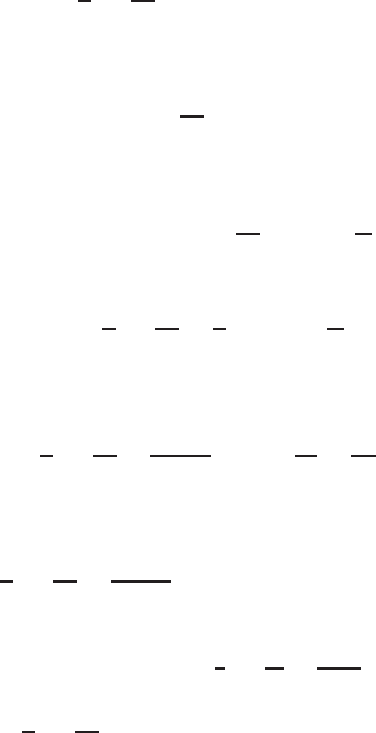
Pr
S
n
>t
n
S
∗
n
= Pr
S
n
S
∗
n
>t
n
<
1
t
n
. (16.34)
Hence,
Pr
1
n
log
S
n
S
∗
n
>
1
n
log t
n
≤
1
t
n
. (16.35)
Setting t
n
= n
2
and summing over n,wehave
∞
n=1
Pr
1
n
log
S
n
S
∗
n
>
2logn
n
≤
∞
n=1
1
n
2
=
π
2
6
. (16.36)
Then, by the Borel–Cantelli lemma,
Pr
1
n
log
S
n
S
∗
n
>
2logn
n
, infinitely often
= 0. (16.37)
This implies that for almost every sequence from the stock market, there
exists an N such that for all n>N,
1
n
log
S
n
S
∗
n
<
2logn
n
. Thus,
lim sup
1
n
log
S
n
S
∗
n
≤ 0 with probability 1. (16.38)
The theorem proves that the log-optimal portfolio will perform as well
as or better than any other portfolio to first order in the exponent.
16.4 SIDE INFORMATION AND THE GROWTH RATE
We showed in Chapter 6 that side information Y for the horse race X can
be used to increase the growth rate by the mutual information I(X;Y).
622 INFORMATION THEORY AND PORTFOLIO THEORY
We now extend this result to the stock market. Here, I(X;Y) is an upper
bound on the increase in the growth rate, with equality if X is a horse
race. We first consider the decrease in growth rate incurred by believing
in the wrong distribution.
Theorem 16.4.1 Let X ∼ f(x).Letb
f
be a log-optimal portfolio cor-
responding to f(x), and let b
g
be a log-optimal portfolio corresponding
to some other density g(x). Then the increase in growth rate W by using
b
f
instead of b
g
is bounded by
W = W(b
f
,F)− W(b
g
,F) ≤ D(f ||g). (16.39)
Proof: We have
W =
f(x) log b
t
f
x −
f(x) log b
t
g
x (16.40)
=
f(x) log
b
t
f
x
b
t
g
x
(16.41)
=
f(x) log
b
t
f
x
b
t
g
x
g(x)
f(x)
f(x)
g(x)
(16.42)
=
f(x) log
b
t
f
x
b
t
g
x
g(x)
f(x)
+ D(f ||g) (16.43)
(a)
≤ log
f(x)
b
t
f
x
b
t
g
x
g(x)
f(x)
+ D(f ||g) (16.44)
= log
g(x)
b
t
f
x
b
t
g
x
+ D(f ||g) (16.45)
(b)
≤ log 1 + D(f ||g) (16.46)
= D(f ||g), (16.47)
where (a) follows from Jensen’s inequality and (b) follows from the
Kuhn–Tucker conditions and the fact that b
g
is log-optimal for g.
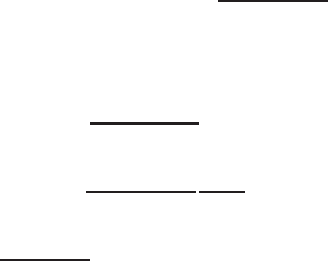
Theorem 16.4.2 The increase W in growth rate due to side informa-
tion Y is bounded by
W ≤ I(X;Y). (16.48)
16.5 INVESTMENT IN STATIONARY MARKETS 623
Proof: Let (X,Y)∼ f(x,y),whereX is the market vector and Y is the
related side information. Given side information Y = y, the log-optimal
investor uses the conditional log-optimal portfolio for the conditional
distribution f(x|Y = y). Hence, conditional on Y = y, we have, from
Theorem 16.4.1,
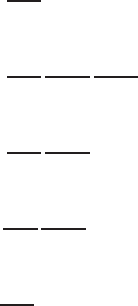
W
Y =y
≤ D(f (x|Y = y)||f(x)) =
x
f(x|Y = y) log
f(x|Y = y)
f(x)
dx.
(16.49)
Averaging this over possible values of Y ,wehave
W ≤
y
f(y)
x
f(x|Y = y) log
f(x|Y = y)
f(x)
dx dy (16.50)
=
y
x
f(y)f(x|Y = y) log
f(x|Y = y)
f(x)
f(y)
f(y)
dx dy (16.51)
=
y
x
f(x,y)log
f(x,y)
f(x)f (y)
dx dy (16.52)
= I(X;Y). (16.53)
Hence, the increase in growth rate is bounded above by the mutual infor-
mation between the side information Y and the stock market X.
16.5 INVESTMENT IN STATIONARY MARKETS
We now extend some of the results of Section 16.4 from i.i.d. markets
to time-dependent market processes. Let X
1
, X
2
,...,X
n
,... beavector-
valued stochastic process with X
i
≥ 0. We consider investment strategies
that depend on the past values of the market in a causal fashion (i.e., b
i
may depend on X
1
, X
2
,...,X
i−1
). Let
S
n
=
n
i=1
b
t
i
(X
1
, X
2
,...,X
i−1
)X
i
. (16.54)
Our objective is to maximize E log S
n
over all such causal portfolio strate-
gies {b
i
(·)}.Now
max
b
1
,b
2
,...,b
n
E log S
n
=
n
i=1
max
b
i
(X
1
,X
2
,...,X
i−1
)
E log b
t
i
X
i
(16.55)
=
n
i=1
E log b
∗t
i
X
i
, (16.56)

624 INFORMATION THEORY AND PORTFOLIO THEORY
where b
∗
i
is the log-optimal portfolio for the conditional distribution of X
i
given the past values of the stock market; that is, b
∗
i
(x
1
, x
2
,...,x
i−1
) is
the portfolio that achieves the conditional maximum, which is denoted by
max
b
E[logb
t
X
i
|(X
1
, X
2
,...,X
i−1
) = (x
1
, x
2
,...,x
i−1
)]
= W
∗
(X
i
|x
1
, x
2
,...,x
i−1
). (16.57)
Taking the expectation over the past, we write
W
∗
(X
i
|X
1
, X
2
,...,X
i−1
) = E max
b
E
log b
t
X
i
|X
1
, X
2
,...,X
i−1
(16.58)
as the conditional optimal growth rate, where the maximum is over all
portfolio-valued functions b defined on X
1
,...,X
i−1
. Thus, the high-
est expected log return is achieved by using the conditional log-optimal
portfolio at each stage. Let
W
∗
(X
1
, X
2
,...,X
n
) = max
b
1
,b
2
,...,b
n
E log S
n
, (16.59)
where the maximum is over all causal portfolio strategies. Then since
log S
∗
n
=
m
i=1
log b
∗t
i
X
i
, we have the following chain rule for W
∗
:
W
∗
(X
1
, X
2
,...,X
n
) =
n
i=1
W
∗
(X
i
|X
1
, X
2
,...,X
i−1
). (16.60)
This chain rule is formally the same as the chain rule for H .Insome
ways, W is the dual of H . In particular, conditioning reduces H but
increases W. We now define the counterpart of the entropy rate for time-
dependent stochastic processes.
Definition The growth rate W
∗
∞
is defined as
W
∗
∞
= lim
n→∞
W
∗
(X
1
, X
2
,...,X
n
)
n
(16.61)
if the limit exists.
Theorem 16.5.1 For a stationary market, the growth rate exists and is
equal to
W
∗
∞
= lim
n→∞
W
∗
(X
n
|X
1
, X
2
,...,X
n−1
). (16.62)