
Van Dyke R.M, Alcock S.E. (ред.) Archaeologies of Memory
Подождите немного. Документ загружается.

5
Glories of the Past in the Past:
Ritual Activities at Palatial Ruins in
Early Iron Age Crete
Mieke Prent
Many thanks are due to the editors of this volume, for their constructive suggestions and
remarks, and to Stuart MacVeagh Thorne, who patiently read and commented on several ver-
sions of this paper.
Introduction
Crete is known for its splendid Bronze Age or “Minoan” civilization, named after the
legendary king Minos. Minos was the son of Zeus and Europa, to whom ancient
Greek authors, from Homer to Plato and Diodoros Siculus, ascribed great fame as
lawgiver and mighty ruler of the seas (for an overview of ancient sources see Poland
1932). Archaeological research since the late nineteenth century has done much to
underscore the pre-eminence of Minoan Crete. Excavation and survey have revealed
a large number of sites, ranging from monumental palaces, villas and sanctuaries to
smaller settlements, roads and harbors. During the middle and late phases of the
Bronze Age (ca. 2000–1600 and 1600–1200 bc respectively) the island was densely
populated and knew a highly organized and complex civilization, with the Minoan
palaces as their administrative, political, and religious centers.
By the end of the thirteenth century bc, the majority of these Bronze Age centers
were abandoned and left to decay. This happened in tandem with the widespread
destruction and dislocation of people that affected large parts of the Mediterranean
in this period, and which the contemporary Egyptian texts ascribe to the “Sea
Peoples” (Sandars 1978). In Crete, changes included a movement of population from
low-lying coastal areas to defensible sites inland (see esp. Nowicki 2000) and a con-
comitant shift in economy, which became more localized and less oriented towards
seaborne trade.
The Early Iron Age in Crete is subdivided into the Protogeometric period (1000/
970 bc–810 bc) and the Geometric period (810–700 bc). It is followed by the
Orientalizing period (700–630 bc), the Archaic period (630–480 bc), the Classical
period (480–330 bc), the Hellenistic (330–67 bc) and Roman (67 bc–330 ad)
82 Mieke Prent
periods.Traces of activity at the old Cretan centers remain scarce until the Early Iron
Age (the tenth to eighth centuries bc). In the course of this period, Crete, like most
other regions in the Greek world, experienced a number of crucial and interrelated
changes, eventually leading to the formation of the Greek city-states or poleis. The
population began to grow, settlements increased in size and number, and the differ-
entiation in tombs and votive assemblages at sanctuaries indicates the articulation of
different social groups, including that of a leading group of aristocratic warriors.These
demographic and socio-political changes were accompanied by an intensification of
overseas contact both within the Aegean and with the Near East, a broad improve-
ment in material standards, and the rediscovery of forgotten skills such as writing and
specialized metal working. It was in this same, formative, period that the ruins of a
number of the old Minoan sites – some two to three hundred years after their aban-
donment – were singled out as the foci for ritual activities. At present, seven instances
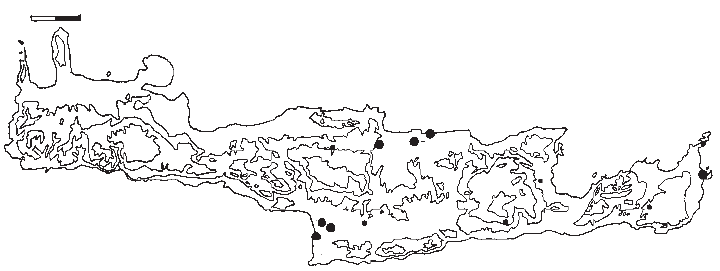
of such Early Iron Age “ruin cults” are known: at the former palaces of Knossos and
Phaistos; at Ayia Triada, Kommos, Amnisos, and Tylisos; and at Palaikastro in the far
east of the island (map 5.1). Each of these sites has yielded evidence for the lasting
visibility of monumental sections of the former palaces and associated building com-
plexes. Such remains constitute potentially strong markers for the local remembrance
of a glorious Bronze Age past, suggesting that their selection as a cult place in the
Early Iron Age represents a deliberate choice. However, as will be explored below, the
motives for these choices indicate the complexity of the phenomenon of memory,
with different roles played by the social, historical, and religious components.
Cult Amidst the Ruins
One of the first excavators to observe the phenomenon of the prolonged visibility
of Cretan Bronze Age monuments was Arthur Evans at Knossos. He described how
01020
KM
8
6
1
2
9
3
4
5
10
11
7
12
Map 5.1 Map of Crete, with sites mentioned in the text: (1) Knossos, (2) Amnisos,
(3) Phaistos, (4) Ayia Triada, (5) Kommos, (6) Tylisos, (7) Palaikastro, (8) Axos, (9) Gortyn,
(10) Lato, (11) Praisos, (12) Itanos
Ritual Activities at Palatial Ruins in Early Iron Age Crete 83
fragments of a Minoan relief-fresco depicting a charging bull, in the Northern
Entrance Passage to the palace, were found one meter higher than the Late Bronze
Age strata, on a level which he associated with Geometric sherds found 20m further
to the north (Evans 1930:171). Imposing sections of the Minoan palace, including its
decoration, clearly had remained visible during the Early Iron Age. This is also indi-
cated by the discovery of a votive deposit of that date in the southwest corner of the
palace’s Central Court. Here, near the level of the Minoan paving, Evans encountered
some terracotta figurines, one of which may have belonged to a clay cauldron,
and drinking equipment consisting of a Geometric krater and tens of drinking cups
ranging in date from the Protogeometric to the Hellenistic periods (Coldstream
2000:284–8; Evans 1928:5–7, 346 n.1). A possible Classical or Hellenistic cult build-
ing was erected between the ruined walls of the adjacent West Wing. Initially, however,
cult activities would have taken place in the open air. The presence of a concentra-
tion of ash and bone (Evans 1899–1900:17) may indicate that the earliest rituals
involved animal sacrifice and/or sacrificial dining.
Evidence for the lasting visibility of the architectural vestiges of the Bronze Age
and their association with cult activities has since accumulated. At Amnisos, a Minoan
harbor town which probably belonged to the territory of Knossos, an imposing
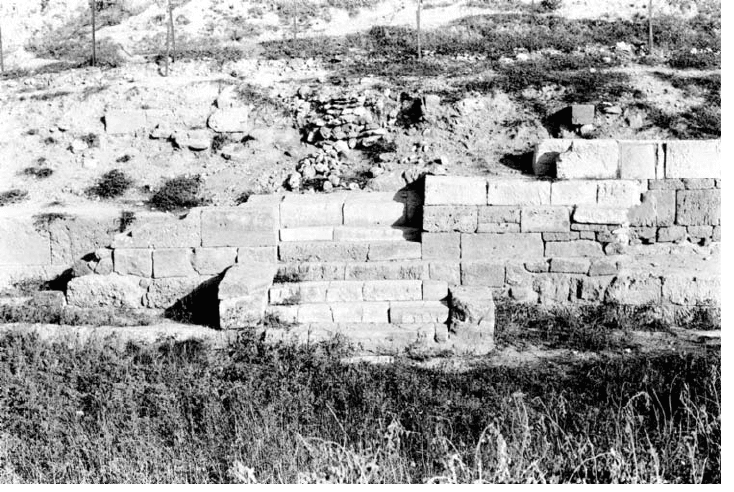
Bronze Age ashlar wall, more than 44 meters in length, attracted cult activities from
the later Protogeometric period (plate 5.1). A layer resting against it, more than 0.70
m thick, contained ash, animal bones, fragments of precious bronze tripods and bowls,
bronze figurines, terracotta drinking cups, kraters, amphorai, and storage vessels –
Plate 5.1 Amnisos. Part of the more than 44m long Bronze Age wall (photo by the author)
84 Mieke Prent
remnants of sacrificial refuse – ranging in date from the late ninth to the seventh
century bc. Due to limited excavation, the original function of the Bronze Age build-
ing has not been determined, but the size and execution of the exposed wall point
to a public character. Traces of seventh-century bc occupation were found in a Late
Bronze Age house some 400 m west of the sanctuary, indicating that other buildings
of the harbor town remained visible at this time (Schäfer 1992:350). While the sur-
rounding settlement was never reoccupied at a large scale, the Early Iron Age sanc-
tuary was frequented for cult purposes into Roman times. During the Classical period
a cult building was erected, as implied by the discovery of architectural fragments of
that date, and portions of the upper courses of the Bronze Age wall were rebuilt
(Schäfer 1992:182–5).
At Phaistos, the second-largest Minoan palace site of Crete, there is comparable
evidence for the lasting visibility of sections of the former palace and for Early Iron
Age cult activities associated with the remains. The early excavators of Phaistos, in
contrast to Evans, considered that later inhabitants used the Bronze Age ruins merely
as a source for ashlar blocks (Pernier and Banti 1951:14). It now appears significant
that a votive deposit of Early Iron Age bronze shields and bowls was found at the
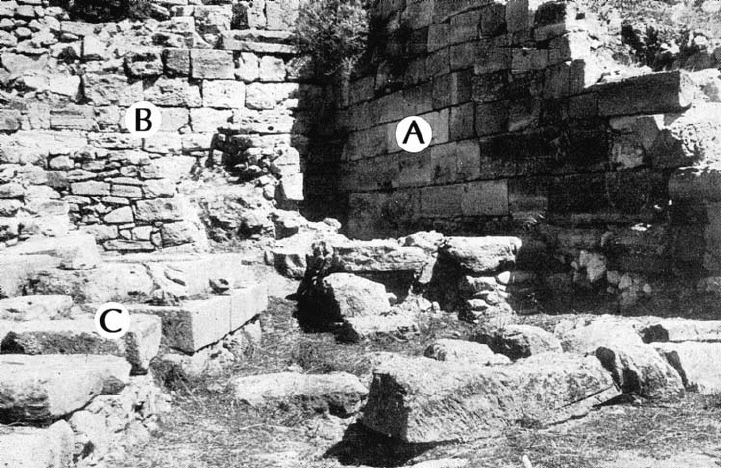
foot of the two well-preserved Bronze Age ashlar walls (ca. four meters high) which
had retained the southwest section of the palace. These walls must then have been
standing as they are today (plate 5.2), and they formed an impressive backdrop
for the Early Iron Age open-air cult. In the seventh century bc a cult building
Plate 5.2 Phaistos. Early Iron Age and later sanctuary at the foot of Bronze Age ashlar walls.
(From Pernier and Banti [1951: Figure 83], reproduced by permission of the Libreria dello
Stato – Istituto Poligrafico e Zecca dello Stato, Rome)
Ritual Activities at Palatial Ruins in Early Iron Age Crete 85
was erected, which was subsequently enlarged in the Hellenistic period (Pernier
1907:262–4).
At Ayia Triada, only 3km west of Phaistos, there is evidence that a monumental
Bronze Age Stoa and adjacent paved court became the focus for cult activities during
the late ninth century bc. In an illuminating restudy of the old excavation material,
L. D’Agata (1998) concludes that in this period a small room was built against the
northeast corner of the standing Stoa. While no votives were found inside the Stoa,
numerous late ninth to early seventh-century anthropomorphic and animal figurines
in both terracotta and bronze had been deposited along the exterior face of its north
wall and on the steps of the monumental Minoan staircase to its east. A second con-
centration of votives of the same date came from the paved court and a stepped area
to the south.
At Tylisos, a partially excavated Bronze Age site in the eastern foothills of the Ida
mountains, an arrangement of Stoa and a paved court similar to that at Ayia Triada
was discovered. As at the latter site, it was this monumental area that began to attract
open-air cult activities in the Early Iron Age. A stone-built altar has been associated
with bronze and terracotta figurines and with a probable fragment of a bronze tripod
of Cypriot type. Most votives remain unpublished and can therefore be dated only
broadly from Geometric to Hellenistic times. It is clear, however, that these were
found in conjunction with the Bronze Age remains, only a few centimeters above
the latest Bronze Age paving (Chatzidakis 1934:66–9, 109–10, pl. XIV).
The clearest picture is provided by Kommos, a site on the south coast of Central
Crete, under excavation since 1976. The use of detailed, modern excavation tech-
niques has made it possible to ascertain that numerous Bronze Age walls were visible
until late in the eighth century bc. This applies both to the more modestly con-
structed Minoan houses on the slope and summit of the settlement hill – where a
complete Protogeometric krater was found among the ruins (Shaw 1981:213, pl. 61d)
– and to the monumental remains of ashlar complex P/T and its associated court at
the bottom of the hill. This complex, for which the excavators propose a palatial or
public function, attracted cult activities from ca. 1000 bc. At that time a first small
cult building – Temple A – was erected, measuring ca. 5.5 ¥ 6.7m. Temple A actu-
ally incorporated part of one of the ashlar walls of the ruined Bronze Age building
T, and both Temple A and its late ninth-century successor Temple B were founded
on a heap of collapsed ashlar blocks from Building T.Visitors also reused some of the
galleries of Building P, the roof of which may have been partially preserved (Shaw
and Shaw 2000:8–16). Animal bones, drinking vessels, and plates are indicative of
repeated sacrificial dining, while characteristic votives consist of life-size and minia-
ture weaponry (including some bronze shields), large terracotta bull and horse figures,
and small ones in terracotta and bronze (Shaw and Shaw 2000:691).
At Palaikastro, in the far east of the island, a portion of a large Bronze Age settle-
ment was converted into a sanctuary for Diktaian Zeus during the Protogeometric
or Geometric period (figure 5.1). Recently, Crowther (1988) has argued that the
mention by the first-century author Diodoros Siculus of a city, founded by Zeus but
still visible in ruined state during the author’s day, refers in all likelihood to the Bronze
Age town at Palaikastro. Re-study of the old excavation material, combined with
86 Mieke Prent
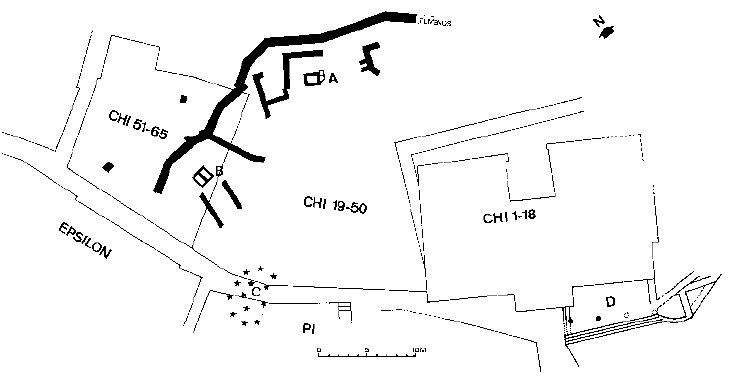
Figure 5.1 Plan of the sanctuary at Palaikastro: (A and B) architectural remains of the fifth
century bc and later, (C) Early Iron Age ash altar, (D) stepped area
information from the new excavations, shows indeed that house and street walls were
standing until long after the thirteenth-century abandonment of the settlement. More
specifically, a stepped area (situated at the southeast limit of the excavated area and
therefore only partially explored) may constitute a later addition to a partially ruined
Bronze Age house. During the Early Iron Age, cult activities focused on the area of
former house block Chi (figure 5.1). In this area an ash altar was found, and around
it were fragments of bronze tripod-cauldrons, bronze bowls, decorated shields and
armour, terracotta drinking cups, and other vessels (Hutchinson et al. 1939–40).Archi-
tectural fragments, ranging in date from the later sixth century bc to the Hellenistic
period, indicate the existence of a series of cult buildings during the later life of the
sanctuary (MacVeagh Thorne and Prent 2000).
The monumental character of the Bronze Age ashlar walls that were visible at these
seven sanctuaries would have stood in sharp contrast to the modest, small-stone archi-
tecture of the Early Iron Age itself (e.g. Hayden 1981:139–41). It is not inconceiv-
able that such massive ashlar walls inspired, besides admiration for the technical skills
required to build them, stories of supernatural origin, in the same way that the mega-
lithic walls of Tiryns on the Greek mainland were believed to have been built by
giant, one-eyed Cyclopes under the direction of Zeus (Bacchylides, Ode 11.72–80).
Confirmation for the idea that monumental walls had divine connotations during the
Early Iron Age can be found in the Homeric epics – in the Iliad (7.445–52, 8.519)
the city walls of Troy are said to have been built or founded by the gods. Never-
theless, it must be emphasized that Early Iron Age Cretans do not appear to have
suffered from any vague, indiscriminate feelings of awe or respect towards ancient
monuments. Outside the immediate areas of the sanctuaries, the reuse of Bronze Age
structures for habitation and other profane purposes, and their destruction by the dis-
Ritual Activities at Palatial Ruins in Early Iron Age Crete 87
mantling of walls and quarrying of ashlar blocks, is well-attested (e.g. Sackett 1992:1–2
for examples at Knossos). Even within areas dedicated to cult, there may be evidence
for the quarrying of ashlar blocks, as revealed by the layer of stone chips around
Temple B at Kommos (Shaw and Shaw 2000:24).
Instead of generalized feelings of awe for Bronze Age remains, more specific con-
siderations seem to have led to the singling out of precisely these sites at which to
worship. Not only are the chosen ruins of the finest ashlar masonry, they are part of
complexes that had served palatial or related public functions during the Bronze Age.
(The only exception is Palaikastro, although suggestions have been made that a palace
is hidden in the unexcavated area immediately south of the sanctuary.) Rather than
a random choice of monumental remains, this implies a relatively faithful preserva-
tion of the memory of the special character of these places. In some cases, the appar-
ent avoidance of the surroundings of these sanctuaries for habitation strengthens this
idea. The abandonment of Amnisos, Ayia Triada, Kommos, Palaikastro, and possibly
Tylisos in the thirteenth century bc here needs no explanation beyond the widely
attested changes in settlement pattern and economy that characterized the closing
centuries of the Bronze Age. At a site like Knossos, on the other hand – which con-
tinued to be an important settlement center long after the Bronze Age – the absence
of later habitation in the area of the palace is striking. Several scholars propose it was
the result of conscious avoidance, or even a taboo placed on habitation (Coldstream
2000:296–8; Evans 1928:7). At Phaistos, one of the few other Cretan Bronze Age sites
that was continuously inhabited into the Early Iron Age, the picture is unfortunately
more fragmentary. The early excavators report the removal of a number of “later
structures” from over the Bronze Age palace without giving precise dates. Both
“Greco-Roman” and “Hellenic” occupation are mentioned, but it is uncertain if
the latter term was meant to include the Geometric period. Well-preserved Early
Iron Age houses have been recorded immediately west of the palace. From there occu-
pation certainly extended west, up the slope, and southwards along the bottom of the
palace hill, in a pattern broadly corresponding to that at Knossos (La Rosa 1992:240).
To recapitulate, at places such as Knossos, Amnisos, and Kommos, there is evidence
for the lasting visibility of larger parts of the Bronze Age sites, including dwellings,
which invited different kinds of reuse, from quarrying to re-habitation. There is,
however, a distinct preference for monumental constructions as the location for Early
Iron Age cult. Apparently, from the tenth century bc on, certain Cretans developed a
special interest in the monuments that centuries earlier had served palatial or related
functions. Their interest found expression in the dedication of sometimes precious
votives and in rituals of sacrificial dining and drinking. The fact that cult was pre-
dominantly practised in the open air would have reinforced the dramatic effect of
these gatherings amid the age-old ruins.
The Worshippers and their Motives
The composition of the votive assemblages associated with these Early Iron Age sanc-
tuaries provides some indication as to who worshipped there. Although the assem-
88 Mieke Prent
blages at first glance seem far from uniform, there are a number of recurrent features.
One of these is the predominance of bronze objects at many of the sanctuaries.This,
in a period when the overseas contacts to obtain the necessary metals were only grad-
ually increasing and specialized skills of metalworking only recently regained, indi-
cates a distinct wealth of votary. We can learn more about the social standing and
aspirations of the dedicants by considering the nature and symbolic connotations of
the attested types of votive in some detail.
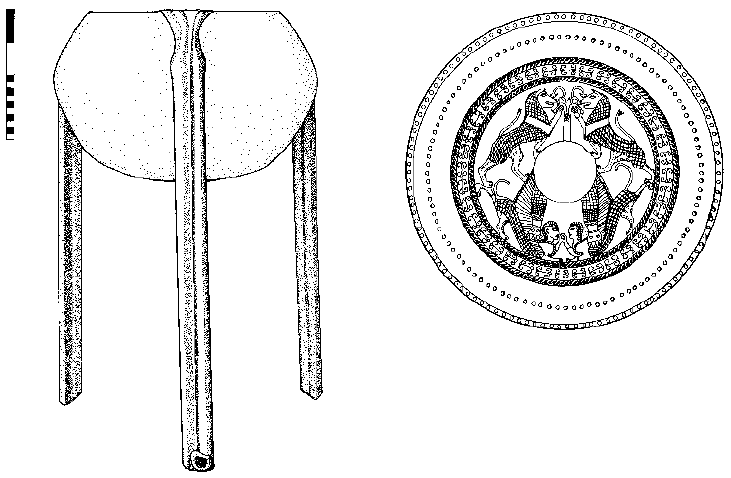
At four of the seven sanctuaries – Amnisos, Phaistos, Kommos, and Palaikastro –
votive assemblages are dominated by large bronzes, which take the form of tripod-
cauldrons and shields (figure 5.2). Objects of this kind constituted the most precious
and conspicuous dedications available in the early Greek world and define the stature
of the votary. Their presence in large numbers is significant because it shows how
much wealth people were prepared to consecrate (Snodgrass 1980:52–4).
The military–aristocratic connotations of the dedicated shields speak for them-
selves. The possession of this kind of armor, often elaborately decorated, was clearly
the reserve of an elite. Bronze shields and other weaponry occur as grave offerings
in rich Cretan tombs from the late ninth to the seventh century bc and would have
articulated the deceased’s role as warrior and leading member of the developing
aristocracy. The dedication of such objects in sanctuaries would have had a similar
function, but added an element of greater visibility and permanency. Precious votives
could remain on display for generations, as attested by ancient authors such as
Pausanias. He mentions seeing such votives and being told that these were of great
antiquity and offered by famous rulers (e.g. Paus, III.2.8, III.3.8.,V.19.6). Clearly, the
Figure 5.2 Bronze tripod-cauldron and decorated shield from Palaikastro
Ritual Activities at Palatial Ruins in Early Iron Age Crete 89
religious dedication of precious objects implied special relations with higher powers.
Like a claim to military prowess, this relationship enhanced a donor’s position in the
community and would have been considered as more than worth the expense.
The bronze tripod-cauldrons, though lacking the overt military connotations of
the shields, were no less tied to the aristocratic ethos. An indication of their value
may be gained from the Homeric epics, in which they constitute the most presti-
gious gift exchanged between fellow aristocrats. In a passage of the Iliad (23.703–5),
a tripod is estimated to have a value of twelve oxen, whereas a skilled, female slave
is considered to be worth only four. O. Murray (1983) has argued that the special
meaning of bronze tripod-cauldrons in early Greek times derived from their use as
cooking vessels at communal dining parties. Drawing on anthropological parallels and
the Homeric epics, Murray describes these as competitive, ritualized affairs, in which
the leading members of society would try to outdo each other in generosity, includ-
ing the provision of vast quantities of food.Tripod-cauldrons would thus have devel-
oped into symbols of the owner’s wealth and – no less importantly – of the ability
to feed, sustain and organize a group of followers. As pointed out by W. Burkert,
bronze cauldrons were also the ideal vessel in which to boil the parts of the sacrifi-
cial meat that were not roasted. Their frequent setting up in sanctuaries may have
been a way of “giving permanence to the sacrificial act” (Burkert 1985:93).
Snodgrass (1980:55–64) and Morgan (1990) have discussed how in the Early Iron
Age precious votives such as tripod-cauldrons and armor tended to accumulate at
specific sanctuaries and how these sanctuaries played a key role in the formation of
regional aristocratic and religious identities. Their analyses concentrate on famous
mainland Greek sites such as Olympia and Delphi, whose location, far from con-
temporary settlement centers, contributed to their development as relatively neutral
meeting places for the leading members of the hundreds of independent Greek com-
munities. Here, people would gather, participate in a common cult, and engage
in friendly exchange as well as in more competitive display of achievement and
wealth – the latter materially reflected in the dedication of precious votives. In like
manner, the accumulation of large bronzes at the sanctuaries of Amnisos, Kommos,
Palaikastro, and Phaistos in Crete may point to their function as meeting places
for the elite.The sanctuary at Phaistos, which was part of a thriving settlement, could
have served prominent residents of the surrounding settlement, whereas the other
three cult places – which were extra-urban in location – could have attracted
worshippers from beyond the borders of the local community.
The elite connotations of the Cretan ruin cults are confirmed when two other
recurrent features of their votive assemblages are taken into account. First, the abun-
dant presence of animal bones and vessels for drinking and eating (figure 5.2) sug-
gests that sacrificial dining was an important aspect of the rituals conducted at these
sanctuaries. Recent literature shows how in early Greece ritualized forms of dining
– particularly when centering around the consumption of meat and wine – became
the prerogative of a male elite and eventually evolved into specific institutions such
as the symposion (“drinking together”) of Archaic times. There, as elsewhere, ritual-
ized dining can be seen as a way of selective bonding, of creating a sense of unity
between participants and, at the same time, defining the exclusiveness of the group
in relation to other segments of society (Murray 1990; Schmitt-Pantel 1992). Second,
90 Mieke Prent
it is noteworthy that the associated votive assemblages lack the vast numbers of simple,
inexpensive terracotta votives that characterize the large community sanctuaries of
this period. At sanctuaries of that kind at Axos, Gortyn, Lato, and Praisos, literally
hundreds of clay anthropomorphic and animal figurines were dedicated from the
eighth century bc on. Apparently, cultic association with vestiges of the Bronze Age
was not used as a way of binding together different segments of the community with
reference to a common past. Instead, the ruin cults appear to have been the exclu-
sive domain of smaller and more restricted groups of worshippers, to whom associa-
tion with the past would have been a mark of social distinction.
The status of these cults may also be expressed in the choice of deity. At Amnisos
and Palaikastro there is later literary evidence for the worship of Zeus, who, as the
primus inter pares (first among equals) of the gods, is already an object of identifica-
tion for aristocratic warriors in the Homeric epics (Van Wees 1992:73–5, 142–6, 198).
At Kommos the principal deity was probably Apollo, but a Hellenistic inscription also
mentions Zeus and Athena (Shaw and Shaw 2000:692–3). These three divinities may
have formed a cult triad, which is also known from elsewhere in the Greek world
and which displays close connections with the political institutions of the poleis. For
the sanctuaries at Phaistos and Knossos, the worship of Rhea, mother of Zeus and
the other Olympian gods, has been proposed (Evans 1928:5–7; La Rosa 1992:240).
Clearly, the attested deities come from the highest ranks of the Greek pantheon.Their
worship would have assumed special relevance for those belonging to, or aspiring to
belong to, the highest ranks of society.
Similar exclusive and aristocratic connotations seem to have been characteristic of
cult activities at the remaining three sanctuaries – Knossos, Ayia Triada, and Tylisos –
even though here an accumulation of large bronze votives is less apparent or not
attested at all. To some extent this lack may be due to the vagaries of archaeological
preservation and discovery – as for instance in the case of Tylisos, where too few
finds were retrieved for us to be able to consider such matters further. It may also
apply to Knossos, where the deposit of ceramic drinking equipment and figurines
in the Central Court may have been the only one to escape later plundering and
disturbance.
At Knossos, however, the drinking equipment found implies the involvement of a
male elite, an idea which becomes more persuasive when considering the evidence
from the North Cemetery (after ca. 1100 bc the central burial ground for the inhab-
itants of Knossos) and the formation of distinctly aristocratic burial styles in the same
period. Coldstream has observed that this cemetery experienced a growing trend
towards uniformity in the course of the tenth century bc, with cremation in rock-
cut chamber tombs becoming the prevailing rite. The concurrent introduction of
funerary meals or symposia, as indicated by the drinking sets in some tombs, is sig-
nificant, in that it provides a link with the votive assemblage of the sanctuary at the
former palace. The presence in the tombs of imported Attic drinking sets has been
cited as an indication that gift-exchange with leading families on the Greek main-
land led to the transmission of the custom of symposia (Coldstream and Catling
1996:715–7) – a result of the increased intercommunication between the rising elite
groups in different parts of the Aegean.