
Van Dyke R.M, Alcock S.E. (ред.) Archaeologies of Memory
Подождите немного. Документ загружается.

Fragments of the Classic Maya Past 111
The least visible spatial contexts, tombs, were the resting places where archaeolo-
gists recovered some of the ornaments I consider below. Because tombs were reused,
remodeled, and sometimes simply accidentally encountered by later Maya people,
objects in tombs were never completely lost to circulation (compare Lillios, this
volume).The placement of Classic Maya costume ornaments with inscriptions in these
practically invisible, yet potentially re-visible, locations reinforces the inherent differ-
ential visibility of the inscriptions on body ornaments.These small, many-sided objects
required handling to reveal written texts and images, obscured when they were worn.
Julia Hendon (2000) has argued that in the creation of social distinctions in Classic
Maya society, access to space was manipulated to create differential knowledge.
Hendon documents that tombs were among the contexts whose locations would have
been differentially evident, and whose contents differentially known, to noble
residents of wards of Classic Maya sites like Copan. The invisibility of an ornament
buried for a time in a tomb, of a surface turned away or covered when in use, or
of an ornament unseen by a person distant from actors in social ceremonies, made
cues for memory available to some, and concealed them from others.
If we take as given that the actions represented on most Classic Maya commem-
orative monuments took place somewhere other than the plazas where these sculp-
tures are found, then the creation and placement of monuments exteriorized a certain
part of normally less visible memory formation. Monumental architecture, massive
terraces that raised some buildings far above ground surface, also coordinated remem-
brance of things that were not necessarily actually seen. Monumental architecture
created highly visible points of reference for memory on the landscape (compare Van
Dyke, this volume). Events that took place in the enclosed interiors of temples at the
summit of monumental platforms, or at scales beyond the perceptual reach of a single
person (such as solstice sightings marked out by multiple buildings), were recalled by
monumental architecture for much wider audiences than the immediate participants.
This ambiguity of monumental spatial settings, which are themselves highly visible
but encapsulate invisible spaces (including the most intimate and invisible, tombs),
allowed the construction of common social memories that were simultaneously
stratified by relative access to the experience of the episodic events they helped
recall.
I have spoken of this contrast primarily in terms of vision, and indeed, memory
research suggests that images are powerful stimuli to long-term memory. But these
spatial settings also were traversed by sound, as any visitor to these sites today will
be reminded, and the absence of sound in our thought about them is a serious
gap. Audible sensory input persists longer that visual input, and it is through speech
encoding that we rehearse short-term memory. Current understanding of the use of
writing in Classic Maya society (Houston 2000; Houston and Stuart 1992) identifies
a distinction between writing (as transcription from one medium to another) and
reading (which is positioned as speaking a text). The commemorative texts placed
throughout Classic Maya sites may well have been prompts for declamation. Inter-
visibility is most obvious to us today due to the persistence of physical structures.The
coordination of memory tied to monumental spatial settings, however, may also have
been promoted by sound.
112 Rosemary A. Joyce
At the same time, I do not think the persistence of the visible is an accidental
feature of Classic Maya sites. The translation of memory into striking images tied
together in spatial sequences, central to the classical “art of memory,” is an effective
strategy in the creation of long term memory. The literal construction of built spaces
in Classic Maya sites embedded with visual images, channeled the construction of
memories over spans far longer than an individual human lifetime. The continuing
existence of buildings from the past, carefully incorporated in later site planning,
suggests that for the Classic Maya these highly visible buildings were material
markers of memory (compare Van Dyke, this volume). At a distance, they were dif-
ferentiated from more obvious commemorative sculptures by their freedom from
textual elaboration. But as privileged visitors with more intimate access knew,
monumental buildings, like freestanding commemorative sculptures, were provided
with inscriptions that tied them to specific dates, actors, and events.
The final characteristic of the spaces within which everyday memory was formed
among the Classic Maya that I want to single out is the frequency and formality of
movement through space. As memories are strengthened by their repeated regenera-
tion, the way Classic Maya spaces channeled movement was a means through which
memory could be rehearsed and, through recall, strengthened. Ranging from every-
day circulation in the house compound, to regular circulation through sites of ritual
practice prescribed by common calendars or triggered by unique events in individual
lives, movement through Maya sites required implicit, embodied memory of prior
performances and, I argue, would have triggered explicit memory. Commemorative
sculpture placed along marked routes of circulation, like monuments at the ends of
raised formal roadways linking elite residences to the royal plazas of sites like Copan
and Seibal, drew on general practical experience of the sequential mobilization of
memories primed by movement through familiar space.
My argument is, in short, that the entire material world surrounding Classic Maya
people was a medium for the construction of memory over time, giving coherence
to the continuity of social life. In the remainder of this paper, I want to offer as
support for this general supposition an extended example.The inscription of texts on
personal ornaments that were passed on through inheritance within families during
the Maya Classic period, and recovered and used as generalized signs of antiquity by
later people, would have transformed the effects of objects as cues for memory. I
suggest the basic action that begins a new life as a mnemonic for these costume
ornaments, inscribing a text, is a material trace of the reconstruction as declarative
memory of practices (skills and habits) that previously formed part of the unarticu-
lated reproduction of non-declarative memory.
The site of the remembering I am concerned with first is the grave; the contex-
tual cues framing memory include the images that surrounded actors in their social
life; and the memory recalled is that of a practice through which an individual person
changed social status. By inscribing the object of this act of memory with a text
describing not the scene of memory, but the scene remembered, the actors involved
reconstructed and thus strengthened their shared memory of the episode recalled.
Converted to an heirloom, the object of memory was conserved and transmitted
Fragments of the Classic Maya Past 113
within a powerful family, and comes to us as a reminder of the small-scale and
intimate practice of political memory necessary if the more readily visible com-
memorative monuments were to have their full impact.
Notes on an Ear Spool
A pair of obsidian ear spools found in the tomb of an adult male noble at Altun Ha,
Belize, dated to approximately 550 ad, was incised with a single continuous inscrip-
tion (Mathews 1979). Stylistically typical of the period between 250 and 400 ad, the
text would have been invisible, obscured by the ear, when the spools were threaded
through the lobes of the ears of a living person (figure 6.1). Only when the ear spools
were handled before their use, for example, before they were placed on the body
being buried, could a person have read the text and reflected on it. The text begins
with a possessive phrase we read as “his/her ear spool,” followed by the titles of the
owner. Originally interpreted as a male name, the owner’s name begins with a title
marking noble women’s names. The text continues on the second ear spool with a
second clause, introduced by the possessive phrase “his/her mother,” followed by two
titles, one specific to junior members of a noble house.
Other burials at the site also contain ornaments that were marked with texts. In
a burial dating to ca. 600 ad, a pin carved from deer antler was inscribed with a
stylistically early text (Peter Mathews, cited in Pendergast 1982:63–4). The text
includes a personal name followed by the sign for “child of a woman,” introducing
the name of the mother, beginning with the sign for “noble woman.” The project
epigrapher, Peter Mathews, compared this text with a jade ornament from the same
burial inscribed with a text in more contemporary style. A woven mat design, sym-
bolic of seats of power, and a brief text that may be glossed “noble woman, his mother,
the young noble man,” are incised on opposite sides of the later ornament.
A bead pendant in a third tomb, dated to ca. 650 ad, carried a longer text at right
angles to the orientation of the suspended bead, and so, like the text on the ear spool,
was not legible when the ornament was being worn.The pendant reproduced at small
scale the format of a commemorative stone monument. An enthroned male noble
was depicted on one side and a long text was on the opposite. Two dates in the text
record specific days in the years 569 and 584 ad , making the pendant slightly older
than the tomb in which it was laid (Mathews, cited in Pendergast 1982:84–7). On
the earlier recorded date, a ritual action took place at a location in the territory of
a named title-holder. On the later date, the ruler of Altun Ha assumed a noble title.
The ruler named is described as the child of a named noble woman and the
offspring of a male person referred to only by title as a lord who had ruled for 20
cycles of 360 days (see also Mathews and Pendergast 1979).
These costume ornaments could not have been intended to display their historical
content, since their texts and images were obscured when they were in use.The inscrip-
tions on these ornaments commemorate at an intimate scale the reproduction of
succession in rulership and genealogical relationships among nobles. Each ornament
114 Rosemary A. Joyce
was displaced in time in the places where it was recovered by archaeologists, and the
sex of the buried person and the named actor are not consistent. I have suggested that
such inscribed ornaments served as mnemonics for historical knowledge of alliances
among noble houses, transacted through marriage ( Joyce 2000b). Here, I want to
examine more closely the memory work that these objects accomplished.
Incorporated in closed tombs which could only be re-entered by destroying the
covering architecture, in the locations where they were recovered these objects have
no audience, and thus have achieved the ideal status of inalienable possessions, no
longer in circulation (Weiner 1992). But this status is in theory unrealizable, because
the end of circulation would mark the end of social connections transacted through
these objects. In fact, the ancient Maya reopened tombs, and redistributed their
contents, despite the requirement this imposed for architectural reconstruction. I thus
treat inscribed objects from Classic Maya tombs as only temporarily at rest.The con-
version they generate from implicit to declarative memory must be situated in their
inscription and display before burial, as they were used as body ornaments during
life, and as objects in funerary rites.
Let us narrow our focus to the ear spools from Tomb A 1/1 at Altun Ha. Massive
architectural monuments form the public spaces of this site, but monuments with
written texts are unknown there. Were it not for objects like these ear spools, we
would know nothing about the political history of the nobles of Altun Ha. Ear spools
themselves were not limited in use to nobles. Both visual evidence and burials
document general use of ear spools by adults. The preparation of the ears through
piercing and progressive widening of the hole in the earlobes was an important
body practice used to transform children into adults in Mesoamerica ( Joyce 2000a).
Ear spools were, consequently, a material reminder of social maturation. The inscrip-
tion of a title describing a male actor as an immature member of his social group on
the Altun Ha ear spools moves this association from a cue for implicit memory,
recognition, to an explicit declaration of recalled events.
This biographical script is complemented by text repositioning the same ornament
at two other time scales, as a mnemonic of other memories associated with the
presentation of ear spools.The kinship statement relating the woman named on one
ear spool to the young man as mother to son ties the ear spools to generational suc-
cession within a family. Recall that the ear spools were found in a context later
than their apparent date of inscription. As the ear spools were transmitted from one
generation to the next, they served as a point of reference for kinship relations. By
explicitly marking one transition in their history, the inscribed text makes explicit
one possible implicit memory, coordinating the recollection of kinship by successive
generations using these ornaments in ceremonies of social maturation.
The inscription of text on these ear spools, in other words, is a technique through
which certain possible memories are cued, and others, as a consequence, pushed to
the background. By marking the ear spools as the property of the woman named as
mother of an immature boy who would have used ear spools as signs of his passage
into adulthood, the text implies the importance of the mother’s family in the life
of the child. The events when ear spools were likely displayed, and their histories
recounted, would have included social ceremonies during which representatives of the
Fragments of the Classic Maya Past 115
families of mother and father came together to mark transitions in the lives of their
offspring through exchanges of goods, including costume ornaments (Gillespie and
Joyce 1997). The life cycle ceremonies marking maturation through the adoption of
ear spools were only one of these contexts. Mortuary ceremonies resulting in the
burials from which ornaments like these were recovered were another occasion for
recalling and contesting kinship relations (compare Lillios, this volume).
Memory, Heirlooms, and History
The work that the Altun Ha ear spools accomplished was a form of “elaboration
process” through which long-term memories were tied to a specific contextual cue
through speech encoding, manifested literally by inscription.This memory work made
conscious implicit memory of the habitual body practices that required the prepara-
tion of the ear of immature adults for the use of ear spools (Joyce 1998, 2000a).
Like the work done by linguistic tagging of chronological relations in Classic Maya
monumental texts, the memory work of the ear spools concretized relationships in
time and made individual episodic memory into shared social memory, at a tempo-
ral and social scale smaller than that encompassed by historical texts on monuments.
By their circulation over the long term of precolumbian history, inscribed costume
ornaments also established memory at a temporal scale of long duration that histor-
ical texts could only pretend to achieve.These objects, converted through their anno-
tation into heirlooms ( Joyce 2000b; compare Lillios 1999), themselves converted
memory into history.
Many heirloom costume ornaments, like those from Altun Ha, were deposited in
burials of nobles within the sites where they were made. Often their inscriptions
seem to record actions by persons other than the deceased individual. For example,
shell plaques from a male burial at Piedras Negras record the names of a woman
(Proskouriakoff 1993:84–7; Stuart 1985). This burial was located within a building
associated with the monuments of a particular ruler of the site. The woman named
in the inscription on the shells was also mentioned in monuments detailing events in
the life of that ruler. The inscription on the shells records the birth of this noble
woman in the territory of the Piedras Negras ruler. Dated shortly before the acces-
sion of the next ruler of the site, the final action recorded on the shells is described
as taking place under the authority of the noble woman, perhaps implying a period
of political transition between the male rulers.
Through their explicit reference to events like those commemorated on monu-
ments, these shell ornaments are a medium of historical connection between the two
male rulers, but their audience was not the larger social group that could have par-
ticipated in rituals in the plazas where monuments were set up. Instead, as parts of
what was probably a single item of costume, perhaps a headband (compare figure 6.1),
the inscription on these shell plaques was likely read only by members of an inti-
mate group. Used during life as regalia in a specific social ceremony, the ornaments
were permanently related to that event through their inscription. Transmitted to a
later male member of the noble house, their history might be recited when they were
116 Rosemary A. Joyce
worn again. Finally deposited in the grave with one of the deceased members of the
group, they evoked implicit memory of the contexts within which they were worn,
were inscribed, and were worn again.They literally formed a connection across gen-
erations in the noble families that ruled Piedras Negras.
Texts inscribed on other Classic Maya heirlooms focus on the object, naming it as
property of a specific historical person while fore-grounding the use of the object
itself. These texts create histories for specific objects that transcend individual
memories. Dubbed “name-tag” texts, they take the form of possessive statements (see
plate 6.1): “his or her [object type], name and titles of a person” (Houston and
Taube 1987; Justeson 1983).The Altun Ha Tomb A 1/1 earspools exemplify this kind
of text.
Because the grammatical form of the Classic Maya possessive statement is identi-
cal to the grammatical form of a third person singular verb, “name-tag” texts suggest
the use of the object by the named person: “her earspools” implies “she wore ear-
spools.”Viewed from a contemporary western perspective in which commodities are
converted into possessions “by endowing them with a personal identity” (Hoskins
1998:194), these texts seem to be intended to mark these objects as personal prop-
erty. But the common occurrence of objects with a person of a different gender than
the person named as their “owner,” in contexts dating later than suggested by calen-
dar dates or style of writing, calls into question the simple equation of these texts
with markers of personal possessions. Instead, they serve to convert these ornaments
into what Hoskins (1993:118–41) has called “history objects,” things whose circula-
tion histories create alliances, objects that could be used as evidence in negotiations
among noble families. The shift in significance of the “name tag” text on an object
of history makes it a focus for the creation of a social memory. For a later male
member of the social network through which the Altun Ha ear spools were passed
on, the implication of the text became “she wore these earspools then, as I wear them
now.”The object, text, and action repeated, and thus recalled and commemorated, the
earlier implied action.
A jade carving collected in Comayagua, Honduras, in the nineteenth century is
another good example (Grube 1992a; Schele and Miller 1986:81–2). The ornament
is a modeled portrait head that would have served as the centerpiece of a man’s belt,
supporting a set of three pendant plaques. Incised on the reverse of the portrait is a
partially eroded text that records the name of a lord of Palenque, Mexico.The actions
in the text appear to be those involved in sacralizing the belt head itself, a step in its
use as an item of ceremonial regalia. The belt head was removed from the western
edge of the Maya world to the opposite extreme, perhaps as a consequence of the
marriage of a woman of Palenque into the ruling family of Copan (Schele and
Mathews 1991).Whenever it was reused, or even simply circulated on to other points
on its journey, it carried along the record of its initial preparation and use, as a “history
object.” Each subsequent use, consequently, evoked and shaped memory.
Texts served to fix the use of these ornaments at particular points in time; they
inscribe specific histories for and on the objects ( Joyce 2000b).These are histories of
being used by specific persons. The names of human beings (also passed down in
Classic Maya noble families) are given permanent material form in these heirlooms.
Fragments of the Classic Maya Past 117
These histories are necessarily carried along as the objects are transmitted from person
to person. When they placed heirloom valuables with inscribed histories in tombs,
Classic Maya nobles took them out of circulation and transformed them from trans-
actable media into more stable points of historical reference available to those with
privileged memory of the circumstances of their use and transmission. Embedded in
physically invisible objects, knowledge of the names and histories of specific orna-
ments might nonetheless be available in memory, providing a basis for the kind of
interplay between physical object and memory that Susanne Küchler (1987, 1988)
analyzes in her studies of Melanesian malangan.
Remembering, Forgetting, and Knowing
While Classic Maya conserved some objects, this was paired with practices that
removed objects from circulation, through burial in tombs and caches and patterned
destruction like the burning and crushing first noted in objects recovered from the
cenote (natural well) at Chichen Itza, Mexico.The numerous jade objects dredged from
the cenote were burned and broken before being thrown into the water, and were
laboriously pieced together from fragments by Tatiana Proskouriakoff (1974). Their
recovery raises the question of the degree to which incised heirloom ornaments from
secondary locations can be considered to have had continued significance as reposi-
tories of social memory. The circulation of inscribed Maya ornaments has been
regarded as evidence of recycling of raw material, through looting of earlier sites. But
the structured nature of the practices in which these items were used is a strong argu-
ment against the assumption that they had lost their significance as historical
mnemonics.
A formal sequence of ritual disposal of valued objects according to a set proce-
dure of great antiquity within Classic Maya culture has been defined by comparison
with the practices of burning and crushing objects recovered at Chichen Itza (Coggins
and Shane 1984; Garber 1993:170). Proskouriakoff (1974, 1993:87) suggested that
jades from the cenote were looted in antiquity from burials, but she was troubled
by the inconsistency between this interpretation and her own identification of an un-
disturbed tomb at Piedras Negras as the probable burial of a ruler named on an
ornament recovered at Chichen Itza. Grube (1992b:494), among others, suggests
instead that these items were carried to the cenote by descendants of the rulers for
whom they were manufactured, who had conserved them as heirlooms of great value.
“Rendering invisible the representations that act as temporary vehicles of social
transmission,” through culturally specific practices of destruction, shifts “proprietary
rights” from objects to their trace in memory (Küchler 1999:68). The ability to
mobilize knowledge from memory was critical in negotiations of relative power
among Classic Maya nobility (Hendon 2000). Destroying the material vehicle of
historical memories left the final determination of memory of events up to the
members of the Maya nobility contesting the meaning of history.
Objects taken out of use in the short term could find their way back into circu-
lation, sometimes being conserved over very long spans of time and used at great dis-
118 Rosemary A. Joyce
tances from their original contexts. Because many objects were forms that continued
to be used in contemporary ceremonies ( Joyce 2001:112–15), even when removed
from the status of “history object” these heirlooms presumably evoked personal mem-
ories of experiences and coordinated those into wider social memory. Jade ornaments
from the earliest complex societies of the Olmec Gulf Coast of Mexico were re-
covered and reused by Classic Maya (Andrews 1986; Proskouriakoff 1974; Schele and
Miller 1986:219), their Postclassic Maya successors (Friedel and Sabloff 1984:103–4),
and the Postclassic Aztecs of Central Mexico (Matos Moctezuma 1996). The lack of
added incised texts on most of these objects suggests a less particular significance.
Such very old objects might have been understood as antiquities from a primordial
civilization (Umberger 1987), their implications depending less on their histories of
use than on their status as icons of temporal displacement from, and connection to,
the origins of cultural practices.They thus resemble the kinds of “disjunctive” memory
discussed by Meskell (this volume).
Not all of the known Classic Maya heirlooms suggest generational transmission
within a noble family like the Altun Ha examples discussed above. While the tem-
poral disjunctions are not as great as the 1000 to 2300 year gap between Olmec
society and later antiquarian use of Olmec objects, heirlooms passed on over spans
beyond the temporal persistence of documented noble families framed and united
longer spans of Classic Maya history. There are numerous examples. A Maya burial
from Kendall, Belize, dating between 250 and 400 ad , included a pendant carved in
a style dating to before 150 ad (Schele and Miller 1986:81). A tomb at Copan with
pottery vessels typical of the period after 650 ad, included an incised peccary skull
(perhaps originally part of a headdress), with a hieroglyphic date several centuries
earlier (Coggins 1988:104–6). In these cases, the reuse of an object, inscribed at an
earlier date in a script still being used, promoted ongoing social memory within
Classic Maya culture.
Other texts were added long after the original creation of the ornament on which
they occur. In these cases, the text connected a contemporary world with a more
ancient one, in a more direct way than the kind of antiquarian practice noted above.
One Gulf Coast Olmec pendant, likely produced sometime between 800 and 500 bc,
has an incised figure and inscription on the reverse, in a style typical of the Maya
writing system of around 50–250 ad (Coe 1966; Schele and Miller 1986:119). The
text is historical; it records the “seating” in office of a named ruler.The figure incised
next to it is shown in the seated position, wearing regalia of office. The implication
is that the ancient object figured in the ceremony of installation of the Maya ruler
at least 600 years later, giving the ornament (and the practice it embodied) a history
longer than Classic Maya society at the time of this inscription.
Several Classic Maya costume ornaments incised with specific notations of politi-
cal ceremonies were recovered from much later contexts than the dates they carry.
The Leiden Plaque, an incised jade belt pendant, was found near the mouth of the
Motagua River in Guatemala, with other objects suggesting a date after 800 ad
(Morley and Morley 1938). On one side it depicts an image of a standing figure
wearing a belt ornamented with sets of three plaques hanging from ornamental masks.
Fragments of the Classic Maya Past 119
The text refers to a “seating” that took place at the Maya city,Tikal, sometime before
400 ad (Mathews 1985:44, Schele and Miller 1986:118, 120–1). This belt ornament
circulated from its original place of creation, probably near to the inland settlement
named in its text, for at least 400 years before being carefully deposited with other
valuables by later Maya people of the coast. As it moved from point to point on its
journey, the text inscribed on it provided a continually legible orientation in time,
space, and experience for new users for whom it served as a historical and personal
mnemonic.
Texts and images incised on costume ornaments condensed the later use of orna-
ments with historical precedents for action, making the reading of the text and the
use of the ornament both acts of explicit memory recall. One pendant, recovered
from the cenote at Chichen Itza, where it was deposited sometime after 800 ad ,pro-
vides a good example (Proskouriakoff 1974).Two sides of this tubular jade bead were
carved, at right angles to the orientation as worn. Like the Altun Ha bead pendant,
the cenote bead replicates the dual-sided structure of a Classic Maya monumental stela,
with an image on one side and text on the other. The image shows a young man
standing with a heel raised in the Classic Maya stylization of movement. The text
refers to events in the life of a young Palenque noble who lived in the eighth century.
One clause literally describes him as “taking a step into” or “entering” the succession
of rulers, mirroring the action in which the figure is depicted.
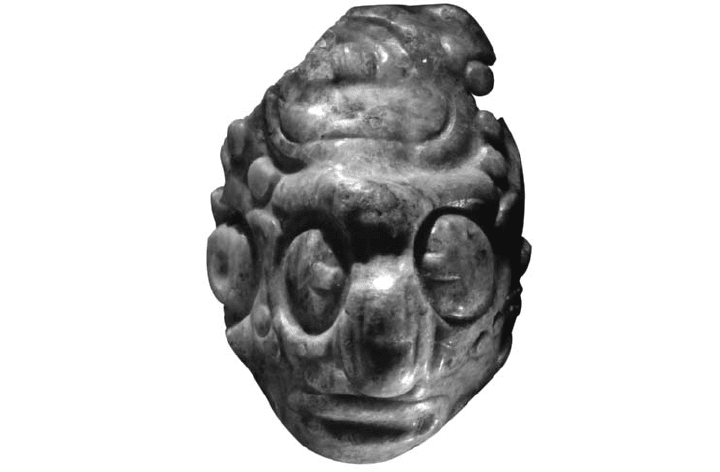
A second heirloom jade ornament incised with its history was also recovered from
the cenote at Chichen Itza (plate 6.2).A single continuous text is incised on the reverse
and bottom surfaces of this three-dimensional pendant portrait head (Grube
1992b:494–5; Proskouriakoff 1944). The text records the completion of thirteen cal-
endrical cycles as lord of Piedras Negras, far south and west of Chichen Itza, by an
unnamed ruler. The future tense verb refers to a date seven cycles into the future. It
states that this date will be the end of the commemorated person’s first twenty-cycle
period as ruler of the site. The ruler’s personal name or titles, largely eroded, end the
text. The principal event commemorated as the basis for measuring elapsed time was
the adoption of the title of ahaw (lord) by the ruler. The ornament itself, a frontal
anthropomorphic face, is an iconic version of the ahaw title and mimics the textual
sign for this title (Fields 1991; Freidel 1993:154–9). It most likely served as the front
ornament of a headdress that signified the right to the ahaw title, like those depicted
in other Maya images (compare figure 6.1).
Even at their furthest remove from their sources of origin, Mesoamerican heir-
loom items continued to be used in ways consistent with their history as noble house
valuables and repositories of powerful histories. Mesoamerican ornaments created at
different times, all of which apparently reached lower Central America after 500 ad,
were treated in distinct ways. Incised “clam shell” shaped pendants created before 500
bc were generally conserved unaltered or were deliberately terminated in the same
fashion as used by the Classic Maya, crushed and burned (Guerrero 1993:193; Hirth
and Grant Hirth 1993:186–7). Incised slate mirror backs with Maya texts dating to
ca. 250–400 ad were generally preserved intact as well (Baudez and Coe 1966; Stone
and Balser 1965). Early Classic Maya jade belt pendant plaques that reached Costa
120 Rosemary A. Joyce
Rica, in contrast, were always cut in a uniform fashion, split in half lengthwise, sep-
arated into quarters (plate 6.3), or further divided into squares, a deliberate dismem-
bering that recognizes the previous markings by systematically distorting them
(Graham 1993:23). Even in these very different cultural settings, the ability of objects
to concretize particular sequences of action allowed them to serve as sites for the
repetition of remembered actions, simultaneously strengthening individual memory
and shaping shared social memory.
Thinking about Classic Maya Memory
I began this paper by arguing that Classic Maya sites, with their carefully orchestrated
presentation of monumental images depicting the use of objects whose real-world
equivalents in turn record depicted actions through both images and inscribed texts,
were amenable to understanding from the perspective of contemporary psychologi-
cal understandings of memory. I distinguished between memory as commemoration,
a public marking of specific topics for shared social memory, and the embodied expe-
rience of memory as an iterative process of recall and recognition. I suggested that
Plate 6.2 Jade pendant head recovered from the cenote at Chichen Itza, inscribed on reverse
with a text referring to events in the history of Piedras Negras (Peabody Museum catalogue
number 37–39–20/4885). Probably worn as the front ornament in a head band like that worn
by the man on Yaxchilan Lintel 26, on the left in figure 6.1. (Photograph by Steve Burger,
courtesy of the Peabody Museum, Harvard University. Used with permission of the President
and Fellows of Harvard College)