
Van Dyke R.M, Alcock S.E. (ред.) Archaeologies of Memory
Подождите немного. Документ загружается.

Spolia in the Heartland of Byzantine Hellenism 61
upon which the vertical walls rest, perhaps recalling the base (crepis) of an ancient
temple. The overall impression was one of stability and strength, the worked stones
visually equipping the building with a sense of powerful rustication. The dressed
blocks were doubtless taken from the temple of Hera at the nearby site of Argos, and
in fact a marble cornice immured in the central apse can easily be traced to this
source. Two ancient, sculpted stelai were showcased near the east end of the building
on the north and south facades. Male and female figures, clad in classical garb and
now faceless, peer out from within the sculpted architectural frames of the grave-
stones (plate 4.2).They offer a suitably direct reminder of the local, ancient resources
that were tapped for the building’s construction. As with the Little Metropolis, the
inclusion of all these antiquities was clearly not an ad hoc affair, but an organized
project that required forethought and purpose. The size, conspicuous placement,
precise juxtaposition to one another and splendid isolation of the stelai neatly under-
score this point.
Several interpretations of the practice of spoliation and reuse in the Byzantine
period have been advanced by a number of scholars. Economics aside (and always, at
a very basic level, assumed), one of the most fundamental, yet until recently over-
looked, explanations concerns aesthetics.As rightly emphasized by Saradi-Mendelovici
(1990:52–3), antiquities could be incorporated simply because they enlivened the
surface of a building. They endowed it with variety ( poikilia), the prerequisite of any
building of high repute in Byzantium. Surfaces should glitter and walls should gleam,
and an embroidery-like texture in facades was always a primary goal. Ancient spolia
enriched and often enabled this aesthetic aspiration, even in the most humble of
country churches.
There is also the widely accepted contention that spolia, especially those exhibit-
ing pagan reliefs, were assigned a new, Christian re-interpretation and/or apotropaic
value appropriate to their new post-antique context.This was most forcefully argued
by Mango in 1963 and was followed (with much textual reinforcement intended to
shed light on the arrangement of sculptures at the Little Metropolis) by Maguire in
1994. The theory holds that the average Byzantine viewer largely distrusted, if not
feared, ancient statuary. As the receptacles par excellence of residual demons from the
pagan past, antiquities were dangerous and so required special measures to neutralize
their (mostly evil) powers. Indeed many written sources, especially saints’ Lives, expose
commonly held beliefs and perceptions that fully justify this explanation. In line with
this approach, the addition of crosses to the ancient “artifact” was thus thought to
counteract any remaining evil spirits.This, according to the theory, would explain the
frequent addition of carved crosses on several of the sculpted reliefs immured in the
Little Metropolis.
While a strictly Christian reinterpretation may seem the most logical explanation,
I know of few instances where the evidence in its favor is absolutely explicit. They
do exist, though; for example, in an unpublished stele from the archaeological museum
in Thebes, a relief inscription was carefully carved into the space surrounding a clas-
sical male figure. As at the Little Metropolis, the usual generic crosses are present, but
here it is the inscription itself that guarantees the transformation of a pagan gentle-
man into a Christian saint, in this case St. Stephanos.We are left to assume such inter-
62 Amy Papalexandrou
pretations, however, for most of the ancient, figural sculpture immured in the walls
of churches.The explanation of apotropaic safeguarding, such as the wrapping of the
Little Metropolis with a “cage of crosses” (Maguire 1994), seems a more measured
approach, although the presence of crosses in Byzantium (sculpted, inscribed, painted)
was often considered a necessary prophylactic in construction regardless of the pres-
ence of antiquities (C
`
urcˇic` 1992:17–20). And we are still at a loss to explain the
immured sculptures for which the cleansing power of the cross was not required at
all. What, for example, are we to infer about the two stelai at Merbaka which are
entirely devoid of such protective devices? Indeed, here the figural statuary play a
celebrated rather than diminished role within the overall decorative and iconographic
program of the main facades.
Liz James’ more nuanced interpretation of ancient statuary in Byzantine contexts
(1996), although not directed specifically to the issue of immured spolia, has much
to recommend it given her consideration of notions of reception and contextualiza-
tion.The force of her argument lies in the determination to look beyond the legends
and lore typically associated with ancient statues, while simultaneously re-evaluating
contemporary versus modern perceptions of the nature and value of the material. She
rightly points out that the power of an ancient object was often viewed in positive
rather than disparaging terms, and so begins to expose the ambiguous nature of pagan
and Christian themes and images, especially in terms of how these objects were “read”
and “misread” by the medieval beholder. What remains to be addressed is the specific
role of memory in this process of appropriation and transformation of the past in some
Byzantine buildings.What, for example, do the choice and arrangement of spolia tell
us about acts of intentional or non-intentional remembering and forgetting? And was
their placement more compelling in contexts that were themselves already rich in
memory associations?
Recalling the two supreme examples of the Little Metropolis and Merbaka, it
would seem that buildings in which ancient material is incorporated in so distinctive
a manner belong to a particular class of monuments whose patrons were attempting
to confront the past as represented through its physical remains. I want to suggest that
a multitude of messages may be encoded in spoliated masonry, among them an appre-
ciation – if not admiration – for antiquities as a visual link to a very great past, the
memory of which became increasingly pronounced in the Middle Byzantine period.
This appears to be true of a ninth-century ad foundation in Boeotia, known as the
church of the Virgin “of Skripou,” that I include as my primary case study.The build-
ing is significant for our purposes because of the substantial amount of spolia used
in its construction, the manner in which this was incorporated, the proximity and
looming presence of a renowned ancient site, and especially because of the testimony
of its patron. Unlike the “classic” examples of Merbaka and the Little Metropolis
where, despite their antiquarian spirit, we have no definitive patrons, dates, or textual
sources that might illuminate the circumstances of construction, the church of Skripou
is not anonymous. On the contrary, its founder “speaks” to us through the medium
of contemporary inscriptions, thereby equipping us with a sufficient body of evidence
with which to decipher his intentions.
Spolia in the Heartland of Byzantine Hellenism 63
Skripou: Patron and Monument in a Landscape of Memory
The church of the Virgin “of Skripou” (hereafter Skripou) is located in the heart of
central Greece. It occupies the site of ancient Orchomenos, one of the famed, wealthy
cities of the Greek mainland that thrived and prospered from the Mycenean period
onward. Significant remains, among them the so-called “Treasury of Minyas” (ac-
tually a Mycenean tholos tomb) are visible today (Schliemann 1881). They offer
impressive and enduring reminders of the earliest history of the site. Also “on view”
is a Hellenistic theater and its auxiliary buildings; a temple allegedly of Asclepius;
Mycenaean schist tombs; Archaic statue bases (their figural counterparts long since
removed); copious springs of mythological affiliation; and a fortified acropolis that
dominates the vast, surrounding plain (Lauffer 1989:492–4).The medieval church takes
its place within this local landscape of antiquity as a vivid reminder of the continued
presence of human activity well into the Middle Ages and beyond. At the same time
its walls, as we will see, offer an inextricable link to an extensive “memory network”
of the ancient site that was, according to many modern interpreters, pulled apart in
order to facilitate the creation of its post-antique successor.This is an important point
in the case of Skripou/Orchomenos, for scholars have seen to it that the ancient and
medieval components are considered in complete isolation from one another despite
the opportunities that a more mutually inclusive investigation might hold for deter-
mining the longevity of cultural memory as it exists and endures within a particular
site (Papalexandrou 2001b).
Skripou is most often referred to as one of the primary monuments marking the
end of the so-called “Dark Ages” (seventh to early ninth centuries ad) while also sig-
naling the initial flowering of art and culture of the “Middle Byzantine” period (ninth
to early thirteenth centuries ad). It is assigned a prominent role in the history of
Byzantine architecture in part because of the firm date for its construction – 873/4
ad – a welcome if unusual inscriptional gift of chronological precision that offers
a perfect correspondence to the period of intense revival of arts and culture during
the reign of the Byzantine emperor Basil I (867–86 ad). The building is impressive
on several counts: it is large, in fact one of the largest Byzantine churches in Greece
(roughly 29m ¥ 31m); its interior space is covered with high, stone vaulting; a series
of elaborate, contemporary inscriptions elucidate the circumstances of construction;
and it was outfitted with a nearly unprecedented program of decorative sculpture,
both inside and out.The general sense is that of an important and lavishly appointed
foundation of the late ninth century on the rustic plains of the Byzantine periphery
(Papalexandrou 1998).
Of the building’s patron we learn much from the aforementioned series of mon-
umental inscriptions, immured one per facade in the lower reaches of the building
fabric.They tell us the name of the patron – Leo – and his high rank of protospatharios
within the imperial administration.We surmise that he came from Constantinople to
central Greece, unquestionably a backwater at this time, in his old age, and that he
constructed a church and monastery where he could (perhaps) retire and (certainly)
64 Amy Papalexandrou
be buried and remembered in perpetuity. The latter is made clear in his supplicatory
inscriptions, where intercession in the afterlife is sought from the Virgin and saints on
his behalf. His burial within the church may in fact be confirmed by the recent dis-
covery of what appears to be a tomb in the narthex, perhaps the patron’s own. The
inherent funerary function of the building adheres to the common formula of the
period in which monasteries, along with a community of monks to perform the re-
quisite rituals, assumed the primary role of commemoration.This fundamental notion
– that an attendant monk, priest or any reader of the patron’s inscriptions becomes
the “performer” of his memorial – must lie at the heart of any analysis of the form,
appearance and meaning of the building (Papalexandrou 2001a:279).
In order to properly contextualize the building, we must also look deeper into
the issue of its immediate surroundings. Although a richly fertile region for agricul-
tural production, then as now, the more subliminal reputation of the Boeotian plain
was likely recognized as well. Ancient Orchomenos was still known to the (educated)
Byzantines as the home of the Graces.The goddesses are explicitly affiliated with the
site in late antique literature and with epigrams that were still being read, or perhaps
read anew, in the ninth and tenth centuries. Contemporary writers also made the con-
nection between deities and site, sometimes with expansive erudition (Papalexandrou
1998:314). The ancient musical and theatrical festivals of the Graces, known as the
Charitesia, had been celebrated in Orchomenos and are preserved in the literary sources
that preoccupied a small circle of literati in the capital. Scholia on Pindar’s Olympian
and Pythian Odes and the epics of Homer make the best case for this interest, but the
marginal remarks in Theocritus’ poem to the Graces demonstrate it equally well
(Boeckh 1811:291–6, 423; Wendel 1914:330–1). For the educated reader, these
mythological figures and historical events may have lent the site a reputation imbued
with poetic and musical energy, a potential counterpoint to the widely accepted
charges of discontinuity with the classical past as allegedly experienced by the average
Byzantine (Mango 1981:54–6). Furthermore, knowledge concerning the historical
battles waged and the famous oracles and wealthy cities situated upon the plains
of central Greece was probably not entirely overlooked in the process of its textual
dissemination through Byzantine scriptoria (Papalexandrou 1998:317). The exotic
flora and fauna of Lake Copais, on whose shores the church was built, were still
known and regarded as natural wonders, and the illustrious Muses continued to haunt
nearby Mount Helicon in the writings of the Byzantine patriarch and scholar
Photius (Henry 1971). Indeed, even in the realm of so-called “low-level” saints’ Lives,
the central Greek city of Thebes retained its heroic “seven-gated” designation in the
ninth century (Paschalides 1991:178). It is within this mytho-historical landscape – a
landscape charged with the memory of antiquity – that our patron conceived his
foundation.
The reality of the material evidence at Skripou exposes the practical side of this
impulse wherein Leo’s builders despoiled a Hellenistic cemetery, the (now excavated)
theater across the road, and an anonymous columnar building.The latter has frequently
been identified as the famed Temple of the Graces, a completely fictitious notion of
the early travelers which has, however, proved enduring because of its local memory
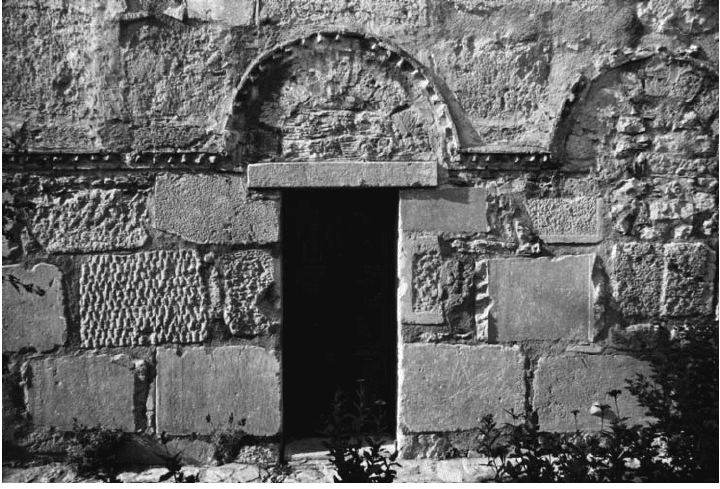
associations. What we see in the walls of Skripou are a preponderance of column
Spolia in the Heartland of Byzantine Hellenism 65
drums, Hellenistic funerary stelai with inscriptions, a series of tripod and statue bases,
several inscribed “Victor Lists” (that is, the protracted inventories of victorious com-
petitors in the ancient musical contests), a single sculpted stele strategically immured
inside the building at the main entrance into the nave, and a plethora of otherwise
standard, unadorned building material (see plate 4.3). The only medieval intruders
into this otherwise uniformly ancient assemblage are the large, contemporary inscrip-
tions of the founder, three of which contain his prayers for salvation.These are neatly
fitted into the “collage” of antiquities but are strictly confined to the eastern, most
sacred, area of the sanctuary walls.
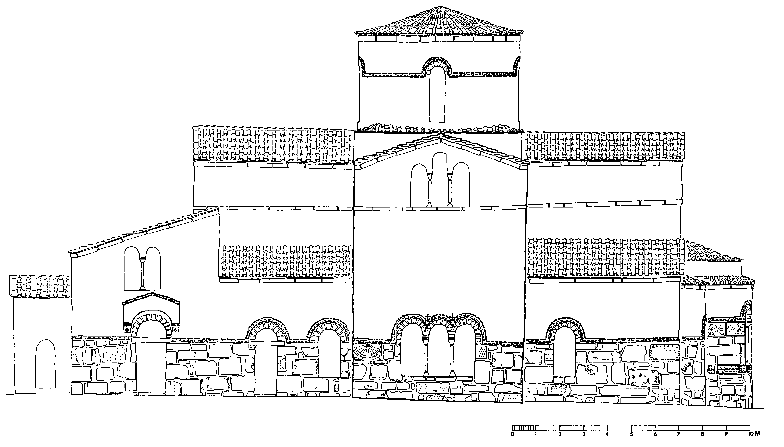
A reconstruction of the south facade (figure 4.1) offers an impression of the build-
ing’s original appearance as determined by the archaeological record.A narrow string-
course (roughly 2.5m above ground level) effectively divides the building horizontally
into two zones, the upper ledge of its brick band projecting significantly outward
while its lower edge lies flush with the surface of the wall. Spolia immured above this
line of demarcation were evidently concealed by a layer of plaster (Papalexandrou
1998:252). Those embedded below, by contrast, were left completely exposed. In
other words, the worked blocks bearing the written word, whether old or new, were
immured within the lowest, most visible tracts of masonry.
Of this general aspect, moreover, we should note that what we see today at Skripou
differs markedly from what its builders initially intended.The present state of the walls
testifies to more than 1100 years of weathering and repair, and all surfaces (rather than
Plate 4.3 Church of the Virgin of Skripou. Detail of south facade (photo by the author)
66 Amy Papalexandrou
Figure 4.1 Church of the Virgin of Skripou. Reconstruction of south facade (drawing from
photo taken by the author)
just the lowest courses) are now in full view.The inclination among scholars is to label
this masonry an awkward conglomeration.We must remember, however, that the con-
temporary viewer did not necessarily share our own value judgments (of which more
will be said below), and that the incorporation and display of spolia in the lower walls
likely enabled the requisite dose of variety in the building fabric. More to the point is
the possibility that the immured fragments offered visual cues for stimulating memory
on a number of different levels. The most obvious involves the construction of iden-
tity, especially on the part of a patron of high social status who had the means to ap-
propriate and re-integrate the local past for its beneficial associations.
The crucial piece of evidence at Skripou that illuminates the effect of its external
walls is a dedicatory inscription immured in the west facade. Here, far from the sup-
plicatory inscriptions of the sanctuary walls, we encounter a patron who is released
from his more usual, spiritual obligations of pious humility. We see instead a worldly
act of commemoration, one that places a degree of emphasis on the ancient site while
simultaneously articulating the patron’s place within the continuum of its history.
The inscription is a secular panegyric, a poem addressed directly to Leo in the most
flattering of terms. Composed in metered verse, it was probably intended to be per-
formed on important occasions such as the dedication of the building and, ultimately,
at the death and memorial services of the patron (Papalexandrou 1998:141–51, 2001a:
277–9). The first section of the 12-line text rather predictably assures Leo that his
works will not be forgotten, and that in fact his memory will endure precisely because
of the construction of the church we see before us:
Spolia in the Heartland of Byzantine Hellenism 67
Neither envy nor time eternal will obscure the works
of your efforts, most wonderful one, in the vast depths of oblivion;
Because your works roar out, even though they are mute
and you have brought to completion this famous precinct
of the Virgin Mother, of the Mighty Goddess (Iphianassa) who
received God,
which is a delightful thing, gleaming on all sides with lovely radiance;
And on either side of Christ stood both the apostles,
the hallowed dust of whom a clump of Roman earth covers . . .
The text of the inscription then takes an interesting turn in its final four lines.
Here the patron is effectively propelled into a context of timeless abundance while
the historical reputation of the ancient site is evoked as a means to anchor this roman-
tic image within a more immediate, even palpable, context of local memory and
topography. It is important to imagine the epigram being read aloud, before the build-
ing and amidst the nearby ruins, in order to gain a clear sense of the contextual arena
for its performance. The conclusion runs as follows:
Among the bountiful creatures through the endless cycles of time,
O highly praised Leo the great protospatharios,
rejoicing in your property and in your most excellent offspring,
as you command the area of the legendary Orchomenos.
(Papalexandrou 2001a:279)
In these verses Leo has not only appropriated some essence of the past, but in owning
and consuming the bounty of the site, he has fully vanquished the heroic city of his
(pagan) predecessors. He has become its new, overtly Christian commander-in-chief,
a most appropriate accomplishment for a man who was at once a literary connois-
seur (or so he would have us believe) and a high-ranking military officer of the impe-
rial court. I would point out that the inscription is written in epic hexameters, that
it is inscribed in the ancient manner (unlike the other contemporary inscriptions
which are carved in low relief ) and that it is replete with classical allusion and meta-
phor, including a reference to the Virgin as Iphianassa, the Homeric Iphigeneia. In
other words, the west facade inscription departs dramatically from the others on the
building through its imitation of the literary form, diction, and appearance of an an-
cient inscription, as well as through its celebratory, subcelestial content. In this epi-
gram Leo has enshrined his own memory (his kleos, or fame) for the future by fusing
it with a well-chosen memory of the past. I suggest that the conspicuous inclusion
of an unprecedented amount of ancient spolia was but the material equivalent of
his verbal expression of fame.The fragmented antiquities have, in effect, become par-
ticipants in the panegyric to the founder.
Spolia and their Readers
At this point I wish to shift the discussion away from the traditionally conspicuous
domain of patrons to that of beholders and especially to a more intensive evaluation
68 Amy Papalexandrou
of the perceptions of spolia within the context of memory. Here I work under the
assumption that the anonymity or reticence of patrons, as for example at the Little
Metropolis and Merbaka, is not necessarily a hindrance but rather a provocative chal-
lenge, one that can also be applied to Skripou as we move beyond the “official” to
the “unofficial” realm. It warrants the question of how the minutiae of archaeologi-
cal evidence, as accessed through a detailed visual analysis of standing remains, can aid
us not only in dissecting messages of intention, but also of contemporary reception
in the visual consumption of spolia-bearing walls. I will focus on two broad issues.
How, precisely, might the act of despoliation and reuse have facilitated memory?
And why might it have been important to remember in this particular way? Of the
former question, I want to explore further the notion, as suggested by Carruthers
(1998:52–57), that ancient, fragmented material in second use held tremendous poten-
tial as a mnemonic device for the viewer. Then, as now, such fragments could func-
tion as visual stimuli – cues for remembering, albeit perhaps in an oblique and not
always intentional way. I hope to demonstrate that spolia bearing ancient inscriptions
furnish a particularly interesting case for analysis, one that has been largely neglected
but which can generate a series of stimulating questions concerning medieval per-
ceptions of, and relationships to, the past, and present, as triggered through the visible
presence of the ancient written word. I will concentrate on the three buildings already
discussed, where the placement and, in the case of Skripou, proliferation of inscribed
stones suggest the perceived importance of the embedded material.
The inscribed word in Byzantium, as in antiquity, was a remarkably powerful
medium of communication and commemoration. Its force was understood at the psy-
chological as well as the intellectual level, and the symbolic import of its visual form
was likely felt by all (Thomas 1992:80).The dedicatory inscriptions at Skripou provide
one very good and pertinent example of the careful attention paid to the inscribed
messages of contemporary founders (Papalexandrou 2001a). Although no compre-
hensive study has been devoted to the issue, the rich stock of surviving inscriptions
and epigrams from the Byzantine period suggests the continued emphasis placed upon
them as permanent articulations that were integral to communicative life at all periods
and at all levels of society.
But what can we say about the inscribed word that was itself understood or
perceived to belong to a past era? And here it is safe, I think, to assume that an “old”
inscription would have been recognizable as such, certainly by members of the
educated elite and perhaps even by those who were only functionally literate. Con-
temporary letterforms, for example, were expressly different from those employed
in antiquity, and it is clear that some Byzantines at least were looking at and often
reading the content of ancient inscriptions.This is attested from as early as the sixth
century but with increased frequency from the Middle Byzantine period on (Dagron
1983). Yet the questions remain. Did visibly “old” inscriptions hold greater, or less,
significance than contemporary writing? Can we assume that all texts in stone,
whether new or old, held an innate symbolic significance? Or did the appearance
of greater antiquity lend a more venerable quality to the word? And could such
inscriptions have generated the type of responses (verbal, aural, tactile, emotional) from
Spolia in the Heartland of Byzantine Hellenism 69
the viewer that contemporary inscriptions likely did? While I do not wish to (and
indeed cannot) answer all these questions here, they form a fresh backdrop against
which to consider the material. It is with this in mind that I tentatively offer a few
interpretations.
Concerning the issue of a potential mnemonic function there is much to be said.
The outer walls of a building such as Skripou, in that they comprise a great pastiche
of fragments locally derived and re-fashioned within a new Christian context, neatly
recall Mary Carruthers’ scenario of “crowding” and “relocation” (Carruthers 1998:
53–6). This is a means of manipulating social memory by appropriating visually re-
cognizable material remains and re-installing them into a new “web” of associations,
thereby recharging them with new meaning. In the material she examines, however,
(she is looking specifically at the late antique use of spolia) it is the primary purpose
of “forgetting” rather than remembering that is at stake, this within a world still hostile
to the pagan past. There are several theories at work here. One holds that too many
images lead to confusion and subsequently to a canceling out of the original meaning.
Another has to do with displacement (sometimes erasure) and its tendency to pro-
mote, rather than destroy, memory. In Carruthers’ view, the negative connotations of
antiquity in places like Rome and Antioch could be “forgotten” not through anni-
hilation but through the kind of “intentional mnemonic replacement” we see in spo-
liated masonry.
While the spoils in the masonry of Skripou are indeed crowded and relocated, it
seems to me that the mentality, to the extent that it can be traced in the founders’
inscription, is quite different and perfectly in accordance with shifting attitudes toward
antiquity in the Middle Byzantine period (Saradi-Mendelovici 1990:58–60). As we
have seen, Leo does not wish to displace the memory of ancient Orchomenos. Rather,
he affirms its existence within his own personal “web” of associations and predicates
it as a place in which both he and the venerable site are neatly accommodated,
without any violent interruption of the “endless cycles of time” of his inscription.
The physical remains – the spoils – with their direct visual impact and evocative
capacity as frequently inscribed reminders of the past, are as found objects, crowded
into a newly constructed memory place without necessarily blocking their alliance
with the greater memory landscape. The crowded facade full of fragments seems less
the result of determined forgetfulness than of organized recollection, and in fact calls
to mind the Byzantine world view of the ninth and tenth centuries known as ency-
clopedism. The heroic attempts to collect and classify nearly everything, from laws and
imperial ceremonial to literature to agricultural lore, reflect nothing so much as the
impulse to fight memory loss (Hunger 1986:515–16; Lemerle 1986:309–46).
Regarding more specifically the appearance of ancient inscriptions, the mnemonic
possibilities of “old writing” seem strong.This is not to imply that the ancient inscrip-
tions reused on Byzantine facades were always read with comprehension. In those
instances where an inscription is turned upside-down or sideways, for example, it is
generally presumed that reading comprehension was not the goal. Here it is certainly
reasonable to postulate a degree of subversiveness on the part of builders, perhaps
with the aim of negating the authority of the past. It would be easy to rush to such
70 Amy Papalexandrou
a conclusion at Skripou, where the vast majority of inscribed stelai are turned on
their sides.
On the other hand, I suggest the possibility that certain easily-recognizable words
within an ancient inscription, even when turned sideways, might have attracted the
attention of a patron or beholder. After all, in our own day, a tilted inscription does
not preclude the perusal of its content.Again, I do not mean to imply a careful reading
of the inscription in all cases. But as Dale Kinney (1996) has pointed out for several
inscribed columns reused in the medieval churches of Rome, an ancient text could
be at least partially read, and misread, and ultimately utilized by its readers to “gen-
erate local histories.” In other words, certain easily distinguishable words or phrases
within an inscription might have suggested an immediate, site-specific association that
would have been understandable either by itself or in tandem with a topical legend
that helped to clarify it.
In this context, inscriptions of considerable length – the lists, treaties, and edicts of
antiquity – immured in a great many Byzantine churches throughout central Greece
acquired added significance, especially since they were nearly always immured right-
side up and at eye level or below. In the village of Geraki, in the Peloponnese, the
small church of St. John features four impressive sections of Diocletian’s famous Price
Edict (Inscriptiones Laconiae et Messeniae V
1
:1115A–D; Corpus Inscriptionum Latinarum
III
2
:816–19) placed so as to completely frame the main entrance in the form of door-
jambs and lintel. A long list of competitors in the Musaea (the games in honor of the
Muses, Inscriptiones Megaridis et Boeotiae VII:1776) was incorporated within a church
at the foot of Mount Helicon. At the Little Metropolis two ancient, inscribed cor-
nices (Inscriptiones Atticae aetatis Romanae III:1736) referring to the Athenian suburban
areas of Kifissia and Flua were carefully positioned in pendant locations on the north
and south walls of the western vestibule. Might these inscriptions, like those on the
reused columns in the churches at Rome, have recalled a past age, one in which the
local inscribed site occupied a distinctive place? They are almost always immured in
prominent locations such as doorways. Perhaps more importantly, they were positioned
upright so as to be visible and legible. Two of the original four such inscriptions
survive in situ at Skripou (Inscriptiones Megaridis et Boeotiae VII:3195, 3196). Both are
positioned as doorjambs and list the victors in the Charitesia of ancient Orchomenos.
Bearing this in mind, and remembering Kinney’s “local histories” as enhanced by
inscriptions, it seems possible that portions, at least, of their content were known, if
only partially understood. The evocative quality of certain words, such as
“Orchomenos,” rapsodos (“singer”), auletes (“flautist”), and kitharistes (“guitarist”), may
have helped to create or define a mystique attached to local topographies and
mythologies. Indeed, it hardly seems coincidental that the poet of Leo’s dedicatory
inscription chose the Homeric word panaoidemos (“famous in the singing of songs”)
to describe his ninth-century foundation.
As a parallel case, I note the later example of Merbaka, where a decree in Latin
(Corpus Inscriptionum Latinarum III
1
:531) was placed upright in the lowest course of
orthostates on the west facade. The large, clearly lettered words of the inscription
make reference to an imperator of Italicum who was also negotiator with the people of
Argos in the heyday of the Roman empire. I should think that its prominent place-