
Van Dyke R.M, Alcock S.E. (ред.) Archaeologies of Memory
Подождите немного. Документ загружается.

The Engraved Slate Plaques of Southwest Iberia 133
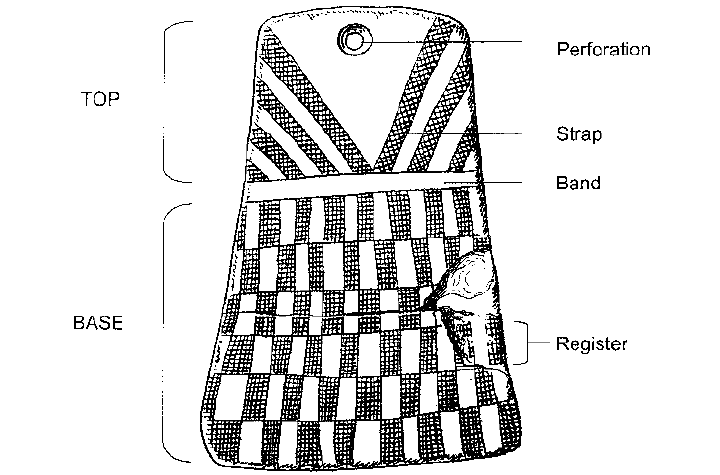
this separating band, and with only a horizontal line separating the top from the base.
The base is where the decorative elements are concentrated, and one (or more) of
six repeating geometric motifs are found here: checkerboard, vertical bands,
triangles, chevrons, herringbone, and zigzags. The checkerboard and triangle motifs
are organized generally along horizontal registers, while the chevrons and herring-
bones are organized along vertical registers. The zigzag and vertical band motifs use
the entire base as their compositional field.
As noted above, approximately half of the plaques have been found in the district
of Évora, and it is also in Évora where we see the full range of forms, compositional
structures, and decorative motifs. Thus, it seems logical to begin the interpretive
process in this district and in the surrounding region of the Alentejo (which also
includes the districts of Portalegre and Beja). Archaeologically, the Alentejo is known
principally for hundreds of megaliths in the form of passage graves, menhirs, and
stone circles; understandably, the character of the Alentejo as a ritual landscape has
traditionally been emphasized. More recently, however, Portuguese archaeologists have
identified late prehistoric settlements in the Alentejo and have demonstrated that the
region was not an empty landscape, visited only during solstices, full moons, or
funerals. Rather, it was inhabited by groups, probably pastoralists and farmers, who
built most of their settlements in relatively perishable materials (Gonçalves 1997).
The Alentejo was also important for being the principal regional source of amphi-
bolite, used to make the polished stone tools that were traded and used throughout
Figure 7.1 Anatomy of a classic Iberian plaque. Plaque from Folha da Amendoeira, Beja (ht.
18cm) (Leisner and Leisner 1959: Tafel 42, 2, 24)
134 Katina T. Lillios
southern Portugal (map 7.1). Amphibolite was a durable and highly workable meta-
morphic stone. Even when local hard stone, such as basalt, was available and some-
times used, communities – even those far from the sources – still preferred
amphibolite. At Late Neolithic and Copper Age sites between 70–150km away,
such as Zambujal, Leceia, and Vila Nova de São Pedro, over 50 percent of the ground-
stone tools were made of amphibolite; at Leceia, almost 80 percent were made of
amphibolite (Lillios 1997). Thus, the value and importance of this stone was widely
recognized throughout southern Portugal in later prehistory.
The association between amphibolite tools and slate plaques becomes closer when
one compares their color (dark grey, green, or blue), luster (shiny) and their form
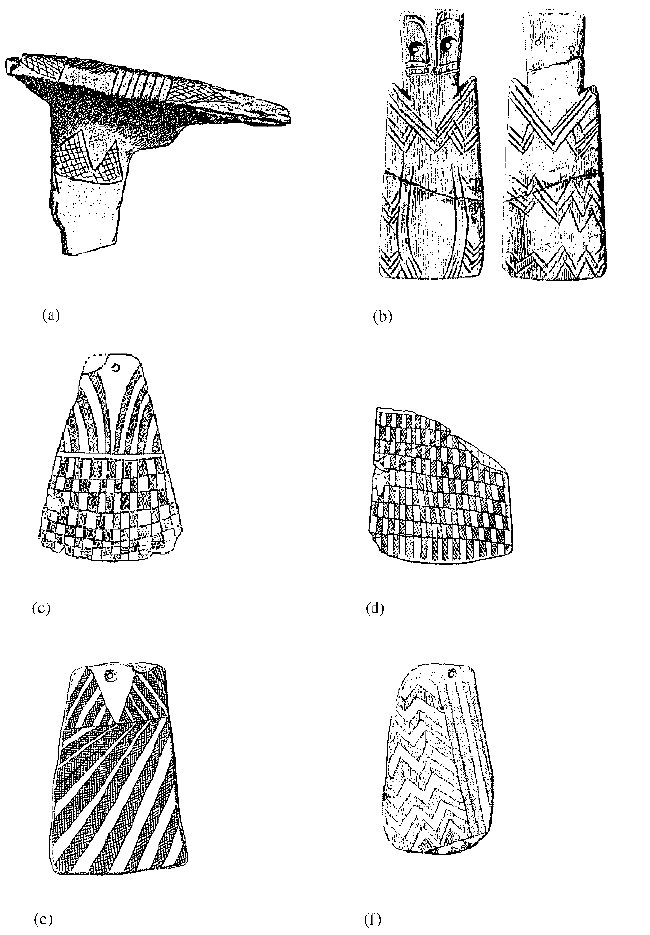
(trapezoidal). Furthermore, in the few representations of hafted adzes in late prehis-
toric Portugal, many of the same features as the slate plaques appear, such as the bipar-
tite compositional structure, the horizontal bands between the top and base (probably
depictions of hafting), and even the triangle motif (figure 7.2a) (Larsson 1998; Lillios
1997;Vasconcellos 1922:292). For these reasons, I suggest that the slate plaques semi-
otically referred to the amphibolite tools that were so important to the economic and
social life of ancient peoples in the Alentejo.
It is also clear that some plaques were meant to depict beings, whether humans,
animals, or deities (figure 7.2b).The arms, eyes, and noses on these plaques are quite
unambiguous. If Iberian plaques represent part of some relatively coherent visual com-
munication system, axes may well have acted as metaphors for humans (Tilley 1999),
much as Battaglia (1983, 1990:133–5) argued in her study of the Sabarl Islanders of
Melanesia. In the context of the agricultural and complex societies of late prehistoric
Portugal, in which the symbolic and social potency of axes as transformative objects
would have been great, the metaphorical fusion of axes and humans seems eminently
reasonable. Plaques may have taken on more anthropomorphic qualities under con-
ditions of social stress, such as war and/or social stratification, when new leaders
emerged who assumed greater control over the means of economic production and
social reproduction.
How can we explain the decoration of the plaques? The answer lies, I suggest, with
the anthropomorphic plaques. Although rarely noted in published references, many of
the “beings” represented are clearly wearing clothing (figure 7.2b). Furthermore, the
decorative motifs on these clothes are also those found on the non-anthropomorphic
plaques. There are also some plaques that, with their decorated borders, are evocative
of woven rugs or blankets. Thus, it seems logical to consider textiles such as cloth-
ing, blankets, or carpets as the inspiration or basis for the decorative motifs on the
slate plaques. There is a great deal of evidence, such as loom weights and spindle
whorls, for a thriving textile industry in the Late Neolithic and Copper Age of Iberia
(Castro Curel 1984; Cardito Rollán 1996). Furthermore, all the motifs found on the
plaques are weaves easily reproducible by card or tablet weaving or on a simple loom
(Held 1978; Barber, personal communication 2002). Finally, there are the few pre-
served textiles themselves.Two fragments of linen (including a fragment painted with
horizontal bands) have been found covering metal axes in two Portuguese Copper
Age burials (Formosinho et al. 1953/1954;Viana et al. 1948).
I would like to suggest, however, that the primary function of the design on the
slate plaques (as is also so often the case with clothing) was to communicate the
The Engraved Slate Plaques of Southwest Iberia 135
Figure 7.2a–f Artifacts discussed in text. (a) Limestone hafted adze from São Martinho de
Sintra (Lisboa) (Vasconcellos 1922: Est. XVII). (b) Plaque from Idanha-a-Nova (Castelo
Branco), ht. 19.5cm (Leisner 1998: Tafel 75). (c) Plaque from Anta 1 da Herdado do Passo
(Évora), ht. 16.2cm (Leisner and Leisner 1951: Est. XXI, 21). (d) Plaque (fragment) from Anta
Grande do Olival da Pega (Évora), ht. 12cm (Leisner and Leisner 1951: Est. XXVIII, 57). (e)
Plaque from Folha da Amendoeira (Beja), ht. 16.5 cm (Leisner and Leisner 1959:Tafel 42, 23).
(f) Plaque fragment recycled into pendant from Ribeira de Odivelas (Évora), ht. 12cm (Leisner
and Leisner 1959: Tafel 34, 9, 2)
136 Katina T. Lillios
deceased individual’s membership within a social group. The regular compositional
structure of the plaques and the relatively small number of decorative elements, in
combination with the uniqueness of each plaque, all point to such a codified com-
munication system. Other indicators of the personal nature of at least some of the
plaques are suggested by their discovery, when context is recorded, along the side or
on the chest of individual bodies (Gonçalves 1999).
Material mnemonics recording genealogical status are well-known in the ethno-
graphic literature. For example, in the knobs along the wooden whakapapa, or geneal-
ogy, staffs of the New Zealand Maori, generations of ancestors were recorded. The
knobs, used as memory aids, were touched by a chief in the recitation of genealogies
that were so critical to the identity and political authority of chiefly Maori. Similar
to the whakapapa staffs are other wooden staffs from Borneo, Myanmar, Sumatra, and
Rarotonga which, in their vertical arrangement of anthropomorphic figures, notches,
or knobs, were used to record ancestry, community organization, or numbers of
enemies killed by the deceased (Schuster and Carpenter 1996:64–5).
The Iberian Slate Plaques as Material Mnemonics?
Viewing heraldic design as an example of an active form of emblemic style created
to communicate a set of information about a person’s affiliation and identity
(Wiessner 1983;Wobst 1977), I make the assumption that the most visible decorative
attributes signify the most inclusive social categories. On the plaques, these attributes
are found on the base. By contrast, attributes found on the top third of the plaque
are either less visible or more ambiguous. Although in the future I plan to analyze
the attributes concentrated on the top of the plaque (the straps and bands), I wish to
focus here on those more visible and unambiguous attributes on the base.
As a working hypothesis, I propose that, for the classic plaques, the design motifs
on the base were emblematic of lineage affiliation, and the number of horizontal
registers indicated the generational distance between the deceased person and an
important ancestor. If this was indeed the case, the following five test implications
should be confirmed:
1 There should not be a relationship between the number of registers and the
size of the plaque.
2 There should be more plaques with high numbers of registers and fewer
plaques with low numbers of registers.
3 Plaques with low numbers of registers should be found over a small
area, and those with larger numbers of registers should be more widely
dispersed.
4 Assuming tombs and tomb groups housed closely related people over many
generations, there should be plaques in continuous sequences of register
numbers, by motif, within these tombs or tomb groups.
5 Those plaques with higher numbers of registers should postdate those with
lower numbers of registers, by motif.
The Engraved Slate Plaques of Southwest Iberia 137
I now review these five test implications in light of the data set available. The four
motifs that will be considered in this discussion are the triangle, checkerboard, zigzag,
and chevron. There are very few classic plaques with the herringbone (n = 1) and
vertical band (n = 4) motifs, so I will not include them here.
1 Design independent of material constraints. It is necessary to rule out the determin-
ing role of raw material constraints if the engraved design on the plaques is to be
taken seriously on its own. When the relationship between the height of complete
plaques and the number of their registers, by motif, is examined, an interesting pattern
becomes clear. Specifically, there is no correlation between the height of the plaque
and the number of registers on that plaque. The correlation coefficient for plaques
with zigzag motifs = 0.01, chevrons = 0.27, triangles = 0.28, and checkerboards =
-0.10. Large plaques sometimes have few registers, and smallish plaques were used to
engrave high numbers of registers. Furthermore, the mean height of the plaques (15
cm) is virtually identical by motif. These data suggest that the quarrying and initial
shaping of the plaque was done to satisfy a basic size requirement, and then the req-
uisite design was applied, perhaps by another person.
Furthermore, when the chaîne opératoire of the engraved designs can be gleaned, we
again see a priority attached to design over raw material constraints. In a few cases,
for example, there appears to have been an attempt to “squeeze” registers at the
bottom of the base to produce the desired number of registers (figure 7.2c). These
“squeezed in” registers are often irregular in size and in the straightness of their lines.
And, on other plaques, there seems to have been ample room to create an additional
register, but this was not done (figure 7.2d). These observations and analyses suggest
that the number of registers on the plaques was more important than specific mate-
rial constraints or any regularity in design.
2 More plaques with more registers vs. fewer plaques with lower numbers of registers.Over
time, more and more people could count themselves as descendants of a founding
ancestor. Thus, there should be more plaques with high numbers of registers, and
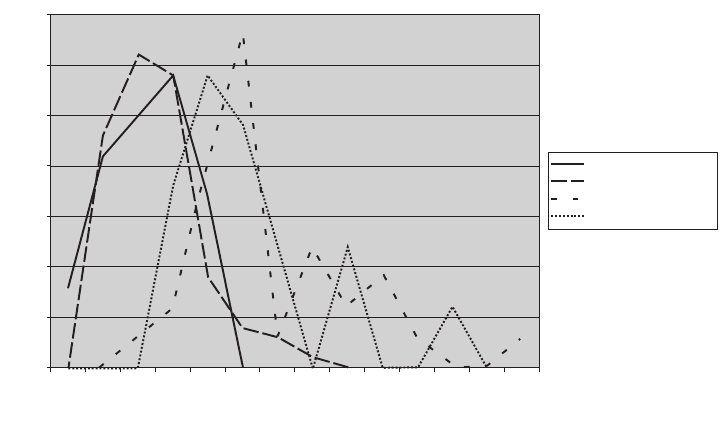
fewer plaques with low numbers of registers. When the number of plaques in rela-
tion to the number of registers is examined, support for this test implication is found
(figure 7.3). In all four motifs, there is an increase in the number of plaques as the
register numbers increase, however, this is then followed by a sharp decrease.This may
simply reflect that it gets progressively more difficult to draw more registers on a
plaque. However, a larger piece of slate could have been selected, and indeed rather
high numbers of registers were at times drawn – up to 14 in some cases. What this
could also indicate is a process in which the reckoning of generations assumed less
importance over time or that people found other media on which to record their
genealogies.
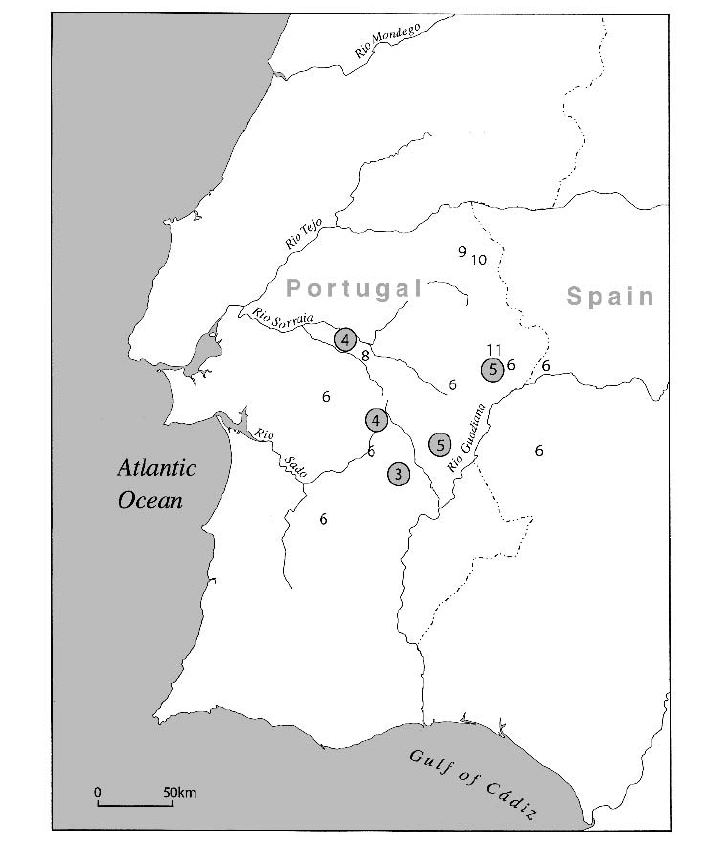
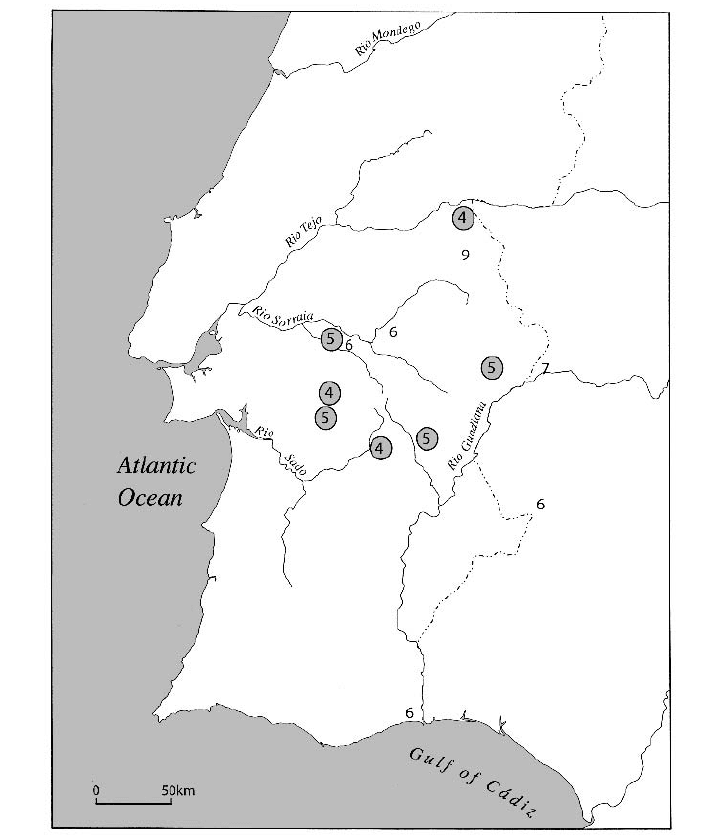
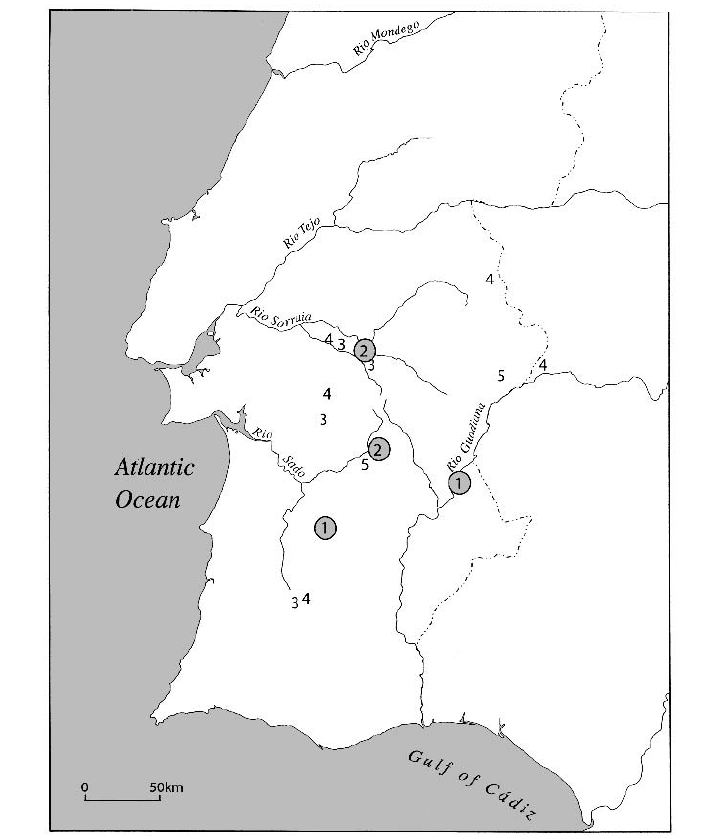
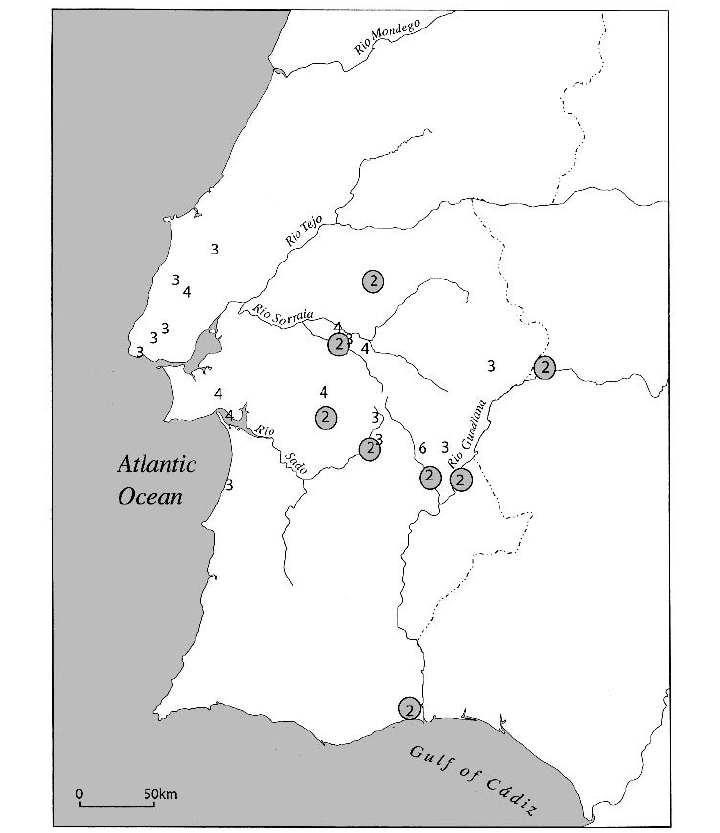
3 Geographic dispersion. Over time, we would expect that the descendants of an
ancestor dispersed over a region, and that the burial of their plaques should reflect
this (map 7.2a–d). Indeed, as the number of registers increases by motif, there is a
geographic dispersal of the plaques. In the case of the triangle plaques, this is a par-
ticularly notable trend (map 7.2d). While there are numerous 2-registered plaques in
the eastern half of Portugal, there are no 2-registered plaques in the western half of
138 Katina T. Lillios
Portugal, suggesting an east–west gradient in the movement of peoples. Such direc-
tionality is consistent with the east–west flow of the major riverways – the Sado and
Tejo.
4 Lineage continuity within tombs. If we assume that tombs and tomb groups housed
closely related family members over many generations, we would expect to see con-
tinuities in the register numbers. When plaques in each tomb are sequenced by their
number of registers, by motif, intriguing support for this test implication can be found
(figure 7.4a–d). There are, indeed, many tombs with continuous sequences or near-
continuous sequences, in which there is a skip of one register. The continuities are
most common for plaques with the triangle motif, although there are continuities for
all the plaque motifs. For the triangles, sequences can be found at Anta Grande do
Olival da Pega (Évora), Escoural (Évora), Anta 1 do Cebolinho (Évora), Brissos
(Évora), and at a number of other sites in Badajoz and Lisboa (figure 7.4d). Also
significant is the fact that Anta Grande do Olival da Pega (the site with one of the
largest numbers of plaques, and indeed one of the largest megalithic tombs in
Portugal) and Herdade do Passo have sequences for three of the four motifs.This may
indicate that the tombs were particularly special burial grounds for chiefly lineages.
With regard to sequences in general, all the classic plaques seem to fall into one
of two categories: either they occur in continuous (or near-continuous) sequences or
they occur as isolates.Very few plaques occur in discontinuous series. And, given that
there are many incomplete plaques and fragments that were not counted in this tally,
the percentage of plaques in discontinuous sequences could actually be close to zero.
In this bimodal distribution, we may be looking at the material expression of post-
marital residence rules, in which the members of one sex were expected to stay in
35
30
25
20
15
10
5
0
1 2 3 4 5 6 7 8 9 10 1 12 13 14
Number of registers
Percentage of plaques
Zigzag (24)
Triangle (70)
Checkerboard (33)
Chevron (17)
Figure 7.3 Percentage of plaques by registers and motif
The Engraved Slate Plaques of Southwest Iberia 139
Map 7.2a Checkerboard plaque distributions, showing plaque with lowest number of regis-
ters at site. The lowest number of plaques in the sequence is highlighted
their natal territory, with members of the opposite sex leaving this territory upon
marriage. Only analyses of associated skeletal remains, including DNA work, could
confirm this.
5 Relative dating. Plaques with higher numbers of registers should postdate those
with lower numbers of registers. Unfortunately, the heavily disturbed and weathered
condition of the skeletal remains in the tombs and the relatively poor resolution of
140 Katina T. Lillios
Map 7.2b Chevron plaque distributions, showing plaque with lowest number of registers at
site. The lowest number of plaques in the sequence is highlighted
radiocarbon dates, at least with respect to pinpointing generational differences, make
this difficult to test.
At the burial site of Pedra Branca (Setúbal), however, there is a sequence of burials
(with plaques) in two different stratigraphic levels: Late Neolithic/Copper Age and
Late Copper Age/Beaker. Unfortunately, the later Late Copper Age/Beaker plaques
are not of the classic form and so are not useful for our immediate problem. Nonethe-
less, the Pedra Branca sequence is significant for establishing a general relative dating
The Engraved Slate Plaques of Southwest Iberia 141
Map 7.2c Zig zag plaque distributions, showing plaque with lowest number of registers at
site. The lowest number of plaques in the sequence is highlighted
sequence of the plaques (Ferreira et al. 1975). Through the use of the Pedra Branca
sequence and a seriation of the plaques as a whole, one might be able to determine
whether this final test implication finds support in the data. Future research will be
devoted to creating such a seriational sequence.
To summarize, the plaques’ distribution and iconography strongly suggest their use
as genealogical records. There does not appear to be a relationship between the size
142 Katina T. Lillios
Map 7.2d Triangle plaque distributions, showing plaque with lowest number of registers at
site. The lowest number of plaques in the sequence is highlighted
of the plaque and the number of registers, indicating that the raw material did not
present constraints to what was depicted on the plaques. Furthermore, representing
the correct number of registers seems to have been more important than represent-
ing registers of regular appearance. Additional support for the model is found in the
greater numbers of plaques by register number, as one would expect more people
could trace their descent from an ancestor over time. There is also a distributional
spread from a core area of plaques with low numbers of registers to a larger area with