
Van Dyke R.M, Alcock S.E. (ред.) Archaeologies of Memory
Подождите немного. Документ загружается.

Mounds, Memory, and Contested Mississippian History 153
L
a
k
e
M
i
c
h
i
g
a
n
N
0 200
miles
Cahokia
Trempealeau
Ogden-Fettie
Toltec
Kings Crossing
C O L E S C R E E K
Sites and
CULTURAL REGIONS
PLUM BAYOU
AMERICAN
BOTTOM
Poverty Point
Watson
Brake
Marksville
Aztalan
Pinson
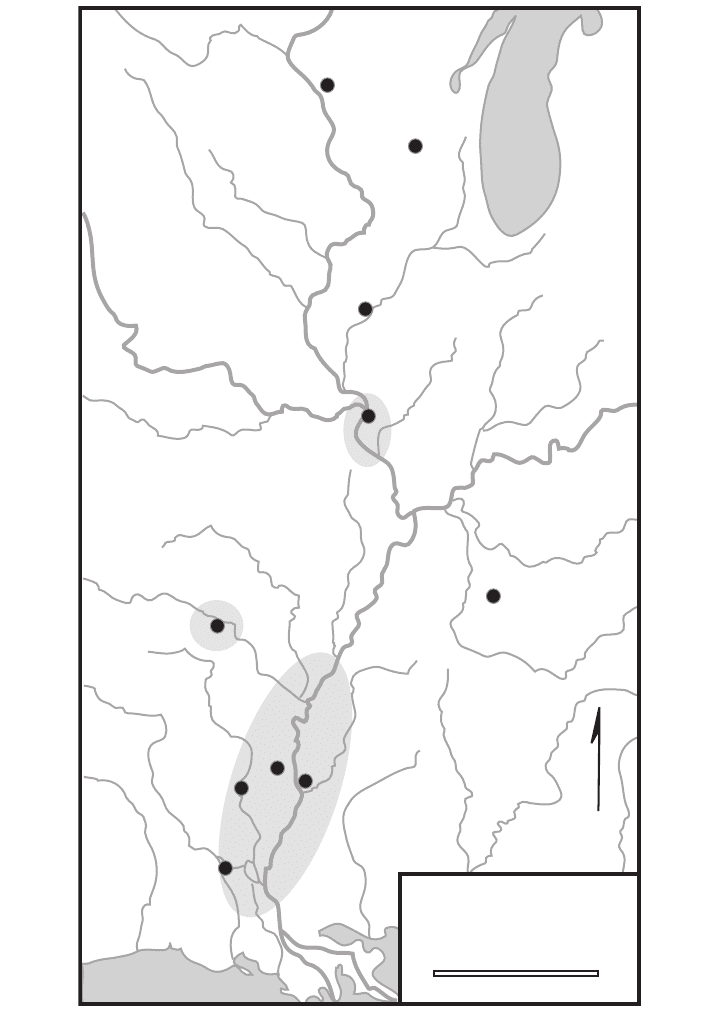
Map 8.1 Map of selected sites and cultural complexes in the precolumbian Mississippi Valley
154 Timothy R. Pauketat and Susan M. Alt
patterns of Mississippi valley mound-construction with respect to an archaeology of
memory.
Mississippi Valley Culture History
The earliest known earthen mounds in the New World are found in Louisiana at the
Watson Brake site (Saunders et al. 1997). Dated to the fourth millennium bc, this oval
arrangement of flat-topped mounds already suggests a degree of social complexity
that appears and disappears through time in a spatially discontinuous fashion across
the east until Indian depopulation and removal (Sassaman and Heckenberger 2001).
Other complex mound sites follow; the well-known Poverty Point site and nearby
late Archaic period sites in Louisiana date to the three centuries after 1600 bc (Gibson
2000). Subsequent Woodland-period mounds dot the eastern United States. These
include, by the first century or two bc, conical burial mounds, earthen embankments,
and four-sided, flat-topped earthen pyramids. Middle Woodland period platform
mounds are less well known than the other mound types, given the early antiquar-
ian attentions paid to enigmatic geometric enclosures and the tombs beneath conical
mounds. However, large platform mounds were built between ca. 200 bc–300 ad
(e.g., Mainfort 1988; Rafferty 1990). Some, as at the Pinson site in Tennessee, were
quite large, reaching heights of up to 18m. These appear to have been platforms for
ritual performances and were not surmounted by “temples” or other buildings.
In the lower Mississippi River valley, mounded “Middle Woodland”
Marksville-culture centers appear to give rise to later Woodland “Baytown” (Troyville)
and then “Coles Creek” centers (or similar cultural cognates, e.g., Ford 1951; Kidder
1992, 1998; Phillips et al. 1951; Williams and Brain 1983). The latter are modest
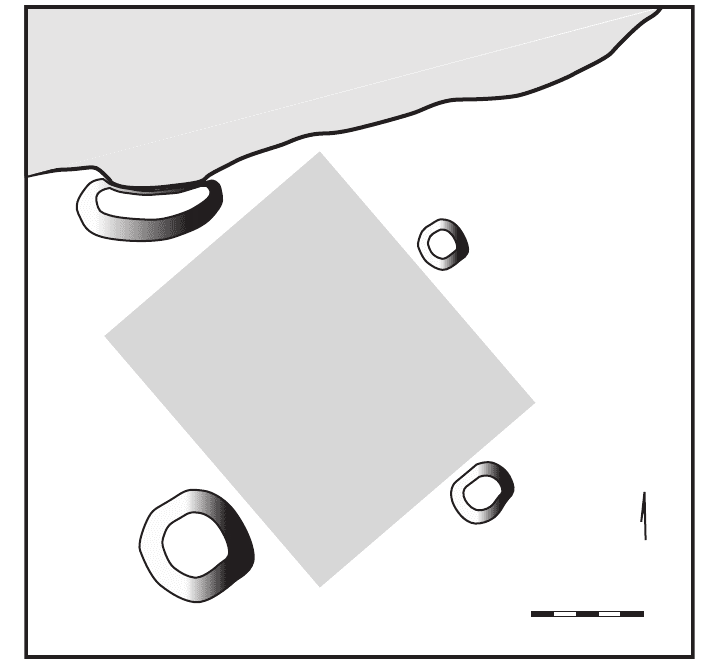
arrangements of one to ten rectangular platforms around rectangular plazas (figure
8.1). We will return to the issue of plazas later. For now, suffice it to say that, like
their Middle Woodland precursors, the Coles Creek mounds do not seem to have
been substructural platforms for buildings (until 900 ad or later, see Kidder 1998).
Few if any of the Coles Creek centers are thought to have supported large popula-
tions, although the largest such complexes cover areas around 30ha.The people living
at or near any given center appear to have had minimal interests in trade with out-
siders, given the “parochial” character of the material assemblages (Kidder 1992, 1998).
Then again, by 1100 ad if not earlier, various Coles Creek residents do seem to have
met and exchanged with Cahokians far to the north.
The mound-plaza arrangements of the Coles Creek sites conjured up images
of Mesoamerica for mid-twentieth-century analysts (see Smith 1984). The lower
Mississippi valley centers, it was thought, might have served as a kind of cultural
conduit of Mesoamerican knowledge up the Mississippi to places like Cahokia. Others
looked to the “Caddoan” culture area of Texas and Oklahoma as a conduit to the
north (see Phillips and Brown 1978:170–4). Although the Mesoamerican conduit
argument has fallen from favor, there are gross similarities of the Coles Creek centers
to a series of later (post 1050 ad) Mississippian sites to the north, especially Cahokia.
Likewise, the apparent similarities between certain Mississippian complexes in the
Mounds, Memory, and Contested Mississippian History 155
trans-Mississippi south and Huastecan sites in northeastern Mexico have also been
noted (Hall 1991; Phillips and Brown 1978).
The relevance of such macroscale parallels lies in what they tell us about the spatial
and temporal discontinuities of mound building. These can be illustrated using the
known cultural–historical details from the central Arkansas River and central
Mississippi River valleys. In the former, the largest Coles-Creek-like regional complex,
the Plum Bayou culture, featured a large central ceremonial center named “Toltec”
(Nassaney 1991, 1992, 1994, 2001; Rolingson 1982, 1998). There are 18 rectangular
or oval platform mounds at Toltec reaching heights of 15m, all arranged around two
probable rectangular plazas, located near a bayou and ringed by an earthen embank-
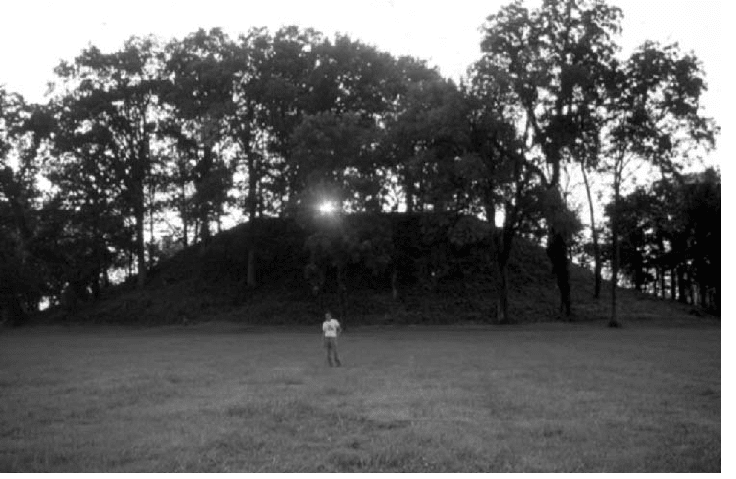
ment enclosing some 42ha (plate 8.1). The mounds themselves appear to have been
built over the period 750–1000 ad during a series of relatively large-scale construc-
tion events (e.g., Rolingson 1998).Their summits do not seem to have been used for
buildings. Unusual refuse suggestive of public feasting involving sacred or valuable
rampart
Mound A
Mound C
Mound B
plaza
050
meters
N
C
h
i
c
k
a
s
a
w
B
a
y
o
u
Figure 8.1 The Kings Crossing Site near Vicksburg, Mississippi (redrawn from Phillips 1970:
Figure 181)
156 Timothy R. Pauketat and Susan M. Alt
material symbols (including crystals and novaculite) is found scattered in the con-
struction fills and possible feasting refuse associated with these mounds. Nassaney
(1992, 1994, 2001) interprets the political economy of Toltec and its hinterland as one
filled with contradiction, as emerging regional inequality was balanced by repeated
acts that memorialized community and, presumably, equality.
That balance was not maintained. The Toltec site, along with much of the central
Arkansas River valley, appears to have been abandoned sometime before 1100 ad.
The few small settlements known in the twelfth century Arkansas valley, and in
adjacent portions of the Mississippi valley, have produced broken earthenware vessels
and microlithic or expedient-core technologies that betray Cahokian origins or inspi-
ration (Buchner 1998; House 1996; Johnson 1987; David Kelley, personal communi-
cation, 2001; Koldehoff and Carr 2001; Mainfort 1996). The Cahokian connection is
noteworthy, as a dramatic social and demographic centralizing process was well under-
way in that northern location at the same time as the abandonment of the Arkansas
valley.
The history of mound construction in the central Mississippi River valley is quite
different than the Arkansas or lower Mississippi regions. Emerson and McElrath
(2001:204) have characterized the 140-km stretch of Mississippi River floodplain, also
called the “American Bottom,” as a border zone prior to 1000 ad.To the north along
the Illinois River, Middle Woodland people built burial mounds near large horticul-
tural villages like those of the well-known Hopewell peoples of Ohio or the
Plate 8.1 Mound A at the Toltec Site, Arkansas
Mounds, Memory, and Contested Mississippian History 157
Marksville people of the lower Mississippi drainage. At the Ogden-Fettie site, one
Middle Woodland mound may have been a rectangular platform like those at Pinson
and points south; there may have been a couple of others at nearby sites (D. Esarey,
personal communication, 2002). But in the American Bottom, only a handful of
modest Middle Woodland mounds are known, and those are in the northern expanse
of floodplain bordering the Illinois River (see Fortier 1998; McElrath and Fortier
2000). As far as we know, none of them were platform mounds.
Moreover, few to no mounds are known in the region during the subsequent Late
Woodland period (300–1050 ad). Certainly, there are no Toltec-sized centers. Most
Late Woodland sites up to ca. 900 ad were relatively modest-sized hamlets, or villages
of at most a few dozen people. Between 900 and 1050 ad some villages (formerly
called “Emergent Mississippian”) in the American Bottom proper did become
enlarged (see Fortier and McElrath 2000).There may have been two or three of these
large villages (of which Cahokia was one) with only a few modest earthen platforms.
However, the evidence for mound construction at this time (at the Lunsford-Pulcher
and perhaps Morrison sites) is equivocal at best (Kelly 1990; Lopinot et al. 1998;
Milner 1998; Pauketat 1994, 1998). The case for Cahokia is even less secure, based as
it is on a single radiocarbon date from a core sample of the lower levels of Cahokia’s
Monks Mound (Reed et al. 1968). It is certain that the Late Woodland people living
in the hilly uplands on either side of the linear floodplain of the American Bottom
did not construct platform mounds.
One could argue that the existing Middle Woodland mounds, or remembered
places in the region, such as cemeteries, remained meaningful features of the land-
scape (see Chesson 2001; Joyce 2001:13). For instance, one Mississippian mound at
the Horseshoe Lake site was built at least partially over a Middle Woodland burial
ground (Pauketat et al. 1998; notes on file, University of Illinois). Another possible
Woodland conical mound atop the bluffcrest overlooking the American Bottom,
locally called “Sugarloaf Mound” and measuring about 7m in height, was probably
visible from Cahokia (certainly it was from atop Monks Mound). It was located along
a historic Indian trail that led from an outlying Mississippian town site to Cahokia
(Koldehoff et al. 1993).
Such instances doubtless indicate the lasting power of landscapes as inscribed social
memories. Perhaps the landscape was a constant reminder of the “works of their
forefathers” during the several centuries when few to no people engaged in the phys-
ical construction of earthen mounds in the American Bottom and adjacent uplands.
Nonetheless, the recognition of a mound-building past by a people would not in itself
constitute the continuity of a mound-building tradition (compare Meskell, this
volume). A long-term social memory of mound building may have existed through
the Late Woodland construction hiatus, but the social memories constructed by the
viewing of ancient tumuli would have been much different from those constructed
as part of the physical inscription of the landscape. If nothing else, the soil engineer-
ing knowledge evidenced in the profiles of mound excavations – never mind cultural
meanings – might have been more than a little difficult to retain during the interim.
“We can infer that a group, perhaps a class, of individuals with a specialized
158 Timothy R. Pauketat and Susan M. Alt
knowledge of soils (soils or mound engineers) were responsible for directing con-
struction of the mound” (Bareis 1975:13). What would happen to this “specialized
knowledge” if mounds were not built for a period of decades, if not centuries?
Given the obvious hiatus and its potential implications, the amplitude of pyrami-
dal mound construction beginning around 1050 ad in the Greater Cahokia region
can be startling to the contemporary archaeologist (for a chronological overview, see
Pauketat 1998; Pauketat and Emerson 1997). At that time, construction began on
scores of platform mounds, including the largest ever built in North America. Monks
Mound at Cahokia reached a height of 30m and was surrounded in a 30sq km area
by the ongoing construction of about 200 other earthen tumuli, most of which were
substructure platforms topped with one or more oversized houses, temples, or council
buildings (Pauketat 1997). Platform mound construction was initiated more or less
simultaneously at a minimum of five and perhaps as many as a dozen other town
sites in the region.Thus, to a great extent, the scale of mound construction at Cahokia,
if not also the very fact of mound construction there, was unprecedented in the
middle of the eleventh century.
Because of this, Cahokia’s historical effects on the other native peoples living in
the Midsouth, upper Midwest, and eastern Plains may have been profound. While
mercantile explanations are not supported by archaeological evidence (Emerson and
Hughes 2000; Milner 1998; Pauketat 1998), there are artifactual, iconographic, and
architectural reasons to suspect that Cahokians may have traveled to obtain exotic raw
materials or that distant people may have visited and then “emulated” Cahokia (Hall
1991, 1997). For instance, ceramic wares and nonlocal arrowheads from the Plum
Bayou and Coles Creek cultural regions are found at tenth and eleventh century sites
in the Greater Cahokia region. In another instance, an early Mississippian mounded
site at Trempealeau, Wisconsin, seems strategically located near an unusual lithic
resource, Hixton Silicified Sediment (Green and Rodell 1994).The distinctive Hixton
material was used by Cahokians to make projectile points, among other things, includ-
ing some made to look like southern Lower Mississippi Valley styles (Ahler 2000).
These and other exotic arrowhead styles (with many made from available local cherts)
are featured in the famous eleventh-century caches from Mound 72 (Fowler et al.
2000).
Sites as far north as southern Minnesota and South Dakota have produced
Cahokian or Cahokia-like objects, styles, and architectural forms. A number of these
sites evince clear “founding” phases where the objects, styles, and forms appear
“intrusive” to the localities in question, almost as if they fell out of the sky (see
Emerson 1991; Stoltman 1991). Because of this settlement and artifact-assemblage
evidence, researchers have suggested that factions of Cahokians may have moved
northward, perhaps to escape conditions deemed unpleasant in the American Bottom
or perhaps to set up “colonies” or short-term extractive outposts of sorts (Emerson
1991; Stoltman 1991, 2000). In a few locations, platform mounds were constructed
as part of these northern “site unit intrusions.” Multi-terraced platform mounds –
thought possible copies of Cahokia’s largest pyramid – were built late in the eleventh
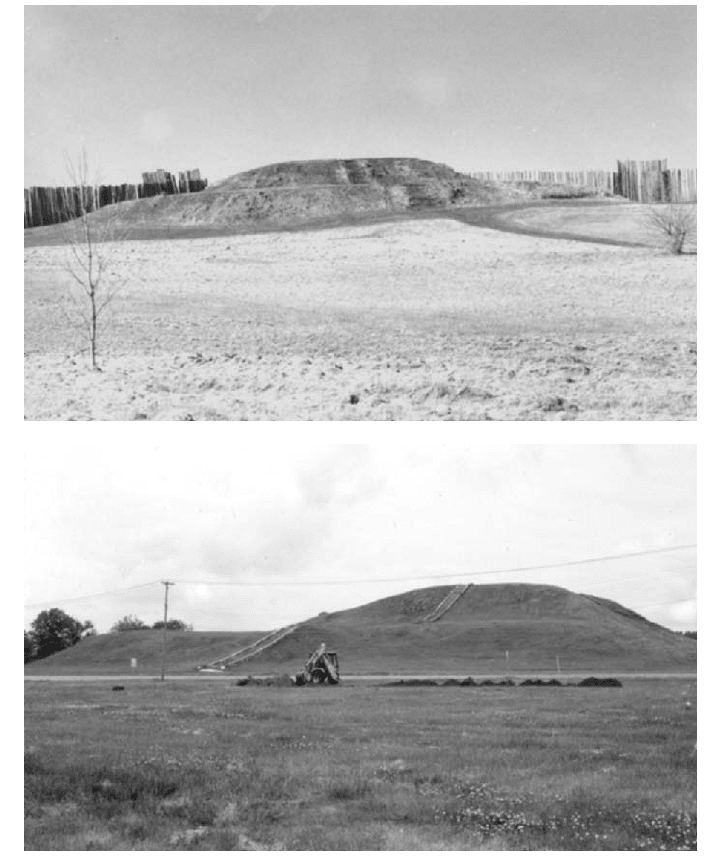
or early twelfth century at the Aztalan and Trempealeau sites in Wisconsin (plates 8a
and b; Green and Rodell 1994:352; see also Overstreet 2000).
Mounds, Memory, and Contested Mississippian History 159
In any event, nearly as abruptly as it began, mound construction ceased in the
American Bottom at ca. 1250–1300 ad. The Greater Cahokia region was largely
abandoned by 1350 ad, although mound construction continued to the south of the
American Bottom in the central and lower Mississippi valleys. There, other newly
founded Mississippian centers, with their own four-sided and flat-topped substructure
mounds, arose to become seats of government for numerous southeastern chiefdoms.
Plate 8.2a and b Platform mounds compared: (a) Aztalan, and (b) Cahokia (Aztalan photo
courtesy William C. Millhouse, Galena, Illinois)
(a)
(b)
160 Timothy R. Pauketat and Susan M. Alt
There, earthen mounds are arranged around open, rectangular plazas, in patterns that
suggest nearly immutable “sacred landscapes” to some (Lewis and Stout 1993). These
spaces have been associated with “cult institutions” (i.e., cultural structures) and are
thought to be imbued with cosmological and cosmographic symbolism said to have
been common to Mississippian peoples everywhere (Knight 1986). Mississippian
symbolism and the use of mounds as platforms were apparent to the first Europeans
traveling through the Southeast. Such symbolism, and the creation of meaning
annually at ritual grounds, continues today (e.g., Howard 1968; Moore 1994). Today,
the rate and amplitude of mound and plaza construction is clearly unlike the Missis-
sippian past.Then again, if we look deeper into the ancient Mississippian mounds, we
can see a lack of uniformity in mode, scale, and rate of mound construction there
too (cf. Anderson 1994; Knight 1989; Pauketat 1993).
The Implications of Mounds and Plazas
Woodland and Mississippian traditions could be said to “survive” in vestigial form to
this day in the practices of various southeastern people, altered to a degree through
contact with Europeans and their diseases (e.g., Hudson 1976). Perhaps as a result of
this perceived continuity, archaeologists tend to envision change as exogenous to the
identities or cultures of Eastern Woodlands peoples. Hence, long-term changes in the
Woodlands are still attributed in many archaeological accounts to population growth,
political–economic cycles, social–organizational dynamics, environmental fluctuations,
and migrations (e.g., Anderson 1994; Blitz 1999; Nassaney 1992; M. Williams 1994;
S. Williams 1990). Except perhaps for migrations, these explanations leave aside the
question of how mound-construction knowledge was transmitted across generational
divides, regions, and linguistic boundaries (but see Drechsel 1994).
Why worry about explaining how mound knowledge was conveyed? For some,
the fact that mound-construction knowledge was transmitted is by itself sufficient.
This position assumes that cultural “structures” or traditions were conveyed in a
relatively uniform manner, as if these were pieces of information that could be
communicated without significant disruption.The standard mound forms found across
the Woodlands, as noted above, seemingly affirm the uniform-transmission assump-
tion.A pyramidal mound is a pyramidal mound, or so the logic goes that holds mean-
ings and functions constant across space and through time. But just this kind of logic
has clearly misled archaeologists in the past.
In southeastern North America, four-sided rectangular mounds were thought to
correlate with a maize-based agricultural system managed by hereditary chiefs. Until
recently, archaeologists had a difficult time accepting that many platform mounds
dated to the Middle Woodland period, since maize and hereditary chiefship were not
thought to characterize this period (but see, for example, Knight 1990; Mainfort 1988;
Rafferty 1990). Likewise, Coles Creek peoples were thought to be the earliest
hierarchical chiefdoms based in maize agriculture, despite a lack of evidence to support
such a position (Steponaitis 1986; but see Fritz and Kidder 1993; Kidder 1992; Kidder
and Fritz 1993; Nassaney 2001)!
Mounds, Memory, and Contested Mississippian History 161
Without a doubt, the archaeology of the last 30 years points to fundamental
problems inherent with ahistorical (structuralist or functionalist) explanations. In part
owing to the growing discordance within these older paradigms, various “historical-
processual” perspectives (i.e., practice-theoretical, agent-centered, feminist, phenome-
nological, and even neo-Darwinian schools of thought) are promulgating a sense of
“traditions” as dynamic phenomena (Pauketat 2001a, following Wolf 1982:387–91;
see also Van Dyke and Alcock, this volume). Traditions for such theorists are not
normative, static, and epiphenomenal. They are “practiced,” put into action, and
made and remade continuously by people through time.They can even be “invented”
(Hobsbawm and Ranger 1983). In effect, traditions are the media of change, co-opted
and promoted in ways that selectively draw from the past (Trouillot 1995). Whole
community, ethnic, and national identities are “imagined” through such selective recol-
lections of traditions (Anderson 1983).
Given this selective, dynamic quality, it follows that traditional knowledge is not a
fixed quantity accessible to all or to be recollected in the same way from the past by
all.“Memory is historically conditioned, changing . . . according to the emergencies of
the moment; . . . it is progressively altered from generation to generation . . . [and] is
inherently revisionist and never more chameleon than when it appears to stay the same”
(Samuel 1994:10). It does not stay the same; it cannot be transmitted as a structure or
as information without incurring change.Trouillot (1995:14–16) is critical of viewing
traditions as fixed collective memories that can be retrieved uniformly by living people.
Consider an individual’s memory: it “is not always a process of summoning represen-
tations of what happened” in one’s lifetime (Trouillot 1995:14). For instance, know-
ledge of one’s own childhood may derive from what one was told later, such that these
later informants actually contribute to the creation of an individual’s history based on
their own imperfect (and etic) recollection. Few people can remember details of various
earlier life experiences, leaving certain recollections weighted in ways more propor-
tionate to the context of recollection than to the importance of the experience at the
time (see also Connerton 1989; Meskell, this volume).
Given that the individual’s history tends to be constructed in these ways, surely the prob-
lems of determining what belongs to the past multiply tenfold when that past is said to
be collective....We may want to assume for purposes of description that the life history
of an individual starts with birth. But when does the life of a collectivity start? At what
point do we set the beginning of the past to be retrieved? How do we decide – and
how does the collectivity decide – which events to include and which to exclude?
(Trouillot 1995:16)
Memories may be fixed to a degree if incorporated in mnemonic devices – litur-
gical recitations, ritual processions, music, song, prayer, etc. – and through the inscrip-
tion of them in material culture, the human body, and space (Van Dyke and Alcock,
this volume; see also Abercrombie 1998; Connerton 1989; Hagedorn 2001:77; Joyce
2000, this volume; Joyce and Hendon 2000; Kus 1997; Meskell, this volume; Rouget
1985:121; Rowlands 1993).Written history clearly constitutes such a case of inscrip-
tion (see Papalexandrou, this volume). However, mounds are also a kind of inscrip-
tion of social memory in space. Each instance of mound construction is an inscriptive
162 Timothy R. Pauketat and Susan M. Alt
act of “memorialization” (Meskell, this volume). Such inscriptive practices in space are
said, of course, to create places (Van Dyke and Alcock, this volume). People “being
in the world” unavoidably transform spaces into places, linking personal histories
to cultural identities (Thomas 1996:83, citing Heidegger 1962). Certain “places are
deliberate creations of past actors” (Joyce and Hendon 2000), especially apparent when
places are named and so imbued with cultural meanings (Tilley 1994:18). “All locales
and landscapes are therefore embedded in the social and individual times of memory
. . . personal biographies, social identities and a biography of place” (Tilley 1994:27).
The meanings of these places change as their biographies were actively created (e.g.,
Gosden and Marshall 1999; Holtorf 1998; Joyce 2000, this volume; Sinopoli, this
volume; H. Williams 1998).
This is not to say that meanings associated with places necessarily change gradu-
ally. No, there appear to be any number of cases where mounds in the Eastern Wood-
lands did not develop gradually within particular regions but were built at specific
historical moments. That these were “deliberate creations of past actors” has already
been implied by the uneven pan-Mississippi-valley pattern of mound construction,
noted earlier. It is further evident in comparisons of regional Mississippian histories
that point to abrupt flashpoints when polities were “consolidated” (King 2000; Knight
1997; Pauketat 2000a). It may also be palpable in the “intrusive” appearance of various
northern Mississippian refugees, colonies, or outposts. Certainly the construction of
copies of Cahokia’s Monks Mound far to the north in Wisconsin, if indeed that is
what the Trempealeau and Aztalan mounds represent, would have constituted land-
mark historical changes for those localities.
That mounds mark the deliberate creations of past actors is also illustrated by a
series of earth-moving events related to the founding of a number of mounded
centers.This is easiest to argue on the basis of the plazas at these centers. Dalan (1997)
and associates (Holley et al. 1993) were the first to realize the significance of the dis-
covery that Mississippian plazas were not just empty spaces but had been physically
constructed. Based on her geophysical surveys and the archaeological excavations of
the “Grand Plaza” at Cahokia by others, including the authors, it is now well estab-
lished that this 19ha rectangular space was built over a short span of time (around
1050 ad ) by cutting and filling an enormous naturally undulating surface (see also
Alt and Pauketat, report in preparation; Holley et al. 1993; Pauketat and Rees 1996;
Pauketat 2001b; Pauketat et al. 2002). The plaza is flat, with a slight dip from north
to south and a sandy construction fill that may have improved drainage.
Since Dalan’s initial work, evidence of additional land reclamation has been found
at Cahokia and at the related East St. Louis site (Kelly 1997; Koldehoff et al. 2000;
Pauketat, report in preparation). Low areas were occasionally filled to create flat sur-
faces. Similar land leveling practices were employed elsewhere, the plaza at the Etowah
site in Georgia being a prominent example (Dalan 1997:101, citing Larson 1989:136).
Recently, Kidder (2002) has made similar observations at the Coles Creek site of
Raffman, in Louisiana, and has implied that central plazas dating as far back as the
Late Archaic sites of Poverty Point and Watson Brake may also have been so con-
structed. Such plazas, he further suggests, cannot be dissociated from the earthen pyr-
amids that surround them. The fact of plaza construction, that is, necessitates that site