
Van Dyke R.M, Alcock S.E. (ред.) Archaeologies of Memory
Подождите немного. Документ загружается.

Memory and the Construction of Chacoan Society 183
Lekson 1999; Mills 2002; Saitta 1997; Sebastian 1992; Toll 1985; Vivian 1990; Wills
2001). They are variously argued to be large habitations, storehouses, empty stages
for ceremony, or assorted combinations thereof; evidence for these explanations is
contradictory and inconclusive. Like many, but by no means all of my colleagues,
I contend that great houses were erected within a context of social inequality, because
construction required substantial planning and investment of labor, and because the
buildings visually dominate their surroundings by means of massive size, exaggerated
height, or commanding topographic position. The precise nature of social power at
Chaco has proved difficult to understand, in part because the Chacoan evidence does
not fit Western notions of direct associations between material wealth and power.
Aside from the architecture itself, two anomalous burials, and a number of caches of
beads and mystery objects, there is little to suggest material inequality. Power is not
always expressed in terms of wealth, however, especially in societies where there are
strong sanctions against glorification of individuals or families. Social hierarchies
within historic and contemporary Puebloan communities are based on unequal access
to farmland and other resources, but they find expression in exclusive access to ritual
knowledge and control of ceremonies rather than in disparate distributions of mate-
rial wealth (Brandt 1977, 1980, 1994; Levy 1992; Ortiz 1969; Whiteley 1985, 1986).
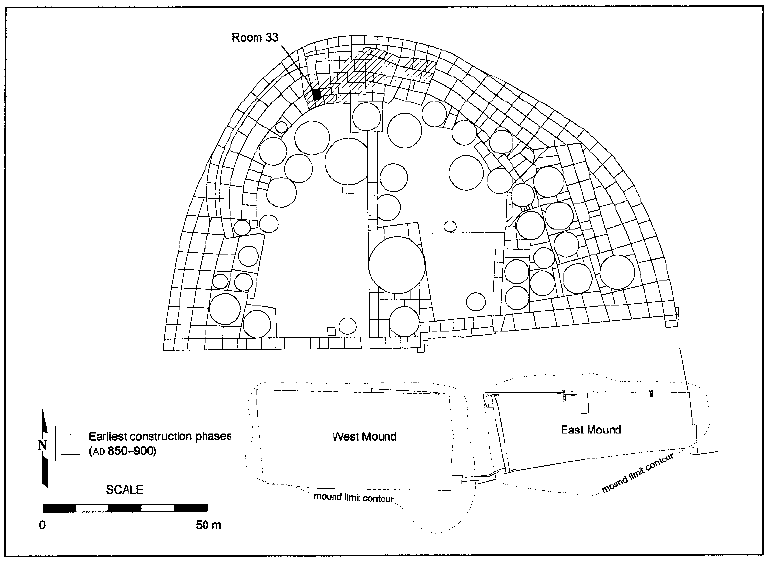
Figure 9.1 Plan of Pueblo Bonito, showing the two mounds and the early construction stages.
(Modified from Judd [1964: Figures 2 and 23]; redrawn by the author and Chuck Riggs)
184 Ruth M. Van Dyke
If similar values pertained in the past, this helps to explain the relative dearth of mate-
rially rich leaders at Chaco juxtaposed with the presence of large-scale architecture
that obviously required, and embodied, significant social inequalities. Although
major construction projects in Chaco were planned and completed in relatively rapid
bursts of activity, the impetus to create monumental buildings did not appear
overnight. As at some Mississippian sites (Pauketat and Alt, this volume), the archi-
tecture at Chaco represents the cumulative result of group and individual decisions
made over several centuries. Those who contributed time, energy, or other resources
to early, small-scale ritual events could not have anticipated the development of social
asymmetries centuries later.
The three earliest great houses in Chaco Canyon – Una Vida, Pueblo Bonito, and
Peñasco Blanco – were initiated during the late 800s ad in the three best spots for
farming. Inhabitants of these sites were able to practice run-off and irrigation agri-
culture, and thus would have been consistently more successful than their dry-farming
neighbors. Perhaps they seemed to have supernatural assistance, and these early great
houses became the foci of agricultural rituals. Inhabitants may have shared surplus
with neighbors, creating debt to be repaid with labor. By the 1000s ad, great house
construction took off exponentially. During the Classic Bonito phase (1040–1100 ad)
massive, formalized additions were made at five existing great houses, and two new
great houses were built. Massed blocks of rooms and multiple stories lent great houses
a dominating air. A shift towards institutionalized inequality is implied (Sebastian
1992:120–32). By the end of the eleventh century, the great houses of Chaco Canyon
were loci for periodic gatherings that were probably ritual in nature and may well
have involved feasting ( Judge 1989; Sebastian 1992; Toll 1985). Participation in con-
struction projects as well as in ritual activities and feasting would have contributed to
a sense of social cohesion among the disparate groups who gathered at Chaco.
Artifact evidence indicates that people came to the canyon from a wide range of
surrounding areas. For example, ceramic and lithic materials were pouring into the
canyon from the slopes of the Chuska Mountains 75 km to the west; these patterns
led to early models depicting Chaco Canyon as a center for regional distribution (e.g.,
Judge et al. 1981), but such models have since been discarded, as the materials were
not redistributed to outlying communities, nor were other tangible items returned in
exchange.
The regional scale of Chacoan influence is evidenced by the appearance of Bonito-
style architecture in outlier communities, dispersed across an area nearly 200 miles in
diameter encompassing northwest New Mexico and neighboring portions of Utah,
Colorado, and Arizona. Communities across this wide area probably shared similar
beliefs and ritual practices (Lekson 1991). As in Chaco Canyon, social inequalities in
the outliers may have been grounded in unequal access to good farmland. Small
groups of people are likely to have been moving around the landscape during this
period, and great houses may have functioned, in part, to attract new settlers to a
community. Bonito-style construction in some settlements is likely to have been
directed by people from Chaco, whereas in other situations, Bonito-style architecture
appears to have been the result of local emulation (Van Dyke 1999b, 2000). Local
leaders may have availed themselves of the opportunity to enhance prestige through
Memory and the Construction of Chacoan Society 185
participation in events at Chaco. By the late 1000s ad , Chaco Canyon had grown
into a major venue for ritual activities, and the center of the Puebloan ideological
universe.
Ritual, Landscape, and Memory
It is notoriously difficult to access prehistoric ideologies, yet many clues suggest the
nature of Chacoan ritual and beliefs. As in contemporary Puebloan societies, land-
scape, myth, and ritual likely formed an interconnecting cosmological whole. Puebloan
descendants of the Chacoans such as the Zuni, Tewa, and Keresans divide their
physical, social, and spiritual worlds into horizontal and vertical dimensions (Cushing
1883, 1896; Ortiz 1969; White 1960). Horizontal divisions correspond to cardinal
directions, and vertical divisions include upper and lower worlds. Nested layers or
symmetrical quarters are connected at a center place – the pueblo village. Multiple
levels are inscribed on the landscape by mountains and shrines, and the pueblo itself
represents this organization in microcosm. Directional affiliations and boundary shrines
are known from the Ancestral Puebloan archaeological sites of Los Aguajes and Kotyiti
(Snead and Preucel 1999).
Horizontal and vertical divisions of the universe, and the notion of a center place,
are likely to have been important at Chaco as well.As at Los Aguajes and Kotyiti, these
beliefs were expressed spatially, on the landscape. Cardinal directions and astronomical
alignments have long been recognized as important in the layout of Chacoan buildings
and roads (e.g., Sofaer 1997). Road segments – which do not consistently connect sites
to other sites, do not link sites with resources, and do not improve mobility on this flat
terrain where people had no wheeled vehicles or draft animals – were almost certainly
symbolic rather than economic in function (Roney 1992).The two most prominent
road alignments extend due north and nearly due south out of Chaco Canyon (map
9.1). The North Road ends rather abruptly at Kutz Canyon, a dramatic area of bad-
lands some 50km north of Chaco. The South Road extends toward Hosta Butte, a
prominent peak. Marshall (1997) has pointed out that the two roads fix Chaco both
horizontally and vertically as a center place, midway between north/down, and
south/up. The roads would have been ideal for ritual processions, which would have
drawn active spatial experience into the cosmographic picture.
Astronomical events also were involved in the spatial configuration of the Chacoan
world. We know that Chacoans watched the skies; petroglyphs atop Fajada Butte at
the east end of the canyon mark solstices, equinoxes, and lunar events (Sofaer et al.
1979; Sofaer et al. 1982; Sinclair et al. 1987). Astronomical alignments also extend to
some great houses. For example, Pueblo Bonito was positioned to dramatically show-
case patterns of shadow and light that correspond with the equinox – the midpoint
of the sun’s journey on the horizon – reinforcing the position of this canyon great
house as a center place within the larger universe, as well as within Chacoan quo-
tidian experience (Sofaer 1997).
I argue that cosmological beliefs and ritual knowledge were expressed through
architecture and landscape features, as ritual was formalized by aspiring leaders during
186 Ruth M. Van Dyke
the Classic Bonito phase (Van Dyke 2000, 2003). This process involved the use of
social memory to legitimate new social structures and to help forge a Chacoan social
identity. Social memory was employed in a manner similar to that described by
Hobsbawm and Ranger (1983:9), in “establishing or symbolizing social cohesion or
the membership of groups, real or artificial communities, (and in) establishing or
legitimizing institutions, status, or relations of authority.”
Connerton (1989) and others have usefully distinguished between inscribed, or
materially visible, memory practices and embodied, or transitory, memory practices.
Earlier in this volume ( Van Dyke and Alcock), we broke down these categories further
into ritual behaviors, narratives, representations and objects, and places. In the Chacoan
world, connections to the past are most visible through places. Architecture and land-
scape features, such as great houses, earthworks, great kivas, and road segments invoked
memory to bolster social authority and social identity. There is also a good deal of
circumstantial evidence to suggest that Chacoan ritual behaviors such as processions,
feasting, and great kiva ceremonies likely referenced the past, but in this prehistoric
setting, the specifics of these activities must remain conjectural.
Great houses
Over their three centuries of occupation, the great houses in Chaco Canyon must
have represented many social ideas for different audiences. During the Classic Bonito
phase, at least one of the functions of great houses seems to have involved memory.
As noted above, there are several well-defined construction phases in the canyon
(Lekson 1984; Windes and Ford 1992). Late eleventh-century construction patterns
in Chaco Canyon are marked not so much by new construction as by repeated,
formal, massive additions to existing great houses, some of which were established as
much as 135 years earlier. Sebastian (1992) argues that these new construction pat-
terns correspond to the rise of institutionalized leadership at Chaco. Clearly those
who directed construction were concerned with maintaining and enhancing build-
ings initiated in an earlier time.
A direct link between memory and social power is suggested by the burial of two
individuals beneath Room 33 in Pueblo Bonito (figure 9.2). There are relatively few
burials at Chaco overall, and most contain little in the way of grave goods.These two
men, however, were buried with thousands of pieces of turquoise and shell jewelry
(Judd 1954:338–9; Pepper 1909, 1920).The two were interred during the late eleventh
century, but they were placed in a room in the original late ninth-century section of
Pueblo Bonito, which was at that time nearly 200 years old.These men were accorded
special treatment with respect to grave goods; their placement in the oldest part of
the central great house in Chaco Canyon is likely to have had special meaning.
The continued use and embellishment of great houses that were centuries old
indicate concerns with conservatism and continuity that fit hand in hand with
legitimation of authority through unbroken connections with the past. But great
houses, with their shifting, myriad possible functions and uses, are somewhat unwieldy
venues at which to examine the construction of memory. Let us turn now to other
Memory and the Construction of Chacoan Society 187
Bonito-style architectural features – earthworks, great kivas, and road segments –
where this process is evidenced even more clearly.
Earthworks
Earthworks at Chacoan great houses come in two varieties. Formal mounds are
located in front of some canyon great houses such as Pueblo Bonito (figure 9.2) and
Pueblo Alto. Encircling berms built of sterile earth, trash, and construction debris are
found around some outlier great houses, particularly in the southern part of the San
Juan Basin.The relationship between the two is not clear, but both are likely to have
symbolic importance that involves memory.
Trash middens are part of a formal spatial arrangement visible at habitation sites
from Pueblo I times onward, when occupants began routinely placing their garbage
in front of dwellings, to the southeast. Congruent with worldviews that emphasize
cyclicality and continuity with ancestors, many contemporary Puebloan peoples
believe refuse must be carefully returned to the earth and treated with respect. Thus,
middens are sacred space, and shrines are often located there (Cameron 2002; Ellis
1966, Ortiz 1969). In Ancestral Pueblo times, human burials often were placed within
middens (e.g., Akins 1986; Roberts 1939).
By contrast, the formal mounds in front of many eleventh-century Chaco Canyon
great houses are in the right location for trash middens, but their contents do not
resemble domestic garbage (Windes 1987). Unlike trash middens at small domestic
sites, these mounds rarely contain burials. Their stratigraphy suggests intermittent,
perhaps annual, episodes of intense deposition. Mounds such as those in front of
Pueblo Alto contain unusually high concentrations of broken utility jars, providing
some of the strongest evidence for periodic feasting at canyon great houses (Toll 1985,
2001; Windes 1987; but see Wills 2001 for a different view). Given the sacred nature
of refuse in contemporary Puebloan contexts, and the formal construction of some
mounds at canyon great houses, it is likely that these features were connected in some
way with ritual activities or beliefs. And given that refuse is material that was used
in the immediate past, it is likely that trash mounds served as tangible reminders of
specific past ritual events.
The second type of earthwork – encircling berms, or nazha – is found at some
outlier great houses (Cameron 2002; Stein and Lekson 1992). Berms are often dis-
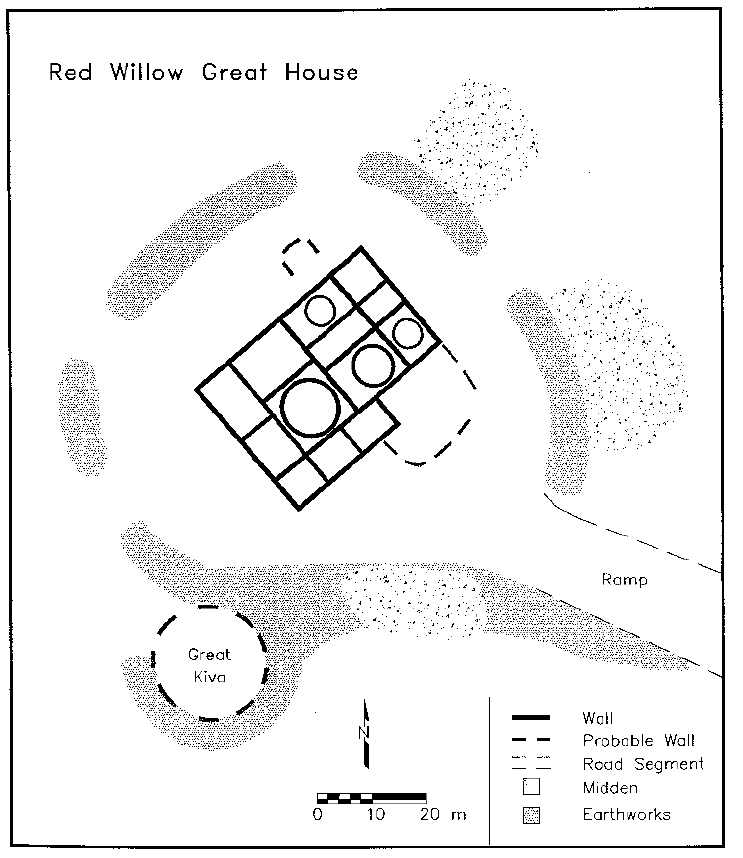
continuous, with breaks to admit road segments (figure 9.3). They have been specu-
lated to demarcate sacred space, or to represent the walls of Chaco Canyon (Stein
and Lekson 1992). It is often unclear from surface indications whether berms are con-
tinuous with midden deposits or are separate earthen constructions. This is true of
the berm at the Andrews great house in the southern San Juan Basin, where an earth-
work is covered with dense trash deposits, yet appears more formalized and distinct
from earlier, amorphous middens nearby (Van Dyke 1999a). In the rare instances
where outlier berms have been excavated, the earthworks have been found to consist
of a confusing array of trash, ash, sterile earth, stone spalls and construction debris
(Cameron 2002).
188 Ruth M. Van Dyke
As noted, outlier great houses often appeared during the eleventh century in the
midst of older, established communities. If, as I have argued above, the appearance of
these structures is related to a shift towards inequality in the social order, great house
builders seeking legitimacy could have profited from symbolic references to long-term
continuity. Following this notion, John Roney (personal communication, 2000) offers
the intriguing speculation that some outlier berms might represent false midden
Figure 9.2 Red Willow great house. (From base map by Marshall and Sofaer [1988]; modi-
fied and redrawn by the author)
Memory and the Construction of Chacoan Society 189
deposits. Earthworks in front of the great house, where the trash midden is supposed
to be, could have been constructed largely of sterile earth and great house construc-
tion debris, and then covered with a thin veneer of trash. The construction of large,
formalized, “fake” refuse deposits is the literal construction of a past where none
existed before. The landscape would have been manipulated to create, out of whole
cloth, a semblance of social continuity.
The Classic Bonito phase great kiva revival
Great kivas are round, semi-subterranean structures considered to represent integra-
tive spaces, where groups engaged in social, ritual, or economic activities (Adler 1989;
Adler and Wilshusen 1990; Hegmon 1989). The earliest great kivas – very large,
circular, slab-lined pitstructures – are documented in Basketmaker III (450–700 ad)
communities in Chaco Canyon, the San Juan Basin, and adjacent areas (Reed 2000).
The great kiva at Shabik’eschee Village, a Basketmaker III site in Chaco Canyon, is
fairly typical (Roberts 1929; Wills and Windes 1989). Social organization is likely to
have been cooperative and communal in the small farming villages of the Basket-
maker III period. These circular spaces would have been good facilities for face-
to-face interactions, community meetings, and ritual performances.
Great kivas were relatively scarce in Chaco Canyon during the Pueblo I period
(700–900 ad), although they did continue in other parts of the Ancestral Pueblo
world. In the Classic Bonito phase, however, there was a dramatic burst of great kiva
construction in the canyon. During this period, 12 great kivas were built in associa-
tion with six canyon great houses, and four more were built in “isolated” contexts
more than 100m from a great house (Vivian and Reiter 1960). The Classic Bonito
phase great kiva is a revival and formalization of the antecedent architectural
form.
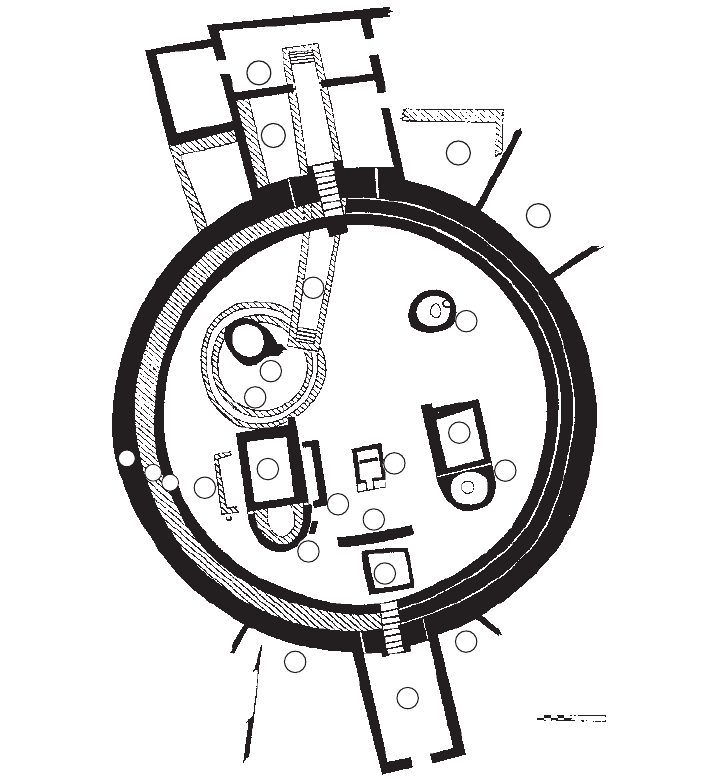
Classic Bonito phase great kivas such as Casa Rinconada exhibit highly formal-
ized, distinctive features (figure 9.4). Dimensions (15–20m in diameter) are fairly
uniform and are unrelated to surrounding community population size (Van Dyke
2002). When associated with a great house, great kivas are often located in an open
space or plaza to the south or southeast. Walls are of the same core-and-veneer
masonry used in great house construction. Great kivas were roofed by means of four
timber or masonry pillars that supported a log framework overlain with layers of
smaller posts, bark, and earth. Standardized floor and wall features include an encir-
cling masonry bench, wall niches, paired masonry floor vaults, a central elevated
masonry firebox, and four roof support seating pits. Great kivas usually are oriented
on a north/south axis, with entry by means of an antechamber to the north. Floor
vaults, seating pits, and niches generally express bilateral symmetry along the
north/south kiva axis. Like great houses, earthworks, and road segments, great kivas
were constructed during the Classic Bonito phase in outlier communities through-
out the San Juan Basin and adjacent areas (Fowler et al. 1987; Herr 1994; Marshall
et al. 1979:263–328; Powers et al. 1983; Van Dyke 2002). Most excavated examples
exhibit the same uniformity in size, orientation, symmetry, and interior features noted
190 Ruth M. Van Dyke
in great kivas in Classic Bonito phase Chaco Canyon (e.g., Eddy 1977; Irwin-Williams
and Shelley 1980; Martin 1936; Morris 1921; Peckham 1958; Roberts 1932).
Multiple lines of evidence suggest the structures were venues for ritual. Contem-
porary kivas are used today for ceremonial purposes by Puebloan peoples. Caches of
turquoise, beads, and other items found in sealed wall niches and at the base of seating
O
N
B
G
H
J
K
L
R
P
P
N
F
N
M
N
P
P
E
D
C
0510
FEET
O
A
Figure 9.3 Plan of the great kiva Casa Rinconada, illustrating floor features. (A) subfloor
passage, (B) circular trench, (C) outer wall, (D) original bench, (E) later bench veneer, (F)
earlier partial vault, (G) west vault, (H) vault extension, (J) firebox, (K) fire screen, (L) subfloor
enclosure, (M) east vault, (N) seating pits for roof support columns, (O) north antechamber,
(P) partial peripheral rooms, (R) south antechamber. (From Vivian and Reiter [1960: 10, Figure
4], reproduced by permission of the School of American Research Press)
Memory and the Construction of Chacoan Society 191
pits in some great kivas are best interpreted as votive deposits. Some great kivas appear
to possess acoustic properties that would have lent themselves well to ceremonial
activities. Floor vaults may have been used as foot drums, overlain with wooden planks
that would make a booming noise when people jumped or danced atop them.A sub-
terranean passageway leading into a screened area in the great kiva at Casa Rinconada
would have facilitated surprise entrances at dramatic moments (figure 9.4).
Perhaps the strongest evidence for the use of great kivas as stages for ritual events
is found in the standardization of size, orientation, layout, and interior features
described above. Religious architecture tends to be conservative, incorporating icono-
graphic material symbols easily recognized by ceremonial participants and observers.
Great kivas fit Adler and Wilshusen’s (1990:135–6) conception of high-level integra-
tive facilities, in which the area of a space used for ritual does not fluctuate with
population size but is part of a suite of uniform characteristics. Abstract, religious
ideas are often communicated through repetition in the inscribed memory processes
discussed by Rowlands (1993). Thus it is likely that the repetitive, conservative,
increasingly formalized iconographic form of the great kiva was more important to
the builders than the mere need to establish a meeting space. Great kivas represented
a shared idea and provided a locus for a suite of religious activities that crosscut other
differences within the canyon as well as among the outliers.
The repetitive iconography inside great kivas is likely to have conveyed symbolic
messages to ritual participants. One of these messages, I argue, involved the con-
struction of a social continuum extending from the Classic Bonito phase back three
hundred years or more. The boom in great kiva construction during the 1000s ad is
an example of Chacoan leaders’ use of architecture to reference the more egalitarian
Pueblo I and Basketmaker III past.These circular, subterranean structures evoke earlier,
communal ideologies and integrative practices, helping to naturalize new and unequal
distributions of labor, surplus, and prestige.
The round shape of these structures would seem to have facilitated social interac-
tion, which is why great kivas are often termed integrative spaces.This may well have
been the case in earlier periods, but I contend an association between great kivas and
social integration during the Classic Bonito phase may be intentionally misleading.
Classic Bonito phase great kivas pose a curious contradiction between exclusionary
and inclusive space: the structures would not have been ideal venues for open public
events on the scale of those envisioned at Chaco which, using conservative popula-
tion estimates, might easily have involved two thousand people (Lekson 1988). Ritual
events accessible to thousands could have taken place in great house plazas, on roofs,
or on top of mounds, but not in great kivas – using an estimate of 1sq.m of floor
space per person, only about 250 people could have fit in a great kiva with an 18m
diameter floor such as Casa Rinconada. The actual number may have been even
smaller, as this estimate discounts the area taken up by the floor features and leaves
no room for activities inside the structure, although people may have crushed together
in tight proximity to witness events in the structure’s center. There were up to ten
great kivas in Chaco Canyon that may have been in contemporaneous use during the
Classic Bonito phase; by the same calculations, canyon great kivas could have accom-
modated a more reasonable total of 2,500 people, if simultaneous events were held
192 Ruth M. Van Dyke
in all of them at the same time. If that was the case, however, which people
visited which great kiva? Were all great kivas of equal status? It seems likely that there
was an exclusionary character to the activities that took place in these struc-
tures. Ritual associated with great kivas may well have been part of a larger set
of beliefs that drew people together, but this process was not uniform, nor was it
monolithic.
Roads to ruins
One of the strongest illustrations of the use of landscape elements to construct social
memory during the Classic Bonito phase is found in the Red Willow outlier com-
munity, approximately 70km southwest of Chaco Canyon. In this community, a road
segment was built to link a Classic Bonito phase great house with an abandoned early
Pueblo II period great kiva several miles away (figure 9.5).
The Red Willow great house is an imposing structure built of core-and-veneer
sandstone masonry (Marshall and Sofaer 1988:142–3). The collapsed building retains
a topographic relief of at least 4m. It contains an estimated seven large (24sq.m or
larger) ground-floor rooms, two second-story rooms, three enclosed ground-floor
kivas, and one second-story kiva (figure 9.3). The surrounding landscape has been
extensively modified. A trash-covered berm encircles the great house, and a great kiva
19m in diameter is found immediately to the southwest. Several small room blocks
are located on the mesa top behind the great house to the west. This imposing
complex of features sits on the southeast edge of a small mesa overlooking the broad,
gray-green expanse of Tohatchi Flats. Surface ceramics indicate that two temporal
components are present at the great house. An early Pueblo II (900–1040 ad) ceramic
group is dominated by Red Mesa Black-on-white and plain grayware. A Classic
Bonito phase (1040–1100 ad) ceramic group is dominated by Gallup Black-on-white
and indented corrugated, with small quantities of Chaco Black-on-white, Mesa Verde
White Ware and White Mountain Red Ware. Mean ceramic dates for 1172 sherds
from eight sample units cluster around 930 ad and 1090 ad, respectively.The ceramic
evidence supports a picture of the Red Willow great house as a Classic Bonito phase
structure established in the late eleventh century in the midst of an early tenth-century
community, perhaps on top of an earlier building.
The great house berm articulates with a ramp that extends downslope off the edge
of the mesa to the east. This ramp leads down to a road segment that extends across
the valley for approximately 2.5 km, climbs a neighboring mesa, and ends at the iso-
lated Los Rayos great kiva (Marshall and Sofaer 1988:42–5). The great kiva depres-
sion is 18m in diameter. Associated features include three cairns, an extensive midden,
and a number of discontiguous surface rooms. The ceramic assemblage is from the
early Pueblo II period and is dominated by Red Mesa Black-on-white and plain gray
ware.
It has not been possible to determine a direct date for the road segment itself.The
high volume of sheet trash in this valley, from occupations ranging from Basketmaker
III through early Pueblo III times, precludes dating the road by means of surface