
Van Dyke R.M, Alcock S.E. (ред.) Archaeologies of Memory
Подождите немного. Документ загружается.

204 Emma Blake
phases of its past afforded, indeed, obliged many such encounters. This study focuses
on one incidence of contact with material of a previous period for the insights this
offers into the preservation of meaning and memory in a particular locality.
In the Byzantine period, a number of Sicilian hypogea dating from the Bronze and
Iron Ages were transformed into modest dwellings and Christian chapels. This reuse
occurred after many centuries of abandonment, and in some cases involved reshap-
ing the interior space, frescoing the tomb walls with Christian imagery, and carving
a facade.That Christian peoples would voluntarily occupy pagan burial sites is, at first
blush, surprising. This chapter explores the cultural context of this reuse and weighs
possible explanations. Pantalica, the most famous and best-studied example of the phe-
nomenon, serves as a case study in which the circumstances and nature of the reuse
are examined in close detail.
Standard explanations, discussed below, attribute the tombs’ later occupation to the
poverty and desperation of the local peasantry, retreating in terror from the coasts
because of pirate raids, while escaping the economic demands of the occupying
groups: Byzantines, and later, the Arabs and Normans. Yet the data do not support
this story. Given the evident symbolic power of past spaces, the reuse of these ancient
pagan sites by Christian peoples begs several questions. Did some memory of the first
use of the rock-cut tombs linger? If so, was this a deliberate referencing of the past,
or even the symbolic absorption of a reviled pre-Christian heritage? If instead cul-
tural ruptures had erased original meanings of the sites, was this reuse an attempt to
appropriate the power of an unknown past? After weighing the evidence for these
possible interpretations, this study offers an alternative approach. Rather than explain-
ing the reuse in terms of either memory or forgetting, commemoration or devalua-
tion, this paper highlights the familiarity of these older sites derived from their
concrete presence in the landscape. It is argued that the situated materiality of the
tombs, and their relevance in the spatialized practices of subsequent peoples, were of
greater importance here than any remembered original meanings. The phenomenon
of Byzantine era reuse of Sicily’s rock-cut tombs provides a salient example of what
at first glance would seem to be an evocation of insular collective memory, but
actually is quite the opposite: a sweeping new and cosmopolitan cultural practice,
troglodytism, that demonstrates Sicily’s participation in the Byzantine world.
Sicily’s Rock-Cut Tombs
The Sicilian practice of hewing funerary cavities out of live rock has a long history.
The geological conditions clearly played a critical role: limestone, a soft, porous, and
easily carvable material, is widespread on the island. It is in those zones of limestone
terrain, primarily in the southeast, the northern interior, and the west, that rock-cut
tombs are known from the third millennium bc Copper Age, and possibly from as
far back as the Middle Neolithic. Presumably the method of construction would have
been the same in prehistory as in later periods, with workers roughly hacking out a
central cavity then shaping more carefully from within, adding decorative features and
so on. There is great variety in the tombs: some are underground, accessed vertically,
Byzantine Era Reuse of Sicily’s Prehistoric Rock-Cut Tombs 205
while others are dug into cliff faces with upright entrances. The tombs may be
grouped or isolated, and their spatial relationships to settlements vary. Some tomb
chambers housed no more than one or two bodies, while other, possibly later tombs
were composed of multiple chambers linked by corridors. However they all share this
funerary or, in some places, possible cult function: there is no evidence of hypogea
used as residences in the prehistoric period. Burials were primarily inhumations, with
a few items such as pottery and objects of adornment included as grave goods.
These tombs were used for centuries, and this longevity possibly reinforced ances-
tral ties (Leighton 1999:79). In this respect they are seen to serve a social function
similar to that proposed for megalithic tombs. Indeed in some areas, such as Sardinia
and certain zones of Southern Italy, both types of burial sites were in use at the same
time (Whitehouse 1981:45). It was in the Bronze Age (2500–900 bc) that Sicily’s
rock-cut tombs reached their apogee in size, elaboration, and variety.They continued
to be used well into the period of Greek colonization up to the sixth century bc,
concurrently with newer burial practices such as jar inhumations and cremations in
urns. While the hollows of these tombs still dot the hillsides of Sicily, tombs with
intact contents are exceedingly rare. Though this tampering in later periods is an
obvious source of frustration for archaeologists, it is proof that the tombs have been
put back in circulation in later times.
Pantalica in Prehistory
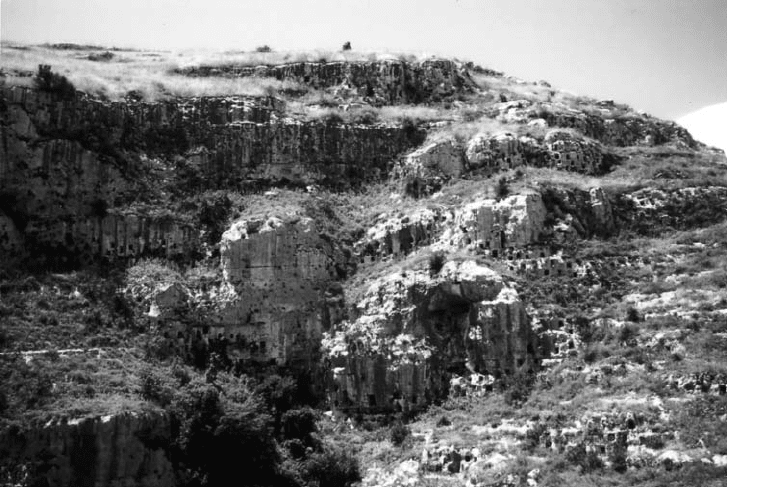
The site of Pantalica is the largest example of these rock-cut necropoli in Sicily
(Plate 10.1). It consists of over five thousand tombs carved into the steep slopes of a
limestone plateau along the Anapo River Gorge in the southeastern part of the island.
The site and associated settlement were apparently founded around 1250 bc, during
the Middle to Late Bronze Age transition, and continued into the Iron Age.
Our knowledge of the site derives largely from the excavations of Paolo Orsi at
the turn of the century (Orsi 1898, 1899a). Though the excavation reports of the
time are frustratingly incomplete from our present-day perspective, Orsi’s writings
are nonetheless informative. The tomb size and form vary widely, including circular,
semi-circular, and quadrangular forms. The hundred or so tombs that still contained
deposits when excavated yielded mostly multiple interments, though some single
burials are known. Bodies were apparently added over time, with older burials rear-
ranged, possibly even removed in some cases, in order to make room for the new
ones.There was a notable variety of grave goods including bronze tools and weapons
and items of adornment, some gold and silver pieces, and pottery. Among the pottery,
there were both local fine wares (including large pedestalled basins) and transport
vessels, a number of which seem influenced by Mycenaean prototypes (Leighton
1999:167–8). One copy of a Mycenaean vase most resembles the LHIIIB-C type,
dating to 1250–1000 bc, which fits the broad time frame of the site’s use: this clas-
sification, however, is not secure and the vessel could be older (Leighton 1999:150).
Variation in grave goods across tombs points to social stratification within the living
community.
206 Emma Blake
Domestic artifacts found on the summit of the plateau indicate the location of the
settlement associated with these tombs. However, the largest structure, previously
thought to be a monumental building contemporary with the necropolis, is now
strongly suspected to be a Byzantine era farmstead superimposed on the prehistoric
settlement. Pantalica continued in use through the Early and Middle Iron Ages, with
a spread of tombs from the north slope to the south. Interestingly, the number of
burials rose in the final phase of the site’s use, in the late eighth and early seventh
centuries bc, before activity at both the necropolis and settlement was curtailed around
650 bc. The timing coincides with the emergence of the Greek colonies nearby and
perhaps corresponds to the Greek incorporation of Pantalica into the hinterland of
Syracuse (Leighton 1999). Apart from a few fourth century bc finds pointing to some
limited Hellenistic period activity, Pantalica’s settlement thereafter apparently remained
unoccupied for around 1300 years (Orsi 1899a:87). However, this site’s abandonment
would not have meant its disappearance: the site is dramatic enough that, visited or
not, it would have certainly been a well-known sight and a landmark of the area.
Byzantine Sicily
After this long hiatus, in the Byzantine period we witness the phenomenon of sus-
tained and extensive reuse of Pantalica’s tombs. Before discussing this reuse, however,
Plate 10.1 Pantalica view (photo by the author)
Byzantine Era Reuse of Sicily’s Prehistoric Rock-Cut Tombs 207
the historical context of Byzantine Sicily requires elaboration. In the political sense,
Byzantine Sicily begins in 535 ad, when the island passed easily under Byzantine
control as the general Belisarius annexed it on his way to the Italian mainland. The
island remained part of this political system for almost 350 years, until the Arab
takeover in 878 ad (Finley, Smith and Duggan 1987:51). Despite this extended occu-
pation, information on Byzantine administration and culture in Sicily is surprisingly
limited, particularly in the early years. Apart from some functionaries, troops, and a
few traders, the Byzantine presence appears to have been slight. Contemporary sources
do not mention Eastern immigrants, and there is little to suggest that the takeover
had much initial impact on the island’s social fabric, though it did usher in a period
of peace for a hundred years, until the mid seventh century (Finley, Smith and Duggan
1987:48; Giunta 1974).
With time, however, Byzantine culture and art took hold in Sicily, and continued
to be felt for several centuries after the political rule was over. The island’s popula-
tion was, from its Greek heritage, predisposed to Byzantine culture, and seems to have
absorbed more and more of it over time. From their foundation (beginning in the
late eighth century bc, the Greek colonies had interacted with local populations,
resulting in a hybridized Greco-Sicilian culture that took different forms throughout
the island. Preserved during the Roman period, Greek remained the dominant lan-
guage in Byzantine times. That this language signaled a corresponding ethnic identi-
fication is suggested by the fact that native-born Sicilians who became popes were
referred to in the annals as the “Greek” popes. And if Sicilians felt particular ties to
the east, these appear to have been reciprocal.The city of Syracuse in particular played
an important role in the Byzantine Empire. The center of Byzantine administration
on Sicily, and the site of a Byzantine mint, Syracuse even briefly replaced Constan-
tinople as capital of the Byzantine Empire from 663–8 ad (Christie 1989:262; Finley
1968:183).
Although the island itself was politically controlled from the East, the Sicilian
church was allowed to remain under Western papal direction.The result was an inter-
esting blend of eastern and western elements in Sicilian Christianity. Monasticism was
introduced from the east.The eastern influence is also noted in the widespread resist-
ance to the rule of celibacy among the clergy, a western innovation. Though a
western-styled basilican plan predominated in Sicilian churches, architectural fragments
suggest the popularity of design elements typical of the so-called Byzantine artistic
style, in some cases imported wholesale from the east (Finley 1968:175–8). All in all,
the evidence was such that Moses Finley (1968:178) in his history of Sicily was able
to write that “By the second half of the seventh century the Sicilian church was
Eastern in every important respect, including the liturgy and the ceremonies, other
than its administrative attachment for a while longer to Rome.” Clearly the religion,
ethnicity, and practices of the island’s inhabitants were imbued with hellenism, new
and old.Thus the characterization “Byzantine” extended far beyond politics to encom-
pass religion, language, art, and ideology.
The Byzantine Empire, of course, was only one of several foreign powers to control
Sicily in the early Middle Ages. Byzantine political power was under threat from
the second quarter of the ninth century, when the Arabs began their conquest of
208 Emma Blake
the island in earnest. This process ended fifty years later with Arab takeover, but
Byzantine cultural influences on Sicily continued for many centuries after the Arab
victory.The Arabs were tolerant towards other religions. They exacted a tribute from
non-Moslem populations, and they generally allowed Byzantine practices to continue
and Byzantine churches and liturgy to be maintained. Similarly, the Normans, who
took over under Roger I in the late eleventh century ad, interfered little with estab-
lished Byzantine practices. Though the Normans were merciless in their takeover of
the island, once it was fully under their control, a period of peace and prosperity
reigned that permitted Byzantine and Moslem cultures to flourish alongside the
culture of the Latin west.While hostilities between the Norman rulers and the Byzan-
tines to the east were quite common, Sicily maintained contact with the Byzantine
Empire during the Norman period. Indeed, by all accounts the kingdom of Sicily
was an incredibly culturally diverse place.The incorporation of many Greek and even
Arabic elements into Norman churches testifies to this mix of influences (Norwich
1992:448–58). This ongoing cultural influence means that a “Byzantine” object may
in fact belong to these subsequent political phases.Therefore, the reuse of the tombs
may be said to be “Byzantine” in character while possibly belonging in some cases
to periods after Byzantine rule had ended.
Byzantine Pantalica
After more or less bypassing the site for over a millennium, people returned to
Pantalica in the Byzantine era. On the plateau itself, stone structures point to a large
fortified farmstead with multiple rooms (Leighton 1999:155–7). On the slopes of
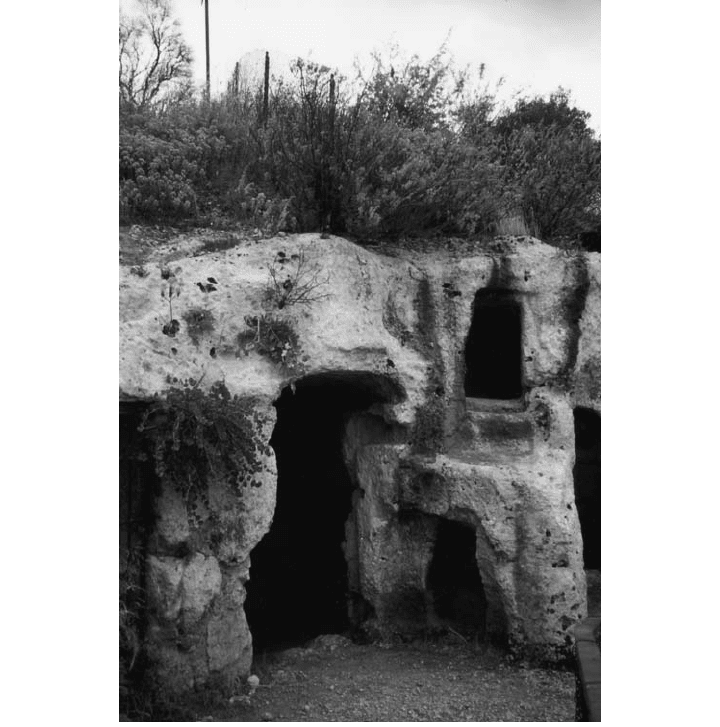
the plateau, three separate agglomerations of dwellings and associated chapels were all
carved into the cliffs alongside or incorporating the earlier tombs (Plate 10.2). Details
of these settlements, and particularly of the chapels, are distinctly Byzantine.
The largest of the three settlement groupings – Filiporto – lay in the southwest
of the complex and consisted of some 150 habitations. Interiors varied considerably,
from multiple adjoining chambers, to single cells, with individual rooms ranging from
6.25sq·m to 34sq·m (Orsi 1898:19). The rooms in most cases had niches carved into
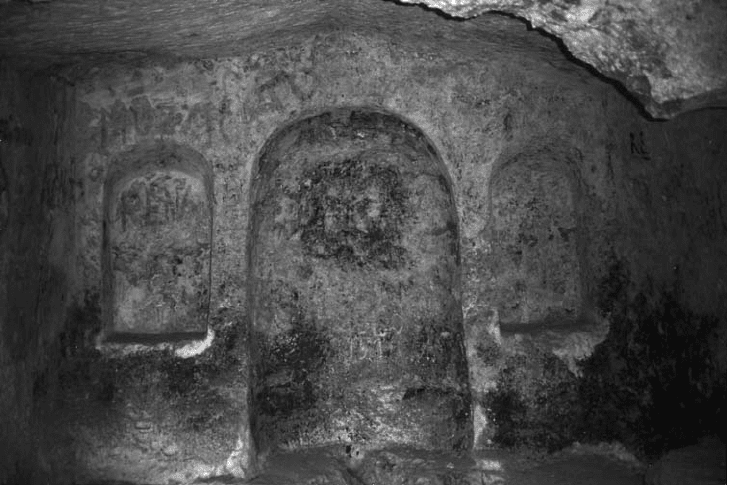
the walls. Some structures were two stories high. Filiporto’s chapel, known locally as
S. Micidiario, has a central apse with two arched niches on either side (Plate 10.3).
An irregular room flanks the church, which in turn is joined by a second room,
possibly used as a latrine (Messina 1979:108).The wall paintings are in extremely poor
shape, but traces of a Christ figure and two angels remain. A fragmentary inscription
in Greek is visible – naming St. Merkourios, a popular subject of Byzantine wall
paintings (Messina 1979:107–8).
The second and third groupings of dwellings are much smaller though each had
its own chapel. The settlement grouping of S. Nicolicchio lies on the south slope of
the plateau and consists of twenty or so living units (Orsi 1898:25–7). Though the
chapel of S. Nicolicchio opens to the south, the apse is in fact east facing, placed at
a right angle from the entrance. Its irregular form is explained by the fact that it
occupies an older space that has been restructured. Despite the limitations imposed
Byzantine Era Reuse of Sicily’s Prehistoric Rock-Cut Tombs 209
by the aspect of the cliff face or the shape of the extant chamber, a majority of rock-
cut churches share this eastward orientation, suggesting that a degree of conformity
was sought, despite restrictions (Caprara 1970:110). The central apse and side niches
of S. Nicolicchio resemble the arrangement of S. Micidiario described above.The fres-
coes are clearer here. Saints Elena and Stefano are depicted, with their names in Greek,
along with another unidentified saint. The third chapel, the Grotta del Crocifisso,
is composed of two attached rooms, with a rectangular apse, which, unusually, faces
west. There are traces of frescoes of the crucifixion, a female figure, and Saint Nicola
(Messina 1979:105–8).
While Orsi provides very little information on the dwellings themselves, his
description of one chamber complex, Grave 56, characterizes the oddity of this reuse.
Plate 10.2 Pantalica, Filiporto settlement complex: prehistoric tomb entrances with expanded
Byzantine era doorway on the left (photo by the author)
210 Emma Blake
Grave 56 consisted of a large trapezoidal room with eleven cells fanning off it, posi-
tioned at two levels. In subsequent times, the outer door to the central chamber had
been expanded and reshaped. Orsi here found a quantity of coarseware sherds and
fragments of glass cups which he dates to the Byzantine period. But what was most
extraordinary was that in the cell opposite the entrance, the prehistoric contents were
still in situ. Skeletal remains were accompanied by sherds of what Orsi describes as
red and brown burnished pottery, probably Pantalica’s Early Iron Age wares (see
Leighton 1999:203–4). In addition, a simple bow fibula and two small blades were
present (Orsi 1899a:58–9). Orsi expresses surprise that these “poor mountain people
of the seventh and eighth centuries had transformed a noble tomb of almost 2000
years earlier into a habitation, clearing out the cells and leaving some modest but
eloquent relics” (Orsi 1899a:58; my translation). This inconsistent treatment of the
older materials, selectively preserving some and discarding the rest, eludes immediate
comprehension.
The exact chronology of Pantalica’s reoccupation is open to debate. A hoard of
gold jewelry and coins, found in 1903 in the courtyard of the fortified structure on
the plateau, provides a possible date for the occupation (Orsi 1910; Uggeri 1974:201).
The gold coins bear the images of the emperors Constantine II through Constantine
IV, thus covering a range of 641–85 ad , dating the hoard’s contents, and probably its
deposition, to the end of the seventh century. The hoard could indicate fears of an
Plate 10.3 Pantalica: chapel of S. Micidiario, interior. Apse with niches and modern-day
graffiti visible (photo by the author)
Byzantine Era Reuse of Sicily’s Prehistoric Rock-Cut Tombs 211
Arab raid, or simply served as a way of storing wealth. Unfortunately we cannot cor-
roborate this date with a close dating of associated pottery, as this period of Sicily’s
history lacks an adequate ceramic typology (Christie 1989:263). The Byzantine and
Arab pottery of earlier centuries has not been sufficiently differentiated from the later
“Arab-Norman” pottery of the mid eleventh century and after (Wilson 1985:329).
Again, the frescoes in the chapels fall into a stylistic range between the seventh to
ninth centuries, but this dating is by no means secure.Though the frescoes tell us that
the churches were in use at least by the seventh to ninth centuries, we do not know
how much earlier the churches themselves may have been established. The first
mention of the medieval settlement of Pantalica comes in a church document of the
diocese of Syracuse from 1093 ad. Pantalica is mentioned in subsequent documents
in 1104, 1145, and 1151 ad . The site was evidently used during the Norman period.
However, a document listing the possessions of the diocese of Syracuse in 1169 makes
no mention of Pantalica, suggesting that perhaps it had been abandoned by then.
There are no subsequent references to it (Messina 1979:104–5). In 1555, a visitor to
the site described it as deserted (Uggeri 1974:201). All this disparate evidence sug-
gests that the period of reuse at Pantalica dates from the end of the seventh to the
mid twelfth century.What can we make of this reuse? To feel at ease with such utterly
remote material culture suggests that perhaps these artifacts and localities were not
so remote after all: perhaps the preservation of a memory of the site’s significance,
however dim, across the centuries, made this “honeycomb,” as Vincent Cronin
(1959:255) called it, a welcome place of refuge.The subsequent portions of this paper
will fill out the context of the phenomenon, and weigh the validity of this theory
against alternate interpretations.
Troglodytism and Tomb Reuse: Identifying the Inhabitants
By placing Pantalica’s reuse against the cultural backdrop of early medieval Sicily, we
are better equipped to explain it, and in turn, gain insight into other cases of reuse.
If this reuse entailed remembering the older sites, then it is crucial to determine
who is doing the remembering, and how the identities of those people may be col-
oring any preserved memories. Pantalica, while an exceptional site for its size and
importance, was by no means unique. For example, Cassibile, the second most exten-
sive rock-cut necropolis, also in the environs of Syracuse but along the south coast
at some remove from Pantalica, was also reused in the Byzantine period, and contains
two rock-cut villages (Orsi 1899b:118). Further, this reuse fits into the larger phe-
nomenon of troglodytism, or occupation of cavities, whether carved out or natural.
Establishing a chronology of this practice is a challenge. It is not known when the
first rock-cut dwellings appeared on Sicily. Underground funerary catacombs were
found in Sicilian cities such as Syracuse, Marsala, and Agrigento by the third century
ad. But these rock-cut spaces’ funerary function and urban context differentiate
them from the phenomenon discussed here (Bonacasa Carra 1986). Rock-cut
dwellings and churches in rural contexts appear later and would seem to be a
distinct practice.
212 Emma Blake
There are several indirect pieces of evidence by which to date the latter practice.
While pottery of the early medieval period is difficult to pin down chronologically,
the lack of late antique wares at the rock-cut sites is informative. The total absence
of such pottery from any of these troglodyte settlements strongly suggests that
they do not predate the late sixth or seventh century (Christie 1989:259–60). In the
case of the troglodyte churches, their proliferation and small size are typical of the
Byzantine emphasis on private worship. Greek inscriptions and Byzantine church
forms and wall paintings would seem to confirm their characterization as Byzantine.
However, the conservatism of Byzantine architecture makes the churches difficult to
date with precision. Ousterhout (1999:27) gives the example of two virtually identi-
cal churches, one built in 907 ad, one built in 1080. Moreover, we must be hesitant
to date a church by the inscriptions or frescoes in it, which can always be added later.
Whatever we may infer from the indirect evidence, the earliest piece of direct
evidence of troglodytism dates from 841, when an Arab chronicler described the
sacking of the Fortezza delle Grotte, the name given to forty inhabited caves in the
interior (Uggeri 1974:211). This dates the inception of this phenomenon to the end
of the period of Byzantine control of the island, at the latest.
Rock-cut churches did not end when the Byzantines lost political control of the
island. Indeed, the Arabs permitted both Byzantine and Latin practices to continue,
and under the Normans, new rock-cut structures were built and older ones reacti-
vated (Messina 1979:14). In western Sicily troglodyte settlements are not thought to
appear until as late as the fourteenth century (Mirazita 1988:74–5).
For the island as a whole, no systematic study has determined how many of these
rock-cut settlements incorporate prehistoric structures. It is often difficult to tell if
the cavity is new or a case of reuse, because the reuse may entail the widening of
doorways and cavities, leaving little of the original surfaces.The reuse was not limited
solely to prehistoric features: it also took place at the Greek quarries of Syracuse and
at Passolatello (Uggeri 1974:204), and several early Christian tombs were later turned
into churches (Messina 1986:248). However, the prehistoric tombs were the most
common objects of appropriation, and so cannot be dismissed as anomalous incidents
as easily as one might do with these other cases.
Who were the inhabitants of these troglodytic sites? The extent to which the
troglodyte settlements were related to monasticism is an ongoing debate. In central
Turkey, Cappadocia, the famous Byzantine troglodyte settlement has long been inter-
preted as a vast monastic complex, and this explanation has been applied to other
such settlements (Rodley 1985). The rock-cut residences were thought to have
appealed to monastic sensibilities, representing the symbolic abandonment of worldly
concerns. Messina suggests that the monastic communities preferred to inhabit earlier
burial sites in order to simulate death (Messina 1979:14). For the Sicilian examples,
there is little scholarly tradition of attributing a monastic function to them. Orsi inter-
prets the site of S. Marco near Noto in Sicily as being a monastic settlement, given
the rows of small “cells” carved in the rock, but he does not venture this interpreta-
tion for other sites (Orsi 1898:16–17). However, because in nearby Apulia and else-
where in the Byzantine Empire this has been the standard explanation, the monastic
connection warrants consideration here.
Byzantine Era Reuse of Sicily’s Prehistoric Rock-Cut Tombs 213
Monastic communities in the west are usually depicted as foreigners from the east.
If this were true of Pantalica’s residents, it would be highly unlikely that they brought
with them the memory of a site they had never seen, so the identity of the inhabi-
tants is critical here. Transplanted Greek monastic communities are known from the
mid seventh century in Ravenna and Rome, some consisting of refugees fleeing Arab
invasions from the Levant and Egypt (Christie 1989:258). The extent to which such
refugees also settled on Sicily is unknown, and has almost certainly been overstated
with regards to southern Italy. This interpretation derives from the widely held belief
that some 50,000 monks fled Greece for Southern Italy to escape persecution. The
story comes from a historian of the last century, Lénormant, whose claim, though
unfounded, has become dogma. This supposed monastic colonization has colored
all considerations of troglodyte settlements, and pins down the date to ca. 1000 ad
(Caprara 1970:113–15). Although there is no secure proof of such a movement, it is
possible that a migration of religious orders did occur.Yet if we are going to pursue
the idea of an influx of people from the east, there is nothing to suggest this took
place in 1000 ad.There are many other moments when similar migrations may have
occurred. One author dates Greek migration earlier, in the eighth century, in response
to the persecutions of the iconoclastic period that sent eastern immigrants in flight
to Sicily (Messina 1975:394). The Moslem threat in Africa and Syria in the seventh
century would warrant a flight as well. Indeed, this explanation of flight fits many
periods: the early sixth-century people could have fled the Vandals in Africa (Caprara
1970:114–15).This last story is told to explain the troglodyte settlements on Sardinia,
which include reused hypogea (Kirova and Saiu Deidda 1984). Each account sounds
plausible, but the structural similarities – the recurring flight of religious orders
westward and northward across widely different time periods – call them all into
question. In prehistoric contexts, explanations of new material culture patterns that
rely on purported movements of peoples have come under scrutiny, and we may be
equally skeptical here.
The theory of foreign monastic orders settling in these rock-cut sites is further
weakened by recent claims that the phenomenon of monasticism at the source – the
east – has been overstated. Scholars have recently been rethinking the monastic char-
acter of Cappadocia, the iconic troglodyte monastic locality. Kalas argues that while
some of the settlements at Cappadocia were inhabited by monastic orders, not all
were. Kalas differentiates the settlements’ function based on the presence of a refec-
tory and other architectural features (Kalas 2000; see also Mathews and Mathews
1997:298). More plausible than the picture of thousands of monks perpetually on the
move is that ideas of monasticism were circulating, instead of peoples. The flow of
information around the Mediterranean was enough to account for the spread of at
least certain elements of these eastern monastic practices, if not the monks themselves.
It seems likely, then, that the idea of troglodytism originated in Eastern monasticism
but was diffused into secular settings (Messina 1972–3:234). Because Pantalica lacks a
refectory or other obvious indicators of monastic activity, we can consider this to be
a secular settlement.
Though we may feel confident that these were secular sites, the vexing issue of
identity of the rural inhabitants remains. Were they Greek immigrants, or former