
Antliff Allan. Anarchy and Art: From the Paris Commune to the Fall of the Berlin Wall (ENG)
Подождите немного. Документ загружается.


Antliff, Allan (Author). Anarchy and Art : From the Paris Commune to the Fall of the Berlin Wall.
Vancouver, BC, CAN: Arsenal Pulp Press, 2007. p lxxx.
http://site.ebrary.com/lib/dominicanuc/Doc?id=10308829&ppg=80
80 ANARCHY AND ART
Tat lin concurred
with
Plemen that futurist art fo r the ruling
c1ass-"emperors and ladies"-was undesirable. He also condemned
contemporary art's "isms" as a "sickness." Finally, he claimed to have
discovered, in his art, a "gateway" for
"
throwling] off the old to admit
a breath of anarchy." Tatlin was certainly fa miliar with
the "isms" of
the avant-garde. Prior to orld ar
Ij he had painted in a variety of
mode rn
i
s
t styles rang
in
g
from
f
auvism to cubism, but in th
e winter
of 1913-1914, he developed a new form of relief scu
lp
t
ure that trans
formed the terms of avant-garde experimentation:
Tatlin was very
int
erested in analyzing the construction and
architectonics of the world. He arrived at a fundamental artis
tic d
i
scovery [w
it
h the rel
i
efs]; non-gurative forms of various
colors and textures
n kts) were removed from the surface of
th pitnf i ntf) th "P in fmn t f)f th pitn f, t fst
w
ithout
divorcing them from the plain background. The represented
relation in
space of each of these components of the picrure was
thus turned into the real context of each component, showing
how they really relate in real space .... Ta tlin called these kinds
of compositions 'selections of materials' because the abstract
picture that was turned into painterly relief was no longer
painted with a brush but composed out of materials of various
structural and painterly characteristics.
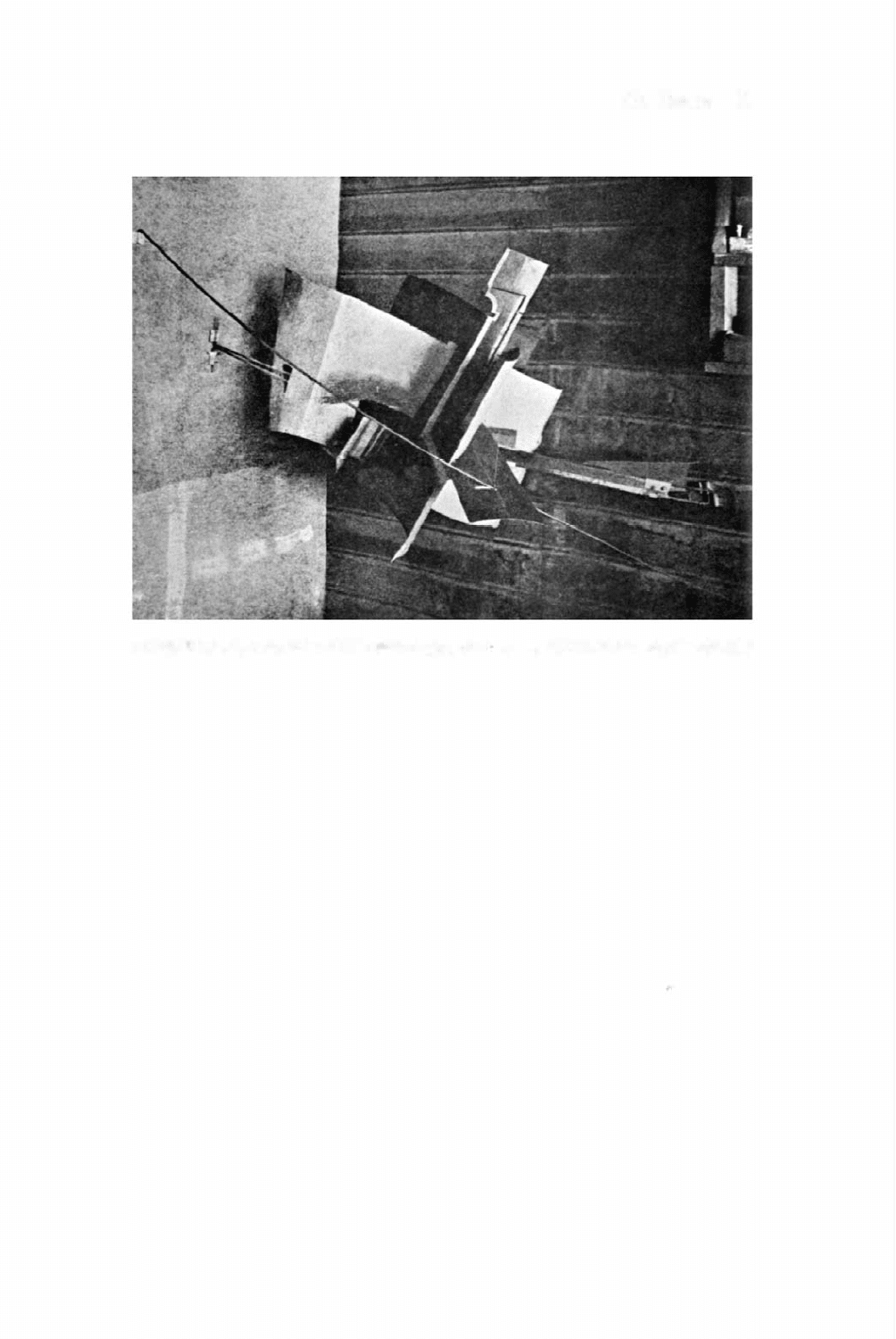
The next step was to break away from the surface of the picture.
Now the composition was involved with real space (in front of
the surface that served as a backdrop, or in between two sur
ces perpendicular to each other) and was supported only by a
wire or
a stiy bent pivot. This was the rst "sculpture without
a pedestal," which at the same
t
ime
i
ne
vita
bly showed architec
tural characteristics because of the real structural relations that
d
eveloped between the various components of the construc
t
ion. Tatl
i
n called these creations cou
n
ter-reliefs�
Antliff, Allan (Author). Anarchy and Art : From the Paris Commune to the Fall of the Berlin Wall.
Vancouver, BC, CAN: Arsenal Pulp Press, 2007. p lxxxi.
http://site.ebrary.com/lib/dominicanuc/Doc?id=10308829&ppg=81
T t Crra/or! 81
Vlndimir Tn t/ill, Corner Counter-Relief, 1914-15. r Vbtrbollt! IIIIJmo�lI. From Vladimir
Evgrafovich lin, '9'5'
The materialism of each element (surface, texture, color, etc.) in a
work: this is the "gateway" through which Tatlin
urged his comrades
to pass. It remained for Rodchenko to give this passage an
explicitly
Stirnerist valiance.
In
1918, Rodchenko was well versed in Tatlin's ideas, having met
the artist in
1915 and collaborated with him on numerous projects,
including Filippov's cafe. He had also conducted his own experimen
tations with the properties of paint on canvas throughout
1915-17, and
by
1918 this was the element he made his own. Here is Rodchenko's
de
scription of his paintings, published on April 28, 1918 in Alltlrkbiin:
Designing vertical plane su rfaces, painted a suitable color, and
intersecting them with lines
of depth, I discover that color
serves
merely as a useful convention for separating one plane

Antliff, Allan (Author). Anarchy and Art : From the Paris Commune to the Fall of the Berlin Wall.
Vancouver, BC, CAN: Arsenal Pulp Press, 2007. p lxxxii.
http://site.ebrary.com/lib/dominicanuc/Doc?id=10308829&ppg=82
82 ANARCH Y AN D ART
from another, and for bringing out those elements which indi
cate depth and its inte rsections ....
Ta king into consideration only the projections of principal and
central lines very different from the parallel peripheral lines or
those that enter in depth, I completely neglect both the quality
and the combination of colors ....
Con
structing projections on ovals, circ
l
es, and e
lli
pses, I often
distinguish only the extremities of the projections with color,
which gives me the possibility of emphasizing the value of the
projections and the color, used as an auxiliary means and
not
an end.
Ry
thl1Bhly tnyinB th prjtin in pth, h.iBht, :m
breadth, I discover an innite number of possibilities for con
struction outside rhe limits
of time.-w
During this same period, Kazimir Malevich, leader of the "supre
matist" group of artists whose ranks included Rodchenko, was ex
perimenting with the same painterly values
in
his own abstractions
(see color plate 6). Malevich's non-objective style, rst manifested
in
the form of a stark black square painted on a white background, was
rooted in the metaphysical mysticism of theosophy and notions of a
"fourth" dimension beyond the sensate third. Malevich argued that
humanity was evolving toward a higher state of being that would unite
us with a
ll living things, and ultimately, the universe itself. Evoking
the third dimensions of space and depth on two-dimensional surfaces
using non-objective forms such as circles, triangles, squares, and lines,
suprematist paintings functioned as an analogue for the perception of
this
"h
igher" dimension-a dimension apprehended by a conscious
ness that was irrational rather than rational, "felt" rather grasped ana
lytically. The hallmark of this consciousness was "simultaneity"; freed
of third-dimensional moorings, things once separate and distinct
merged. defying all logic and common sense.
l
This illogic fo rmed the

Antliff, Allan (Author). Anarchy and Art : From the Paris Commune to the Fall of the Berlin Wall.
Vancouver, BC, CAN: Arsenal Pulp Press, 2007. p lxxxiii.
http://site.ebrary.com/lib/dominicanuc/Doc?id=10308829&ppg=83
lff Crfntors 83
basis for the poetics of suprematism's most important literary allies,
Alexei Kruchenykh and Ve limir Khlebnikov, who utilized transra
tiona
I language (wum) to create "unresolved dissonances" that tapped
our inner psyche and opened us to "simultaneity."4!
At the turn of the century, many radicals, anarchists included,
m
ixed spirituality and politics. For Malcvich and his cohorts, the
Russian revolution signaled a breakthrough into suprematist con
sciousness, an idea he promoted in
Al1arkhiia, where he declaimed
suprematist "egoism" as the visionary individualism of the anarchist
revolution.
For example,
A01-khiia's March 27, 1918 issue featured a
proclamation by Malevich entitled "To the New Limit":
Ve are revealing new pages
of art in anarchy's new dawns ....
The ensign of anarchy is the ensign of our "ego," and our spirit,
lik� a fr.�
w
incl, will mal Ollr cr.ativ wrk AlItt�r in th hracl
spaces of the soul. You who are bold and young .... sh of
f
the
touch
of dominating authorities. And, dean, meet, and build
the world in awareness of your day:H
Asserting the revolutionary hegemony of suprematism, Malevich
was morc than ready to take on his non-objectivist rivals. In the same
issue of
Al1khiin (March 28) in which Tadin's reply to "Plamen" ap
peared, he published his own "Reply" in which he blasted the fu tur
ists' "counter-revolutionary" activities and dismissed their anarchism
as a "revolt" against existing conditions that paled in comparison with
the suprematists' spiritual-artistic revolution, which had pushed hu
manity to "the limit of an absolutely new world."H
The year 1918 also saw Malevich embark on an unprecedented
se
rie
s of paintings. This cycle-his Whi 0 White paintings-was
unveiled on April 27, 1919 at the "10th State Exhibition of Non-ob
jective Creation and Suprematism" (see color plate 7). Malevich's ac
companying statement on "Suprematism" elucidated the aim of his
latest work.4$ Hitherto the suprematists had painted color forms oat
ing against a white ground. Non-objective form and pure color had
overcome the old artistic practice of representation and its methods

Antliff, Allan (Author). Anarchy and Art : From the Paris Commune to the Fall of the Berlin Wall.
Vancouver, BC, CAN: Arsenal Pulp Press, 2007. p lxxxiv.
http://site.ebrary.com/lib/dominicanuc/Doc?id=10308829&ppg=84
84 ANARCHY AND ART
of
color-mixing that simulated
"things and objects." However, the
persistence of color frustrated Malevich, because aesthetic delibera
tions over
the arrangement of color were far removed from the higher
suprematist state of mindY' Even if an artist's work was "constructed
abstractly
but based on color interrelations," Malevich wrote, his will
would
remain "locked up" by "the walls of aesthetic planes, instead of
being able to penetrate philosophically."�7 The move to Wb ite on Wbite
broke through this limitation, liberating the artist approach a revo
lutionary, suprematist consciousness in a medium from which the old
world was nally, completely purged. Devoid of color, the
Wbite on
Wb ite
forms dissolved into a void and Malevich's egoist "will" was free
to soar, uninhibited, beyond the known world:
I am free only when-by means of critical and philosophical
lIhst:lntiti(m-my will r:n . �trr:t :l snht:lntition of n.w
p
h
enomena from what already exists. I have breached the blue
lampshades
of color limitations, and have passed into the white
beyond: follow me, comrade aviators! ... The white free depths,
eternity, is before yoU.48
As we have seen, Malevich was just as committed to the anarchist
revolution as Rodchenko, however at the Ap
ril 1919 exhibition it be
came clear
all concerned that Rodchenko's Black 011 Blnck paintings
and his manifesto, "Rodchenko's System" (reprinted at the end of this
chapter) were being pitted against Malevich's "Suprematism" state
ment and his
Wbite 0 White series. During the days leading up to
the exhibition Rodchenko's wife and fellow non-objectivist, Va rvara
Stepanova, kept a diary where she discussed the critical purpose of
Rodchenko's work. Throughout, Stepanova called Rodchenko "Ami,"
a pseudonym he used in Aarkhiin.49
The
exhibition, wr
ote Stepa
nova, was "a contest between Anti and
Malevich, the rest are rubbish. Malevich has hung ve white canvases,
Anti black ones."so Stepanova praised "Anti" for his powerful distilla
tion of "pure painterly effects, without being obscured by incidental
elements, not even by color." She also recorded her (and presumably

Antliff, Allan (Author). Anarchy and Art : From the Paris Commune to the Fall of the Berlin Wall.
Vancouver, BC, CAN: Arsenal Pulp Press, 2007. p lxxxv.
http://site.ebrary.com/lib/dominicanuc/Doc?id=10308829&ppg=85
Tr t ntors 85
Rodchenko's) view of the implications the Black 011 Black series held
for Malevich. "Anti's works" were "a new step in painting after supre
matism .... The destruction of the square and a new form, the inten
sification of painting for its own sake, as a professional fe ature, a new
interesting facture and just painting, not a smooth coating in a single
color! the most unrewarding-black.";] We can probe the anarchist
fo undations of the "destruction of the square" -clearly a reference to
Malevich-through a reading of "Rodchenko's System" as a step-by
step process of egoistic afrmation and negationY
"Rodchenko's System" opened with Stirner's most fundamental
materialist axiom, "At the basis of my cause I have placed nothing,";;
and its fifth aphorism was another passage from Stirner: "I devour it
tht: IIlOIIlent 1 .lvaIu,: th thesis, I am ell 'I' only when I lkvour
it .... The fact that
T devour myself shows merely that T exist." These
phorisms :lre importnt for Rorlchen ko's 11l:lnifesto, h\lt to grSp their
import we have to return, once more, to The Ego and Its OW.
In the previous chapter, we saw how positing the notion of an "1,"
as Stirner argued, assumed there was an absolute condition of "being"
that transcended our uniqueness. Such "Absolute thinking," wrote
Stirner, "is that thinking which forgets that it is
my thinking, that f
think, and that it exists only through me. But I, as T, swallow up again
what is mine, am its master; it is only my
opinion, which T can at any
moment
(hauge, i.e. annihilate, take back into myself and consume."'"
For Stirner, the sensuous, devouring ego was the irreducible core of
uniqueness and the cornerstone of the mastering "I" that had no es
sence, that was, in effect, the "nothing" at the foundation of his phi
losophy.
"1 am not an ego along with other egos," wrote Stirner:
I am unique. Hence my wants toO are unique, and my deeds;
in sho
rt, everything about me is unique. And it is only as this
unique that I take everything for my own, as I set myself to
work, and develop myself, only as rhis. I do not develop man,
nor as
man, but as I, I develop-mysel
This is
the meaning of the-uique o.
iS
Antliff, Allan (Author). Anarchy and Art : From the Paris Commune to the Fall of the Berlin Wall.
Vancouver, BC, CAN: Arsenal Pulp Press, 2007. p lxxxvi.
http://site.ebrary.com/lib/dominicanuc/Doc?id=10308829&ppg=86
86 ANARCHY AND ART
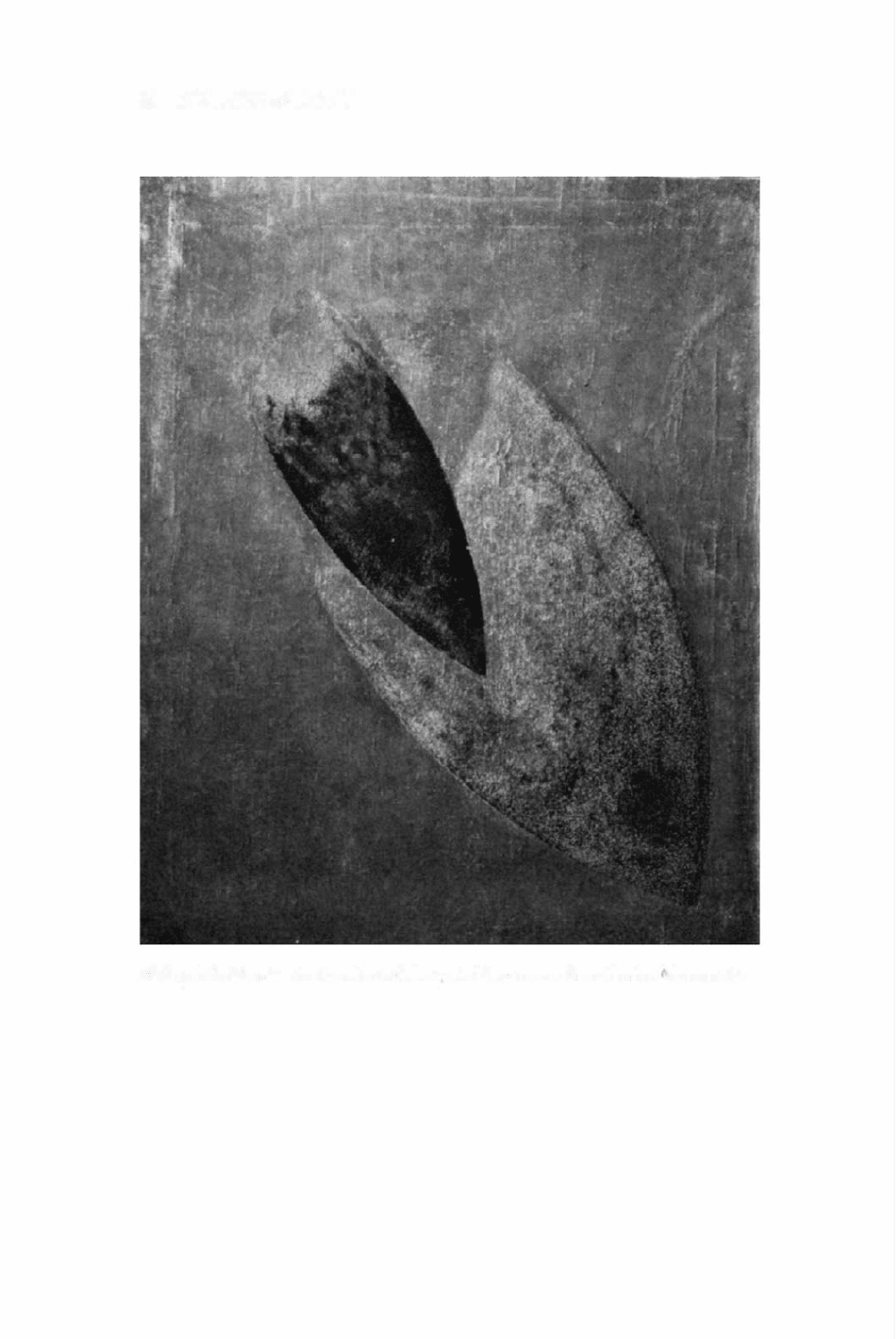
lIksa/J{/,- Rorheko, Black on Black #81, 1918. Oil O {a/IlJOS. Stat RSSill l\lIlSet/, St.
Pb.

Antliff, Allan (Author). Anarchy and Art : From the Paris Commune to the Fall of the Berlin Wall.
Vancouver, BC, CAN: Arsenal Pulp Press, 2007. p lxxxvii.
http://site.ebrary.com/lib/dominicanuc/Doc?id=10308829&ppg=87
Tre Cntors 87
Sup rem at ism celebrated the evolution of a mystifying abstrac
tion, humanity. Malevich's anarchist "ego" was a manifestation of a
dawning collective consciousness that penetrated a realm which was
unabashedly metaphysicaL Far from asserting uniqueness, the tran
srationalism of Malevich and his poetic allies sought to break down
the 'false' barriers separating the self from a hidden "fourth dimen
sion" outside of time and the material world. In Stirnerist terms, this
was just one more instance of groveling subservience to a mysterious
"higher" condition apart from the self.
Quoting Stirner, Rodchenko set himself against all this. For his
second aphorism ("colors disappear-everything merges into black"),
he borrowed a passage from Kruchenykh's transrational play, G
CIy, in whi:h Malvi:h anu Krudlnykh both figuru as uramatis
personae.'o Putting this "transrational" poet into service to trumpet
his the.sis W:l S n egoistic pl1t-down th:lt wOllld not h:lve heen lost on
Malevich.
An aphorism from the German psychologist Otto Weininger's
book
Uber die letzteu Dige (1907) and two quotations from Walt
Whitman's
Lenves of Gmss (IS55) served the same end. Here,
Rodchenko transformed We ininger's psychological insight into an el
l
iptic commentary on himself. By "murdering" suprematism, he was
achieving "self-justication" of a consummate egoistic sort, since, fol
lowing Stirner. the "self' that justied the act was itself devoid of an
"essence": it was the "nothing" that the "murderer" aspired to "prove."
Finally, the Whitman passages, which praised the invigorating role
death plays in the process of life, indicated that Rodchenko's "voy
age
of the soul" necessitated both creation (his paintings) and nega
tion (again, suprematism) and introduced the afrmative section of
"Rodchenko's System."
In the closing section, alluding
his debt Ta tlin, Rodchenko
attributed his own "assent" to the downfall of all "isms" whose "fu
neral bells" were rung by the
Black 0 Blnck series. From this point
on, the motive of his work would be "invention (analysis)" utilizing
the material constituents of the object ("painting is the body") to

Antliff, Allan (Author). Anarchy and Art : From the Paris Commune to the Fall of the Berlin Wall.
Vancouver, BC, CAN: Arsenal Pulp Press, 2007. p lxxxviii.
http://site.ebrary.com/lib/dominicanuc/Doc?id=10308829&ppg=88
88 ANARCHY AND ART
"create something new from painting." Once through Tatlin's "gate
way," Rodchenko stripped the canvas of metaphysics and distilled its
base elements, the painterly "body" and the creative "spirit." Having
mastered the "isms" of the avant-garde, he would now master paint
ing itself, moment by moment, in a process of free invention. These
were the qualities Stepanova celebrated in her diarYI where she wrote
that "Anti," the "analyst," and "inventor," created work that presented
nothing but "painting." The
Black 0 Blocks "[left] no room for col
or," and their
cture gained an extraordinary presence as a result. In
her
diar
y, Stepanova related that the "lustrous, matt, aky, uneven,
smooth" surfaces of the
Black 0 Blacks so impressed fe llow anarchist
Udal'tsova that she asked for one to be taken down so that she could
fcl it.57 Th xhibition, Stnov conduuu, was a trIIIndolis suc
cess for "Anti" and "his mastery, his fa cture."58
Tn erly 1919, Rochenko c_ clebr:ucd his cretive egoislll, h\lt cO\lld
painterly anarchism combat terror, repression, and ideological assaults?
Rodchenko's plight recalls the plaintive objections he once raised in
AU1·kbiia during the revolution's hopeful early days. Attending a
meeting of the Communist-dominated "Proletarian Culture" orga
nization, he heard a vitriolic speech on "proletarian art" from one
"comrade Zalevskii" that condemned cubism and futurism as the "last
word in bourgeois art" and the antithesis of working-class culture.
The pre-revolutionary avant-garde, countered Rodchenko, were "dar
ing inventors" who, though "hungry and starving" under the old or
der, had produced "revolutionary creations." The bourgeoisie "hated"
the cubists and futurists because it "want[ed] to see only itself and its
taste in the mirror of art." Now Zalevskii demanded that the workers
emulate their oppressors. "But the worker," wrote Rodchenko, does
not
wam to "srrangle his brother, the rebellious artist." "I am sure,"
he concluded, "that working people want true creators, not submissive
bureaucrats."w Rodchenko voiced his objections freely because he ad
dressed a large working-class readership from the platform of a still
viable anarchist movement. Though beset by adversaries, he could
still appeal to the readers of
Al1adbiia for support and rally other art-

Antliff, Allan (Author). Anarchy and Art : From the Paris Commune to the Fall of the Berlin Wall.
Vancouver, BC, CAN: Arsenal Pulp Press, 2007. p lxxxix.
http://site.ebrary.com/lib/dominicanuc/Doc?id=10308829&ppg=89
Tr ue Crea tors 89
ists to the cause. But as Communist power progressed, these freedoms
were shut down.
Rodchenko's capitulation came in March of 1921, when he, Gan,
and Stepanova joined with Konstantin edunetskii, K
Iog,son,
Gregorii Stenberg, and Vladimir Stenberg to form "The First
Working Group of Constructivists," The group drew up a manifesto
wherein they dedic ted themselves to "Soviet construction" guided
by "scientic communism, based on the theory of historical material
ism." Repudiating artistic anarchism circa 1918, they declared that
art had no role
play in the "social production of the future culture"
because "it arose from the mainstreams of individualism."60
Arguably, the date of this declaration-March 18-was not coin
ilicntal. The night bdore, the Communist Party hali crushcli the
last icker of resistance to its rule at the island fortress of Kronstandt,
whe.r n nrhist-Ied sovie.t hd lled for rvohltion ginst the
Communist dictatorship and then held out for sixteen days until its
rebellious inhabitants were subdued by Red Army detachments.61
Alarmed by anarchist involvement in the rebellion, the Cheka swept
the streets of Russia, throwing hundreds of anarchists, including
Askarov and Chernyi, into prison.62 Plainly, the time was ripe for a
retreat into Marxist orthodoxy.