
Baker K.R. Optimization Modeling with Spreadsheets
Подождите немного. Документ загружается.

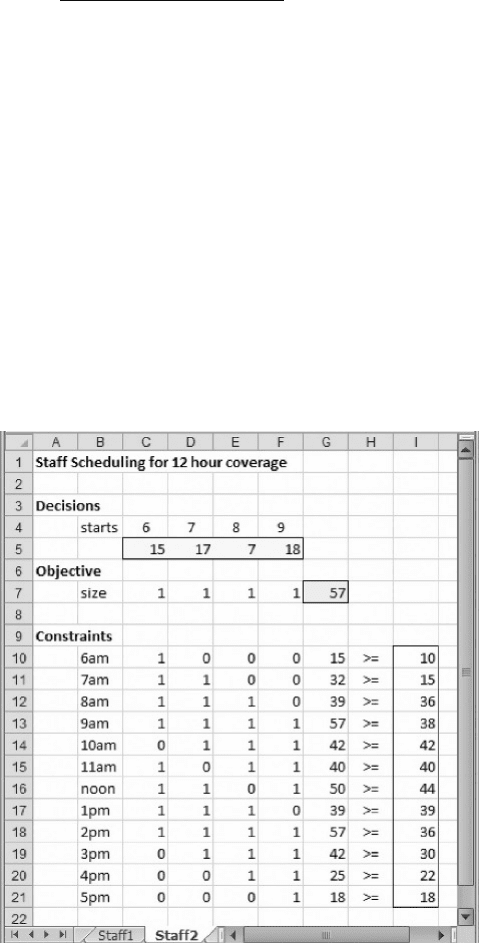
with an hour break in the middle. In this case, the columns of the model would appear
as follows:
Start: 6 am 7 am 8 am 9 am
10006−7 requirements
11007−8 requirements
11108−9 requirements
11119−10 requirements
011110−11 requirements
101111−12 requirements
110112−1 requirements
11101−2 requirements
11112−3 requirements
01113−4 requirements
00114−5 requirements
00015−6 requirements
For the particular set of hourly staff requirements shown in Figure 2.15, the optimal
staff size is 57.
Figure 2.15. Hourly Staffing model.
46 Chapter 2 Linear Programming: Allocation, Covering, and Blending Models

However, if work rules allow the lunch break to occur after as few as three hours
of work or as many as five hours of work, then 12 full-time shift assignments are
available, rather than four. The shift start times would remain the same, but the column
profiles would take the following form.
Start:666777888999
111000000000
111111000000
111111111000
011111111111
101011111111
110101011111
111110101011
111111110101
111111111110
000111111111
000000111111
000000000111
With these rules in place, the optimal staff size drops to 54. The example illus-
trates how an “optimal” solution can disguise possible inefficiency until we view
the problem from a broader perspective. The solution in the four-shift model of
Figure 2.15 is optimal for the situation it describes, but the rigidity of the rules govern-
ing shift patterns leads to inefficiency. When th ese rules become more flexible, then a
more efficient solution is attainable. In contrast to the effect of additional constraints,
additional flexibility can improve the objective function. Nevertheless, a good deal of
overstaffing occurs in either model. We might have to look beyond the optimization
model to avoid some of this remaining inefficiency. For example, if we can create
incentives that shift customer demands from one period to another, we can influence
the size of the optimal staff.
One variation of the staff-scheduling problem combines full and part-time shifts.
We can imagine full-time shifts as columns in which the 1s delineate an eight-hour
workday, whereas the part-time shifts might be columns containing a smaller
number of 1s. Such models usually have an objective function that measures the
cost of the workforce rather than its size, to reflect salary differences between
full- and part-t ime workers. In all these variations, however, the essential structure
of the model represents a covering problem by minimizing workforce cost or work-
force size subject to a systematic set of GT constraints for time-dependent staffing
requirements.
2.4. BLENDING MODELS
Blending relationships are very common in linear programming applications, yet
they remain difficult for beginners to identify in problem descriptions and to
2.4. Blending Models 47

implement in spreadsheet models. Because of this difficulty, we begin with a special
case—the representation of proportions. As an example, let’s return to the product
mix version of Example 2.1. In Figure 2.9 the optimal product mix consisted of 16
chairs, 120 desks, and 144 tables. Suppose that this outcome is unacceptable because
of the imbalance in volumes. For more balance, th e Marketing Department might
require that each product must make up at least 20% of the units sold.
When we describe outcomes in terms of a proportion, and when we place a floor
(or ceiling) on the proportion, we are using a special type of blending constraint. In our
example, a direct statement of the requirement for chairs is the following
C
C + D + T
≥ 0.2
This GT constraint has a parameter on the RHS and all the decision variables on the
LHS, as is usually the case. Although this is a valid constraint, it is not in linear form
because the quantities C, D, and T appear in both the numerator and denominator of the
fraction. (The ratio divides decision variables by decision variables.) However, we can
convert the nonlinear inequality to a linear one with a bit of algebra. First, multiply
both sides of the inequality by (C + D + T ), yielding
C ≥ 0.2(C + D + T)
Next, collect terms involving the decision variables on the LHS, so that we get
0.8C − 0. 2D − 0.2T ≥ 0
This form conveys the same requirement as the original fractional constraint, and we
recognize it immediately as a linear form. The coefficients on the LHS turn out to be
either the complement of the 20 percent floor (1 – 0.2) or the floor itself (but with a
minus sign). In a similar fashion, the requirement that the other products must respect
the floor leads to the following two constraints
0.8D − 0 .2 C − 0.2T ≥ 0
0.8T − 0.2C − 0.2D ≥ 0
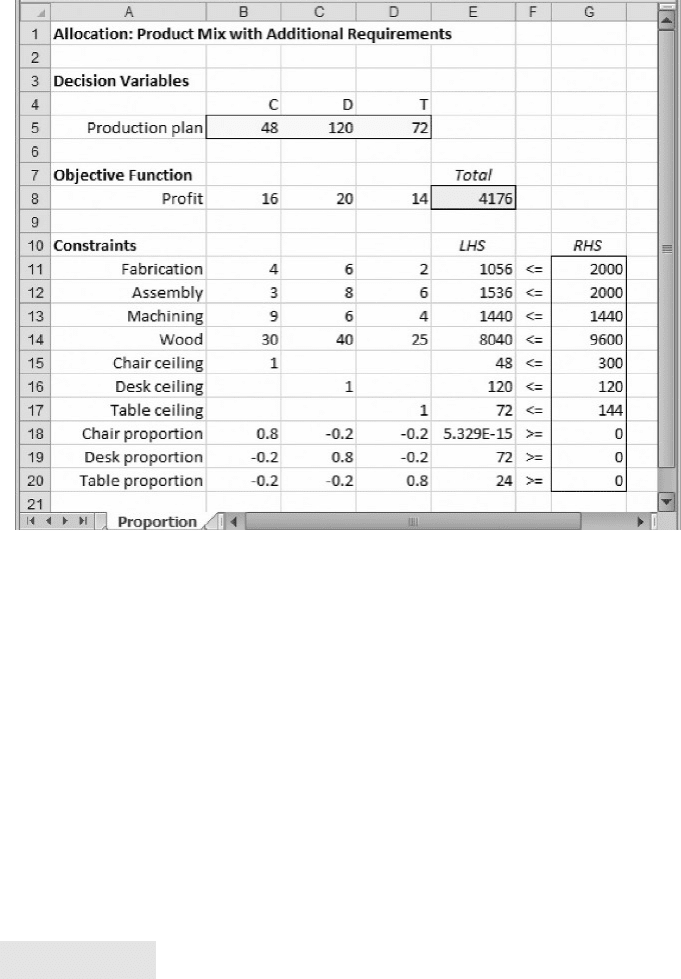
Appending these three constraints to the product mix model gives rise to the linear
program described in Figure 2.16. In the figure, we show the spreadsheet after the
model has been optimized. Before the constraints were added, the optimal mix gener-
ated profits of $4672. With the 20 percent floor imposed, we expect optimal profits to
drop. As shown in Figure 2.16, the new optimal mix becomes 48 chairs, 120 desks,
and 72 tables. Thus, swapping chairs for tables in the product mix, we can achieve
the best possible level of profit, achieving a total of $4176. As we might have expected,
chairs make up exactly 20 percent of the optimal output in this solution, while desks
and tables each account for more than 20 percent.
Whenever we encounter a constraint in the form of a lower limit or an upper limit
on a proportion, we can follow similar steps.
48
Chapter 2 Linear Programming: Allocation, Covering, and Blending Models
†
Write the fraction that expresses the constrained proportion.
†
Write the inequality implied by the lower limit or upper limit.
†
Multiply through by the denominator and collect terms.
The result should be a linear inequality, ready to incorporate in the model.
In general, the blending problem involves mixing materials that have different
individual properties and describing the properties of the blend with weighted
averages. We might be familiar with the phenomenon of mixing from spending
time in a chemistry laboratory mixing fluids with different concentrations of a particu-
lar substance, but the concept extends beyond laboratory work. Consider the example
of Keogh Coffee Roasters.
EXAMPLE 2.4
Keogh Coffee Roasters
Keogh Coffee Roasters blends three types of coffee beans (Brazilian, Colombian, and Peruvian)
into ground coffee that is sold at retail. Each kind of bean has a distinctive aroma and taste, and
the company has a chief taster who can rate the fragrance of the aroma and the strength of the
taste on a scale of 1 to 100. The features of the beans are tabulated below.
Figure 2.16. Modified product mix model.
2.4. Blending Models 49

Aroma Strength Cost per
Bean Rating Rating Pound
Brazilian 75 15 $0.50
Colombian 60 20 $0.60
Peruvian 85 18 $0.70
Keogh would like to create a blend that has an aroma rating of at least 78 and a strength rating of
at least 16. However, its supplies of the various beans are limited. The available quantities are
1500 lb of Brazilian, 1200 lb of Colombian, and 2000 lb of Peruvian beans, all delivered under a
previously arranged purchase agreement. Keogh wants to make 4000 lb of the blend at the
lowest possible cost. B
For a little background on blending arithmetic, suppose that we blend Brazilian
and Peruvian beans in equal quantities of 25 lb each. Then we should expect the
blend to have an aroma rating of 80, just halfway between the two pure ratings of
75 and 85. Mathematically, we take the weighted average of the two ratings
Aroma rating =
75(25) + 85(25)
25 + 25
=
4000
50
= 80
Now suppose that we blend the beans in amounts B, C, and P. The blend has an aroma
rating calculated by a weighted average of the three ratings
Aroma rating =
75B + 60C + 85P
B + C + P
To impose a constraint that requires the aroma rating to be at least 78, we write
75B + 60C + 85P
B + C + P
≥ 78
Once again, this constraint is nonlinear, by virtue of having decision variables in the
denominator of the fraction. However, as shown above, we can convert the require-
ment into a linear constraint. First, multiply both sides of the inequality by (B +
C + P), yielding
75B + 60C + 85P ≥ 78(B + C + P)
Next, collect terms involving the decision variables on the left-hand side, to obtain
−3B − 18C + 7P ≥ 0
This form conveys the same requirement as the original fractional constraint, but in
linear form. The coefficients on the left-hand side turn out to be just the differences
between the individual aroma ratings (75, 60, 85) and the requirement of 78, with
signs indicating whether the individual rating is above or below the target. In a similar
fashion, a requirement that the strength of the blend must be at least 16 leads to the
constraint
−1B + 4C + 2P ≥ 0
50
Chapter 2 Linear Programming: Allocation, Covering, and Blending Models
In general, the natural way to describe a blending requirement uses fractions, but
in that form, blending requirements are nonlinear. We prefer to convert these require-
ments to linear constraints because with a linear model we can harness the full power
of the linear solver. As we shall see later, the nonlinear solver has more limitations than
the linear solver.
Now, with an idea of how to restate the blending requirements, we return to
Example 2.4. In addition to the blending constraints, we need a constraint that gener-
ates a 4000-lb blend, along with three constraints that limit the supplies of the different
beans. The algebraic problem statement is as follows.
Maximize z = 0.50B + 0.60C + 0.70P
subject to
− 3B − 18C + 7P ≥ 0
− 1B + 4C + 2P ≥ 0
B + C + P ≥ 4000
B ≤ 1500
C ≤ 1200
P ≤ 2000
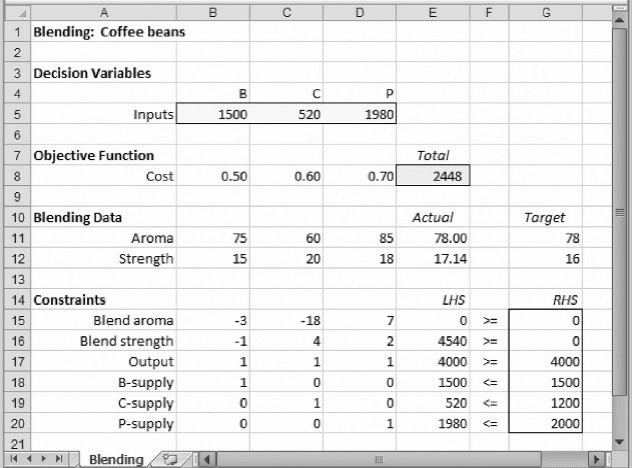
Figure 2.17 shows the spreadsheet for our model, which contains a GT constraint
and three LT constraints, in addition to the two blending constraints. In a sense, the
Figure 2.17. Keogh Coffee Roasters model.
2.4. Blending Models 51
model has what we might think of as covering and allocation constraints, in addition to
blending constraints. The Blending Data module, in rows 10–12, is not strictly part of
the optimization model. We’ll come back to this part of the worksheet later. Each con-
straint in rows 15–20 is expressed in our standard form: a SUMPRODUCT formula
on the LHS and a parameter on the RHS. This model contains three LT constraints and
three GT constraints. It is helpful to keep constraints of the same type in adjacent
locations on the worksheet, for convenience in entering the constraint information
in the task pane. In this case, with only two entries in the Add Constraint window,
we can specify all six inequalities.
The output constraint is formulated as an inequality. Although Keogh Coffee
Roasters wishes to produce 4000 lb, our model allows the production of a larger quan-
tity if this will reduce costs. (Our intuition probably tells us that we should be able to
minimize costs with a 4000-lb blend, but we would accept a solution that reduced costs
while producing more than 4000 lb: we could simply throw away the excess.) In many
situations, it is a good idea to use the weaker form of the constraint, giving the model
some “additional rope” and avoiding EQ constraints. In other words, we should build
the model with some latitude in satisfying the constraints of the decision problem
whenever possible. The solution will either confirm our intuition (as this one does)
or else teach us a lesson about the limitations of our intuition.
The model specification is the following
Objective:
Variables:
Constraints:
E8 (minimize)
B5:D5
E15:E17 ≥ G15:G17
E18:E20 ≤ G18:G20
The linear solver produces an optimal blend of 1500 lb of Brazilian, 520 lb of
Colombian and 1980 lb of Peruvian beans, for a total cost of $2448, as shown in
the figure. By using linear programming, Keogh Coffee Roasters can optimize the
cost of its blend while meeting its taste and aroma requirements. Of the two blending
constraints, only the first (aroma) constraint is binding in this solution; the optimal
blend actually has better-than-required strength. The output constraint is also binding
(consistent with our intuitive expectation), as is the limit on Brazilian supply.
In Figure 2.19, we calculate the actual aroma and taste ratings in cells E11:E12,
using the weighted-average ratio formula directly. For example, the calculation in cell
E11 uses the formula
=SUMPRODUCT($B$5:$D$5,B11:D11)/E17. Thus, where-
as the first constraint of the model is binding (LHS and RHS of row 15 both equal to
zero), the aroma calculation in the Blending Data module shows that the weighted aver-
age equals the requirement of 78 exactly. Although the second constraint shows that the
strength requirement is not binding, the comparison of LHS (4540) with RHS (zero) is
not as helpful as a means of interpreting the slack in the constraint. However, cell E12
shows that the optimal blend’s strength is 17.14, which we can easily compare to the
requirement of 16.
Blending problems arise whenever weighted averages characterize the properties
of a composite product. In our example, we treated taste and aroma as if they were
52
Chapter 2 Linear Programming: Allocation, Covering, and Blending Models
numerically objective measures, for the purposes of illustration. However, it is not dif-
ficult to enumerate some applications where the parameters are “harder” numbers and
blending concerns are relevant.
†
Gasoline is a blend, and the octane rating of gasoline is a weighted average of
its constituents. The inputs into a gasoline blend have different octane ratings as
a function of their crude oil source and their previous processing steps. The
classification of gasoline blends as regular, premium, or super premium is
usually based on a minimum octane rating in each category. The principle of
weighted average blending applies as well to other fluids, such as the viscosity
of lubricants, the sugar content of fruit juice or the fat content of ice cream.
†
Chemical compounds other than fluids often have such constituents as nickel,
copper, sulfur, potassium, and the like. These constituents may have functional
benefits, or they may be considered impurities. In either event, different com-
pounds have different percentage compositions of these elements, and compo-
sitions blend according to weighted averages when elements are mixed
together. The principle of weighted averages applies to metal in alloys, pollu-
tants in emissions, or active ingredients in medications.
†
Investment portfolios consist of discrete assets, such as stocks and bonds. Each
asset in the portfolio has its own financial characteristics, but properties of the
overall portfolio dictate admissible investment strategies. The principle of
weighted averages applies to maturities of bonds, rates of return on stocks,
and riskiness ratings of assets.
2.5. MODELING ERRORS IN LINEAR PROGRAMMING
We have presented our examples as if they were built by knowledgeable analysts, with
each step implemented correctly and all errors avoided. However, someone new to the
experience of building optimization models seldom makes it through all of the steps
without some kind of difficulty. Even experts run into problems, especially when
they are working on complex models. It is probably unrealistic to expect that the pro-
cess of building and analyzing a model can be carried out without encountering some
sort of difficulty along the way. To be effective in modeling, we have to know how to
deal with errors when they occur.
2.5.1. Exceptions
Given a linear programming model, Solver always finds an optimal solution, provided
one exists. The first kind of modeling error is formulating a model that does not have
an optimal solution. Two exceptions can cause difficulties: infeasible constraints and
an unbounded objective function.
A model contains infeasible constraints if no set of decision variables can
satisfy all constraints simultaneously. For example, in the product mix example of
2.5. Modeling Errors in Linear Programming 53

Figure 2.9, suppose we had signed a contract promising that 200 chairs would be deliv-
ered to a single large customer, as part of the product mix. Adding the requirement
C ≥ 200 to the other constraints of the model creates an inconsistency. (The implied
machining requirement would be 1800 hours, which exceeds the capacity available.)
Presented with a set of inconsistent constraints, Solver detects the inconsistency and
delivers the following result message in the solution log as well as at the bottom of
the task pane:
Solver could not find a feasible
solution.
Whenever this message appears, there must have been an inconsistency in the set of
constraints.
For the model builder, the task is to locate the inconsistency when confronted with
the infeasibility message. There are potentially two levels to this task: (1) finding the
offending constraint or constraints, and (2) identifying the source of the inconsistency.
Sometimes, the offending constraint can be discovered by “eyeballing” the model—
scanning for visual clues to the location of an error. For example, a parameter could
be entered incorrectly. (Perhaps the chair contract calls for only 20 units, but 200
has been entered inadvertently.) Alternatively, a constraint could be entered backward,
as a LT constraint when it should have been a GT constraint. However, the more stan-
dard way to search for an inconsistency is to remove constraints from the model, one
at a time, and to rerun Solver each time. (In large problems, it might make more sense
to remove several constraints at a time.) If the model remains infeasible, restore the
constraint and try removing a different one. If the model reaches an optimal solution,
then we know that something about the constraint we removed was a partial cause of
the infeasibility.
Identifying the source of an inconsistency refers to the part of the task that lies at
the interface between model and problem. If the inconsistency resulted from a ty po,
then it is a simple matter to repair it. However, a more subtle difficulty arises when
the formulation contains too many constraints. This result can occur if, during the
modeling process, there was a thorough attempt to include all the considerations men-
tioned by various parties. Isolated desires and secondary considerations could wind up
being expressed as model constraints, contributing to a logical conflict. In th ese situ-
ations, it makes sense to eliminate some of the constraints, so that the model is at least
feasible. Thereafter, various additional considerations can be revisited, to see whether
they can be accommodated without causing infeasibility.
The second kind of modeling error occurs when there is no limit to the objective
function in the direction of optimization. An unbounded objective function occurs if,
with a set of feasible decisions, the objective can grow infinitely positive in a maximi-
zation problem or infinitely negative in a minimization problem. The most common
cause of an unbounded objective is failure to invoke the Assume Non-Negative
option. For example, in the trail mix example of Figure 2.11, suppose we had forgotten
to set the option to True. Then it would be mathematically possible to make the objec-
tive function as negative as we wish by taking negative quantities for some of the
ingredients. Consider the mix corresponding to R ¼ 115, P ¼ –40, and W ¼ –50.
54
Chapter 2 Linear Programming: Allocation, Covering, and Blending Models

This combination satisfies all four constraints, with a total cost of – $5.00. Mathemat-
ically, this mix could be expanded in the same proportion, with all constraints met
and the total cost becoming as negative as we like. Presented with conditions that
permit an objective function to expand infinitely in the direction of optimization,
Solver detects the unbounded possibilities and delivers the following result message
in the solution log as well as at the bottom of the task pane:
The objective (Set Cell) values do
not converge.
The reference to “Set Cell” provides consistency with older versions of the software,
which did not use the term “objective.”
For the model builder, the task is to locate the cause of an unbounded objective
function. The problem could lie in the objective function or in the constraints. A
simple typo in an objective function cell could induce unbounded possibilities.
However, unboundedness can also occur when a constraint is omitted from the
model, allowing decision variables to reach values never intended by the model
builder. Whereas locating the cause of infeasibility directs attention to the constraints,
it is more difficult to know where to look for the cause of unboundedness.
2.5.2. Debugging
Even a model that contains feasible constraints and a bounded objective function can
be logically flawed. Beyond its ability to detect infeasible and unbounded formu-
lations, Solver has no automatic means of detecting logical errors. That responsibility
lies with the model builder. However, a few techniques that are helpful to spreadsheet
users can augment the capabilities in Solver.
†
Set all decision variables to zero. A good first step is to enter zero for each of
the decision variables and confirm that the objective function and constraints
behave as expected. Then, make one variable at a time positive. Taking succes-
sive values for a variable equal to 1, 10, and 100 can show whether the scaling
properties of the model seem valid.
†
Display formulas. By simultaneously pressing the Control and tilde ()keys,
we can look at all the formulas in the spreadsheet window. As in Figure 2.2, we
look for the SUMPRODUCT formulas in the cells corresponding to the objec-
tive function and the LHS of each constraint. No other formulas are necessary,
although in the next chapter we shall look at some cases where an alternative
form is convenient. Pressing the Control and tilde keys simultaneously once
more restores the display.
†
Invoke Formula Auditing. The Formula Auditing tools appear on the Formulas
tab. In Figure 2.18, we have selected, one at a time, each of the constraint for-
mulas and selected the Trace Precedents icon for each one. The resulting logical
map exhibits a systematic structure that helps validate the formulas. An
2.5. Modeling Errors in Linear Programming 55