
Baker K.R. Optimization Modeling with Spreadsheets
Подождите немного. Документ загружается.


usually of two types: capacity constraints on production resources and demand con-
straints on potential sales. In Example 2.1, suppose that the company markets its
chairs, tables, and desks through a distributor who also provides monthly forecasts
of demands. Next month’s forecasts are:
Chairs Desks Tables
Demand 300 120 144
With this information, we can extend the basic allocation model to include three
demand constraints as well. The full model takes the following algebraic form.
Maximize z = 16C + 20D + 14T
subject to
4C + 6D + 2T ≤ 2000
3C + 8D + 6T ≤ 2000
9C + 6D + 4T ≤ 1440
30C + 40D + 25T ≤ 9600
C ≤ 300
D ≤ 120
T ≤ 144
The spreadsheet version of this model simply adds three rows to the model in
Figure 2.6. Most easily, the LHS formula can be copied from the wood supply con-
straint (cell E14) into cells E15:E17 after the new coefficients have been added, as
shown in Figure 2.7.
We must then update the model specification so that all seven constraints are
included. To make this adjustment most simply, we can select the range E15:E17
and add the corresponding constraints via the Add Constraint window. The updated
representation in the window of the Model tab lists two sets of constraints, as
shown in Figure 2.8. Although it may not be necessary in every case, it is a good
habit to click the Refresh icon after adding or deleting variables or constraints, so
we do that here.
Alternatively, to update the allocation model, we can double-click on the icon for
the existing Normal constraints, which opens the Change Constraint window. This
time, we can edit the Cell Reference box and the Constraint box so that the ranges
include all seven of the constraints. Then, the window on the Model tab displays
only one set of constraints. Again, it is a good habit to click Refresh.
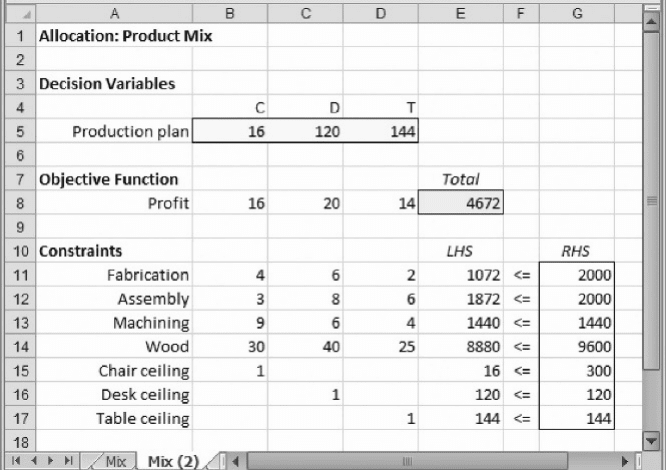
A new optimization run then reveals that the optimal product mix becomes 16
chairs, 120 desks, and 144 tables, as shown in Figure 2.9. The optimal profit contri-
bution in the product mix model is $4672. This amount is less than the optimal
profit in the original allocation model. Not surprisingly, the imposition of demand ceil-
ings leads to a reduction in the optimal profit. In fact, looking back at Figure 2.7, we
36
Chapter 2 Linear Programming: Allocation, Covering, and Blending Models
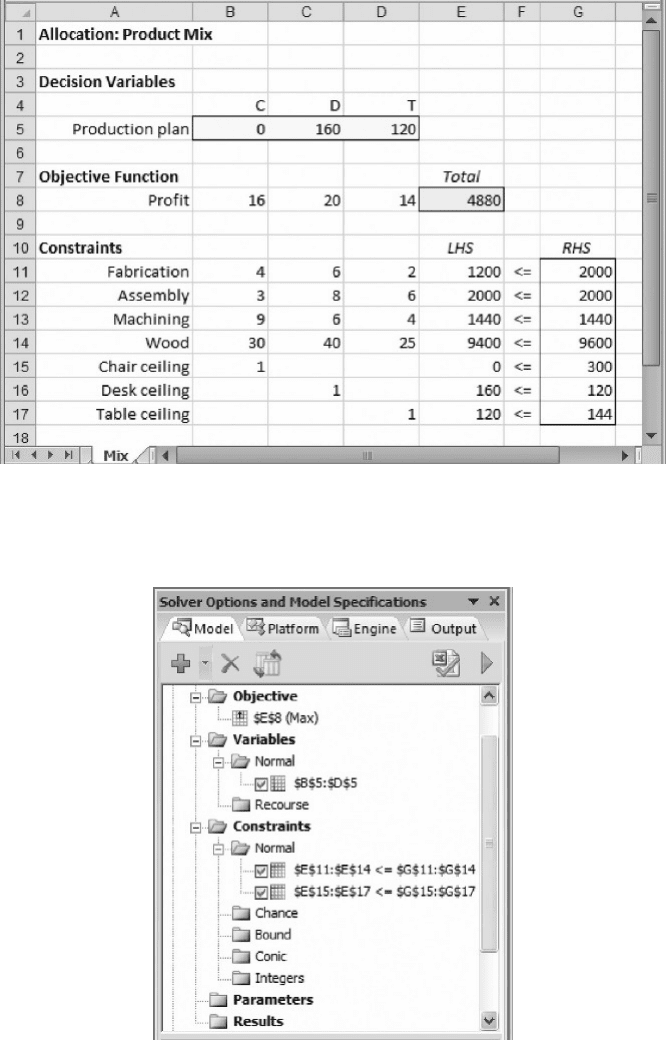
Figure 2.8. Specifying additional constraints.
Figure 2.7. Product mix model.
2.2. Allocation Models 37
can see immediately that the product mix of 160 desks and 120 tables does not meet all
of the demand ceiling constraints. This outcome illustrates the intuitive principle that
the addition of constraints to a model cannot improve the optimal objective function—
it will be the same or worse when constraints are added.
Three binding constraints occur in the product mix model: the demand ceiling
for desks, the demand ceiling for tables, and machining capacity. None of the other
constraints is binding.
In general, the product mix model involves different types of capacity and perhaps
different types of demand. For example, in our scenario, the different types of capacity
are labor, equipment, and material inputs for production. Alternatively, the labor might
be broken down into regular-time and overtime hours, or the material could come from
“make” versus “buy” sources (i.e., from in-house fabrication and assembly or from an
outside subcontractor). Similarly, demand could be specified by geographical region
or by time period, the latter for a multiperiod formulation. In the multiperiod case, it is
usually helpful to keep track of inventory levels, partly because inventories affect costs
but also because inventory can be considered yet another source of product, just like
regular-time capacity or subcontracted production. One common variation of the basic
product mix model is to include GT constraints on potential sales of certain products.
A minimum demand quantity might reflect a contractual commitm ent or represent a
sales level that management wishes to meet under any circumstances. Such demand
thresholds may or may not be part of the model; the distinctive features of the product
Figure 2.9. Optimal Solution to the product mix model.
38 Chapter 2 Linear Programming: Allocation, Covering, and Blending Models
mix model are capacity constraints on productive resources and demand constraints on
market requirements.
2.3. COVERING MODELS
The covering problem calls for minimizing an objective (usually cost related) subject
to GT constraints on required coverage. Whereas the allocation model divides
resources and assigns them to competing activities, the covering model combines
resources and coordinates activities. Consider the example of Herrick Foods
Company.
EXAMPLE 2.2
Herrick Foods Company
Herrick Foods Company wishes to introduce packaged trail mix as a new product. The ingredi-
ents for the trail mix are seeds, raisins, flakes, and two kinds of nuts. Each ingredient contains a
certain amount of vitamins, minerals, protein, and calories; and the Marketing Department has
specified the product be designed so that a certain minimum nutritional profile is met. The
decision problem is to minimize the product cost and determine the product composition—
that is, by choosing the amount of each ingredient in the mix. The data shown below summarize
the parameters of the problem.
Grams per pound
Nutritional
Seeds Raisins Flakes Pecans Walnuts requirement
Vitamins 10 20 10 30 20 16
Minerals 5 7 4 9 2 10
Protein 1 4 10 2 1 15
Calories 500 450 160 300 500 600
Cost/pound $4 $5 $3 $7 $6
B
To determine the decision variables, we again ask, “What must be decided?” The
answer is we need to determine the amount of each ingredient to put in a package of
trail mix. For the purposes of notation, we can use S, R, F, P, and W to represent the
number of pounds of each ingredient in a package.
Next, we ask, “What measure will we use to compare sets of decision variables?”
This should be the total cost of a package, and our interest lies in the lowest possible
total cost. To calculate the total cost of a particular composition, we sum the costs of
each ingredient in the package
Cost = 4S + 5R + 3F + 7P + 6W
To identify the model’s constraints, we ask, “What restrictions limit our choice of
decision variables?” In this scenario, the main limitation is the requirement to meet the
2.3. Covering Models 39
specified nutritional profile. Each dimension of this profile gives rise to a separate con-
straint. An example of such a constraint states, in words, that the number of grams of
vitamins provided in the package must be greater than or equal to the number of grams
required by the specified profile. Laying out those words in the format of an inequality,
we can write
Grams of vitamins provided ≥ Grams of vitamins required
where we chose to place “grams required” on the RHS because it is represented by a
parameter of the model (16 grams, in this case). Converting the inequality to symbols,
we can then write
Vitamin content = 10S + 20R + 10F + 30P + 20W ≥ 16 (Vitamin floor)
Similar constraints must hold for mineral protein, and calorie content. The entire
model, stated in algebraic terms, reads as follows.
Minimize z = 4S + 5R + 3F + 7P + 6W
subject to
10S + 20R + 10F + 30P + 20W ≥ 16
5S + 7R + 4F + 9P + 2W ≥ 10
1S + 4R + 10F + 2P + 1W ≥ 15
500S
+ 450R + 160F + 300P + 500W ≥ 600
In this basic scenario, no other constraints arise, although we could imagine that there
could also be limited quantities of the ingredients available, expressed as LT con-
straints, or a weight requirement for the package, expressed as an EQ constraint.
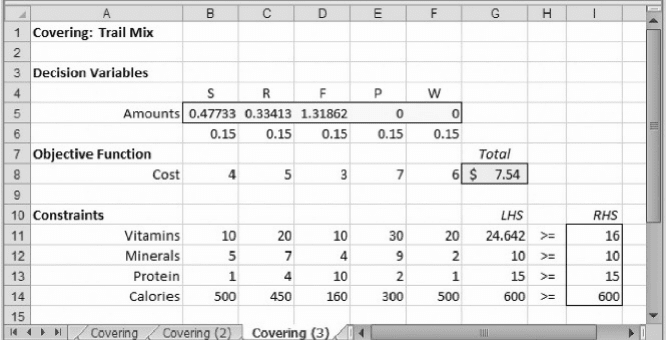
A spreadsheet model for the basic scenario appears in Figure 2.10. Again, we see
the three modules: a highlighted row for decision variables, a highlighted single cell
for the objective function value, and a set of constraint relationships with highlighted
RHS’s. If we were to displ ay the formulas for this model, we would again see that the
only formula in the worksheet is the SUMPRODUCT formula.
Once we have persuaded ourselves that the model is valid, we proceed to the
Model tab in the task pane and enter the following information
Objective:
Variables:
Constraints:
G8 (minimize)
B5:F5
G11:G14 ≥ I11:I14
As in the allocation model, we move to the Engine tab, specify the linear solver, and
invoke the option for nonnegative variables.
After contemplating some hypotheses about the problem (e.g., will the solution
require all five ingredients?) we run Solver and find the result message in the solution
log. The optim al solution is reproduced in Figure 2.11. It calls for 0.48 lb of seeds,
0.33 lb of raisins, and 1.32 lb of flakes, with no nuts at all. Evidently, nuts are prohi-
bitively expensive, given the nature of the required nutritional profile and the other
40
Chapter 2 Linear Programming: Allocation, Covering, and Blending Models
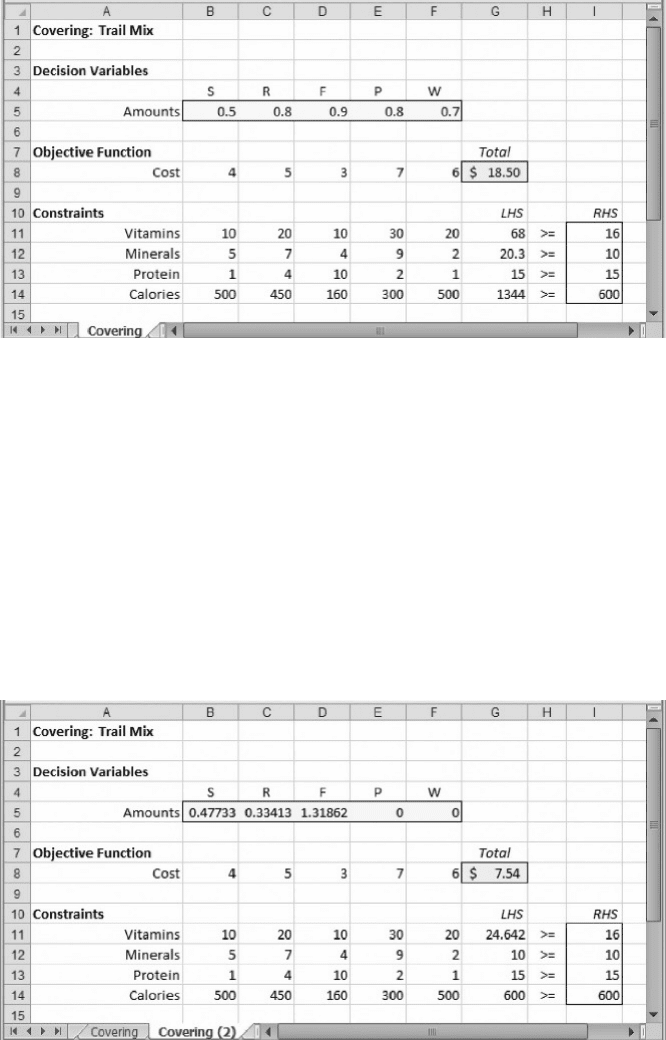
ingredients available. The optimal mix achieves all of the nutritional requirements at a
minimum cost of $7.54. The tight constraints in this solution are the requirements for
minerals, protein, and calories.
Herrick Foods might decide that trail mix without nuts is not an appealing pro-
duct. This concern illustrates another situation where the solution to the model may
not represent a solution to the practical problem. In building the model, we have not
considered the implication of a product without nuts. Alerted to this possibility, we
may wish to revisit the model and make sure that some nuts appear in the optimal
mix. One way to do so is to require a minimum of 0.15 lb of both pecans and walnuts
Figure 2.11. Optimal solution for the Herrick Foods model.
Figure 2.10. Model for Herrick Foods example.
2.3. Covering Models 41
in the mix. In Figure 2.12, we show an amended model that requires at least 0.15 lb of
every ingredient.
The value of 0.15 appears just below the corresponding decision variable, and in
the Model tab of the task pane, we add the constraint that the range B5:F5 must be
greater than or equal to the range B6:F6. After this update, we revise the model
specification as follows
Objective:
Variables:
Constraints:
G8 (minimize)
B5:F5
B5:F5 ≥ B6:F6
G11:G14 ≥ I11:I14
The requirement that a particular decision variable must be greater than or equal to a
given value is called a lower bound constraint. Here, the first set of constraints is for-
mulated as a range of lower bound constraints. Similarly, a requirement that a particu-
lar decision variable must be less than or equal to a given value would be called an
upper bound constraint. (We could have used such constraints in the product mix
model, but in Figure 2.9 we posed them in the standard SUMPRODUCT style, so
that they resembled the other constraints in the model.)
After including the lower bound constraints, running Solver again produces the
optimal solution shown in Figure 2.13. By using linear programming and acknowled-
ging a requirement to include all five ingredients in the ultimate mixture, Herrick
Foods has identified the desired composition of its trail mix product.
Imposing lower bounds on the original Herrick Foods model leads to an optimal
solution that contains all five of the ingredients. We might have expected that nuts
would appear exactly at their lower limit because without the lower boun d constraints,
the optimization left nuts completely out of the solution. Thus, when we added the
lower bound, there was no incentive to include nuts at any level greater than the
Figure 2.12. Herrick Foods model with additional constraints.
42 Chapter 2 Linear Programming: Allocation, Covering, and Blending Models
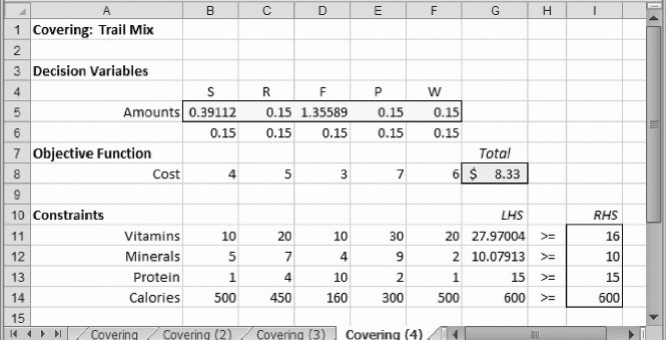
lower bound. The optimal cost is also higher in the amended model than in the orig-
inal, at $8.33. This result again reflects the intuitive principle that adding constraints to
a model cannot improve the objective function—it will be the same or worse when
constraints are added.
The trail mix example is a simplified version of a classic covering problem known
as the diet problem. This problem arises, for example, in the determination of weekly
menus for large institutional populations, such as those in nursing homes, prisons, and
summer camps. The purpose of the model is to determine meal selection for each of
the 21 meals served each week to everyone in a large group. The variables may rep-
resent quantities of various food groups (meats, vegetables, fruits, etc.), and weekly
nutritional requirements reflect limits on the totals of weekly requirements for fat, cal-
ories, protein, carbohydrates, and so on. A common phenomenon, akin to the results of
our first trail mix model, is that cost minimization drives the solution toward a limited
number of meals. Camp ers may not find a steady diet of tofu appealing, even if that is
the model’s optimal solution. Subtle differences between the problem and the model
become clearer once a solution is obtained. For that reason, a more detailed and com-
plicated set of constraints must often be added to the diet model in order to generate an
appetizing weekly menu.
2.3.1. The Staff-Scheduling Problem
Many service industries face the problem of scheduling their workforce to meet fluc-
tuating staffing requirements. Nurses, telephone operators, toll collectors, and bus dri-
vers operate in this type of environment—providing service over a period that extends
beyond the normal 8 hr working day and possibly continuing around the clock. Many
companies restrict themselves to full-time workers and they meet fluctuating
Figure 2.13. Optimal solution to the modified Herrick Foods model.
2.3. Covering Models 43
requirements of this sort by assigning staff to overlapping work shifts. As an example,
consider the daily staffing problem at Acme Communications.
EXAMPLE 2.3
Acme Communications
Acme Communications operates a regional call center where the workday is broken down into
six 4-hour shifts, and each operator works two consecutive shifts. The table below describes staff
requirements on each shift.
Shift number #1 #2 #3 #4 #5 #6
Time period 2 am–6 am 6 am– 10 am 10 am–2 pm 2 pm–6 pm 6 pm–10 pm 10 pm– 2 am
Requirement 10 20 45 40 50 12
The call center’s manager wishes to assign operators to the six available starting times so that
the staffing requirements are covered in each period and the total workforce size is as small
as possible. B
For Acme’s problem, the decision variables are the number of operators assigned
to each of the six starting times. For example, let x
1
represent the number assigned to
begin work on shift #1. These operators work during shifts #1 and #2, from 2 am to
10 am. Similarly, x
2
represents the number assigned to work during shifts #2 and
#3, from 6 am to 2 pm. With this notation, the number of operators working during
shift #2 must equal x
1
+ x
2
. By a similar logic, the number of operators working
during shift #3 must equal x
2
+ x
3
, and so on. Finally, the number working during
shift #1 must equal x
6
+ x
1
because the requirements repeat in 24-hour cycles. An
algebraic statement of the problem is shown below.
Minimize z = x
1
+ x
2
+ x
3
+ x
4
+ x
5
+ x
6
subject to
x
1
+ x
6
≥ 10
x
1
+ x
2
≥ 20
x
2
+ x
3
≥ 45
x
3
+ x
4
≥ 40
x
4
+ x
5
≥ 50
x
5
+ x
6
≥ 12
Figure 2.14 shows a spreadsheet model for this problem.
Staffing models of this sort have a distinctive structure. First, because the number
of operators working on any given shift is the total assigned to two starting times, two
variables appear in each constraint. Thus, in the spreadsheet, there are two 1s on the
LHS of each constraint row. Second, because operators work two consecutive
44
Chapter 2 Linear Programming: Allocation, Covering, and Blending Models
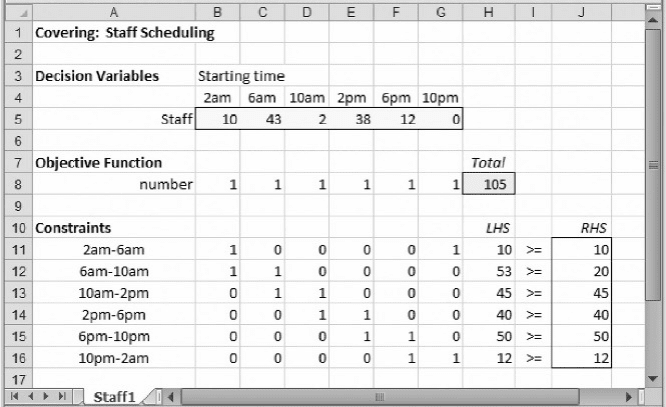
shifts, two consecutive 1s appear in the columns corresponding to variables. (In the
case of x
6
, shifts #6 and #1 are consecutive.) The model specification is as follows
Objective:
Variables:
Constraints:
H8 (minimize)
B5:G5
H11:H16 ≥ J11:J16
Figure 2.14 displays an optimal solution, which achieves a total workforce of 105 by
assigning various numbers of operators to five starting times, with no one starting
work at 10 pm.
In general, we can structure the staff-scheduling model around the shift definition.
Time periods correspond to rows in the model and alternative shift assignments cor-
respond to columns. For a problem in which the assignments correspond to days, we
can imagine seven constraint s (each one representing a daily staffing requirement) and
seven assignments (each one corresponding to a different start of a 5-day work stretch).
In the constraints module, the column of coefficients under a given shift assignment
shows the profile of the work shift. In Figure 2.14, those coefficients are two consecu-
tive 1s, reflecting the fact that each assignment comprises two consecutive 4-hour time
periods. In a more detailed version with 2-hour time periods, we can imagine four con-
secutive 1s. In an hourly version, we can imagine eight consecutive 1s. In most appli-
cations, however, when the time periods are this detailed, provisions are usually made
for meal breaks as well. As an example, imagi ne a service facility that operates over a
12-hour span from 6 am to 6 pm. Shifts begin on the hour and contain 8 hours of work
Figure 2.14. Staffing model.
2.3. Covering Models 45