
Battarbee R.W., Binney H.A. (Eds.) Natural Climate Variability and Global Warming: A Holocene Perspective
Подождите немного. Документ загружается.

..
100
|
Michel Crucifix
..
Inductive and deductive climate models
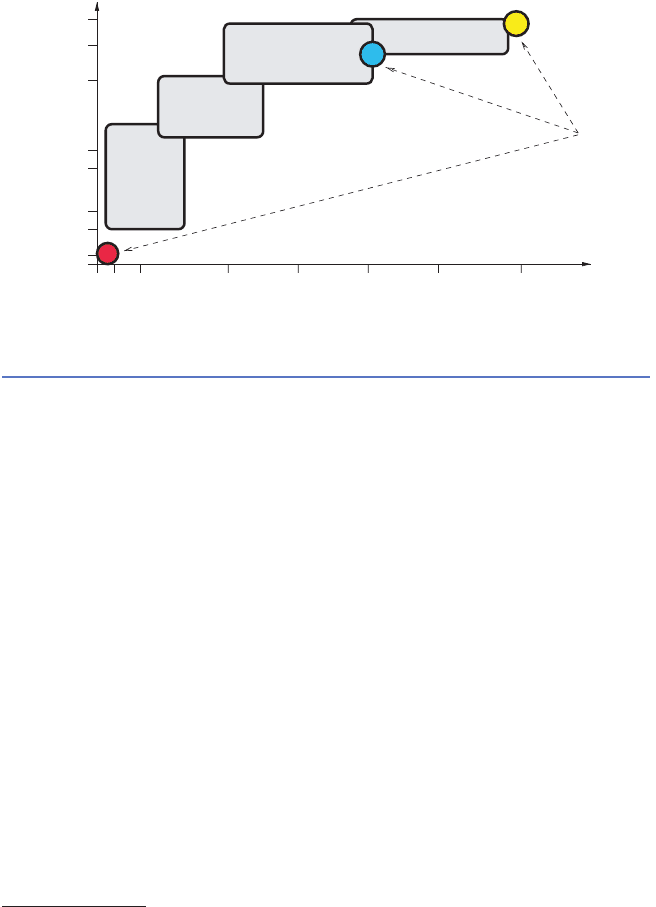
It has become customary to define three categories of global climate models
(Claussen et al. 2002; Renssen et al. 2004) (Figure 4.2).
•
Conceptual models are made of a small number of differential equations designed
to represent interactions between the major climate components. They are called
inductive because the number of adjustable parameters is of the same order of mag-
nitude as the number of differential equations (number of degrees of freedom).
Their primary purpose is to formulate a phenomenological theory of climate
dynamics. This may cover problems as various as the stability of the ocean circula-
tion (Stommel 1961) or the astronomical theory of paleoclimates (Imbrie and
Imbrie 1980; Saltzman and Maasch 1990; Paillard 2001). Conceptual models can
produce very complex solutions that may even be chaotic. The conceptual models
that can successfully be tuned on the climate record provide a structure to observa-
tions which, according to information theory (Leung and North 1990), may confer
on them a prediction skill.*
•
Comprehensive climate models are built from first principles of physics (equa-
tions of movement, radiative transfer, etc.) numerically implemented on three-
dimensional grids representing the atmosphere, the oceans, and sea-ice.† The
characteristic horizontal spatial scale of the grid is of the order of 100 km and the
* Saltzman (2002) considered as an “act of faith” that long-term climate dynamics may be described by
some low-order model, similar to thinking in physics that the cosmos is governed by a “unified
theory”. There is no easy demonstration of this, but Hargreaves and Annan (2002) showed that the
Saltzman and Maasch (1990) model does have significant skill in predicting climate over about 100 kyr.
† Technically, the discretized equations of motion may be solved directly on the grid (grid-based mod-
els). Another possibility (spectral models) is to compute first the spherical harmonics of the physical
quantities and then to resolve the equations of motion in this “conjugate” space. Differential operators,
such as the Laplacian, are indeed more easily expressed in the conjugate space. The spatial resolution of
a spectral model depends on the number of spherical transforms retained to perform the calculations.
For example, T32 means a triangular (T) truncation to the first 32 spherical harmonics. This approxi-
mately corresponds to a resolution of 400 km × 400 km.
200 km
Millennium
Meso–
scale
models
DecadeYear
100 m
10 km
Day Century Milankovitch
20 km
100 km
Global
Continents/
oceans
Region
Regional
models
Comprehensive
models
EMICs
Inductive
models
3
2
1
Figure 4.2 Time- and space-
scales covered by numerical
models used for weather and
climate prediction.
Conceptual models have only
a few degrees of freedom and
are designed to formulate and
test hypotheses in a very well-
defined framework. Three
examples are given here: (1)
turbulence in the boundary
layer; (2) stability of the ocean
circulation; and (3) ice-sheet
response to astronomical
forcing. Comprehensive
climate models (also called
“general circulation models”)
include the largest number of
degrees of freedom and are
suitable to study climate
dynamics on time-scales of a
few decades to a few centuries.
Earth models of intermediate
complexity (EMICs) usually
cover longer time-scales.
Mesoscale and regional
models simulate weather and
climate over a limited domain
of the globe. A mesoscale
model typically covers a
domain the size of the UK,
and a regional model may
cover Europe or the USA.
9781405159050_4_004.qxd 6/3/08 3:54 PM Page 100
Modeling the climate of the Holocene
|
101
..
integration time step is a few hours (see Johns et al. (2006) for a recent example).
Synoptic atmospheric variability is thus explicitly calculated. Comprehensive
climate models are “deductive” because the number of constitutive equations is
several orders of magnitude larger than the number of adjustable parameters.
Phenomena occurring at spatial scales smaller than the model grid, such as convec-
tive cloud formation, are parameterized by means of phenomenological equations.
Climate modelers establish these equations on the basis of local observations
(soundings, aircraft measurements, surface data) and specialized models. A para-
meterization has to be “physically reasonable” and respect conservation principles
(conservation of energy, entropy, momentum, etc.). In spite of these constraints,
different mathematical formulations of a parameterization may seem to provide
equally good results and there is no easy way to know which one is best. This is what
is called structural uncertainty.
In practice, the parameters need to be tuned again so that the climate generated
by the global model agrees with observed global-scale features of the climate
system (e.g. the existence of a meridional overturning cell in the North Atlantic).
This tuning process is too often viewed as a necessary evil about which little detail is
given in the model documentation.
Fortunately, tuning tends to be better recognized as a natural step of model
development. Model parameters are attributed uncertainty ranges (constrained by
laboratory measurements and local observations), and the likelihood of a given
parameter combination is estimated from the agreement between the model and a
well-defined set of global observations (surface temperature, precipitation, satel-
lite estimates of the radiative balance, etc.) (more detail is given below).
Nowadays, the development of comprehensive models mobilizes large multi-
disciplinary teams driven by the aim of providing reliable future climate predic-
tions. These models must therefore include all processes relevant at the decadal
to century time-scales with as much detail as computational power permits. This
covers various aspects such as soil dynamics, vegetation dynamics, ocean biogeo-
chemistry, ice-sheet dynamics, and river hydrology. At the time of writing, a
100-year long simulation of climate with a comprehensive climate model (e.g.
1.5 × 1.5° resolution) requires more than a month of a supercomputer with power-
ful data storage facilities.
•
Earth models of intermediate complexity (EMICs) fill the gap between
conceptual and comprehensive climate models (Claussen et al. 2002). They resem-
ble comprehensive climate models but calculations are made on longer time-scales
and larger spatial scales. The degree of parameterization is higher, which may
imply a larger structural uncertainty. Yet, like comprehensive models, the number
of degrees of freedom in EMICs exceeds the number of adjustable parameters by
several orders of magnitude. The EMIC category covers a range of models that may
be used to study interdecadal to astronomical time-scales depending on the model.
Examples of EMICS used to study the Holocene are given in Table 4.1.
Earth models of intermediate complexity and conceptual models are useful
because they cover spatial and temporal scales for which comprehensive models
..
9781405159050_4_004.qxd 6/3/08 3:54 PM Page 101

..
102
|
Michel Crucifix
..
are not suitable. Consider the glacial–interglacial cycles: the growth and decay of
the total continental ice mass at the glacial–interglacial time-scale is of the order of
a few centimeters of sea-level equivalent per year. These one or two centimeters
result from a difference between total evaporation, precipitation, melting, and
freezing that is so small compared with the quantities themselves that it cannot be
confidently estimated by a general circulation model (Saltzman 1988, 2002). In
fact, the present net accumulation rates of snow over Antarctica and Greenland are
even not accurately known (Rignot and Thomas 2002). Earth models of interme-
diate complexity provide a solution. They may be tuned to reproduce reasonable
results over a given section of a glacial–interglacial cycle (e.g. the last glacial incep-
tion, as in Gallée et al. 2002) and then used to study other periods (Loutre et al.
2007).
We have so far considered global climate models. Comparison with (paleo) data
may make it necessary to resolve smaller spatial scales than those of a comprehen-
sive climate model. The method demanding least computing time is statistical
downscaling (Murphy 1998), where statistical relationships are applied between
climate variations at the synoptic scale (200–300 km) and the local climate. Two
more elaborate strategies are documented in the literature: nesting and zooming
(Giorgi and Mearns 1999). Under “nesting”, output of a global model is used to
drive a regional dynamical model of the atmosphere that resolves horizontal length
scales of the order of 30 to 50 km. “Regional” indicates that this high-resolution
model only covers a defined region of the globe, such as Europe. Zooming is based
Table 4.1 Examples of Earth models of intermediate complexity (EMICs) used to study the Holocene
Model
LLN-2D
MoBidiC
CLIMBER-2
Green McGill
Paleoclimate Model
ECBILT (coupled to a
low-resolution ocean model)
ECBILT–CLIO (coupled to a higher
resolution ocean–sea-ice model)
Reference
Loutre et al. 2007
Crucifix et al. 2002
Bauer et al. 2004
Ganopolski et al. 1998
Claussen et al. 1999;
Claussen et al. this volume
Brovkin et al. 2002
Wang et al. 2005a
Wang et al. 2005b
Wang and Mysak 2005
Weber and Oerlemans 2003
Renssen et al. 2005
Renssen et al. 2002
Example of published applications over the Holocene
Prediction of the next glacial inception
Vegetation–climate interactions at high latitudes
Impact of freshwater input in the North Atlantic around 8000 years ago
Factor decomposition (see text)
Desertification of the Sahara in response to orbital forcing
Changes in ocean and terrestrial carbon storages during the Holocene
Analysis of the carbon budget
Existence of a climate optimum after the disappearance of the
Laurentide Ice Sheet
Impact of freshwater input in the North Atlantic around 8000 years ago
The influence of changes in precipitation and temperature on the
evolution of three representative glaciers
See text
Impact of freshwater input in the North Atlantic around 8000 years ago
9781405159050_4_004.qxd 6/3/08 3:54 PM Page 102

Modeling the climate of the Holocene
|
103
..
on a comprehensive climate model featuring an irregular mesh refined over the
region of interest in order to capture the smaller spatial scales.
Initial conditions, boundary conditions, and
model parameters
Mathematically speaking, a climate model is a system of equations with diagnostic
and prognostic equations. Diagnostic equations instantaneously link different
variables to each other, for example, the hydrostatic assumption linking pressure
and density. Prognostic equations need to be integrated forward in time, for exam-
ple, the Navier–Stokes equations describing hydrodynamics. In theory, it should
be possible to integrate prognostic equations backwards in time, but this task is
almost insurmountable because many diagnostic relationships are nonbijective
(i.e. cannot easily be inverted). The model is thus integrated forward in time and
one must define initial conditions, boundary conditions, and parameters.
•
Initial conditions represent the climate state from which the model equations
are integrated. They are generally supplied from a previous experiment or from
observations.
•
Boundary conditions define values or fluxes at the boundary of the domain, such
as the surface topography and incoming shortwave radiation at the top of the
atmosphere. The latter is calculated from the geometry of the Earth’s orbit.
•
Parameters are constants used in the equations. Some are directly specified from
laboratory experiments (e.g. heat capacity of water) or direct observations (albedo
of sea-ice, concentrations of greenhouse gases). Others are more phenomenological
and they must be calibrated by comparing model results with observations (see below).
Once initial conditions, boundary conditions, and parameters are specified, the model
is run to perform either an steady-state experiment or a transient experiment.
The climate modeler’s “steady-state experiment” is an integration for which
boundary conditions and parameters are constant, except for the insolation
seasonal cycle. Such experiments are suited to study the statistics of a quasi-steady
climate, where the time-scale of the external forcing change is larger than the
longest dissipative time-scale of the system. This is about a few thousand years if
deep-ocean dynamics are taken into account (this number is reached by dividing
the depth of the ocean to the square by the turbulent vertical diffusion coefficient).
Initial conditions seem unimportant in steady-state experiments because they are
eventually dissipated (“forgotten”). There are two caveats to this statement. First,
it is more economical to guess initial conditions that are not too far from the
solution in order to reduce as much as possible the time spent by the system to
reach it (spin-up time). Second, there may be two quasi-state solutions to the
model equations, with only a small probability of transition from the one to
the next: For example, a green and a white Sahara (Claussen, this volume). An
experiment is said to be transient if the boundary conditions and some other
..
9781405159050_4_004.qxd 6/3/08 3:54 PM Page 103

..
104
|
Michel Crucifix
..
parameters (such as greenhouse gas concentrations) change during the integra-
tion. These changes constitute an external forcing that influences the climate
trajectory. Two categories of transient experiments may be distinguished. In the
first one, the external forcing varies slowly or at a rate comparable to the dissipative
time-scales of the system. A good example is the change in the spatial and seasonal
incoming solar radiation due to the quasi-cyclic variations in the Earth’s orbit:
eccentricity, precession, and tilt of the rotation axis on the ecliptic (i.e. orbital
forcing). Such experiments allow us to identify and understand nonlinear pro-
cesses in the response to the forcing, such as deglaciation or desertification of the
Sahara (Claussen et al. 1999). The response is said to be abrupt if its characteristic
time-scale is shorter than that of the forcing (Alley et al. 2003). The second
category of transient experiments gathers those in which the forcing varies with a
characteristic time shorter than the dissipative time-scales of the system. In this
case the abrupt character of the response is due to the forcing itself. Experiments
of this kind are usually performed to test hypothetical scenarios such as a discharge
of freshwater in the ocean (Renssen et al. 2001; Bauer et al. 2004; LeGrande
et al. 2006).
Model–data comparison versus data assimilation
The classic methodology assumes a clear distinction between model input (initial
conditions, boundary conditions, parameters) and output (the predicted climate).
Boundary conditions and parameters are considered as “known” and there is no
formal uncertainty attached to them. The model output is then compared with
observations. There is usually a pair of experiments. One is designed to produce
a simulation of the pre-industrial climate and, in the other, boundary conditions
and certain parameters (such as greenhouse gas concentrations) are modified to
predict past climate.
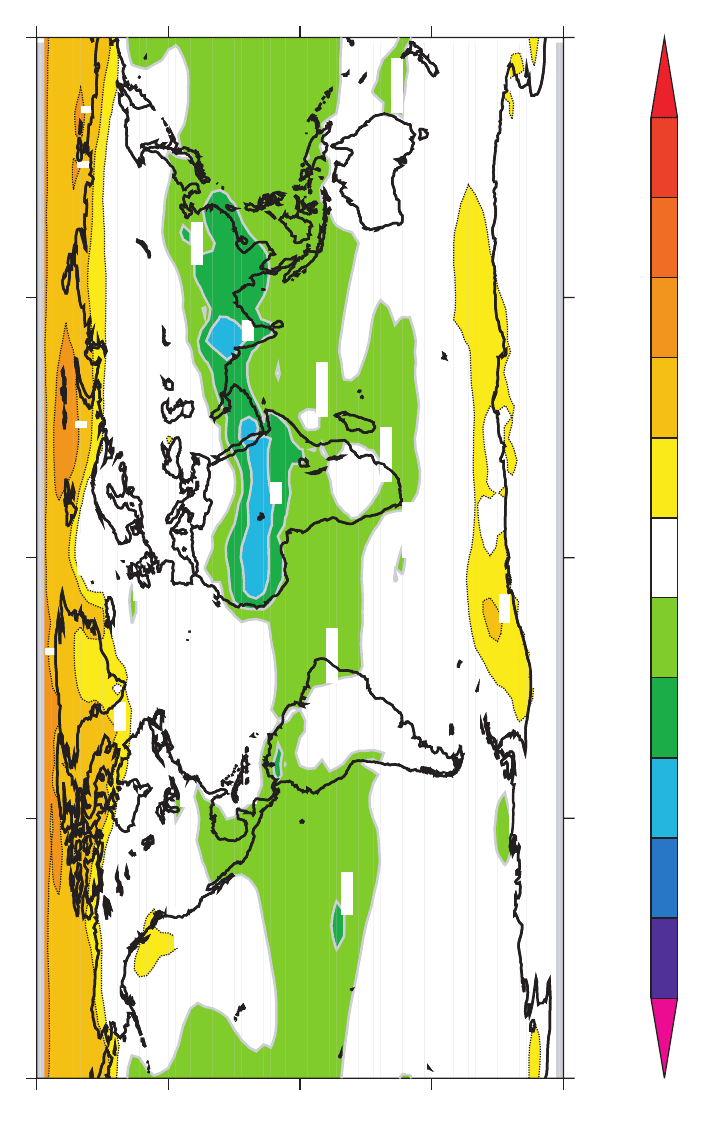
The Paleoclimate Modeling Intercomparison Project (PMIP) framed past
climate simulations (mid-Holocene and Last Glacial Maximum) with different
comprehensive climate models and organized a systematic comparison between
the model output and paleoclimatic data (Joussaume and Taylor 2000; Braconnot
et al. 2007) (Figure 4.3). Appropriate proxy models may facilitate the model–data
comparison. Proxy models are calibrated to map climate model outputs on observ-
able quantities such as the dominant biome (Haxeltine and Prentice 1996), lake
level, or glacier length (Weber and Oerlemans 2003). Climate models may also
directly include the necessary equations to simulate observable features such as
dust flux (Joussaume and Jouzel 1993a), oxygen (Joussaume and Jouzel 1993b),
carbon (Marchal et al. 1999), and boron isotopic ratios (LeGrande et al. 2006).
It was shown that climate models correctly reproduce a number of observed
features of the mid-Holocene climate: increased precipitation in the Sahel,
decreased precipitation in South America, reduced sea-ice cover in the Norwegian
Sea, northward advance of boreal forest in Russia, and reduced frequency of El
9781405159050_4_004.qxd 6/3/08 3:54 PM Page 104
Modeling the climate of the Holocene
|
105
....
–4
–3
–2
–1
–0.5
–0.25
0.25
0.5
1
2
3
4
0 180E90E180W
90W
Eq
90N
45S
45N
90S
–1
–1
–0.5
–0.5
-0.25
–0.25
–0.25
–0.25
–0.25
-0.25
–0.25
–0.25
–0.25
–0.25
0.25
0.25
0.25
0.25
0.25
0.5
0.5
1
1
1
1
0 180E90E180W 90W
Figure 4.3 Change in annual mean surface temperature induced by switching from today’s orbital forcing to that of 6000 years ago (see also Figure 4.4) as
simulated by Paleoclimate Modeling Intercomparison Project (PMIP) models (the mean model response is displayed). The plot evidences well the annual
polar warming and equatorial cooling. Sensitivity experiments suggest that the annual tropical cooling is mainly caused by the increase in obliquity and the
resulting decrease in annual mean insolation below 43° of latitude. The polar warming results from a combination of obliquity (larger annual mean
insolation, concentrated in summer) and precession (larger summer and autumn insolation). Seasonal changes in insolation are translated into an annual
temperature signal by the sea-ice feedback. Cooling of northern sub-tropical deserts is a signature of enhanced summer monsoon precipitation and the
resulting increase in surface evaporation. Note that the vegetation response was not taken into account in these experiments. (Data were supplied by
Jean-Yves Peterschmitt and extracted from the PMIP database in Saclay, France.)
9781405159050_4_004.qxd 6/3/08 3:54 PM Page 105
..
106
|
Michel Crucifix
..
Niño events (see the recent reviews by Braconnot et al. 2004; Renssen et al. 2004;
Cane et al. 2006; pioneering work is covered in Wright et al. 1993). It is then pos-
sible to decrypt the mechanisms of these climate changes by means of appropriate
sensitivity experiments. One method, known as “factor separation” (Stein and
Alpert 1993), consists in sequentially freezing certain components such as vegeta-
tion or sea-ice distribution normally calculated by the model. It was used by
Ganopolski et al. (1998) to show that hemispheric warming in response to mid-
Holocene orbital parameters results from feedbacks between boreal vegetation and
sea-ice (in the CLIMBER model) (see also Harvey 1988; Crucifix and Loutre 2002).
More generally, feedback analysis of mid-Holocene experiments has highlighted
the importance of ocean dynamics and vegetation and justified including vegeta-
tion dynamics in climate models used for future climate prediction.
Climate models are never in “perfect agreement” with data. For example, the
“IPSL” (i.e. the climate model of the “Institut Pierre et Simon Laplace” in Saclay,
France) model simulation of the mid-Holocene climate indicates, compared with
the present-day, increased aridity in central Eurasia and a northward advance of
the boreal forest’s northern limit in Canada, contrary to observations (Wohlfahrt
et al. 2004). Climate modelers tend to be very defensive when it comes to
model–data comparisons because discrepancies call the model performance into
question. This attitude is unfortunate because model–data differences contain
particularly useful information. There are at least two things the modeler would
like to know about them. First, what is their cause? Are they due to a process badly
accounted for, an inadequate boundary condition (e.g. incorrect specification of
ice sheets) or a data misinterpretation? Second, does this disagreement affect the
model’s prediction of future climate change?
A new methodology is being formalized to address these questions, called “prob-
abilistic inference with climate models” or “climate data assimilation” (Rougier
2006). The fundamental idea is to attribute explicitly uncertainty ranges to model para-
meters, which are explored by performing large ensembles of sensitivity experi-
ments. A likelihood is attributed to a parameter value depending on (i) the difference
between the model prediction obtained with this parameter value and the data-
estimate, (ii) the data uncertainty, and (iii) prior knowledge on the parameter.
This is a data assimilation because observations (temperature, precipitation, etc.)
provide explicit constraints on model parameters and/or boundary conditions.
Climate data assimilation may help us to refine estimates on phenomenological
parameters used in parameterizations. It therefore provides a formal framework to
“tuning” by clarifying which information is being used to constrain parameters
and estimate probability distribution functions on both model input and output.
The trouble with this process is that it puts a high demand on computing
resources because it requires numerous experiments. It has therefore been imple-
mented in only a few cases using modern climatic observations (Murphy et al.
2004), plus a small number of studies using large-scale estimates of the Last Glacial
Maximum temperature (Annan et al. 2005; Schneider von Deimling et al. 2006).
Examples above are based on steady-state experiments. Data assimilation also
applies to transient experiments. In short experiments (i.e., time length shorter
9781405159050_4_004.qxd 6/3/08 3:54 PM Page 106
Modeling the climate of the Holocene
|
107
..
than the dissipative time-scales of the system), data assimilation is used to provide
estimates of climate variables for which there is no direct observation (e.g. Goosse
et al. this volume) by constraining initial conditions (cf. Jones and Widdmann
2004; van der Schrier and Barkmeijer 2005). In long transient simulations, data
assimilation may be used to constrain model parameters (Hargreaves and Annan
2002) (see below).
How long will the Holocene last?
The Holocene is a particularly long episode of stable climatic conditions compared
with the three previous interglacial periods (Sirocko et al. 2007). Its stability
certainly favored the establishment of modern civilizations. What explains the
stability of the Holocene, and how long will it be?
Modeling the long-term evolution of climate requires taking into account
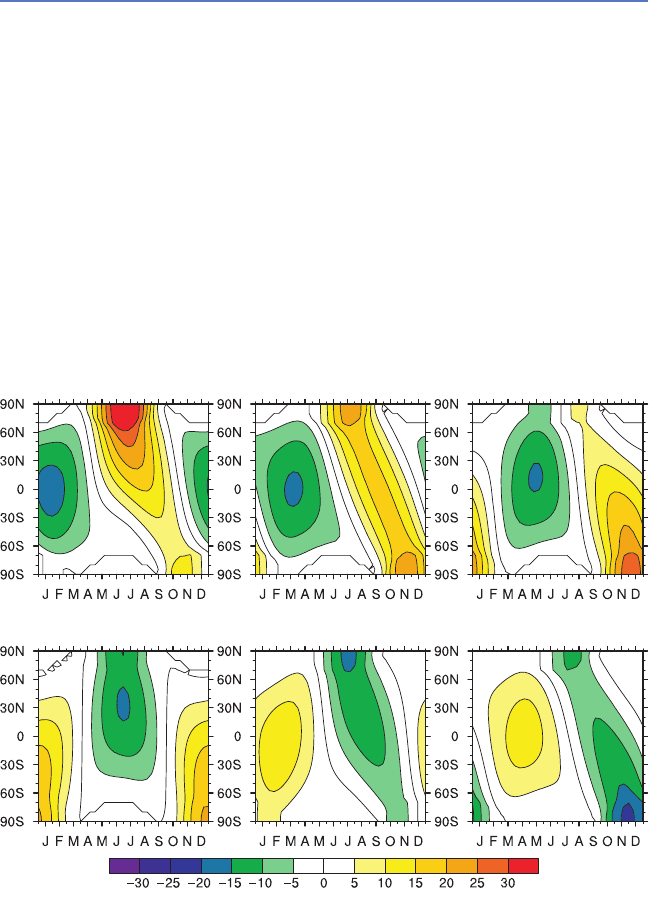
changes in the spatial and seasonal distribution of incoming shortwave radiation
(insolation) at the top of the atmosphere (Figure 4.4). The latter is fully deter-
mined by three parameters: eccentricity, obliquity, and climatic precession (Berger
1978). Eccentricity is a geometric measure of the stretching of the Earth’s orbit.
It varies between about 0.002 and 0.040 on periods of 400 000 and 100 000 years.
It is presently small (0.016) and a minimum will be reached in 27 000 years.
..
Insolation anomaly (W m
–2
)
9 kyr BP 6 kyr BP 3 kyr BP
3 kyr AP
6 kyr AP
Present
Figure 4.4 Month–latitude
distribution of incoming
shortwave radiation
(insolation) received from the
Sun at the top of the
atmosphere between 9000
years BP and 6000 years AP
(after present). A mean
distribution assuming no
eccentricity and a mean
obliquity of 23°20′ was
subtracted in order to
highlight the effects of
precession and obliquity
changes. Precession
redistributes heat across the
seasons (positive anomaly
around July 9000 years BP
and positive anomaly around
January at present). The
decrease in obliquity during
the Holocene contributes to
reduce summer insolation in
both hemispheres.
9781405159050_4_004.qxd 6/3/08 3:54 PM Page 107
..
108
|
Michel Crucifix
..
Obliquity is the angle between the Equator and the orbital plane (ecliptic). It varies
between 22 and 25° with a period of 40 000 years. Obliquity has decreased by 0.8°
during the past 9000 years, and it will continue to decrease over the next 10 000
years. As a consequence, the distribution of insolation is being slightly modified
with (i) less insolation available to the summer hemisphere, with highest differ-
ences at high latitudes, and (ii) a decrease in annual mean insolation polewards of
43°N and 43°S, symmetric about the Equator, which compensates for a corres-
ponding increase equatorwards of 43°. Changes in annual mean insolation are
small (1 to 2 W m
−2
) but provisional calculations confirmed by sensitivity experi-
ments with a comprehensive climate model reveal that the corresponding thermal
forcing easily explains sea-surface temperature changes by 0.5 to 1°C (Liu et al.
2002; Loutre et al. 2004). Precession is the cycling of the angle formed by the posi-
tion of the Earth on 21 March, the Sun, and the point of the orbit closest to the
Sun (perihelion). The cycle takes about 21 000 years. Perihelion was reached in July
11 000 years ago. It then drifted from July to later in the year. It occurs in January
today. Given that insolation decreases with the square of the Earth–Sun distance,
precession during the Holocene caused a decrease in June insolation and a corre-
sponding increase in January. Precession does not alter annual mean insolation at
any latitude. The seasonal redistributing action of precession makes it an efficient
modulator of seasonal weather systems, such as tropical monsoons (Kutzbach and
Otto-Bliesner 1982; Harrison et al. 2003; Braconnot et al. 2004). These effects
naturally become less important when eccentricity decreases as at present.
All comprehensive model experiments so far have demonstrated that orbital
forcing induces significant and measurable changes in temperature, precipitation,
and atmospheric circulation. These changes constitute the “fast” climate response
to orbital forcing, which drives – and may be altered by – the slow components of
the climate system (ice sheets, deep-ocean dynamics, ocean biogeochemistry,
vegetation) over several millennia.
Conceptual models provide a convenient theoretical framework to study free
and forced interactions between the slow components of the climate system. A par-
ticularly significant development is Saltzman’s model of the Late Cenozoic Ice
Ages (Saltzman and Maasch 1990). This three-equation model with nine para-
meters represents the interactions between the carbon cycle, ice sheets, and ocean
circulation. Probabilistic inference with this model (Hargreaves and Annan 2002)
indicates an immediate end to the Holocene, with ice volume reaching a maximum
in around 60 kyr (assuming no anthropogenic perturbation). But is this prediction
correct? For example, it is noted that the Saltzman–Maasch model fails to repro-
duce the steadily increasing trend in CO
2
concentration during marine isotope
stage (MIS) 11 (after termination V, 400 000 years ago) (Raynaud et al. 2005;
Siegenthaler et al. 2005). Therefore, some stabilizing mechanisms may have been
ignored in this model. We therefore turn to another conceptual model presented
by Paillard (2001).
Paillard’s conceptual model features three possible climate regimes (glacial,
mild glacial, interglacial) to which the system is successively attracted depending
on insolation and ice volume. Contrary to Saltzman’s, Paillard’s model succeeds in
9781405159050_4_004.qxd 6/3/08 3:54 PM Page 108
Modeling the climate of the Holocene
|
109
..
predicting the correct length for MIS 11 (two precession cycles). Paillard’s model
can then be used to predict the length of the Holocene. The result is ambiguous.
The prediction can either be a short Holocene (glacial inception already begun) or
a very long one (glacial inception in 50 kyr) depending on the model parameters.
Yet the tested parameter values seem equally reasonable: the model provides a
satisfactory fit to data of the past 800 kyr (Imbrie et al. 1984) in both cases. Only the
observation that we are presently not undergoing a glaciation allows us to reject
the first solution. In other words, the length of the Holocene would not have been
predictable 9000 years ago with Paillard’s model.
There is presently no comprehensive model or even an EMIC (see above) cap-
able of representing the interactions between the slow components of the climate
system satisfactorily enough to predict the evolution of ice volume and greenhouse
gas concentrations over several glacial–interglacial cycles. There are a few EMICs,
however, that are able to simulate the evolution of the atmosphere–ocean–ice-sheet
system on those time-scales: the LLN-2D model (Gallée et al. 1991, 1992),
CLIMBER-2 (Petoukhov et al. 2000; Calov et al. 2005), and the Toronto climate–
ice-sheet model (Tarasov and Peltier 1999). The LLN-2D model is particularly suit-
able to study the evolution of ice volume in response to hypothetical CO
2
scenarios
and orbital forcing because it successfully reproduces several past glacial–interglacial
cycles assuming that the evolution of greenhouse gas concentrations is correctly
prescribed (Loutre and Berger 2003).
Both CLIMBER and LLN-2D consistently show no glacial inception during the
Holocene when observed CO
2
concentrations are prescribed (Claussen et al. 2005;
Loutre et al. 2007). Other CO
2
scenarios were then tested. Neither LLN-2D nor
CLIMBER predicted a modern glacial inception as long as CO
2
remained above
240 ppmv during the Holocene. The LLN-2D further shows that even if CO
2
con-
centration decreased in the future down to glacial levels, glaciation will not occur
before 50 000 years (Loutre et al. 2007).
The quasi-absence of precessional forcing due to the weak eccentricity may
therefore explain the exceptional stability of the Holocene. This statement, how-
ever, calls for a few clarifications. First, sensitivity experiments with the LLN-2D
model suggest that there is actually a window, roughly between −5000 and +5000
years from now, during which a low enough CO
2
concentration (below 240 ppmv)
induces a glacial inception (Figure 4.5, red line). This is consistent with sensitivity
experiments with a more comprehensive model calibrated on the present-day
climate showing accumulation of perennial snow for 240 ppmv CO
2
and 450 ppbv
CH
4
(Ruddiman et al. 2005) (the methane feedback is implicitly taken into account
in the LLN-2D via the model calibration on previous glacial–interglacial cycles).
These results confirm Paillard’s prediction that the present orbital configuration
may be compatible with a glacial inception (Paillard 2001), but they also show that
the inception scenario is no longer possible given the present CO
2
concentration.
Second, the LLN-2D predicts a three-precession cycle duration for MIS 11 when
forced by the Vostok CO
2
concentrations (Petit et al. 1999), but sensitivity experi-
ments with slightly lower CO
2
concentrations result in a short MIS 11 (Loutre and
Berger 2003). Paillard (2001) also found that small parameter changes may make
..
9781405159050_4_004.qxd 6/3/08 3:54 PM Page 109