
Battarbee R.W., Binney H.A. (Eds.) Natural Climate Variability and Global Warming: A Holocene Perspective
Подождите немного. Документ загружается.

..
130
|
Eystein Jansen et al.
..
insolation, as was the case for the early to mid-Holocene, would exacerbate this
feature, stabilize the surface layer in the warm season, and produce a stronger
contrast between the euphotic zone proxies and those derived from thermocline
species.
For the thermal maximum this implies that the strong solar insolation
maximum of the early to mid-Holocene originating from summer season orbital
forcing did not manifest itself below the euphotic zone, and was only captured
by the temperature reconstructions derived from phytoplankton with an upper
surface ocean habitat. The difference between the alkenone- and diatom-based
SST reconstructions is most likely due to the calibration of the methodologies. The
diatom transfer functions are calibrated to surface August temperatures, whereas
alkenones are mainly produced in the spring season and calibrated to the mean
annual temperatures of the uppermost surface layer. Those foraminiferal species
(e.g. Globigerina bulloides) that normally calcify above the summer-time thermo-
cline would be expected to show the same pattern as phytoplankton-based proxies.
For foraminiferal-based transfer functions the higher degree of stratification will
give a mixed response depending on the blend of species with surface or thermo-
cline habitat preference. In the Nordic Seas, thermocline species dominate the
100
80
60
40
20
0
6 7 8 9 10 11 12
Depth (m)
Annual
Winter
Spring
Summer
Temperature (°C)
(a)
(b)
50
0
10
25
100
5
6
7
8
9
10
11
12
13
1950 1960 1970 1980 1990
2000
5
6
7
8
9
10
11
12
13
1950 1960 1970 1980 1990
2000
5
6
7
8
9
10
11
12
13
1950 1960 1970 1980 1990 2000
Winter
Spring
Summer
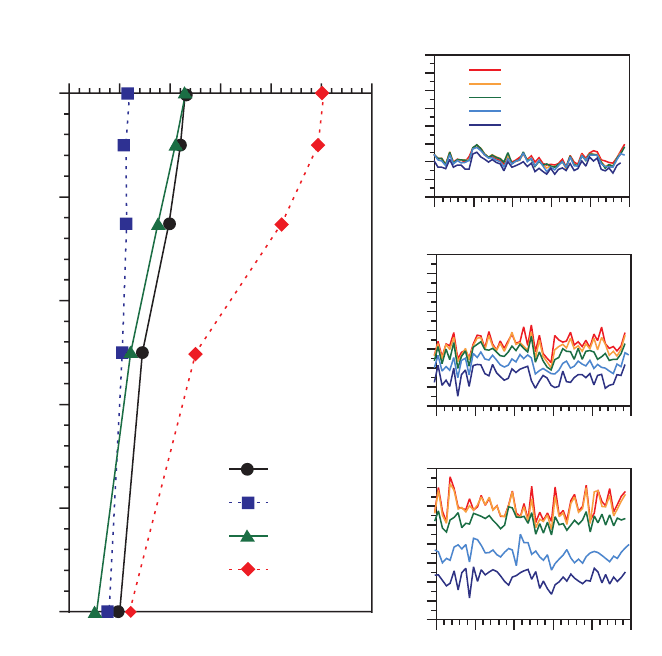
Figure 5.6 (a) Seasonal and
annual water temperature
averages for the last 50 years
from Ocean Weather Ship
Mike in the upper 100 m of
the water column. The
averages are based on the
temperature records
presented in (b). (From
(Nyland et al. 2006.)
9781405159050_4_005.qxd 6/3/08 3:55 PM Page 130
The thermal optimum in the North Atlantic
|
131
..
foraminiferal assemblage and the resulting transfer function temperatures are
consistent with the O-isotope-based records (Andersson et al. 2003; Risebrobakken
et al. 2003). As a consequence of these findings, the wide use of N. pachyderma, as
well as foraminiferal transfer functions in paleoceanographic studies from high-
latitude areas, should be qualified with the information that the reconstruction is
primarily that of temperature in the thermocline, and thus reflects winter-time or
annual mean temperatures.
Dynamical responses or radiative forcing only?
So far we have seen that the seasonal character of orbital forcing explains the
thermal maximum and also the temperature reconstructions that do not display
any early to mid-Holocene optimum. The difference between the data-sets reflects
seasonality anomalies. It has also been inferred that the early to mid-Holocene
thermal maximum reflects enhanced advection of heat, either in the form of
advection of warmer waters from the North Atlantic, by stronger advection of
Atlantic waters towards the Arctic or by enhanced activity of the Westerlies (e.g. a
mechanism akin to that described by Blindheim et al. 2000).
The MD95-2011 data rule out the existence of an advection of North Atlantic
warm water anomalies to the north. The core location lies underneath the main
flow path of Atlantic waters towards the Arctic. At present, the thickness of the
Atlantic water layer in this area is 400–600 m, much thicker than the suggested
depth distribution of the proxy temperature recorders from the site (Figure 5.5).
The advective time constant of the present Norwegian Sea from south to north is in
the order of several years (Skagseth 2004). Therefore, an advective temperature
anomaly would be expected to override seasonal changes and be manifested down
to several hundred meters water depth. The thermal maximum is, however, only
manifest in the upper 50 m, which implies that it is attributable to the radiative
forcing from the orbital configuration. This is consistent with the model results of
Liu et al. (2003) who found a difference between the surface layer and thermocline
waters in the model’s response to orbital forcing. It remains to be tested if this is a
robust feature of model behavior in the Nordic Seas.
Ruling out advective transport of warm water anomalies as an explanation, it is
possible that oceanic heat fluxes towards the Arctic, larger than later in the
Holocene, could have occurred. One possible case is that a larger heat flux could
have been contained in stronger along-slope currents, similar to the positive mode
of the North Atlantic Oscillation (NOA) observed in recent decades (Blindheim
et al. 2000; Skagseth 2004). The available data cannot register such a situation with
stronger flow of warm waters towards the Arctic and without any change in the
mean temperature of the Atlantic water masses. There is, at present, no reliable
kinetic flow proxy data-set from which to evaluate this aspect. Nevertheless, it
seems likely that the polar amplification of the thermal maximum is mainly due to
the polar amplification of orbital forcing and to sea-ice albedo feedbacks due to the
summer insolation anomaly, as also noted from the PMIP2 models depicted in
..
9781405159050_4_005.qxd 6/3/08 3:55 PM Page 131

..
132
|
Eystein Jansen et al.
..
Crucifix (this volume, Figure 4.3). This is also consistent with the shorter duration
and early timing of the maximum temperatures near the present sea-ice margin,
which implies a connection to the time of the strongest insolation anomaly along
the sea-ice margin. Further to the south the maximum temperatures occurred
later, after 8 ka (Figure 5.5), and continued at times when temperatures close to the
present sea-ice margin had started to fall (Sarnthein et al. 2003; Kim et al. 2004;
Hald et al. personal communication). Thus the polar amplification does not
appear to be mainly due to advection of oceanic heat.
Holocene climate variability
Internal variability is an inherent part of the climate system. On sub-orbital time-
scales internal variability of the ocean and ocean–atmosphere systems has been
used to attribute the Atlantic Multi-decadal Oscillation (e.g. Sutton and Hodson
2005) to multi-century to millennial variability (e.g. Schulz et al. 2007), primarily
suggesting an origin from low-frequency variations in the Atlantic Meridional
Overturning Circulation.
Some studies have suggested that there may have existed different prevailing
atmospheric patterns in the early to mid-Holocene than in recent times, indicating
that atmospheric forcing might have influenced the ocean response and vice
versa. Rimbu et al. (2004), comparing the alkenone data-set for the Northern
Hemisphere of Kim et al. (2004) with climate model experiments, note that the
SST anomaly pattern appears to be similar to the tripole pattern of the positive
phase of the NAO, suggesting a prevailing situation with a stronger tendency
for meridional ocean and atmosphere heat transport in the eastern sector of the
high-latitude North Atlantic realm. This pattern of model response to 6 ka orbital
forcing is, however, not robust when comparing the coupled AOGCMs used in the
PMIP2 experiments. A PMIP2 model–model intercomparison shows that three of
the nine models support a positive NAO-like atmospheric circulation in the mean
state for the mid-Holocene as compared with the pre-industrial period without
significant changes in simulated NAO variability (Gladstone et al. 2005). Some
observational evidence comes from lake studies in northern Scandinavia, indicat-
ing a generally more maritime climate in the early to mid-Holocene than in the late
Holocene (Hammarlund et al. 2002). A general feature of NAO-related responses
in northern Europe is a strong increase in winter precipitation in years of positive
NAO index, i.e. the pattern indicated by Rimbu et al. (2004). When combining
several glacier mass balance records and calculating the winter precipitation
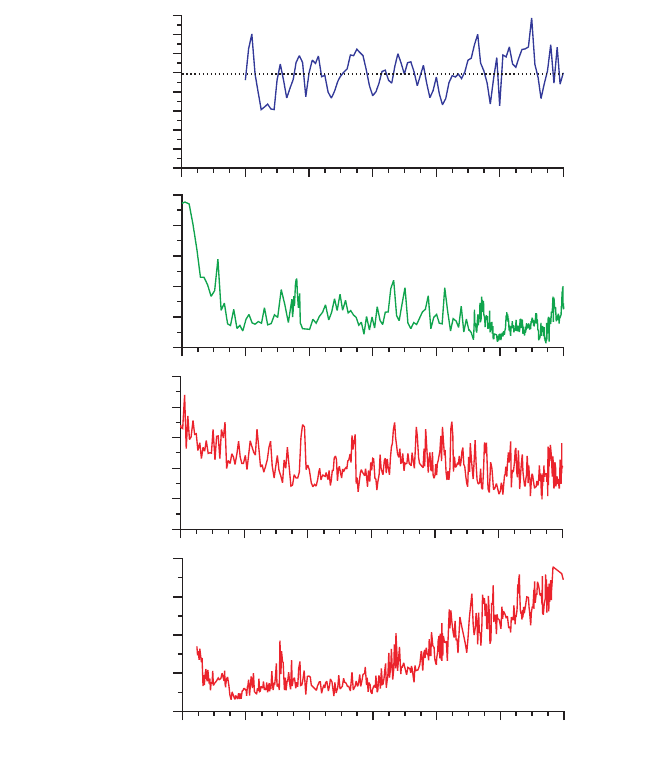
contribution to Norwegian glaciers, Nesje (personal communication) (Figure 5.7)
finds no strong early to mid-Holocene winter precipitation maximum, thus
documenting lack of evidence for a general NAO positive state. Rather, the glacier-
based precipitation records follow the pattern of cold intervals punctuating the
overall trends and occurring at century to millennial time-scales. This is com-
parable to the pattern of warm and cold phases seen in many other records.
9781405159050_4_005.qxd 6/3/08 3:55 PM Page 132
The thermal optimum in the North Atlantic
|
133
..
A feature of many Holocene climate records is that variability on century to
multi-century time-scales often displays somewhat lower amplitudes between
about 8 and 6 ka, and a tendency for an increased amplitude of the variability
towards present (see Figures 5.5 and 5.7). In a number of records there is strong
variability in the early Holocene with the 8.2 ka event being probably the most
pronounced. Since much of this variability and the 8.2 ka event may plausibly be
linked with the final demise of the large Northern Hemisphere ice sheets and thus
have a dynamical origin from Ice-Age processes, we focus here on the evolution
after the 8.2 ka event. In Figure 5.5 it is apparent that the amplitude of multi-
century to millennial scale variability is not stationary through the Holocene.
Risebrobakken et al. (2003) showed that there is an increase in the amplitude of
century to millennial scale variability after the mid-Holocene, and that there is very
little persistence in the main frequencies of variability through the Holocene. The
..
0
20
40
60
80
100
.Namredyhcap)%( )nis(
A
g
e years BP
0
20
40
60
80
100
120
140
160
)%( noitatipicerp retniW
1
2
2
3
3
4
0
0.04
0.08
0.12
0.16
12 000 10 000 8000 6000 4000 2000 0
oitar galP/ztrQ
oitar galP/ztrQ
MD99-2269
(a)
(b)
(c)
(d)
MD95-2011
MD95-2011
Average from 4 Norwegian glaciers
Figure 5.7 (a) Mean winter
(October–April) precipitation
in percent of 1961–90 mean
(= 100%) calculated from
Jostedalsbreen, Folgefonna,
Spørteggbreen, and
Bjørnbreen (compilation by
Atle Nesje, personal
communication). (b) Relative
percent Neogloboquadrina
pachyderma (sin) in MD95-
2011 (Andersson et al. 2003;
Risebrobakken et al. 2003).
(c) Ice-rafting proxy data
(quartz/plagioclase ratio)
from cores MD95-2011 and
(d) MD99-2269 (Moros et al.
2006).
9781405159050_4_005.qxd 6/3/08 3:55 PM Page 133
..
134
|
Eystein Jansen et al.
..
noticeable increased amplitude after about 4 ka in the Nordic Seas thermocline
temperature (Figure 5.5) and sea-ice proxies (Figure 5.7) indicates increased
climate variability affecting winter-time conditions. This pattern is also generally
consistent with the onset of neoglaciation in Europe (Nesje et al. 2000) and an
increase in Arctic sea-ice cover (Koç and Jansen 1994).
We do not have evidence of stronger external forcing throughout the pre-
industrial Holocene. It is therefore likely that the nonstationary aspect of the vari-
ability indicates that the stronger century to millennial scale variability is excited by
changes in boundary conditions, which amplify processes occurring at time-scales
of more than 100 years. The amplitude of millennial to sub-millennial scale
variability appears potentially linked with sea-ice extent, Northern Hemisphere
snow cover, and ocean surface temperature, and indicates that increased sea-ice
cover following the reduced summer insolation may have put in place amplifica-
tion mechanisms leading to stronger ocean temperature variability. One plausible
mechanism, drawing on the general trends of orbital forcing through the
Holocene, is that the reduction in boreal summer insolation and a less pronounced
summertime surface ocean stratification induced sea-ice/snow albedo feedbacks
which drove the overturning circulation past a threshold into a more variable
mode of operation. In the absence of a clear attribution of this variability to exter-
nal forcings (e.g. solar, volcanic; e.g. Risebrobakken et al. 2003), it appears most
likely that the century to millennial scale variability is primarily caused by the long
time-scale internal dynamics of the climate system.
Moros et al. (2006) (Figure 5.7) published records of ice-rafted debris (IRD)
in the form of quartz content of marine sediments, presumed to originate from
melting sea-ice. The data show a strong increase in the drift-ice occurrence off East
Greenland in the latest half of the Holocene. This is coherent with orbital forcing,
which led to an increased sea-ice cover in the marginal ice zone. Koç and Jansen
(1994) found a similar pattern based on sea-ice diatom records, although this
study had a much lower temporal resolution. The IRD record from the central
Nordic Seas basically follows the foraminiferal temperature data (Figure 5.7), indi-
cating that sea-ice here is related to protrusions of colder waters to the south-east
and probably related to changes in atmospheric dynamics. The IRD record from
the central Nordic Seas is, in a number of aspects, similar to the IRD data of Bond
et al. (2001), although the different methods and temporal resolution do not make
a detailed correlation possible. Overall, the data of Bond et al. as well as the IRD
data from the Nordic Seas indicate that there is not one single sea-ice response in
the region and that the general sea-ice response appears as one following the
orbital forcing, but punctuated by colder intervals at millennial to century scales
with increased presence of sea-ice and colder thermocline temperatures. As first
noted by Risebrobakken et al. (2003), there is not a single persistent variability in
the high-latitude North Atlantic through the Holocene. The emergence of higher
amplitude millennial scale variability in many records appears to be linked to a
threshold reached after the thermal optimum, and caused by decreased summer
insolation and seasonality. The winter-time precipitation records are in line with
this evidence, indicating that the cold intervals in the ocean records are linked with
a colder, less moist winter-time climate over Scandinavia.
9781405159050_4_005.qxd 6/3/08 3:55 PM Page 134

The thermal optimum in the North Atlantic
|
135
..
Conclusions
The early to mid-Holocene thermal maximum is clearly documented in SST records
in the high-latitude North Atlantic–Nordic Seas, with a polar amplification, and an
earlier and shorter lasting extension in the areas near the modern sea-ice limit in
the Nordic Seas than to the south. Further south, the maximum is most clearly
expressed between 8 and 6 ka. In the Irminger Sea the maximum SSTs were
delayed, probably due to downwind effects from the remnants of the Laurentide
Ice Sheet.
The maximum is expressed by proxy records which sample the uppermost
surface layer above the seasonal thermocline. Proxy data from recorders that
sample the sub-surface do not document the maximum temperatures. This shows
that the SST maximum is mainly forced by the summer insolation maximum and
sub-surface proxy data that reflect annual mean or winter-time conditions are not
influenced by the summer-time insolation forcing.
The origin of the thermal maximum is primarily from orbital forcing and not
advection of SST anomalies from the south. It is difficult to attribute the thermal
maximum to long-term persistent atmospheric patterns.
Superimposed on the SST trends is century to millennial scale climate variabil-
ity. This variability does not occur as a stationary response to specific external
forcing, but appears primarily to be induced and later amplified after the thermal
maximum by changes in climate system internal dynamics.
Acknowledgments
The authors are grateful to Atle Nesje for compiling winter precipitation data and
to Øyvind Lie and Trond Dokken for fruitful discussions and comments. This
study is an outcome of the NORPAST-2 project funded by the Norwegian
Research Council, and the MOTIF and PACLIVA projects funded by the European
Union. This is publication A174 from the Bjerknes Centre.
References
Andersen C., Koç N., Jennings A. & Andrews J.T. (2004) Non-uniform response of
the major surface currents in the Nordic Seas to insolation forcing: implications
for the Holocene climate variability. Paleoceanography, 19(2): Art. No. PA2003
APR 6.
Andersson C., Risebrobakken B., Jansen E. & Dahl S.O. (2003) Late Holocene sur-
face ocean conditions of the Norwegian Sea (Voring Plateau). Paleoceanography,
18(2): Art. No. 1044 JUN 4.
Berner K.S. (2006) Variability of the two main branches of the North Atlantic Drift
through the Holocene. PhD thesis, University of Tromsø.
..
9781405159050_4_005.qxd 6/3/08 3:55 PM Page 135
..
136
|
Eystein Jansen et al.
..
Bjune A.E., Bakke J., Nesje A. & Birks H.J.B. (2005) Holocene mean July tempera-
ture and winter precipitation in western Norway inferred from palynological
and glaciological lake-sediment proxies. The Holocene, 15, 177–189.
Blindheim J., Borovkov V., Hansen B., Malmberg S.A., Turrell W.R. & Østerhus S.
(2000) Upper layer cooling and freshening in the Norwegian Sea in relation to
atmospheric forcing. Deep-Sea Research Part I–Oceanographic Research Papers,
47, 655–680.
Bond G., Kromer B., Beer J., et al. (2001) Persistent solar influence on north
Atlantic climate during the Holocene. Science, 294, 2130–2136.
Calvo E., Grimalt J.O. & Jansen E. (2002) High resolution Uk37 sea surface tem-
perature reconstruction in the Norwegian Sea during the Holocene. Quaternary
Science Reviews, 21, 1385–1394.
Crucifix M. (this volume) Modelling the climate of the Holocene. In: Global
Warming and Natural Climate Variability: a Holocene Perspective (Eds R.W.
Battarbee & H.A. Binney), pp. 98–122. Blackwell, Oxford.
Duplessy J.C., Cortijo E., Ivanova E., et al. (2005) Paleoceanography of the Barents
Sea during the Holocene. Paleoceanography, 20 (4): Art. No. PA4004 OCT 7.
Dutkiewicz S., Sokolov A., Scott J. & Stone P. (2005) A Three-dimensional Ocean–
Sea-ice–Carbon Cycle Model and its Coupling to a Two-dimensional Atmospheric
Model: Uses in Climate Change Studies. MIT Joint Program on the Science and
Policy of Global Change, Report 122. http://web.mit.edu/globalchange/www/
MITJPSPGC_Rpt122.pdf.
Gladstone R.M., Ross I., Valdes P.J., et al. (2005) Mid-Holocene NAO: a PMIP2
model intercomparison. Geophysical Research Letters, 32(16): Art. No. L16707
AUG.
Hall I.R., Bianchi G.G. & Evans J.R. (2004) Centennial to millennial scale
Holocene climate-deep water linkage in the North Atlantic. Quaternary Science
Reviews, 23, 1529–1536.
Hammarlund D., Barnekow L., Birks H.J.B., Buchardt B. & Edwards T.W.D.
(2002) Holocene changes in atmospheric circulation recorded in the oxygen-
isotope stratigraphy of lacustrine carbonates from northern Sweden. The
Holocene, 12, 339–351.
Jansen E., Overpeck J., Briffa K.R., et al. (2007) Palaeoclimate. In: Climate Change
2007: the Physical Science Basis. Contribution of Working Group I to the Fourth
Assessment Report of the Intergovernmental Panel on Climate Change (Eds S.
Solomon, D. Qin, M. Manning, et al.), Cambridge University Press, Cambridge.
Kim J.-H. & Schneider R.R. (2004a) GHOST Global Database for Alkenone-derived
6ka Sea-surface Temperatures. http://www.pangaea.de/Projects/GHOST/.
Kim J.-H. & Schneider R.R. (2004b) GHOST Global Database for Alkenone-derived
Holocene Sea-surface Temperature Records. http://www.pangaea.de/Projects/
GHOST/.
Kim J.-H., Rimbu N., Lorenz S.J., et al. (2004) North Pacific and North Atlantic
sea-surface temperature variability during the Holocene. Quaternary Science
Reviews, 23, 2141–2154.
9781405159050_4_005.qxd 6/3/08 3:55 PM Page 136
The thermal optimum in the North Atlantic
|
137
..
Koç N. & Jansen E. (1994) Response of the high-latitude Northern-Hemisphere to
orbital climate forcing – Evidence from the Nordic Seas. Geology, 22, 523–526.
Liu Z., Brady E. & Lynch-Stieglitz J. (2003) Global ocean response to orbital forc-
ing in the Holocene. Paleoceanography, 18(2): Art. No. 1041 MAY 22.
Moros M., Andrews J.T., Eberl D.D. & Jansen E. (2006) Holocene history of drift
ice in the northern North Atlantic: evidence for different spatial and temporal
modes. Paleoceanography, 21(2): Art. No. PA2017 JUN 8.
Nesje A., Dahl S.O., Andersson C. & Matthews J.A. (2000) The lacustrine sedimentary
sequence in Sygneskardvatnet, western Norway: a continuous, high-resolution
record of the Jostedalsbreen ice cap during the Holocene. Quaternary Science
Reviews, 19, 1047–1065.
Nyland B.F., Jansen E., Elderfield H. & Andersson C. (2006) Neogloboquadrina
pachyderma (dex. and sin.) Mg/Ca and delta O-18 records from the Norwegian
Sea. Geochemistry Geophysics Geosystems, 7: Art. No. Q10P17 OCT 12.
Renssen H., Goosse H., Fichefet T., Brovkin V., Driesschaert E. & Wolk F. (2005)
Simulating the Holocene climate evolution at northern high latitudes using a
coupled atmosphere–sea ice–ocean–vegetation model. Climate Dynamics, 24,
23–43.
Rimbu N., Lohmann G., Lorenz S.J., Kim J.H. & Schneider R.R. (2004) Holocene
climate variability as derived from alkenone sea surface temperature and cou-
pled ocean–atmosphere model experiments. Climate Dynamics, 23, 215–227.
Risebrobakken B., Jansen E., Andersson C., Mjelde E. & Hevroy K. (2003) A high-
resolution study of Holocene paleoclimatic and paleoceanographic changes in
the Nordic Seas. Paleoceanography, 18(1): Art. No. 1017 MAR 26.
Sarnthein M., Van Kreveld S., Erlenkeuser H., et al. (2003) Centennial-to-millennial-
scale periodicities of Holocene climate and sediment injections off the western
Barents shelf, 75 degrees N. Boreas, 32, 447–461.
Schulz M., Prange M. & Klocker A. (2007) Low-frequency oscillations of the
Atlantic Ocean meridional overturning circulation in a coupled climate model.
Climate of the Past, 3, 97–107.
Seppä H., Hammarlund D. & Antonsson K. (2005) Low-frequency and high-
frequency changes in temperature and effective humidity during the Holocene
in south-central Sweden: implications for atmospheric and oceanic forcings of
climate. Climate Dynamics, 25, 285–297.
Skagseth Ø. (2004) Monthly to annual variability of the Norwegian Atlantic slope
current: connection between the northern North Atlantic and the Norwegian
Sea. Deep-Sea Research Part I-Oceanographic Research Papers, 51, 349–366.
Sutton R.W. & Hodson D.L.R. (2005) Atlantic Ocean Forcing of North American
and European Summer Climate. Science, 309.
..
9781405159050_4_005.qxd 6/3/08 3:55 PM Page 137

....
6
Holocene climate change
and the evidence for solar
and other forcings
Jürg Beer and Bas van Geel
Keywords
Climate change, solar forcing, orbital forcing, volcanic forcing, 850 bc climate event, socio-
economic impacts
Introduction
Future climate change may have considerable effects on the hydrologic cycle and
temperature, with significant consequences for sea level, food production, world
economy, health, and biodiversity. How and why does the natural climate system
vary on decadal to millennial time-scales? Do we sufficiently understand natural
climate change, and what is the relative importance of natural processes versus
human activities in explaining the global warming of the last few decades? How
much of the recent warming is induced by natural (solar, volcanic) rather than
anthropogenic forcing?
In addition to historical documents produced by people observing environmental
change, nature itself provides a wealth of information stored in various archives
such as ice cores, sediments, tree rings, and speleothems. A growing proportion of
this stored information can be deciphered thanks to impressive developments in
analytic techniques (cf. Birks, this volume). An increasingly clear view of the past
environment is emerging. We are still far away, however, from having a complete
picture of all the physical, chemical, and biological processes involved. The main
problem is identifying all the relevant processes and quantifying the forcing fac-
tors, and the corresponding response of the numerous interlinked components of
the climate system (atmosphere, hydrosphere, cryosphere, biosphere). Therefore,
any primary change will trigger a chain of secondary reactions, some of which
amplify the primary change (positive feedback). These positive feedback mechan-
isms occur on very different time-scales, ranging from minutes (e.g. the ozone
chemistry in the stratosphere) to millennia (e.g. the formation of continental
ice sheets).
9781405159050_4_006.qxd 6/3/08 5:08 PM Page 138

Holocene climate change and solar and other forcings
|
139
..
In this chapter we give an overview of the mechanisms causing natural climate
change on decadal to millennial time-scales. Proxy climate records provide the
basis for both a better understanding of the processes involved, and for testing cli-
mate models. Based on selected literature from high-resolution Holocene records
of climate change, we evaluate the role of the various potential forcing factors.
Forcing mechanisms
The climate system generally can be described in terms of energy transport. The
main energy source is the Sun, which emits electromagnetic radiation with wave-
lengths covering the full spectrum and peaking in the visible part (400–750 nm).
On its way through the atmosphere to the Earth’s surface, part of this radiation is
reflected, scattered, or absorbed. The absorbed energy (~70 percent) is ultimately
re-emitted into space with much longer wavelengths. Since the incoming solar
radiation covers only half the globe (day side) and peaks at low latitudes, there are
permanent energy gradients on the Earth’s surface, which the climate system tries
to eliminate by transporting energy through the atmosphere and the ocean (ther-
mohaline circulation).
All the radiative processes depend strongly on the composition of the atmo-
sphere (gases, aerosols, dust, clouds), which provide another level of complexity, as
these components are strongly connected to chemical, thermal, and dynamical
changes taking place in the atmosphere on vastly differing time-scales.
Any change in these complex processes can force the climate to change. We
distinguish between external (orbital and solar) and internal (volcanic and ocean
circulation) forcings which we will address in the following sections.
Orbital forcing
The amount of solar radiation arriving at a given point on the top of the atmo-
sphere depends on the solar luminosity (the total amount of radiation emitted by
the Sun) and the relative position of Sun and Earth in space (distance, direction of
the Earth’s rotational axis relative to the ecliptic). Whereas the former depends on
processes taking place within the Sun, the latter is determined by the distortion of
the Earth’s orbit by the gravitational forces of the other planets (mainly Jupiter and
Saturn) (Laskar et al. 2004). Orbital forcing affects three parameters with typical
periodicities: the eccentricity (the deviation of the orbit from a circle, with periods
of ~400 and ~100 kyr), the obliquity (the tilt angle of the Earth’s axis with a period
of ~40 kyr), and the precession of the Earth’s axis (~20 kyr period). Whereas the
eccentricity leads to changes in the mean annual distance between Sun and Earth,
and therefore to changes in the total incoming radiation, the other two parameters
affect only the relative distribution of the solar radiation, with implications for the
energy transport within the climate system. At the time-scale of the Holocene,
..
9781405159050_4_006.qxd 6/3/08 5:08 PM Page 139