
Battarbee R.W., Binney H.A. (Eds.) Natural Climate Variability and Global Warming: A Holocene Perspective
Подождите немного. Документ загружается.

..
70
|
Frank Oldfield
..
direct. Once human activities are superimposed on these relationships, forcing-
response linkages often become even more difficult to discern and characterize as
more processes interact to introduce additional thresholds and delays in response
(e.g. Trimble and Lund 1982; Wasson and Sidorchuk 2000).
Most reconstructions spanning the whole period of human impact on land-
cover are based on calculations of sediment yield from lake sediment studies.
In interpreting sediment yield calculations from lake sediment studies, the effects
of catchment size on sensitivity to perturbations, as well as on yield as a percentage
of total erosion, must be borne in mind (Dearing and Jones 2003). One implication
of the summary in Dearing and Jones is that the most sensitive systems are likely
to be small catchments with minimal sediment storage within the drainage net.
On the other hand, these may be least representative of processes occurring at a
regional scale.
Deforestation and the creation of more open, especially tilled landscapes, has
the effect of reducing rainfall interception and evapotranspiration, exposing more
of the land surface to rain-splash impact, and increasing hydrologic efficiency
within river catchments. These effects tend to increase sediment delivery as well as
to increase the volume of material derived from surface soil and slope wash, rather
than from within-channel sources, although within-channel instability may also
be triggered by land-cover-driven changes in hydrology. These effects are addi-
tional to those arising from changed feedback to atmospheric processes considered
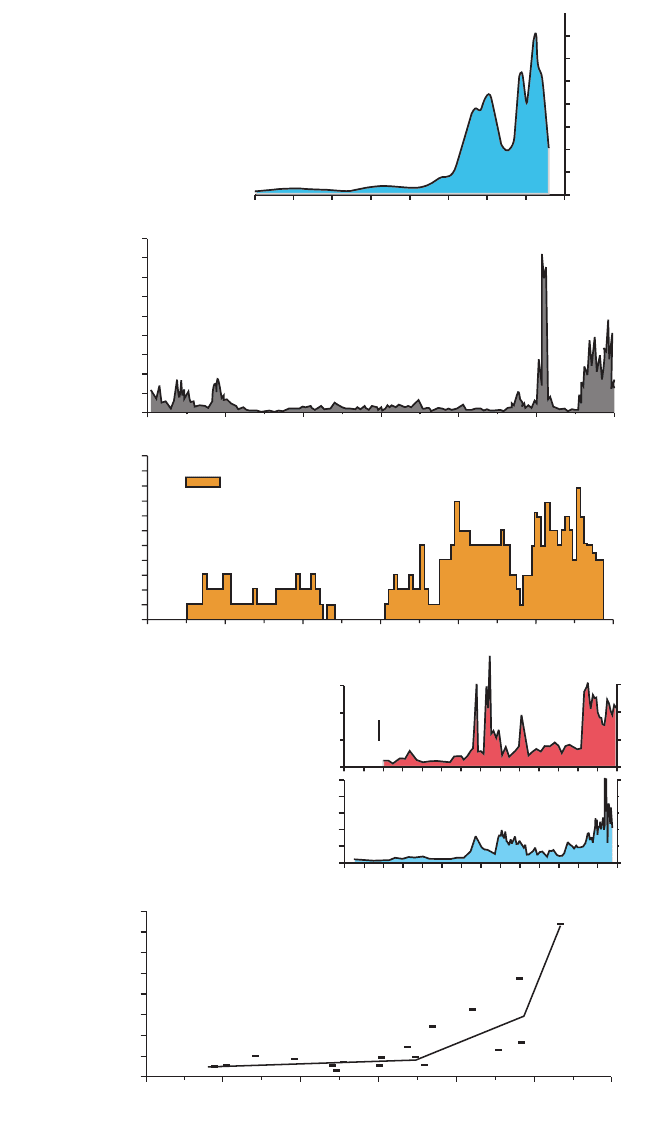
above. Figure 3.6 shows some European examples of mainly lake-sediment-budget
studies illustrating links between sediment yield and human occupation of the
catchment. In all cases, there are clear links between the history of human occupa-
tion and sediment yield, but they only emerge when the time frame exceeds the
shorter time-scales on which individual flood events have been documented.
Foster et al. (2003), in stating that “as the time scale of observation becomes
shorter, changes in climate and hydro-meteorological conditions become progres-
sively more important” echo earlier observations in a range of environmental con-
texts (cf. Messerli et al. 2000). Equally, as the time perspective lengthens, the role of
human activities in transforming the landscape upon which climate variability acts
often becomes more important (Lang et al. 2000; Sidorchuk 2000).
Moving beyond Europe to other long-settled parts of the world, a growing
number of Chinese studies are shedding a similar light on the impact of human
activities on erosion and sedimentation. Xu (1999) in his study of the Yellow River
detects a sharp increase in mean sediment accumulation rate as a result of
increased human impacts over the past two to three millennia, as do Saito et al.
(2001) in their calculations based on deltaic sedimentation at the mouths of both
the Yangtze and Yellow rivers. These inferences are strongly reinforced by He et al.
(2006) who detect a sharp increase in erosion rates over the same period on the
Loess Plateau of China, culminating in rates some four times those prevailing
before significant anthropogenic impact. The impact of these changes on sediment
delivery during the extreme flood event of 1998 is evaluated in a simulation study
by Xu et al. (2005). Alongside these studies based on major regions and river
systems, detailed multi-disciplinary research on individual lake catchments is
9781405159050_4_003.qxd 6/3/08 3:53 PM Page 70
The role of people in the Holocene
|
71
....
MiM
MiM-flux
(mg cm
–2
a
–1
)
Sediment load (t yr
–1
)
180
160
140
120
100
80
60
40
20
0
(a)
(b)
(c)
1.6
1.4
1.2
1.0
0.8
0.6
0.4
0.2
0
Mean sedimentation rate
(cm yr
–1
)
Thousand years BP
024681012
Number of dated alluvial
units per 100 years
10.0
9.0
8.0
7.0
6.0
5.0
Alluvial units
Relative frequency
40
30
20
10
0
8
IR-OSL age
76543210
76543210
120
80
40
0
0.5
0
χ
fd
flux
(d)
(e)
(f)
024681012
024681012
Figure 3.6 Long-term
changes in sediment yields
from lake sediments and
alluvial sequences.
(a) Frequency of OSL-dated
soil-erosion-derived
sediments from the loess hills
of southern Germany (Lang
2003). (b) Sediment
accumulation rates at
Holzmaar, western Germany
(Zolitschka 1998).
(c) Frequency of dated alluvial
units in British rivers
(Macklin 1999). (d) Changes
in the deposition of inorganic
mineral matter at Lago di
Mezzano, central Italy
(Ramrath et al. 2000).
(e) Depositional flux of
magnetic minerals derived
from soil erosion into the
mid-Adriatic core RF 93-30
(see Figure 3.4). (f) Alluvial
accumulation rates in the
Yellow River, China (Xu
1999). Note the close parallels
(allowing for some
imprecision in chronologies)
between (a) and (b) and
between (d) and (e).
(Reproduced from Oldfield
F. (2005) Environmental
Change: Key Issues and
Alternative Approaches.
Cambridge University
Press, Cambridge.)
9781405159050_4_003.qxd 6/3/08 3:53 PM Page 71

..
72
|
Frank Oldfield
..
beginning to shed important light on the links between China’s long history of
human occupation and the effects on erosion and sediment accumulation rates. In
a wide-ranging study of Erhai Lake in south-west China (see summary in Dearing,
2006) detectable human impact on the landscape is shown to stretch back at least
7000 years, with increased topsoil erosion from 2200 years BP in response to the
expansion of agriculture by Han peoples. Peak erosion occurred during the 17th to
19th centuries ad. One inference from the study relates to the likely role of irriga-
tion systems from 4300 years BP as moderators of the hydrologic regime within the
catchment: evidence for minimum flood peaks declines on millennial time-scales
from that date to the present day, despite evidence for a strengthening monsoon
system over the past 1500 years.
Evidence for the dramatic impact on erosion by the first European settlers in
North America is widespread. The classic study of Davis (1976) at Frains Lake,
Michigan is paralleled by others from as far afield as coastal California, where
Plater et al. (2006) detect an order of magnitude increase in sediment accumula-
tion rates on the arrival of the first European immigrants. Where it has been pos-
sible to discriminate between sediment derived from topsoil and that derived from
deeper in the regolith, accelerated loss of topsoil is seen to coincide with the first
evidence for deforestation and tillage by European settlers (cf. Oldfield et al. 1985;
Yu and Oldfield 1989).
In so far as the results of the many and varied studies of Holocene erosion and
sedimentation encourage generalizations, they support the view that the land-
scape, as transformed by forest clearance and tillage for example, creates a new
canvas upon which climate variability and especially hydrologic extremes act. As
the land-cover is transformed, the impact of continued variability will change even
without a shift in the magnitude/frequency of extreme events. The interplay
through time between climate variability and changing land-cover introduces the
type of nonstationarity in hydrologic response that negates the assumptions upon
which magnitude/frequency projections are based. This is a significant concern for
the future (Clarke 2003). Only the empirical evidence from a long-term view of the
past can provide well-founded guidance. The need for long-time perspectives in
order to understand the nature of human impacts on ecosystems and the hydrologic
implications of these impacts is strongly reinforced by Batchelor and Sundblad’s
(1999) schematic representation of impacts and recovery times (Figure 3.5).
Holocene vegetation changes and atmospheric
methane and carbon dioxide concentrations
To what extent have changes in land-use and land-cover modified the atmospheric
concentrations of both methane and carbon dioxide during the pre-industrial
parts of the Holocene? Forest clearance, followed by cultivation or pastoralism,
reduces carbon sequestration in the terrestrial biosphere by generating an initial
release to the atmosphere usually through burning, by diminishing the store of
9781405159050_4_003.qxd 6/3/08 3:53 PM Page 72
The role of people in the Holocene
|
73
..
carbon in standing crops and soils, and by increasing the rate of carbon turnover.
Moreover, Lal (2002) shows that much of the carbon transported from sites as a
result of land-use-driven soil erosion is also emitted to the atmosphere. The initial
changes occur rapidly and recovery from them in the event of reforestation is a
much slower process. Rice paddy cultivation, especially under conditions where
drainage is poorly controlled, leads to methane release.
Several types of conversion are important in changing the carbon budgets of
terrestrial ecosystems, for example, from most types of “natural” plant cover to
permanent cropland, slash and burn agriculture or pasture; or from undisturbed
forest to commercial plantations or managed forest (see Lawrence and Chase
2006). Wu et al. (2003) have attempted to quantify the loss of carbon from soils as a
result of anthropogenic land-cover changes. Despite indications that paddy and
irrigated soils have experienced an increase in soil organic carbon, they estimate a
loss of some 7.1 pg of soil organic carbon over the country as a whole as a result of
human activities, land-cover conversion, and associated soil degradation in many
regions, especially in north-east China. Other activities, such as drainage of
swamps and peatlands, can also lead to reduced carbon sequestration in the terres-
trial biosphere as well as to increased vulnerability to wildfires.
Ruddiman’s proposal (2003) that human activities have had significant effects on
atmospheric carbon dioxide and methane from 8000 and 5000 years BP, respectively,
have attracted considerable interest and controversy (EPICA Community members
2004; Claussen et al. 2005; Crucifix et al. 2005; Ruddiman 2005a,b; Ruddimann
et al. 2005; Schmidt and Shindell 2005; Broecker 2006; Birks, this volume). The
significance of this debate goes beyond improving reconstructions of past changes
in the carbon cycle. Ruddiman’s hypothesis has wider implications in relation to
past climate change and future climate sensitivity to greenhouse gas forcing.
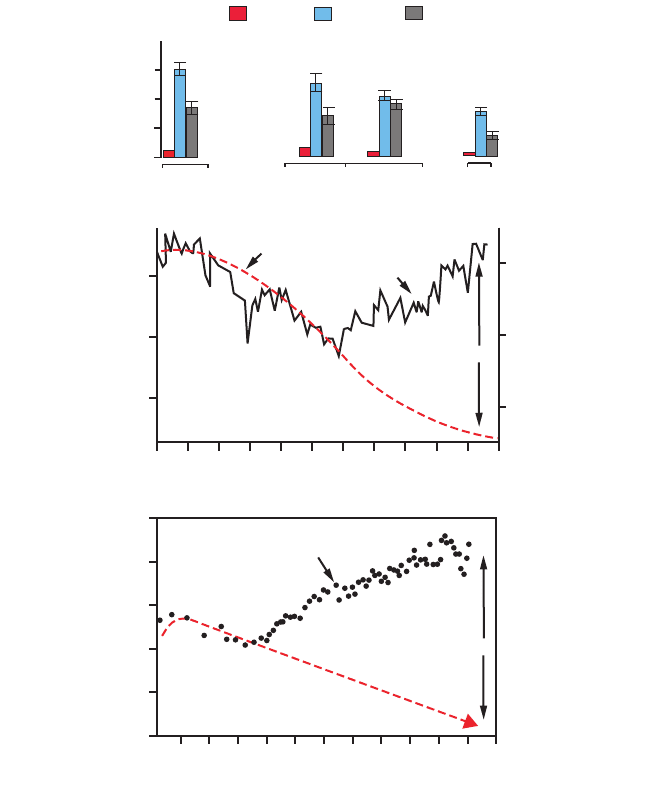
Part of Ruddiman’s claim was based on the fact that increases in atmospheric
CO
2
and methane concentrations from 8000 and 5000 years BP onwards, respec-
tively, appeared to be unique to the Holocene (Figure 3.7). At the time of propos-
ing his hypothesis, data for atmospheric greenhouse concentrations were only
available from Marine Isotope Stage (MIS) 9 and subsequent interglacials . The
subsequent availability of data for MIS 11, the interglacial associated with orbital
forcing most comparable to that prevailing during the Holocene, has provided a
more appropriate basis for comparing the behavior of each greenhouse gas with
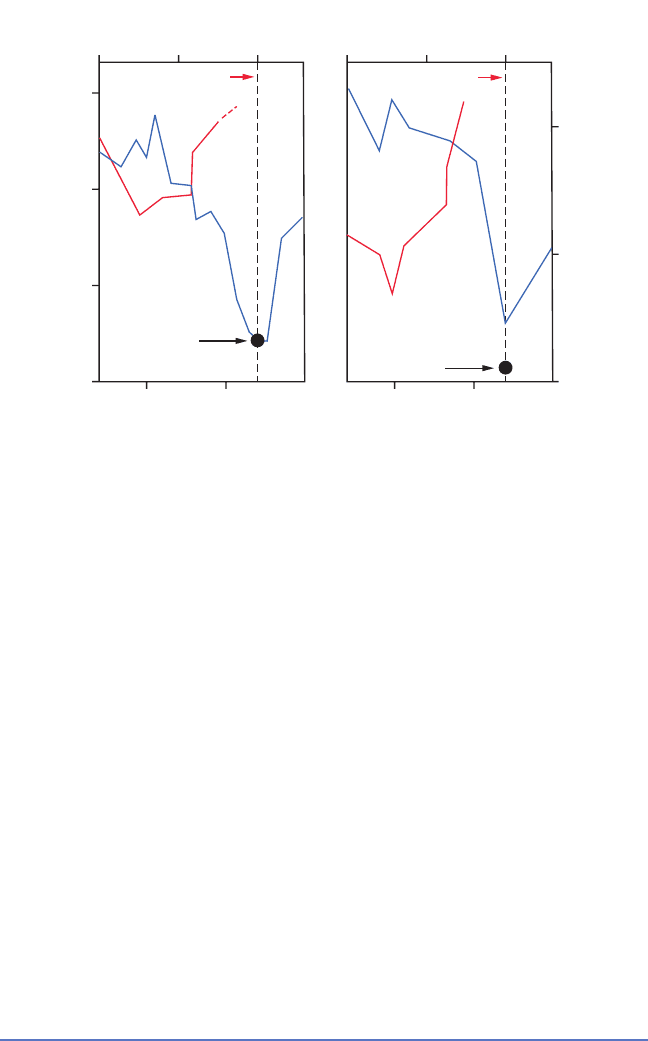
and without the possibility of human intervention. For some (EPICA Community
Members 2004; Broecker 2006), the comparison disposes of Ruddiman’s claim
that the Holocene CO
2
increase is unique. For Ruddiman (2005a) their argument
is not conclusive, for he adopts a different part of the MIS 11 CO
2
curve for com-
parison and advances credible reasons for his choice (Figure 3.8). At the same time,
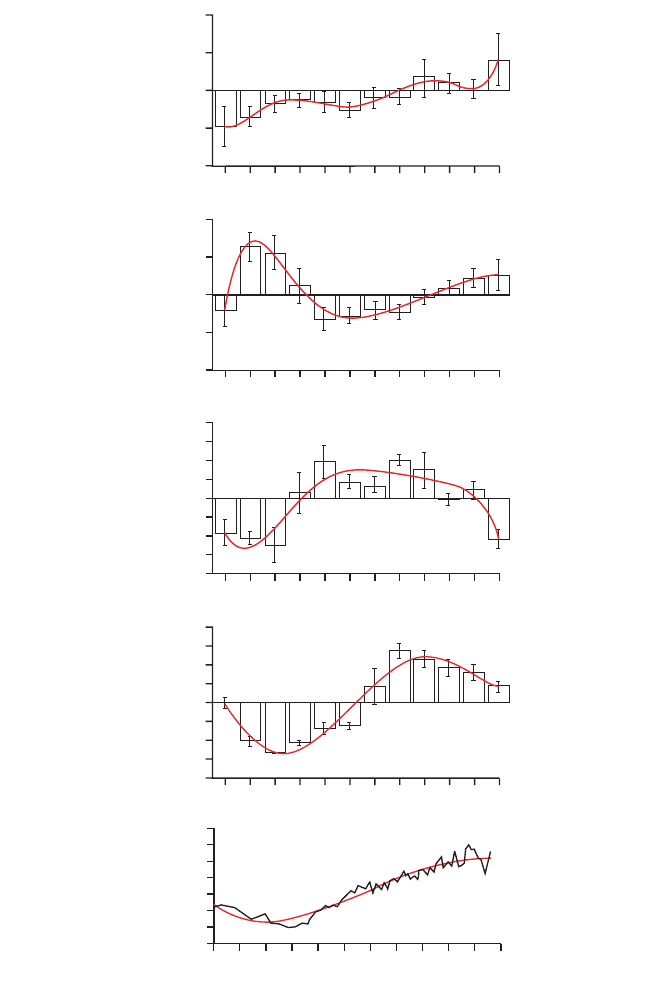
and in parallel with Ruddiman, Carcaillet et al. (2002) provide a wealth of evidence
in support of the view that fire alone may have made a significant contribution to
the Holocene increase in atmospheric CO
2
(Figure 3.9).
Another dimension to the controversy over Ruddiman’s hypothesis arises
from the mismatch between inferences based on empirical evidence for past
land-use/cover change and model-based reconstructions incorporating stable
..
9781405159050_4_003.qxd 6/3/08 3:53 PM Page 73
..
74
|
Frank Oldfield
..
isotope evidence (Joos et al. 2004). Figure 3.10, which shows an estimate of the
change in total biospheric carbon during the Holocene, indicates the extent to
which any attempt to calculate past carbon budgets depends on the approach used.
Broecker (2006) casts doubt on Ruddiman’s hypothesis by claiming that for it to
work “the forest biomass of 8000 years ago must have been more than double that
in the year 1800 A.D.”. This requirement he finds quite unlikely to have been met,
but it may seem less incredible to many Old World paleoecologists. More difficult
to counter are the arguments based on the latest measurements of the
13
C to
12
C
ratio in Antarctic ice, quoted by Broecker (2006). These are interpreted as favoring
the view that the main changes in atmospheric CO
2
were the result of changes in
the world’s oceans. In response to the stable isotope data, Ruddiman has revised
his latest estimate of anthropogenic carbon release downwards to 14 ppm CO
2
Years ago
)bpp( enahteM
500
490
480
700
600
500
10 000 5 000
0
Solar radiation
Observed CH
4
N
a
t
u
r
a
l
C
H
4
t
r
e
n
d
250 ppb
Years a
g
o
290
280
270
260
250
240
10 000 5 000 0
Observed CO
2
Natural
CO
2
peak
40 ppm
N
a
t
u
r
a
l
C
O
2
t
r
e
n
d
CH
4
sources
(T g yr
–1
)
South
DCB
A
160
80
0
Tropics
North
Solar radiation (Watts m
–2
)
CO
2
(ppm)
Figure 3.7 Actual and
inferred “natural” trends of
atmospheric concentrations
of CO
2
and CH
4
during the
Holocene (Ruddiman 2003).
The histograms ascribing
methane to different source
regions during the Holocene
(Flückiger et al. 2004) are
shown at the top of the graph.
9781405159050_4_003.qxd 6/3/08 3:53 PM Page 74
The role of people in the Holocene
|
75
..
rather than the original 40. This would imply a much lower biomass reduction of
17–20 percent.
Ruddiman’s ascription of the post-5000 year BP rise in atmospheric methane
concentrations (see also Ruddiman and Thompson 2001) has provoked rather less
controversy and the ascription of the main part of the increase to tropical sources
(Flückiger et al. 2001; Figure 3.7) lends credibility to Ruddiman’s hypothesis.
Schmidt and Shindell (2005), however, consider that “in the absence of further
studies ruling out boreal wetlands, tropical river deltas and peatlands as sources of
the late Holocene increase in methane emissions, a definitive attribution of the
trend to anthropogenic sources is premature”.
Up to now, much of the debate over Ruddiman’s hypothesis has been in terms of
acceptance or rejection as it stands. It seems quite likely that any resolution will
require more empirical evidence to constrain the range of possibilities and to
address the issue in less extreme terms. The extent to which human activities such
as deforestation and paddy cultivation contributed to the observed increases
remains an open question. Even if the greater percentage of the Holocene increases
proves to be unrelated to anthropogenic activities, there still remains the intriguing
possibility that on shorter, more recent time-scales the fortunes of human popula-
tions may have led to sufficiently large oscillations in forest biomass to have
produced significant fluctuations in atmospheric CO
2
.
Human societies, climate change, and cultural collapse
How have human societies reacted to climate change in the past and what lessons
may we learn for the future from the interactions between climate variability
..
Years ago
HC
4
(ppb)
700
600
500
400
405
(ka) (ka)
400
10 000
0
Stage 11
Predicted
Years ago
CO
2
(ppm)
280
260
240
405 400
10 000
0
Pre-industrial
Predicted
Stage 1
Stage 1
Stage 11
Pre-industrial
Figure 3.8 Ruddiman’s
interpretation of the
comparison between
greenhouse gas concentration
trends during the Holocene
(red line – from the Vostok
core measurements) and
those during Marine Isotope
Stage 11 (blue line – from
Dome C). (From Ruddiman
et al. (2005a) with kind
permission from Springer
Science and Business Media.)
9781405159050_4_003.qxd 6/3/08 3:53 PM Page 75
..
76
|
Frank Oldfield
..
(notably the incidence of damaging extremes such as severe drought) and the
changing patterns of social organization developed as a response to the resulting
environmental stresses? This theme too is controversial. At one extreme, those
who favor a degree of environmental determinism can point to many instances
xedni laocrahC
1.0
0.5
0
–0.5
–1.0
Europe
(39°N–66°N)
xedni laocrahC
1.0
0.5
0
–0.5
–1.0
North-eastern North America
(39°N–66°N)
Calibrated years before present
OC
2
)vmpp(
290
280
270
260
10 000 5000 0
Taylor Dome
(Antarctica)
xedni laocrahC
2.0
1.0
0
–1.0
–2.0
Southeast Asia
(1°S–9°S)
xedni laocrahC
2.0
1.0
0
–1.0
–2.0
Central America
(1°S–9°N)
Figure 3.9 Biomass burning
reconstructions for different
parts of the world expressed as
a charcoal index, derived
from stratigraphic data,
compared with the
atmospheric CO
2
concentration curve from the
Taylor Dome, Antarctica
(Carcaillet et al. 2002).
9781405159050_4_003.qxd 6/3/08 3:53 PM Page 76
The role of people in the Holocene
|
77
..
where the transformation, decline or collapse of societies, even whole civilizations,
coincides with major climatic changes or periods of intense and persistent drought
(e.g. Hodell et al. 1995; Weiss 1997; Cullen et al. 2000; deMenocal 2001; Weiss and
Bradley 2001; Haug et al. 2003; Huang et al. 2003; Bradley, this volume; Beer
and van Geel, this volume). By contrast, most authorities with a background in
social sciences stress instead the degree to which poorly adapted patterns of social
organization or inappropriate response strategies appear to be more direct and
significant factors in social decline or collapse (e.g. Redman 1999). To a large
degree, these differences reflect different academic backgrounds and training:
there is a tendency to favor interpretations that lie within the scope of the discip-
lines with which we are familiar, although the historical rejection of determinism
in the wake of its eventual discrediting during the middle decades of the 20th
century may have reinforced the second type of attitude. If we take a wider and
more balanced view and detach the issue from the emotive concept of “collapse”, it
is clearly unrealistic to suppose that climate variability has had no effect on human
welfare and social viability – there are too many examples from the more recent
past, for which well-documented historical evidence is available. Equally, explana-
tions based entirely on climate determinism have been shown to be inadequate
wherever interdisciplinary studies have been carried out that span biophysical and
cultural/socio-economic research. The key lies in trying to unravel and learn from
the interactions between the biophysical and the social systems. This poses
formidable challenges.
One of the most recent attempts to present an overview is that of Diamond
(2005). He examines diverse case studies of societal collapse in the light of a wide
range of possible causative factors, of which climatically induced stress is only one.
The others include eight broad categories of unsustainable damage to the environ-
ment, the impact of hostile neighbors, interactions with trade partners, and the
nature of the societal response to environmental problems. In almost all the cases
..
0
400
800
1200
1600
2000
Palynology and
sedimentology
data
PMIP-carbon
models
Biospheric carbon change (Gt C)
Isotopic budget
(no CO
3
effects)
Isotopic budget
(including CO
3
effects)
=
=
Figure 3.10 Estimates of the
increase in biospheric carbon
storage between the Last
Glacial Maximum and the
present day. Note the contrast
between the range of
sedimentologically derived
estimates and those based on
modeling and isotope studies.
PMIP, Paleo-model
Intercomparison Project.
(Reproduced from Oldfield F.
(2005) Environmental
Change: Key Issues and
Alternative Approaches.
Cambridge University Press,
Cambridge.)
9781405159050_4_003.qxd 6/3/08 3:53 PM Page 77
..
78
|
Frank Oldfield
..
he considers, environmental damage and societal reactions form a constant thread.
The role of climate varies from case to case, with sustained drought a key factor in
many, including those considered by the more “determinist” authors referred to in
the previous paragraph. In each case, however, the notion of a single, simple
response leading to total demise never provides a fully satisfactory explanation.
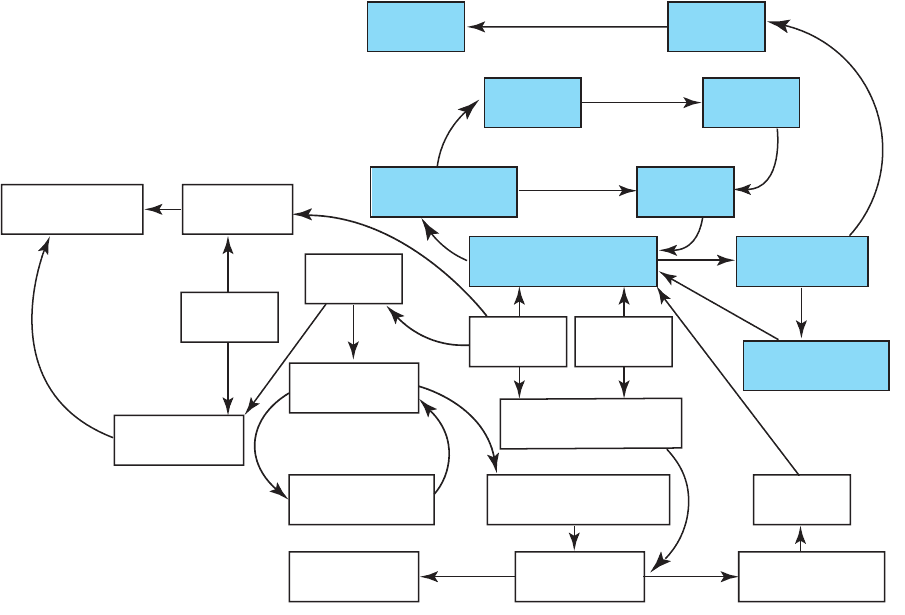
Moreover, in the most extreme case, that of Easter Island (Bahn and Flenley 1992,
2003; Figure 3.11), it seems unlikely that climate played any significant role.
Although much of Bahn and Flenley’s scheme is particular to Easter Island, the
processes and interactions portrayed in, and linking, the shaded boxes are not
without parallels in the present day, for example, in southern Sudan where climate
variability imposes additional stresses.
Although it is tempting to explain the demise of Norse settlements in Greenland
by climatic deterioration during the early stages of the Little Ice Age, it is clear that
many other factors played an important role, including land degradation, adop-
tion of a life-style too dependent on European contact and supplies (both of which
dwindled as sea-ice in the North Atlantic made navigation more difficult), the
Population
decline
Insufficient
good land
Human
population growth
Human
immigration
Forest
More land needed
for agriculture
Felling palms for statue
moving and canoes
Eating of palm
fruits by rodents
Rodent
population growth
Decline of
statue building
Prevention of palm
regeneration
Decline of
palm tree
Decline of fishing
and rodents
Forest
Direct culling
of sea birds
Reduction of
sea bird resource
Eating of bird
eggs by rodents
More food
needed
Forest clearance for
agriculture and firewood
Introduction
of rodents
Sea bird
resource
Soil exhaustion
and erosion
Warfare
Crop
destruction
Figure 3.11 Bahn and Flenley’s (1992) conceptual model
of the interactions between human activities and their
environment that could have led to the dramatic
population decline on Easter Island. The shaded boxes
identify processes and interactions that are less specific to
Easter Island. (Based on Oldfield 2005.)
9781405159050_4_003.qxd 6/3/08 3:53 PM Page 78
The role of people in the Holocene
|
79
..
replacement of walrus ivory by Africa elephant ivory, and failure to broaden and
adapt diets in parallel with the Inuit who survived through the period of Norse
abandonment (Barlow et al. 1997; Pringle 1997; Diamond 2005; Orlove 2005).
Similar evidence for a complex of interactive processes, both biophysical and cul-
tural, lies at the heart of many other analyses of cultural transformation or demise.
Rosen’s (1995) analysis of the collapse of early Bronze Age societies in southern
Levant stresses an inability to adapt appropriate technological responses to a
diminished water supply. Hassan’s (1986, 1997) recent studies show that the
failure of the Nile floods around 2150 bc appears to have been the main reason for
the demise of the Old Kingdom, but out of the crisis that drought created came a
period of radical social change of long-term importance for emerging concepts of
social justice (http://www.bbc.co.uk/history/).
Severe drought still seems to be the dominant reason for the collapse of pre-
historic communities in the Saharan region (Hassan 1986, 1997; Cremaschi and
Di Lernia 1999), although there is no simple link between climate and cultural
dynamics and one of the most significant responses to desertification appears to
have been the movement of people into the Nile Valley, leading to the appearance
of Neolithic sites in the Delta and central Sudan. Response via migration has also
characterized some sub-Saharan societies. Tyson et al. (2002) point to southward
migration by Iron Age agriculturalists following changed rainfall patterns in
southern Africa, notably the southern migration of the Sotho-Tswana speaking
people during the first few centuries of the past millennium and earlier. These
migrations appear to be linked to the anti-phase incidence of rainfall north and
south of the Equator documented by records from Lake Naivasha in Kenya and
Cold Air cave in the Makapansgat Valley, South Africa. Verschuren et al. (2000)
link their reconstruction of hydrologic change in Lake Naivasha to Webster’s
(1979) reconstruction of periods of prosperity, famine, and migration, but
Robertshaw et al.’s (2004) evaluation of the records from the region once more
stress multi-causation and the importance of the administrative structures in place
during different periods of famine and disease.
One example of inferred collapse is that of the Mapungubwe agro-pastoralist
society in the Limpopo Valley, which lasted for some 300 years before its demise
around ad 1280–90. Huffman (1996) ascribes this mainly to drought and O’Connor
and Kiker (2004), using a modeling approach, suggest that both crop failure and
destabilization of pastoralism may have been involved. Scott and Lee-Thorp
(2004), however, point out that the evidence for societal collapse is not unambigu-
ous and the suggestion that drought may have been responsible is not borne out by
the latest paleoclimatic evidence.
Two well-documented examples of societal collapse come from the New World,
that of the Anasazi in the south-west of the USA and the Maya in Yucatan during
the 12th and 10th centuries ad, respectively. Drought has been invoked in both
cases (see e.g. Hoddell et al. 1995), but a fuller review of the evidence (Diamond
2005) reveals, in both cases, discrepancies in a simple climate-collapse hypothesis.
In the case of the Maya, using numerical values expressing estimates of different
types and degrees of vulnerability, both climatically and anthropogenically related,
..
9781405159050_4_003.qxd 6/3/08 3:53 PM Page 79