
Battarbee R.W., Binney H.A. (Eds.) Natural Climate Variability and Global Warming: A Holocene Perspective
Подождите немного. Документ загружается.

..
60
|
Frank Oldfield
..
England (e.g. Oldfield 1963). Such long-term records of recurrent recovery suggest
that the forest ecosystems of these regions, hence the soils also, have been remark-
ably resilient (sensu Lal 1997) in the face of repeated phases of deforestation. This is
despite the fact that several pollen diagrams from the north of England suggest that
the area deforested during Late Iron Age and Romano-British times, between
around 2500 and 1500 years BP, was as extensive as during the peak deforestation
in the 17th century (Oldfield and Statham 1965; Dumayne-Peaty and Barber 1998;
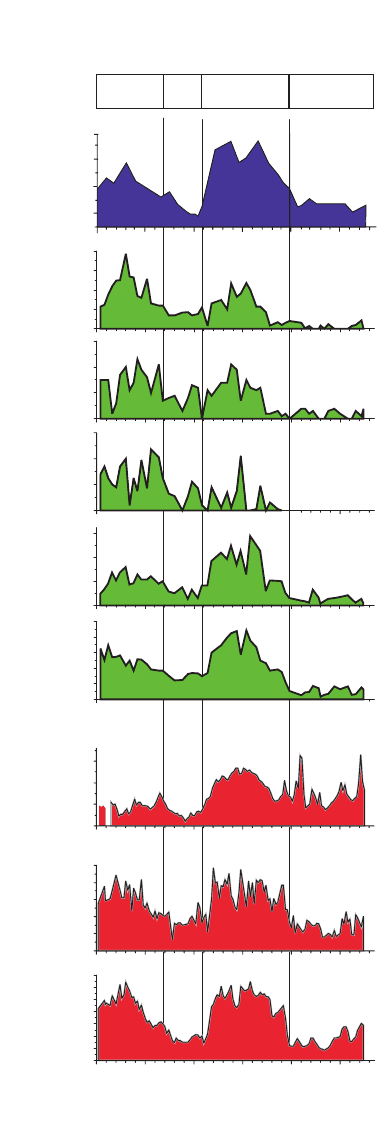
Wimble et al. 2000; Oldfield et al. 2003a; Figure 3.1). Strong evidence for the
importance of deforestation during the period of Roman occupation also comes
from many studies in France (e.g. Noel et al. 2001; Cyprien et al. 2004).
In some other parts of Europe, the evidence points to earlier and somewhat
more progressive conversion of forest to less productive ecosystems as a result
of human activities. In parts of Denmark, for example, there are indications of
irreversible deforestation from ca. 500 bc onwards (Bradshaw et al. 2005a).
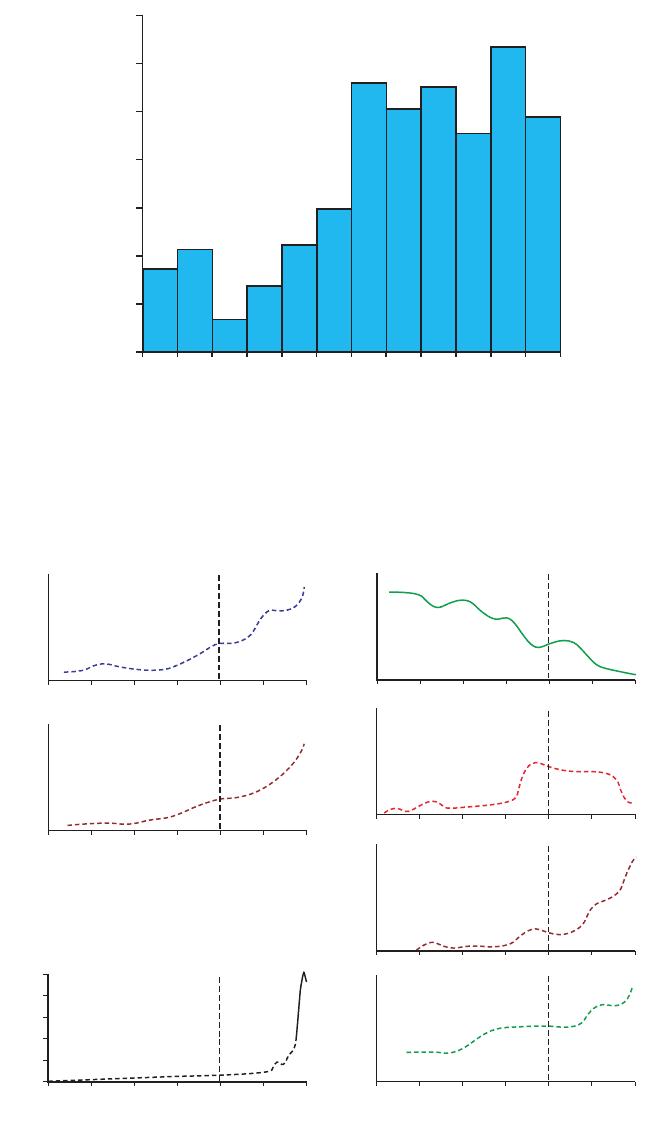
Odgaard and Rasmussen (2000) reinforce this view by statistical comparisons
between the mosaic of land-cover types documented in 1800 and those inferred
from successive pollen records spanning the period 4500 bc to ad 1800 at 20 sites
(Figure 3.2). In-depth, multi-disciplinary studies of ecological and cultural history
at the regional scale are relatively rare, but one such is that of Berglund (1991) in
the Ystad region of southern Sweden (Figure 3.3). As in the Danish study, he
records the progressive deforestation of the landscape during prehistory. Inter-
mediate between the studies showing progressive deforestation without significant
recovery, and those marked by recurrent re-afforestation, are sites such as Lough
Neagh in Northern Ireland where pulses of forest clearance, marked by peaks in
weeds and bracken, are superimposed on evidence for a progressive increase in
grassland (O’Sullivan et al. 1973).
Heathlands are distinctive habitats often of high conservation value in northern
and western Europe. Understanding their origins and history is germane to any
future management designed to preserve the special habitats and high biodiversity
that they contain (Walker et al. 2003). They have often been seen as, in part at least,
the result of forest clearance combined with subsequent soil degradation and/or
sustained management practices favoring the persistence of ericaceous shrubs and
acidophilous herbs. Fyfe et al. (2003) interpret their pollen records from Exmoor
in south-west England as indicating the expansion of heathland from Neolithic
times onwards, rather as did Godwin in his early study of the Breckland heaths of
East Anglia (Godwin 1944), although they regard the use of fire as important for
the maintenance of heathland. Savukynien et al. (2003) present evidence from
Lithuania that points to the development of heathland from 1200 years BP
onwards, as well as its maintenance largely through burning until recent times
when its extent has been reduced. Following the earlier work of Kaland (1986),
Prosch-Danielson and Simonsen (2000) show that the expansion of coastal heath-
land in south-west Norway took place from 4000 to 200 bc, but was mostly com-
pleted by the end of the Bronze Age. They suggest that the expansion can best be
explained as a result of the interaction between land-use history, topography, and
edaphic conditions, within a climatic regime that favored heathland development.
9781405159050_4_003.qxd 6/3/08 3:53 PM Page 60
The role of people in the Holocene
|
61
....
200 BC
600 AD
1200 AD
1770 AD
LPZ
1
2
3
4
Date
020
Hard IRM
(–100mT)
(%)
Potassium
2 6 10 14
0
50
100
150
250
200
(mg/g)
0
40
80
Strontium
(μg/g)
048
12
(%)
Plantago
lanceolata
0
4
Cultivated
(%)
0
2
Calluna
(%)
012
6
Miscellaneous
Herbs
(%)
02040
Poaceae
(%)
Depth (cm)
n-alkane
28.4
29.2
MC #
Figure 3.1 The impact of forest clearance during the late Iron Age and Romano-British period. Evidence from Gormire, North Yorkshire, UK. The chemical
elements and “Hard-IRM” (a rock magnetic parameter) are indicative of the erosion of inorganic mineral soil. The pollen record links deforestation to
evidence for human activities – both pastoralism and cultivation – as well as to the spread of moorland over the past 2000 years. The n-alkane record reflects
the relative abundance in the sediments of a biomarker specific to open grassland. (Based on Oldfield et al. 2003a.)
9781405159050_4_003.qxd 6/3/08 3:53 PM Page 61
..
62
|
Frank Oldfield
..
40
35
30
25
20
15
10
5
LEB EN MNA MNB LN EBA BA PRIA RA LIA MED1800
* * *** *** *** *** *** ***
Time period
% variance explained
Figure 3.2 Plot of the extent
to which forest composition
inferred from pollen diagrams
from 10 sites in Denmark
corresponds with forest
composition at ad 1800.
Note how the percentage of
between-site variance
explained increases steeply
along with the significance of
the relationship (*** = p<
0.001) from middle Neolithic
to late Bronze Age times. The
results show that both the
differentiation between sites
and the macroscale land-
cover patterns were
established some 3000 years
ago. LEB, late Ertebølle; EN,
early Neolithic; MNA, MNB,
middle Neolithic A and B;
LN, late Neolithic; EBA, early
Bronze Age; BA, Bronze Age;
PRIA, Pre-Roman Iron Age;
RA, Roman; LIA, Late Iron
Age; MED, Medieval. (From
Odgaard B.V. & Rasmussen P.
(2000). With permission from
Blackwell Publishing Ltd.)
SOILS
HUMAN INDUCED CHANGES
Water erosion
Soil leaching
+
–
+
–
BIOTA
Fire impact
Arable land
Lake eutrophication
+
–
+
–
+
–
Woodland
Open land
4000 3000 2000 1000 0 1000 2000
BC AD
4000 3000 2000 1000 0 1000 2000
BC AD
POPULATION
4000 BC – AD 2000
Deforestation
20
10
0
Population (000’s)
Figure 3.3 Some of the
human-induced changes
inferred from the multi-
disciplinary Ystad Project in
southern Sweden. (Based on
Berglund 1991; Dearing et al.
2006.)
9781405159050_4_003.qxd 6/3/08 3:53 PM Page 62
The role of people in the Holocene
|
63
..
Bunting’s (1996) evidence for the development of heathland in the Orkneys also
points to a complex interaction between human, edaphic, and climatic factors.
In less oceanic areas such as south-west Sweden, extensive heathlands were not
formed until historical times (Malmer 1965; Björkman 2001), mainly through
intensive grazing subsequent to deliberate deforestation.
It is entirely possible that anthropogenic transformation of upland ecosystems
in Britain began before the Neolithic period. Evidence from sub-peat charcoal lay-
ers and from organic biomarkers (Chiverrell et al. in press) confirms that fire was
prevalent in upland regions of northern England currently covered by moorland
or blanket peat. Several authors (Jacobi et al. 1976; Simmons 1996; Innes and
Simmons 2000; Innes and Blackford 2003) have suggested Mesolithic peoples used
fire as part of their woodland management strategy in order to increase animal
abundance. Drier climatic conditions during the Mesolithic period, however, may
also have led to more widespread natural fires (Bradshaw et al. 1996; Brown 1997;
Tipping and Milburn 2000).
Holocene pollen diagrams from east European sites that are outside the zone of
Mediterranean climate record deforestation ranging in age from older than 7000
years BP in north-eastern Bulgaria (Bozilova and Tonkov 1998) to the 13th
century ad in Russian Karelia (Vuorela et al. 2001). Kremenetski et al. (1999) find
evidence for major human impacts from Bronze Age times onwards in southern
Russia, whereas in Estonia, clear signs of human impact are delayed until around
1500 years BP (Niinemets and Saarse 2006).
Several studies in the Alps point to human activities, notably grazing and the use
of fire, as the main factors responsible for shifts in the tree line and changes in
forest composition from Neolithic times onwards (e.g. Gobet et al. 2003; Carcaillet
and Muller 2005; Tinner et al. 2005). In the Lake Garda region of northern Italy,
Valsecchi et al. (2005) estimate that over 60 percent of the pollen source area was
deforested during the Bronze Age between 2000 and 1100 bc, whereas in the East
Pyrenees, Guiter et al. (2005) point to significant anthropogenic reduction in
forest cover from ca. 2500 years BP, accelerating during the past 2000 years.
The relative importance of the roles Holocene climate change and human
activity played in the development of the present-day plant cover in those parts of
Europe experiencing a Mediterranean-type climate remains a matter of debate.
There is strong evidence from both marine and terrestrial archives for extensive
desiccation beginning between 5000 and 4000 years BP and continuing at least
until 3000 to 2000 years BP (e.g. Bar-Matthews and Ayalon 2004; Kallel et al. 2004;
Roberts et al. 2004). Many pollen diagrams document the spread of xerophytic
scrub and steppe biomes during this period and some authors stress climate
change as the main cause (e.g. Jalut et al. 2000; Sadori and Narcisi 2001; Pantaléon-
Cano et al. 2003). At the same time, many others, while acknowledging the
importance of climate change, note widespread evidence for the degradation of
Mediterranean ecosystems through human activities, beginning mainly during
Bronze Age times towards the end of the third millennium bc, and often peaking
during the Medieval period (van Andel et al. 1986; Jahns 1993, 2005; Brochier et al.
1998; Atherden and Hall 1999; Ramrath et al. 2000; Carrion et al. 2001; Oldfield
..
9781405159050_4_003.qxd 6/3/08 3:53 PM Page 63
..
64
|
Frank Oldfield
..
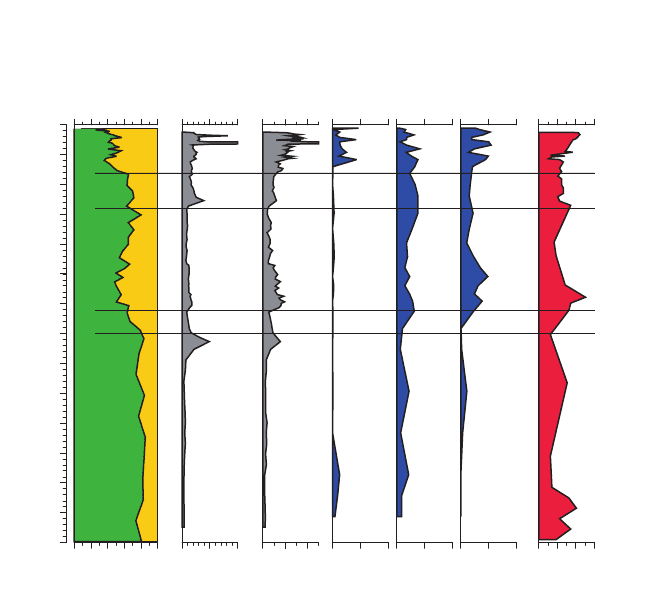
et al. 2003b, Sobrino et al. 2004; Butzer 2005; Figure 3.4). As noted in a later sec-
tion, feedback from the creation of extensive garrigue and bare ground in place of
woodland, through overgrazing and soil erosion, would have tended to reinforce
any summer drought initially resulting from climate change.
Summarizing the evidence from Europe as a whole, the following generaliza-
tions are proposed.
•
Paleoecological evidence distinguishes between landscapes characterized by relatively
resilient woodland ecosystems within which repeated forest recovery occurred over
most of the past 6000 years until the Middle Ages and open landscapes reflecting
progressive deforestation from prehistoric times onwards.
•
Among the latter are the heathlands of north-western Europe and Mediterranean
garrigue. In both cases, human activities and climate change have acted synergisti-
cally in edaphically sensitive environments to promote or hasten the transformation
of ecosystems. The extent to which persistence of these has depended on their
maintenance through sustained human impact and the use of fire has varied from
place to place.
•
Throughout Europe, from the western edge of Ireland (Molloy and O’Connell
1995; O’Connell et al. 2000) to the Urals, all but the most remote or northerly sites
show episodes of human impact through deforestation from Neolithic or Bronze
Age times onwards (cf. Berglund 2000). Even in the central Swedish forest region as
0
500
1000
1500
2000
2500
3000
3500
4000
4500
5000
5500
6000
6500
7000
20 40 60 80 0 50
100
0 0.4 5 10 5 10 5 10 12 15 18 21100 0.2
Years BP
A
B
C
D
Trees
Herbs + shrubs
IRM300-flux
Bulimina marginata
Melonis padanum
Valvulineria complanata
Temperature (UK-37°C
)
ab
% % total benthic forams
χ
fd
-flux
Figure 3.4 Evidence for
human impact over the past
4000 years from an Adriatic
core (RF 93-30) integrating
evidence from a large area
along the eastern flank of
Italy. The pollen record shows
deforestation from 3500 years
BP onwards, with periods of
peak human activity in the
Bronze Age (ca. 3500–2000
years BP) and Medieval (post-
800 years BP) periods. The
magnetic properties (IRM 300
and χ
fd
, both also influenced
by tephra layers) mainly
record terrigenous input
during these periods. The
benthic foraminifers show
distinctive faunal changes at
the onset of both periods of
erosion. The alkenone-
inferred surface water
temperature highlights the
likelihood that some of the
changes, especially between
3500 and 3000 years BP, may
also reflect climatic forcing.
A–D refer to the main
horizons of change as
identified in the original
reference. (Based on Oldfield
et al. 2003b.)
9781405159050_4_003.qxd 6/3/08 3:53 PM Page 64
The role of people in the Holocene
|
65
..
far as 62° north, there is clear evidence of deforestation for sedentary farming from
ca. ad 100 onwards (Emanuelsson 2001).
•
Mesolithic cultures may also have had a significant impact on upland ecosystems
in Britain at least, through the use of fire.
•
At many sites in the Mediterranean region and western Europe there is evidence
for extensive and, in some cases, permanent deforestation from an early stage in
the past 2000 to 3000 years.
•
Many studies confirm the importance of fire in the creation and maintenance of
deforested ecosystems.
•
In the Mediterranean region, it seems likely that climatically induced summer
drought during the second half of the Holocene may have been reinforced by feed-
back from land-cover transformed by human impact, for example, from woodland
to garrigue.
Even in Europe, where palynological evidence for agriculture and pastoralism is
relatively unambiguous and there have been many studies of Holocene climate
variability (Verschuren and Charman, this volume), the relations between human
activities and climate change remain open to much debate (see e.g. Berglund
2003). There are cases where favorable climatic conditions appear to have encour-
aged the expansion of agriculture, as during Romano-British times in Britain.
Equally, one may argue that challenging environmental conditions triggered crit-
ical advances in adaptive technology (e.g. Rosen 1995). These issues are explored
further below, as is the challenge of developing more quantitative expressions of
landscape openness from palynological data.
Looking briefly beyond Europe to other regions where a long history of human
occupation and land management raises questions of early, long-term, and sus-
tained human impact on ecosystems, the picture is less clear, partly because much
less evidence is available and partly because pollen-analytic data are often less
amenable to interpretation in terms of human impact. Hoelzmann et al. (2004),
summarizing evidence from the arid and sub-arid parts of Africa, including the
Sahara, point to climate change as the primary cause of mid-Holocene desiccation.
All authorities now accept, however, that feedback from changing land-cover was
critical in reinforcing the effects of externally driven changes in climate (Claussen
et al. 1999; deMenocal et al. 2000). What remains in doubt, partly because of
the absence of unambiguous pollen indicators of human activity (Waller and
Salzmann 1999), is the degree to which human activities were responsible for some
of the land-cover changes that helped to trigger the shift to aridification in parts of
the region. Similar difficulties lie in the way of establishing the role of past human
activities in the spread of savannah (Saltzmann 2000), although Sowunmi (2004)
claims that human activities were responsible for a significant expansion of savan-
nah from 3000 years BP onwards in coastal Nigeria. Indeed, Ballouche (2004)
states that “most of the West African savannas are cultural landscapes which have
been strongly shaped by humans”. Evidence from East Africa also points to
significant human impacts on land-cover in pre-colonial times (Taylor 1990;
Mworia-Maitima 1997), though the evidence for strong hydrologic variability and
recurrent drought is incontrovertible (Verschuren and Charman, this volume). In
..
9781405159050_4_003.qxd 6/3/08 3:53 PM Page 65
..
66
|
Frank Oldfield
..
southern Africa (Scott and Lee-Thorp 2004), the main spread of agriculture and
grazing associated with increasing population densities and deforestation appears
to have taken place during the past 2000 years, peaking around 800 years BP. This
is consistent with evidence from marine cores summarized by Shi et al. (1998).
Although the evidence from western, south-eastern, and eastern Asia for the
early origins of different forms of agriculture is well documented (see summaries
in Yasuda 2002), it is much more difficult to determine the timing and extent
of human-induced land-cover change for most regions. Some of the strongest
evidence is emerging from China, for early deforestation (Ren and Zhang 1998;
Ren 2000), the long-term maintenance and expansion of open landscapes, and the
likely impact of these processes on the climate (Fu 2003). Huang et al. (2002) find
evidence for deforestation and cultivation on the southern Loess Plateau from
7500 years BP onwards, and Zhou et al. (2002) ascribe the south-eastern displace-
ment of the desert–loess boundary to human activity over the past 3000 years,
although evidence presented by Li et al. (2003) suggests that the vegetation of the
east-central part of the Loess Plateau to the north of Xian was dominated by steppe
and grassland throughout the Holocene. In the far north-east of China,
Makohonienko et al. (2004) document deforestation from around 900 bc onwards
and show that the spread of grassland over the Manchurian Plains was the result of
human activities over the past 1000 years. Li et al. (2006) also show that in Inner
Mongolia human impact on the landscape, already significant before 5400 years
BP, intensified from 4700 years BP onwards. In the region of the Yellow River
delta, successive episodes of deforestation and cultivation took place from 4000
years BP onwards (Yi et al. 2003). Ji et al. (2006) show that deforestation by human
populations began as early as 7000 years ago around Erhai Lake in Yunnan
Province, south-west China.
In the case of the Indian sub-continent, it is relatively easy to reconstruct in out-
line the main sequences and patterns of cultural changes over the past 6000 years,
from early Neolithic times onwards (see e.g. Misra 2001). Many studies confirm
that the establishment of settled agriculture was widespread from the fourth mil-
lennium bc onwards, not only in the Indus Valley where the Harappan Civilization
flourished but also in southern India (Fuller et al. 2004). What is much more
difficult to glean is any clear indication of the impact pre-colonial societies had on
land-cover. Maloney (1980, 1981) finds evidence for early prehistoric deforesta-
tion in Indonesia.
Evidence from Oceania points to rapid deforestation on many islands spanning
the past 3000 to 800 years, depending on location, with devastating human con-
sequences in some cases (Bahn and Flenley 1992; Diamond 2005). Even in the New
World, clear indications of deforestation and changed land-cover go back as far as
4000 years in central Mexico (Watts and Bradbury 1982; Bradbury 2000; Fisher
2005) and 2000 years in the Cuzco area of Peru (Chepstow-Lusty et al. 1998).
Australian landscape evolution has been dominated by the traditional use of fire in
land management for many thousands of years (see e.g. Bowman 1998), although
there are a few indications of changing Holocene patterns and intensities of abori-
ginal fire use, which may well stretch back for over 40 000 years.
9781405159050_4_003.qxd 6/3/08 3:53 PM Page 66
The role of people in the Holocene
|
67
..
The above account, albeit partial and regionally selective, confirms the reality of
extensive land-cover transformation through human activities long before ad
1700, the starting point for some recent evaluations of anthropogenic land-cover
change (Ramankutty and Foley 1999; Goldewijk 2003). This is a key observation
when we come to consider the likely impact of land-use and land-cover change on
climate directly and on the carbon cycle. A further important conclusion to draw
from this account is the extent to which many habitats of great value for amenity
and biodiversity are themselves the result of human intervention, rather than a
simple and direct response to “natural” climatic and edaphic conditions. This can
be illustrated by studies both at regional scale (Segerström et al. 1996; Berglund
et al. in press) and for individual sites (Oldfield 1969). Such studies, together with
others (e.g. He et al. 2002; Latty et al. 2004) showing that legacies of disturbance
events may have impacts on ecosystem processes on century time-scales and
beyond, suggest that paleoresearch can contribute to developing plans for future
conservation. Paleoresearch, embracing long-term perspectives, shows that it is
impossible to generalize about the rates, trajectories or degree of recovery from
disturbance using only a small number of isolated case studies. The degree of
asymmetry or hysteresis between the sudden impact of fire or land clearance,
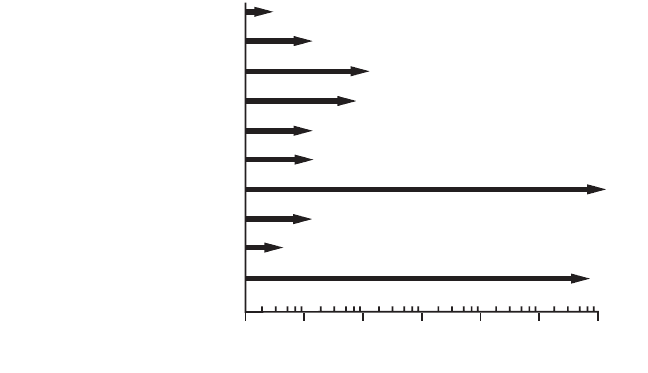
for example, and the rates of recovery varies with a wide range of factors (see
Figure 3.5). There is a need for more comparative studies taking the long-term
view and oriented towards a stronger theoretical basis for understanding the
ecosystem processes involved (Dearing et al. 2006). Such studies are needed in
order to improve our understanding of vulnerability, provide realistic guidance for
conservation and restoration, and add empirically derived, temporal dimensions
to the evidence against which the performance of ecosystems models can be tested.
All the emphasis above has been on terrestrial ecosystems, but from the 1960s
onwards it has been increasingly apparent that human activities have had a major
impact on water quality, in both inland (e.g. Digerfeldt 1972; Battarbee 1978,
..
1 10 100 1000 10 000 100 000 1 000 000
log
River water quality
Lake water quality
Groundwater quality
Re-establishment of vegetation
Improved groundwater recharge
Reduced flooding
Re-established biodiversity
Improved soil fertility
Reduced soil erosion
Re-establishment of eroded soils
Years
Figure 3.5 Projected time-
scales of recovery from
degradation resulting from
land-use changes (Batchelor
and Sundblad 1999). The
figure is taken from Chhabra
et al. (2006) and provides
some indication of the strong
hysteresis between the
rapidity with which lake and
catchment systems can be
degraded and the long-term
nature of several aspects of
recovery.
9781405159050_4_003.qxd 6/3/08 3:53 PM Page 67

..
68
|
Frank Oldfield
..
1990) and near-shore marine (Andren et al. 1999, 2004) environments. Although
the main impacts have taken place over the past 200 years, there is growing evid-
ence for discernable impacts in Europe at least from Bronze Age times onwards
(e.g. Gaillard et al. 1991; Renberg et al. 1993; Anderson et al. 1995; Oldfield et al.
2003b; Bradshaw et al. 2005b).
The impacts of past land-cover changes on climate
Changes in land-cover affect climate through, for example, changes in albedo, in
moisture retention and water vapor flux, and in gas and fine particulate flux into
the atmosphere, with implications for temperature, cloud formation, and precipi-
tation regimes. All these and other interlinked processes are being observed,
measured, and modeled at the present day (summarized in Chhabra et al. 2006;
Lawrence and Chase 2006). Observational (Lim et al. 2005) and experimental
studies (Sturm et al. 2005) of present-day vegetation changes confirm the sensitiv-
ity of surface climate to changes in land-cover. Model sensitivity studies suggest
that biomass burning can increase cloud condensation nuclei, which can seriously
reduce the efficiency of rain production in convective clouds. This in turn changes
the energy budget, convective heating, and vertical temperature gradients, with
likely effects on atmospheric circulation (Nober et al. 2003). Pielke (2005) claims
that at the scale at which thunderstorms are generated, for example, the effects of
spatially heterogeneous land-cover may be at least as important in altering weather
as changes in climate patterns associated with greenhouse gases. A growing num-
ber of modeling studies designed to estimate the likely impact of hypothesized
land-cover change on future climate (Bounoua et al. 2002; Snyder et al. 2004;
Fedemma et al. 2005; Crucifix, this volume; Claussen, this volume) highlight their
importance. This carries with it the implication that these processes should be
taken into account in evaluating the climatic significance of past land-cover
changes.
Several studies point to the importance of past changes in land-use and land-
cover as modulators of climate at least at the regional scale. Moreover, land-cover
change is being increasingly incorporated in climate/Earth system models, espe-
cially those of intermediate (reduced) complexity (Claussen, this volume). Recent
studies by Werth and Avissar (2005) and Schneider and Eugster (2005) attempt to
assess the likely effects of past land-cover change on climate in south-east Asia and
the Swiss Plateau, respectively, and identify significant local effects on temperature
and precipitation regimes. Fu (2003) estimates that over the past 3000 years over
60 percent of East Asia has been affected by various forms of land-cover conver-
sion, e.g. forest to farmland, grassland to semi-desert, and various types of land
degradation. By comparing the effects of inferred “natural” and the existing, trans-
formed land-cover in climate simulations, he suggests that major changes in the
hydrologic balance have resulted, with important implications for precipitation,
runoff, and soil water content. He cites these changes as likely contributors to a
9781405159050_4_003.qxd 6/3/08 3:53 PM Page 68

The role of people in the Holocene
|
69
..
decline in atmospheric and soil humidity, and the consequent trend to
aridification over the same period, especially in northern China. On a global scale,
Myhre et al. (2005) use comparison of MODIS-derived land-surface cover and
inferred “natural” vegetation to estimate radiative forcing due to surface albedo
changes resulting from anthropogenic vegetation changes. They infer weaker cool-
ing on a global scale than do earlier modeling studies (Bauer et al. 2003; Matthews
et al. 2004), but identify regionally important effects. They claim that 25–33
percent of the temperature change forced by land-cover change pre-dated indus-
trialization (see also Goosse et al. this volume). As hinted above there are conflict-
ing views on the extent to which aridification trends in the Sahel region of Africa
have been reinforced by anthropogenic changes in vegetation. Taylor et al. (2002)
suggest that these changes are not large enough to have been the main cause of
Sahel drought in recent decades, although they may have a larger impact in the
future. Govaerts and Lattanzio (2007), however, use satellite-derived surface
albedo data from the past two decades to show that the feedback from reduced
precipitation and effects on land-cover sustains drought conditions arising ini-
tially from changes in sea-surface temperatures in the tropical Atlantic. Another
view of Sahel desertification, on a longer time-scale, is presented by Foley et al.
(2003). They envisage the possibility that nonlinear shifts from wet to dry states
might have been triggered by stochastic events (e.g. a period of drought) super-
imposed on trends that included land degradation. One of the very few attempts to
apply a modeling approach to the issue of land-cover–climate feedbacks in Europe
during prehistoric times is that of Reale and Dirmeyer (2000) in their study of the
effects of vegetation on Mediterranean climate during the Roman classical period.
From the research published so far, it is clear that further work on feedbacks
from changing land-cover to the climate system (see e.g. Koster et al. 2006) have
important implications for interpreting past ecosystem changes and deepening
our understanding of past human–environment interactions. Given sufficiently
robust reconstructions of past land-cover change (see below) there should also be
scope for using them to test the credibility of models used to assess the extent to
which land-cover feedback will affect future climate change, especially at the
regional scale.
Impacts on hydrologic and erosion regimes
Holocene reconstructions of hydrologic and erosion regimes stretching beyond
the time-span of documentary records mainly depend on lake sediments or dat-
able, alluvial sequences, supplemented in moist, temperate environments by peat
stratigraphic evidence for hydrologic variability (Verschuren and Charman, this
volume). In the absence of significant human impacts on catchments, Holocene
variability in hydrologic regimes and erosion processes can usually be ascribed to
changes in climate (e.g. Knox 2000) or tectonic activity, though the relationships
between forcing mechanisms and the resulting responses are seldom simple and
..
9781405159050_4_003.qxd 6/3/08 3:53 PM Page 69