
Benson М. The Philosophy of Leibniz
Подождите немного. Документ загружается.

80 The
Philosophy
of
Leibniz
make
the
universe they express
the
universe
of
monads that express
it...
this
leads
to an
infinite
regress."
54
Still
another
version
of the
same objection
asserts
that
Leibniz's
doctrine
of
mirroring should have
led him to the
Spinozistic conclusion that there
is
only
one
substance. For,
it is
said,
if the
attributes
of
monads
are
their percep-
tions,
and if at all
times every monad
is
perceiving
the
same thing, namely,
the
universe
of
monads, then
by the
Identity
of
Indiscernibles
there
is at
most
one
monad.
55
3. A
Numerical Model
of the
Possible Worlds
So far as I
know, Russell
was the
first
to
offer
a
numerical model
in
support
of
the
claim that
the
relation
of
expression
is
possible between every pair
of
monads
and
between every monad
and the
whole system
of
monads.
56
The
model
to be
described
here
is
constructed
on a
basis somewhat
different
from
his,
and it is
more
fully
worked out.
Like most models, this
one
will
succeed
in
representing only some
of the
properties
of the
structure
in
question.
The
features
of the
Leibnizian scheme
that
we do
seek
to
depict
are the
following:
1.
The
number
of
possible worlds
is
infinite.
2.
The
number
of
complete individual concepts
in
each possible world
is
also infinite.
3.
Every complete individual concept belongs
to
exactly
one
possible
world.
4.
In the
actual world, every individual goes through
a
continuous series
of
distinct states,
a
different
one for
each moment
of
time.
5.
In the
actual world,
the
state
of any
individual
at any
time mirrors
the
states
of all
other
individuals
at
that time.
6.
In the
actual world,
the
state
of any
individual
at any
time completely
determines
and is
determined
by its
states
at all
other times.
7.
In the
actual world,
the
state
of any
individual
at any
time
is
different
from
the
states
of all
other individuals
at all
other times.
We
shall suppose that
a
possible state
of a
possible individual
is a
compo-
site "complete" property,
in
which each simple property
P or its
complement
54
Joseph (1949), 144, 146, 158. More recent commentators
are
similarly
puzzled.
Cf.
e.g.,
Levin
(1980),
who
finds
(p.
228)
that
"failure
to
resolve
the
circularity
in the
description
of
monads
is
what
makes Leibniz's theory incoherent."
55
Oddly enough, Russell
himself
seems
to
have
accepted this
line
of
argument.
Russell
(1959,
56-57),
quoting
a
1909 paper,
says,
"If the
axiom
of
internal
relations
('Every
relation
is
grounded
in the
natures
of the
related terms')
is
true,
it
follows
that there
is no
diversity,
and
that
there
is
only
one
thing."
He
explains,
"Nothing
quite
true
of A can be
said about
A
short
of
taking
account
of the
whole universe;
and
then
what
is
said about
A
will
be the
same
as
what
would
be
said
about
anything
else, since
the
natures
of
different
things
must,
like those
of
Leibniz's
monads,
all
express
the
same system
of
relations."
56
Russell
(1972), 397.
Cf.
also
Russell,
viii.
Possible
"Worlds
81
P,
but not
both,
is a
factor.
57
According
to (4)
above,
the
states
of any
monad
in
the
actual world form
a
continuous (temporal) series;
we
assume that
the
possible states
of any
possible individual also form some such series. Thus,
every
complete individual concept, whether
or not
there
is a
corresponding
individual,
will
be
considered
to
consist
of a
continuous series
of
"complete"
properties
of the
aforementioned type.
We
shall represent each such concept
by
a
segment
of the
ascending series
of
real numbers equal
to or
greater than
1,
with each number
in
such
a
segment representing
one of the
successive
states.
58
Accordingly,
let the
ascending series
of
real numbers
r
such that
1
<
r <
1V
2
represent
the
successive states
of
monad
1 in
world
1
(the actual world).
Let the
ascending series
of
real numbers
r
such that
2
<
r < 2
V
2
represent
the
successive
states
of
monad
2 in
world
1.
Generalizing,
let the
ascending series
of
real numbers
r
such that
p
<
r < p +
V
2
represent
the
successive states
of
the
/7th
monad
in
world
1.
The
states
of the
first
monad
of the
second world
are to be
represented
by
the
ascending series
of
real numbers
r
such that
1Y
2
^
r <
l
3
/
4
.
The
states
of
the
pth
monad
in
world
2 are to be
represented
by the
ascending series
of
real
numbers
r
such that
p +
V
2
<
r < p +
3
/
4
.
In
general,
the
states
of the
pth
monad
in the nth
world
are to be
represented
by the
ascending series
of
real
numbers
r
such that
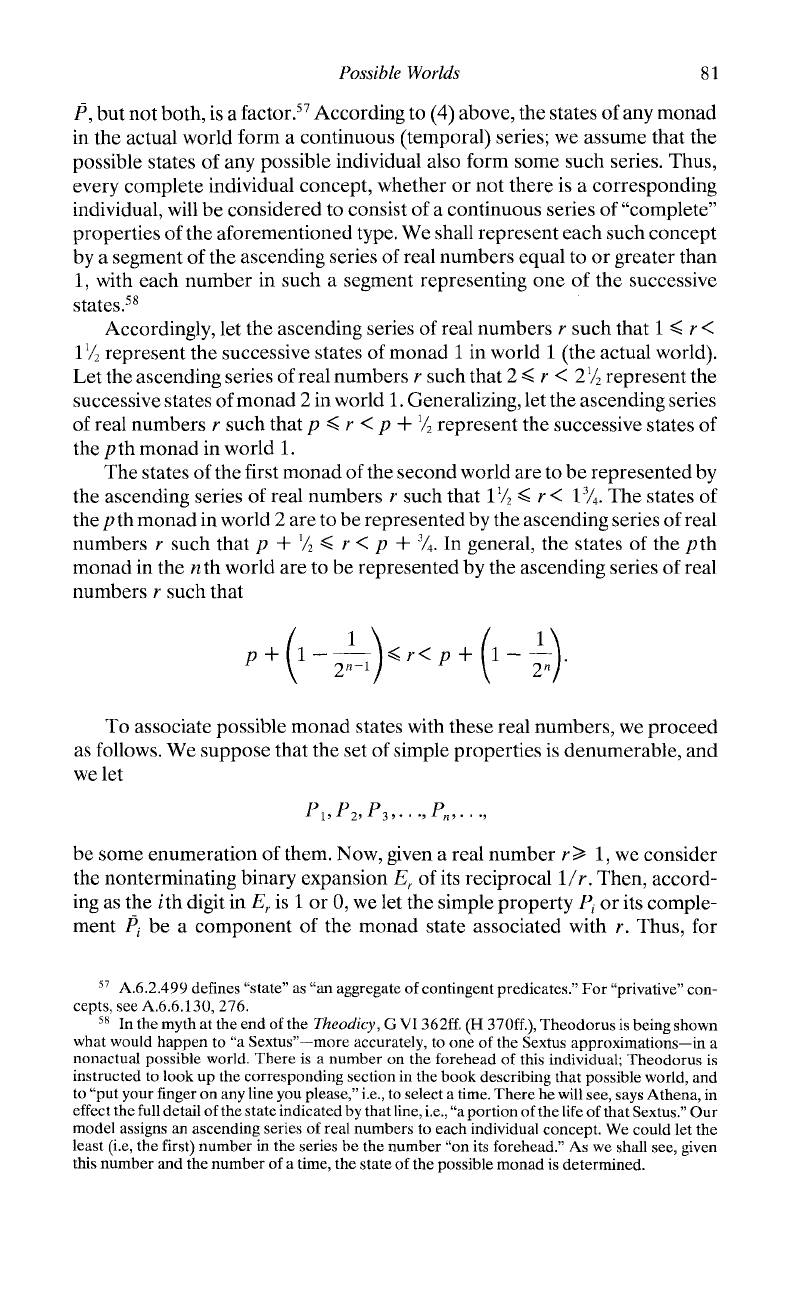
To
associate
possible
monad states with these real numbers,
we
proceed
as
follows.
We
suppose that
the set of
simple properties
is
denumerable,
and
we
let
be
some enumeration
of
them. Now, given
a
real number
r^
1, we
consider
the
nonterminating binary expansion
E
r
of its
reciprocal
l/r.
Then, accord-
ing
as the
ith
digit
in
E
r
is 1 or 0, we let the
simple property
P
i
or its
comple-
ment
Pj
be a
component
of the
monad state associated with
r.
Thus,
for
57
A.6.2.499
defines
"state"
as "an
aggregate
of
contingent
predicates."
For
"privative" con-
cepts,
see
A.6.6.130,
276.
58
In the
myth
at the end of the
Theodicy,
G
VI
362ff.
(H
370ff.),
Theodorus
is
being shown
what
would
happen
to "a
Sextus"—more
accurately,
to one of the
Sextus
approximations—in
a
nonactual
possible
world.
There
is a
number
on the
forehead
of
this
individual;
Theodorus
is
instructed
to
look
up the
corresponding section
in the
book describing that possible world,
and
to
"put your
finger
on any
line
you
please," i.e.,
to
select
a
time. There
he
will
see,
says
Athena,
in
effect
the
full
detail
of the
state indicated
by
that
line,
i.e.,
"a
portion
of the
life
of
that Sextus."
Our
model
assigns
an
ascending series
of
real numbers
to
each
individual
concept.
We
could
let the
least
(i.e,
the
first)
number
in the
series
be the
number
"on its
forehead."
As we
shall see,
given
this
number
and the
number
of a
time,
the
state
of the
possible monad
is
determined.
82
The
Philosophy
of
Leibniz
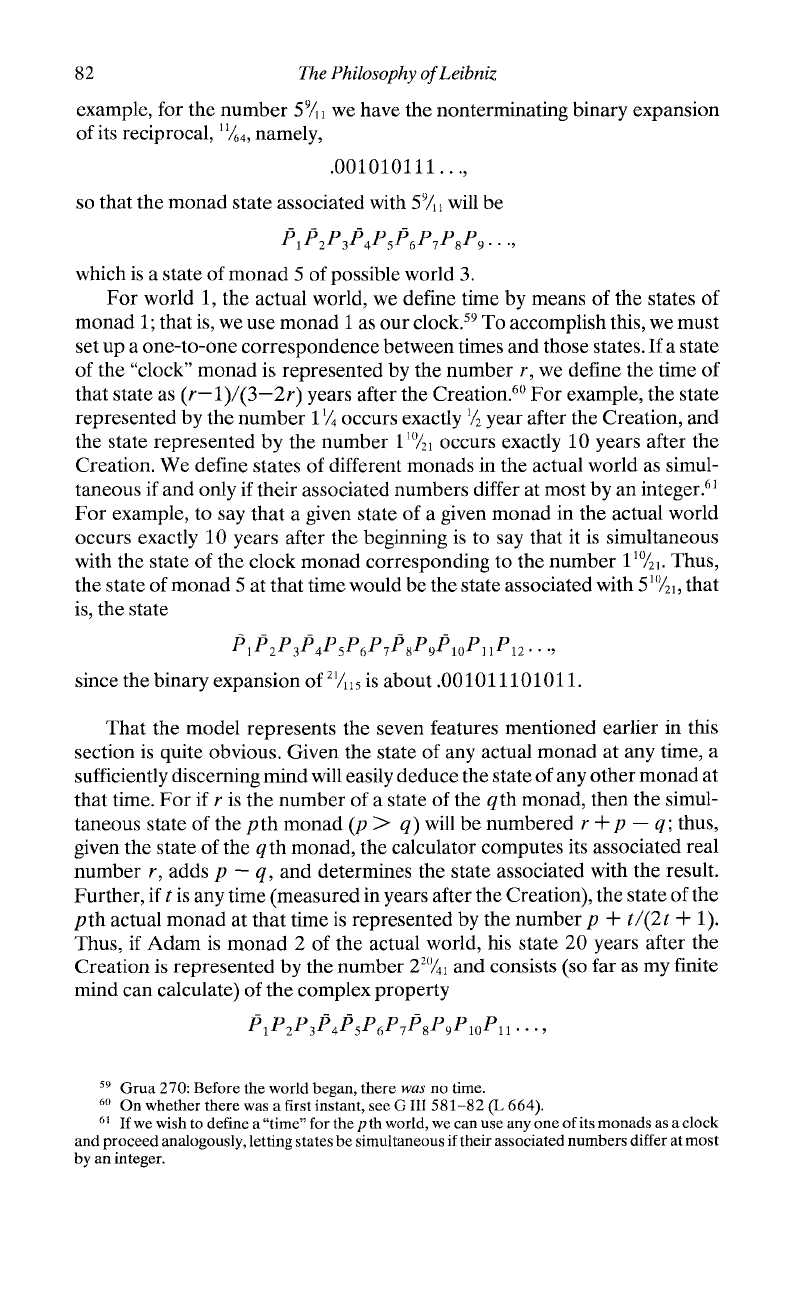
example,
for the
number
5
9
/
u
we
have
the
nonterminating binary expansion
of its
reciprocal,'
V
64
,
namely,
.001010111...,
so
that
the
monad state associated with
5
9
/!
i
will
be
p,/WVyVVVV..,
which
is a
state
of
monad
5 of
possible world
3.
For
world
1,
the
actual world,
we
define
time
by
means
of the
states
of
monad
1;
that
is, we use
monad
1 as our
clock.
59
To
accomplish this,
we
must
set
up a
one-to-one
correspondence between times
and
those states.
If
a
state
of
the
"clock" monad
is
represented
by the
number
r, we
define
the
time
of
that
state
as
(A—l)/(3—2r)
years
after
the
Creation.
60
For
example,
the
state
represented
by the
number
1V
4
occurs exactly
V
2
year
after
the
Creation,
and
the
state represented
by the
number
I
10
/
2
i
occurs exactly
10
years
after
the
Creation.
We
define
states
of
different
monads
in the
actual world
as
simul-
taneous
if and
only
if
their associated numbers
differ
at
most
by an
integer.
61
For
example,
to say
that
a
given state
of a
given
monad
in the
actual world
occurs exactly
10
years
after
the
beginning
is to say
that
it is
simultaneous
with
the
state
of the
clock monad corresponding
to the
number
I
10
/
2
i.
Thus,
the
state
of
monad
5 at
that time would
be the
state associated with
5"l/
2]
,
that
is,
the
state
*1*
2*
3*
4*
5*
6*
7*
8* 9*
10*
1 1* 12 • •
•>
since
the
binary expansion
of
2
Vi
1
5
is
about
.001011101011.
That
the
model represents
the
seven features mentioned earlier
in
this
section
is
quite obvious. Given
the
state
of any
actual monad
at any
time,
a
sufficiently
discerning mind
will
easily deduce
the
state
of any
other
monad
at
that time.
For if r is the
number
of a
state
of the
qth
monad, then
the
simul-
taneous state
of the
pth
monad
(p > q)
will
be
numbered
r + p —
q;
thus,
given
the
state
of the
qth
monad,
the
calculator computes
its
associated real
number
r,
adds
p — q, and
determines
the
state associated with
the
result.
Further,
if t is any
time (measured
in
years
after
the
Creation),
the
state
of the
pth
actual monad
at
that
time
is
represented
by the
number
p +
t/(2t
+ 1).
Thus,
if
Adam
is
monad
2 of the
actual world,
his
state
20
years
after
the
Creation
is
represented
by the
number
2
20
/
4
i
and
consists
(so far as my
finite
mind
can
calculate)
of the
complex property
11*2*3'
4-*
5-*
6-*
7-*
8-*
9*10*
11 • •
•>
59
Grua
270: Before
the
world began,
there
was no
time.
60
On
whether
there
was a
first
instant,
see G
III
581-82
(L
664).
61
If we
wish
to
define
a
"time"
for the pth
world,
we can use
anyone
of its
monads
as a
clock
and
proceed
analogously, letting states
be
simultaneous
if
their associated
numbers
differ
at
most
by
an
integer.
Possible
Worlds
83
which
we
read
off
from
the
binary expansion
.01100110111
...
of the
reciprocal
of
that number. Since
a
sufficiently
discerning mind
can
calculate
the
state
of any
individual
at any
time,
it is
trivially
the
case that, given that
individual's state
at any
time, this mind
can
determine what
it
must
be at any
other time.
We
have taken
no
account
of the
different
"degrees
of
clarity"
with
which
the
various monads
of the
actual world
are
said
to
perceive
one
another.
62
Perhaps
a
partial representation
of
this could
be
built into
our
model along
the
following
lines.
Let
n(A\
n(B\
and
n(C)
be the
numbers
of
states
of
monads
A,
B,
and
C,
respectively.
Then,
in
these states,
A
perceives
C
more
clearly than
B
does,
if and
only
if the
absolute value
of
«(C)
—
n(A)
is
less
than
the
absolute value
of
n(C)
—
n(B\
Thus, although each monad
will
per-
ceive
all
states
of all
others,
no two
monads
will
perceive with
the
same degree
of
clarity.
On
this scheme, however, each monad
will
perceive
all of its own
past
and
future
states more clearly than
it
perceives
any
state
of any
other
monad, and, among
its own
states,
it
will perceive
all of the
near past
and
future
more clearly than
any of the
more distant past
and
future.
Obviously
this
does
not
quite
fit
Leibniz's intentions.
The
model also does
not
adequately
reflect
what Leibniz
says
about
the
relation
of
temporal priority.
He
defines
a
state
5 of a
given monad
as
prior
to
a
state
S'
of
that monad
if S
"involves
a
reason for"
S'.
Thus,
he
says,
"my
earlier state involves
a
reason
for the
existence
of my
later
state."
He
adds:
"And since
my
prior state, because
of the
connection among
all
things,
involves
the
prior state
of
other things
as
well,
it
also involves
the
reason
for
the
later state
of
those
other things
and
thus
is
prior
to
them."
63
But in
this
model,
although
we
have represented
the
"involve" relation,
the
later states
of
a
monad determine
the
earlier states
just
as
clearly
as the
earlier determine
the
later.
Perhaps someone
can
find
a way of
remedying these
and
other deficien-
cies
in our
scheme. Nevertheless, even
as it
stands,
the
model
suffices
to
show
that
there
is no
inconsistency
in the
mirroring aspect
of
Leibniz's monadology.
62
Leibniz says that monads
cannot
equally well express everything: "otherwise
there
would
be
no
distinction between
souls"
G II 90 (M
113).
63
GMVII18(L666).
V
Truth
Leibniz
has a
very special,
and
philosophically notorious,
way of
under-
standing
what
it
means
to say
that
a
proposition
is
true.
1.
The
Predicate-in-Subject Principle
His
best-known
and
most important dictum
on
this
subject
goes
as follows:
An
affirmation
is
true
if its
predicate
is in its
subject; thus,
in
every true
affirmative
proposition, necessary
or
contingent, universal
or
singular,
the
concept
of the
predi-
cate
is
somehow contained
in the
concept
of the
subject,
in
such
a way
that anyone
who
understood
the two
concepts
as God
understands them would
eo
ipso
perceive that
the
predicate
is in the
subject.
1
Clearly,
this assertion concerns only simple propositions
of the
forms
'A
is
B'
and
'Every
A is
B'.
(Strictly speaking,
the
form
pertains
to the
represent-
ing
sentence,
of
course,
and not to the
proposition
represented.)
Complex
propositions, such
as
conjunctions, disjunctions,
and
conditionals,
are
1
C
16-17;
cf. C
402.
Another typical statement
(S
474):
"A
simple proposition
is
true
if the
predicate
is
contained
in the
subject;
i.e.,
if by
resolving
the
terms
A and B
(which
is
done
by
sub-
stituting
other
equipollent
and
more
analyzed
terms)
it
appears that
the
value
or
concept
of the
predicate
is
contained
in the
concept
of the
subject."
Other
references,
many
fromPLR
62
n.
5,
are
Gil
43;
G
VII300,309,
Cl
1,51,
55,85,
272,
388,
401
if.,
518ff.;
Grua
304, 305, 536;
FC
179.
At GM VII
261,
C
518-19,
S
474,
and
else-
where,
Leibniz ascribes
the
Predicate-in-subject principle
to
Aristotle:
"...
in the
Prior
Analytics
[Aristotle] wrote that
the
predicate
[of a
true proposition]
is
contained
in
[inesse]
the
subject—better,
the
concept
of the
predicate
is in the
concept
of the
subject—while,
conversely,
the
individuals
of the
subject
are
included
in the
individuals
of the
predicate."
A.6.6.396-97:
Truth
is a
feature
of
propositions,
not of
sentences
nor of
inscriptions.
At
A.6.6.269
truth
as
applied
to
ideas
is
defined,
and at
A.6.6.398
it is
reduced
to
that
of
propositions.
At G VI
300,
"A is B," "B is
truly
predicated
of
A," "B is in
A,"
and
"the
concept
B is
some-
how
contained
in the
concept
A
"
are
given
as
alternative formulations.
84
Truth
85
excluded
prima
facie,
as are all
negative
propositions
and all
particular
affirmative
propositions.
2
For the
simple
affirmative
propositions
of
singular
or
universal form,
however,
Leibniz
seems
to
regard
the
assertion
as
com-
pletely self-evident;
he
repeats
it in
many places, often
relying
on the
context
to
supply
the
qualifications explicitly indicated
in the
passage
just
quoted.
3
This
dictum,
which
may be
called "the
Predicate-in-Subject
principle,"
4
is
closely
related
to
various
other
Leibnizian
doctrines,
including
the
doctrine
concerning
complete
individual
concepts.
Leibniz explains:
In
saying
that
the
individual
concept
of
Adam
involves
all
that
will
ever happen
to
him,
I
mean
nothing
else than
what
all
philosophers
mean
when
they
say
that
the
pre-
dicate
is in the
subject
of a
true
proposition.
5
And he
adds:
It
is
true that
the
consequences
of so
clear
a
thesis
are
paradoxical,
but
that
is the
fault
of the
philosophers,
who do not
follow
out
sufficiently
far
these
perfectly
clear
notions.
6
Thus,
the
completeness
of
individual
concepts
is
considered
by
Leibniz
to be a
consequence
of the
Predicate-in-Subject
principle
as
applied
to
singular
propositions.
Further,
from this
principle
concerning
the
truth
of
propositions
he
infers
the
metaphysical claim
that
every individual sub-
stance,
or
monad,
is
causally
independent
of
every
other:
In
consulting
the
notion
which
I
have
of
every
true proposition,
I
find
that
every
predicate,
necessary
or
contingent,
past, present,
or
future,
is
comprised
in the
notion
of
the
subject,
and I ask no
more.
...
The
proposition
in
question
is of
great
impor-
tance,
and
deserves
to be
well
established,
for it
follows
that
every
soul
is a
world
apart,
2
Leibniz sometimes includes propositions expressed
by
sentences
of the
form
'Some
A
is
B\
but in his
treatment
of
these
he
clearly
confuses
the
question
of
whether
the
concept
B
is
included
in the
concept
A
with
the
question whether
the
concept
B is
included
in
some concept
that
includes
A.
Thus,
in
considering,
at C 51
(P
19),
the
proposition "Some metal
is
gold,"
he
grants
that
the
concept Metal does
not
contain
the
concept Gold,
but he
says that "some metal,
with
some addition
or
specification (e.g.,
'that
which makes
up the
greater part
of a
Hungarian
ducat')
is of
such
a
nature
as to
involve
the
nature
of
gold."
I do not
think that
he
means that
the
concept "Metal that makes
up the
greater part
of a
Hungarian ducat" contains
the
concept Gold
as
a
part,
but
rather that some metal, e.g., that metal which
in
fact
makes
up the
greater part
of a
Hungarian
ducat,
is
such that
its
concept contains
the
concept Gold.
3
Generally Leibniz regards
a
proposition
as
false
if and
only
if it is not
true,
as,
e.g.,
at C 393
(P
82),
but at C 364 (P 54 n. 2) he
says that propositions containing impossible terms
are
neither
true
nor
false.
4
Broad
(1975),
6ff.)
uses
the
rather
unfortunate
phrase
"predicate-in-notion
principle."
Cf.
Broad
(1949).
5
G II 43 (R
216). Compare
S
475-6:
"Given that there
is
somebody
who is
Strong, Brash,
Learned,
a
King,
General
of an
army, Victor
in the
battle
of
Arbela,
and the
rest
of
what
is
ascribed
in
this
way to
Alexander
the
Great, God,
intuiting
the
individual essence
of
Alexander
the
Great,
will
see a
complete concept
in
which
all of
these
are
contained
virtually,
or
from
which
they
all
follow.
King does
not
follow
from Strong,
nor
Victor from General,
but
from
the
concept
of
Alexander
follow
King, Strong, Victor,
and
General;
and
that there
is
such
a
concept
is
manifest
from
the
previously given definition
of
true proposition.
For
when
we say
'Alexander
is
strong'
we
mean only that Strong
is
contained
in the
concept
of
Alexander,
and
similarly
as
con-
cerns
the
rest
of
Alexander's predicates."
6
G
II
43
(R
216).
8
6 The
Philosophy
of
Leibniz
independent
of
everything
else
except God; that
it is not
only immortal
and so to
speak
incapable
of
being
affected,
but
that
it
keeps
in its
substance traces
of all
that happens
to it. It
follows
also
in
what consists
the
intercourse
of
substances,
and
particularly
the
union
of
soul
and
body....
Each
substance expresses
the
whole sequence
of the
uni-
verse according
to the
view
or
respect which
is
proper
to it,
whence
it
happens that
they
agree perfectly
together.
7
It has
generally
been
assumed that Leibniz considers Predicate-in-
Subject
containment
to be
both
a
necessary
and a
sufficient
condition
for the
truth
of the
propositions
in
question.
In
earlier papers
I
have argued that
it
was
only necessary; other scholars, including most notably
Theo
Meijering,
have presented strong evidence
for the
more usual
view.
8
It now
seems
to me
that this issue
is
resolvable
via the
ambiguity
of ens and
est:
if
'A
is
5'
and
'Every
A is
5'
are
essential propositions,
the
criterion
is
both necessary
and
sufficient,
but if
they
are
existential,
it is
necessary only
or
sufficient
only.
9
Thus consider,
for
example,
a
singular
affirmative
essential proposition
'A
is
B\
This
is
equivalent
to
'AB
is an
entity'
or
'AB
is
absolutely
pos-
sible'.
(The
distinction between
the
absolute
and the
hypothetical types
of
possibility
and
necessity
will
be
discussed
in
chapter
6.)
And,
where
A is a
complete individual concept,
the
absolute possibility
of
AB is
equivalent,
for
Leibniz,
to B's
being included
in A.
Accordingly, "Pegasus
is a
winged
horse,"
as an
essential proposition, would seem
to be
true despite
the
non-
existence
of
Pegasus,
and the
same holds
for
essential "Pegasus
is
Pegasus"
and all
other propositions
of
that
form.
10
Likewise,
the
universal
affirmative
essential proposition
'Every
A is
B'
is
equivalent,
as we
have seen,
to
'An
A
that
is not a B is
absolutely
impossible'.
This
too
holds, according
to
Leibniz,
if and
only
if the
concept
A
involves
or
contains
the
concept
B.
An
example would
be
"Every
man is
liable
to
sin";
taken essentially this amounts
to the
same
as "A man not
liable
to sin is
absolutely
impossible,",
and
hence
it is
false.
11
Essential "Every
man is an
7
G
II
46
(R
205).
At
first
reading, Leibniz's claim that
the
Predicate-in-Subject
principle
implies
that there
is no
causal interaction among created souls seems preposterous.
I
think that
his
willingness
to
make such
an
inference
is a
symptom
of his
general confusion
of
reasons
and
causes.
He is
following
a
tradition
in
which
causa
equals Greek
aitia,
where
X is the
aitia
of Y's
being
in
such
and
such
a
condition
if X is
prominently mentioned
in an
appropriate answer
to a
question
of why Y is in
that condition.
For
Leibniz,
God is the
ultimate
aitia
for any
created
monad's being
in any
given condition;
e.g.,
the
deep
answer
to
"Why
did
Caesar cross
the
Rubicon?"
is
"God
chose
to
create
Ceasar-who-was-going-to-cross-the-Rubicon,"
i.e., "God
chose
to
create this sort
of
individual rather than some other."
See
chap.
9,
sec.
2.
8
Meijering
(1978).
9
This presupposes, however, that
the
subject
of the
sentence expresses
a
consistent
con-
cept.
For
there
are,
according
to
Leibniz,
false
sentences
of the form "AB is
A."
E.g.,
he
plainly
regards
the
sentence
"The
necessary body
is
necessary"
as
false
because
it is
impossible that
there
be a
necessary body.
(G
III
433).
10
At C 378 # 83 (P 67) he
extends this
to
such essential propositions
as
"Man
is an
animal,"
which
I am not
considering
to be
strictly
of the
form
"A is B." He
says
that this essential proposi-
tion
is
true,
for the
concept
Man is the
same
as the
concept Man-Animal
and
hence contains
the
concept
Animal.
11
Cf. C 392 # 144 (P
81),
and
note that according
to
GII
108
there
are
nonactual
possible
worlds
in
which there
are
people
but no
sin.
Truth
87
animal,"
on the
other hand,
is
true,
for it is
absolutely impossible that there
should
be a man who is not an
animal.
12
But the
corresponding existential propositions,
as we
shall
see
below,
behave
differently.
In
their case Leibniz clearly does
not
regard
the
inclusion
of
predicate
in
subject
as a
sufficient,
nor
perhaps even
as a
necessary,
con-
dition
for
truth.
2.
Containment
As we saw in
chapter
3, the
containment relation among concepts
is
charac-
terized
by
Leibniz
in two
ways:
(1) The
concept
A is
contained
in (or is
included
in) the
concept
B,
and B
involves
A,
if and
only
if it is
absolutely
impossible
for
there
to be an
object
falling
under
B but not
under
A.
(2) The
concept
A is
contained
in B if and
only
if all the
simple components
of
A are
components
of
B.
It is
clear that Leibniz regards
the two
characterizations
as
equivalent.
Thus,
the
concept Animal
is
contained
in the
concept Man,
for by
tradition
it is
considered impossible
for
something
to be a man
without being
an
animal,
and,
of
course,
the
same tradition guarantees that
the
concept
Man
can
be
analyzed
as
Rational Animal.
When
we
consider
the
containment
of
concepts
in
complete
individual
concepts, however,
the
matter becomes
a bit
more complicated. Leibniz says,
it
will
be
remembered, that
the
concept
(or
property) King
is
included
in the
complete individual concept
of
Alexander
the
Great.
But
this inclusion rela-
tion cannot
be
exactly
the
same
as
that which holds between Animal
and Man
or
between Plane Curve
and
Circle.
For Man and
Circle
are
complex
con-
cepts that contain,
in the
sense defined above, simpler ones like Animal
and
Plane Curve, while
the
complete individual concept
of
Alexander cannot
contain
King
in
that same way.
It is not
absolutely impossible
for
something
to be
Alexander without being
a
king;
indeed, before
336
B.C.
such
was
actually
the
case.
The
concept
of
Alexander seems
to be a
temporally
ordered series
of
states, each
of
which
is
itself
a
"complete" property
or
concept—complete
in the
sense that
it
contains,
for
every property
P,
either
P
or the
complement
of P and not
both. Thus,
the
property King
is
not,
strictly
speaking, contained
in the
concept
of
Alexander,
but
rather
it is
con-
tained
in
some elements
of the
series
of
states that constitute that concept.
There
is no
evidence that Leibniz ever
explicitly
considered this
asymmetry
between individual
and
general concepts. Usually
he
seems
to
regard
the
complete concept
of an
individual simply
as a
complex property
of
the
same type
as any
other complex property,
with
components that
are
less
specific
concepts
and are
ultimately
analyzable into simples. Just
as the
con-
cept
Man is the
concept Rational Animal,
so the
concept
of
Julius Caesar
would
be the
concept Rational-Animal-Roman-General
who
subdued Gaul,
12
If not
obvious, this
is
evident from
the
text cited
inn.
10.
88 The
Philosophy
of
Leibniz
defeated
Pompey
at
Pharsalus,
was
assassinated
in 44
B.C.,
and so on,
including
every property
of
Caesar.
13
Thus considered,
an
individual concept
would
be in
effect
a
limiting case
of a
general concept,
an
infima
species
generated
by the
successive addition
of
components
or
"determinations"
to a
general concept, with results that become more
and
more specific, until
finally
it is
"complete"
and
characterizes exactly
one
possible
individual.
14
Leibniz's substitution
of
both proper names
and
general terms
indifferently
for
the
variables
in
expressions like
"A is
B"
and his
acceptance
of
both
kinds
of
terms
in
subject
or
predicate positions
and in
compounds formed
by
juxtaposition (compare "the apostle
who
denied Christ
is
Peter"
and
"Peter
the
apostle
who
denied Christ
is an
existent thing")
are
further
indications
that
he
took
individual concepts
to be of the
same type,
as it
were,
as the
others.
But
difficulties
arise when
we try to fit
this interpretation together
coherently with some
of his
other doctrines.
For
monad names
M and
specifications
of
moments
of
time
t, I
shall
use
'the
/-stage
of
M'
as
short
for
'the
state
of the
monad
M at the
time
/'.
Thus,
using
this abbreviation,
we may say of any
335
B.C. -stage
of
Alexander
the
Great that
it
contains—in
the
fundamental sense
of
"contain"
as
defined
by
Leibniz—the
attribute King, while
his 340
B.C.-stages
do
not. Then,
in a
derivative
sense
of
"contain,"
we may say
that
the
attribute King
is
contained
in a
complete individual concept, meaning thereby that
it is
contained,
in the
fundamental
sense,
in at
least some
of the
/-states
of the
individual
falling
under that concept.
Now,
it
might seem preferable
to
treat
the
matter
in a
quite
different
and
apparently simpler
way in
which, instead
of
taking
the
complete individual
concept
to be a
temporally ordered series
of
states,
we
would consider
it a
complex property composed
of
component properties expressed
by
phrases
like "was king
in 336
B.C."
This would harmonize better with much
of
what
Leibniz says,
as we
have indicated above. Instead
of
trying
to
apply
the
Predicate-in-Subject
principle
to
sentences like "Alexander
is a
king,"
we
would
apply
it
only
to the
corresponding sentences asserting that Alexander
was
a
king
at
such
and
such times
or
during such
and
such intervals. After all,
it
appears that propositions,
not
sentences,
are
what Leibniz means
to
talk
about,
and it can be
argued that
on any
occasion
of its use the
sentence
"Alexander
is
king'
will
express some proposition that could
be
expressed
by
a
sentence
in
which
the
relevant time
or
times
are
explicitly mentioned.
But
this
way of
dealing with
the
matter would
be
hard
to
reconcile with
various
Leibnizian
texts
and
doctrines.
We may
note
that
in our
specific
example
he
says several times that
King—not
King between
336 and 323
B.C.
—is
included
in the
complete individual concept
of
Alexander.
15
More
important, though,
are the
systematic reasons against
the
interpretation
in
question. Leibniz defines
the
nonsimultaneity
of two
states
of a
substance
as
13
Cf. the
description
of
Alexander's
concept
in n. 5.
14
GII
54
(M
61).
15
G IV 433 (L
307-8);
cf. S
475-76, quoted
in n. 1.
Truth
89
the
inclusion
in one of a
property that
is
lacking
in the
other,
and it is
plain
that
in
general
he
hopes
to
reduce temporal relations
to
nontemporal
properties
of the
relata;
if
qualities
had
time specifications built
in, as it
were,
this
would make
no
sense.
16
Further,
if
such time specifications were built
in,
no
unactualized individual concept would contain
any
property belonging
to
any
individual
in the
actual world. Thus,
for
example,
no
member
of any
other possible world could have
a
property expressed
by
"was
a
king
in 336
B.C.
"—that
is,
"was
a
king
at a
time
336
earth revolutions before
the
birth
of
Jesus Christ," since Jesus Christ would
not
exist
in
that world.
(Specifying
times
with reference
to any
states
of any
other monad
or
monads would have
the
same
effect.)
But
clearly Leibniz thinks
of
forming
concepts
of
other
possible individuals
by
taking
different
combinations
of the
same ingredients
that form
the
concepts
of
actual
individuals.
17
Though
his
doctrines imply
that there
is no
cross-world identity
of
individuals, these same doctrines
certainly
require cross-world identity
of
properties. Thus although, because
of
"the interconnections
of
things," Adam would
not
have existed
if any of the
rest
of us had not
existed,
God
could have created
a
completely
different
first
man
with
a
completely
different
wife
and
progeny,
and in
that possible world
there would
be men in the
same sense
of
"man" that there
are in
ours.
18
For
these reasons
I
believe that
Leibnizian
statements
to the
effect
that
an
(incomplete)
attribute
or
concept
B is
contained
in a
complete individual
concept
A are
best interpreted
as
meaning that
the
concept
B is a
component
of
the
relevant
^-states
of the
concept
A.
If A and B are
both general,
the
containment relation
is as
defined
in
chapter
4.
3.
Truth Conditions
The
singular
affirmative
essential proposition
'A
is
B'
is
equivalent
to 'AB is
absolutely
possible'.
Its
truth value, therefore,
will
not
fluctuate with time.
For, according
to
Leibniz, until
God
created
the
actual world, there
was no
time,
though
he
knew exactly what
was
possible
and
what
was
not.
In
other
words,
the
range
of
possibilities does
not
depend
on
which
of the
possible
worlds
was
chosen
for
existence,
and
hence
it is
independent
of
temporal
variations
in the
actual world
or in any of the
other worlds that could have
existed.
(Note that this invariability
of
truth value holds even though
the
complete individual concepts that
are the
subjects
of
such propositions
will
be
temporally ordered series
of
states.)
Similar
considerations apply
to the
universal
affirmative
essential propo-
sition
'Every
A is
B',
which Leibniz makes equivalent
to
'An
A
non-B
is
absolutely
impossible'.
Thus
the
absolute impossibility
of a man who is not an
animal
does
not
depend
on
which possible world
God
created,
and
therefore
16
GMVII
128(L666);F482.
17
I do not
mean
to
imply
that
all
properties
are
exemplified
in the
actual
world.
18
G II 42 (M
45).