
Benson М. The Philosophy of Leibniz
Подождите немного. Документ загружается.

110
The
Philosophy
of
Leibniz
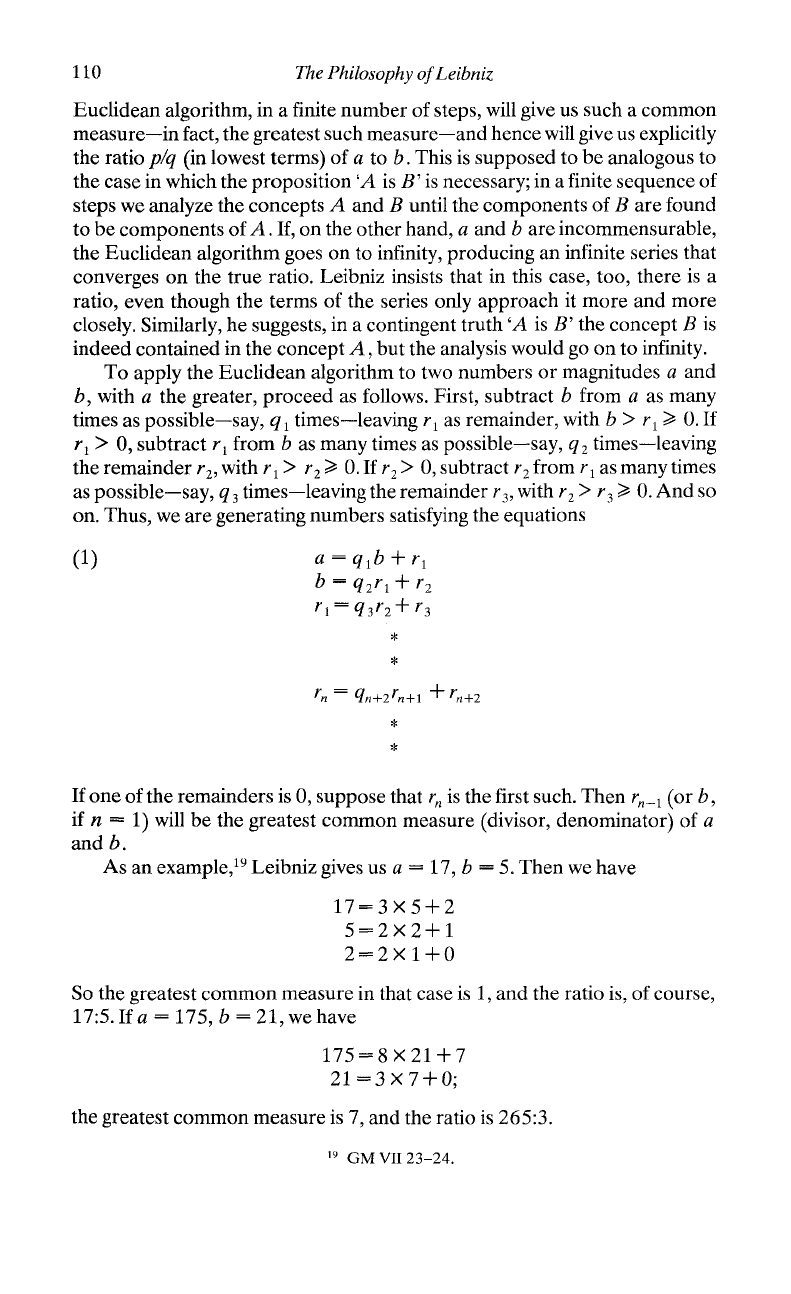
Euclidean algorithm,
in a
finite
number
of
steps,
will
give
us
such
a
common
measure—in
fact,
the
greatest such
measure—and
hence
will
give
us
explicitly
the
ratio
p/q (in
lowest terms)
of a to
b.
This
is
supposed
to be
analogous
to
the
case
in
which
the
proposition
'A
is
B'
is
necessary;
in a
finite
sequence
of
steps
we
analyze
the
concepts
A and B
until
the
components
of B are
found
to be
components
of
A.
If, on the
other hand,
a and b are
incommensurable,
the
Euclidean algorithm goes
on to
infinity,
producing
an
infinite
series that
converges
on the
true ratio. Leibniz insists that
in
this case, too, there
is a
ratio, even though
the
terms
of the
series only approach
it
more
and
more
closely.
Similarly,
he
suggests,
in a
contingent truth
'A
is
B'
the
concept
B is
indeed contained
in the
concept
A,
but the
analysis would
go on to
infinity.
To
apply
the
Euclidean algorithm
to two
numbers
or
magnitudes
a and
b,
with
a the
greater,
proceed
as
follows.
First, subtract
b
from
a as
many
times
as
possible—say,
q
l
times—leaving
r
1
as
remainder, with
b >
r
l
>
0. If
r
l
> 0,
subtract
r
l
from
b as
many times
as
possible—say,
q
2
times—leaving
the
remainder
r
2
,
with
r
1
>
r
2
^
0. If
r
2
> 0,
subtract
r
2
from
r
1
as
many times
as
possible—say,
q
3
times—leaving
the
remainder
r
3
,
with
r
2
>
r
3
>
0. And so
on.
Thus,
we are
generating numbers
satisfying
the
equations
If
one of the
remainders
is 0,
suppose that
r
n
is the
first
such. Then
r
n
_\
(or b,
if
n
=
1)
will
be the
greatest common measure (divisor, denominator)
of a
and
b.
As an
example,
19
Leibniz
gives
us a
=
17, b = 5.
Then
we
have
17
= 3X5 + 2
5=2X2+1
2=2X1+0
So
the
greatest common measure
in
that case
is
1,
and the
ratio
is, of
course,
17:5.
If
a
=
175,
b = 21,
we
have
175
=
8X21
+ 7
21=3X7
+ 0;
the
greatest common measure
is 7, and the
ratio
is
265:3.
19
GM VII
23-24.
Necessary
and
Contingent Truths
111
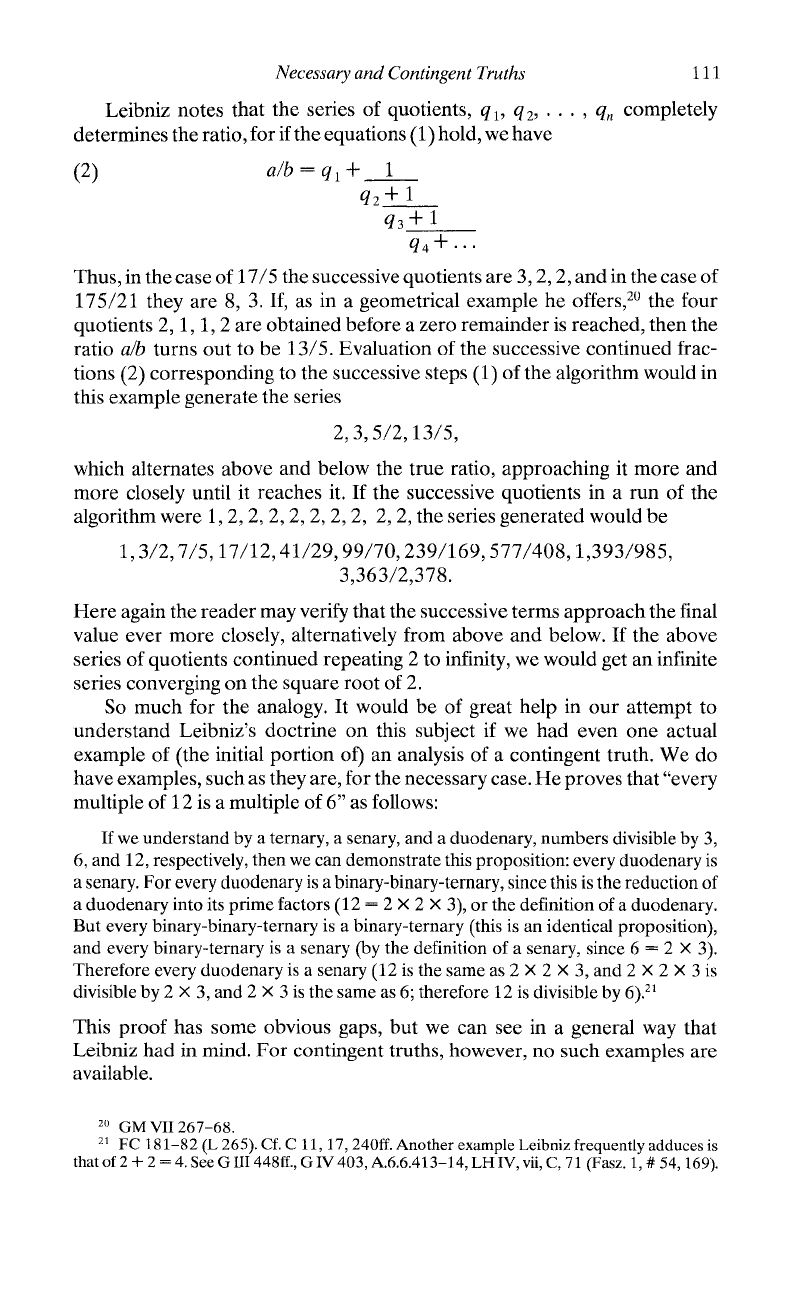
Leibniz notes that
the
series
of
quotients,
q^
q
2
,
•
•
• ,
q
n
completely
determines
the
ratio,
for
if
the
equations
(1)
hold,
we
have
Thus,
in the
case
of
17/5
the
successive quotients
are
3,2,2,
and in the
case
of
175/21
they
are 8, 3.
If,
as in a
geometrical example
he
offers,
20
the
four
quotients
2,1,1,2
are
obtained before
a
zero remainder
is
reached, then
the
ratio
alb
turns
out to be
13/5.
Evaluation
of the
successive continued
frac-
tions
(2)
corresponding
to the
successive steps
(1) of the
algorithm would
in
this example generate
the
series
2,3,5/2,13/5,
which
alternates above
and
below
the
true ratio, approaching
it
more
and
more closely until
it
reaches
it. If the
successive quotients
in a run of the
algorithm
were
1, 2, 2,
2,2,
2, 2, 2, 2, 2, the
series generated would
be
1,3/2,7/5,17/12,41/29,99/70,239/169,577/408,1,393/985,
3,363/2,378.
Here again
the
reader
may
verify
that
the
successive terms approach
the
final
value
ever more closely, alternatively
from
above
and
below.
If the
above
series
of
quotients continued repeating
2 to
infinity,
we
would
get an
infinite
series converging
on the
square root
of
2.
So
much
for the
analogy.
It
would
be of
great help
in our
attempt
to
understand
Leibniz's doctrine
on
this subject
if we had
even
one
actual
example
of
(the initial portion
of) an
analysis
of a
contingent truth.
We do
have examples, such
as
they are,
for the
necessary case.
He
proves that "every
multiple
of
12
is a
multiple
of
6"
as
follows:
If
we
understand
by a
ternary,
a
senary,
and a
duodenary, numbers divisible
by 3,
6, and
12,
respectively, then
we can
demonstrate this
proposition:
every duodenary
is
a
senary.
For
every duodenary
is a
binary-binary-ternary, since this
is the
reduction
of
a
duodenary into
its
prime
factors
(12 = 2 X 2 X 3), or the
definition
of a
duodenary.
But
every binary-binary-ternary
is a
binary-ternary (this
is an
identical
proposition),
and
every binary-ternary
is a
senary
(by the
definition
of a
senary, since
6 =
2X3).
Therefore every duodenary
is a
senary
(12
is the
same
as 2 X 2 X 3, and 2 X 2 X 3 is
divisible
by 2 X 3, and 2 X 3 is the
same
as 6;
therefore
12 is
divisible
by
6).
21
This proof
has
some obvious gaps,
but we can see in a
general
way
that
Leibniz
had in
mind.
For
contingent truths, however,
no
such examples
are
available.
20
GM VII
267-68.
21
FC
181-82(L265).
Cf. C 11,
17,
240ff.
Another
example Leibniz frequently adduces
is
that
of 2 + 2 = 4. See G
HI
448ft,
GIV
403,
A.6.6.413-14,
LHIV,
vii,
C, 71
(Fasz.
1,
#
54,169).
112
The
Philosophy
of
Leibniz
A
Leibnizian "analysis"
or
"resolution"
of a
proposition
'A
is B'
consists
in
making
a
succession
of
definitional replacements
in the
terms
A and B
,
22
If
the
proposition
is a
necessary truth,
the
succession
of
such replacements
will
eventually
end in a
so-called
identity;
23
if the
proposition
is a
contingent
truth,
the
results
are
supposed
to
"converge
upon,"
though never actually
reach,
a
proposition
in
which
the
elements
of the
predicate term
are
some-
how
"explicitly"
present
in the
subject
term.
24
He
says:
A
true contingent proposition cannot
be
reduced
to
identical propositions,
but is
proved
by
showing that
if the
analysis
is
continued
further
and
further,
it
constantly
approaches identical propositions,
but
never reaches them. Therefore
it is God
alone,
who
grasps
the
entire
infinite
in his
mind,
who
knows
all
contingent truths with cer-
tainty.
25
Thus,
the
idea seems
to be
that
as we
progressively analyze
the
concept
of
Caesar,
or
that part
of it of
which
we are
aware,
we
find
it
more
and
more
understandable that
a
person
with
those
attributes would cross
the
Rubicon.
For if
some
man
were able
to
carry
out the
complete demonstration
by
virtue
of
which
he
could prove this connection between
the
subject,
who is
Caesar,
and the
predicate, which
is his
successful undertaking,
he
would
actually
show that
the
future
dictatorship
of
Caesar
is
based
in his
concept
or
nature
and
that there
is a
reason
in
that
concept
why he has
resolved
to
cross
the
Rubicon rather than stop there
...
and
why
it was
reasonable
and
consequently assured that this should
happen.
26
In
some texts Leibniz
concedes
that
the
mathematical analogy
is not
perfect,
for in the
mathematical case
we can
sometimes calculate
by
other
means
the
value
of the
ratio even when
the
series
is
infinite, whereas this
never
happens
with
a
contingent
proposition.
27
Obviously
we
need
a
better
grasp
of
what
he has in
mind
here,
and
especially
of how the
supposed feature
of
contingent truths
is to be
connected with
the
real basis
of
their contin-
gency,
which
is
that
God
could have chosen
not to
create
this actual
world.
28
22
C
258:
Resolutio
est
substitutio
definitionis
in
locum
definiti.
Cf. C
518,
FC 181 (L
264).
23
A.6.2.479:
Propositions
of
reason
follow
solely
from
definitions.
Cf. C
351, 518,
A.2.1.95,386.
24
C 388 # 134 (P
77). Couturat
(CL 213 n. 4),
citing
C
376-77
(P
66)-"But
the
concept
of
Peter
is
complete,
and so
involves
infinite
things;
so one can
never arrive
at a
perfect proof
(of
'Peter
denies'),
but one
always
approaches
it
more
and
more,
so
that
the
difference
is
less than
any
given
difference"—makes
the
obvious point
that
the
terminology
is
borrowed
from
the
calculus
of
infinitesimals.
Cf.
also
C 374
#
66 and C
376-77
# 74.
25
C388#
134
(P
77).
26
G IV
437-38
(L
311).
At
A.6.2.480
Leibniz
briefly
considers
the
questions "How
can
definitions
alone
generate something
new in the
mind?"
and
"Aren't
the new
propositions only
the old
ones expressed
differently?"
Another problem, pointed
out in
Maher (1980), 239,
is
this: Even
if
Caesar's concept
is
infinitely
complex,
"it
would seem that
any
given
predicate which
is in the
subject
must
emerge
after
a
finite
number
of
steps."
27
C
272-73,
18. Cf. C 388 # 136 (P
77-78),
Schneider (1974), 156,
287 n. 3).
28
G IV 438 (L
311),
A.6.6.446-7.
Schneider (1974),
291
ff.,
makes
a
serious attempt
to
work
out the
analogy,
but
finally
concludes (302), "Mir scheint
daher,
dass
in der
Leibniz-
Forschung
mit
Recht
wiederholt
der
Versuch
von
Leibniz kritisiert worden ist,
das
mathema-
tische
Konvergenz-modell
auch
auf
Begriffe
zu
ubertragen."
Necessary
and
Contingent
Truths
113
One
wonders why,
in
seeking
the
"root
of
contingency," Leibniz
did not
make
use of the
fact
that
for any
time
t,
the
singular existential proposition
'A
is,
B'
is
false
of the
actual world
if the
actual world does
not
contain
the
indi-
vidual
concept
A,
or,
what amounts
to the
same thing,
if
there
is no
existent
individual
falling
under
A.
He is
well aware that this applies even when
the
concept
B is
included
in the
concept
A,
as is
evident when
he
equates singu-
lar
existential
'A
is
A'
with
'A
exists'.
So he has
ready
at
hand,
if he
will
only
use it, an
explanation
of
how,
for
example,
the
true proposition "Caesar
crossed
the
Rubicon," although
its
predicate concept
is
contained
in
that
of
its
subject,
can
nevertheless
be
false
of
some possible world (and indeed
is
false
of
every possible world
not
containing Caesar,
or,
more strictly,
not
con-
taining Caesar's concept). Likewise, existential "Pegasus
is a
winged horse"
is
a
falsehood, since
no
winged horse exists;
but it
would
be
true
if
Pegasus
existed,
and
hence
it is
only contingently
false.
For all
other types
of
proposi-
tion
the
crucial
notion'S
is
true
of
possible world
W
could
be
defined recur-
sively
by
reference ultimately
to the
singular atomic propositions
'A
is,
B\
using perhaps
a
"substitution" interpretation
of the
quantifiers
and
treating
disjunctions,
conjunctions, conditionals,
and
negations
in the
obvious way.
Thus Leibniz could save
the
possible-worlds analysis
of
contingency
and
necessity,
maintaining
at
least
for
singular
and
universal
affirmative
proposi-
tions that
the
predicate's inclusion
in the
subject
is a
necessary
or
sufficient
condition
for
their
truth.
29
But,
for
good
or for
ill,
he did not do
this.
One
line
of
thought that might
have
guided
him is the
following.
The
predicate
of the
contingent truth
"Caesar crossed
the
Rubicon" must
be
contained
in the
subject, since anyone
who
really knew
who
Caesar
was (in the
sense
of
being able
to
distinguish
him
from
all
other possible individuals, however similar
to
Caesar they might
be)
would
see
that such
a
person would have
to
cross
the
Rubicon.
30
But, unlike
what
we
find
in a
necessary truth like
"A
bachelor
is a
man," where
a
finite
number
of
substitutions
of
definiens
for
definiendum
convert
the
sentence
into
an
explicit identity
("An
unmarried
man is a
man"),
there
would seem
to
be no
upper limit
to the
length
of the
analysis
of
Caesar's
concept (that
is, of
what
it is to be
Caesar, that very man,
as
contrasted with anybody
and
every-
body else) that might
be
required
to
reach
the
component "crossed
the
Rubicon" attribute.
So, the
difference between
a
necessary truth like
"A
bachelor
is a
man"
and a
contingent truth like "Caesar crossed
the
Rubicon"
is
marked
by
this
difference
in
their analyses.
We put
aside,
for the
moment,
questions about
the
meaning
of the
term contingent truth
and
instead look
to
29
Unless existential import
is
built
in, as was
described
in
chap.
5,
sec.
4.
Maher
(1980)
observes
that
the
account
of
contingency
proposed
in
this paragraph would
imply
that "Caesar
is
a
man"
is
contingent.
I see no
implausibility
in
this,
as the
existential proposition "Caesar
is a
man"
is
equivalent
to
"Caesar
the man is an
existent," which
would
be
false
if
Caesar
did not
exist.
Leibniz
would add, however, that
(in his
special sense
of
"essential")
the
attribute
of
being
a man
is
essential
to
Caesar,
as it is an
attribute that
he has at all
times. Maher also objects that
the
pro-
posed
account would make
(existential)
"Caesar
did not
cross
the
Rubicon" necessary. Regard-
ing
this,
seen.
35.
30
See
chap.
5,
sec.
6.
s
114
The
Philosophy
of
Leibniz
its
extension,
trying
to
find
a
feature that
is
shared
by all the
propositions
to
which
the
term
is in
fact
applied; that feature
is
apparently that they require
an
infinite analysis
to
reveal
the
presence
of the
predicate
in the
subject.
31
This line
of
thought, which
in its
general outlines
is
frequently
followed
by
philosophers
in our own
day,
is, as I
have argued elsewhere, seriously defec-
tive.
32
What
a
term means,
and
what
the
objects
to
which
the
term
is in
fact
applied
may
have
in
common,
are by no
means necessarily
the
same. Leibniz
would
still
owe us an
explanation
of how
"Caesar crossed
the
Rubicon" could
under
any
conditions have been
false
if
crossing
the
Rubicon
is a
very part
of
what
it is to be
Caesar.
His
only
way
out,
it
seems
to me, is to
agree that
the
essential proposition "Caesar crossed
the
Rubicon" couldn't have been
false,
and
that only
the
corresponding existential proposition implies Caesar's
existence
and
hence
is
contingent.
Often
Leibniz writes
as
though
the
distinction between necessary
and
contingent truths coincides with that between true essential
and
existential
propositions,
it
being assumed
here
that
we are
dealing only with categorical
propositions.
33
From
what
he
says,
it is
clear that
the
intuition behind this
is
that
insofar
as the
truth
of a
proposition depends
on
what exists
and
what
does
not
exist,
the
proposition must
be
contingent (for
God
could have
created
a
different
series
of
individuals
from
the one he
chose,
and
hence
there
is a
possible world
of
which
the
proposition
is
false); while
if, on the
other hand,
the
truth
of a
proposition
is
independent
of
what exists
or
does
not
exist, that proposition must
be
necessary,
or
true
of all
possible worlds.
But
this idea, like that concerning
infinite
analysis, collides with other
Leibnizian
doctrines clearly implying that some true existential propositions
are
true
(at all
times)
of all
possible worlds.
If we
obtain
the
existential inter-
pretation
of a
sentence
by
transforming
it
into
secundi
adjecti
form
and
then
taking
ens in the
sense
of
existens,
we
find
that every universal
affirmative
existential proposition
of the
form
'Every
A is
A'
will
be
true
at all
times
and
of
all
possible worlds although
it
"concerns existence
or
nonexistence"
(since
its
secundi
adjecti
counterpart
is
'A
non-^4
does
not
exist').
The
same
will
hold
of
such propositions
as
"Every
man is an
animal" taken existentially,
as
well
as of
various other types
of
existential propositions.
This
difficulty
argues
for the
second
way of
defining
truth conditions
for
existential propositions,
as set
forth
in
section
4 of
chapter
5,
which implies
that
no
existential proposition
of
"Every
A is
B"
form
is
necessary, that
is,
true
of all
possible worlds, unless
the
concept
A is
such that
it is
instantiated
in
every possible world.
But
such
a
concept would amount
to
existens
or
ens,
for
which
we
have
to
make exceptions anyway.
The
same point holds
for the
other types
of
existential categorical propositions:
none
will
be
true
of a
pos-
sible
world unless
the
subject concept
is
instantiated
in
that world. Thus, with
31
Here
cf. C
513,
where Leibniz distinguishes between what
we
take
to be
true
and
what
absolutely
is
true.
32
Mates
(1958).
33
C18;cf.C376#74(P66).
Necessary
and
Contingent
Truths
115
a few
dubious exceptions,
on
this interpretation
the
existential categorical
propositions
will
all be
contingent.
34
Note that
on
either interpretation
the
existential proposition
'A
is B'
will
be
false
of all
possible worlds
if the
concept
'AB'
is
inconsistent.
In
particular,
when
a
false existential proposition
has a
complete individual concept
as
sub-
ject (with
the
necessary specifications
of
time),
it
will
be
false
of all
possible
worlds,
and
hence
its
negation
will
be a
necessary truth. This
has
seemed
counterintuitive
to
some commentators,
but I am
convinced that
it
represents
the
Leibnizian
view. Thus,
the
existential proposition
(1)
Socrates
is
tall
is
false
(at all
times)
of
every possible world,
for the
concept Tall
is not
con-
tained
in the
complete individual concept
of
Socrates, since
he
exists
and is
not
tall. Hence
its
negation,
(2)
Socrates
is not
tall
is
true
(at all
times)
of all
possible worlds,
and
thus
is a
necessary truth.
But
that,
I
think,
is
exactly what Leibniz means
to
assert. Anybody,
in any
world,
who
was
tall would
not be our
Socrates, that
is to say
that this individual
would
not be
Socrates;
in
other words,
it is
absolutely impossible that
Socrates should have been tall
or
should have
had any
attributes whatever
other than
the
ones
he
does have. This point
will
be
discussed more
fully
in
chapter
7.
It
is
worth mentioning that some
of the
paradoxical aspect
of the
fore-
going
may be
removed
by
distinguishing between denying
the
predication
of
Tall,
on the one
hand,
and
affirming
that
of
non-Tall,
on the
other. Thus, exis-
tential
(3)
Socrates
is
non-tall
would
be
true
of the
actual world
but
false
of all
others; hence, unlike (2),
it
would
be
contingent.
35
34
The
exceptions
I
have
in
mind
are
negative identities like "Caesar
is not
Porapey."
Cf. n. 4
above
and
Burk
134ff.
35
Similarly, consider (with Fried
1981)
the
four
sentences:
1.
Ford
is a
Republican.
2.
Ford
is a
non-Republican.
3.
Ford
is a
Democrat.
4.
Ford
is a
non-Democrat.
Taken
as
expressing existential propositions,
(1) and (4) are
contingent truths
and
their
negations
are
contingent falsehoods;
(2) and (3)
express impossibilities
and
their negations
are
necessary truths.
As
regards (2), Fried assures
us (p.
49), without evidence, that "Leibniz wants
such
a
proposition
to be
contingently false." Does
he?
Leibniz would say, "Anybody
who was not
a
Republican would
be
somebody other than
Ford."
I
cannot claim, however, that
the
Leibnizian texts
are
unambiguous
on
this point.
At
GIV218
(H
235)
he
says that
no
contradiction follows
from
the
falsehood "Spinoza died
in
Leyden,"
which seems analogous
to
(3),
and
"nothing would have been
so
possible."
Yet he
goes
on to
explain that
the
reason
the
proposition
is
false
is
that
God
chose
a
universe,
a
"sequence,"
not
including that event.
It
seems that Leibniz
has
forgotten,
for the
moment, that
his
doctrines
116
The
Philosophy
of
Leibniz
Tangentially related
to
these matters
is the
claim, recently made
by
several
scholars,
36
that Leibniz recognized certain truths
as
necessary
although they
do not
satisfy
his
regular definition, that
is, are not
such that
their opposites imply
contradiction.
The
propositions they have
in
mind
are
negative
identities such
as:
Yellowness
is not
sweetness,
Square
is not
circle,
White
is not
red,
Warmth
is not
color,
37
the
terms
of
which
are
examples
of
what Leibniz calls
disparata.
He
defines
this word
as
follows:
"A
and B are
disparata
if A is not B and B is not
A,
as
Man
and
Stone."
38
But
surely Leibniz would
say
that
the
opposites
of
these propositions
do
imply
contradictions, however
difficult
it
might
be for us to see
what
the
reductions would
be. In the
only passage
in
which
he
discusses
the
matter
explicitly,
he
says that
the
propositions
are
"nearly" identities
(in his
sense
of
"identity,"
of
course), which suggests that
he
thought
the
required reductions
would
not be
very lengthy. Lest this seem
too
fantastic,
we
should recall that
sometimes what
he
offers
as
"analyses" seem more causal than
conceptual,
39
as,
for
example, when
he
analyzes Green
as
Yellow plus
Blue.
40
In any
case,
actual reductions
to
identities
are few and far
between
in the
Leibnizian
writings,
and we
don't even know
how he
would handle
a
mathematical
example like
"A
square
is not a
circle."
The
upshot
of all
this
is, in my
opinion, that
the
possible-worlds
frame-
work
can be
consistently applied
at
most
to the
semantics
of
existential
propositions.
If the
inclusion
of
concept
B in
concept
A is a
necessary
and
sufficient
condition
for the
truth
of
'A
is
B',
as is the
case when
'A
is
B'
is an
essential proposition, then
it
seems impossible that this proposition should
be
true
of
some possible worlds
and
false
of
others.
For the
selection
of a
given
possible world
for
existence cannot determine
the
relationships
of the
concepts that
are in
God's
mind prior
to
Creation.
The
"infinite analysis"
imply
that there
is no
possible world
in
which Spinoza does
die in
Leyden,
for
such
a
person
would
have
been
somebody
else,
not
Spinoza.
S 478
seems
to
imply that nonpredicability
of all
purely positive terms
is a
sufficient
condi-
tion
for
nonexistence.
That
is,
'A
est
non-ens'
is
true
if and
only
if, for all
positive
B,
'A
est
B'
is
not
true. But,
on the
other hand, note
C
264:
"A
non
est B
idem
est
quod
A est
non-B."
36
Wilson
(1969),
62-63;
Poser (1969),
133;
Schneider
(1974),
25Iff.;
Burk
134-35.
37
Cf.A.6.6.82and362.
38
G
VII
225;
cf. C 47, 53, 62,
239, 363,
G VII
237.
LH
IV vii C
38v: "Disparata
sunt
quae
specie
differunt."
(At
A.6.6.362,
however, Leibniz gives
Man and
Animal
as
examples
of
disparata.)
Burk
110
argues that
no two
concepts
are
"completely" disparate. This
is
because
he
thinks
that every pair
of
compound concepts have
a
common component. That view
is
surely
mistaken,
for any
consistent combination
of
simple concepts
and/or
complements
of
simple
concepts
is a
complex concept.
In any
case, Leibniz nowhere entertains
the
idea that disparate-
ness comes
in
degrees.
39
GIV
422-23
(L
291).
411
A.6.6.403;GIV426(L294).
Necessary
and
Contingent Truths
117
account
of
contingent propositions
may
perhaps
be
accepted
as a
characteri-
zation
of
those propositions that
we, in our
ignorance, call
"contingent,"
41
but
it
cannot intelligibly define
the
class
of
propositions that
are
contingent,
being true
of
some possible worlds
and
false
of
others.
2.
Hypothetical Necessity
Following
a
tradition extending back
to
Aristotle,
42
Leibniz attempted
to
dis-
tinguish
absolute
and
hypothetical necessity. Unfortunately,
the
distinction
seems
to
originate
from
a
certain confusion that also goes back
at
least
as far
as
Aristotle.
It is the
confusion
of
'Necessarily,
if P
then
Q'
with
'If
P
then
necessarily
Q\
In
classical Greek,
as in
English
and
other modern languages, when
a
modalized conditional
is to be
expressed,
one
naturally puts
the
modal
operator
in the
consequent:
we
say,
"If
Reagan
was
elected, then
he
must have
received
the
most votes," instead
of the
more logically perspicuous
but
less
idiomatic "Necessarily,
if
Reagan
was
elected,
he
received
the
most votes."
Thus
we
make
it
appear
that necessity
is
being conditionally predicated
of the
consequent, rather than unconditionally predicated
of the
whole.
43
If we add
the
true premise "Reagan
was
elected,"
we may go on (if we are
philosophi-
cally
confused enough)
to
detach
by
modus ponens
the
consequent, "Reagan
must
have received
the
most votes";
and
then, since there
was
obviously
no
logical necessity that Reagan receive
the
most votes,
we
might suppose that
some other kind
of
necessity
is
involved.
The
tendency
to
fall
into this kind
of
fallacy,
which
we may
call
the
"fallacy
of the
slipped
modal
operator,"
is
very strong,
as one can
verify
for
oneself
by
discussing
it
with friends
who are not
logicians. People want
to say
things like
"Of
course,
it
isn't really necessary that Smith have
a
wife,
but
given
that
(or on the
hypothesis
that)
he is a
husband,
it is
necessary."
44
In
the Sea
Fight chapter
of De
Interpretation,
45
Aristotle appears
to
argue
as
follows:
If it is now
true that something
will
be so,
then
it
cannot
not
be so and
will
necessarily
be so; and if it is now
true that
it
won't
be so,
then
41
Because
we
have
to
discover
their
truth
a
posteriori, i.e.,
by
experience:
C 17,
FC
182,
G
III
259,
G
VII
44.
42
Aristotle, Physics
200al2-14.
43
A
typical
Leibnizian example
in
which
the
fallacy
is
clear
is at G III 36:
"Granted that,
if
God
foresees something,
it
will
necessarily happen,
yet
this
necessity, since
it is
only hypo-
thetical,
does
not
negate contingency
and
freedom."
44
So we
find
Leibniz
saying,
at C
271:
"For even contingent propositions,
on the
hypothesis
of
the
existence
of
things,
are
necessary. Just
as it is
impossible
to
take money
away
from
Codrus,
given
that
he
doesn't have any."
Leibniz
suspected that some sort
of
logical
fallacy
is
involved when
we say
"What
will
happen, must happen,"
but he
thought
it
resided
in a
"suppressed repetition"
and
that what
is
meant
is
more properly expressed
by
"What
will
happen,
if
it
will
happen,
it
must happen,"
or
"Of
what
will
happen,
it is
inconceivable
that
if it
will
happen
it
won't happen"
(A.6.1.541).
In
this
last
rephrasal
the
modal operator clearly governs
a
conditional,
as it
should,
but the
triviality
of
the
result seems
not yet
appreciated
by
Leibniz.
45
De
Interpretations,
chap.
9.
118
The
Philosophy
of
Leibniz
necessarily
it
won't
be so;
consequently,
if it is now
true that
it
will
be so or it is
now
true that
it
won't
be so,
then either necessarily
it
will
be so or
necessarily
it
won't
be
so—everything
that will happen, therefore, will happen neces-
sarily,
and
nothing
will
come
about
by
chance.
The
argument clearly rests
on
the
fallacy
we are
discussing. Aristotle's tendency
to let the
modal
operator
"necessarily" slip over into
the
consequent
of a
conditional
is
also visible else-
where
in his
logical writings. Thus,
in the
Prior
Analytics^
6
the
slippage
is
visible
in his
statements
of
valid modes
of the
syllogism (for example,
Barbara:
"If A is
predicated
of all B and B of all C,
then
it is
necessary
for A
to be
predicated
of all
C").
And in the
Physics passage
in
which
the
notion
of
hypothetical necessity
is
first
introduced,
we
read:
"If
something
is
going
to be
a saw and do its
work,
it
must necessarily
be
made
of
iron.
But the
necessity
is
hypothetical
[ex
hypotheseos]...
,"
47
Leibniz
is
interested
in the
distinction between
the
absolute
and the
hypo-
thetical modalities primarily
as a way of
distinguishing logical from physical
necessity.
48
He
holds that many things that were antecedently possible,
or
possible
per se,
became impossible once
God had
created
the
actual world.
Thus, given that
God has
created this world,
it is
impossible that
a
moving
body should deviate
from
uniform motion unless acted upon
by
something
else, though considered
in
itself this state
of
affairs
is by no
means impos-
sible.
49
In
other words,
it is
hypothetically impossible, though absolutely pos-
sible,
for
such
a
state
of
affairs
to
exist.
In
general,
for
Leibniz
a
proposition
P
is
hypothetically necessary
if and
only
if the
conditional proposition
'If
the
actual
world exists, then
P'
is
absolutely necessary
but P
itself
is not
(or, what
comes
to the
same thing,
if and
only
if P is not
absolutely necessary
but the
conjunction
'The
actual world exists,
and
not-P'
is
absolutely
impossible).
50
Since
the
actual world
is the set of
complete individual concepts
of
actual
individuals,
to
bring
it
into existence
is to
create
an
individual corresponding
to
each
and
every
one of its
constituent concepts.
And
because
of the
mutual
mirroring
of
these concepts,
if one
such individual exists, they
all
will
exist.
Therefore,
the
proposition "The actual world exists"
is
equivalent
to
each
and
every
proposition
of the
form
'A
exists',
where
A is any
concept belonging
to
the
actual world.
So the
absolutely necessary truth
"If
Caesar exists, then
he
46
Prior
Analytics
25b37ff.
47
Physics
200al2-14.
48
At G
VII
303
(L
487)
he
says:
"The
present
world
is
necessary
in a
physical
or
hypo-
thetical
sense,
not
absolutely
or
metaphysically.
That
is,
once
it is
established
to be
such
as it is, it
follows
that
things
such
as
they
are
will
come
into
being."
Sometimes,
however,
Leibniz
seems
to
define
hypothetical
necessity
by
reference
to
God's
foresight;
cf. G VII
389-90
(L
696).
Further
references
on
hypothetical
necessity,
from
Poser
(1969),
73n:
GII18,
G III
400,
GIV
437,
G V
163ff.,
G VII
303, Grua
271,
273, 300,
305ff.,
309,
C
271, 525,
GM
III
576.
49
Grua 288,
C 22.
Regarding
such
laws
of
nature,
Leibniz
says
at C 20
(S&G 350):
"Since
the
fact
that
the
series [viz.
this
series
of
things,
the
actual
world]
itself
exists
is
contingent,
and
depends
on a
free
decree
of
God,
its
laws
too,
considered
absolutely,
will
be
contingent;
hypo-
thetically,
however,
if the
series
is
supposed,
they
are
necessary
and so far
essential."
50
Cf. G VI
280-81:
Thus,
as
concerns
the
devil,
"it is
written
in the
book
of
eternal
truths,
which
contain
all
possibilities
prior
to any
decree
of
God,
that
if
he
were
once
created
he
would
freely
turn
to
evil."
So it is
only
hypothetically
necessary
that
the
devil
sins.
Grua
300:
A
con-
tingent
truth
is
necessary
exposito
decreto
Dei.
Necessary
and
Contingent Truths
119
will
cross
the
Rubicon"
is
equivalent
to "If the
actual world exists, then
Caesar
will
cross
the
Rubicon,"
and
hence
the
proposition "Caesar
will
cross
the
Rubicon," though
not
absolutely necessary,
is
hypothetically necessary.
In
fact,
if P is any
proposition true
of the
actual world,
the
proposition
'If
P,
then Caesar
will
cross
the
Rubicon'
is
again absolutely necessary
and
could
be
used
to
establish
the
hypothetical necessity
of
"Caesar
will
cross
the
Rubicon." Thus,
we may say in
general that
a
proposition
P is
hypothetically
necessary
if and
only
if, for
some true proposition
Q,
'If
Q
then
P'
is
absolutely
necessary though
P is
not.
It
follows
that
the
hypothetically necessary propositions coincide
with
the
contingently true
propositions.
51
This
is
what Leibniz
has in
mind when
he
tells
us
that those who, with ancient Diodorus Cronus,
say
that whatever
is
necessary
has
been,
is
now,
or
will
be the
case simply
confuse
hypothetical
necessity with
absolute.
52
One
important
use
Leibniz
found
for
this doctrine
was
that
it
permitted
him
to
concede
to his
critics that according
to his
philosophy,
the
proposition
"Judas
will
sin"
was
indeed necessary.
But he
could then escape their
strictures
by the
(perhaps somewhat sophistic) device
of
pointing
out
that
the
necessity
was
only hypothetical,
not
absolute.
53
To
this,
by
redefining "free,"
he
could
add
that
it was not
only hypothetically necessary that Judas should
sin,
but
that
he
should
sin
freely.
54
Leibniz says that
he
agrees
with
Aristotle
in
defining
an act as
free
if it is
spontaneous
and
deliberate
or
spontaneous
involving
choice.
55
His own
phrase
for the
crucial feature
is
"rational spontaneity."
An act is
"spon-
taneous,"
he
explains,
if the
principle (origin)
of the act is in the
agent.
56
Thus,
he
seeks
to
make
the
freedom
of an act
compatible
with
that act's being
a
hypothetically
necessary
effect
of
antecedent events, including motives
or
other causes, which,
he
says,
"incline without necessitating, that
is,
without
imposing
an
absolute
necessity."
57
He
rejects
as "an
impossible chimera"
the
51
C
271: For,
on the
hypothesis
of the
existence
of
things, contingent propositions
too are
necessary.
Grua 273:
"...
contingentia,
seu
ut
ita
dicam
per
accidem
sive
ex
hypothesi
necessaria."
LHIV
vii B 3
40-49
(Fasz.
2, #
97,369):
contingent propositions
are
necessary
per
accidens.
Notice that
the
hypothetically possible, too,
will
coincide
with
the
contingently true.
52
GIII572(L661),GVII409(L709),GVI442,Grua288,GVI212ff.(H230ff.),C534.
Cf.
Mondadori
(1983),
p.
502.
At
Grua 289,
Leibniz
says that
"no
pentagon exists"
is
necessary
if
taken
in the
sense
of "no
pentagon
has
existed
or
ever
will
exist,"
but it is not
necessary
if we
abstract
from
time. This means that "the actual series
of
things contains
no
pentagon"
is a
hypothetically necessary truth,
but "no
possible series
of
things contains
a
pentagon"
is
false.
53
G
VI37,123,184,284-85
(H
61,144,203,298-99);
G
VII
302.
The
free
actions
of
men
are
certain,
according
to
Leibniz, because they
are
foreseen and, indeed, foreordained
by
God,
but
"infallible certitude
is one
thing
and
absolute necessity
is
another,
as
Augustine
and
Aquinas
and
other
learned
men
recognized
long ago"
(from
the
"Metaphysical Discussion with
Fardella,"
printed
in
Stein
[1888],
322-26).
54
Similarly,
God
created
Adam
libere
peccans
(G III
35).
55
A.6.6.175-76,
G VI
122
(H
143),
G III
364.
5(1
C 25, G VI 296 (H
309-10),
Hansch (1728),
34.
57
G VII 390 (L
697),
C
504,
G III
468. Note
this
explication
of the
famous
phrase
"inclines
without
necessitating."
Cf.
GII
46 (M
50),
G
VI127
(FI
148).