
Bielajew A.F. Fundamentals of the Monte Carlo method for neutral and charged particle transport
Подождите немного. Документ загружается.

10.6. USING ELEMENTAL VOLUMES TO MAKE OBJECTS 141
142 CHAPTER 10. GEOMETRY
10.6.3 Combinatorial geometry
So far we have introduced elemental volumes and indicated how they may be combined
to make objects. We have also introduced a simple yet powerful tracking algorithm for
simply-connected surfaces and have given some idea as to the subtleties involved in multiply-
connected elements.
The general discussion of this is called combinatorial geometry and would take us beyond
the scope of this book. Before dismissing the topic, however, the following capabilities of
combinatorial codes are either necessary or desirable:
1. The ability for a particle to locate itself unambiguously in a unique elemental volume
baseduponitspositionanddirection.
2. A systematic numbering/identification scheme for the elemental volumes. For small
applications this can be coded by the user. For involved applications, the combinatorial
code should be able to do this on its own.
3. The ability to model reflecting, absorbing or partially absorbing surfaces.
4. The ability to “build” objects in standard position and then translate and rotate them
into actual position.
5. The ability to re-use objects, once, twice, or in repetitive patterns.
6. The ability to model various sources of particles, either originating interior or exterior
to the geometry.
7. The ability to see the results of geometry construction graphically.
8. A graphical tool to build geometries.
10.7 Law of reflection
The use of some of the inherent symmetry of the geometry can realize some real simplifica-
tions. We will consider the use of reflecting planes to mimic some of the inherent symmetry
of a geometry.
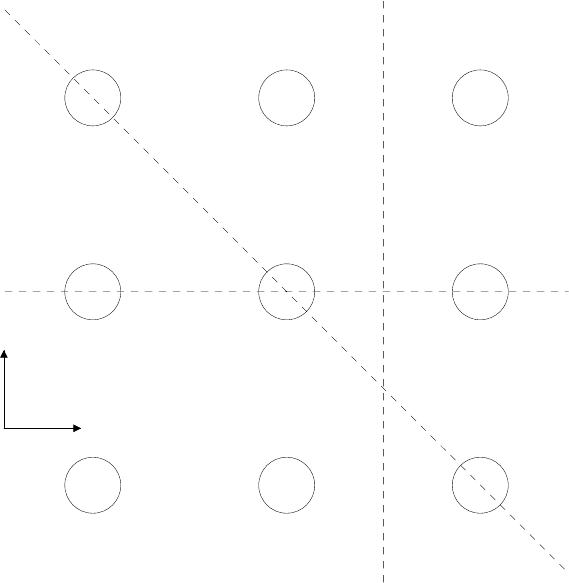
For example, consider the geometry depicted in fig. 10.10. In this case, an infinite square
lattice of cylinders is irradiated uniformly from the top. The cylinders are all uniform and
aligned. How should one approach this problem? Clearly, one can not model an infinite
array of cylinders. If one tried, one would have to pick a finite set and decide somehow
that it was big enough. Instead, it is much more efficient to exploit the symmetry of the
problem. It turns out that in this instance, one needs to transport particles in only 1/8’th
10.7. LAW OF REFLECTION 143
-1.5 -0.5 0.5 1.5
-1.5
-0.5
0.5
1.5
-1.5 -0.5 0.5 1.5
-1.5
-0.5
0.5
1.5
-1.5 -0.5 0.5 1.5
-1.5
-0.5
0.5
1.5
.
.
.
. . .
. . .
a
.
.
.
b
c
x
y
z
Figure 10.10: Top end view of an infinite square lattice of cylinders. Three planes of symme-
try are drawn, a, b,andc. A complete simulation of the entire lattice may be performed by
restricting the transport to the interior of the three planes. When a particle strikes a plane
it is reflected back in, thereby mimicking the symmetry associated with this plane.

144 CHAPTER 10. GEOMETRY
of a cylinder! To see this we find the symmetries in this problem. In fig. 10.10 we have
drawn three planes of symmetry in the problem, planes a, b,andc
6
. There is reflection
symmetry for each of these planes. Therefore, to mimic the infinite lattice, any particles
that strike these reflecting planes should be reflected. One only needs to transport particles
in the region bounded by the reflecting planes. Because of the highly symmetric nature of
the problem, we only need to perform the simulation in a portion of the cylinder and the
“response” functions for the rest of the lattice is found by reflection.
The rule for particle reflection about a plane of arbitrary orientation is easy to derive. Let ~u
be the unit direction vector of a particle and ˆn be the unit direction normal of the reflecting
plane. Now divide the particle’s direction vector into two portions, ~u
k
,paralleltoˆn,and~u
⊥
,
perpendicular to ~n. The parallel part gets reflected, ~u
0
k
= −~u
k
, and the perpendicular part
remains unchanged, ~u
0
⊥
= ~u
⊥
. That is, the new direction vector is ~u
0
= −~u
k
+ ~u
⊥
. Another
way of writing this is,
~u
0
= ~u − 2(~u ·~n)~n. (10.21)
Applying eq. 10.21 to the problem in fig. 10.10, we have: For reflection at plane a,(u
0
x
,u
0
y
,u
0
z
)=
(−u
x
,u
y
,u
z
). For reflection at plane b,(u
0
x
,u
0
y
,u
0
z
)=(u
x
, −u
y
,u
z
). For reflection at plane
c,(u
0
x
,u
0
y
,u
0
z
)=(−u
y
, −u
x
,u
z
). The use of this reflection technique can result in great gains
in efficiency. Most practical problems will not enjoy such a great amount of symmetry but
one is encouraged to make use of any available symmetry. The saving in computing time is
well worth the extra care and coding.
6
Note that this symmetry applies only to a square lattice, where the spacing is the same for the x and
y-axes. For a rectangular symmetry, the planes of reflection would be somewhat different. There would be
no plane c as for the square lattice in fig. 10.10.
Bibliography
[Olm47] J. M. H. Olmsted. Solid Analytic Geometry. (Appleton-Century-Crofts Inc, New
York), 1947.
Problems
1. Consider a right circular cylinder of radius R and length L where R and L are in units
of, say, cm’s. The interior of this object is defined by the planes z =0,z = L and the
cylinder x
2
+ y
2
= R
2
.
A beam of at least 10
4
particles is incident on the middle of the flat end of the ge-
ometry at ~x = 0 with unit direction vector ~u =ˆz. These particles exhibit discrete
interactions with an attenuation factor of Σ = 1 cm
−1
. Thus, the interaction proba-
bility distribution function at location z is p(z)dz =Σexp(−Σz)dz . These particles
scatter isotropically once they reach the scattering point.
Write a Monte Carlo code to simulate this problem and answer the following questions:
(a) The total pathlength/history is the sum of the distance from start to interaction
(if it occurs) plus the drift distance to exit the geometry. For R = 0 and L = ∞,
what is the average total pathlength/history and its associated estimated error,
t ± s
t
?
(b) For L = 10 cm, what is the average pathlength and its associated estimated error,
t ±s
t
when R is 0.1,0.2,0.5,1,2,5,10,20,50,100,200,500,1000 cm’s? Plot the results
and discuss the small-R and large-R limits.
(c) For R = 10 cm, what is the average pathlength and its associated estimated error,
t ±s
t
when L is 0.1,0.2,0.5,1,2,5,10,20,50,100,200,500,1000 cm’s? Plot the results
and discuss the small-L and large-L limits.
2. Consider a right circular cylinder of radius R and length L. The interior of this object
is defined by the planes z =0,z = L and the cylinder x
2
+ y
2
= R
2
. For this exercise,
R = L = 1 cm. A beam of at least 10
4
particles is incident on the middle of the
flat end of the geometry at ~x = 0 with unit direction vector ~u =ˆz. These particles
145
146 BIBLIOGRAPHY
exhibit discrete interactions with an attenuation factor Σ which will be given later in
units of cm
−1
’s. Thus, the interaction probability distribution function at location z is
p(z)dz =Σexp(−Σz)dz. At the interaction point, the particle scatters into a polar,
Θ, and an azimuthal, Φ, angle with probability distribution:
p(Θ, Φ) dΘ dΦ =
η(2 + η)
4π
sin Θ dΘ dΦ
(1 − cos Θ + η)
2
,
where η is a dimensionless constant that describes forward scattering for η −→ 0and
isotropic scattering for η −→ ∞. After the first interaction, second and subsequent
interactions can occur with the same interaction probability until the particle escapes
from the geometry, possibly having scattered repeatedly.
Write a Monte Carlo code to simulate this problem and answer the following associated
questions:
(a) i. Show that in the limit, η −→ 0, p(Θ) sin Θ dΘ dΦ −→ δ(1−cosΘ)sinΘdΘdΦ/2π.
ii. Show that in the limit, η −→ ∞, p(Θ) sin Θ dΘ dΦ −→ sin Θ dΘ dΦ/4π.
(b) For the set of Σ’s, Σ = 0.1, 1, 10 cm
−1
’s and both forward (η −→ 0) and isotropic
(η −→ ∞) scattering, calculate the backscatter and transmission coefficients
(number backscattered or transmitted divided by the number of histories), and
the associated estimated statistical uncertainty.
(c) For Σ = 10 cm
−1
, do simulations for a set of η’s with enough points such that
both asymptotic limits are nearly reached and the η behavior of the backscatter
and transmission coefficients for intermediate η are fully described.
(d) Repeat 2(b) but with the back plane of the geometry being a reflective surface.
(e) Repeat 2(b) but with both the back plane and the cylindrical surface of the
geometry reflective but with absorption included in the following way—at each
interaction point, there is a 0.8 probability that the particle will scatter in the
way previously described and a 0.2 probability that it will be absorbed.
(f) Repeat 2(b) but with grazing incidence of the starting point, i.e. the particles are
incident on the middle of the flat end of the geometry at ~x = 0 with unit direction
vector ~u =ˆy.
3. A cylindrical beam of particles with the following starting characteristics:
ψ(~x, ~u)=
2
R
2
beam
Θ(R
2
beam
−x
2
− y
2
)δ(z)δ(ˆz − ~u)
is incident on a geometry defined by the plane, z = 0 and the cylinder x
2
+ y
2
= R
2
cyl
.
Once inside the target (i.e. z ≥ 0), the particle scatters isotropically with elastic

BIBLIOGRAPHY 147
scattering cross section, Σ
s
= 1 and absorption cross section Σ
a
=0.25. Outside the
target (i.e. z<0), Σ
s
=Σ
a
=0. Note to take care that you inform the particles
whether they are inside the cylinder or outside.
(a) Let R
cyl
= 1. Tally and plot the average path-length/R
2
cyl
(per particle) inside the
cylinder and its estimated error as a function of 0.1 ≤ R
beam
≤ 10 using 10000
incident particle histories.
(b) Now let R
beam
= 1. Tally and plot the average path-length/R
2
cyl
(per particle)
inside the cylinder and its estimated error as a function of 0.1 ≤ R
cyl
≤ 10 using
10000 incident particle histories.
(c) Compare both the average values and the estimated errors of the above two ex-
amples. What conclusions do you make? Which is the more efficient way to solve
the problem?
4. A geometry is defined by the infinite square lattice of cylinders
∞
X
i=−∞
∞
X
j=−∞
(x − di)
2
+(y − dj )
2
= R
2
cyl
,
where i and j are integers and d is the lattice spacing constant. 10000 particles start out
from the origin with an isotropically symmetric direction. Inside the cylinders there
is only absorption, with an absorption constant Σ
a
. Outside the cylinders there is
only isotropic elastic scattering, with an interaction constant Σ
s
. Starting with default
values of R
cyl
=0.25, Σ
s
=1,Σ
a
= 1, tally and plot the average square cylindrical
radius distance x
2
+ y
2
(and its estimated error) where the particle is absorbed as a
function of the following geometrical variables:
(a) d, taking note that d<0.5
(b) Σ
s
(c) Σ
a
5. The particle interaction scheme we will consider is that of either isotropic or forward
scattering with a scattering constant, Σ
scat
, and particle absorption with the constant,
Σ
abs
.Inthisexample,Σ
scat
=1cm
−1
and Σ
abs
=0.05 cm
−1
. The particles are incident
normally on a planar geometry consisting of 21 planes normal to the z-axis separated
by 1 cm. That is, z =0, 1, 2, ...20 cm. Tally the average pathlength in each planar
zone. Once within the geometry, if it hits the plane at z =0orz = 20, it escapes.
A working version of transport portion of the code is attached. The difficulty in
doing this exercise is writing an efficient subroutine geometry.Usethesubroutine
zplane() from the code library to solve this problem. (It is possible to do it in about
15 lines of executable code.)
Plot the results for isotropic and forward scattering. Compare and explain the results.
Hand in only your plot(s), your subroutine geometry and associated discussion.
148 BIBLIOGRAPHY
! Starting position
x=0
y=0
z=0
! Starting direction
u=0
v=0
w=1
iregion = 1 ! Starts incident on plane 1
1 continue ! Beginning of the transport loop
t = -log(1 - rng())/(Sigma_scat + Sigma_abs)
call geometry
*(
* t, ! On input, this is the proposed transport distance
* ! On output, if hit = .true., t is set to the
! distance to the plane which it hits
* hit, ! Set to .true. if the input distance t is greater
! than the transport distance to a plane
* iregion, ! Input: the current region number
* new_region ! The new region number.
! If new_region is set to 0 then is escape from either
! the front or the back of the geometry
*)
! Transport the particle
x=x+u*t
y=y+v*t
z=z+w*t
path(iregion) = path(iregion) + t ! Tally the pathlength in region
! iregion
path2(iregion) = path2(iregion) + t**2 ! Tally its square for statistics
if (hit) then
! Particle moves out of the current region
if (new_region .eq. 0) then
! It has escaped the geometry, do the next particle
BIBLIOGRAPHY 149
continue
else
iregion = new_region ! It has changed its region number
goto 1 ! Continue transport in the new region
end if
else
if (rng() .lt. Sigma_scat/(Sigma_scat + Sigma_abs)) then
! Particle interacts isotropically
! For forward scattering, comment out the next two lines
call isotropic(costhe)
call rotate(u,v,w,costhe)
goto 1 ! Continue transport in the same region
else
! Particle is absorbed, do the next particle
continue
end if
end if
6. A geometry consists of a unit cube at the center of which is a sphere with diameter
D,whereD ≤ 1. The planar surfaces are reflecting with an efficiency of =0.95.
That means, if a particle strikes a planar surface, it has p =0.95 of being reflected and
p =0.05 of being absorbed. The sphere, on the other hand, is totally absorbing. That
is, if a particle strikes the sphere, it has p = 1 of being absorbed. The source for this
is distributed uniformly throughout the box and radiates isotropically. The interior of
the box is vacuum.
Write a Monte Carlo code to simulate this problem and tally the number of reflections
a particle experiences before it is absorbed as a function of the diameter of the sphere.
Tally the number of particles absorbed by the sphere vs. the number of particles ab-
sorbed by the planes as a function of the diameter of the sphere.
Use your discretion as to how many histories to execute to get a reasonable result and
how fine a grid spacing in a to produce reasonable results.
150 BIBLIOGRAPHY