
Bielajew A.F. Fundamentals of the Monte Carlo method for neutral and charged particle transport
Подождите немного. Документ загружается.

2.2. DISCRETE RANDOM VARIABLES 21
• c(x) is a monotonically increasing function of x as a result of p(x)alwaysbeingpositive
and the definition of c(x) in Equation 2.15.
Cumulative probability distribution functions can be related to uniform random numbers to
provide a way for sampling these distributions. We will complete this discussion in Chapter 4.
Cumulative probability distribution functions for multi-dimensional probability distribution
functions are usually defined in terms of the one-dimensional forms of the marginal and
conditional probability distribution functions.
2.2 Discrete random variables
A more complete discussion of probability theory would include some discussion of discrete
random variables. An example would be the results of flipping a coin or a card game. We
will have some small use for this in Chapter 5 and will introduce what we need at that point.
22 CHAPTER 2. ELEMENTARY PROBABILITY THEORY
Bibliography
Problems
1. Which of the following are candidate probability distributions? For those that are not,
explain. For those that are, determine the normalization constant N. Those that are
proper probability distributions, which contain moments that do not exist?
f(x)=N exp(−µx)0≤ x<∞
f(x)=N exp(−µx)0≤ x<Λ/µ
f(x)=N sin(x)0≤ x<π
f(x)=N sin(x)0≤ x<2π
f(x)=
N
√
x
0 ≤ x<1
f(x)=
N
√
x
1 ≤ x<∞
f(x)=N
x
(x
2
+ a
2
)
3/2
0 ≤ x<∞
2. Verify that Equations 2.4, 2.6, and 2.7 are true probability distributions.
3. Prove Equation 2.11. Simplify in the case that x and y are independent.
23
24 BIBLIOGRAPHY
Chapter 3
Random Number Generation
Anyone who considers arithmetical methods of producing random digits is, of
course, in a state of sin.
John von Neumann (1951)
The “pseudo” random number generator (RNG) is the “soul” or “heartbeat” of a Monte
Carlo simulation. It is what generates the pseudo-random nature of Monte Carlo simulations
thereby imitating the true stochastic or random nature of particle interactions. Consequently,
much mathematical study has been devoted to RNG’s [Ehr81, Knu81, Jam88]. These three
references are excellent reviews of RNG theory and methods up to about 1987. The following
references contain more modern material [MZT90, MZ91, L
¨
94, Jam94, Knu97]. It must also
be noted that random number generation is an area of active research. Information that
was given last year may be proven to be misleading this year. The best way to stay in tune
is to track the discussions concerning this topic on the web sites of organizations for which
random number generation is critical. A particularly good one is CERN’s site (www.cern.ch).
CERN is the European Laboratory for Particle Physics. Monte Carlo applications are quite
important in particle physics.
Sometimes one hears the opinion that Monte Carlo codes should be connected somehow to
a source of “true” random numbers. Such true random numbers could be produced by the
noise in an electronic circuit or the time intervals between decays of a radioactive substance.
There are two good reasons NOT to do this. Either a piece of hardware producing the
random numbers would have to be interfaced to a computer somehow, or an array contain-
ing enough random numbers would have to stored. Neither would be practical. However,
the most compelling reason for using mathematically-derived pseudo-random numbers is
repeatability—essential for code debugging. When a Monte Carlo code matures, error dis-
covery becomes less frequent, errors become more subtle and are revealed after the simulation
has run for a long time. Replaying the precise sequence of events that leads to the fault is
essential.
25

26 CHAPTER 3. RANDOM NUMBER GENERATION
We will not endeavor to explain the theory behind random number generation, merely give
some guidelines for good use. The operative phrase to be used when considering RNG’s
is “use extreme caution”. DO USE an RNG that is known to work well and is widely
tested. DO NOT FIDDLE with RNG’s unless you understand thoroughly the underlying
mathematics and have the ability to test the new RNG thoroughly. DO NOT TRUST
RNG’s that come bundled with standard mathematical packages. For example, DEC’s RAN
RNG (a system utility) and IBM’s RANDU (part of the SSP mathematical package) are known
to give strong triplet correlations. This would affect, for example, the “random” seeding of
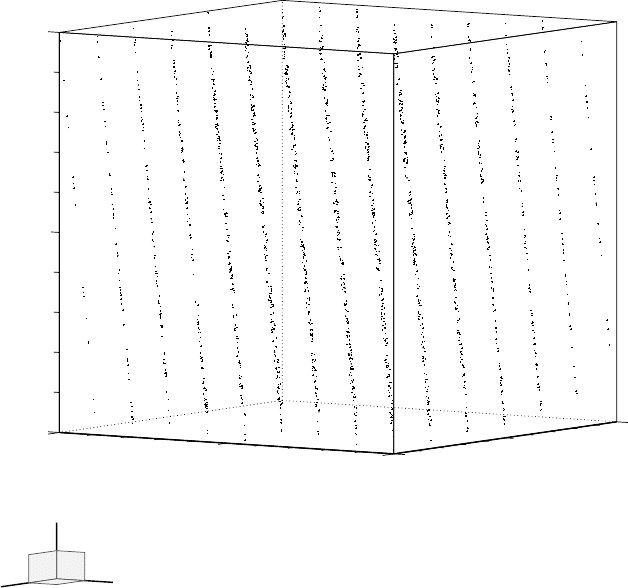
an isotropic distribution of point sources in a 3-dimensional object. A picture of an artefact
generated by these RNG’s is given in Figure 3.1. This is known as the “spectral” property
of LCRNG’s.
The gathering of random numbers into planes is a well-known artefact of RNG’s. Marsaglia’s
classic paper [Mar68] entitled “Random numbers fall mainly in the planes”, describes how
random numbers gather into (n − 1)-dimensional hyperplanes in n-space. Good RNG’s ei-
ther maximise the number of planes that are constructed to give the illusion of randomness
or practically eliminate this artefact entirely. One must be aware of this behaviour in case
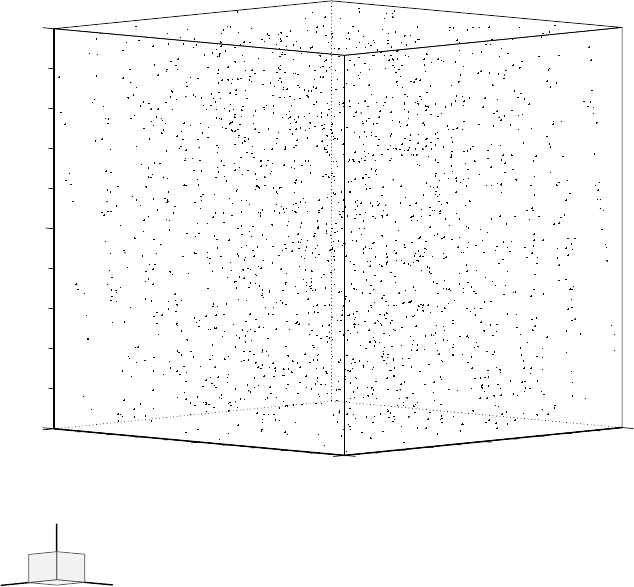
anomalies do occur. In some cases, despite the shortcoming of RNG’s, no anomalies are de-
tected. An example of this is the same data that produced the obvious artefact in Figure 3.1
but displayed with a 10
◦
rotation about the z-axis does not exhibit the artefact. This is
shown in Figure 3.2.
3.1 Linear congruential random number generators
Most computer architectures support 32-bit 2’s-complement integer arithmetic
1
. The follow-
ing equation describes a linear congruential random number generator (LCRNG) suitable
for machines that employ 2’s-complement integer arithmetic:
X
n+1
=mod(aX
n
+ c, 2
32
) . (3.1)
This LCRNG generates a 32-bit string of random bits X
n+1
from another representation one
step earlier in the cycle, X
n
. Upon multiplication or addition, the high-order bits (greater
than position 32) are simply lost leaving the low-order bits scrambled in a pseudo-random
1
In 32-bit 2’s-complement integer arithmetic
00000000000000000000000000000000 = 0
00000000000000000000000000000001 = 1
00000000000000000000000000000010 = 2 ···
01111111111111111111111111111111 = 2
31
− 1 = 2147483647
10000000000000000000000000000000 = −2
31
= −2147483648
10000000000000000000000000000001 = −2
31
+1=−2147483647
10000000000000000000000000000010 = −2
31
+2=−2147483646 ···
11111111111111111111111111111111 = −1.
3.1. LINEAR CONGRUENTIAL RANDOM NUMBER GENERATORS 27
Marsaglia planes − View 1
X
Y
Z
z
0
1
x
0
1
y
0
1
Figure 3.1: The gathering of random numbers into two-dimensional planes when a three-
dimensional cube is seeded.
28 CHAPTER 3. RANDOM NUMBER GENERATION
Marsaglia planes − View 2
X
Y
Z
z
0
1
x
0
1
y
0
1
Figure 3.2: The identical data in Figure 3.1 but rotated by 10
◦
about the z-axis.
3.1. LINEAR CONGRUENTIAL RANDOM NUMBER GENERATORS 29
fashion. In this equation a is a “magic” multiplier and c is an odd number. The operations
of addition and multiplication take place as if X
n+1
, X
n
, a,andc are all 32-bit integers.
It is dangerous to consider all the bits as individually random. In fact, the higher-order bits
are more random than the lower-order bits. Random bits are more conveniently produced
by techniques we will discuss later.
The multiplier a is a magic number. Although there are guidelines to follow to determine a
good multiplier, optimum ones are determined experimentally. Particularly good examples
are a = 663608941 and a = 69069. The latter has been suggested by Donald Knuth as the
“best” 32-bit multiplier. It is also easy to remember!
When c is an odd number, the cycle length of the of the LCRNG is 2
32
(about 4 billion,
in effect, creating every integer in the realm of possibility and an artefactually uniform
random number when converted to floating point numbers. When c is set to zero, the
LCRNG becomes what is known as a multiplicative congruential random number generator
(MCRNG) with a cycle of 2
30
(about 1 billion) but with faster execution, saving a fetch and
an integer addition. The seed, X
0
can be any integer in the case of an LCRNG. In the case
of a MCRNG, it is particularly critical to seed the RNG with an odd number. Conventional
practice is to use either a large odd number (a “random” seed) or a large prime number. If
one seeds the MCRNG with an even integer a reduced cycle length will be obtained. The
severity of the truncation is proportional to the number of times the initial seed can be
divided by two.
The conversion of the random integer to uniform on the range 0 to 1 contains its subtleties as
well and is, to some extent, dependent on architecture. The typical mathematical conversion
is:
r
n
=1/2+X
n
/2
32
. (3.2)
One subtlety to note is that this should be expected to produce a range 0 ≤ r
n
< 1 because
the integer representation is asymmetric—it has one more negative integer than positive
integer.
One might code the initialization, generation and conversion in the following fashion:
:Initialisation: i = 987654321
:Iteration: i = i * 663608941
r=0.5+i*0.23283064e-09
Some computers will generate one exact floating-point zero with this algorithm, others may
generate 2! One way out of this situation is to make the conversion factor slightly smaller, say
0.2328306e-09. This makes the range to be approximately 10
−7
≤ r
n
< 1 −10
−7
and appears
30 CHAPTER 3. RANDOM NUMBER GENERATION
to work on all computers. Another benefit of this is that it avoids an exact zero which can
cause problems in certain sampling algorithms. We will see more on this later. Although
the endpoints of the distribution are truncated, it usually has no effect. Moreover, if you are
depending upon good uniformity at the endpoints of the random number distribution, then
you probably have to resort to special techniques to obtain them.
3.2 Long sequence random number generators
For many practical applications, cycle lengths of one or four billion are just simply inade-
quate. In fact, a modern workstation just calculating random numbers with these RNG’s
would cycle them in just a few minutes!
One approach is to employ longer integers! The identical algorithm may be employed with
64-bit integers producing a sequence length of 2
64
or about 1.84 × 10
19
inthecaseofthe
LCRNG or 2
62
or about 4.61×10
18
for the MCRNG. A well-studied multiplier for this purpose
is a = 6364136223846793005. This 64-bit RNG is an excellent choice for the emerging 64-bit
architectures (assuming that they support 64-bit 2’s complement integer arithmetic) or it
can be “faked” using 32-bit architectures [Bie86]. However, this latter approach is no longer
recommended since more powerful long-sequence RNG’s have been developed.
A new approach called the “subtract-with-borrow” algorithm was developed by George
Marsaglia and co-workers [MZT90, MZ91]. This algorithm was very attractive. It was
implemented in floating-point arithmetic and was portable to all machines. Initialization
and restart capabilities are more involved than for LCRNG’s but the long sequence lengths
and speed of execution make it worthwhile.
Tezuka, l’Ecuyer and Couture [TlC93, Tez94, Cl96] proved that Marsaglia’s algorithm is in
fact equivalent to a linear congruential generator but with a very big integer word length
which greatly reduced the “spectral” anomalies. Since LCRNG’s are so well-studied this is
actually a comfort since for a while the “subtract-with-borrow” algorithm were being em-
ployed with little theoretical understanding, something many researchers felt uncomfortable
with.
The spectral property of this new class of generator has been addressed by L¨uscher [L
¨
94] who
used Kolmogorov’s chaos theory to show how the algorithm could be improved by skipping
some random numbers.
A version of L¨uscher’s algorithm [Jam94] will be distributed with the source library routines
associated with this course. However, keep in mind that the mathematics of random number
generation is still in its infancy. If you take up a Monte Carlo project at some time in the
future, make sure you become well-informed as to the “state-of-the-art”.
An example of Marsaglia and Zaman’s “subtract-with-borrow” algorithm is given as follows: