
Bielajew A.F. Fundamentals of the Monte Carlo method for neutral and charged particle transport
Подождите немного. Документ загружается.

13.2. STATISTICALLY GROUPED INTERACTIONS 181
the “primary” electron can only give at most half its energy to the target electron if we
adopt the convention that the higher energy electron is always denoted “the primary”. This
is because the two electrons are indistinguishable. In the e
+
e
−
case the positron can give up
all its energy to the atomic electron.
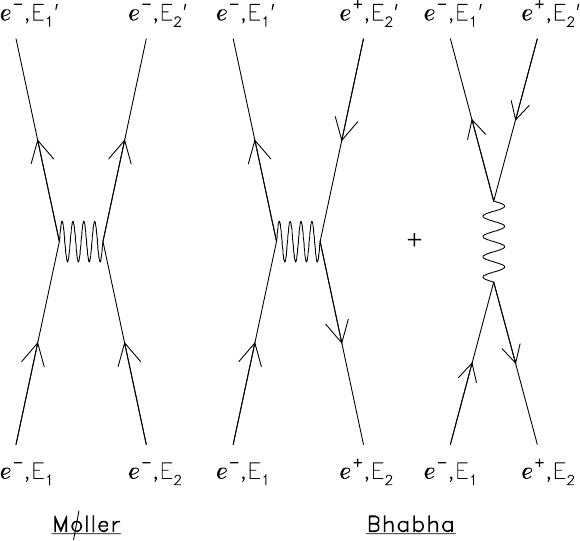
Møller and Bhabha cross sections scale with Z for different media. The cross section
scales approximately as 1/v
2
,wherev is the velocity of the scattered electron. Many more
low energy secondary particles are produced from the Møller interaction than from the
bremsstrahlung interaction.
13.1.3 Positron annihilation
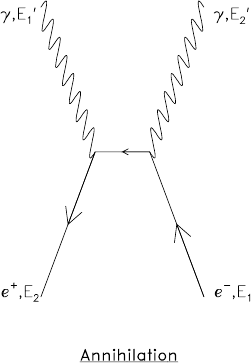
Two photon annihilation is depicted in fig. 13.3. Two-photon “in-flight” annihilation can be
modeled using the cross section formulae of Heitler [Hei54]. It is conventional to consider the
atomic electrons to be free, ignoring binding effects. Three and higher-photon annihilations
(e
+
e
−
−→ nγ[n>2]) as well as one-photon annihilation which is possible in the Coulomb
field of a nucleus (e
+
e
−
N −→ γN
∗
) can be ignored as well. The higher-order processes are
very much suppressed relative to the two-body process (by at least a factor of 1/137) while
the one-body process competes with the two-photon process only at very high energies where
the cross section becomes very small. If a positron survives until it reaches the transport
cut-off energy it can be converted it into two photons (annihilation at rest), with or without
modeling the residual drift before annihilation.
13.2 Statistically grouped interactions
13.2.1 “Continuous” energy loss
One method to account for the energy loss to sub-threshold (soft bremsstrahlung and soft
collisions) is to assume that the energy is lost continuously along its path. The formalism that
may be used is the Bethe-Bloch theory of charged particle energy loss [Bet30, Bet32, Blo33]
as expressed by Berger and Seltzer [BS64] and in ICRU 37 [ICR84]. This continuous energy
loss scales with the Z of the medium for the collision contribution and Z
2
for the radiative
part. Charged particles can also polarise the medium in which they travel. This “density
effect” is important at high energies and for dense media. Default density effect parameters
are available from a 1982 compilation by Sternheimer, Seltzer and Berger [SSB82] and
state-of-the-art compilations (as defined by the stopping-power guru Berger who distributes
a PC-based stopping power program [Ber92]).
Again, atomic binding effects are treated rather crudely by the Bethe-Bloch formalism.
It assumes that each electron can be treated as if it were bound by an average binding
potential. The use of more refined theories does not seem advantageous unless one wants

182 CHAPTER 13. ELECTRON MONTE CARLO SIMULATION
to study electron transport below the K-shell binding energy of the highest atomic number
element in the problem.
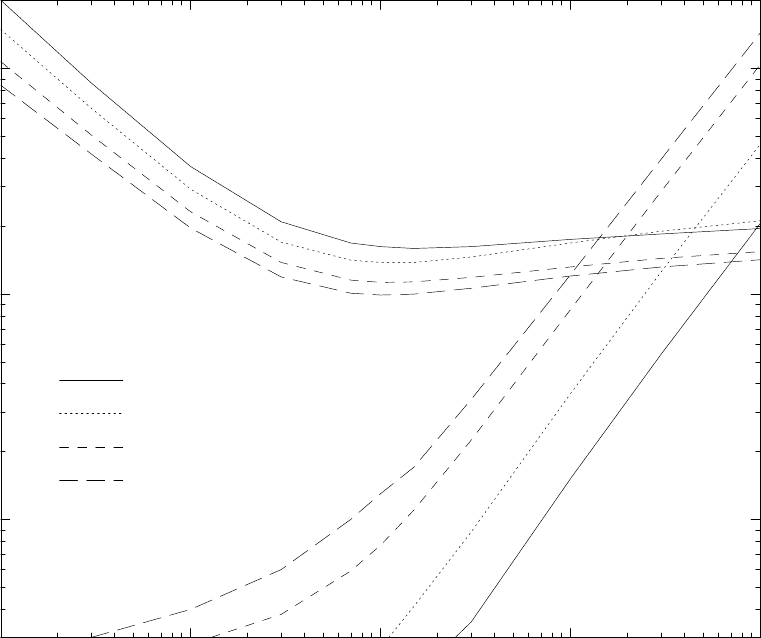
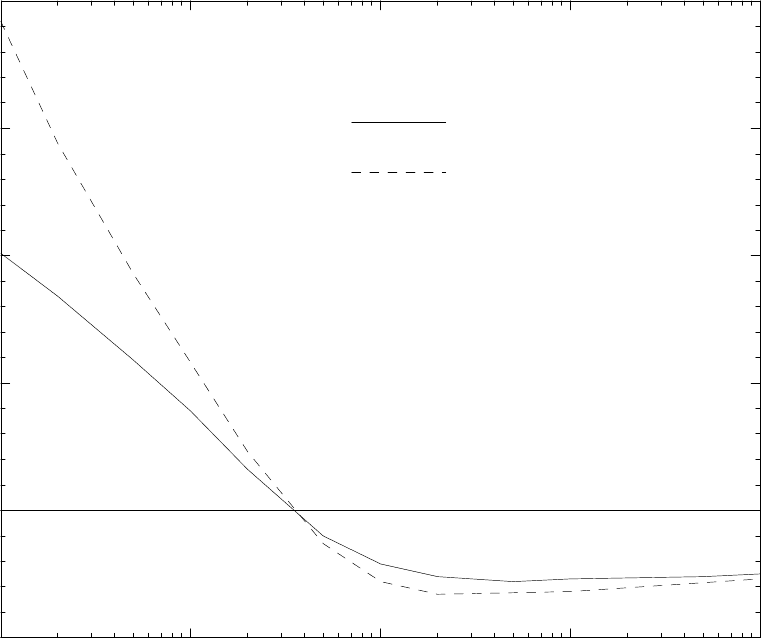
The stopping power versus energy for different materials is shown in fig. 13.4. The difference
in the collision part is due mostly to the difference in ionisation potentials of the various
atoms and partly to a Z/A difference, because the vertical scale is plotted in MeV/(g/cm
2
),
a normalisation by atomic weight rather than electron density. Note that at high energy the
argon line rises above the carbon line. Argon, being a gas, is reduced less by the density
effect at this energy. The radiative contribution reflects mostly the relative Z
2
dependence
of bremsstrahlung production.
The collisional energy loss by electrons and positrons is different for the same reasons de-
scribed in the “catastrophic” interaction section. Annihilation is generally not treated as
part of the positron slowing down process and is treated discretely as a “catastrophic” event.
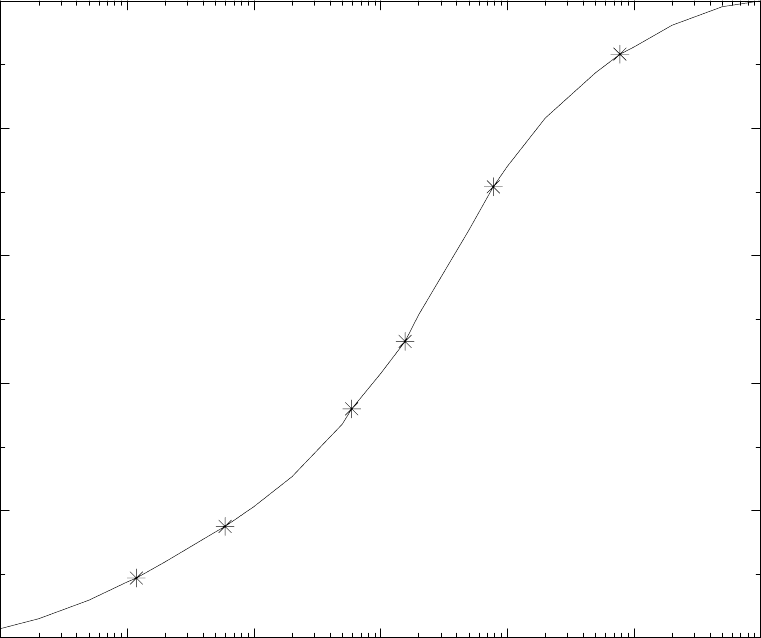
The differences are reflected in fig. 13.5, the positron/electron collision stopping power. The
positron radiative stopping power is reduced with respect to the electron radiative stopping
power. At 1 MeV this difference is a few percent in carbon and 60% in lead. This relative
difference is depicted in fig. 13.6.
13.2.2 Multiple scattering
Elastic scattering of electrons and positrons from nuclei is predominantly small angle with
the occasional large-angle scattering event. If it were not for screening by the atomic elec-
trons, the cross section would be infinite. The cross sections are, nonetheless, very large.
There are several statistical theories that deal with multiple scattering. Some of these theo-
ries assume that the charged particle has interacted enough times so that these interactions
may be grouped together. The most popular such theory is the Fermi-Eyges theory [Eyg48],
a small angle theory. This theory neglects large angle scattering and is unsuitable for ac-
curate electron transport unless large angle scattering is somehow included (perhaps as a
catastrophic interaction). The most accurate theory is that of Goudsmit and Saunder-
son [GS40a, GS40b]. This theory does not require that many atoms participate in the
production of a multiple scattering angle. However, calculation times required to produce
few-atom distributions can get very long, can have intrinsic numerical difficulties and are not
efficient computationally for Monte Carlo codes such as EGS4 [NHR85, BHNR94] where the
physics and geometry adjust the electron step-length dynamically. A fixed step-size scheme
permits an efficient implementation of Goudsmit-Saunderson theory and this has been done
in ETRAN [Sel89, Sel91], ITS [HM84, Hal89, HKM
+
92] and MCNP [Bri86, Bri93, Bri97].
Apart from accounting for energy-loss during the course of a step, there is no intrinsic diffi-
culty with large steps either. EGS4 uses the Moli`ere theory [Mol47, Mol48] which produces
results as good as Goudsmit-Saunderson for many applications and is much easier to imple-
ment in EGS4’s transport scheme.
The Moli`ere theory, although originally designed as a small angle theory has been shown
13.3. ELECTRON TRANSPORT “MECHANICS” 183
with small modifications to predict large angle scattering quite successfully [Bet53, Bie94].
The Moli`ere theory includes the contribution of single event large angle scattering, for ex-
ample, an electron backscatter from a single atom. The Moli`ere theory ignores differences
in the scattering of electrons and positrons, and uses the screened Rutherford cross sections
instead of the more accurate Mott cross sections. However, the differences are known to
be small. Owing to analytic approximations made by Moli`ere theory, this theory requires a
minimum step-size as it breaks down numerically if less than 25 atoms or so participate in
the development of the angular distribution [Bie94, AMB93]. A recent development [KB98]
has surmounted this difficulty. Apart from accounting for energy loss, there is also a large
step-size restriction because the Moli`ere theory is couched in a small-angle formalism. Be-
yond this there are other corrections that can be applied [Bet53, Win87] related to the
mathematical connection between the small-angle and any-angle theories.
13.3 Electron transport “mechanics”
13.3.1 Typical electron tracks
A typical Monte Carlo electron track simulation is shown in fig. 13.7. An electron is being
transported through a medium. Along the way energy is being lost “continuously” to sub-
threshold knock-on electrons and bremsstrahlung. The track is broken up into small straight-
line segments called multiple scattering substeps. In this case the length of these substeps
was chosen so that the electron lost 4% of its energy during each step. At the end of
each of these steps the multiple scattering angle is selected according to some theoretical
distribution. Catastrophic events, here a single knock-on electron, sets other particles in
motion. These particles are followed separately in the same fashion. The original particle, if
it is does not fall below the transport threshold, is also transported. In general terms, this
is exactly what the any electron transport logic simulates.
13.3.2 Typical multiple scattering substeps
Now we demonstrate in fig. 13.8 what a multiple scattering substep should look like.
A single electron step is characterised by the length of total curved path-length to the end
point of the step, t. (This is a reasonable parameter to use because the number of atoms
encountered along the way should be proportional to t.) At the end of the step the deflection
from the initial direction, Θ, is sampled. Associated with the step is the average projected
distance along the original direction of motion, s. There is no satisfactory theory for the
relation between s and t! The lateral deflection, ρ, the distance transported perpendicular
to the original direction of motion, is often ignored by electron Monte Carlo codes. This is
not to say that lateral transport is not modelled! Recalling fig. 13.7, we see that such lateral
184 CHAPTER 13. ELECTRON MONTE CARLO SIMULATION
deflections do occur as a result of multiple scattering. It is only the lateral deflection during
the course of a substep which is ignored. One can guess that if the multiple scattering steps
are small enough, the electron track may be simulated more exactly.
13.4 Examples of electron transport
13.4.1 Effect of physical modeling on a 20 MeV e
−
depth-dose
curve
In this section we will study the effects on the depth-dose curve of turning on and off
various physical processes. Figure 13.9 presents two CSDA calculations (i.e. no secondaries
are created and energy-loss straggling is not taken into account). For the histogram, no
multiple scattering is modeled and hence there is a large peak at the end of the range of
the particles because they all reach the same depth before being terminating and depositing
their residual kinetic energy (189 keV in this case). Note that the size of this peak is very
much a calculational artefact which depends on how thick the layer is in which the histories
terminate. The curve with the stars includes the effect of multiple scattering. This leads to
a lateral spreading of the electrons which shortens the depth of penetration of most electrons
and increases the dose at shallower depths because the fluence has increased. In this case, the
depth-straggling is entirely caused by the lateral scattering since every electron has traveled
thesamedistance.
Figure 13.10 presents three depth-dose curves calculated with all multiple scattering turned
off - i.e. the electrons travel in straight lines (except for some minor deflections when sec-
ondary electrons are created). In the cases including energy-loss straggling, a depth strag-
gling is introduced because the actual distance traveled by the electrons varies, depending
on how much energy they give up to secondaries. Two features are worth noting. Firstly,
the energy-loss straggling induced by the creation of bremsstrahlung photons plays a sig-
nificant role despite the fact that far fewer secondary photons are produced than electrons.
They do, however, have a larger mean energy. Secondly, the inclusion of secondary electron
transport in the calculation leads to a dose buildup region near the surface. Figure 13.11
presents a combination of the effects in the previous two figures. The extremes of no energy-
loss straggling and the full simulation are shown to bracket the results in which energy-loss
straggling from either the creation of bremsstrahlung or knock-on electrons is included. The
bremsstrahlung straggling has more of an effect, especially near the peak of the depth-dose
curve.
13.4. EXAMPLES OF ELECTRON TRANSPORT 185
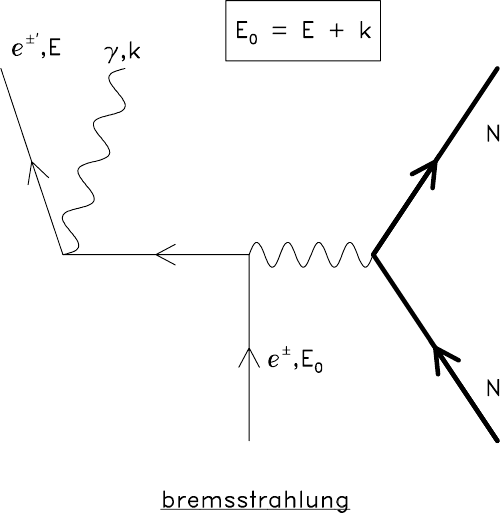
Figure 13.1: Hard bremsstrahlung production in the field of an atom as depicted by a
Feynman diagram. There are two possibilities. The predominant mode (shown here) is a
two-body interaction where the nucleus recoils. This effect dominates by a factor of about
Z
2
over the three-body case where an atomic electron recoils (not shown).
186 CHAPTER 13. ELECTRON MONTE CARLO SIMULATION
Figure 13.2: Feynman diagrams depicting the Møller and Bhabha interactions. Note the
extra interaction channel in the case of the Bhabha interaction.
13.4. EXAMPLES OF ELECTRON TRANSPORT 187
Figure 13.3: Feynman diagram depicting two-photon positron annihilation.
188 CHAPTER 13. ELECTRON MONTE CARLO SIMULATION
10
−2
10
−1
10
0
10
1
electron kinetic energy (MeV)
10
−1
10
0
10
1
d
E
/d
(
ρ
x
) [MeV/(g cm
−2
)]
Z = 6, Carbon
Z = 18, Argon
Z = 50, Tin
Z = 82, Lead
collision stopping power
radiative
stopping
power
Figure 13.4: Stopping power versus energy.
13.4. EXAMPLES OF ELECTRON TRANSPORT 189
10
−2
10
−1
10
0
10
1
particle energy (MeV)
0.95
1.00
1.05
1.10
1.15
e
+
/
e
−
collision stopping power
Water
Lead
Figure 13.5: Positron/electron collision stopping power.
190 CHAPTER 13. ELECTRON MONTE CARLO SIMULATION
10
−7
10
−6
10
−5
10
−4
10
−3
10
−2
10
−1
particle energy/
Z
2
(MeV)
0.0
0.2
0.4
0.6
0.8
e
+
/
e
−
bremsstrahlung σ
Figure 13.6: Positron/electron bremsstrahlung cross section.