
Bielajew A.F. Fundamentals of the Monte Carlo method for neutral and charged particle transport
Подождите немного. Документ загружается.

13.4. EXAMPLES OF ELECTRON TRANSPORT 191
0.0000 0.0020 0.0040 0.0060
0.0000
0.0005
0.0010
0.0015
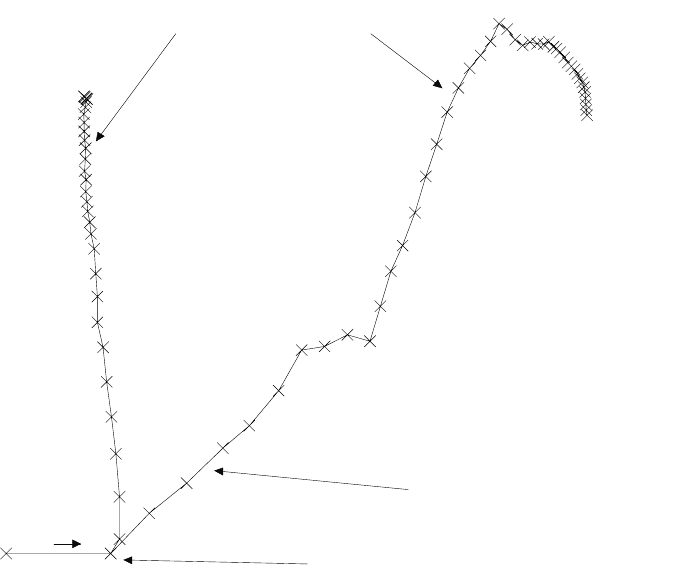
multiple scattering substep
discrete interaction, Moller interaction
e
−
primary track
e
−
secondary track, δ−ray
followed separately
continuous energy loss
e
−
Figure 13.7: A typical electron track simulation. The vertical scale has been exaggerated
somewhat.
192 CHAPTER 13. ELECTRON MONTE CARLO SIMULATION
0.000 0.002 0.004 0.006 0.008 0.010
0.0000
0.0020
0.0040
0.0060
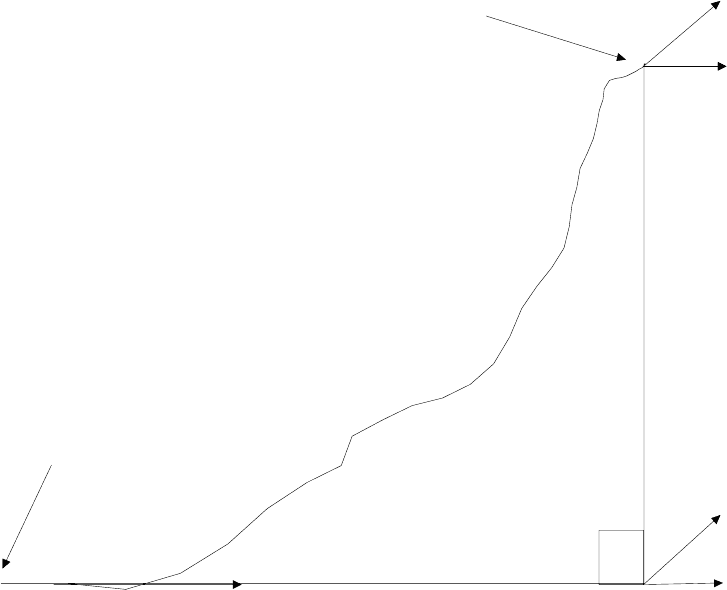
initial direction
s
ρ
t
Θ
Θ
start of sub−step
end of sub−step
Figure 13.8: A typical multiple scattering substep.
13.4. EXAMPLES OF ELECTRON TRANSPORT 193
0.0 0.2 0.4 0.6 0.8 1.0
depth (cm)
0.0
1.0
2.0
3.0
4.0
absorbed dose/fluence (10
−10
Gy cm
2
)
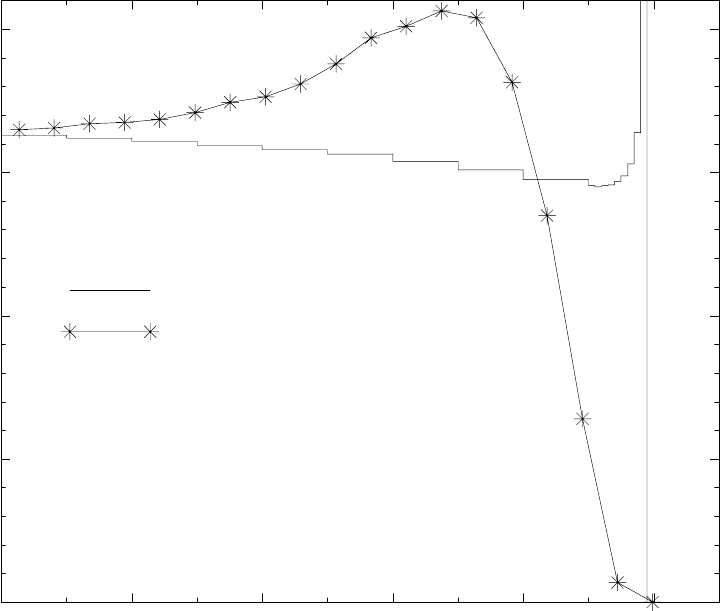
20 MeV
e
−
on water
broad parallel beam, CSDA calculation
no multiple scatter
with multiple scatter
Figure 13.9: Depth-dose curve for a broad parallel beam (BPB) of 20 MeV electrons incident
on a water slab. The histogram represents a CSDA calculation in which multiple scatter-
ing has been turned off, and the stars show a CSDA calculation which includes multiple
scattering.
194 CHAPTER 13. ELECTRON MONTE CARLO SIMULATION
0.0 0.2 0.4 0.6 0.8 1.0 1.2
depth/
r
0
0.0
1.0
2.0
3.0
4.0
absorbed dose/fluence (10
−10
Gy cm
2
)
20 MeV
e
−
on water
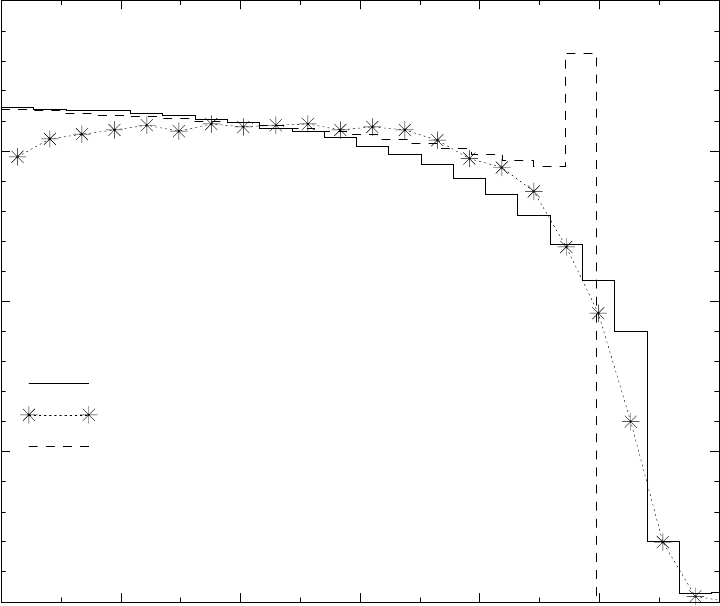
broad parallel beam, no multiple scattering
bremsstrahlung > 10 keV only
knock−on > 10 keV only
no straggling
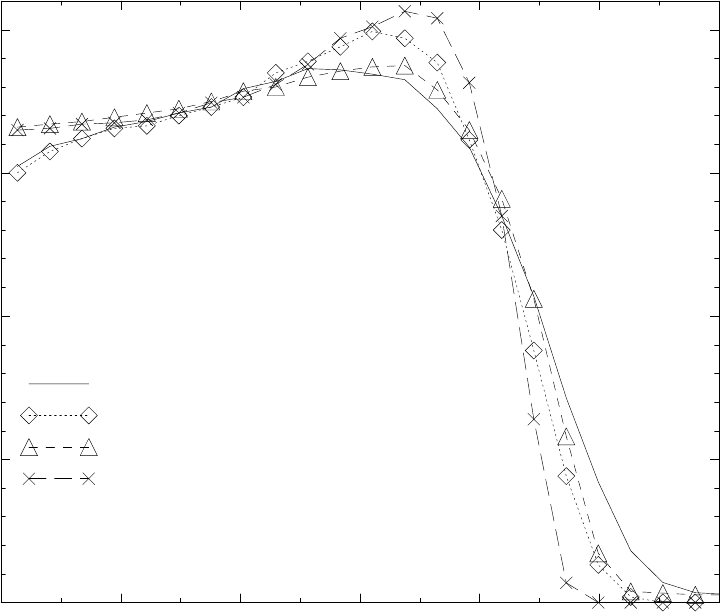
Figure 13.10: Depth-dose curves for a BPB of 20 MeV electrons incident on a water slab, but
with multiple scattering turned off. The dashed histogram calculation models no straggling
and is the same simulation as given by the histogram in fig. 13.9. Note the difference caused
by the different bin size. The solid histogram includes energy-loss straggling due to the
creation of bremsstrahlung photons with an energy above 10 keV. The curve denoted by the
stars includes only that energy-loss straggling induced by the creation of knock-on electrons
with an energy above 10 keV.
13.4. EXAMPLES OF ELECTRON TRANSPORT 195
0.0 0.2 0.4 0.6 0.8 1.0 1.2
depth/
r
0
0.0
1.0
2.0
3.0
4.0
absorbed dose/fluence (10
−10
Gy cm
2
)
20 MeV
e
−
on water
broad parallel beam, with multiple scattering
full straggling
knock−on > 10 keV only
bremsstrahlung > 10 keV only
no straggling
Figure 13.11: BPB of 20 MeV electrons on water with multiple scattering included in all
cases and various amounts of energy-loss straggling included by turning on the creation of
secondary photons and electrons above a 10 keV threshold.
196 CHAPTER 13. ELECTRON MONTE CARLO SIMULATION
13.5 Electron transport logic
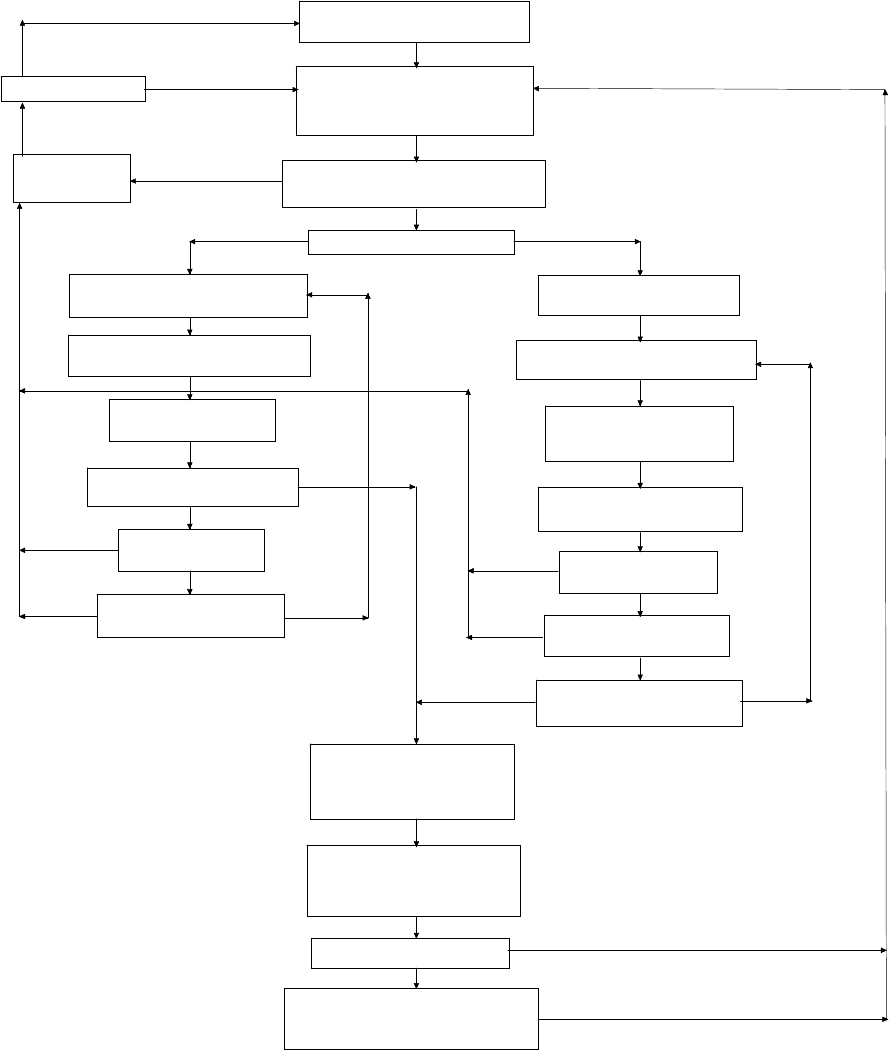
Figure 13.12 is a schematic flow chart showing the essential differences between different kinds
of electron transport algorithms. EGS4 is a “class II” algorithm which samples interactions
discretely and correlates the energy loss to secondary particles with an equal loss in the
energy of the primary electron (positron).
There is a close similarity between this flow chart and the photon transport flow chart.
The essential differences are the nature of the particle interactions as well as the additional
continuous energy-loss mechanism and multiple scattering. Positrons are treated by the same
subroutine in EGS4 although it is not shown in fig. 13.12.
Imagine that an electron’s parameters (energy, direction, etc.) are on top of the particle stack.
(STACK is an array containing the phase-space parameters of particles awaiting transport.)
The electron transport routine, picks up these parameters and first asks if the energy of this
particle is greater than the transport cutoff energy, called ECUT.Ifitisnot,theelectronis
discarded. (This is not to that the particle is simply thrown away! “Discard” means that the
scoring routines are informed that an electron is about to be taken off the transport stack.) If
there is no electron on the top of the stack, control is given to the photon transport routine.
Otherwise, the next electron in the stack is picked up and transported. If the original
electron’s energy was great enough to be transported, the distance to the next catastrophic
interaction point is determined, exactly as in the photon case. The multiple scattering step-
size t is then selected and the particle transported, taking into account the constraints of the
geometry. After the transport, the multiple scattering angle is selected and the electron’s
direction adjusted. The continuous energy loss is then deducted. If the electron, as a result
of its transport, has left the geometry defining the problem, it is discarded. Otherwise,
its energy is tested to see if it has fallen below the cutoff as a result of its transport. If
the electron has not yet reached the point of interaction a new multiple scattering step is
effected. This innermost loop undergoes the heaviest use in most calculations because often
many multiple scattering steps occur between points of interaction (see fig. 13.7). If the
distance to a discrete interaction has been reached, then the type of interaction is chosen.
Secondary particles resulting from the interaction are placed on the stack as dictated by the
differential cross sections, lower energies on top to prevent stack overflows. The energy and
direction of the original electron are adjusted and the process starts all over again.
13.5. ELECTRON TRANSPORT LOGIC 197
0.0 0.2 0.4 0.6 0.8 1.0
0.0
20.0
40.0
60.0
Electron transport
PLACE INITIAL ELECTRON’S
PARAMETERS ON STACK
PICK UP ENERGY, POSITION,
DIRECTION, GEOMETRY OF
CURRENT PARTICLE FROM
TOP OF STACK
ELECTRON ENERGY > CUTOFF
AND ELECTRON IN GEOMETRY?
CLASS II CALCULATION?
SELECT MULTIPLE SCATTER
STEP SIZE AND TRANSPORT
SAMPLE DEFLECTION ANGLE
AND CHANGE DIRECTION
SAMPLE ELOSS
E = E - ELOSS
IS A SECONDARY
CREATED DURING STEP?
ELECTRON LEFT
GEOMETRY?
ELECTRON ENERGY
LESS THAN CUTOFF?
SAMPLE DISTANCE TO
DISCRETE INTERACTION
SELECT MULTIPLE SCATTER
STEP SIZE AND TRANSPORT
SAMPLE DEFLECTION
ANGLE AND CHANGE
DIRECTION
CALCULATE ELOSS
E = E - ELOSS(CSDA)
HAS ELECTRON
LEFT GEOMETRY?
ELECTRON ENERGY
LESS THAN CUTOFF?
REACHED POINT OF
DISCRETE INTERACTION?
DISCRETE INTERACTION
- KNOCK-ON
- BREMSSTRAHLUNG
SAMPLE ENERGY
AND DIRECTION OF
SECONDARY, STORE
PARAMETERS ON STACK
CLASS II CALCULATION?
CHANGE ENERGY AND
DIRECTION OF PRIMARY
AS A RESULT OF INTERACTION
STACK EMPTY?
TERMINATE
HISTORY
SAMPLE
Y
N
Y
N
YN
Y
N
Y
N
YN
Y
N
Y
N
Y
N
N
Y
Figure 13.12: Flow chart for electron transport. Much detail is left out.
198 CHAPTER 13. ELECTRON MONTE CARLO SIMULATION
Bibliography
[AMB93] P. Andreo, J. Medin, and A. F. Bielajew. Constraints on the multiple scattering
theory of Moli`ere in Monte Carlo simulations of the transport of charged particles.
Med. Phys., 20:1315 – 1325, 1993.
[Ber92] M. J. Berger. ESTAR, PSTAR and ASTAR: Computer Programs for Calculating
Stopping-Power and Ranges for Electrons, Protons, and Helium Ions. NIST
Report NISTIR-4999 (Washington DC), 1992.
[Bet30] H. A. Bethe. Theory of passage of swift corpuscular rays through matter. Ann.
Physik, 5:325, 1930.
[Bet32] H. A. Bethe. Scattering of electrons. Z. f¨ur Physik, 76:293, 1932.
[Bet53] H. A. Bethe. Moli`ere’s theory of multiple scattering. Phys. Rev., 89:1256 – 1266,
1953.
[BHNR94] A. F. Bielajew, H. Hirayama, W. R. Nelson, and D. W. O. Rogers. His-
tory, overview and recent improvements of EGS4. National Research Council
of Canada Report PIRS-0436, 1994.
[Bie94] A. F. Bielajew. Plural and multiple small-angle scattering from a screened
Rutherford cross section. Nucl. Inst. and Meth., B86:257 – 269, 1994.
[Blo33] F. Bloch. Stopping power of atoms with several electrons. Z. f¨ur Physik, 81:363,
1933.
[Bri86] J. Briesmeister. MCNP—A general purpose Monte Carlo code for neutron and
photon transport, Version 3A. Los Alamos National Laboratory Report LA-7396-
M (Los Alamos, NM), 1986.
[Bri93] J. F. Briesmeister. MCNP—A general Monte Carlo N-particle transport code.
Los Alamos National Laboratory Report LA-12625-M (Los Alamos, NM), 1993.
[Bri97] J. F. Briesmeister. MCNP—A general Monte Carlo N-particle transport code.
Los Alamos National Laboratory Report LA-12625-M, Version 4B (Los Alamos,
NM), 1997.
199
200 BIBLIOGRAPHY
[BS64] M. J. Berger and S. M. Seltzer. Tables of energy losses and ranges of electrons
and positrons. NASA Report SP-3012 (Washington DC), 1964.
[Eyg48] L. Eyges. Multiple scattering with energy loss. Phys. Rev., 74:1534, 1948.
[GS40a] S. A. Goudsmit and J. L. Saunderson. Multiple scattering of electrons. Phys.
Rev., 57:24 – 29, 1940.
[GS40b] S. A. Goudsmit and J. L. Saunderson. Multiple scattering of electrons. II. Phys.
Rev., 58:36 – 42, 1940.
[Hal89] J. Halbleib. Structure and Operation of the ITS code system. In T.M. Jenkins,
W.R. Nelson, A. Rindi, A.E. Nahum, and D.W.O. Rogers, editors, Monte Carlo
Transport of Electrons and Photons, pages 249 – 262. Plenum Press, New York,
1989.
[Hei54] W. Heitler. The quantum theory of radiation. (Clarendon Press, Oxford), 1954.
[HKM
+
92] J. A. Halbleib, R. P. Kensek, T. A. Mehlhorn, G. D. Valdez, S. M. Seltzer,
and M. J. Berger. ITS Version 3.0: The Integrated TIGER Series of coupled
electron/photon Monte Carlo transport codes. Sandia report SAND91-1634,
1992.
[HM84] J. A. Halbleib and T. A. Mehlhorn. ITS: The integrated TIGER series of
coupled electron/photon Monte Carlo transport codes. Sandia Report SAND84-
0573, 1984.
[ICR84] ICRU. Stopping powers for electrons and positrons. ICRU Report 37, ICRU,
Washington D.C., 1984.
[KB98] I. Kawrakow and A. F. Bielajew. On the representation of electron multiple
elastic-scattering distributions for Monte Carlo calculations. Nuclear Instruments
and Methods, B134:325 – 336, 1998.
[KM59] H. W. Koch and J. W. Motz. Bremsstrahlung cross-section formulas and related
data. Rev. Mod. Phys., 31:920 – 955, 1959.
[Mol47] G. Z. Moli`ere. Theorie der Streuung schneller geladener Teilchen. I. Einzelstreu-
ung am abgeschirmten Coulomb-Field. Z. Naturforsch, 2a:133 – 145, 1947.
[Mol48] G. Z. Moli`ere. Theorie der Streuung schneller geladener Teilchen. II. Mehrfach-
und Vielfachstreuung. Z. Naturforsch, 3a:78 – 97, 1948.
[NHR85] W. R. Nelson, H. Hirayama, and D. W. O. Rogers. The EGS4 Code System.
Report SLAC–265, Stanford Linear Accelerator Center, Stanford, Calif, 1985.