
Bielajew A.F. Fundamentals of the Monte Carlo method for neutral and charged particle transport
Подождите немного. Документ загружается.

Chapter 12
Photon Monte Carlo Simulation
“I could have done it in a much more complicated way”
said the red Queen, immensely proud.
Lewis Carroll
In this chapter we discuss the basic mechanism by which the simulation of photon interaction
and transport is undertaken. We start with a review of the basic interaction processes
that are involved, some common simplifications and the relative importance of the various
processes. We discuss when and how one goes about choosing, by random selection, which
process occurs. We discuss the rudimentary geometry involved in the transport and deflection
of photons. We conclude with a schematic presentation of the logic flow executed by a
typical photon Monte Carlo transport algorithm. This chapter will only sketch the bare
minimum required to construct a photon Monte Carlo code. A particularly good reference
for a description of basic interaction mechanisms is the excellent book [Eva55] by Robley
Evans, The Atomic Nucleus. This book should be in the bookshelf of anyone undertaking
a career in the radiation sciences. Simpler descriptions of photon interaction processes are
useful as well and are included in many common textbooks [JC83, Att86, SF96].
12.1 Basic photon interaction processes
We now give a brief discussion of the photon interaction processes that should be modeled
by a photon Monte Carlo code, namely:
• Pair production in the nuclear field
• The Compton interaction (incoherent scattering)
161

162 CHAPTER 12. PHOTON MONTE CARLO SIMULATION
• The photoelectric interaction
• The Rayleigh interaction (coherent scattering)
12.1.1 Pair production in the nuclear field
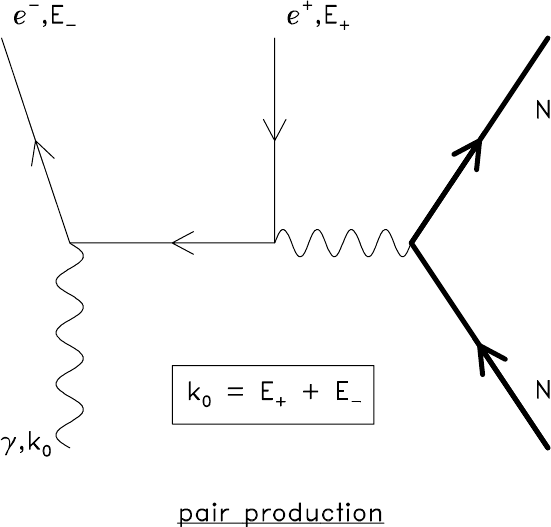
As seen in Figure 12.1, a photon can interact in the field of a nucleus, annihilate and produce
an electron-positron pair. A third body, usually a nucleus, is required to be present to
conserve energy and momentum. This interaction scales as Z
2
for different nuclei. Thus,
materials containing high atomic number materials more readily convert photons into charged
particles than do low atomic number materials. This interaction is the quantum “analog”
of the bremsstrahlung interaction, which we will encounter in Chapter 13 Electron Monte
Carlo simulation. At high energies, greater than 50 MeV or so in all materials, the pair and
bremsstrahlung interactions dominate. The pair interaction gives rise to charged particles
in the form of electrons and positrons (muons at very high energy) and the bremsstrahlung
interaction of the electrons and positrons leads to more photons. Thus there is a “cascade”
process that quickly converts high energy electromagnetic particles into copious amounts of
lower energy electromagnetic particles. Hence, a high-energy photon or electron beam not
only has “high energy”, it is also able to deposit a lot of its energy near one place by virtue
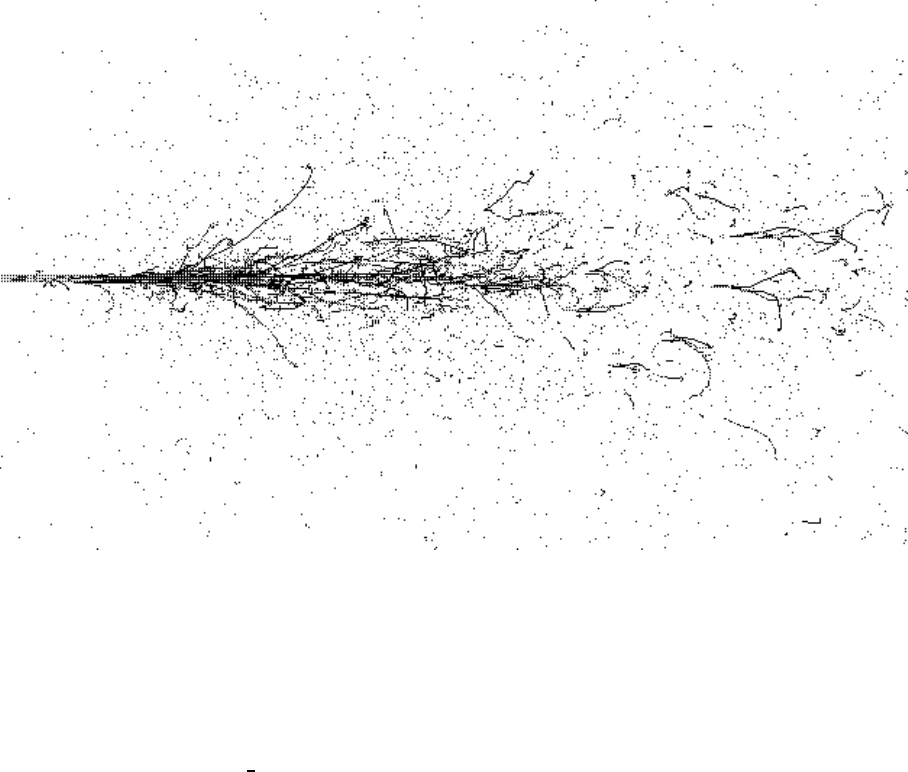
of this cascade phenomenon. A picture of this process is given in Figure 12.2.
The high-energy limit of the pair production cross section per nucleus takes the form:
lim
α→∞
σ
pp
(α)=σ
pp
0
Z
2
ln(2α) −
109
42
, (12.1)
where α = E
γ
/m
e
c
2
, that is, the energy of the photon divided by the rest mass energy
1
of
the electron (0.51099907 ± 0.00000015 MeV) and σ
pp
0
=1.80 × 10
−27
cm
2
/nucleus. We note
that the cross section grows logarithmically with incoming photon energy.
The kinetic energy distribution of the electrons and positrons is remarkably “flat” except
near the kinematic extremes of K
±
= 0 and K
±
= E
γ
− 2m
e
c
2
. Note as well that the
rest-mass energy of the electron-positron pair must be created and so this interaction has a
threshold at E
γ
=2m
e
c
2
. It is exactly zero below this energy.
Occasionally it is one of the electrons in the atomic cloud surrounding the nucleus that
interacts with the incoming photon and provides the necessary third body for momentum
and energy conservation. This interaction channel is suppressed by a factor of 1/Z relative
to the nucleus-participating channel as well as additional phase-space and Pauli exclusion
differences. In this case, the atomic electron is ejected with two electrons and one positron
emitted. This is called “triplet” production. It is common to include the effects of triplet pro-
duction by “scaling up” the two-body reaction channel and ignoring the 3-body kinematics.
This is a good approximation for all but the low-Z atoms.
1
The latest information on particle data is available on the web at: http://pdg.lbl.gov/pdg.html This
web page is maintained by the Particle Data Group at the Lawrence Berkeley laboratory.
12.1. BASIC PHOTON INTERACTION PROCESSES 163
Figure 12.1: The Feynman diagram depicting pair production in the field of a nucleus. Occa-
sionally (suppressed by a factor of 1/Z), “triplet” production occurs whereby the incoming
photon interacts with one of the electrons in the atomic cloud resulting in a final state with
two electrons and one positron. (Picture not shown.)
164 CHAPTER 12. PHOTON MONTE CARLO SIMULATION
Figure 12.2: A simulation of the cascade resulting from five 1.0 GeV electrons incident
from the left on a target. The electrons produce photons which produce electron-positron
pairs and so on until the energy of the particles falls below the cascade region. Electron
and positron tracks are shown with black lines. Photon tracks are not shown explaining
why some electrons and positrons appear to be “disconnected”. This simulation depicted
here was produced by the EGS4 code [NHR85, BHNR94] and the system for viewing the
trajectories is called EGS Windows [BW91].
12.1. BASIC PHOTON INTERACTION PROCESSES 165
Further reading on the pair production interaction can be found in the reviews by Davies,
Bethe, Maximon [DBM54], Motz, Olsen, and Koch [MOK69], and Tsai [Tsa74].
12.1.2 The Compton interaction (incoherent scattering)
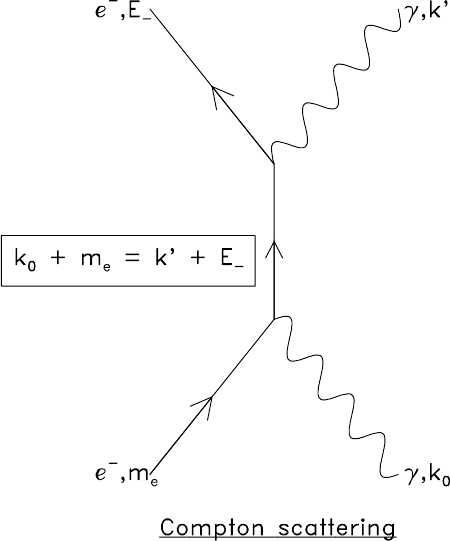
Figure 12.3: The Feynman diagram depicting the Compton interaction in free space. The
photon strikes an electron assumed to be “at rest”. The electron is set into motion and the
photon recoils with less energy.
The Compton interaction [CA35] is an inelastic “bounce” of a photon from an electron in
the atomic shell of a nucleus. It is also known as “incoherent” scattering in recognition of the
fact that the recoil photon is reduced in energy. A Feynman diagram depicting this process is

166 CHAPTER 12. PHOTON MONTE CARLO SIMULATION
given in Figure 12.3. At large energies, the Compton interaction approaches asymptotically:
lim
α→∞
σ
inc
(α)=σ
inc
0
Z
α
, (12.2)
where σ
inc
0
=3.33 × 10
−25
cm
2
/nucleus. It is proportional to Z (i.e. the number of elec-
trons) and falls off as 1/E
γ
. Thus, the Compton cross section per unit mass is nearly a
constant independent of material and the energy-weighted cross section is nearly a constant
independent of energy. Unlike the pair production cross section, the Compton cross section
decreases with increased energy.
At low energies, the Compton cross section becomes a constant with energy. That is,
lim
α→0
σ
inc
(α)=2σ
inc
0
Z. (12.3)
This is the classical limit and it corresponds to Thomson scattering, which describes the
scattering of light from “free” (unbound) electrons. In almost all applications, the electrons
are bound to atoms and this binding has a profound effect on the cross section at low energies.
However, above about 100 keV on can consider these bound electrons as “free”, and ignore
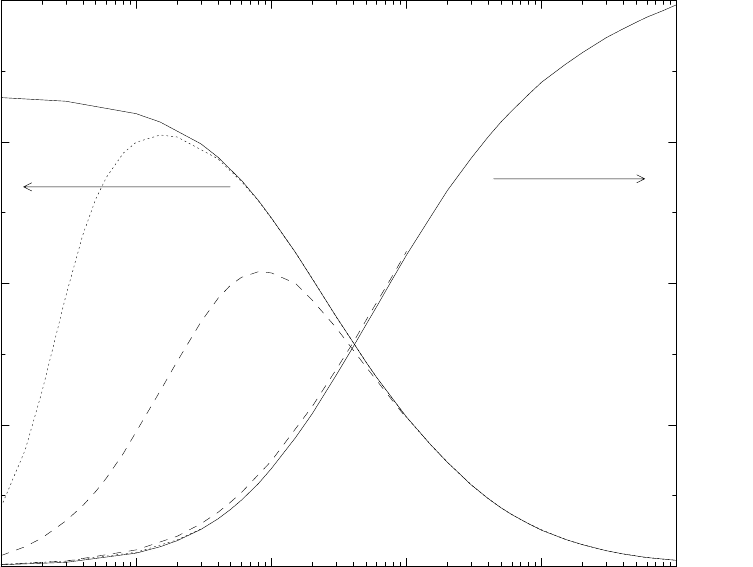
atomic binding effects. As seen in Figure 12.4, this is a good approximation for photon
energies down to 100 of keV or so, for most materials. This lower bound is defined by the
K-shell energy although the effects can have influence greatly above it, particularly for the
low-Z elements. Below this energy the cross section is depressed since the K-shell electrons
are too tightly bound to be liberated by the incoming photon. The unbound Compton
differential cross section is taken from the Klein-Nishina cross section [KN29], derived in
lowest order Quantum Electrodynamics, without any further approximation.
It is possible to improve the modeling of the Compton interaction. Namito and Hirayama [NH91]
have considered the effect of binding for the Compton effect as well as allowing for the trans-
port of polarised photons for both the Compton and Rayleigh interactions.
12.1.3 Photoelectric interaction
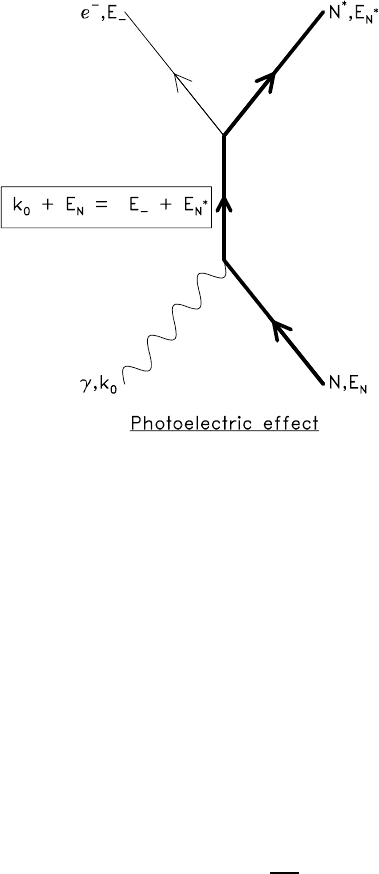
The dominant low energy photon process is the photoelectric effect. In this case the photon
gets absorbed by an electron of an atom resulting in escape of the electron from the atom and
accompanying small energy photons as the electron cloud of the atom settles into its ground
state. The theory concerning this phenomenon is not complete and exceedingly complicated.
The cross section formulae are usually in the form of numerical fits and take the form:
σ
ph
(E
γ
) ∝
Z
m
E
n
γ
, (12.4)
where the exponent on Z ranges from 4 (low energy, below 100 keV) to 4.6 (high energy,
above 500 keV) and the exponent on E
γ
ranges from 3 (low energy, below 100 keV) to 1
12.1. BASIC PHOTON INTERACTION PROCESSES 167
10
−3
10
−2
10
−1
10
0
10
1
Inicident γ energy (MeV)
0.0
0.2
0.4
0.6
0.8
Effect of binding on Compton cross section
10
−3
10
−2
10
−1
10
0
10
1
0.0
0.2
0.4
0.6
0.8
σ (barns/
e
−
)
free electron
hydrogen
lead
fraction of
energy to
e
−
Figure 12.4: The effect of atomic binding on the Compton cross section.
168 CHAPTER 12. PHOTON MONTE CARLO SIMULATION
Figure 12.5: Photoelectric effect
(high energy, above 500 keV). Note that the high-energy fall-off is the same as the Compton
interaction. However, the high-energy photoelectric cross section is depressed by a factor of
about Z
3.6
10
−8
relative to the Compton cross section and so is negligible in comparison to
the Compton cross section at high energies.
A useful approximation that applies in the regime where the photoelectric effect is dominant
is:
σ
ph
(E
γ
) ∝
Z
4
E
3
γ
, (12.5)
which is often employed for simple analytic calculations. However, most Monte Carlo codes
employ a table look-up for the photoelectric interaction.
Angular distributions of the photoelectron can be determined according to the theory of
Sauter [Sau31]. Although Sauter’s theory is relativistic, it appears to work in the non-
relativistic regime as well.
12.1. BASIC PHOTON INTERACTION PROCESSES 169
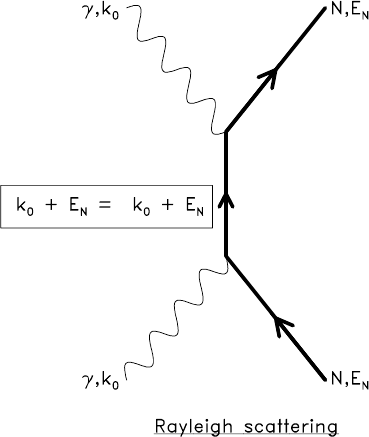
Figure 12.6: Rayleigh scattering
12.1.4 Rayleigh (coherent) interaction
Now we consider the Rayleigh interaction, also known as coherent scattering. In terms of
cross section, the Rayleigh cross section is at least an order of magnitude less that the
photoelectric cross section. However, it is still important! As can be seen from the Feynman
diagram in Figure 12.6, the distinguishing feature of this interaction in contrast to the
photoelectric interaction is that there is a photon in the final state. Indeed, if low energy
photons impinge on an optically thick shield both Compton and Rayleigh scattered photons
will emerge from the far side. Moreover, the proportions will be a sensitive function of the
incoming energy.
The coherent interaction is an elastic (no energy loss) scattering from atoms. It is not
good enough to treat molecules as if they are made up of independent atoms. A good
demonstration of the importance of molecular structure was demonstrated by Johns and
Yaffe [JY83].

170 CHAPTER 12. PHOTON MONTE CARLO SIMULATION
The Rayleigh differential cross section has the following form:
σ
coh
(E
γ
, Θ) =
r
2
e
2
(1 + cos
2
Θ)[F (q, Z)]
2
, (12.6)
where r
e
is the classical electron radius (2.8179 × 10
−13
cm), q is the momentum-transfer
parameter, q =(E
γ
/hc)sin(Θ/2), and F (q, Z)istheatomic form factor. F (q, Z) approaches
Z as q goes to zero either by virtue of E
γ
going to zero or Θ going to zero. The atomic
form factor also falls off rapidly with angle although the Z-dependence increases with angle
to approximately Z
3/2
.
The tabulation of the form factors published by Hubbell and Øverbø [HØ79].
12.1.5 Relative importance of various processes
We now consider the relative importance of the various processes involved.
For carbon, a moderately low-Z material, the relative strengths of the photon interactions
versus energy is shown in Figure 12.7. For this material we note three distinct regions of single
interaction dominance: photoelectric below 20 keV, pair above 30 MeV and Compton in
between. The almost order of magnitude depression of the Rayleigh and triplet contributions
is some justification for the relatively crude approximations we have discussed. For lead,
shown in Figure 12.8, there are several differences and many similarities. The same comment
about the relative unimportance of the Rayleigh and triplet cross sections applies. The
“Compton dominance” section is much smaller, now extending only from 700 keV to 4 MeV.
We also note quite a complicated structure below about 90 keV, the K-shell binding energy
of the lead atom. Below this threshold, atomic structure effects become very important.
Finally, we consider the total cross section versus energy for the materials hydrogen, water
and lead, shown in Figure 12.9. The total cross section is plotted in the units cm
2
/g. The
Compton dominance regions are equivalent except for a relative A/Z factor. At high energy
the Z
2
dependence of pair production is evident in the lead. At lower energies the Z
n
(n>4)
dependence of the photoelectric cross section is quite evident.
12.2 Photon transport logic
We now discuss a simplified version of photon transport logic. It is simplified by ignoring
electron creation and considering that the transport occurs in only a single volume element
and a single medium.
This photon transport logic is schematised in Figure 12.10. Imagine that an initial photon’s
parameters are present at the top of an array called STACK. STACK is an array that retains
particle phase space characteristics for processing. We also imagine that there is a photon