
Bielajew A.F. Fundamentals of the Monte Carlo method for neutral and charged particle transport
Подождите немного. Документ загружается.

15.1. WHAT DOES CONDENSED HISTORY MONTE CARLO DO? 241
x
x
x
x
x
x
xx
x
xx
x
x
x
x
x
xx
-
e
δ
γ
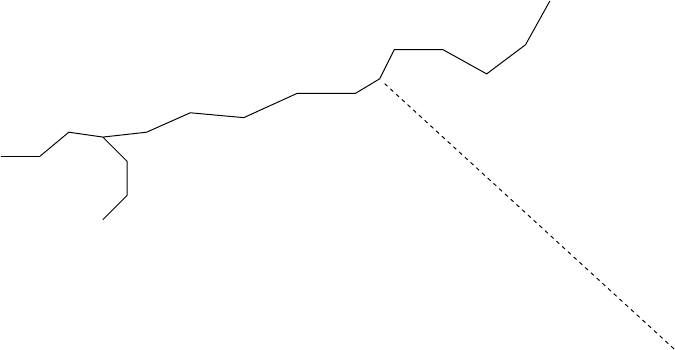
Figure 15.2: This is how a Monte Carlo calculates of the complete electron history as depicted
in Figure 15.1. The transport takes place in steps, the vertices of which are marked with the
symbol “×”.
number of steps required to follow a particle to termination. For this case N = r(E
i
)/s
max
,
where r(E
i
) is the range of an electron with starting energy E
i
.
Another popular choice is a constant fractional energy loss per electron step, i.e. ∆E/E =
constant. This has a slight disadvantage that the electron steps get shorter and shorter
as the energy of the electrons in the simulation gets smaller and smaller. In terms of the
dynamic range of the energies of the particles in the simulation, generally the lower ones
play a lesser important role (there are exceptions to this of course!) and so, despite its
popularity, it is probably wasteful in many applications. One can predict the number of steps
required to follow a particle to termination in this case as well. For this case N = log(1 −
∆E/E)/log(Emin/E
i
)whereEmin is the minimum electron energy for which transport takes
place. One sees that as Emin is pushed downwards by the requirements of some applications,
that the number of steps acquires a slow logarithmic growth, unlike the geometric restriction.
The constant fractional energy loss per electron step is built into the ETRAN Monte Carlo
code [Ber63, Sel89, Sel91] and its well-known progeny, the ITS system [HKM
+
92] and
the electron component of MCNP [Bri86, Bri93]. In these code systems, the value of the
constant is kept in internal tables and its value determined through trial and error. In the
EGS system [NHR85, BHNR94], it is available to the user as a “tuning” parameter, to be
adjusted (lowered) until the answer converges to the (presumably correct) result.
There are other schemes of step-size restriction that will not be discussed. However, we see
that the two discussed thus far play the role of an “integration mesh-density”. To get better
results one must increase the resolution. To be practical, the mesh density ought to be as
large as possible, consistent with target accuracy of the application. Larsen [Lar92] has
made an interesting analysis of Monte Carlo algorithms and how they should be expected
242 CHAPTER 15. ADVANCED ELECTRON TRANSPORT ALGORITHMS
to converge. He showed that the ETRAN scheme proposed by Berger [Ber63] contains
O(∆s) errors. Thus, one expects that accurate calculation with ETRAN methods would
converge slowly and require small step-sizes to get the answer correct. Indeed, this was the
case with the EGS code as well, motivating the step-size restrictions introduced into EGS
by Rogers [Rog84b].
Larsen [Lar92] also proposed an alternative Monte Carlo method (calling it “Method 3”) to
enable faster convergence since it contains O(∆s
2
) errors. The algorithm for each sub-step,
∆s, is that first it must be broken into two parts. The first part is a drift of length ∆s/2
in the initial direction of motion, and a deduction in energy due to continuous energy losses
over the first part of this step. The multiple-scattering angle is sampled at this new energy
but for a deflection angle assuming that the particle as gone the full sub-step distance,
∆s, and deflection by this angle. The sub-step is then completed by executing a drift of
distance ∆s/2 in the new direction. Although this method may seem as is if is doubling the
number of steps, this is actually not the case since the most computer-intensive part of the
process, namely sampling the multiple-scattering angle and rotation, is performed only once
per sub-step.
The result of the “Method 3” procedure is to impart longitudinal and lateral distributions
to the sub-step, both correlated to the multiple-scattering angle, Θ. Assuming the particle
starts at the origin and is directed along the z-axis, after a total sub-step pathlength of ∆s,
the final resting place will be:
∆x =(∆s/2) sin Θ cos Φ
∆y =(∆s/2) sin Θ sin Φ
∆z =(∆s/2)(1 + cos Θ) , (15.18)
where Φ is a randomly selected azimuthal angle and it is understood that Θ is sampled
from the Goudsmit-Saunderson [GS40a, GS40b] multiple-scattering theory at the mid-point
energy.
Only two previously published Monte Carlo methods have followed this prescription. Berger’s
method [Ber63] is similar except that he proposed a straggling term for the lateral compo-
nents and the energy dependence was taken account for directly. However, the longitudinal
and lateral distributions have only been recently been implemented into ETRAN [Sel91].
The other method is the PRESTA algorithm [BR86, BR87] that has been incorporated
into EGS. This algorithm is different from Method-3 in that the final longitudinal position
was determined by its average rather than the distribution implied by Eq. 15.18. However,
this only contributes to the O(∆s
2
) error. The other very important distinction is that the
PRESTA algorithm employs the Moli`ere multiple-scattering method method [Mol47, Mol48]
with corrections and limitations discussed by Bethe [Bet53].
There has also been a recently-published method called the Longitudinal and Lateral Corre-
lation Algorithm (LLCA) proposed by Kawrakow [Kaw96a]. It incorporates the Method-3
15.1. WHAT DOES CONDENSED HISTORY MONTE CARLO DO? 243
transport scheme except that the multiple-scattering theory, while representing an improve-
ment over Moli`ere’s method is still an approximation [Kaw96b] to the Goudsmit-Saunderson
method. However, there is one important improvement over Method-3 in that the lateral
position of the electron at the end of the sub-step is connected to the multiple-scattering
angle by means of a distribution, rather than direct correlation as implied by Eq. 15.18.
For the present, this distribution function has only been calculated using single-scattering
methods (analog Monte Carlo or event-by-event elastic scattering). Presumably, this is an
O(∆s
2
)orhighercorrection.
15.1.2 Physics’ step-size constraints
There are also step-size restrictions related to keeping the step-sizes within range of the
validity of the theories underlying the condensed history method. This is important, for
example, when using the Moli`ere multiple-scattering theory [Mol47, Mol48]. Bethe [Bet53]
analyzed Moli`ere multiple-scattering theory, comparing it to the “exact” theory of Goudsmit
and Saunderson [GS40a, GS40b] and provided a correction that improves the large-angle
behaviour of Moli`ere theory for large angles as Moli`ere theory is couched in the small-angle
formalism of Bothe [Bot21] and Wentzel [Wen22]. The electron step-size constraint arises
from not allowing the multiple-scattering angle to attain values greater than 1 radian.
Small-angle multiple scattering theories still play an important role in electron Monte Carlo
calculations of the Class II variety since Class II condensed history techniques sample the
multiple-scattering distributions “on-the-fly” as the pathlength can, in principle be any-
thing within the constraints already discussed. Class I algorithms, as defined in Berger’s
work [Ber63], demand that the electrons follow a predetermined energy grid, allowing the
multiple-scattering distributions to be pre-calculated. While Class I and Class II have their
attributes and shortcomings, the use of an approximate multiple-scattering theory in Class
II calculations, considered with the conclusion of the previous section, forces the realiza-
tion that one can not necessarily expect that the limit of small step-size will produce the
correct answer for Class-II/approximate multiple-scattering algorithms! It should also be
remarked that Class-I/exact multiple-scattering schemes are subject to numerical instabil-
ities as smaller step-sizes require an increasing number of terms in the Legendre serious of
Eq. 15.11 to be summed. There have been studies demonstrating that one can converge to
the incorrect answer in a Class-II/approximate multiple-scattering algorithm [Rog93, Bie96].
Step-size instability of the Moli`ere theory [Mol48] has been studied extensively [AMB93,
Bie94] and comparisons with Goudsmit-Saunderson theory [GS40a, GS40b] have been
performed [Bet53, Win87] as well as comparisons with single-elastic scattering Monte
Carlo [Bie94]. This has motivated the development of a new multiple-scattering theory
based on Goudsmit-Saunderson theory [GS40a, GS40b] but formulated in such a way as
to allow sampling “on-the-fly” as required by Class II algorithms and eliminating the small
step-size numerical instability of the Goudsmit-Saunderson Legendre summation that arises

244 CHAPTER 15. ADVANCED ELECTRON TRANSPORT ALGORITHMS
from the form expressed in Eq. 15.11. This recent work [KB98] will be discussed in a later
section. However, this new multiple-scattering theory will guarantee that condensed his-
tory Monte Carlo will always converge to the correct answer in the limit of small electron
step-size.
15.1.3 Boundary step-size constraints
The final category of electron step-size constraint we consider relates to the geometry, specifi-
cally interfaces and material boundaries. Although the transport theory expressed in Eq. 15.5
and the various solutions to it describe electron transport in infinite, unbounded uniform
media, practical applications contain boundaries and interfaces between media. Except
for the stopping of electrons at interfaces and the updating the material-dependent trans-
port data, this problem was not considered until the EGS/PRESTA algorithm was devel-
oped [BR86, BR87]. This algorithm requires knowledge of the nearest distance to any
interface and shortens the electron step-size accordingly, by setting s = s
⊥
min
where s
⊥
min
is
the nearest distance to any interface. This is always a perpendicular distance (as suggested
by the notation) unless the closest distance happens to be along an intersection of two sur-
faces. This procedure requires more information from the geometry
2
but it is necessary to
avoid potential misuse of the underlying transport theory. Of course this shortening can not
continue indefinitely as the electron would never reach the surface, a transport equivalent of
Xeno’s paradox. PRESTA continues the procedure until the transport steps approach the
lower limit of validity of Moli`ere theory, usually from about 3 to 20 mean-free-path distances,
and then allows the electron to reach the surface, does not model the lateral components
of sub-step transport given in Eq. 15.18 (This is a necessary part of the transport logic,
otherwise the lateral transport takes the electron away from the surface, in either medium),
updates material-dependent data and carries on in the next medium. The initial distance
is again related to the lower limit of validity of Moli`ere theory and thereafter the algorithm
adjusts step-sizes according to s
⊥
min
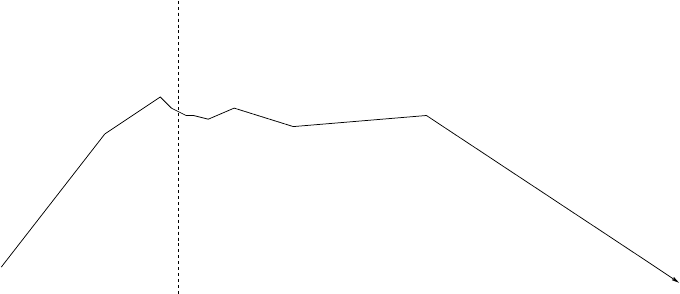
. As a particle recedes from a boundary, its steps grow
and grow, allowing for efficient, rapid transport away from interfaced. This behaviour is
depicted in Figure 15.3.
However, this technique is not without its difficulties. Because lateral transport is not
modeled for the steps that touch the boundary, the multiple-scattering deflection is performed
at the end of the sub-step. Electron can thus backscatter from a surface, requiring careful
handling of the transport logic in the vicinity of interfaces [Bie95]. This “boundary-crossing
algorithm” as implemented in PRESTA also pushes the Moli`ere theory towards the edge of
its region of validity. Granted, the misuse of Moli`ere theory is minimized but it still exists.
2
The general requirements for electron transport in a geometry composed entirely of planar and quadric
surfaces (i.e. spheroids, cones, hyperboloids, paraboloids) has recently been developed [Bie95]. Although
the distance of intersection to any quadric surface along the particle trajectory requires finding the root of
a quadratic equation, the nearest distance to a quadric surface is the root of an n
th
-order equation where
n ≤ 6!
15.2. THE NEW MULTIPLE-SCATTERING THEORY 245
Medium 1 Medium 2
x
x
x
x
x
xx
x
x
x
x
x
Figure 15.3: This is a depiction of operation of the PRESTA algorithm, which adjusts
electron step-sizes in the vicinity of boundaries.
A more fundamental shortcoming was pointed out by Foote and Smyth [FS95] who pointed
out that the deflection at the interface can cause a spurious events whereby an electron,
having crossed a boundary can assume a trajectory that is parallel, or nearly so, to the
surface at this point. The artefact shows up interfaces between condensed materials and
gases. An electron penetrating the gas may be scattered into a near-parallel trajectory with
the boundary. Even step-sizes of the order of several mean-free-path distances may be too
large in the gas.
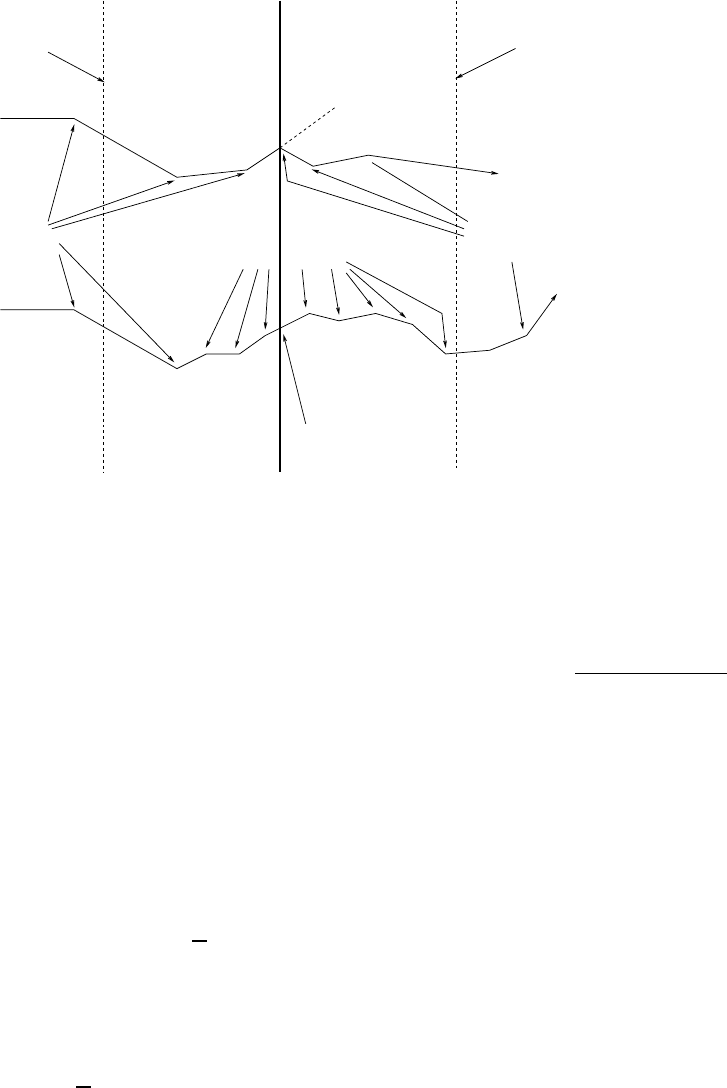
This artefact can be eliminated through use of a condensed history method that “evaporates”
to a single-scattering method in the vicinity of interfaces [Bie96]. The algorithm is sketched
in Figure 15.4. Using the new method, the only way that an electron can cross the interface
is through a “no scatter drift” across the interface which involves no approximation. This
technique, coupled with the new multiple-scattering theory will allow for error-free Monte
Carlo calculations in the limit of small step-size in applications with arbitrarily complex
geometries, interfaces and media.
15.2 The new multiple-scattering theory
The “exact” multiple-scattering angular distribution of Eq. 15.11 may be integrated easily
over azimuthal angles (assuming that the cross section does not depend on polarisation) and
written:
ψ(cos Θ,s)=
X
l
(l +1/2)P
l
(cos Θ) exp
−
Z
s
0
ds
0
κ
l
(E)
, (15.19)
246 CHAPTER 15. ADVANCED ELECTRON TRANSPORT ALGORITHMS
no scattering
the new way
the old way
single scattering
scattering
multiple
scattering
multiple
skin
depth
depth
skin
Θ
Medium 2Medium 1
Figure 15.4: This is a depiction of the new boundary-cross algorithm which eliminates
boundary-related artefacts.
and then reorganized in the following form [KB98]:
ψ(cos Θ,s)=e
−λ
δ(1−cos Θ)+λe
−λ
˜σ +(1−e
−λ
−λe
−λ
)
X
l
(l+1/2)P
l
(cos Θ)
e
−λg
l
− 1 − λg
l
e
−λ
−1 − λ
,
(15.20)
where
λ =
Z
s
0
ds
0
σ
s
(E) (15.21)
is the distance measured in mean-free-path taking into account the change in energy of the
scattering cross section, and e
−λ
is the probability that the electron can go a distance λ
without scattering even once,
˜σ =
1
λ
Z
s
0
ds
0
σ
s
(cos Θ,E) (15.22)
is the angular distribution of a single-scattering event with probability λe
−λ
taking into
account energy loss, and
g
l
=
1
λ
Z
s
0
ds
0
Z
π
0
d(cos Θ) σ
s
(cos Θ,E)P
l
(cos Θ) , (15.23)
which is related to the κ
l
defined in Eq. 15.8.
The general from of Eq. 15.21 was suggested by Berger and Wang [BW89] as a way of
reducing some of the singularity in Eq. 15.11 to make the summation for large-l tractable.
15.3. LONGITUDINAL AND LATERAL DISTRIBUTIONS 247
This approach has some moderate success for Class I pre-calculations but Class II algorithms
must still sample “on-the-fly”. Therefore, we have adopted an alternative approach.
This approach is based on a similar analysis of the small-angle multiple-scattering prob-
lem [Bie94]. Consider the part of Eq. 15.20 that describes two or more scatterings. Defining
the notation
ψ
(2+)
(µ, s)=
X
l
(l +1/2)P
l
(µ)
e
−λg
l
− 1 − λg
l
e
−λ
−1 − λ
, (15.24)
where µ = cos Θ. The change of variables,
u =(1+a)
1 −
2a
1 − µ +2a
!
(15.25)
allows us to write an alternate form of ψ
(2+)
(µ, s), namely
q
(2+)
(u, s)du = ψ
(2+)
(µ, s)dµ, (15.26)
where for the moment, a is an arbitrary parameter.
The motivation for this transformation is quite subtle. The magnitude of the derivative of
u with respect to µ is:
du =(1+a)
1 −
2a
1 − µ +2a
!
, (15.27)
which resembles a screened Rutherford cross section with an arbitrary screening angle, a.As
discovered in the small-angle study, most of the shape of the multiple-scattering distribution,
which is peaked strongly in the forward direction for the usual case of small screening angles,
resembles a screened Rutherford cross section with some effective width. The “effective
screening” angle a canthenbefixedbythrequirementthatq
(2+)
(u, s) be as flat as possible for
all angles and all transport distances. The procedure is described elsewhere. It suffices to say
that the q
(2+)
-surfaces produced, starting with a screened Rutherford cross section employing
the Moli`ere screening angle [Mol47] along with Mott [Mot29, Mot32] that includes spin
and relativistic corrections [Mot29, Mot32], are flat enough so that a linear interpolation
table that is accurate to within 0.2% can be represented in a few hundred kB of data for 100
atomic elements suitable for applications from 1 keV upwards
3
.
15.3 Longitudinal and lateral distributions
In this section we consider longitudinal and lateral transport components of Monte Carlo
sub-step. Although the transport scheme represented by Eq. 15.18 has been shown to yield
results correct to O(∆s), it can be shown that all the moments represented by Eqs. 15.13–
15.17 are not correct. Thus, even average penetration distances and lateral diffusion are not
3
We are grateful to Dr Stephen Seltzer for providing the Mott cross section data.

248 CHAPTER 15. ADVANCED ELECTRON TRANSPORT ALGORITHMS
accounted for correctly. For most applications, electrons scatter for many elastic and inelastic
scatterings before tallying some result. After many scatterings, the only information that
really matters are the first few moments. There are, of course exceptions, the most important
one being low energy electron backscatter. In the application, single and plural events can
lead to backscatter from a foil. The “boundary-crossing algorithm” discussed previously may
come to the rescue, however. This is because electrons must penetrate using single-scattering
methods to a skin-depth of several mean-free-path distances before the condensed history
algorithm is allowed to take over. If single and plural scattering from within the skin-depth
is contributing in a significant way to the backscatter events, then this will automatically be
accounted for.
We now describe a transport algorithm that gives exactly the Lewis moments, hzi, hz cos Θi,
hz
2
i,andhx
2
+ y
2
i with only a little more computational effort
4
.
We create the ansatz:
∆x/s =[β(s) − δ
k
(s, ξ
x
)] sin Θ cos[Φ −δ
φ
(s, ξ
φ
)] + δ
⊥
(s, ξ
x
)
∆y/s =[β(s) − δ
k
(s, ξ
x
)] sin Θ sin[Φ − δ
φ
(s, ξ
φ
)] + δ
⊥
(s, ξ
y
)
∆z/s =[β(s) − δ
k
(s, ξ
z
)]cosΘ+[α(s) − δ
k
(s, ξ
x
)] , (15.28)
where δ
⊥
, δ
k
and δ
φ
are transverse, longitudinal and azimuthal straggling functions and
ξ
i
is a uniform random variable between 0 and 1. The lateral and longitudinal straggling
functions have the property that their average is exactly zero, i.e.
R
1
0
dξδ
⊥
(s, ξ)=0and
R
1
0
dξδ
k
(s, ξ) = 0 while the azimuthal straggling function’s average value represents the
average angle between the direction of motion and the azimuthal component of the straggling
function [Kaw96a]. It also has a straggling component. This function has been determined
by single-scattering calculations [Kaw96a]. The functions α(s)andβ(s) can be found by
insisting that hzi and hz cos Θi comply with hzi in Eq. 15.13 and with hz cos Θi in Eq. 15.14.
The values of
R
1
0
dξδ
2
⊥
(s, ξ)and
R
1
0
dξδ
2
k
(s, ξ) can be determined by forcing agreement with
hz
2
i,andhx
2
+ y
2
i. It should be remarked that the shape of the straggling functions is not
determined by this approach. We can derive more information about them by calculating
higher Lewis moments. This will lead to information about
R
1
0
dξδ
n
⊥
(s, ξ)and
R
1
0
dξδ
n
k
(s, ξ),
where n>2. Since we do not know the exact shape of the straggling functions, we have
to guess. Small-angle theory suggests Gaussian’s for the lateral straggling functions. This
work remains to be done. The use of the previously-computed azimuthal straggling function,
should guarantee compliance with hx sin Θ cos Φi and hy sin Θ sin Φi.
Before ending this section, we make a few remarks on the computational efficiency of this
new method. The most computationally intensive part of Eq. 15.28 is sampling the multiple-
scattering distribution, which is required by any method. The straggling functions can be
4
It is very important remark that more advanced methods have to be computationally efficient. It is
pointless to develop complicated calculational schemes that cost more to execute than simply turning down
the step-size to obtain the same degree of accuracy!

15.4. THE FUTURE OF CONDENSED HISTORY ALGORITHMS 249
pre-calculated and put into interpolation tables, a task no more difficult than the multiple-
scattering table described in the previous section. Alternatively, since the shape of the
distributions is arbitrary, simple forms may be used and sampling these distributions may
be very rapid.
One possible criticism of this approach is that it is bound to produce the occasional un-
physical result of the form x
2
+ y
2
+ z
s
>s
2
. It is anticipated that this type of event will
be rare, and some indication of this has been given by Berger [Ber63], who first suggest
Gaussian straggling terms for the lateral component. Another criticism is that the ansatz in
Eq. 15.28 is not general enough. Indeed, although moments of the type hz
n
i canbeusedto
determine
R
1
0
dξδ
n
k
(s, ξ), they will likely be in conflict with higher order moments of the sort
hz
n
cos
m
Θi. Actually, this criticism is coupled directly to the previous one and results from
our incomplete understanding of the solution to the complete transport problem. Further
research along these lines, such as the Fokker-Planck solution to this problem, while approx-
imate will shed more insight on the general transport solution. However, it is also likely that
Eq. 15.28 represents a significant advance in condensed history methods and may provide
true step-size independence for a large class of electron transport problems.
15.4 The future of condensed history algorithms
We conclude with some comments on the future of condensed history algorithms to place
its research in some sort of larger perspective. We investigate briefly two scenarios that are
pointed to by present computer hardware developments. Will condensed history continue to
play a role when computers get much faster? and Will analog-based condensation techniques
ever replace our analytic-based ones?.
Will condensed history continue to play a role when computers get much faster?
The other was of asking this question is: Will analog Monte Carlo techniques replace con-
densed history methods for most future applications?
Depending on the application, condensed history techniques “outrun” single-scattering cal-
culations by a factor 10
3
—10
5
. Computing power per unit cost increases by approximately
a factor of 2 every year. This means that an application that runs today with condensed
history calculations can be done in the same amount of time by analog methods in about
10–17 years!
The answer to this is that the problems usually expand in complexity as the technology to
address them advances. In the next decade or two we will not be asking the same questions!
The questions will be more complex and the simpler, cruder method of condensed history,
whatever it evolves to in that time, will still have an important role to play.
A perfect example of this is radiotherapy treatment planning calculations. Presently, con-
densed history techniques are not used because it takes a few hours to perform on a workstation-

250 CHAPTER 15. ADVANCED ELECTRON TRANSPORT ALGORITHMS
class computer. Software and hardware technology may reduce this to seconds in about 5
years, making it feasible for routine use. In a few more years, calculation times will be
microseconds and Monte Carlo will be used in all phases of treatment planning, even the
most sophisticated such as inverse planning and scan-plan-treat single pass tomotherapy
machines.
Condensed history gets this answer to sufficient accuracy and medical physics will not resort
to single-scattering methods that take 10
3
—10
5
longer to execute for marginal (and and
largely unnecessary) gain in accuracy. Once calculation error has been reduced to about 2%
or so, its contribution to the overall error of treatment delivery will be negligible.
Will analog-based condensation techniques ever replace our analytic-based ones?
One approach to addressing the problem of slow execution for single-scattering Monte Carlo
is to pre-compute electron single-scattering histories and tally the emergence of particles from
macroscopic objects of various shapes, depending on the application. Then one transports
these objects in the application rather than electrons! Ballinger et. al. [BRM92] used
hemispheres as his intended application was primarily low-energy backscatter from foils.
Ballinger et. al. did their calculations within the hemispheres almost completely in analog
mode, for both elastic and inelastic events.
Neuenschwander and Born [NB92] and later Neuenschwander et. al. [Nel95] used EGS4 [NHR85,
BHNR94] condensed history methods for pre-calculation in spheres for the intended appli-
cation of transport within radiotherapy targets (CT-based images) and realized a speed
increase of about 11 over condensed history. Svatos et. al. [SBN
+
95] is following up on this
work by using analog methods.
Since these “analog-based condensation” techniques play a role in specialized applications it
begs the question whether or not these techniques can play a more general role. To answer
this, consider that we are seeking the general solution to the problem: given an electron
starting at the origin directed along the z-axis for a set of energies E
n
, what is the complete
description of the “phase space” of particles emerging from a set spheres
5
of radii r
n
?Thatis,
what is ψ(~x,
~
Ω,E,s,q; E
n
,r
n
), where ~x is the final position on the sphere,
~
Ω is the direction
at the exit point of the sphere, E is the exit energy, s is the total pathlength, q is the charge
(3 possible values in our model, electrons, positrons or photons), E
n
is the starting energy,
and r
n
is the radius of the sphere. Now, imagine that we require n-points to fit some input or
output phase-space variable (e.g. 100 different values of E) and that we must provide storage
for N decades of input energy. (The input and output energies would likely be tabulated on
a logarithmic mesh.) The result is that one would require 3Nn
8
real words of data to store
the results of the general problem!
To make the example more concrete, imagine that we wish to store 9 decades in input energy
(from, say, 1 keV to 100 TeV) and set n = 100. This would require 1.2 exabytes (1.2 ×10
18
)
5
We will use this geometry as an example. A set of spheres is necessary so that geometry-adaptive
techniques may be employed.