
Bielajew A.F. Fundamentals of the Monte Carlo method for neutral and charged particle transport
Подождите немного. Документ загружается.

16.2. TRANSPORT IN A MEDIUM 261
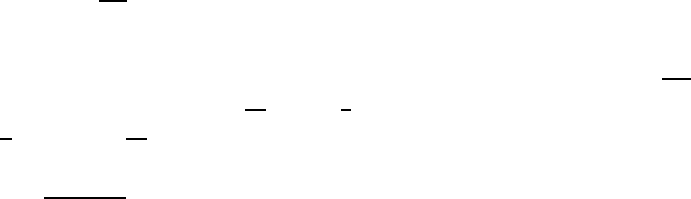
inelastic forces. Assuming the medium is isotropic and homogeneous, the equation of motion
takes the general form,
d
~
p
dt
=
~
F
ret
(E(t)) +
~
F
ms
(E(t)) +
~
F
em
(
~
x(t),E(t),
~
u(t)), (16.10)
where
~
p is the momentum, t is the time,
~
F
ret
is the force due to inelastic (retarding) forces,
~
F
ms
is the force due to elastic (multiple scattering) forces, and
~
F
em
is the force due to
external (electric and magnetic) forces. We may integrate eq. 16.10 implicitly to obtain,
~
v =
~
v
0
+
1
m
0
γ(E)
Z
t
0
dt
0
{
~
F
ret
(E(t
0
)) +
~
F
ms
(E(t
0
)) +
~
F
em
(
~
x(t
0
),E(t),
~
u(t
0
))}. (16.11)
~
x =
~
x
0
+
~
v
0
t +
Z
t
0
dt
00
~
v(t
00
) (16.12)
These are very complex equations of motion with much interplay among all the constituents.
~
F
ret
accounts for inelastic processes having to do mostly with electron-electron interactions
and bremsstrahlung photon creation in the nuclear field. This force affects mostly E,the
energy, and consequently v, the magnitude of the velocity,
~
v. There is some deflection as
well but angular deflection is dominated by multiple scattering.
~
F
ret
couples to
~
F
ms
and
~
F
em
because they all depend on E.
~
F
ms
accounts for elastic processes having to do mostly
with deflections caused by the nuclei of the medium. It changes the direction of the velocity.
Consequently,
~
F
ms
couples to
~
F
em
since the latter depends on
~
u, the direction of motion of
the particle. (By definition,
~
u is a unit vector.) The energy lost to the nuclear recoil can
usually be ignored and
~
F
ms
does not couple to
~
F
ret
.
~
F
em
accounts for the interaction with the
external electric and magnetic fields. It depends on E,
~
u and also
~
x if the external fields are
spatially dependent.
~
F
em
can alter both the magnitude and direction of
~
v thereby coupling
directly to both
~
F
ms
and
~
F
ret
. Moreover, outside the integral in eq. 16.11 is an overall factor
of 1/(m
0
γ(E)), owing to the fact that the mass changes when the energy changes.
To complicate matters even further, we do not know the exact nature of
~
F
ret
and
~
F
ms
.For
“microscopic” Monte Carlo methods, where we model every electron interaction, we can
only say something about the momentum before and after the interaction. For complete
rigour, one would have to solve the quantum mechanical equations of motion incorporating
external fields. However, unless the external fields are very strong, they may be treated in a
perturbation formalism for microscopic Monte Carlo methods.
In this lecture we restrict ourselves to “condensed-history” Monte Carlo, for which the argu-
ments are even more subtle. For complete rigour, one should incorporate the external fields
into the Boltzmann transport equation and solve directly. To our knowledge, this has not
been attempted. Instead, we attempt to superimpose the transport in the external fields
upon “field-free” charged particle transport and discuss what approximations need to be
made.
262CHAPTER 16. ELECTRON TRANSPORT IN ELECTRIC AND MAGNETIC FIELDS
A major difficulty arises from the fact that during a condensed-history transport step the
trajectory of the particle is not known nor are the exact forms of
~
F
ret
and
~
F
ms
known.
Instead we wish to make use of the already existing statistical treatments of
~
F
ret
and
~
F
ms
,
for example, Bethe-Bloch slowing down theory [Bet30, Bet32, Blo33] and Moli`ere [Mol47,
Mol48] multiple scattering theory. If the external fields are different for the different possible
particle trajectories, we are faced an unresolvable ambiguity. Therefore, we must demand
that the transport steps be small enough so that the fields do not change very much over the
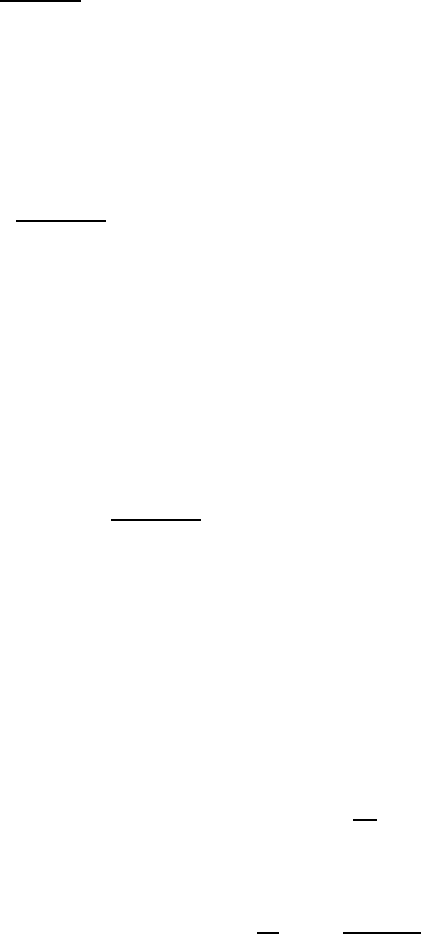
course of the step. With this approximation, eq. 16.11 becomes,
~
v =
~
v
0
+
1
m
0
γ(E)
Z
t
0
dt
0
{h
~
F
ret
(E(t
0
))i + h
~
F
ms
(E(t
0
))i +
~
F
em
(
~
x
0
,E(t),
~
u(t
0
))}, (16.13)
where
~
x
0
is the position at the beginning of the particle’s step and the h
~
Fi’s denote that we
are now employing the statistical formulations of the physical effects produced by h
~
Fi.
We make the further approximation that the energy does not change very much during the
course of a particle step. With the approximation of small energy losses, eq. 16.13 becomes,
~
v =
~
v
0
+
1
m
0
γ(E
0
)
h
~
F
ret
(E
0
)it + h
~
F
ms
(E
0
)it +
Z
t
0
dt
0
~
F
em
(
~
x
0
,E
0
,
~
u(t
0
))
, (16.14)
where E
0
is the energy evaluated at the beginning of the particle’s step.
Finally, we make the approximation that the direction angle
~
u does not change much over
the course of the step. While this can be accomplished by reducing the size of the step for
most of the charged particle steps, occasionally large angle scatterings associated with single
nucleus-electron interactions will occur. Therefore, this approximation must break down at
least some of the time. Fortunately, multiple scattering is dominated by small angle events
with only relatively few large angle ones [Ber63]. With this approximation,
~
v =
~
v
0
+
t
m
0
γ(E
0
)
{h
~
F
ret
(E
0
)i + h
~
F
ms
(E
0
)i +
~
F
em
(
~
x
0
,E
0
,
~
u
0
)}. (16.15)
where
~
u
0
is the direction vector evaluated at the beginning of the particle’s step. At this
point, by virtue of the approximations we have made, the
~
F’s are decoupled. Note that
nothing has been said about the sizes of the
~
F’s relative to one another except that they do
not perturb the “force-free” trajectory too much.
To make a closer connection to applying the equations to Monte Carlo simulations, we recast
the equations so that they are dependent upon the total path-length of the step, s, rather
than the time. To this end we write,
t =
Z
s
0
ds
v
, (16.16)
which, to 1
st
-order may be written,
t =
s
v
0
1+
∆v(E
0
)
v
0
!
, (16.17)
16.2. TRANSPORT IN A MEDIUM 263
where ∆v(E
0
)=v
0
− v(E
0
) accounts for energy losses in the relationship expressed by
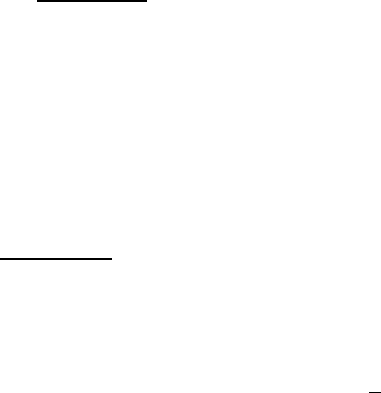
eq. 16.16. From eq. 16.15, we find that to 1
st
-order in the
~
F’s,
∆v(E
0
)=−
s
m
0
γ(E
0
)v
0
~
u
0
·{h
~
F
ret
(E
0
)i + h
~
F
ms
(E
0
)i +
~
F
em
(
~
x
0
,E
0
,
~
u
0
)}, (16.18)
where
~
u
0
is the direction vector evaluated at the start of the electron step. Using eqs. 16.12,
16.15–16.18 we find that the new direction vector,
~
u =
~
v/|
~
v| takes the form,
~
u =
~
u
0
+∆
~
u, (16.19)
where,
∆
~
u =
s
m
0
γ(E
0
)v
2
0
{h
~
F
⊥,ret
(E
0
)i + h
~
F
⊥,ms
(E
0
)i +
~
F
⊥,em
(
~
x
0
,E
0
,
~
u
0
)}, (16.20)
The
~
F
⊥
’s are the components of the
~
F’s in the direction perpendicular to
~
u
0
. In similar
fashion we find that,
~
x =
~
x
0
+
~
u
0
s +
s
2
∆
~
u (16.21)
We may write eq. 16.21 slightly differently as,
~
x =
~
x
0
+
~
u
0
s + ~
(1)
⊥,ret+ms
+ ~
(1)
⊥,em
, (16.22)
where the ~
(1)
’s are the 1
st
-order perturbations of the trajectory due to inelastic slowing
down plus multiple scattering and the deflection and energy change in the external electric
and magnetic fields. Since the ~
(1)
’s are decoupled, we may calculate ~
(1)
⊥,ret+ms
as if there
were no external fields and ~
(1)
⊥,em
as if the transport had occurred in a vacuum. We note that,
to 1
st
-order, the deflections are perpendicular to the initial trajectory. If we had carried out
the analysis to 2
nd
-order in the
~
F’s, we would obtain an equation of the form,
~
x =
~
x
0
+
~
u
0
s(1 −
(2)
k
)+~
(1)
⊥,ret+ms
+ ~
(1)
⊥,em
+ ~
(2)
⊥
, (16.23)
where ~
(2)
⊥
is the 2
nd
-order perpendicular deflection, and 1 −
(2)
k
can be identified as the path-
length correction, a quantity that accounts for the curvature of the charged particle step.
Rather than transporting the charged particle the full path-length s in the initial direction,
this distance must be shortened owing to the deflection of the particle during the step. This
is seen to be a 2
nd
-order effect. We have seen in Lecture 16 that these corrections can be
quite large if one attempts to use large step-sizes in field-free simulations. Clearly, if the 1
st
-
order effects of multiple scattering, slowing down or speeding up, and deflection due to the
external field are to be considered small in a perturbation sense, then one should ensure the
the 2
nd
-order affects should be commensurately smaller. A reliable method for calculating
264CHAPTER 16. ELECTRON TRANSPORT IN ELECTRIC AND MAGNETIC FIELDS
path-length corrections in field-free transport is discussed in Lecture 16. The terms ~
(2)
⊥
and
(2)
k
contain “mixing terms” between the field-free and external field components. To our
knowledge, no theory has yet been developed to encompass all of these effects. Until such
time that such a theory is developed, we restrict ourselves to charged particle steps that
are small enough so that the 1
st
-order equations discussed herein are valid. However, if we
make this restriction, we may transport particles in any medium with any external field
configuration, no matter how strong.
16.3 Application to Monte Carlo, Benchmarks
At the start of a transport step in a medium with external fields present, we know
~
x
0
,the
position,
~
u
0
, the unit direction vector, E
0
, the energy (which one may easily use to find
v
0
, the magnitude of the velocity, or β
0
= v
0
/c),
~
D
0
, the macroscopic electric field strength
at
~
x
0
,and
~
H
0
, the macroscopic magnetic field strength at
~
x
0
. In the condensed-history
approach to electron Monte Carlo transport, aside from those discrete interactions which
we consider explicitly, the interactions are grouped together and treated by theories which
consider the medium in which the transport takes place to be a homogeneous, bulk medium.
Therefore, using the macroscopic fields,
~
D and
~
H, rather than the microscopic fields,
~
E and
~
B, is consistent with the condensed-history approach. After the transport step, we wish to
know
~
x
f
,
~
u
f
,andE
f
, the final position, unit direction vector, and energy.
If we make the identification,
~
F
⊥,em
(
~
x
0
,E
0
,
~
u
0
)=e(
~
D
0
−
~
u
0
(
~
u
0
·
~
D
0
)+
~
v
0
×
~
H
0
), (16.24)
we may use the results of the previous section and write directly the equation, for
~
u
f
,
~
u
f
=
~
u
0
+∆
~
u
ms,ret
+∆
~
u
em
, (16.25)
where the deflection due to multiple scattering and inelastic collisions is:
∆
~
u
ms,ret
=
s
m
0
γ(E
0
)v
2
0
{h
~
F
⊥,ret
(E
0
)i + h
~
F
⊥,ms
(E
0
)i}, (16.26)
and the deflection due to the external electromagnetic field is:
∆
~
u
em
=
es
m
0
γ(E
0
)v
2
0
(
~
D
0
−
~
u
0
(
~
u
0
·
~
D
0
)+
~
v
0
×
~
H
0
). (16.27)
Using the results of the previous section, we may also write directly the equation for
~
x
f
,
~
x
f
=
~
x
0
+
~
u
0
s +
s
2
(∆
~
u
ms,ret
+∆
~
u
em
). (16.28)
16.3. APPLICATION TO MONTE CARLO, BENCHMARKS 265
We may also have written these equations from the results of the vacuum transport section,
sec. 16.1, by superimposing the inelastic and multiple scattering forces on the transport in
a vacuum but with external electric and magnetic fields.
We wish to ensure that new direction vector remains properly normalized, i.e. |
~
u
f
| =1.
Therefore, after the transport has taken place according to eqs. 16.24–16.28, we normalize
~
u
f
using,
~
u
0
f
=
~
u
f
q
1+|∆
~
u
ms,ret
|
2
+2∆
~
u
ms,ret
· ∆
~
u
em
+ |∆
~
u
em
|
2
. (16.29)
Note that there is no inherent contradiction introduced by eq. 16.29 because the normaliza-
tion uses terms that are higher than 1
st
-order in the ∆
~
u’s. We remark that
~
u
f
is already
normalized to 1
st
-order in the ∆
~
u’s, consistent with our development. For repeated trans-
port steps, the
~
u
f
we calculate becomes the
~
u
0
of the next step. We have assumed that
~
u
0
is properly normalized in our development. Unless we obey this normalization condition to
all orders, the 2
nd
and higher-order terms will eventually accumulate and cause substantial
error.
Finally, we calculate the energy loss from the equation,
E
f
= E
0
− ∆E
ret
+ e
~
D
0
·(
~
x
f
−
~
x
0
), (16.30)
where ∆E
ret
is the energy loss due to inelastic collisions. It takes the form,
∆E
ret
=
Z
s
0
ds
0
|dE/ds
0
|, (16.31)
where |dE/ds
0
| is the stopping power.
At this point we should re-state the constraints we must impose so that our method is valid.
The condition that the fields not change very much over the transport step takes the form,
|
~
D(
~
x
f)
−
~
D(
~
x
0
)|
|
~
D(
~
x
0
|)
≡ δ
D
1, (16.32)
and,
|
~
H(
~
x
f
) −
~
H(
~
x
0
)|
|
~
H(
~
x
0
)|
≡ δ
H
1. (16.33)
The constraint that the energy does not change very much over the transport step takes the
form,
∆E
ret
E
0,kinetic
≡ δ
ret
1, (16.34)
and,
|∆E
em
|
E
0,kinetic
≡ δ
em
1. (16.35)

266CHAPTER 16. ELECTRON TRANSPORT IN ELECTRIC AND MAGNETIC FIELDS
Finally, the constraint that the direction does not change very much over the transport step
takes the form,
|∆
~
u
ms,ret
|1, (16.36)
and,
|∆
~
u
em
|1. (16.37)
Recall that all of the constraints expressed by eqs. 16.32–16.37 can be satisfied by using a
small electron step-size except |∆
~
u
ms,ret
|1, which must be violated some of the time if
the multiple scattering model includes large-angle single-event Rutherford scattering. We
have argued that this occurs infrequently enough so that the error introduced is negligible.
The error, if any, would show up in high-Z media subjected to strong magnetic fields, since
high-Z media produce more large-angle events and the magnetic force is direction dependent.
An algorithm for electron transport in media subjected to external electric and magnetic
fields would be of the following form:
• Choose a total path-length for the step, s, consistent with the constraints expressed in
eqs. 16.32–16.37.
• Calculate
~
u
f
using eqs. 16.25–16.27. The inelastic and elastic scattering portions,
h
~
F
⊥,ret
(E
0
)i and h
~
F
⊥,ms
(E
0
)i, can be calculated using any slowing-down and multiple
scattering theory.
• Transport the particle according to eq. 16.28
2
.
• Normalize the direction vector,
~
u
f
, using eq. 16.29
3
.
• Calculate the new energy according to eqs. 16.30 and 16.31.
• Repeat.
To proceed further would entail detailed knowledge of a specific Monte Carlo code. This
would take us beyond the scope of this lecture. Rather, we assert that this has been done
2
The EGS code simplifies the procedure even more [RBMG84] and ignores the lateral transport caused
by h
~
F
⊥,ret
i, h
~
F
⊥,ms
i,and
~
F
⊥,em
at this stage. If the steps are short enough, accurate electron transport
will be accomplished through the deflection of the direction vector,
~
u. (For a discussion of the importance
of lateral transport during an electron step caused by multiple scattering, see Lecture 16.)
3
Although this guarantees that the direction vector remains normalized, a different procedure has been
adopted for the EGS code. This normalization was applied for the electric field deflection only. For deflection
by the magnetic field, only the components transverse to the magnetic field are normalized. Within the
structure of the EGS code, this guarantees that the parallel component of
~
u does not change thereby
imposing conservation of momentum in the direction parallel to the magnetic field.
16.3. APPLICATION TO MONTE CARLO, BENCHMARKS 267
both for the EGS code [RBMG84] and the ITS codes [Hal74, HSV75, HSV77]. We simply
give examples of some benchmark calculations.
First we present a test of transport in a vacuum in a constant electric field. In fig. 16.1
Figure 16.1: Electron trajectories influenced by a constant electric field in vacuum calculated
using the EGS4 Monte Carlo code compared with an exact analytical solution.
we compare electron trajectories calculated using the EGS Monte Carlo code and the exact
analytical solution, eq. 17.6 discussed in sec. 16.1.1. In this example, the electric field is
aligned with the ordinate with a field strength of 511 kV/cm. Three positron trajectories
are depicted with energies 0.1, 1.0, and 10 MeV initially directed at a 45
◦
angle against the
electric field. We also show two negatron (e
−
) trajectories with energies 2.0 and 20 MeV
initially directed perpendicular to the electric field. The Monte Carlo calculated trajectories
are depicted by the solid lines while the exact analytical solutions are shown with dotted
lines. The electron step-size limits were obtained by letting the change in kinetic energy be
at most two percent (the constraint expressed by eq. 16.35) and the deflection be at most
0.02 (the constraint expressed by eq. 16.37). We see only minor evidence that the neglect of
lateral transport during the course of a step causes error. This error can be further reduced
by shortening the step-sizes even more.
Next we present a test of transport in a vacuum in a constant magnetic field. In fig. 16.2
we compare 0.1 MeV negatron and 1.0 MeV positron trajectories calculated using the EGS
Monte Carlo code and the exact analytical solution, eqs. 17.9 and 17.10 also discussed in
268CHAPTER 16. ELECTRON TRANSPORT IN ELECTRIC AND MAGNETIC FIELDS
Figure 16.2: Electron trajectories influenced by a constant magnetic field in vacuum calcu-
lated using the EGS4 Monte Carlo code compared with exact analytical solutions.
sec. 16.1.1. In this case the magnetic field is aligned with the abscissa with a field strength
of 0.17 Tesla. The initial velocities are directed 45
◦
away from the
~
B-axis. The analytic
solutions are represented by the solid lines. The agreement is excellent in both cases.
The “vacuum” tests were designed to verify that the differential equations of electron trans-
port in external fields are being correctly integrated during the course of the electron simu-
lation. We have verified that the relatively crude “first-order” method presented in sec. 16.2
works acceptably well in vacuum. If more accuracy is desired, then one merely has to shorten
the electron step-size. We may have been much more sophisticated if we were interested in
rapid and accurate transport in vacuum. For constant, or nearly constant fields, we may
have employed the exact analytic solutions expressed in sec. 16.1 into the Monte Carlo code
directly. If the simulations take place in finite geometries, then one would have to find so-
lutions of the intersection points of the electron trajectories with the surfaces enclosing the
geometry in which the simulation takes place. This is a straightforward but tedious problem
for most classes of bounding surfaces, for example, cones or cylinders.
For electron transport in spatially varying fields or simulations in tenuous media where the
multiple scattering and retardation forces may be considered to be perturbations upon the
deflections and energy losses due to the external fields, one may use more sophisticated inte-
gration techniques to obtain electron trajectories more quickly. For example, the ITS series
of codes uses a fifth-order Runge-Kutta technique to integrate the external field transport
16.3. APPLICATION TO MONTE CARLO, BENCHMARKS 269
equations [Hal74, HSV75, HSV77].
When one is interested in electron transport in dense media, unless more theoretical work is
done to elucidate the complex interplay of multiple scattering, retardation and external field
forces, one must resort to a method similar to that presented at the start of this section.
We have verified that this method works well and now wish to perform benchmarks in dense
media. Unfortunately, the authors are not aware of clear-cut benchmark experiments of
this sort. Instead, we present three examples which verify at most semi-quantitatively, that
external field transport in dense media is possible.
The first example is that of a 10 MeV negatron through 10 m of air with a magnetic field with
strength 0.17 T aligned with the electron’s initial direction of motion. An “end-on” view is
Figure 16.3: An “end-on” view of a 10 MeV negatron being transported through air. The
particle’s initial direction and the magnetic field direction are normal to and out of the plane
of view. The vertical axis is 10 cm long.
shown in fig. 16.3. Because the initial direction and the magnetic field are aligned, there is
no deflection by the magnetic field until the particle is deflected by the medium. The initial
deflection, a creation of a low energy δ-ray in the left-hand side of the figure, caused the
initial deflection in this example. Afterwards, the negatron spirals in the counter-clockwise
direction. The electron transport cut-off energy in this example is 10 keV at which point
the simulation of δ-ray transport is seen to come to an abrupt end. An interesting feature of
this example is that a relatively high-energy δ-ray was produced spiraling many times before
losing all its energy. The δ-ray actually drifted about 20 cm in the direction of the magnetic
field.
270CHAPTER 16. ELECTRON TRANSPORT IN ELECTRIC AND MAGNETIC FIELDS
A second example is a representation of electric field focusing of electrons. In this case, a
Figure 16.4: 10 MeV electrons incident on water containing a uniformly charged cylinder.
The charge on the cylinder strongly focusses the electrons. The horizontal axis is 5 cm long.
uniformly charged cylinder with radius 0.5 cm, is placed 2.5 cm deep in a water target. The
target is irradiated by a broad, parallel beam of 10 MeV negatrons. The electric potential is
Φ(ρ)[MV] = −ln(2ρ), which is zero on the surface of the cylinder, and is sufficient to “bind”
any electron which strikes the surface of the water. The variable ρ is the distance away from
the cylinder’s axis measured in centimeters. The electric field outside the water is zero as
well as inside the cylinder. We note the strong focusing of the electrons although in a few
cases, the multiple scattering turns particles away from the cylinder.
Finally, we present an example that provides some quantitative support for the viability of
electron transport in dense media in the presence of strong electric fields. It is somewhat
related to the previous example, having to do with focusing of electrons into a cylinder held
at high potential [RBMG84]. Some explanation is required beforehand, however.
When electrons bombard insulating materials and come to rest as a result of slowing down in
the medium, they become trapped and can set up large electric fields in the medium. Subse-
quent bombardments may be greatly perturbed by the presence of these fields, and this may
result in a deleterious effect on the accuracy of dosimetry measurements in these insulating
materials [RBMG84]. It was common practice to place a radiation detection device in a
cylindrical hole drilled in a plastic phantom and subject it to electron bombardment. The
air in the cylinder becomes ionized and conducting during bombardment and large amounts
of positive charge may be induced to the cylinder to bring its surface to constant potential.
Therefore, electrons are focussed to the cylinder causing one to measure an artificially high
response in the detector. These effects were calculated by Monte Carlo methods [RBMG84]