
Bielajew A.F. Fundamentals of the Monte Carlo method for neutral and charged particle transport
Подождите немного. Документ загружается.

16.3. APPLICATION TO MONTE CARLO, BENCHMARKS 271
but the benchmark of the Monte Carlo code is not “clear-cut”. The electric field strength
had to be estimated and it was further assumed that the electric field strength at the surface
of the cylinder was proportional to the total amount of charge bombarding the insulating
material.
Figure 16.5: Measured and calculated response enhancement due to the presence of large
electric fields versus total electron dose responsible for the stored charge causing the focusing
effect. The incident electron energy was 5.7 MeV and the 0.7 cm diameter cylinder was
located 1.5 cm deep in a polymethylmethacrylate (PMMA) medium.
Given these approximations, a comparison of the calculated and measured enhancement of
detector response is presented in fig. 16.5. In this comparison, the incident electron energy
was 5.7 MeV and the cylinder in which the detector was placed was 0.7 cm in diameter
placed at a depth of 1.5 cm in a polymethylmethacrylate (PMMA) medium. In this case, the
maximum field strength exceeded 1MV/cm! We note that the experimental and calculated
results agree to within the 1% accuracy of the simulations.
272CHAPTER 16. ELECTRON TRANSPORT IN ELECTRIC AND MAGNETIC FIELDS
Bibliography
[Ber63] M. J. Berger. Monte Carlo Calculation of the penetration and diffusion of fast
charged particles. Methods in Comput. Phys., 1:135 – 215, 1963.
[Bet30] H. A. Bethe. Theory of passage of swift corpuscular rays through matter. Ann.
Physik, 5:325, 1930.
[Bet32] H. A. Bethe. Scattering of electrons. Z. f¨ur Physik, 76:293, 1932.
[Blo33] F. Bloch. Stopping power of atoms with several electrons. Z. f¨ur Physik, 81:363,
1933.
[Hal74] J. A. Halbleib, Sr. . J. Appl. Phys., 45:4103 –, 1974.
[HM84] J. A. Halbleib and T. A. Mehlhorn. ITS: The integrated TIGER series of
coupled electron/photon Monte Carlo transport codes. Sandia Report SAND84-
0573, 1984.
[HSV75] J. A. Halbleib, Sr., and W. H. Vandevender. Coupled electron/photon transport
in static external magnetic fields. IEEE Transactions on Nuclear Science, NS-
22:2356 – 2361, 1975.
[HSV77] J. A. Halbleib, Sr., and W. H. Vandevender. Coupled electron photon collisional
transport in externally applied electromagnetic fields. J. Appl. Phys., 48:2312 –
2319, 1977.
[Jac75] J. D. Jackson. Classical Electrodynamics. Wiley, New York, 1975.
[Mol47] G. Z. Moli`ere. Theorie der Streuung schneller geladener Teilchen. I. Einzelstreu-
ung am abgeschirmten Coulomb-Field. Z. Naturforsch, 2a:133 – 145, 1947.
[Mol48] G. Z. Moli`ere. Theorie der Streuung schneller geladener Teilchen. II. Mehrfach-
und Vielfachstreuung. Z. Naturforsch, 3a:78 – 97, 1948.
[NHR85] W. R. Nelson, H. Hirayama, and D. W. O. Rogers. The EGS4 Code System.
Report SLAC–265, Stanford Linear Accelerator Center, Stanford, Calif, 1985.
273
274 BIBLIOGRAPHY
[RBMG84] J. A. Rawlinson, A. F. Bielajew, P. Munro, and D. M. Galbraith. Theoretical
and experimental investigation of dose enhancement due to charge storage in
electron-irradiated phantoms. Med. Phys., 11:814 – 821, 1984.
Problems
1.
Chapter 17
Variance reduction techniques
In this chapter we discuss various techniques which may be used to make calculations more
efficient. In some cases, these techniques require that no further approximations be made
to the transport physics. In other cases, the gains in computing speed come at the cost
of computing results that may be less accurate since approximations are introduced. The
techniques may be divided into 3 categories: those that concern electron transport only, those
that concern photon transport only, and other more general methods. The set of techniques
we discuss does not represent an exhaustive list. There is much reference material available
and we only cite a few of them (refs. [Kah56], [HH64], [MI75], [Car81], [Lun81]). An
especially rich source of references is McGrath’s book [MI75], which contains an annotated
bibliography. Instead we shall concentrate on techniques that have been of considerable use
to the authors and their close colleagues. However, it is appropriate to discuss briefly what
we are trying to accomplish by employing variance reduction techniques.
17.0.1 Variance reduction or efficiency increase?
What we really mean to do when we employ variance reduction techniques is to reduce the
time it takes to calculate a result with a given variance. Analogue Monte Carlo calculations
attempt to simulate the full stochastic development of the electromagnetic cascade. Hence,
with the calculated result is associated an estimated variance, s
2
.Themethodbywhichs
2
is
estimated was discussed in Chapter 5 Error estimation. Let us assume that it is calculated
by some consistent method as discussed previously. If the estimated variance is too large
for our purposes we run more histories until our criterion is satisfied. How do we estimate
how many more histories are needed? How do we know that the estimated variance is
meaningful? Assuming we can do this, what do we do if it is too expensive to simulate the
requisite number of histories? We may need a more subtle approach than reducing variance
by “grinding out” more histories.
Let us say we devise some “tricks” that allow us to reduce the variance by, say, a factor of 10
275

276 CHAPTER 17. VARIANCE REDUCTION TECHNIQUES
using the same number of histories. Let’s also imagine that this new subtle approach we have
devised takes, say, 20 times longer on average to complete a particle history. (For example,
our variance reduction technique may involve some detailed, expensive calculation executed
every particle step.) Although we have reduced the variance by a factor of 10, we take 20
times longer to calculate each particle history. We have actually reduced the efficiency by a
factor of two! To add to the insult, we have wasted our own time implementing a technique
which reduces efficiency!
We require a measure that we may use to estimate gains in efficiency of a given “variance
reduction” technique. It is common to use the efficiency, , defined by:
=
1
s
2
T
, (17.1)
where T is a measure of the computing time used (e.g. CPU seconds). The motivation for
this choice comes from the following: We can safely assume that mean values of quantities
calculated by Monte Carlo methods are distributed normally. This is a consequence of the
the Central Limit Theorem
1
as discussed in Chapter 5 Error estimation. It follows then that
for calculations performed using identical methods, the quantities s
2
N and s
2
T ,whereN is
the number of histories, are constant, on average, as long as one is in the region of validity of
the Central Limit Theorem. This is so because N should be directly proportional to T .By
considering the efficiency to be constant, eq. 17.1 may be used to estimate the total computing
time required to reach a given statistical accuracy if a preliminary result has already been
obtained. For example, if one wishes to reduce the uncertainty, s, by a factor of 2, one
needs 4 times as many histories. More importantly, eq. 17.1 allows us to make a quantitative
estimate of the gain (or loss!) in efficiency resulting from the use of a given “variance
reduction” technique since it accounts for not only the reduction in variance but also the
increased computing time it may take to incorporate the technique. In the aforementioned
example, using eq. 17.1 we would obtain (with subtlety)/(brute force) = 0.5, a reduction
of 1/2. In the following sections we attempt to present more successful variance reduction
techniques!
1
Invoking the Central Limit Theorem requires that the population variance of a score or tally exists.
While one can imagine score distributions where the population variance does not exist, they usually appear
under contrived circumstances and rarely physical ones in radiation transport. If a population variance does
not exist then one can always appeal to the Strong Law of Large Numbers [Fel67] which states that as long
as a population mean exists, then repeated simulations should bring one closer to the true population mean.
However, the way that this mean is approached may be much slower than that suggested by the Central
Limit Theorem. If the population mean does not exist, then estimates of the sample mean are guaranteed
not to be meaningful. An example of such a distribution would be
p(x)dx = x
−2
dx, 1 ≤ x ≤∞, (17.2)
that can be sampled straightforwardly but that does not have a mean!
A careful discussion of a score, especially one that has not been previously studied, ought to include a
study of the underlying distribution or a crude but somehow representative analytic model that may be able
to characterize the distribution.

17.1. ELECTRON-SPECIFIC METHODS 277
17.1 Electron-specific methods
17.1.1 Geometry interrogation reduction
This section might also have been named “Code optimisation” or “Don’t calculate what
you don’t really need”, or something equivalent. We note that there is a fundamental dif-
ference between the transport of photons and electrons in a condensed-history transport
code. Photons travel relatively long distances before interacting and their transport steps
are often interrupted by boundary crossings (i.e. entering a new scoring region or element
of the geometry). The transport of electrons is different, however. In addition to hav-
ing its step interrupted by boundary crossings or the sampling of discrete interactions, the
electron has other constraints on step-size. These constraints may have to do with ensur-
ing that the underlying multiple scattering theories are not being violated in any way (See
Chapter 14 Electron step-size artefacts and PRESTA), or the transport may have to be
interrupted so that the equations of transport in an external electromagnetic field may be
integrated [Bie89]. Therefore, it is often unnecessary to make repeated and expensive checks
with the geometry routines of the transport code because the electron is being transported
in an effectively infinite medium for most of the transport steps. The EGS4 code [NHR85],
has an option that allows the user to avoid these redundant geometry subroutine calls. With
this option switched on, whenever the geometry must be checked for whatever reason, the
closest distance to any boundary is calculated and stored. This variable is then decremented
by the length of each transport step. If this variable is greater than zero, the electron can not
be close enough to a boundary to cross it and the geometry subroutines are not interrogated.
If this variable drops to zero or less, the geometry subroutines are called because a boundary
crossing may occur.
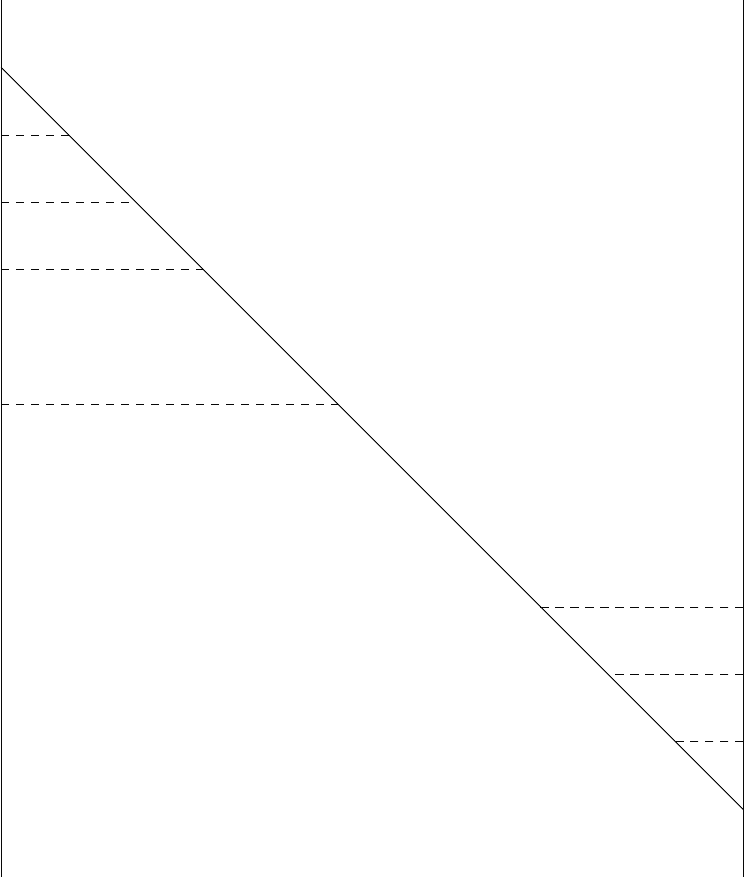
By way of example, consider the transport of an electron between two boundaries as depicted
in figure 17.1. For the sake of argument, each transport step (between either the x’s and
o’s has a distance
√
2 and the transport trajectory is directly diagonal between the two
boundaries. For simplicity, we neglect scattering in this example. When the geometry
routines are interrogated, the start of the step is delineated by an x. When the geometry
routines can be skipped, the start of the step is delineated by an o.
This is the way the algorithm works. The closest distance to any boundary is usually
calculated in EGS4 by SUBROUTINE HOWFAR. This distance is called DNEAR and it is calculated
before the particle is transported. (In EGS4/PRESTA, it is calculated before the call to
SUBROUTINE HOWFAR.) After transport by distance VSTEP in the case of electrons or USTEP
in the case of photons, DNEAR is decremented by VSTEP or USTEP. On the subsequent step,
if the next USTEP is less than DNEAR then is is known that the step will not cause the
particle to escape the current region and so the call to SUBROUTINE HOWFAR is avoided. (The
EGS4/PRESTA scheme is slightly more efficient since it employs a more current version of
DNEAR. However, it also calculates DNEAR for every electron step.)
278 CHAPTER 17. VARIANCE REDUCTION TECHNIQUES
x
x
x
x
x
o
o
x
start
x
o
x
1
2
3
5
Boundary
Boundary
3
2
1
end
Figure 17.1: An electron is transported between two boundaries. The geometry routines are
called only when required.
17.1. ELECTRON-SPECIFIC METHODS 279
There is no approximation involved in this technique. The gain in transport efficiency is
slightly offset by the extra calculation time that is spent calculating the distance to the closest
boundary. (This parameter is not always needed for other aspects of the particle transport.)
As an example, consider the case of a pencil beam of 1 MeV electrons incident normally
on a 0.3 cm slab of carbon divided into twelve 0.025 cm slabs. For this set of simulations,
transport and secondary particle creation thresholds were set at 10 keV kinetic energy and
we used EGS4 [NHR85] setting the energy loss per electron step at 1% for accurate electron
transport [Rog84b] at low energies. The case that interrogates the geometry routines on
every step is called the “base case”. We invoke the trick of interrogating the geometry
routines only when needed and call this the “RIG” (reduced interrogation of geometry) case.
The efficiency ratio, (RIG)/(base), was found to be 1.34, a significant improvement. (This
was done by calculating DNEAR in the HOWFAR routine of a planar geometry code. A
discussion of DNEAR is given on pages 256–258 of the EGS4 manual [NHR85].)
Strictly speaking, this technique may be used for photons as well. For most practical prob-
lems, however, the mean free path for the photons in the problem is of the order, or greater
than the distance between boundaries. For deep penetration problems or similar problems,
this may not be true. However, this technique is usually more effective at speeding up the
electron transport part of the simulation.
The extra time required to calculate the distance to the closest boundary may be consid-
erable, especially for simulations involving curved surfaces. If this is so then the efficiency
gain may be much less or efficiency may be lost. It is advisable to test this technique before
employing it in “production” runs.
17.1.2 Discard within a zone
In the previous example, we may be just interested in the energy deposited in the planar
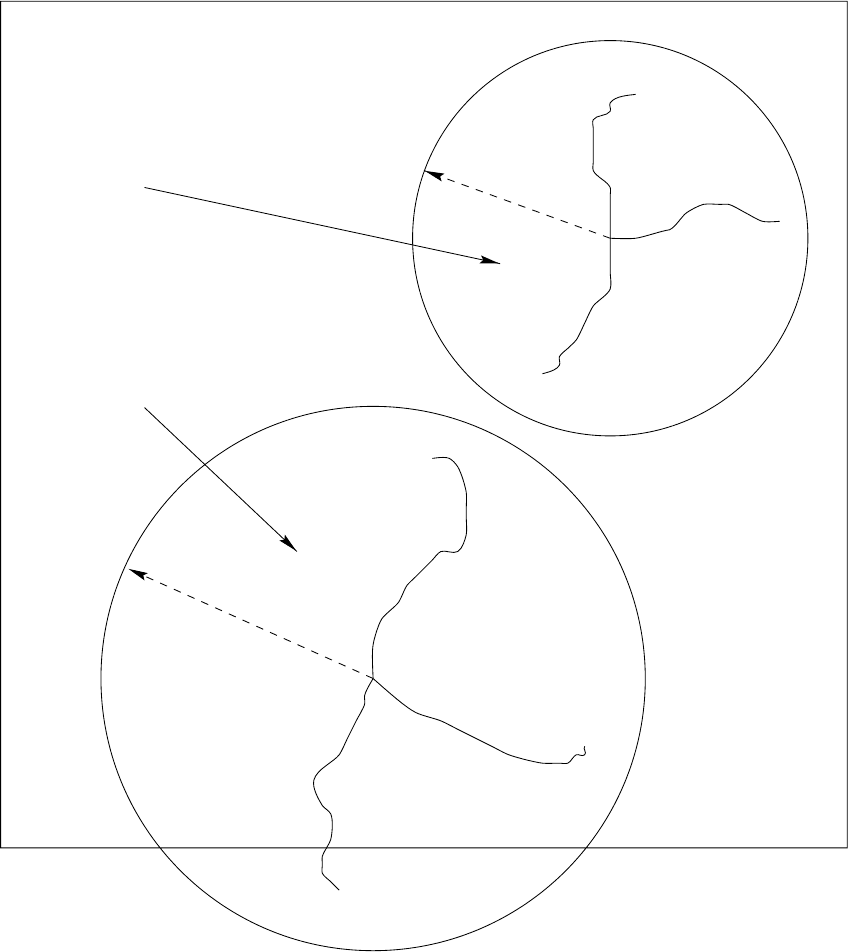
zones of the carbon slab. We may, therefore, deposit the energy of an electron entirely within
a zone if that electron’s range is less than the distance to any bounding surface of the zone in
which it is being transported. A depiction of this process can be seen in figure 17.2. We note
that we make an approximation in doing this—we neglect the creation and transport of any
bremsstrahlung γ’s that may otherwise created. For the worst possible case in this particular
example, we will be discarding electrons that have a range that is half of the zone thickness,
i.e. having a kinetic energy of about 110 keV. The radiative yield of these electrons is only
about 0.07%. Therefore, unless we are directly interested in the radiative component of the
electron’s slowing down process in this problem, the approximation is an excellent one. For
the above example, we realise a gain in the efficiency ratio, (zonal discard + RIG)/(base),
of about 2.3. In this case, the transport cut-off, below which no electron was transported,
was 10 keV. If we had used a higher cut-off the efficiency gain would have been less.
Before adopting this technique, the user should carefully analyze the consequences of the
approximation—the neglect of bremsstrahlung from the low energy electron component.
280 CHAPTER 17. VARIANCE REDUCTION TECHNIQUES
R(E)
R(E)
no electron
can escape
electrons
can
escape
the zone
zonal boundary
Figure 17.2: A depiction of electron zonal discard.