
Bielajew A.F. Fundamentals of the Monte Carlo method for neutral and charged particle transport
Подождите немного. Документ загружается.

17.3. GENERAL METHODS 291
where ξ is a random number chosen uniformly over the range, 0 <ξ≤ 1.
In the case C → 0, eqs. 17.13–17.15 reduce to the equations of simple interaction forcing given
in sec. 17.2.1. In the case Λ →∞, eqs. 17.13–17.15 reduce to the equations of exponential
transform given in the previous section. However, the equations of this section permit any
value of C to be used irrespective of the photon’s direction as long as the geometry is finite,
i.e. 0 < Λ < ∞. In particular, the strong surface biasing, C<−1 need not be restricted
to forward directed photons (µ>0), and penetration problems may use C>1. This latter
choice actually causes the interaction probability to increase with depth for forward directed
photons! Again, as in the previous section, the same comments about particle splitting,
russian roulette, and weight windowing apply.
17.3 General methods
17.3.1 Secondary particle enhancement
In some applications, one wishes to study the behaviour of secondary particles in an en-
ergy regime where they are highly suppressed. For example, X-rays from diagnostic X-
ray tubes arise from bremsstrahlung radiation. The bremsstrahlung cross section is much
smaller than the Møller cross section in the diagnostic regime (≈70 keV). So, calculating
the bremsstrahlung characteristics by Monte Carlo method can be difficult since most of the
effort is spent creating knock-on electrons. Another example would be the calculation of the
effect of pair production in low-Z materials in the radiotherapy regime, below 50 MeV.
One approach is to enhance the number of these secondary particles by creating many of
them, say N, once an interaction takes place and then giving them all a weight of 1/N to
keep the game “fair”. Once the interaction occurs, the secondary energy and directional
probabilities can be sampled to produce distributions in energy and angle of the secondary
particles emanating from a single interaction point. This method is more sophisticated than
“splitting” where N identical particles are produced.
It is important that the stochastic nature of the primary particle be preserved. For this
reason, the energy deducted from the primary particle is not the average of the secondary
particles produced. The proper “straggling” is guaranteed by subtracting the entire energy of
one of the secondary particles. This has the minor disadvantage that energy conservation is
violated for the incident particle history that produces the “spray” of secondaries. However,
over many histories and many interactions, energy conservation is preserved in an average
sense.
The details of the implementation this method for the bremsstrahlung interaction in the
EGS4 code is documented elsewhere [BMC89]. Examples of the use of this method in the
radiotherapy regime [FRR90] and the diagnostic regime [NNS
+
90] have been published.
292 CHAPTER 17. VARIANCE REDUCTION TECHNIQUES
17.3.2 Sectioned problems, use of pre-computed results
One approach to saving computer time is to split the problem into separate, manageable parts
using the results of a previous Monte Carlo simulations as part of another simulation. These
applications tend to be very specialised and unique problems demand unique approaches.
For illustration, we shall present two related examples.
Fluence to dose conversion factors for monoenergetic, infinitely broad electron and photon
beams incident normally on semi-infinite slabs of tissue and water have been calculated
previously [RB85, Rog84a]. These factors, called K
E
(z), vary with depth, z, and on the
energy of the photon beam, E, at the water surface. Dose due to an arbitrary incident
spectrum as a function of depth, D(z), is calculated from the following relation:
D(z)=
Z
E
max
E
min
Φ(E)K
E
(z)dE, (17.16)
where Φ(E) is the electron or photon fluence spectrum and it is non-zero between the limits
of E
min
and E
max
. Each K
E
array represents a long calculation. If one uses these pre-
calculated factors, one can expect orders of magnitude gains in efficiency. If one is interested
in normally incident broad beams only, the calculated results should be quite accurate.
The only approximations arise from the numerical integration represented by eq. 17.16 and
associated interpolation errors. However, there are two important assumptions buried in
the K
E
’s—the incident beams are broad and incident normally. For photons, using narrow
beams in this method can cause 10% to 50% overestimates of the peak dose. For narrow
electron beams this method is not recommended at all.
Another example is the study of the effects of scatter in a
60
Co therapy unit [REBvD88]. For
the purpose of modeling the therapy unit in a reasonable amount of computing time, it was
divided into two parts. First, the source capsule itself was modeled accurately and the phase
space parameters (energy, direction, position) of those particles leaving the source capsule
and entering the collimator system were stored. About 2 × 10
6
particles were stored in this
fashion taking about 24 hrs of VAX 11/780 CPU time for executing the simulation. This
data was then used repeatedly in modeling the transport of particles through the collimators
and filters of the therapy head. The approximation inherent in this stage of the calculation is
the interaction between the source capsule and the rest of the therapy head. However, since
the capsule is small with respect to the therapy head and we are interested in calculating the
effects of the radiation somewhat downstream from the therapy head, the approximation is
an excellent one. Another aspect of this calculation was that the effect of the contaminant
electrons downstream from the therapy head was studied. Again, this part of the calculation
was “split off” and done by the method described previously. That is, eq. 17.16 was used to
calculate the depth-dose profiles in tissue.
By splitting the problem into 3 parts, the total amount of CPU time used to simulate the
60
Co therapy head [REBvD88] required 5–16 hours of CPU time for each geometry. If
we had attempted to simulate the problem entirely without “dividing and conquering”, the

17.3. GENERAL METHODS 293
amount of CPU time required would have been prohibitive.
17.3.3 Geometry equivalence theorem
A special but important subset of Monte Carlo calculations is normal beam incidence on
semi-infinite geometries, with or without infinite planar inhomogeneities. The use of a simple
theorem, called the “geometry equivalence” or “reciprocity” theorem, provides an elegant
technique for calculating some results more quickly. First we prove the theorem.
Imagine that we have a zero radius beam coincident with the z-axis impinging on the geome-
try described above. We “measure” a response that must have the form f(z, |ρ|), where ρ is
the cylindrical radius. This functional form holds true since there is no preferred azimuthal
direction in the problem. If the beam is now shifted off the axis by an amount ρ ,then
the new functional form of the response must have the form, f(z, |ρ −ρ |), by translational
symmetry. Finally, consider that we have a finite circular beam of radius ρ
b
and we wish
to integrate the response over a finite-size detection region with circular radius ρ
d
.This
integrated response has the form,
F (z, ρ
b
,ρ
d
)=
Z
|ρ |≤ρ
b
dρ
0
Z
|ρ|≤ρ
d
dρ f(z,|ρ − ρ |), (17.17)
where
R
|ρ|≤ρ
d
dρ is shorthand for
R
2π
0
dφ
R
ρ
d
0
dρ. If we exchange integration indices in eq. 17.17,
then we obtain the reciprocity relationship,
F (z, ρ
b
,ρ
d
)=F (z,ρ
d
,ρ
b
). (17.18)
What eq. 17.18 means is the following: If we have a circular beam of radius ρ
b
and a circular
detection region of radius ρ
d
, then the response we calculate is the same if we had a circular
beam of radius ρ
b
and a circular detection region of radius ρ
d
! The gain in efficiency comes
when we wish to calculate the response of a small detector in a large area beam. If one does
the calculation directly, then much computer time is squandered tracking particles that may
never reach the detector. By using the reciprocity theorem one calculates the same quantity
faster.
In an extreme form the reciprocity theorem takes the form [ICR84],
lim
→0
F (z, ρ
b
,) = lim
→0
F (z, , ρ
b
), (17.19)
which allows one to calculate the “central axis” depth-dose for a finite radius beam by scoring
the dose in a finite region from a zero-area beam. The gain in efficiency in this case is infinite!
The radius, ρ
b
, can even be infinite to simulate a broad beam.
A few remarks about the reciprocity theorem and it’s derivation should be made. If the
response function, f (z, |ρ|), has a finite lateral extent, then the restriction that the geometry

294 CHAPTER 17. VARIANCE REDUCTION TECHNIQUES
should be semi-infinite may be relaxed as long as the geometry, including the inhomogeneous
slabs, is big enough to contain all of the incident beam once the detection region radius
and the beam radius are exchanged. Unfortunately, electron-photon beams always produce
infinitely wide response functions owing to radiation scatter and bremsstrahlung photon
creation. In practice, however, the lateral tails often contribute so little that simulation (and
experiments!) in finite geometries is useful. Also, in the above development it was assumed
that the detection region was infinitely thin. This is not a necessary approximation but this
detail was omitted for clarity. The interested reader is encouraged to repeat the derivation
with a detection region of finite extent. The derivation proceeds in the same manner but
with more cumbersome equations.
17.3.4 Use of geometry symmetry
In the previous section, we saw that the use of some of the inherent symmetry of the geometry
realised considerable increase in efficiency. Some uses of symmetry are more obvious, for
example, the use of cylindrical-planar or spherical-conical simulation geometries if both the
source and target configurations contain these symmetries. Other uses of symmetry are less
obvious but still important. These applications involve the use of reflecting planes to mimic
some of the inherent symmetry.
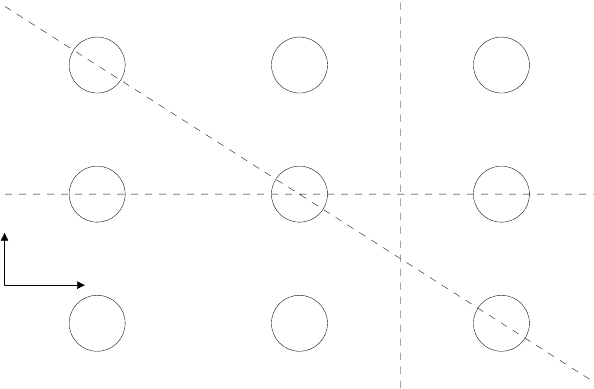
For example, consider the geometry depicted in fig. 17.7. In this case, an infinite square
lattice of cylinders is irradiated uniformly from the top. The cylinders are all uniform and
aligned. How should one approach this problem? Clearly, one can not model an infinite array
of cylinders. If one tried, one would have to pick a finite set and decide somehow that it was
big enough. Instead, it is much more efficient to exploit the symmetry of the problem. It
turns out that in this instance, one needs to transport particles in only 1/8’th of a cylinder!
To see this we find the symmetries in this problem. In fig. 17.7 we have drawn three planes
of symmetry in the problem, planes a, b,andc
5
. There is reflection symmetry for each of
these planes. Therefore, to mimic the infinite lattice, any particles that strike these reflecting
planes should be reflected. One only needs to transport particles in the region bounded by
the reflecting planes. Because of the highly symmetric nature of the problem, we only need
to perform the simulation in a portion of the cylinder and the “response” functions for the
rest of the lattice is found by reflection.
The rule for particle reflection about a plane of arbitrary orientation is easy to derive. Let
~
u
be the unit direction vector of a particle and
~
n be the unit direction normal of the reflecting
plane. Now divide the particle’s direction vector into two portions,
~
u
k
, parallel to
~
n,and
~
u
⊥
,
perpendicular to
~
n. The parallel part gets reflected,
~
u
0
k
= −
~
u
k
, and the perpendicular part
remains unchanged,
~
u
0
⊥
=
~
u
⊥
. That is, the new direction vector is
~
u
0
= −
~
u
k
+
~
u
⊥
. Another
5
Note that this symmetry applies only to a square lattice, where the spacing is the same for the x and
y-axes. For a rectangular symmetry, the planes of reflection would be somewhat different. There would be
no plane c as for the square lattice in fig. 17.7.
17.3. GENERAL METHODS 295
−1.5 −0.5 0.5 1.5
−1.5
−0.5
0.5
1.5
−1.5 −0.5 0.5 1.5
−1.5
−0.5
0.5
1.5
.
.
.
. . .
. . .
a
.
.
.
b
c
x
y
z
Figure 17.7: Top end view of an infinite square lattice of cylinders. Three planes of symmetry
are drawn, a, b,andc. A complete simulation of the entire lattice may be performed by
restricting the transport to the interior of the three planes. When a particle strikes a plane
it is reflected back in, thereby mimicking the symmetry associated with this plane.
296 CHAPTER 17. VARIANCE REDUCTION TECHNIQUES
way of writing this is,
~
u
0
=
~
u − 2(
~
u ·
~
n)
~
n. (17.20)
Applying eq. 17.20 to the problem in fig. 17.7, we have: For reflection at plane a,(u
0
x
,u
0
y
,u
0
z
)=
(−u
x
,u
y
,u
z
). For reflection at plane b,(u
0
x
,u
0
y
,u
0
z
)=(u
x
, −u
y
,u
z
). For reflection at plane
c,(u
0
x
,u
0
y
,u
0
z
)=(−u
y
, −u
x
,u
z
). The use of this reflection technique can result in great gains
in efficiency. Most practical problems will not enjoy such a great amount of symmetry but
one is encouraged to make use of any available symmetry. The saving in computing time is
well worth the extra care and coding.
Bibliography
[Bie89] A. F. Bielajew. Electron Transport in
~
E and
~
B Fields. In T.M. Jenkins,
W.R. Nelson, A. Rindi, A.E. Nahum, and D.W.O. Rogers, editors, Monte Carlo
Transport of Electrons and Photons, pages 421 – 434. Plenum Press, New York,
1989.
[BMC89] A. F. Bielajew, R. Mohan, and C. S. Chui. Improved bremsstrahlung pho-
ton angular sampling in the EGS4 code system. National Research Council of
Canada Report PIRS-0203, 1989.
[BR87] A. F. Bielajew and D. W. O. Rogers. PRESTA: The Parameter Reduced
Electron-Step Transport Algorithm for electron Monte Carlo transport. Nuclear
Instruments and Methods, B18:165 – 181, 1987.
[BRN85] A. F. Bielajew, D. W. O. Rogers, and A. E. Nahum. Monte Carlo simulation
of ion chamber response to
60
Co – Resolution of anomalies associated with
interfaces,. Phys. Med. Biol., 30:419 – 428, 1985.
[Car81] G. A. Carlsson. Effective Use of Monte Carlo Methods. Report ULi-RAD-R-
049, Department of Radiology, Link¨oping University, Link¨oping, Sweden, 1981.
[Fel67] W. Feller. An introduction to probability theory and its applications, Volume I,
3rd Edition. Wiley, New York, 1967.
[FRR90] B. A. Faddegon, C. K. Ross, and D. W. O. Rogers. Forward directed
bremsstrahlung of 10 – 30 MeV electrons incident on thick targets of Al and
Pb. Medical Physics, 17:773 – 785, 1990.
[HB85] J. S. Hendricks and T. E. Booth. Monte-Carlo Methods and Applications
in Neutronics, Photonics and Statistical Physics. (R Alcouffe, R Dautray,
A Forster, G Ledanois, and B Mercier eds.), page 83, 1985.
[HH64] J. M. Hammersley and D. C. Handscomb. Monte Carlo Methods. (John Wiley
and Sons, New York), 1964.
297
298 BIBLIOGRAPHY
[ICR84] ICRU. Radiation Dosimetry: Electron beams with energies between 1 and 50
MeV. ICRU Report 35, ICRU, Washington D.C., 1984.
[Kah56] H. Kahn. Use of different Monte Carlo sampling techniques. in Symposium
on Monte Carlo Methods, (H.A. Meyer ed.) (John Wiley and Sons, New York),
pages 146 – 190, 1956.
[Lun81] T. Lund. An Introduction to the Monte Carlo Method. Report HS-RP/067,
CERN, Geneva, 1981.
[MI75] E. J. McGrath and D. C. Irving. Techniques for Efficient Monte Carlo Simula-
tion, Vols. I, II, and III. Report ORNL-RSIC-38, Radiation Shielding Informa-
tion Center, Oak Ridge National Laboratory, Oak Ridge, Tennessee, 1975.
[NHR85] W. R. Nelson, H. Hirayama, and D. W. O. Rogers. The EGS4 Code System.
Report SLAC–265, Stanford Linear Accelerator Center, Stanford, Calif, 1985.
[NNS
+
90] Y.Namito,W.R.Nelson,S.M.Seltzer,A.F.Bielajew,andD.W.O.Rogers.
Low-energy x-ray production studies using the EGS4 code system . Med. Phys.
(abstract), 17:557, 1990.
[RB84] D. W. O. Rogers and A. F. Bielajew. The use of EGS for Monte Carlo calcu-
lations in medical physics. Report PXNR-2692, National Research Council of
Canada, (Ottawa, Canada K1A 0R6), 1984.
[RB85] D. W. O. Rogers and A. F. Bielajew. Calculated buildup curves for photons
with energies up to
60
Co . Med. Phys., 12:738 – 744, 1985.
[REBvD88] D. W. O. Rogers, G. M Ewart, A. F. Bielajew, and G. van Dyk. Calculation of
Electron Contamination in a
60
Co Therapy Beam. In “Proceedings of the IAEA
International Symposium on Dosimetry in Radiotherapy” (IAEA, Vienna), Vol
1, pages 303 – 312, 1988.
[Rog84a] D. W. O. Rogers. Fluence to Dose Equivalent Conversion Factors Calculated
with EGS3 for Electrons from 100 keV to 20 GeV and Photons from 20 keV to
20 GeV. Health Physics, 46:891 – 914, 1984.
[Rog84b] D. W. O. Rogers. Low energy electron transport with EGS. Nucl. Inst. Meth.,
227:535 – 548, 1984.
Problems
1.

Chapter 18
Code Library
This distribution resides on AFS in ˜bielajew/Public/NE590.
Conventions:
Subroutine and code names are written in teletype font.
The subroutines are distributed as combined Fortran77 source files. They are known to
compile error-free on SunOS and Linux unix machines.
299

300 CHAPTER 18. CODE LIBRARY
18.1 Utility/General
Readme
A general “readme” file, an ASCII condensation of this chapter.