
Boults Е. Illustrated history of landscape design
Подождите немного. Документ загружается.


ix
T
his work would not be possible without the signifi cant contributions of Tim Mollette–Parks.
His input was critical throughout the entire project. Tim provided invaluable assistance in
visualizing a poetic format that married word and image, and offered insightful comments on
the text. His research on current work formed the basis of the fi nal chapter.
A residency at the MacDowell Colony was absolutely essential to our completion of the manuscript.
We very much appreciated the opportunity to work without distraction in a truly creative and inspir-
ing environment.
Heartfelt thanks are due to professors Randy Hester, Joe McBride, and Marc Treib for their belief
in our approach. We are indebted to Marc for his comments on the Japanese garden sections. We
thank, too, Elizabeth Byrne and her staff at the College of Environmental Design library, who helped
direct us to important sources within the extraordinary collection.
Elizabeth’s gratitude extends to Professor Heath Schenker, for fi rst giving her the opportunity to
teach landscape architecture history at the University of California, Davis; to Gerrie Robinson,
whose commitment to teaching is admirable and whose moral support was constant; to her stu-
dents, who enthusiastically embraced her approach to the subject; and to Pamela Cunningham, for
expert wordsmithing. In addition, Elizabeth would like to acknowledge John Furlong, former director
of the Radcliffe Seminars Landscape Design program, whose inspired teaching was instrumental in
helping her discover her passion for landscape architecture.
Chip would like to thank the Department of Landscape Architecture and Environmental Planning
at the University of California, Berkeley, for nurturing a place for creative expression; his students,
who encourage and enrich his visual experimentations; and James Natalie, who provided valuable
assistance at a crucial juncture. Additionally, the Beatrix Farrand Research Fund provided impor-
tant research support for this project. Chip is also extremely thankful to Bill Thomson for publishing
his comic strips in Landscape Architecture magazine, which set the gears in motion for this work.
Finally, he would like to thank all the original artists of Mad magazine, who opened the door to a
drawing life.
Acknowledgments

xi
T
he constructed landscape embodies a vision of creative power. The gardens and landscapes
of the past serve as an endless source of possibility and inspiration. Discovering how the ele-
ments of nature have been recombined in different times and places intrigues us. Our purpose
in assembling a visual reference of historic landscapes is to provide to the reader a useful guide
that captures our exuberance for landscape design.
We examine landscape history as designers, and through the language of design, which is draw-
ing. Plans, sections, elevations, and perspectives are all useful in communicating form and spatial
relationships. To this vocabulary we’ve added sequential drawings, to capture the dynamic experience
of space.
As an art form, a designed landscape is a cultural product, representing the ideals and values of its
creator, owner, or patron, and situated within a unique social, economic, and political environment.
Studying landscape history can inspire contemporary designers, and help them position their work
in relationship to present circumstances. Precedents can be rejected or translated into current idi-
oms. Our experience in leading summer study-abroad programs has taught us the value of fi rsthand
experience of historic sites. Observation and analysis (accomplished through drawing) can inform
the design process and elevate the quality of one’s work.
Our approach to the material outlined in this book is unique in its design focus, chronological orga-
nization, and visual orientation. Presenting landscape history chronologically enables the reader to
make cross-cultural connections and to understand how common themes may manifest themselves
at different times, and to appreciate design trends that are truly unique. The idea for the graphic
format originated with Chip’s “creative learning” comic series in Landscape Architecture magazine.
Visual media dominates culture today. Images transmit ideas. We hope the pen-and-ink illustra-
tions in this book provide an overview of landscape history and encourage people to investigate the
landscape through the act of drawing.
The content of the book is organized by century. Each section begins with a pictograph—an
idea-drawing that illustrates the important concepts of the time period—followed by an illustra-
tive timeline of some signifi cant events in world history. These provide a broad context in which to
examine specifi c works. Representative examples of gardens and designed landscapes are grouped
according to geographic region. Spaces are portrayed through the use of storyboards, case stud-
ies, and visual narratives. Sections conclude with summaries of design concepts, principles, and
vocabularies, as well as lists of “neat stuff”—historic and contemporary works of art that illumi-
nate a specifi c era. The fi rst and last chapters depart from this format and are designed as visual
chronologies—embellished timelines organized thematically.
Built landscapes tell stories; a picture is worth a thousand words. Our goal is to take the reader on
a visual romp through the great garden spaces of the past. We hope our work inspires the reader to
further explore the landscape and discover his or her own story.
Introduction
1
E
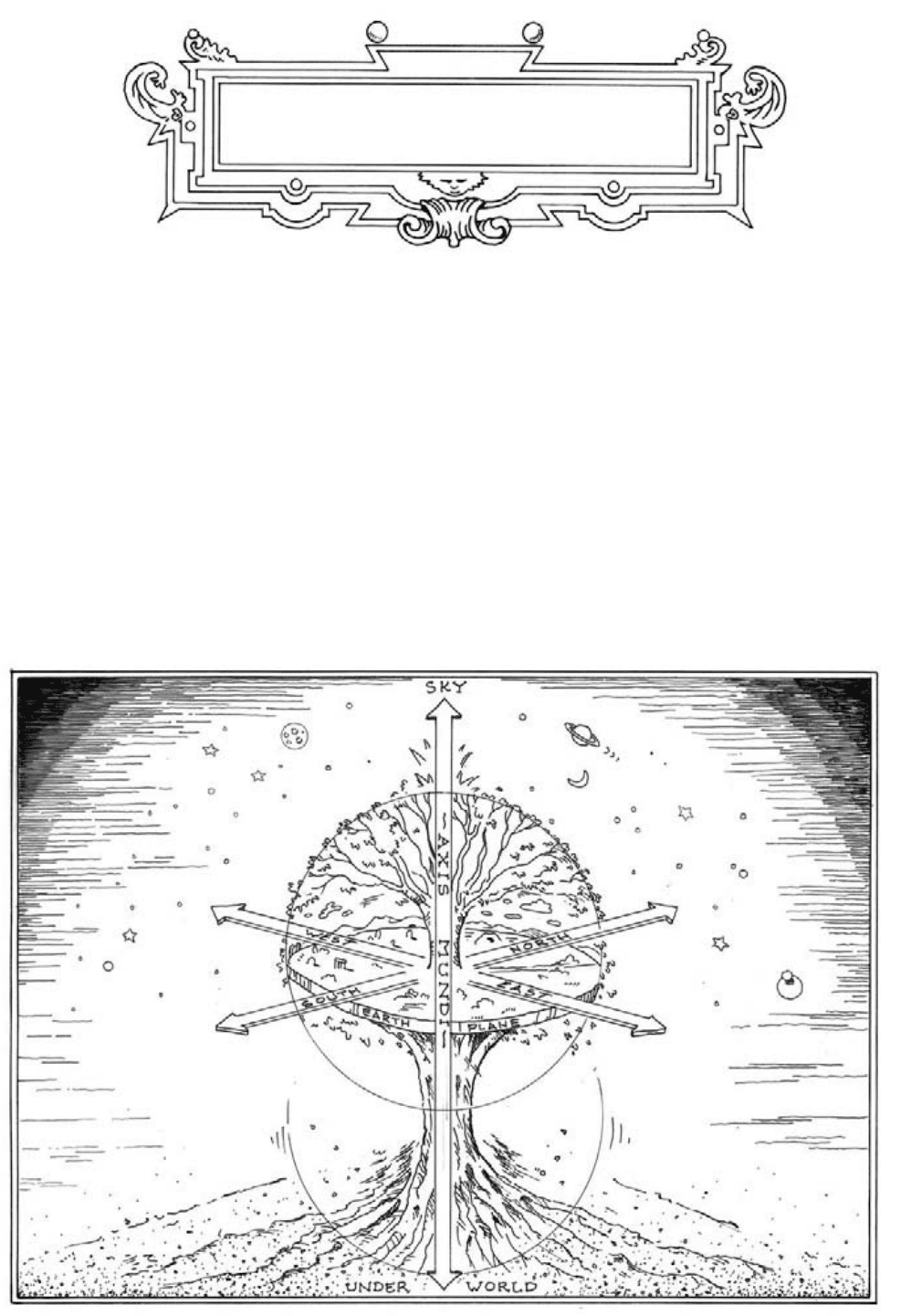
arly cultures attempted to re-create or express in their built landscapes the sacred meanings and spiritual
signifi cance of natural sites and phenomena. People altered the landscape to try to understand and/or honor the
mysteries of nature. Early “landscape design” elaborated on humankind’s intuitive impulse to dig and to mound.
Our ancestors constructed earthworks, raised stones, and marked the ground, leaving traces of basic shapes and
axial alignments. The purpose or function of many of these spaces is still conjecture.
Cultural values shifted in later antiquity with the advent of philosophical systems based on a human being’s capacity
for deductive reasoning. People looked for rational explanations for nature’s mysteries. The ancient Greeks respected
nature as the sanctuary of the Gods, but equally valued the human domain. Their focus on the role of the individual in
relationship to the larger community fostered democratic ideals that were revealed in architecture, in urban form, and
in the consideration of the landscape as a place of civic responsibility.
The illustrative chronology presented in this chapter is organized thematically, as follows:
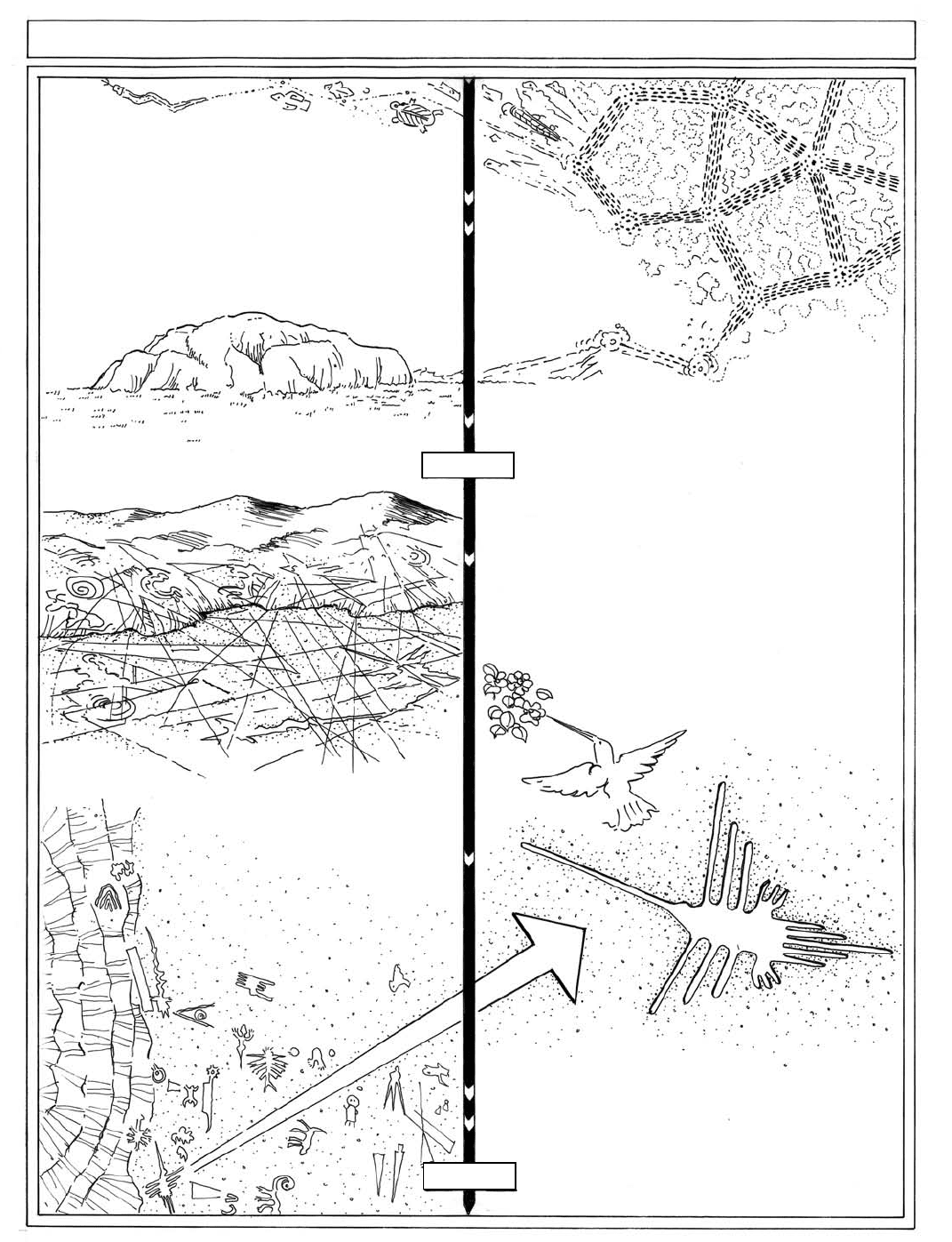
• Cosmological Landscapes characterizes prehistoric earthworks and patterns.
• Ancient Gardens describes early parks and villas.
• Landscape and Architecture illustrates temple grounds, buildings, and important site plans.
G i L i d i d l d
PREHISTORY TO 6th CENTURY
2
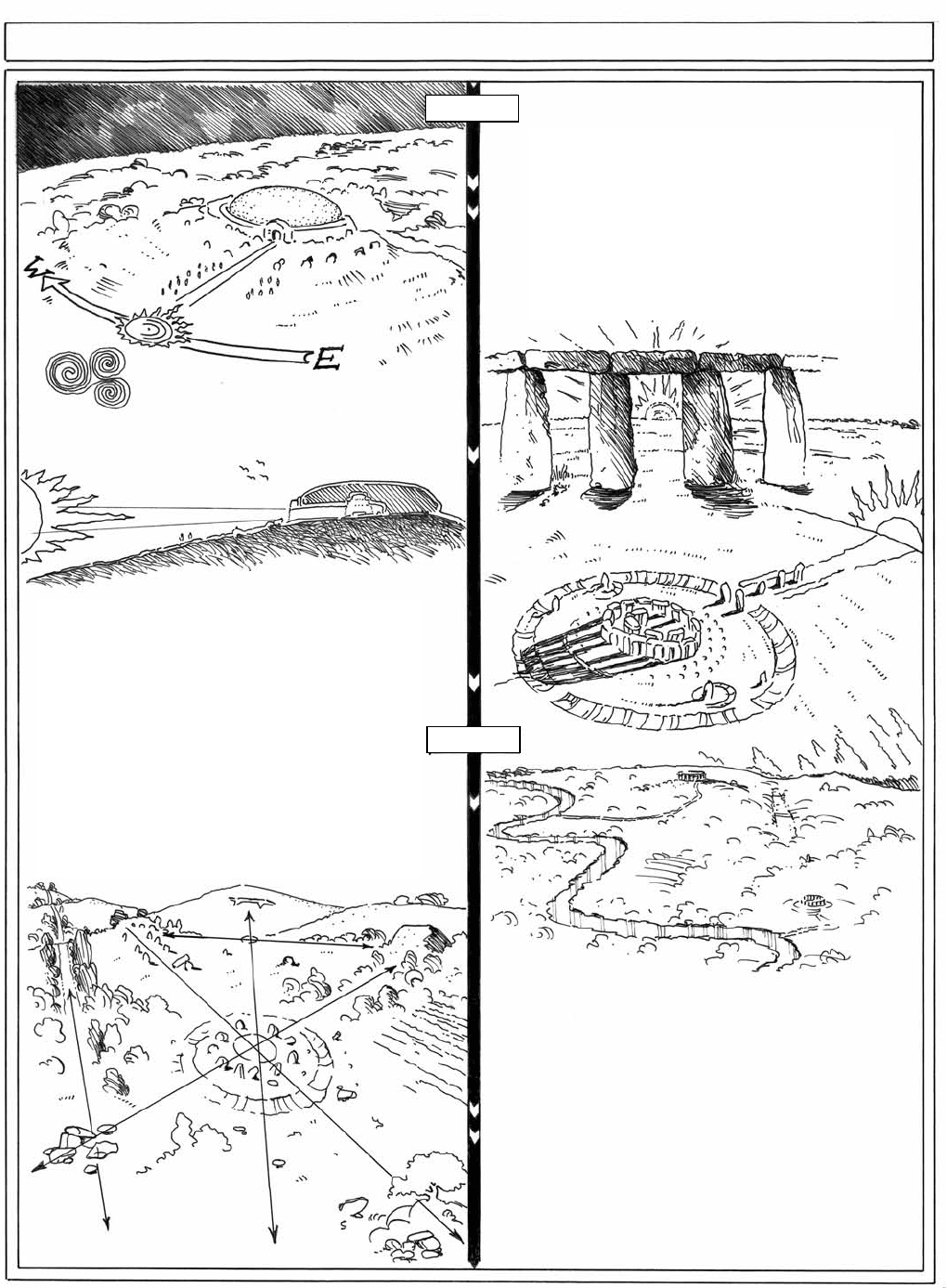
c. 3200 BCE
NEW GRANGE, IRELAND
The circular passage tomb at New Grange is over 250
feet wide and contains three recessed chambers. On
the winter solstice, the sun rises through a clerestory
above the entryway, illuminating the central chamber.
A curbstone carved with triple-spiral motifs marks
the entryway.
2950 BCE–1600 BCE
STONEHENGE, ENGLAND
Built by different groups of people at different times,
this particular site on the Salisbury plain in southwest
England evolved from an earthen embankment, to a
wooden structure, to the stone circles we recognize to-
day. A circular ditch and bank (or “henge”), about 330
feet in diameter, marked the fi rst phase of construc-
tion. Extant postholes within the circle indicate the
position of a wooden structure from about 2600 BCE.
The standing stones date from subsequent centuries.
All the shapes open to the northeast, framing sunrise
on the summer solstice.
Woodhenge, located about 2 miles from Stonehenge,
was a timber circle of roughly the same diameter that
marked a burial site dating from the Neolithic era. Sunrise
on the summer solstice aligned with its entryway.
LEY LINES, ENGLAND
Some people believe that Great Britain and continental
Europe are marked with a network of straight lines that
connect geographic features and sacred sites through
underlying paths of energy within the earth.
3500 BCE
2000 BCE
3
200 BCE
600 BCE
4
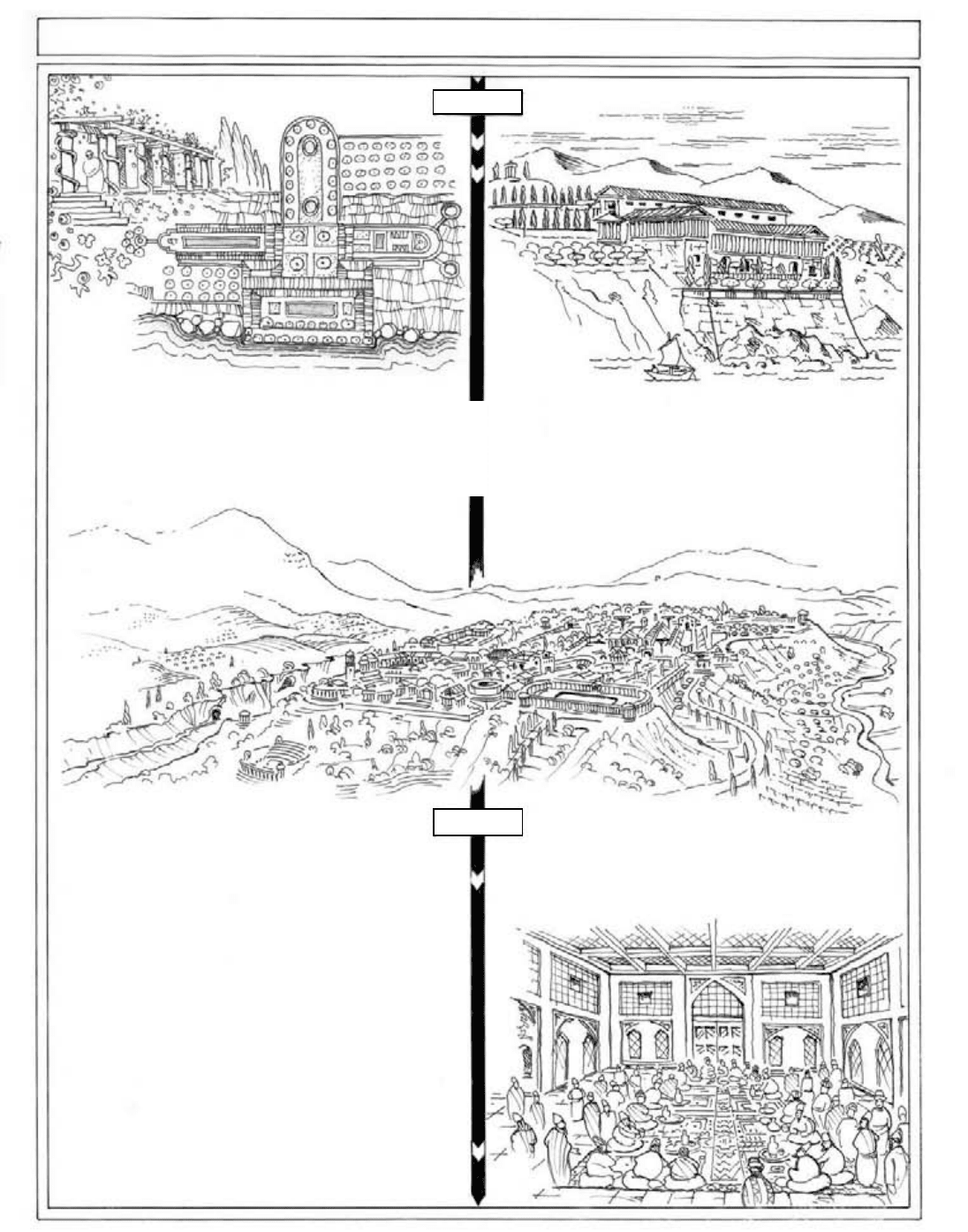
ANCIENT GARDENS
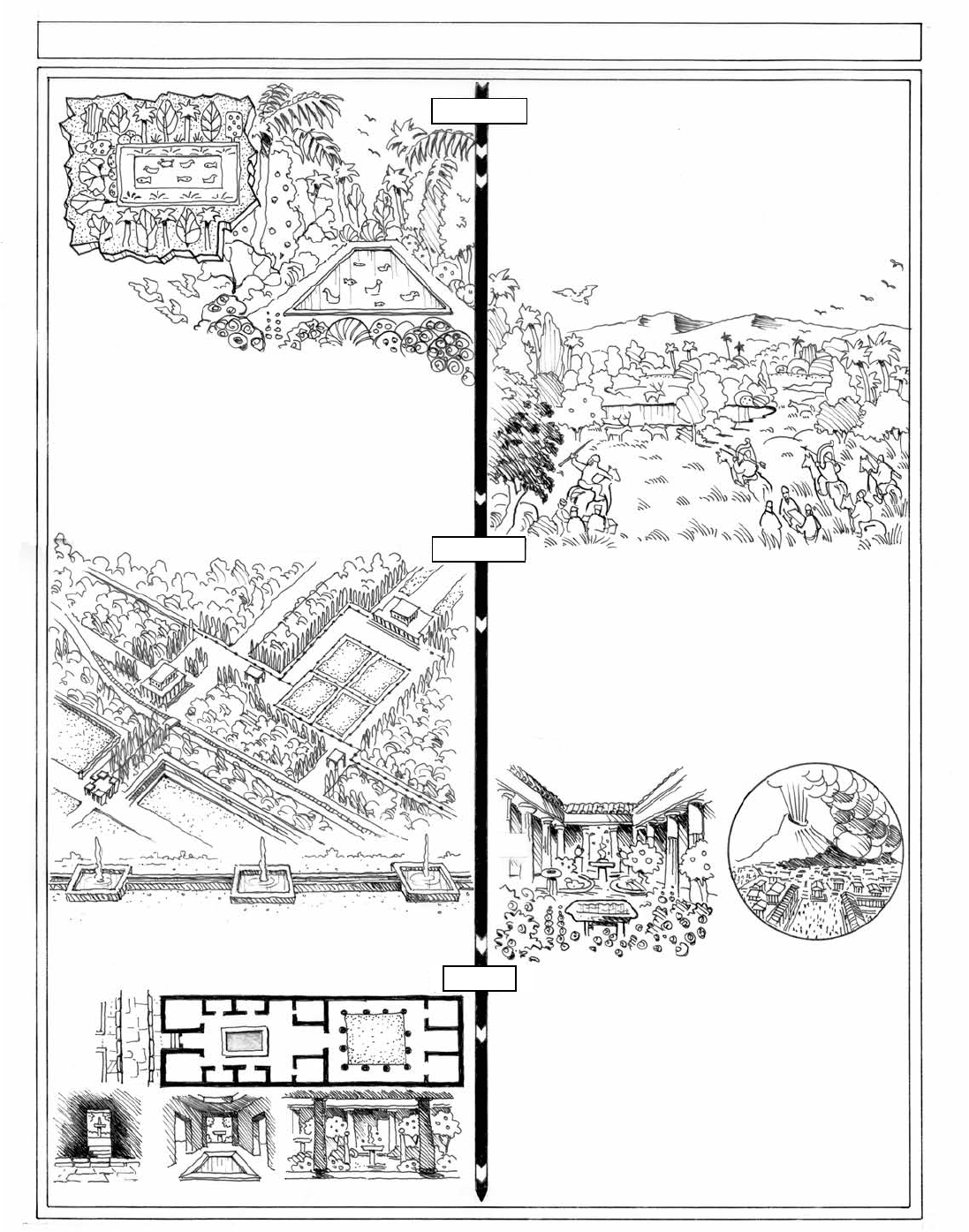
1380 BCE
TOMB OF NEBAMUN, THEBES
The gardens depicted on the walls of wealthy
Egyptian offi cials are an important primary
source of information about the ancient Egyptian
landscape. Shown here is an ordered arrangement
of specifi c plants around a rectangular basin
stocked with fi sh.
2500 BCE–612 BCE
MESOPOTAMIAN HUNTING PARKS
Written accounts describe the large enclosed parks of
the Sumerians, Babylonians, and Assyrians as being
stocked with exotic plants and animals—evidence of early
management of the landscape. The Epic of Gilgamesh
described the ancient Sumerian city of Uruk as being
composed of equal parts city, garden, and fi eld.
2
546 BCE
PASARGADAE, PERSIA
The imperial capital of Cyrus the Great was described
by ancient Greeks and Romans as having a geometric
division of space defi ned by water and trees, an early
example of the four-square pattern later associated
with “paradise” gardens. Existing ruins show the close
relationship of buildings and gardens and the decorative
use of water. Gardens provided visual and climatic
comfort, not spaces for active use.
3
c. 79 CE
HOUSE OF THE VETTII, POMPEII
The former Greek colony of Pompeii was a popular
resort town for wealthy Romans. Forms of 1st-century
architecture and landscape were preserved under layers
of ash and debris from the eruption of Mt. Vesuvius in
79 CE. A typical Roman town house contained a paved
atrium and a garden court surrounded by a roofed
colonnade, or peristyle. Garden scenes painted on the
walls of the peristyle garden visually extended the space.
500 BCE
1500 BCE
50 CE
5
ANCIENT GARDENS
c. 540 CE
SPRING OF KHOSROW CARPET (IRAQ)
Woven with gold and precious stones, the carpet made
for the audience hall in King Khosrow’s imperial palace
near Baghdad was over 450 feet long. Depicting a lushly
planted garden of rectangular beds divided by paths and
watercourses, the carpet, which survives only through
written accounts, symbolized an Eden-like paradise in a
harsh desert environment.
118 CE
HADRIAN’S VILLA, TIVOLI, ITALY
Located 15 miles east of Rome in the foothills of the
Sabine mountains, the complex of structures and
decorative elements that comprise the imperial villa
of Hadrian refl ect the emperor’s fascination with
architecture and his love of Classical culture. Today,
ruins cover about 150 acres, or half of what scholars
have estimated as the full extent of the villa.
4
c. 100 CE
PLINY’S SEASIDE VILLA, NEAR ROME
In his numerous letters, Pliny the Younger (61–112 CE) recorded many aspects of his life and times, including detailed
descriptions of his country houses and their relationship to the landscape. He planned the rooms of his villa marittima
according to their functional and climatic requirements, and to take advantage of views. The architectural form of Pliny’s
villa, as well as its function as a place of escape from urban responsibility, particularly inspired Renaissance designers.
100 CE
500 CE
6
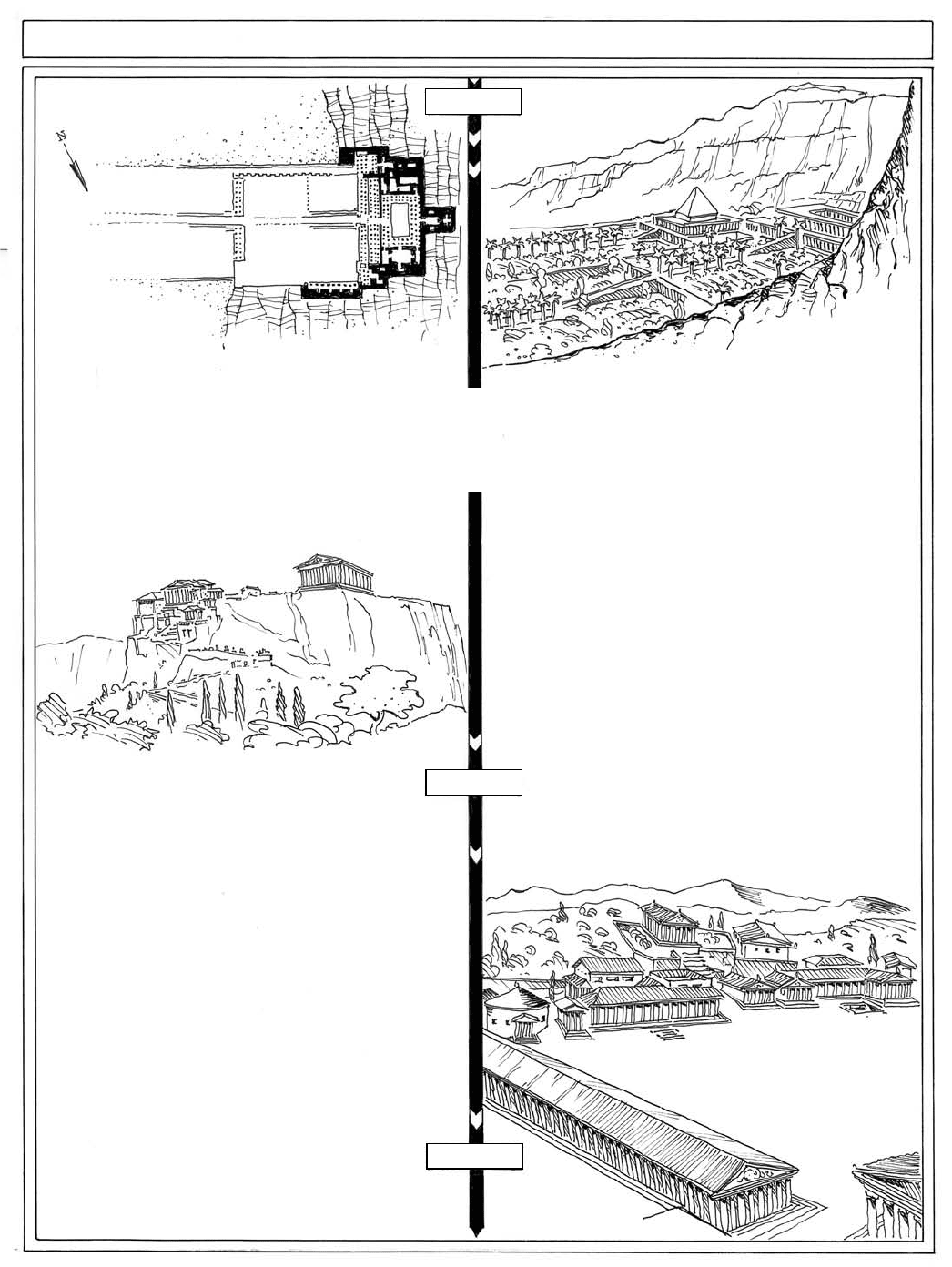
1400 BCE
MORTUARY TEMPLE OF HATSHEPSUT, DEIR EL-BAHRI, EGYPT
Dramatically sited at the base of a cliff on the west bank of the Nile River, Queen Hatshepsut’s tomb comprised a
series of monumental terraces and colonnades symmetrically organized around a processional axis. Tomb paintings
show frankincense and myrrh trees imported from Somalia; archeological evidence confi rms the presence of exotic
vegetation on the terraces.
5
1400 BCE
400 BCE
200 BCE