
Boults Е. Illustrated history of landscape design
Подождите немного. Документ загружается.

47
CHINESE
PRECEDENTS
In an attempt to create a strong, cen-
tralized government, political reforms
of the mid-7th century abolished the
private ownership of land and estab-
lished the primacy of the Fujiwara clan
as imperial regents. The capital, which
previously had been relocated with
each successive emperor, now moved to
Nara, and remained there for 75 years.
The city’s strict geometric layout
was modeled on the Chinese capital
of Chang-an. The concept of an urban
lifestyle and a sophisticated municipal
bureaucracy also came from China, and
contrasted with the self-suffi cient,
family-oriented, agrarian settlements
in Japan.
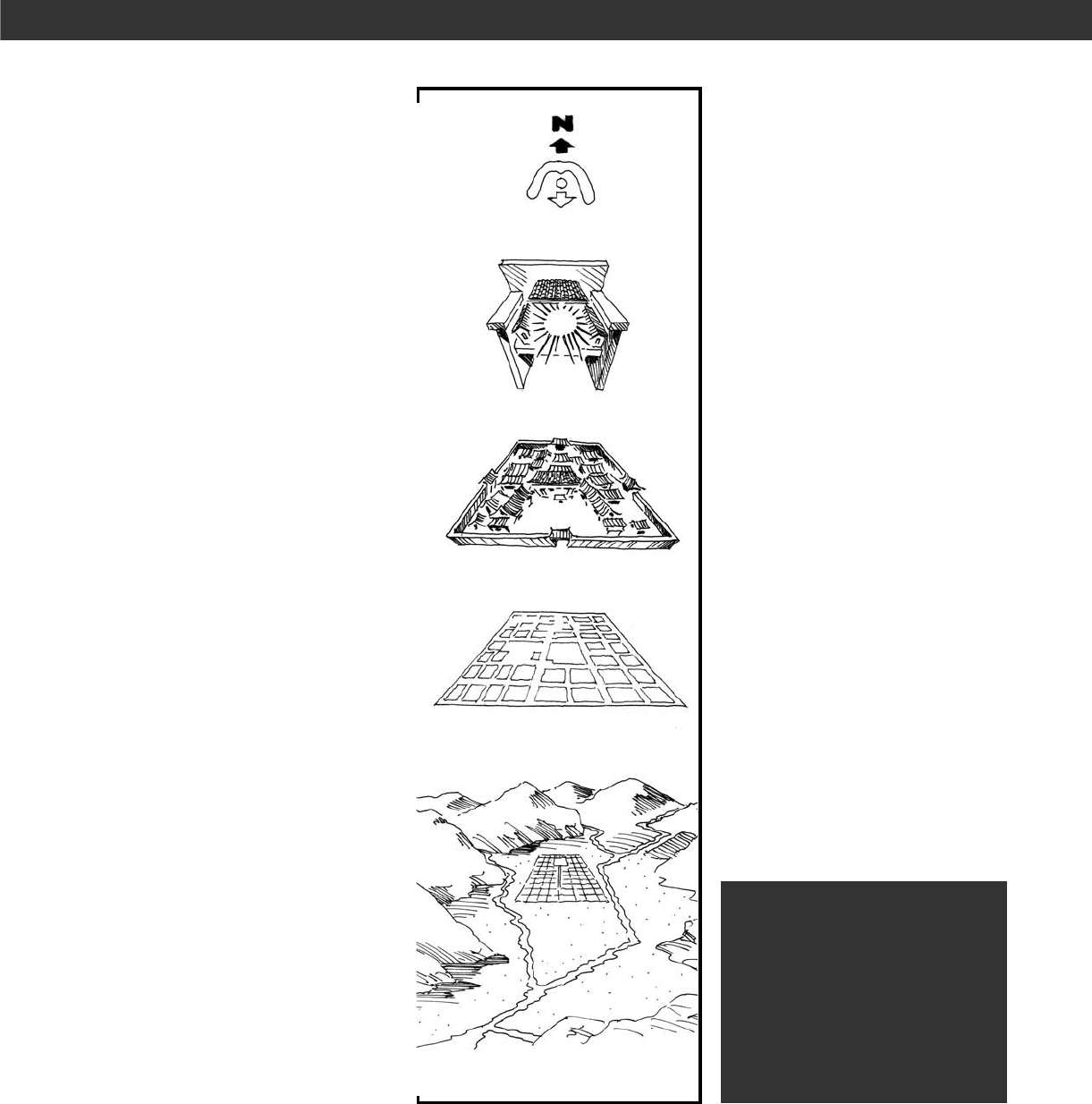
22
DESIGN FOR A NEW CAPITAL:
The siting of the palace and city of
Kyoto is based on geomantic con-
cepts similar to those at Chang-an.
The divine source of power lies to
the north. The mountains to the
north of Kyoto embrace the city
like an armchair, providing a seat
for the emperor—the refuge of a
“bright courtyard” in Chinese.
23
Chinese Tang culture dominated the
court at Nara in the 6th and 7th
centuries. Early diplomatic missions
to the continent were recorded in the
Chronicles of Japan (the Nihon Shoki,
c. 720), which also described the
naturalistic form and immense scale
of Chinese imperial palace gardens,
including Yangdi’s park. The emerging
aristocracy in Japan eagerly adopted
as a style the large lakes and plea-
sure pavilions symbolic of the power
and authority of the Chinese emperor.
Little archeological evidence remains
of Nara gardens, but surviving scroll
paintings, and poems collected in the
8th-century anthology Manyoshu,
document the pond-and-island type
gardens of the period and serve as a
record of the activities and entertain-
ments that took place there. Chinese
infl uence waned in the early 10th
century as the Tang dynasty declined.
The last Japanese envoy was sent to
China in 894, and Japan entered a
period of isolation that lasted until
the 12th century.
MAINLAND INFLUENCES
Many cultural infl uences reached Japan
via the Korean peninsula, which at its
closest point, is only about 300 miles
from the island of Honshu. Chinese
beliefs and artistic styles had a huge
impact on Japanese designers, who
adapted mainland ideas to local cus-
toms and blended foreign styles with
vernacular traditions.
In the mid-6th century, the fi rst Bud-
dhist missionaries arrived in Japan.
Buddhist cosmology deemed mountains
sacred, a concept sympathetic to
Shinto beliefs. Early Buddhist retreats
occupied forests and peaks—sites
often revered in the Shinto tradition.
Empress Suiko and her regent, Prince
Shotoku (574–622), promoted Bud-
dhism as the state religion in an effort
to unify the population and strengthen
government infl uence.
MIDDLE AGES / JAPAN / NARA PERIOD (645–784)
48
MIDDLE AGES / JAPAN / HEIAN PERIOD (794–1185)
THE GOLDEN AGE OF GARDENS
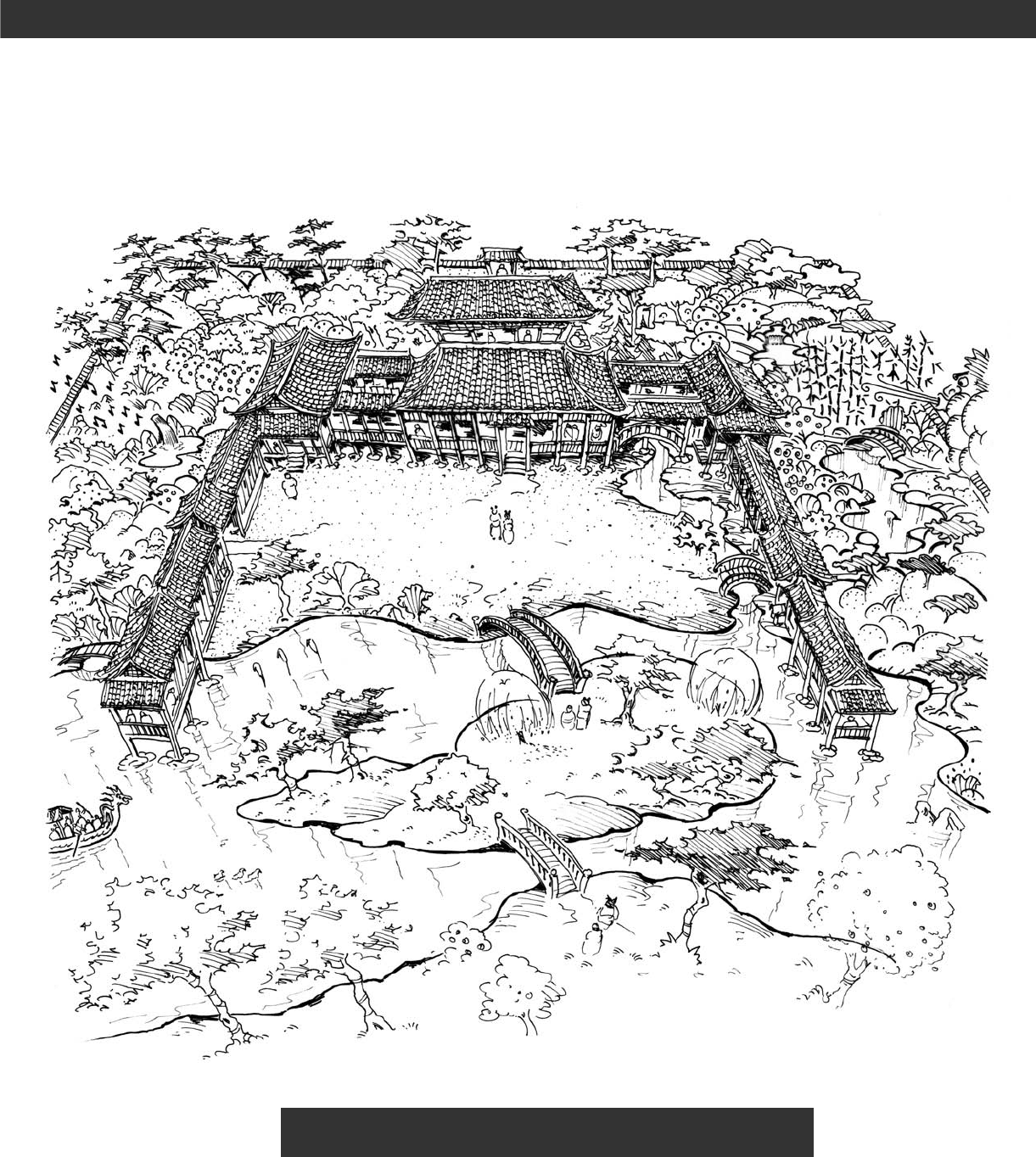
SHINDEN-ZUKURI: Heian gardens were settings for poetry contests, fl ower-
viewing festivals, boating parties, and musical events.
49
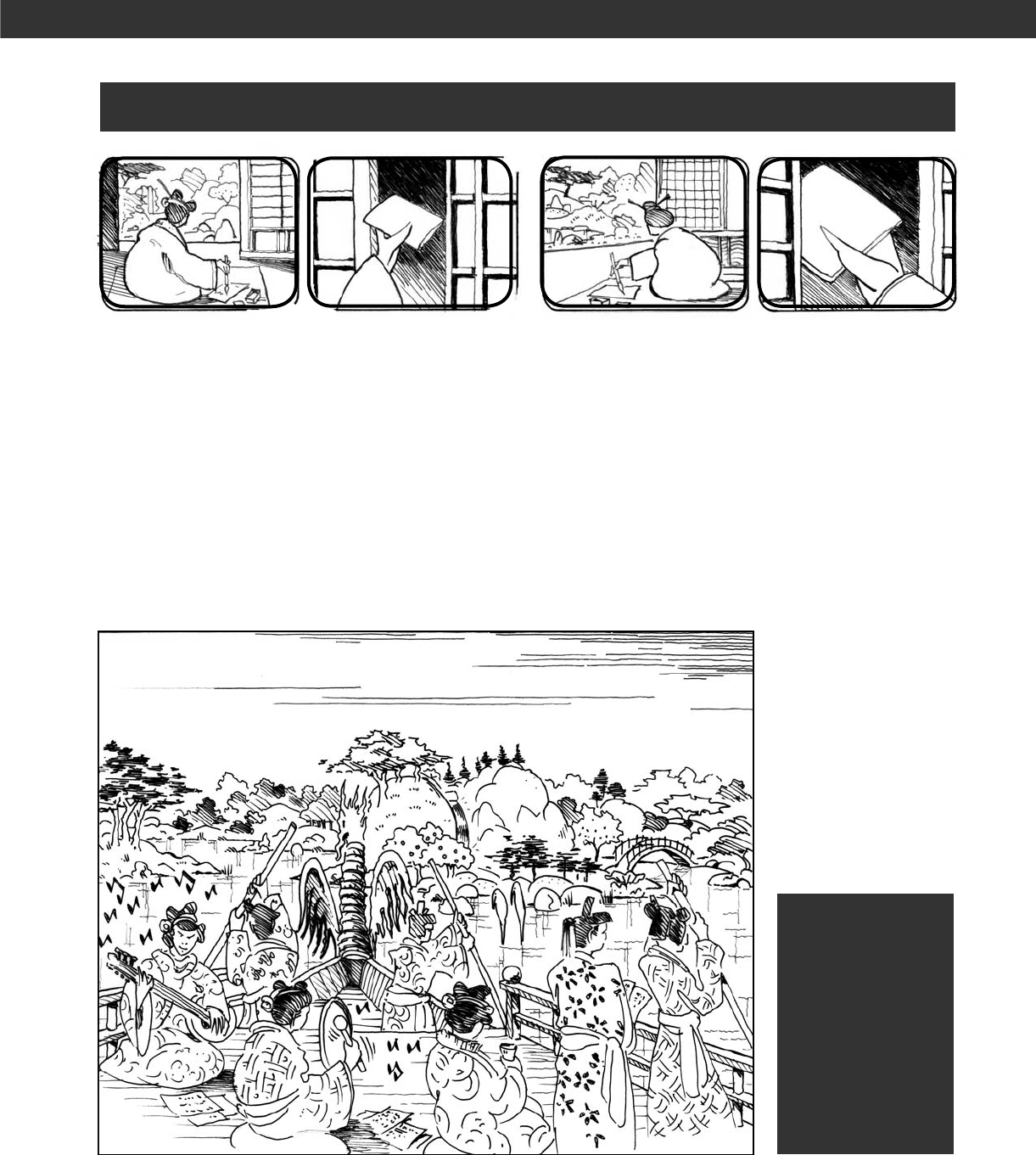
TRAVELING POETRY: The women at Prince Genji’s mansion compete for his attention. They exchange poems extolling the virtues
of their seasonally themed gardens. Here, autumn versus spring:
Under threat from the increasingly
powerful Buddhist priests at Nara,
the imperial court moved once more, in
794, to the politically neutral territory
of Kyoto. The new capital, known then
as Heian-kyo, or the City of Peace and
Tranquility, was planned on a grid like
Chang-an and Nara.
The Heian period is marked by a fl our-
ishing of aesthetic pursuits and cultur-
al refi nement. By the 10th century, the
Fujiwara regents assumed complete
administrative control of the govern-
ment. The aristocratic classes, now
powerless in affairs of state, turned
their attentions to advanced forms of
poetry, literature, music, fashion, and
landscape design.
The excavation and restoration of
actual Heian gardens is ongoing. The
Sakuteiki, a garden manual written in
the early 11th century by Tachibana no
Toshitsuna, half-brother of the regent,
provides an additional source of infor-
mation about medieval gardens in Ja-
pan. The author describes theories and
concepts of rock placement, borrowed
scenery, and geomantic principles of
estate layout, and even categorizes 10
different types of waterfalls. A spiritual
and philosophical approach to garden
making, the work blends common-sense
advice with knowledge of local environ-
mental conditions.
AUTUMN: “Your garden quietly awaits the spring. Permit the winds to
bring a touch of Autumn.”
SPRING: “Fleeting, your leaves that scatter in the wind. The pine at
the cliffs is forever green with Spring.”
24
TALE OF GENJI: The
medieval mindset and
attitude toward nature
is characterized in the
Tale of Genji, a novel
written in the Japanese
vernacular by Lady
Murasaki Shikibu in
the early 11th century.
The story unfolds in
a princely garden and
details the highly struc-
tured life at court.
MIDDLE AGES / JAPAN / HEIAN PERIOD (794–1185)
50
Architecture provided the framework
for gardens in the Heian period. Lar
ge
central courtyards, open to the south,
were defi ned by the shinden-zukuri build-
ing form. The shinden hall was the main
residence and audience chamber. Ancil-
lary pavilions were joined to the shinden
by covered walkways. Structures were
made of unpainted wood. The main hall
opened onto a pond-and-island-type gar-
den—a precedent that alluded to the
mythological islands of the Immortals,
legendary in Chinese folklore. In Japanese
gardens, the ponds often referenced
actual coastal scenery, and the islands
symbolized the myth of the turtle and
the crane. The turtle island represented
Mt. Shumisen, the sacred center of the
universe in Buddhist doctrine; the crane
island symbolized longevity; together
they formed an auspicious balance of
nature.
Buddhist temples of the Heian period
were also built in the shinden zukuri
style. The Amida form of Buddhism
reached its peak of popularity during
the 11th and 12th centuries. The focus of
Amida Buddhism was devotion and the
reward of paradise—a “pure land of the
west”—for the virtuous. Thus, temple
gardens became earthly recreations of
paradise. Aristocratic estate gardens
were often converted to temple gardens
in the 11–12th centuries as the nobility
now entered the priesthood and under-
took garden design as a form of artistic
expression.
Shinden-style palaces and temples had
south-facing pavilions and balustraded
verandas that bordered large central
ponds. Water fl owed through the garden
in constructed streams that mimicked
natural drainage patterns, moving
across a site in an auspicious pattern
from east to south to west. Care-
fully placed rocks along the convoluted
shorelines masked the full extent of the
ponds, creating an illusion of distance.
Other landscape elements in a shinden-
style garden included earth mounds,
vermillion-colored bridges, and a minimal
number of rocks and trees.
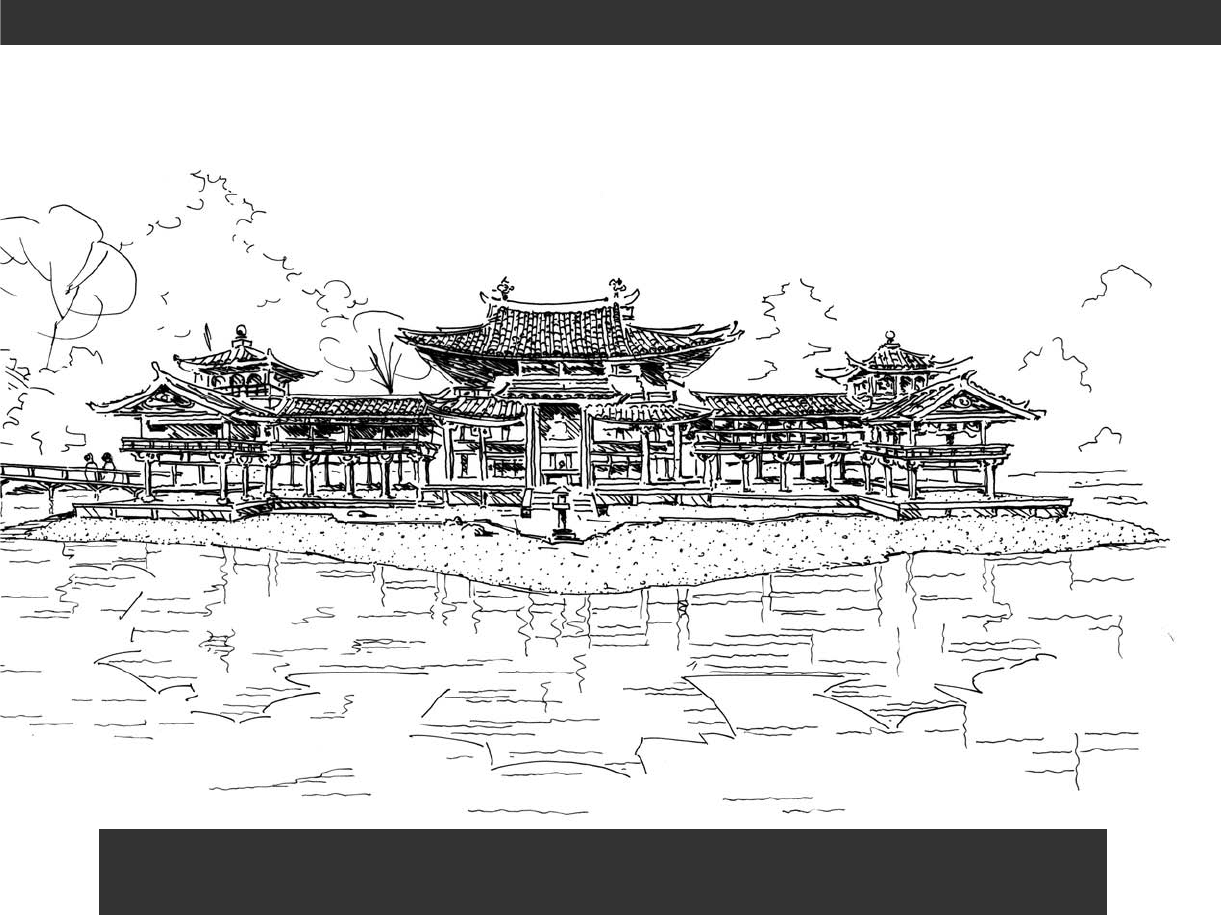
BYODO-IN exemplifi es a shinden-style temple of the period. Originally built in 1052 by Fujiwara no Yorimichi, a devotee of Amida
Buddhism, the main structure (called the Phoenix Hall) contains a large statue of Buddha and faces east so the devout would
face the western paradise to pray.
MIDDLE AGES / JAPAN / HEIAN PERIOD (794–1185)
SHINDEN-STYLE COURTYARDS
51
MIDDLE AGES / JAPAN / KAMAKURA PERIOD (1185–1334)
SECOND WAVE OF CHINESE INFLUENCE
Agricultural production improved at the
end of the Heian age. As trade increased,
markets developed and a merchant class
was established. Provincial landowners
formed hierarchical power structures
independent of the capital, further
weakening the central government. Civil
war ensued. The Fujiwara were ousted
by the Taira; the Taira were deposed by
the Minamoto. The Minamoto clan moved
the seat of the new military govern-
ment northeast, to Kamakura, near Edo,
although the cultural capital remained at
Kyoto. Contact with China was renewed,
and a second wave of Chinese infl uence
ensued. Japanese priests visited Chinese
monasteries, and Chinese artists and
intellectuals immigrated to Japan as the
Mongolian invasion persisted. In particu-
lar, Zen Buddhism and Song period art
entered Japan and had profound infl u-
ences on garden design.
The height of Song painting in China
corresponded to the late Heian/early
Kamakura period. Painting was as much
an intellectual pursuit as it was a tech-
nical skill; this aspect of Song culture
appealed to the priests and the military
class, whose members sought new ways
to defi ne their cultural ambitions in
opposition to Kyoto society. Creating
an illusion of space and conveying the
essential spirit of nature were common
attributes of Song painting.
ZEN AND THE
SAMURAI SPIRIT
The Kamakura period is marked by a
spirit of self-discipline and control,
evidenced by the growth of religion (Zen
Buddhism) and a new military class (the
samurai warrior) dedicated to a provin-
cial warlord, or shogun. Amid the politi-
cal and social instability of the 13th and
14th centuries, a turning inward can be
seen not only in the wide acceptance
of Zen Buddhism with its emphasis on
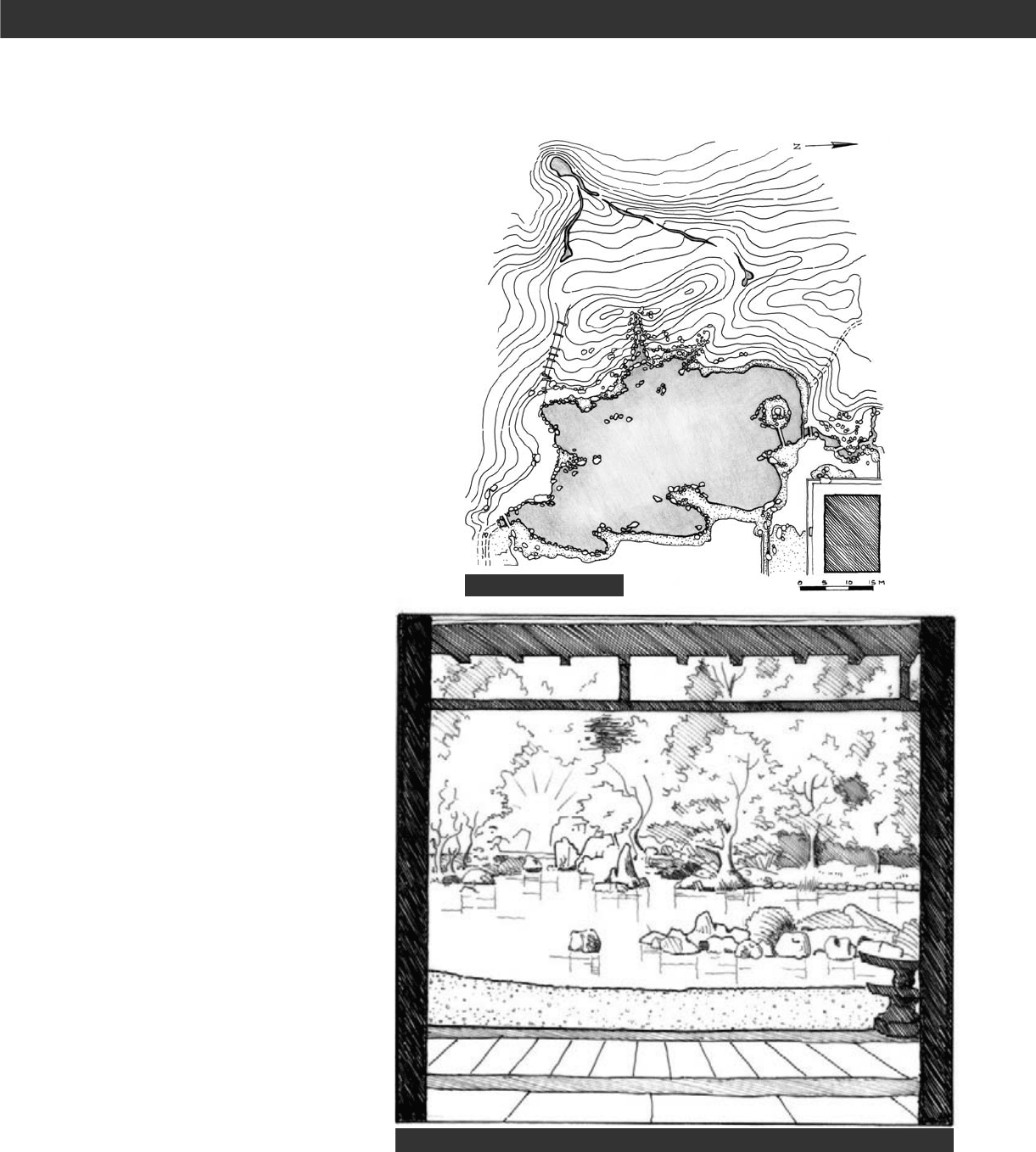
FRAM Th g y j a ot q ingle
vantage point where the landscape itself becomes the subject matter.
TENRYU-JI SITE PLAN
52
meditation, but also in garden design,
where only “essential” characteristics
of nature were re-created. Gardens
contained “empty” spaces, just as Song
landscape paintings contained voids.
During the Kamakura period, the military
government sponsored Zen Buddhist
temples—austere centers of learning
and intellectualism that contrasted
with the lavish imperial palaces built
MIDDLE AGES /JAPAN / KAMAKURA PERIOD
during the Heian period. Temple gardens
were designed by monks and itinerant
“rock-setting priests” who had visited
Buddhist monasteries in China.
25
The Zen
priest Muso Soseki (1275–1351, given the
honorifi c title Muso Kokushi), promoted
gardening as a religious activity. He is
credited with the layout of several temple
gardens, including the redesign in 1339 of
Tenryu-ji and Saiho-ji, former aristocratic
estates outside Kyoto.
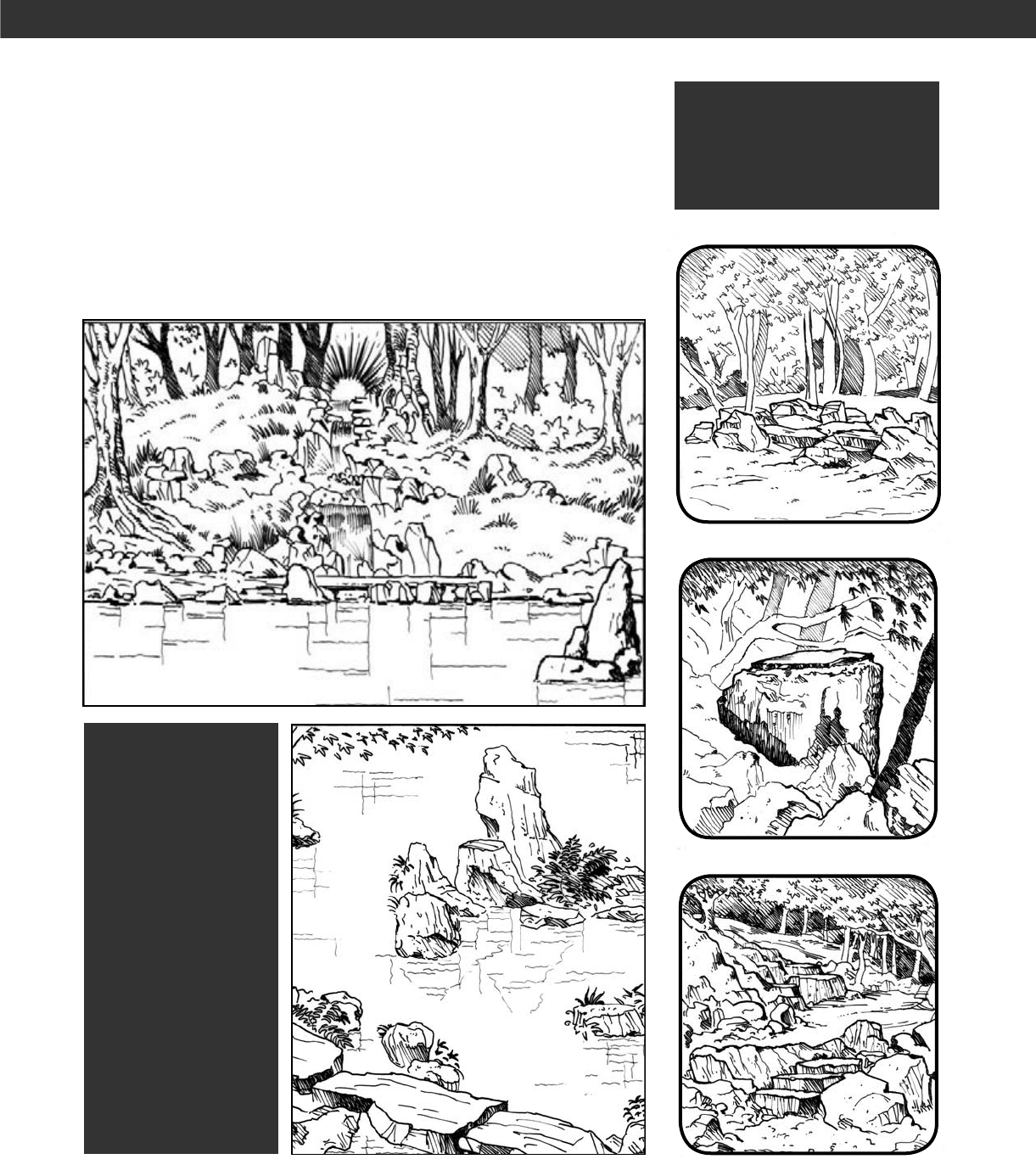
쒀 DRAGON GATE: A wa-
terfall with its upright carp
stone can be understood
as an allegory of achieve-
ment and enlightenment—
the carp becomes a
dragon if it can climb the
falls—referencing success
in the civil service examina-
tions or the attainment of
Buddhahood.
쑺 IMMORTAL ISLAND: The
vertical arrangement of
seven stones at Tenryu-ji
shows early Chinese infl u-
ence, possibly representing
the islands of the Immor-
tals. Rock arrangements
in Japanese gardens would
evolve to form more hori-
zontal compositions.
SEQUENCE OF SPACE: The upper
garden at Saiho-ji contains arrange-
ments of fl at-topped rocks repre-
senting a turtle island, a zazen-
seki, or meditation seat, and a dry
waterfall.
53
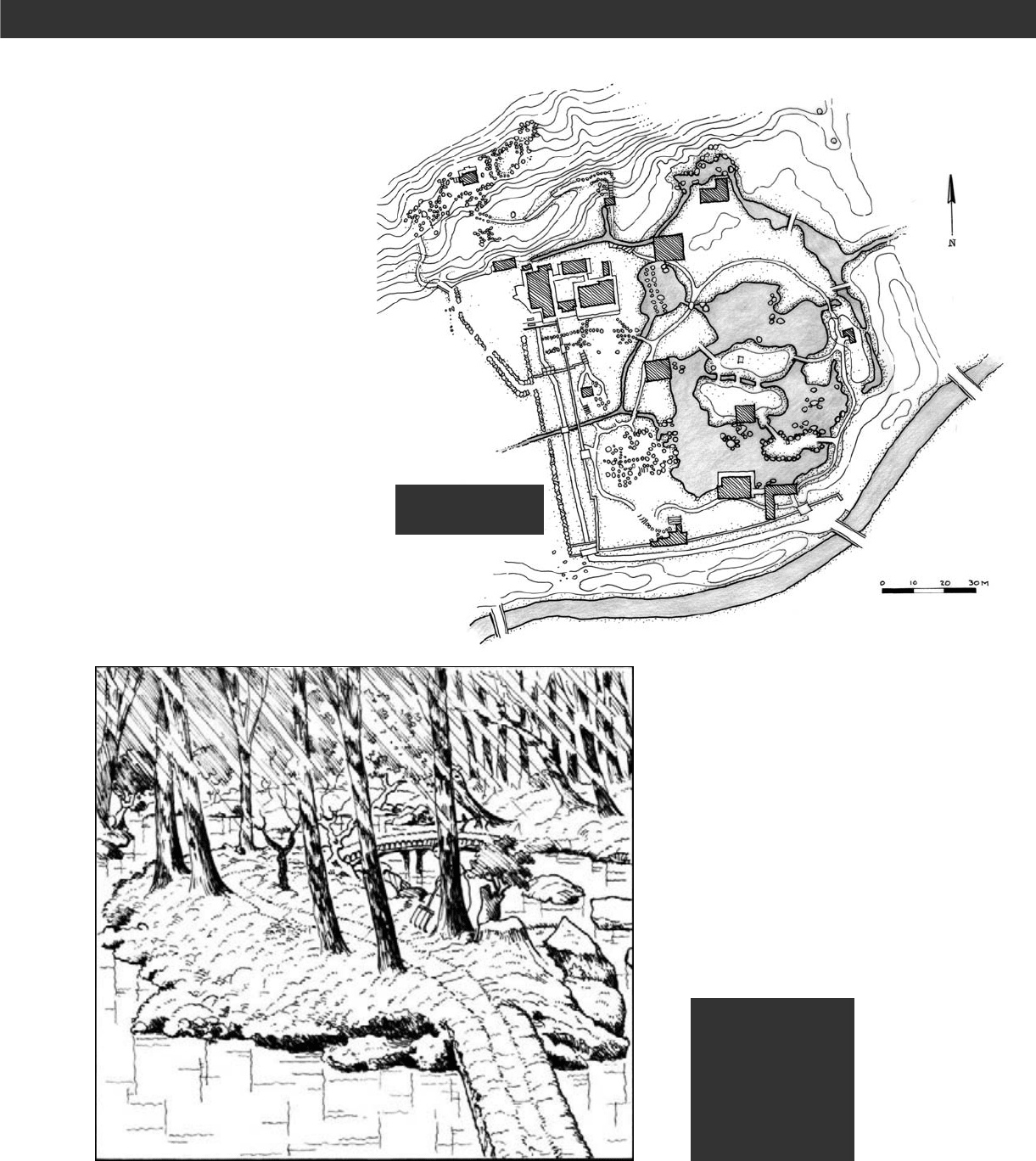
MOSS TEMPLE:
Saiho-ji contains an
early paradise garden
around a lower lake
and an upper garden
of horizontal, fl at-
topped rocks, now
covered with moss.
TENRYU-JI
Tenryu-ji represents an important
transition between the pond-and-
island-style gardens of the Heian
court and the contemplative style
gardens of the later Kamakura/
early Muromachi period. The garden is
less than 1 acre in size and contains
a pond with a single arrangement
of vertical rocks. Just beyond this
grouping of upright stones is a “drag-
on gate” waterfall. A horizontal stone
in the foreground of the falls bridges
a narrow outlet and serves as a visual
counterpoint to the high stack of
vertical rocks in the background—
creating an illusion of distance and
a layering of space similar to that
represented in Song paintings.
26
SAIHO-JI: Site plan
c. 14th-century.
SAIHO-JI
Built on the site of an 8th-century
temple, and converted to temple
grounds by Muso Kokushi, Saiho-ji is
another transitional garden of the
Kamakura period. The dry cascade
of stone illustrates the development
of kare sansui, a concept originally
mentioned in the Sakuteiki, which
creates the illusion of streams and
waterfalls through the placement of
rocks and gravel.
MIDDLE AGES /JAPAN / KAMAKURA PERIOD
54
In the mid-14th century, a less symmetri-
cal, more informal architectural style
developed, called the shoin-zukuri, or
“reading room” style. A shoin was an al-
cove that projected out from the exterior
wall and sometimes contained a writing
desk and “picture window” that faced the
garden. The often diagonal arrangement
of interior spaces enabled the garden
to be approached from an oblique angle,
creating a variety of framing possibilities.
The garden now became something to be
seen more intimately, from a fi xed point
of view. The idea of borrowed scenery, or
shakkei, also mentioned in the Sakuteiki,
became a guiding principle of landscape
design, as did the aesthetic of kare san-
sui. Other features of the shoin-zukuri
style were tokonoma alcoves for the
display of art; sliding doors with paper
insets, which enhanced the fl exibility of in-
terior spaces; and tatami fl ooring mats.
The end of the 14th century saw the rise
of the Ashikaga clan and the return of
the shoguns to the Muromachi district
of Kyoto. The Ashikaga accumulated pow-
er and wealth by heavily taxing the peas-
ants. They embraced the subtle aesthet-
ics of the Song dynasty and could afford
to be generous patrons of the arts. Many
Chinese artists immigrated to Japan
during this time and taught calligraphy
and poetry to the samurai.
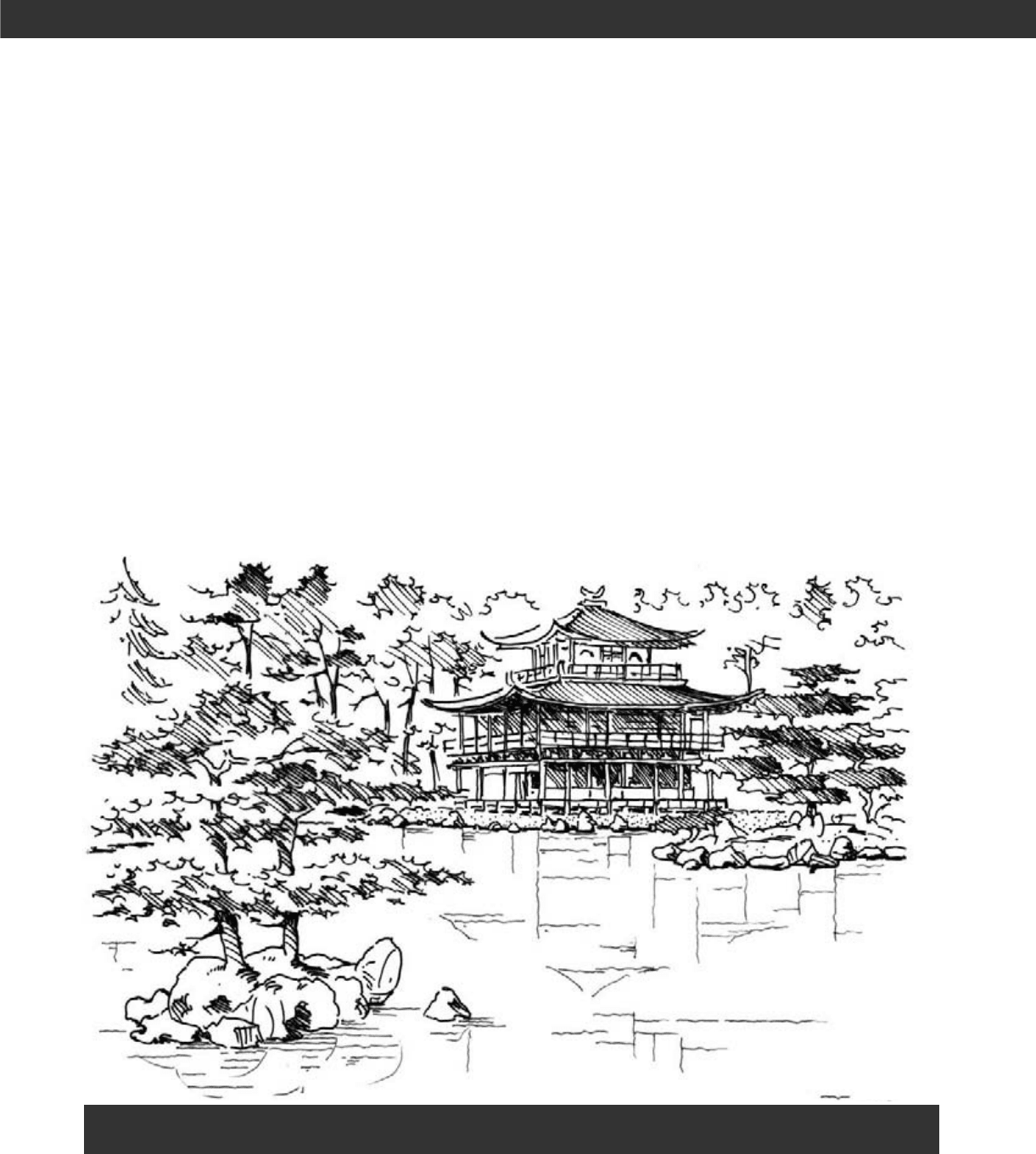
KINKAKU-JI
The third Ashikaga shogun, Yoshimitsu,
converted a shinden-style estate to a
picturesque retreat in the northwest sec-
tor of Kyoto beginning in 1397. Kinkaku-
MIDDLE AGES /JAPAN / KAMAKURA PERIOD
NEW WAYS TO CONTEMPLATE THE LANDSCAPE
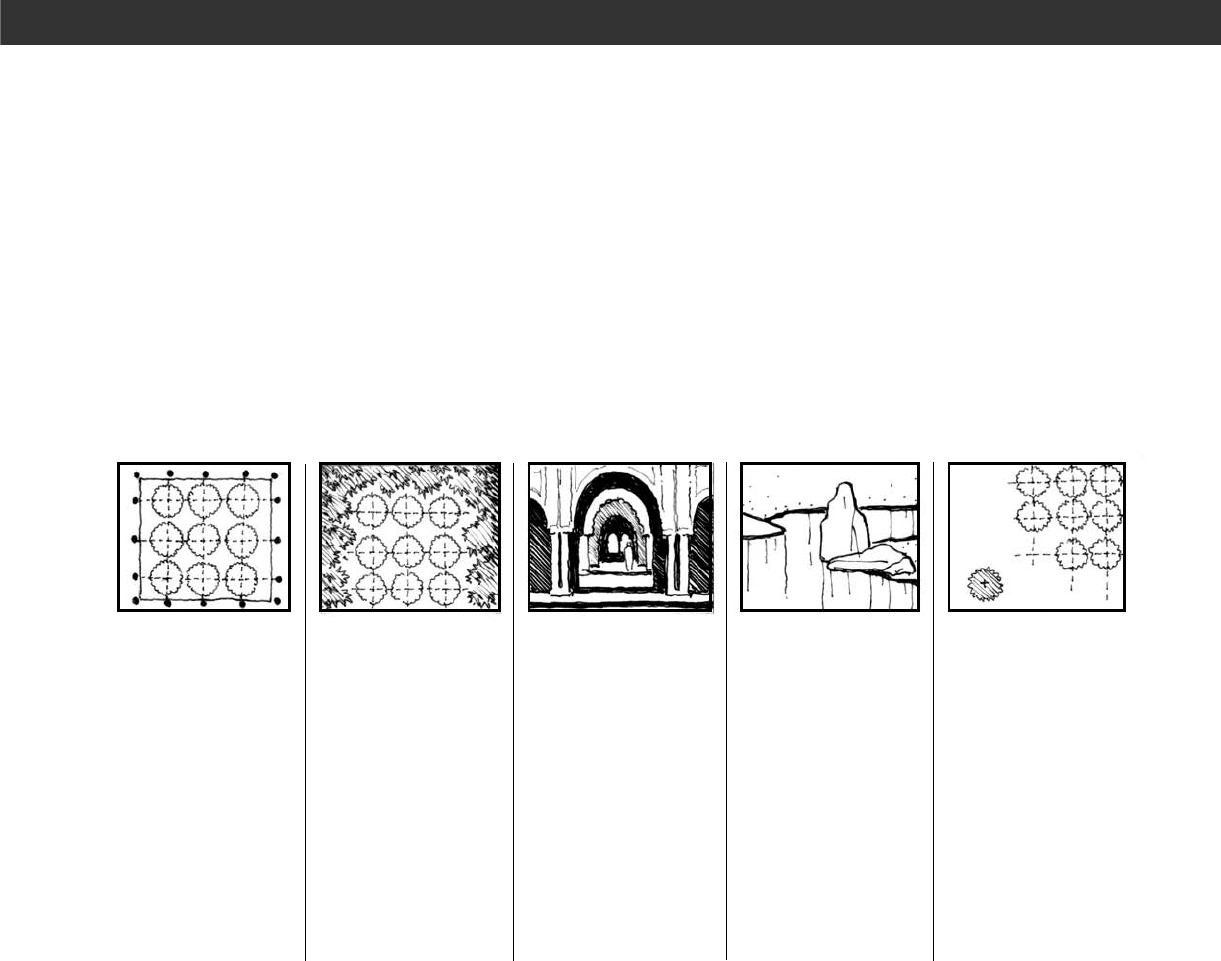
KINKAKU-JI: One important garden that fuses the ethics and aesthetics of the early Muromachi period is Kinkaku-ji, situated in
the northwest sector of Kyoto.
ji, or the Garden of the Golden Pavilion,
blends elements of a Heian paradise
garden with Song painting conventions.
The landscape is carefully composed
to manipulate perspectives and vistas,
particularly when seen from a boat. An
island and small peninsula divide the lake;
trees and shrubs on the distant banks
are kept small, to visually extend the
space. The 4
1
⁄2-acre garden contains many
symbolic elements, including turtle and
crane islands, ship mooring stones, and
a dragon gate waterfall. The three-story
pavilion itself functions in accordance with
Zen tenets: the lowest fl oor was for recep-
tion, the middle fl oor for conversation and
study, and the top fl oor for meditation.
The shift from outward contemplation to
inward contemplation reaches its fullest
expression in the garden during the later
Muromachi period.
55
SUMMARY
The gardens examined in this chapter responded to a wide range of environmental and cultural conditions, but despite their dif-
ferent contexts, they expressed a similar desire to create areas of signifi cance through the functional and aesthetic modifi ca-
tion of nature.
During the Middle Ages, nature was largely uncontrollable, and political order was unstable. Whether for protection or defense,
to mitigate forces of nature, or to create a more perfect representation of nature, medieval gardens were enclosed. The act of
enclosing space creates a realm distinct from its surroundings; a locus amoenus that in the Middle Ages often symbolized an
idea of paradise.
MIDDLE AGES / CONCLUSION
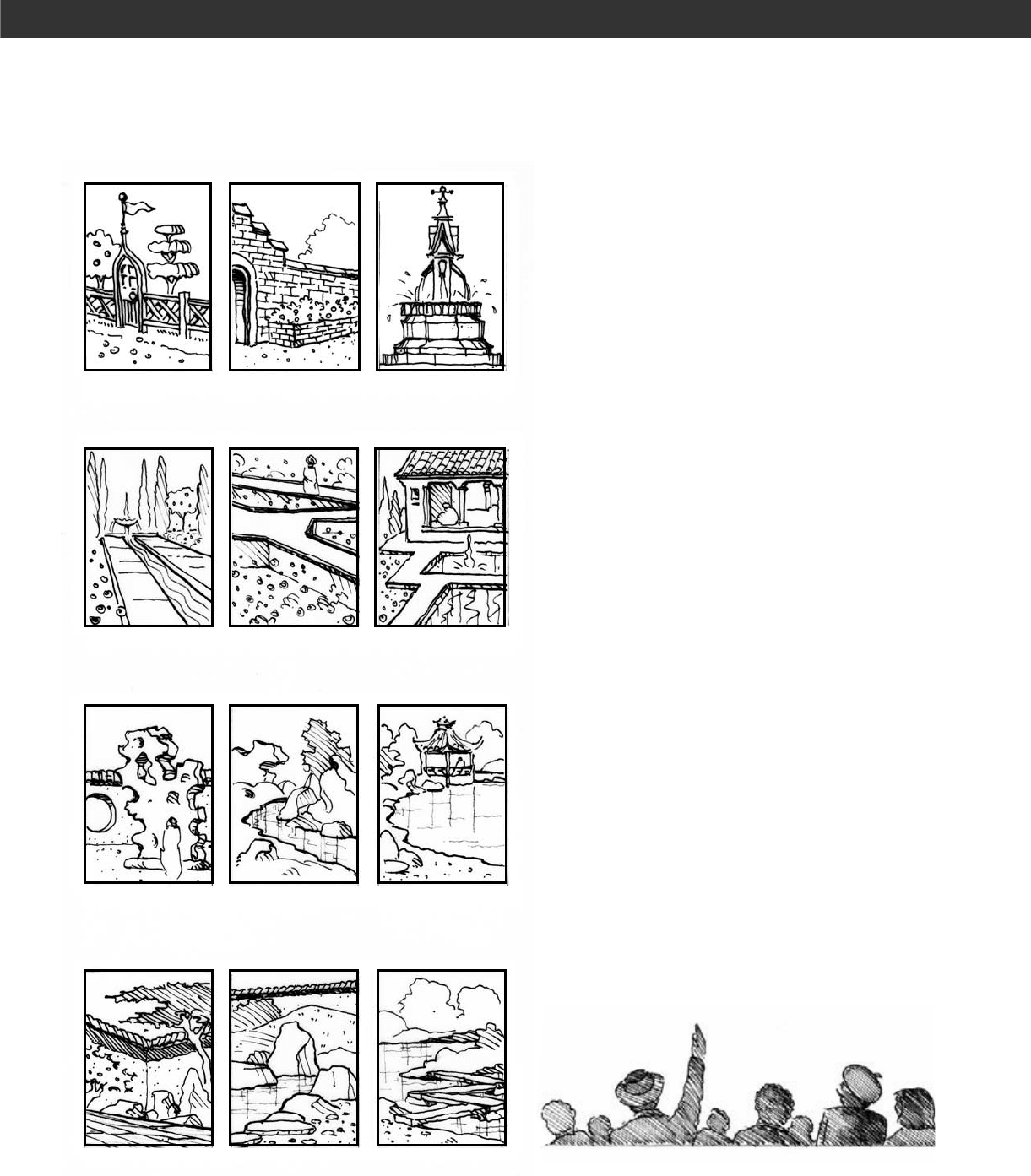
DESIGN PRINCIPLES
UTILITY
The medieval cloister
is an embodiment of
utilitarian geometry.
A simple square
bounded by an arcade
becomes an ambulato-
ry to facilitate prayer.
A square, subdivided
by raised planting
beds, becomes a living
encyclopedia of herbs
and fl owers.
CONTRAST
A small plot of plea-
sure amid a landscape
of labor—the carefully
tended pleasance is
set in opposition to its
untamed surroundings.
SCALE
The Moorish courtyard
is an outdoor living
room—human-scaled
open space defi ned by
architecture. The tran-
sition between inside
and outside is medi-
ated by architectural
elements; porticos and
loggias provide sec-
ondary thresholds.
BALANCE
The Chinese garden
is a microcosm of
nature where inherent
forces are balanced
visually, symbolically,
and experientially. An
intuitive equilibrium is
created between rock
and water, solid and
void, word and image.
APPROPRIATION
Shakkei is the principle
of “borrowed” scenery.
The landscape beyond
a garden’s borders
is appropriated to
become a visual com-
ponent of Japanese
gardens.
56
MIDDLE AGES / CONCLUSION
BOOKS
A
DVENTURES OF MARCO POLO
CANTERBURY TALES, by Geoffrey Chaucer
T
HE DECAMERON, by Giovanni Boccaccio
T
HE DIVINE COMEDY, by Dante Alighieri
I
NVISIBLE CITIES, by Italo Calvino
T
HE NAME OF THE ROSE, by Umberto Eco
O
NE THOUSAND AND ONE NIGHTS
(various English translations)
T
HE ROMANCE OF THE ROSE, by Guillaume de Lorris
T
ALES OF THE ALHAMBRA, by Washington Irving
T
HE TALE OF GENJI, by Murasaki Shikibu
T
HE TALE OF HEIKE,
translated by Helen Craig McCullough
FILMS
THE ADVENTURES OF ROBIN HOOD (1938)
B
RAVEHEART (1995)
E
L CID (1961)
G
ENGHIS KHAN (1954)
K
INGDOM OF HEAVEN (2005)
T
HE LION IN WINTER (1968)
T
HE SEVENTH SEAL (1957)
PAINTINGS
EMPEROR MING HUANG’S JOURNEY TO SHU,
artist unknown (8th century)
E
ARLY SPRING, by Kuo Hsi (1072)
S
IX PERSIMMONS, by Mu Chi (13th century)
S
CROVEGNI CHAPEL FRESCOES, by Giotto (1305)
T
HE EFFECTS OF GOOD AND BAD GOVERNMENT
ON THE CITY AND COUNTRYSIDE,
by Ambrogio Lorenzetti (1338)
DESIGN VOCABULARY
WESTERN EUROPE
Fences, Walls and Fountains
MOORISH SPAIN
Runnels and Raised Paths
JAPAN
Courtyards, Lakes, and Islands
CHINA
Rocks and Water
F
o
r further exploration