
Boults Е. Illustrated history of landscape design
Подождите немного. Документ загружается.

57
15th CENTURY
T
he 15th century was an age of exploration—a period of expansion and cultural advancement that proceeded
at a different pace, however, across the world. New discoveries and new lands reshaped medieval worldviews.
Europe emerged as a world power, with Italy at the center of early Renaissance thought. The new merchant
class challenged aristocratic power structures and church authority. But the desire for economic hegemony led to
the exploitation of many cultures, particularly those in the Americas and Africa.
As horizons broadened, gardens became places to contemplate nature, not escape from it. Garden prototypes es-
tablished during the Middle Ages reached maturity in the 15th century. The Zen garden became the ultimate expres-
sion of kare sansui in Japan; the chahar bagh epitomized Islamic garden form; and the Italian villa evolved as the
physical representation of a philosophical ideal.
58
15th CENTURY / A BRIEF CHRONOLOGY
1400 1410
1420
1460
1470
c. 1400
1374 1419
1420
1426
1427
1465
1459
1459
1469
1474
1405–1433
MAPPA MUNDI
OSPEDALE DEGLI INNOCENTI
PETRARCH
CHINESE NAVY
OIL PAINT
MING WORKS
SPATIAL REALISM
THE SONGHAI
HANGING GARDEN
TOWN PLAN
FERDINAND & ISABELLA
THE STRIFE OF LOVE
IN A DREAM
59
15th CENTURY / A BRIEF CHRONOLOGY
1430
1440
1450
1480
1500
1436
1438
1435
1440
1480
1494
1492
1498
1500
1453
1453
DUOMO
TENOCHTITLAN
PERSPECTIVE
PRINTING PRESS
ALLEGORY OF SPRING
ACCOUNTING METHODS
DISCOVERY?
WORLD TRAVELER
THE INCA
VITRUVIAN MAN
ISTANBUL
ACQUA VERGINE
1490
1490

60
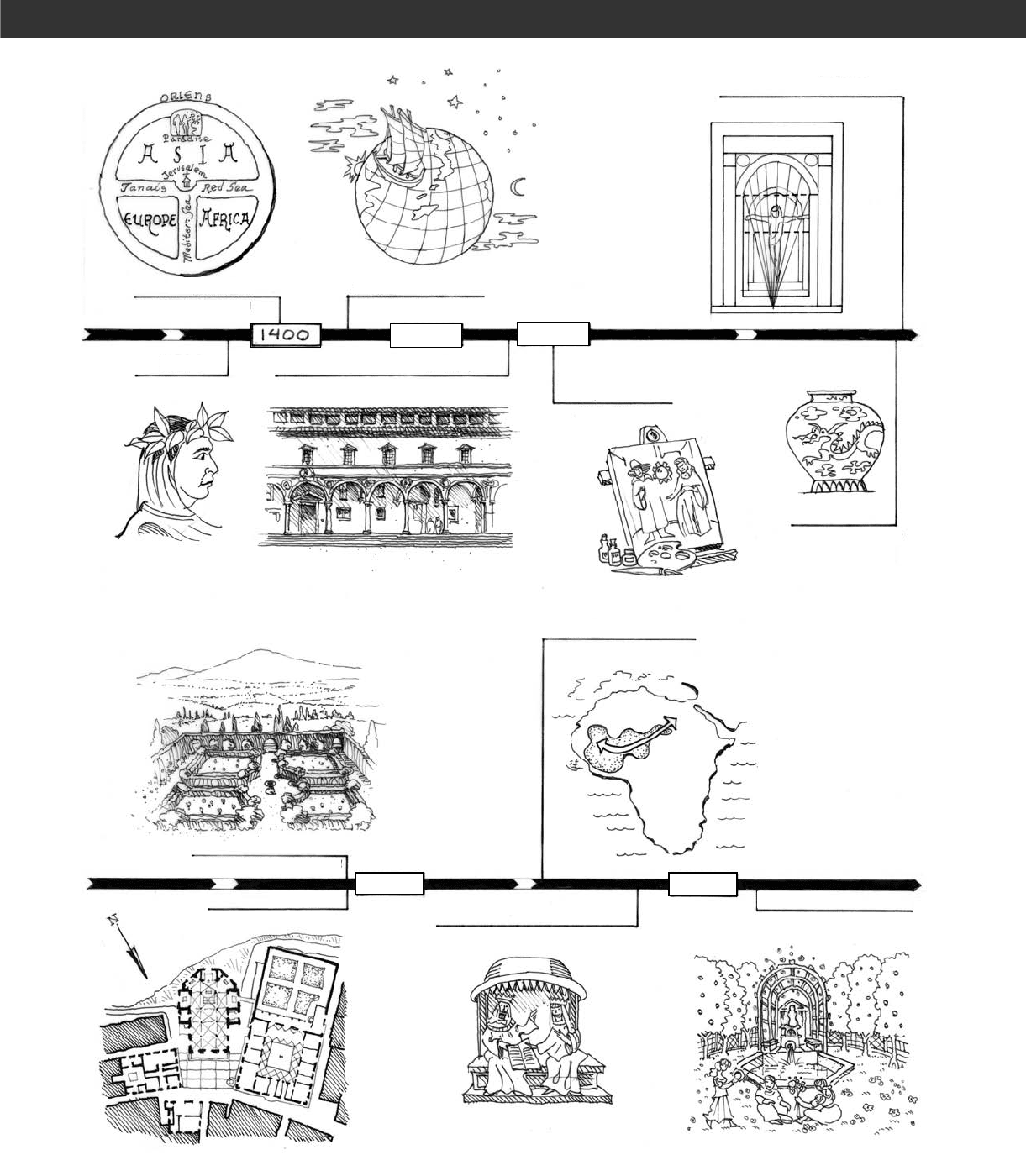
1374 PETRARCH
Petrarch, an Italian poet and early
humanist, studied the art and literature
of antiquity. He fostered scholarship
based on classical ideals.
c. 1400 MAPPA MUNDI
Early medieval maps drawn by Christian
cartographers were centered on Jeru-
salem and illustrated a world of three
continents: Asia, Europe, and Africa.
East, the direction of paradise, was at
the top.
1405–1433 CHINESE NAVY
Ming Emperor Yongle sent naval com-
mander Zheng He on diplomatic and
trade expeditions that circled the globe.
1419 OSPEDALE DEGL’INNOCENTI
Filippo Brunelleschi (1377–1446) applied
a classical architectural vocabulary to
his design for the Foundling Hospital in
Florence. The delicate Corinthian colon-
nade with rounded arches displayed a
clear, rational proportioning system.
1420 OIL PAINT
Oil painting was invented by early
Netherlandish painters. Artists like Jan
Van Eyck captured realistic details, rich
colorations, and deep modeling with the
new slow-drying medium.
1426 MING WORKS
Ming dynasty rulers restored the Great
Wall and the Grand Canal, and developed
trade connections with Europe. Ming
textiles, lacquer work, and ceramics,
particularly blue-and-white porcelains,
were highly coveted by Europeans.
1427 SPATIAL REALISM
Masaccio (1401–1428) fi rst depicted
one-point perspective in the Holy Trin-
ity, a fresco he painted in the church of
Santa Maria Novella, Florence. The real-
istically placed vanishing point created a
sense of drama and an illusion of space.
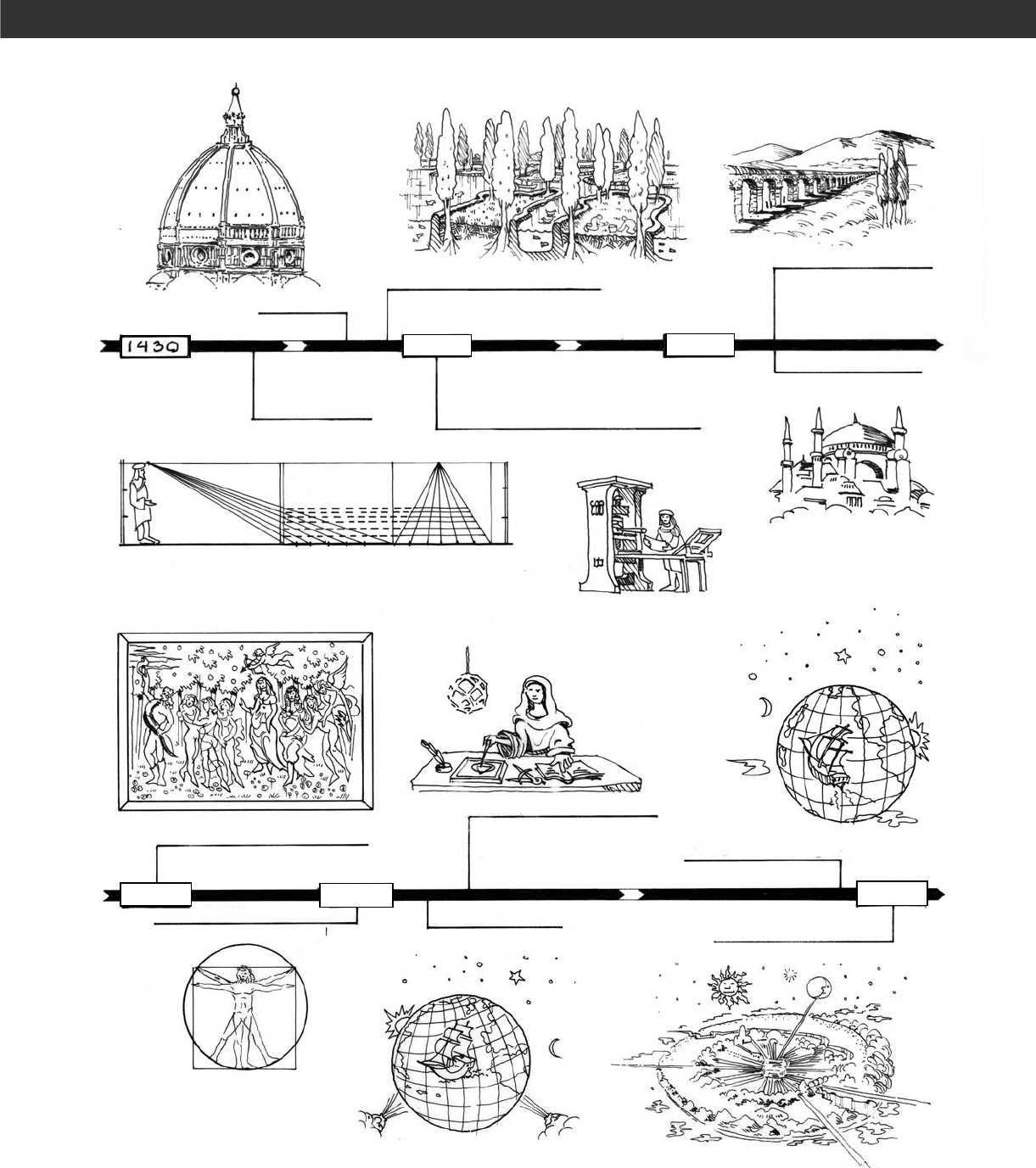
1435 PERSPECTIVE
Leon Battista Alberti described how
to construct a perspective grid in his
treatise on painting, Della pittura.
1436 DUOMO
Brunelleschi completed the design of the
dome on the Cathedral of Santa Maria
del Fiore, Florence. The double-layered
octagonal dome was the largest masonry
dome ever built. His fi rsthand study of
ancient Roman ruins may have infl uenced
his success with this engineering marvel.
1438 TENOCHTITLAN
Cultivated islands called chinampas,
along with an extensive network of
canals, dikes, and causeways, helped
Mexico’s capital city expand.
1440 PRINTING PRESS
Johannes Gutenberg (1398–1468) per-
fected movable type in the fi rst printing
press in Germany. The more effi cient way
of publishing accelerated the dissemina-
tion of knowledge in the Renaissance.
1453 ISTANBUL
The Ottomans conquered Constantinople
and renamed it Istanbul, converting the
church to a mosque.
1453 ACQUA VERGINE
Pope Nicholas V restored the ancient Ro-
man aqueduct, and established the Vati-
can Library to house the papacy’s growing
collection of ancient manuscripts.
1459 TOWN PLAN
Pope Pius II rebuilt his native Tuscan
village, Pienza, as one of the earliest
models of Renaissance town planning. He
organized palace, church, and town hall
as a single urban entity embodying the
classical concept of civitas—the balance
of people, nature, and government.
1459 HANGING GARDEN
Palazzo Piccolomini was designed by Ber-
nardo Rossellino, a student of Alberti’s,
as part of Pius II’s urbanization project
in Pienza. A terraced garden on the
south side of the palace is framed by a
loggia affording stunning views.
1465 THE SONGHAI
King Sonni Ali consolidated the Songhai
Empire; it became the leading power in
western Sudan and upper Africa under
later dynastic rulers.
1469 FERDINAND AND ISABELLA
Ferdinand and Isabella symbolically united
the kingdoms of Castile and Aragon,
and in 1492 completed the reconquest
of Spain when Granada fell to the
Christians. Ferdinand and Isabella saw
non-Catholics as a threat and initiated a
long period of intolerance and persecution
known as the Inquisition.
1474 THE STRIFE OF LOVE IN A DREAM
The extensive woodcuts in the novel
Hypnerotomachia Poliphili became a
sourcebook of design ideas for future
gardeners. Friar Francesco Colonna’s de-
tailed descriptions of plant species shed
light on the horticultural content of early
Renaissance gardens.
1480 PRIMAVERA, BY BOTTICELLI
Mythological subjects were interpreted
as humanistic allegories and became part
of the secular iconography of the Renais-
sance.
1490 VITRUVIAN MAN
Leonardo diagrammed the proportional
relationships of the human body accord-
ing to classical ideals, illustrating his
point that man is the model of the world.
1492 DISCOVERY?
The Italian navigator Christopher Colum-
bus convinced Ferdinand and Isabella to
sponsor an expedition to India by sailing
west. He landed in the Bahamas and
named the islands the “West Indies.”
1494 ACCOUNTING METHODS
Fra Luca Pacioli wrote Summa de
arithmetica, geometria, proportioni et
proportionalita.
1498 WORLD TRAVELER
The Age of Discovery continued with
Vasco da Gama’s voyage from Portugal,
around the Cape of Good Hope, to India.
1500 THE INCA
The Inca empire at its height included 6
million people. Cuzco, the regional capital,
was thought to be mapped with sacred
lines called ceques that radiated from
the temple of the sun.
15th CENTURY / A BRIEF CHRONOLOGY
61
15th CENTURY
/ JAPAN
MUROMACHI ERA
Gardens of the Muromachi era (1333–
1573) were characterized by a reduced
scale, a refi ned purpose, and a distinct
architectural setting that refl ected the
values of the military regime of the Ashi-
kaga shoguns, who returned the capital
to Kyoto. The samurai knights obeyed
a code of fearlessness, loyalty, and
service. Estate and temple gardens no
longer served solely as pleasure palaces
or allegories of paradise, as they did for
their Heian predecessors. Muromachi
gardens now focused on aspects of form
and artful composition.
Zen Buddhism, fi rst introduced during
the Kamakura era, was widely promoted
by the ruling shoguns. Since Zen practice
is an individual pursuit concerned with
meditation and the development of the
interior self, large ceremonial spaces
were less critical. Priests established
individual subtemples within larger
temple compounds. Small temple gardens
became sites for seated contempla-
tion, not ritual, and were meant to be
seen from fi xed points of view. The sliding
partitions of the shoin provided unique
opportunities for framing landscape
views.
1
Gardens, engaged only visually,
became aids to meditation, not sites of
active use.
A MINIMALIST
AESTHETIC
Large landscapes were represented in
small spaces. Garden elements were
abstracted and reduced to their es-
sential characteristics, expressed in the
form of kare sansui, or dry landscape
gardens, and conceptually similar to
tray landscapes.
Kyoto was substantially destroyed dur-
ing the Onin Wars of 1467–1477. Feudal
lords called daimyo rose to power in
the provinces in the 15th century as
the power of the Ashikaga declined. A
dispute over imperial succession arose
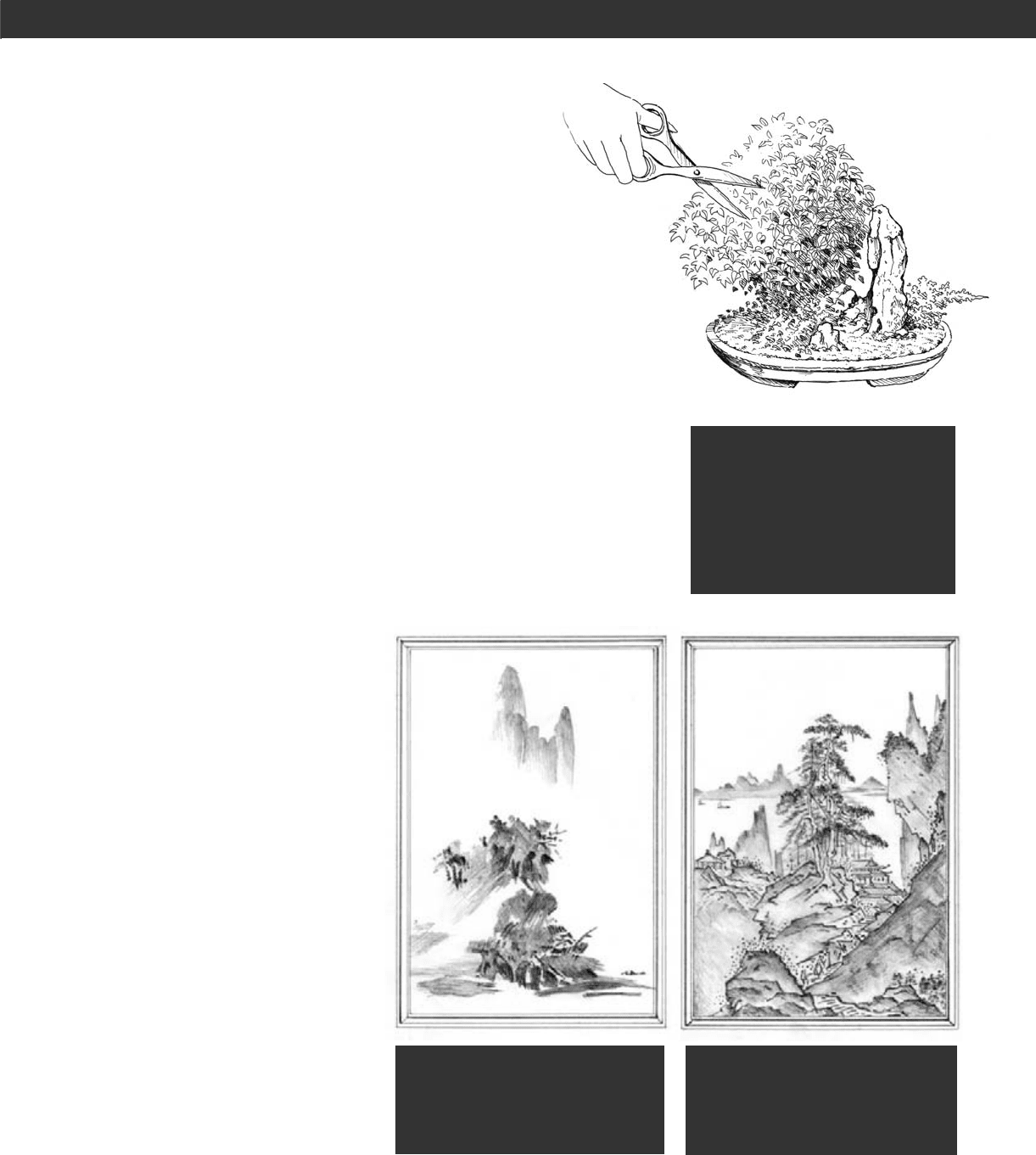
LANDSCAPE BY SESSHU: Sesshu
depicted the essence of the Japanese
landscape with an economy of line and
form.
LANDSCAPE BY SESSHU: The fl at-
topped, straight-sided rocks used in
the dry landscape gardens at Daisen-
in resemble the painter’s rendering of
landforms.
NATURE ABSTRACTED: Miniature
tray landscapes became accepted
art forms during the Kamakura
period, and may have infl uenced the
development of Zen gardens. Bonseki
are tray gardens composed solely of
stones and sand; bonsai are dwarfed
plants grown in tray like containers.
between the daimyo and the shogun,
leading to the decade of civil war.
Despite an entire century of political
turmoil, the arts fl ourished in 15th-
century Japan, including Noh drama,
gardening, painting, and the early prac-
tice of the tea ritual.
A distinct Japanese painting style de-
veloped during the Muromachi period, as
did a distinct social class of gardening
specialists. Both infl uenced the design
of gardens. Sesshu (1420–1506) was a
Buddhist monk who elaborated on Chi-
nese ink painting techniques, devising his
own vocabulary of short angular strokes
and dots. Like Song dynasty artists, he
captured the immensity and depth of the
landscape within the confi nes of a hang-
ing scroll.
62
One group of garden designers not
connected to the nobility or the
priesthood gained the respect of the
military-minded Ashikaga shoguns
and established themselves as garden
building specialists. The kawaramono
were poor people, not bounded to
landowners, who lived by the untaxed
riverside. They did the “unclean” work
of tanning and grave-digging. Zen’ami
(c. 1386–1483) was one such person
who gained respect and status for
his ability to arrange rocks as they
appeared in ink paintings.
2
He is often
credited with the placement of the
rocks at Ginkaku-ji.
3
Examples of Muromachi-period gardens
include Ginkaku-ji and the Zen gardens
of Ryoan-ji and Daisen-in.
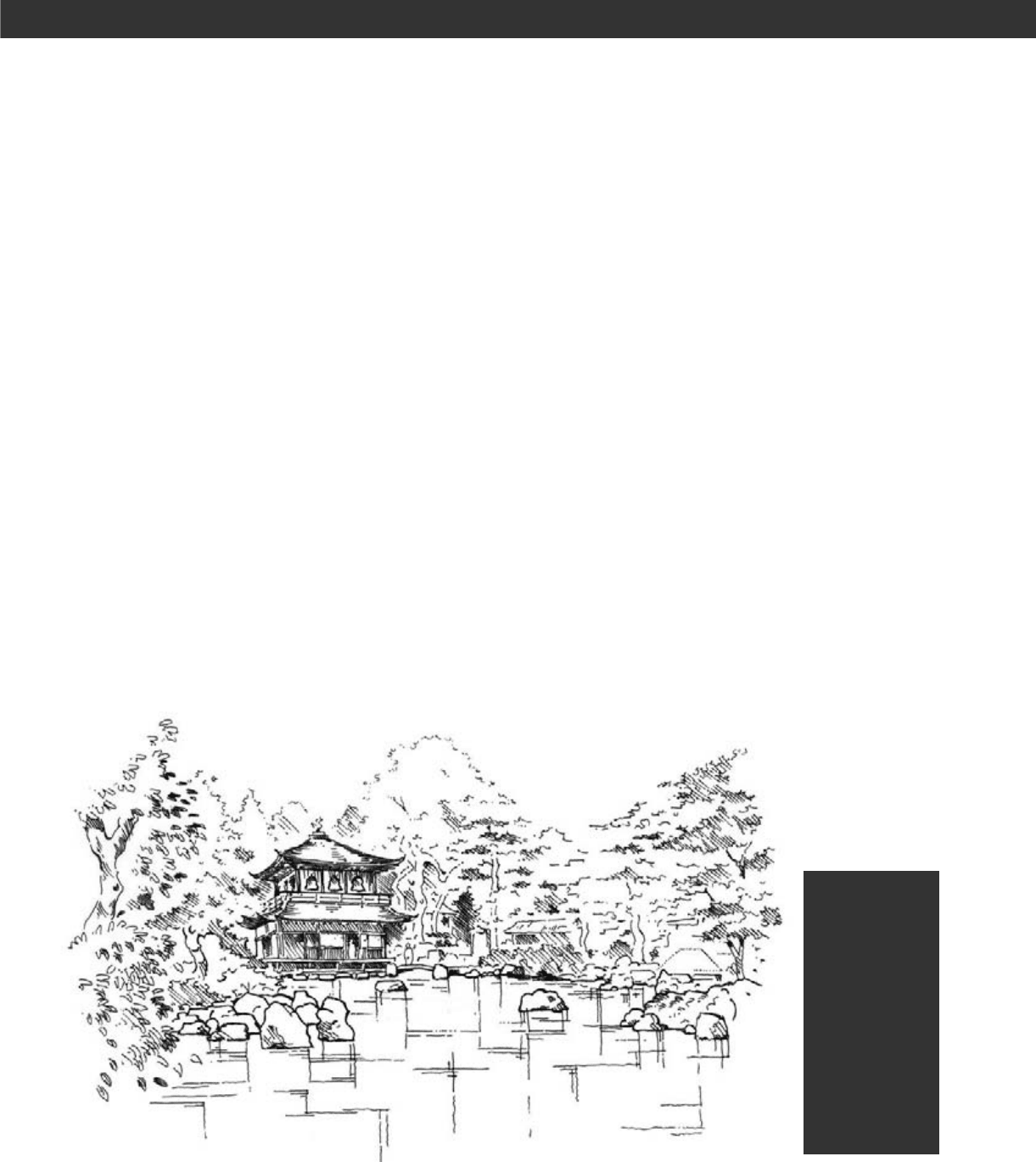
GINKAKU-JI
Ginkaku-ji dates from 1480 and was
built by the eighth Ashikaga shogun,
Yoshimasa, grandson of Yoshimitsu.
The pond-style garden of Ginkaku-ji
(called the Garden of the Silver Pavil-
ion) was created on a more modest
scale than Kinkaku-ji (the Garden of
the Golden Pavilion). Yoshimasa was
inspired by the restrained beauty of
the garden at Saiho-ji, which he often
visited, and he sought to duplicate
many of its same features at his villa.
4
The garden contained a tea pavilion,
chapel, and bridges leading to an island
with fl at-topped rocks. The two-storied
Silver Pavilion (its name derives from an
unrealized project to cover the ceiling
with silver leaf) contained a meditation
chapel and Buddha hall, and afforded
superb views of the garden. The large
sand mounds—the Sea of Silver Sand
and the truncated cone of the Moon-
viewing Platform—were added during
later restorations.
ZEN GARDENS
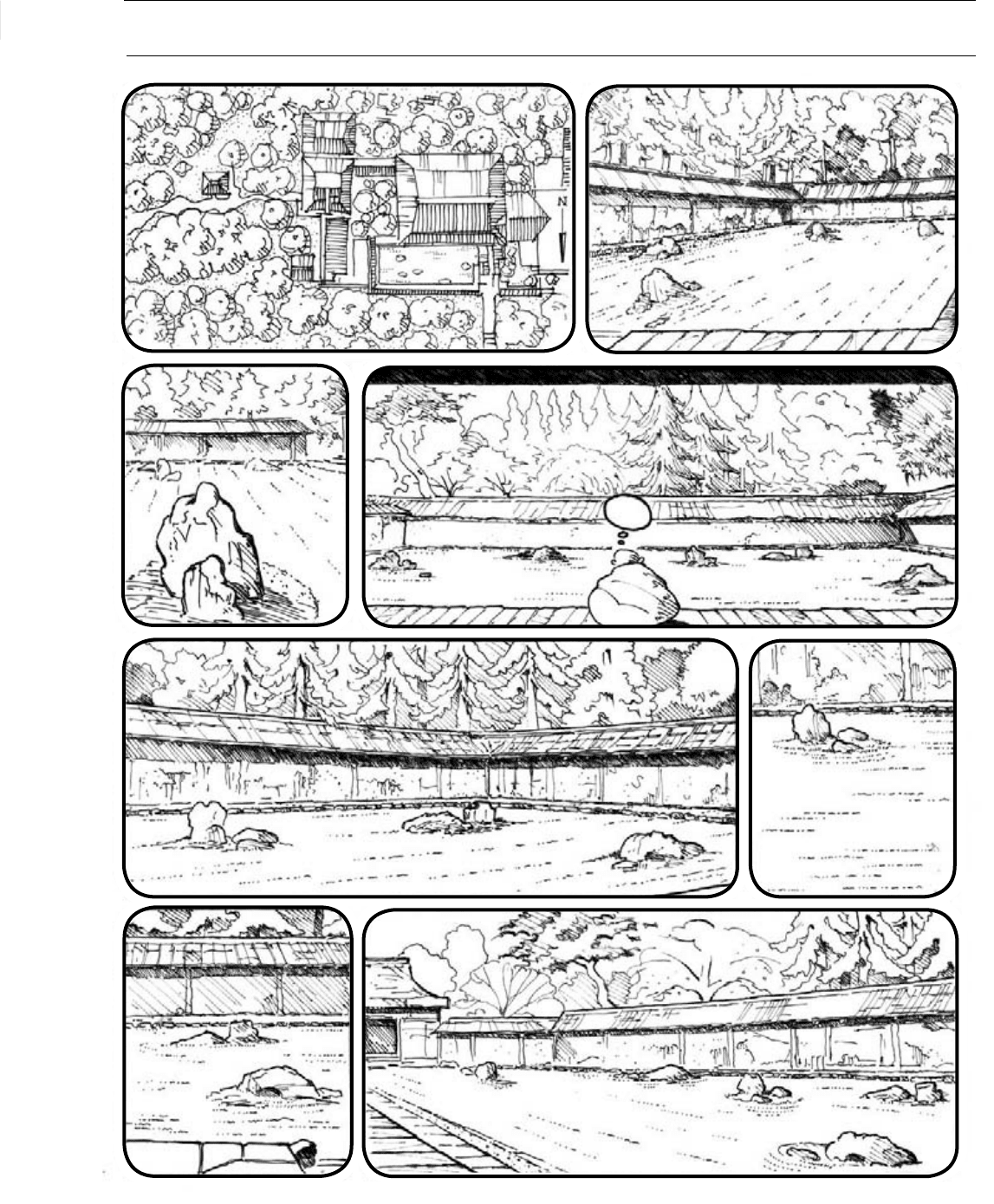
RYOAN-JI
The well-known temple garden at Ryoan-ji
was rebuilt in 1488 following its destruc-
tion during the Onin War. The enigmatic
arrangement of rocks and sand occupies
a walled courtyard on the southern
side of the abbot’s quarters. The 15
rocks, unremarkable in themselves, are
arranged in fi ve groups that create a dy-
namic spatial composition. Visual forces
GINKAKU-JI:
Unlike its Heian
predecessors,
this pond-and-
island-style gar-
den was experi-
enced by walking,
not boating.
Particular vistas
were meant to
be contemplated
from fi xed points
on the path
around the lake.
are balanced in asymmetrical relation-
ships that can be perceived within each
group and within the total ensemble. The
meaning of the abstraction is unclear;
perhaps, in keeping with the spirit of Zen
inquiry, the interpretation is left to the
viewer.
DAISEN-IN
Although Daisen-in was built very early
in the 16th century, it is included in this
chapter as part of the discussion of Zen
gardens. Daisen-in was built in 1509 as
a subtemple of the large Zen monastery
complex of Daitoku-ji. A kare sansui
style garden surrounds the shoin-style
temple. The most famous garden, on the
northeast side, uses rocks and sand to
narrate an allegory of life’s challenges
and resolutions, beginning with the
sacred mountain and concluding in the
endless void.
5
Daitoku-ji held a large collection of
Song art. The Japanese artist Soami
(1472–1523) created the landscape
paintings on the interior walls, and is
thought to have infl uenced the design
of the garden, although no documentary
evidence supports this claim.
15th CENTURY / JAPAN
63
VISUAL NARRATIVE: Ryoan-Ji
64
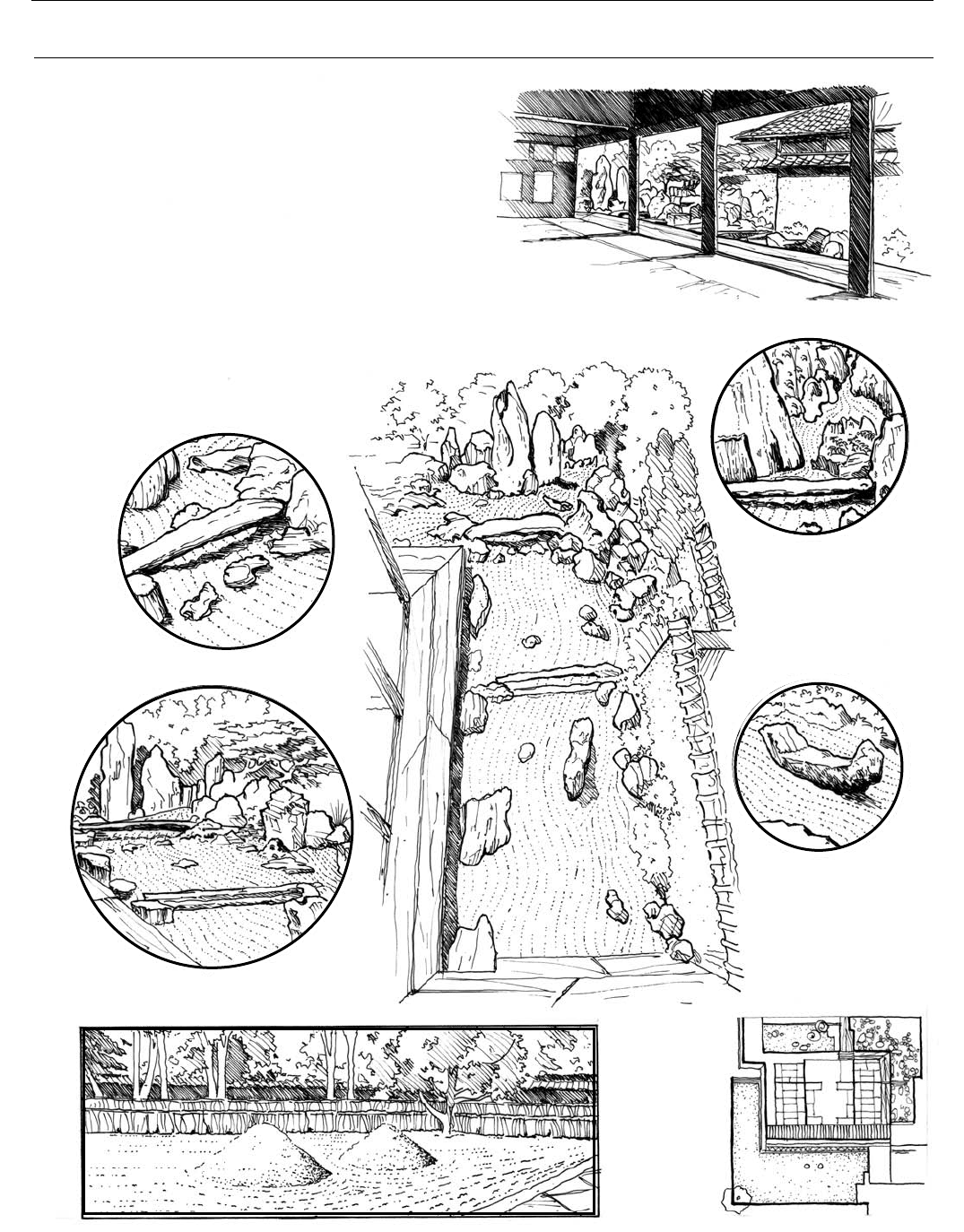
Daisen-In
CASE STUDY:
Observing the garden from the temple’s interior, the visitor’s
gaze moves from left to right. The dry course of water appears
to fall from a high mountain gorge, becoming a river fl owing by
rocks, under bridges, and fi nally out to sea.
The large stone parallel to the edge of the veranda serves as an
eye-drop, bringing the viewer into the scene. The layering of ob-
jects in this small 12 foot by 47 foot space creates a sense of
depth similar to that captured by the Song dynasty painters.
The entry garden on the south side of the temple features two
simple cones of sand; their form probably derives from earlier
utilitarian functions.
6
A wall (not shown) that now bisects the
garden was added in the 20th century based on evidence that
such a structure existed in the original garden.
65
15th CENTURY / CHINA
MING DYNASTY
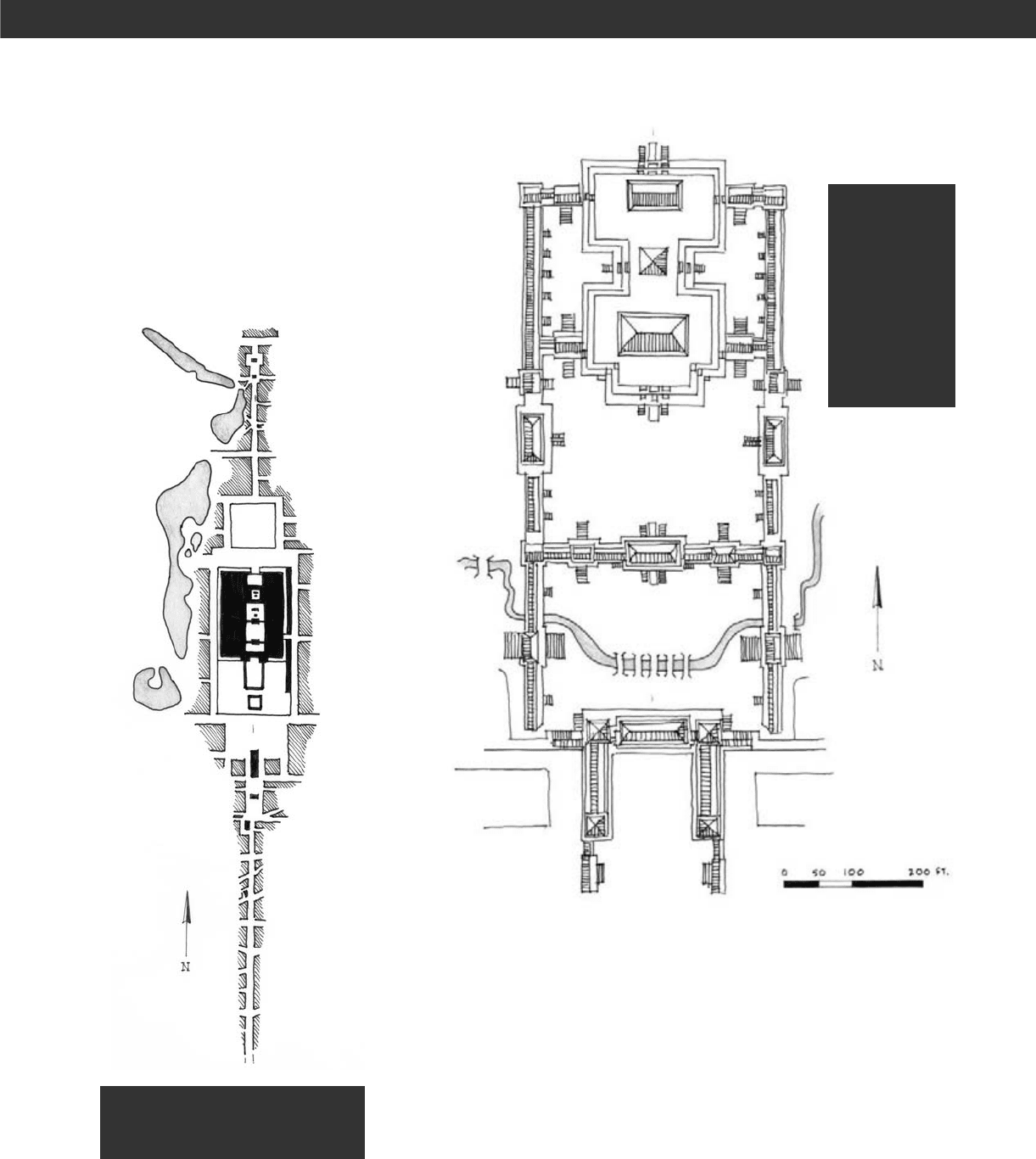
IMPERIAL CAPITAL: The present
form of the Forbidden City was es-
tablished during the Ming dynasty.
PERFECT
HARMONY:
Hierarchically
ordered spaces
emphasized the
divine power
of the Chinese
emperor, who
was always
positioned at
the center.
8
The Yuan dynasty collapsed in 1368 when rebels defeated
the Mongol rulers. The Chinese reestablished themselves
as indigenous rulers during the Ming dynasty (1368–
1644). In 1403, the third Ming emperor, Yongle, moved
the capital back to Beijing and began construction of the
Forbidden City, on the foundations of what remained of
Khublai Khan’s destroyed palace complex.
7
It remained the
imperial capital until 1912.
FORBIDDEN CITY
The Forbidden City consisted of
hundreds of buildings and courtyards
symmetrically arranged around a north-
south axis. All buildings faced south. A
moat and a wall surrounded the Forbid-
den City, which was contained within
the boundaries of the Imperial City. The
emperor and his family occupied the in-
ner court; the outer court was used for
ceremonies and by lesser offi cials. Yongle
further excavated the lake originally
developed by the Khan in the western
section of the city, and as part of an ir-
rigation project created two other lakes
that formed the three “sea palaces” of
the imperial park (Nanhai, Zhonghai, and
Beihai). Earth dredged from the moat
formed an auspiciously located hill,
called Coal Hill (now Jingshan Park), at
the north end of the city.
66
15th CENTURY / CENTRAL ASIA
The close relationship between gardens
and urban form in 15th-century Central
Asia is exemplifi ed by the planned city
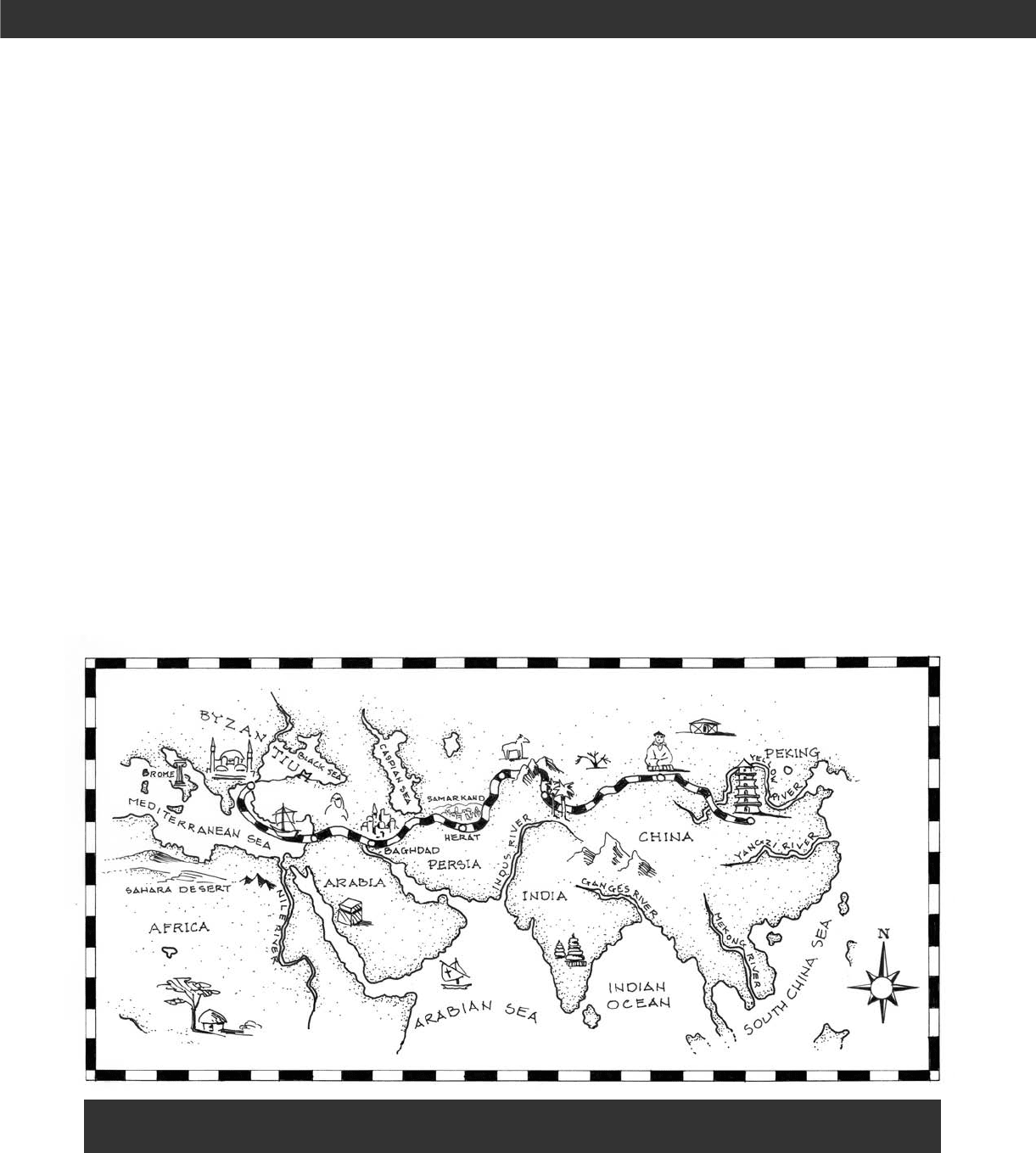
of Samarkand, where the managed
landscape formed an integral part of
the ordered city. Located on the impor-
tant Silk Route between China and the
Mediterranean, Samarkand reveals the
infl uences of many different cultures.
Founded by the Persians in the 8th
century BCE, the city was conquered
by Alexander in the 4th century BCE,
overrun by the Turks in the 6th century
CE, and dominated by the Arabs in the
8th century, when it became a center
of Islamic scholarship. Samarkand was
sacked by the Mongols in 1220. Timur
(1336–1405, also known as Tamerlane)
established Samarkand as the capital
of his empire in 1370, and rebuilt the
city as a cultural mecca.
TIMURID GARDEN CITIES
A nomadic tribesman from Central
Asia, Timur wanted to control lucra-
tive trade routes, and through ruthless
warfare subjugated lands from India
to Turkey, including parts of Russia. He
weakened Mongol power in Central Asia
and crippled the Ottoman Turks who
were threatening Europe. The King of
Castile (northern Spain) sent an envoy,
Ruy Gonzalez de Clavijo, to establish
diplomatic ties with Timur. Clavijo’s de-
scriptions remain an important source
of information on the lush gardens and
fertile plains of Samarkand.
9
The court moved to Herat after Timur’s
death. The Timurid period, from the late
14th to early 15th centuries, was described
by Timur’s descendent Babur as the
Golden Age for art and science.
10
Obser-
vatories were built and constellations
mapped; Herat and Samarkand blossomed
under the leadership of Timur’s heirs.
FOUR-FOLD
GARDEN
GEOMETRY
Once surrounded by forests, orchards,
and meadows, the gardens at Samar-
kand have vanished. But the pleasure
gardens and royal encampments
described by Clavijo and Babur estab-
lished a prototype for later gardens:
the four-square garden with water
axis and central pavilion. Although the
rectangular subdivision of space is
evidenced in ancient Persian gardens,
the fi rst reference to this form as
chahar-bagh (literally, “four gardens”)
was during Timur’s reign.
11
SILK ROUTE: Material goods, scientifi c concepts, and philosophical ideologies were transferred between continents, enriching
cultures worldwide.