
Boults Е. Illustrated history of landscape design
Подождите немного. Документ загружается.

17
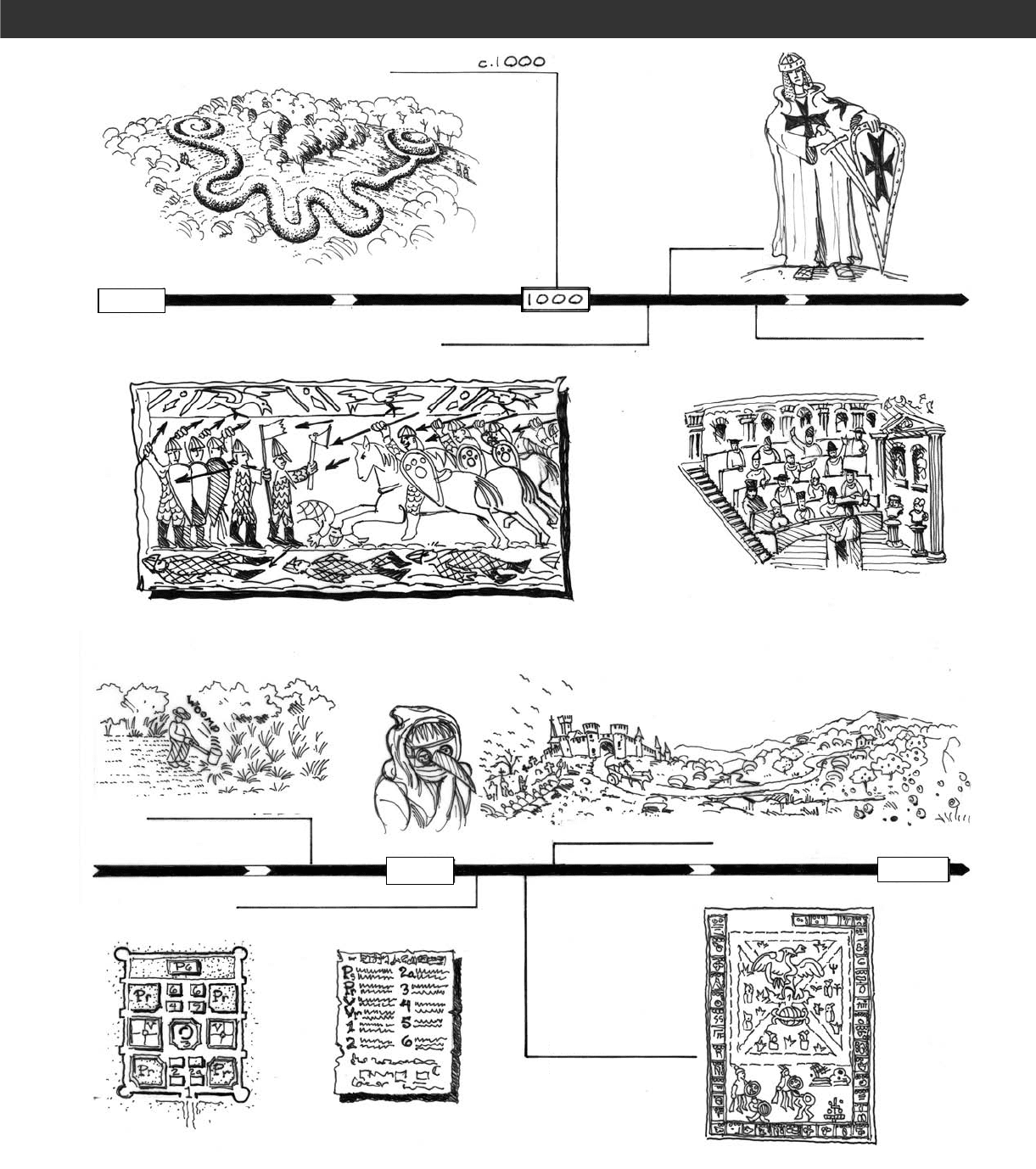
MIDDLE AGES / A BRIEF CHRONOLOGY
1000
1300
1400
1070
1260
1346
1305
1325
1088
1074 – 1291
SERPENT MOUND
BAYEUX TAPESTRY
FLOWERY MEAD
BLACK DEATH
VILLA MANAGEMENT
AZTEC CAPITAL
FIRST UNIVERSITIES
CRUSADES
900

18
532 CONSTANTINOPLE
Hagia Sophia was rebuilt on the site of a
centuries-old basilica in Constantinople
(Turkey) by Emperor Justinian I. As the
capital of the eastern Roman Empire,
Constantinople became the leading
European power while Rome declined.
About 1 million people lived in Constanti-
nople in the 5th century, second only to
Baghdad.
c. 700–1400 HOHOKAM CANALS
The Hohokam peoples of southern
Arizona diverted water from the Salt,
Gila, and San Pedro rivers in a complex
system of irrigation canals that enabled
the cultivation of fi elds more than 16
miles distant from their water source.
The more than 250 miles of canals were
created with simple tools and human
power.
c. 750–1035 VIKING AGE
The constant threat of Viking raids on
northern Europe, and the Viking con-
quests of Britain during the 9th and
10th centuries, made the landscape
unsafe and contributed to the medieval
European mind-set of seeking protection
from nature.
752 GREAT BUDDHA
The Great Buddha, or Daibutsu, was
constructed by Emperor Shomu at Nara
(Japan). Buddhism spread to Japan
from India by way of China and Korea,
assimilating elements of folk religions
along the way.
836 SAMARRA (IRAQ)
The palace city of Samarra, with its
iconic spiral minaret at the Grand
Mosque, was the administrative head-
quarters of the Abbasid caliphs for a
brief period in the 9th century. Archeolo-
gists have found evidence of irrigation
channels at Samarra, suggesting the
existence of palace gardens.
c. 1000 SERPENT MOUND
Over a quarter mile long, the Serpent
Mound, built by the Fort Ancient culture
of Ohio, is the largest animal effi gy in
existence. Snakes were signifi cant in
Native American mythology, but the
purpose of Serpent Mound confounds
archeologists to this day.
1070 BAYEUX TAPESTRY
The Bayeux tapestry was commissioned
by Bishop Odo (half-brother of William
the Conqueror) to illustrate the events
surrounding the Norman invasion of
England in 1066. The 230-foot-long
embroidered cloth depicts William’s vic-
tory at the Battle of Hastings, which led
to the imposition of the European feudal
system on Britain.
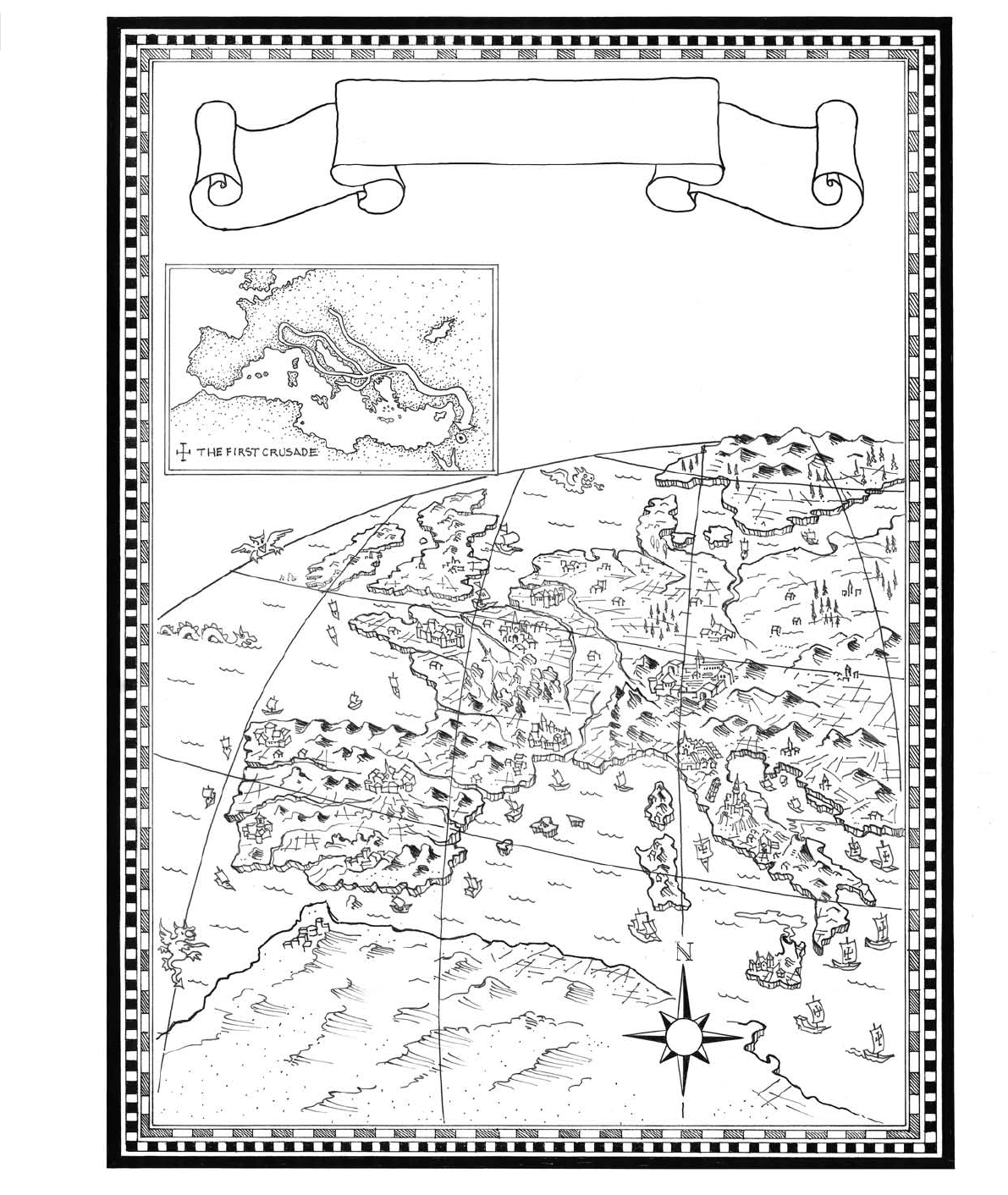
1074–1291 CRUSADES
The fi rst crusades were initiated by Pope
Urban II to liberate Christian holy sites
from Muslim control and to support
the Byzantine emperor against threats
from the Islamic empire. Although the
crusades resulted in an important
exchange of information and knowledge
between East and West, a wave of
violence and persecution ensued, which
was particularly devastating to Jewish
communities.
1088 FIRST UNIVERSITIES
The University of Bologna, founded
around the study of rhetoric, grammar,
and logic, later expanded its curriculum
to include philosophy and mathemat-
ics—subjects fi rst developed by the
Arabs and Greeks. In the 12th century,
Frederick I (Barbarossa) declared Euro-
pean universities free from the infl u-
ences of church and state, establishing
an enduring model of scholarship that
thrived during the Renaissance.
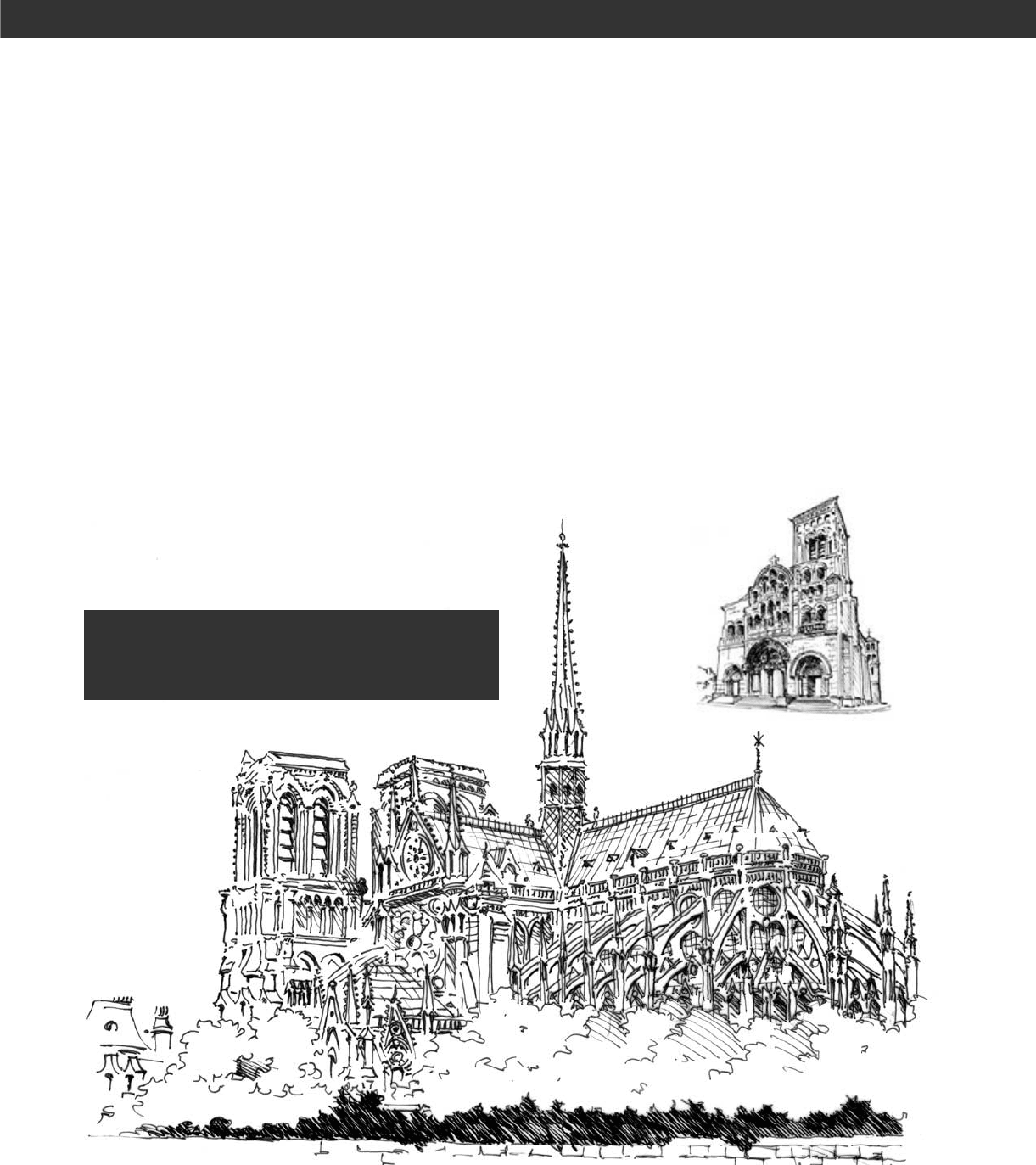
c. 1100–1200 CATHEDRALS
During the surge of large-scale cathe-
dral building projects in Europe, new
architectural forms such as the ribbed
vault, pointed arch, and fl ying buttress
emphasized verticality and defi ned the
Gothic style. The focus was on the
heavenly realm above, rather than the
earthly realm below.
c. 1125 ANGKOR WAT
The Khmer empire of Cambodia had its
capital at Angkor from the 9th–15th
centuries. The temple complex called Ang-
kor Wat was symbolic of Hindu cosmol-
ogy, with its concentric canals, terraces,
galleries, and central temple. The temple’s
roof structure represented sacred Mount
Meru, an axis mundi between sacred and
profane worlds.
c. 1200 ANASAZI
The cliff dwellings at Mesa Verde, Colo-
rado, are typical of the highly organized
Anasazi culture of the American South-
west. Construction peaked at around
1200 CE. The mesas and cliffs were oc-
cupied by the Anasazi for over 700 years,
but completely abandoned by 1276.
c. 1200–1300 THE “SHAMBLES”
The dense fabric of a medieval city
refl ected its commercial function. Space
was at a premium; workshops and living
quarters encroached on public space,
creating the intimate streetscape that
characterizes medieval European cities
today.
1260 FLOWERY MEAD
Albertus Magnus wrote a gardening man-
ual, De Vegetabilibus et Plantis, based on
ancient Roman and contemporary English
treatises. Albertus also described a
pleasure garden and included detailed in-
structions for creating a “fl owery mead.”
1305 VILLA MANAGEMENT
Piero de’ Crescenzi wrote Liber Ruralium
Commodorum, borrowing extensively from
Albertus Magnus. His practical advice on
agricultural estate management at vari-
ous scales was particularly valuable to
villa designers of the Italian Renaissance.
1325 AZTEC CAPITAL
The Aztec capital of Tenochtitlan (Mexico
City) was founded where, according to
legend, an eagle perched on a cactus
growing from a rock near a spring.
1346 BLACK DEATH
The plague struck Europe, killing one-third
to one-half of the population. The epi-
demic spread along active trade routes.
People abandoned the city and sought
refuge in the countryside.
MIDDLE AGES / A BRIEF CHRONOLOGY
19
From the fall of the Roman Empire to
the rebirth of humanist ideals in the
Renaissance, the focus of western
European culture turned inward. Lacking
a central authority to maintain the
political, social, economic, and physical
infrastructure, the landscape fell into
ruin. Rival militias battled to establish
control over the land. The plague rav-
aged cities and towns. People sought
protection within walled castles, and
spiritual fulfi llment within walled monas-
teries. Oppressed by the hardships of a
feudal economy, individuals focused on
the glorious promises of the next world
rather than on the harsh limitations of
The Catholic Church was able to assume
a powerful role in the Middle Ages by
establishing ecclesiastical seats in
formerly imperial towns. The coronation
of Charlemagne as Holy Roman Emperor
by Pope Leo III in 800 CE brought about
a degree of stability to western Europe,
and shored up the papacy’s hold on its
lands. Monasticism fl ourished as spiri-
tual and mystical communities formed
apart from the secular world. In an en-
vironment besieged by violence, disease
and repression, ancient knowledge was
preserved in monasteries, where monks
copied both historical manuscripts and
the contemporary texts brought by
travelers from the east who took shelter
within their retreats. Arab scholars also
brought new knowledge of plants and
horticultural practices to the west.
Some religious mystics sought solitude
in the landscape, living as hermits in
caves rather than in monastic communi-
ties. The landscape, once considered sa-
cred in itself, represented in the Middle
Ages a place of penance; a wilderness to
be tamed, eventually, within the literal
and allegorical confi nes of the walled
garden.
RELIGIOUS FERVOR: Powerful bishops built great cathedrals
from the 11th–14th centuries, in the Romanesque and, later,
Gothic, style. The cathedral of Notre Dame in Paris was
begun in 1163.
WALLED MINDS,
WALLED GARDENS
20
MIDDLE AGES / WESTERN EUROPE
21
Agriculture was the primary activity of
life in the early Middle Ages. The many
prose poems and treatises on gardening
practices written by medieval scholars
attest to the importance of a healthy,
productive landscape. People were tied
to the landscape socially, politically, and
economically in a feudal system where
entitlement to land equaled power.
The function of the early medieval gar-
den in Europe was primarily utilitarian.
People grew vegetables and herbs for
food and medicine. In the late Middle
Ages, a money economy developed and
cities emerged as trading centers.
An infl uential “middle class” began to
evolve from the powerful guilds and
burgeoning merchant class. As trade
resumed and the landscape grew less
frightening, people with means built
pleasure gardens. The garden became
laden with allegorical symbolism both
sacred and profane, and was the locus
for literary tales of chivalry and courtly
love.
Sources of information about early
medieval gardens in western Europe are
limited. Evidence from the 9th century
includes Charlemagne’s Capitulare de vil-
lis, or regulations on the administration
of imperial towns; the idealized “Plan
of St. Gall”; and poems written by two
monks, one containing a detailed list of
plants similar to Charlemagne’s, and
the other a gardening calendar. Later
sources include the many paintings,
tapestries, illuminated manuscripts,
and literary descriptions of gardens
that date from the 13th–15th centuries.
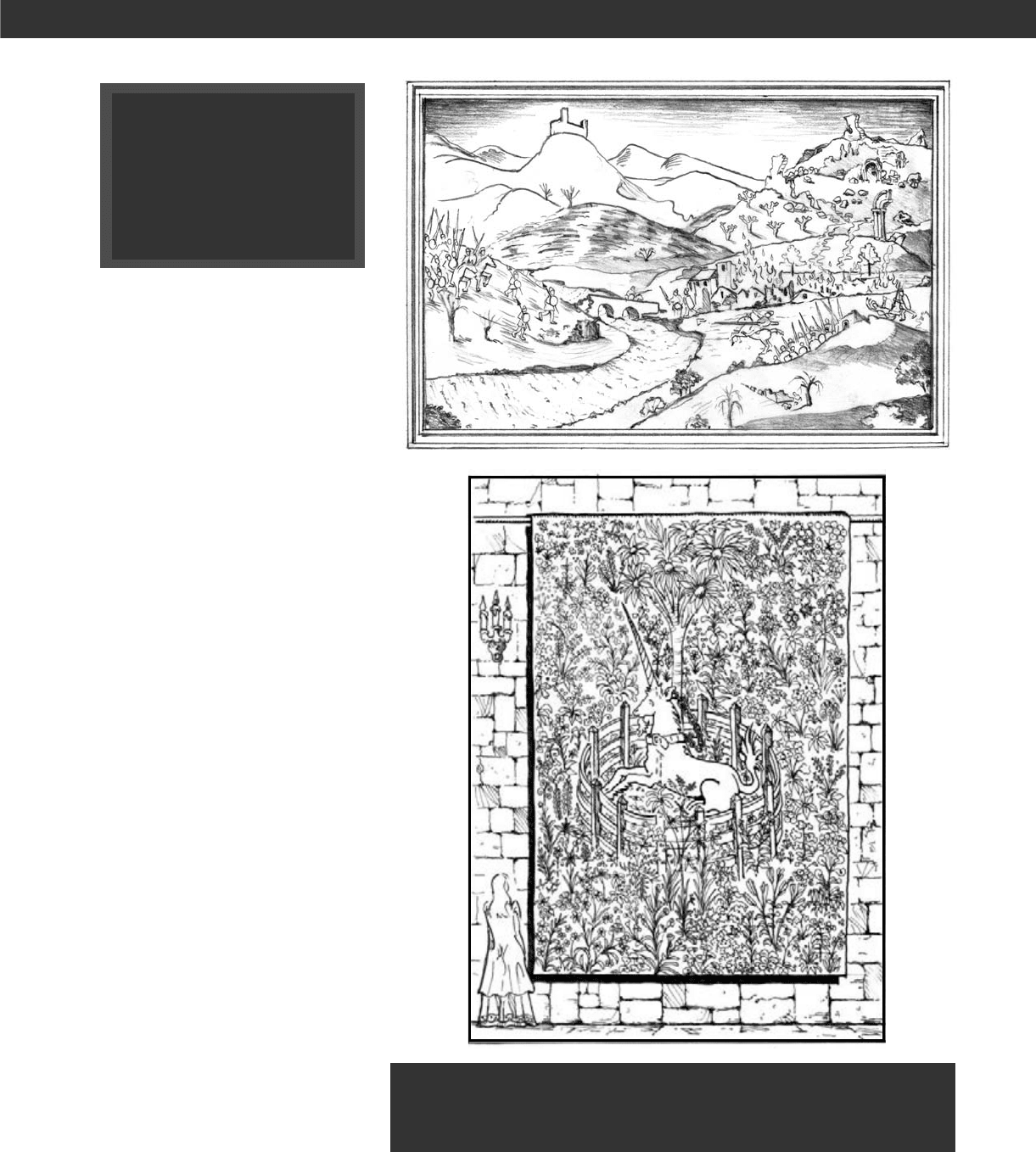
SCARY PLACES: The Effects of
Good and Bad Government on the
City and Countryside were pan-
oramic frescoes painted by Ambrogio
Lorenzetti at the Palazzo Pubblico in
Siena, Italy, in 1338. They document
the important relationship between
the urban and rural landscape during
the Middle Ages.
KEY SOURCE: The Unicorn Tapestries displayed at the Cloisters in New York date from
the 15th century. The story of the hunt of the elusive unicorn can be understood as
an allegory of courtly love or interpreted as a metaphor for events in the life of Christ.
The garden scenes contain remarkably accurate depictions of plants and fl owers.
MIDDLE AGES / WESTERN EUROPE
22
MIDDLE AGES / WESTERN EUROPE
USES AND SYMBOLISM OF WALLED GARDENS
The walled garden of the Middle
Ages, however simple in concept and
form, existed as a place cultivated
and tended, a locus amoenus, or
pleasant place, separated from the
dark wild. The hortus conclusus, or
enclosed garden, the pleasance, or
pleasure garden, and the monastic
cloister garden all are characteris-
tic forms of medieval gardens.
The hortus conclusus became
symbolic of the Virgin Mary following
the religious zeal of the Crusades.
Verses taken from the Song of
Solomon describe elements typical
of a hortus conclusus: the “fountain
in my gardens”; “a spring of running
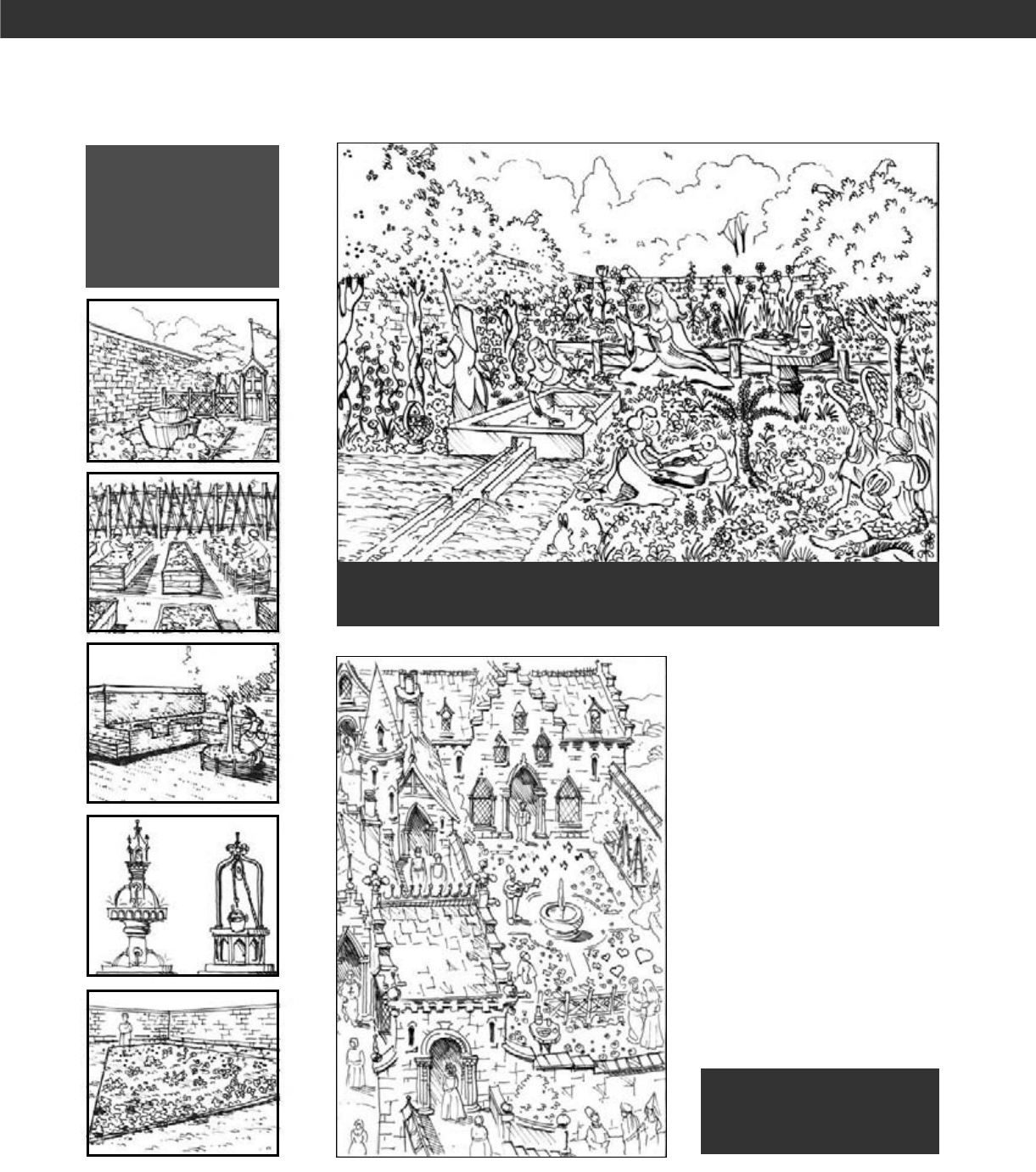
PLEASANCE: Pleasance gardens
are associated with the cult of
chivalry and knighthood that
emerged in the late Middle Ages.
COMMON ATTRIBUTES:
Medieval gardens typically
included a wall or fence, the
geometric subdivision of
raised planting beds, turf
seats, a well or fountain,
and grass or “fl owery mead.”
HORTUS CONCLUSUS: Depictions of medieval walled gardens are laden with religious
symbolism. A walled garden is mentioned in the Song of Solomon and is understood as
representing the chastity of the Virgin Mary.
1
23
water”; “the closed gate.” Sym-
bolic fl owers include lilies (purity),
roses (martyrdom), and violets
(humility).
2
The pleasance, nestled within
the castle walls, was a safe
place for both refl ection and
recreation, and served as an
escape from the dark confi nes
of the castle. A herbarium
contained the more utilitarian
aspects of the pleasance, like
the herb garden and lawn area,
while the viridarium contained
more ornamental plants and
trees. Particularly elaborate
pleasance gardens contained
labyrinths, mounts, topiary, and
even menageries.
Monasteries were self-suffi cient
centers of learning, work, and
prayer. Monks had to be knowl-
edgeable about botanical sci-
ence and medicinal herbs for the
sustainability of the community.
Kitchen gardens and “physic”
gardens yielded food, vegetables,
seasonings, and medicines. The
monks cultivated fl owers, such
as the lily and the rose, to
decorate altars. They concocted
dyes and pesticides from other
plant species. The fi rst hospi-
tals and universities in Europe
evolved from the monastery
paradigm.
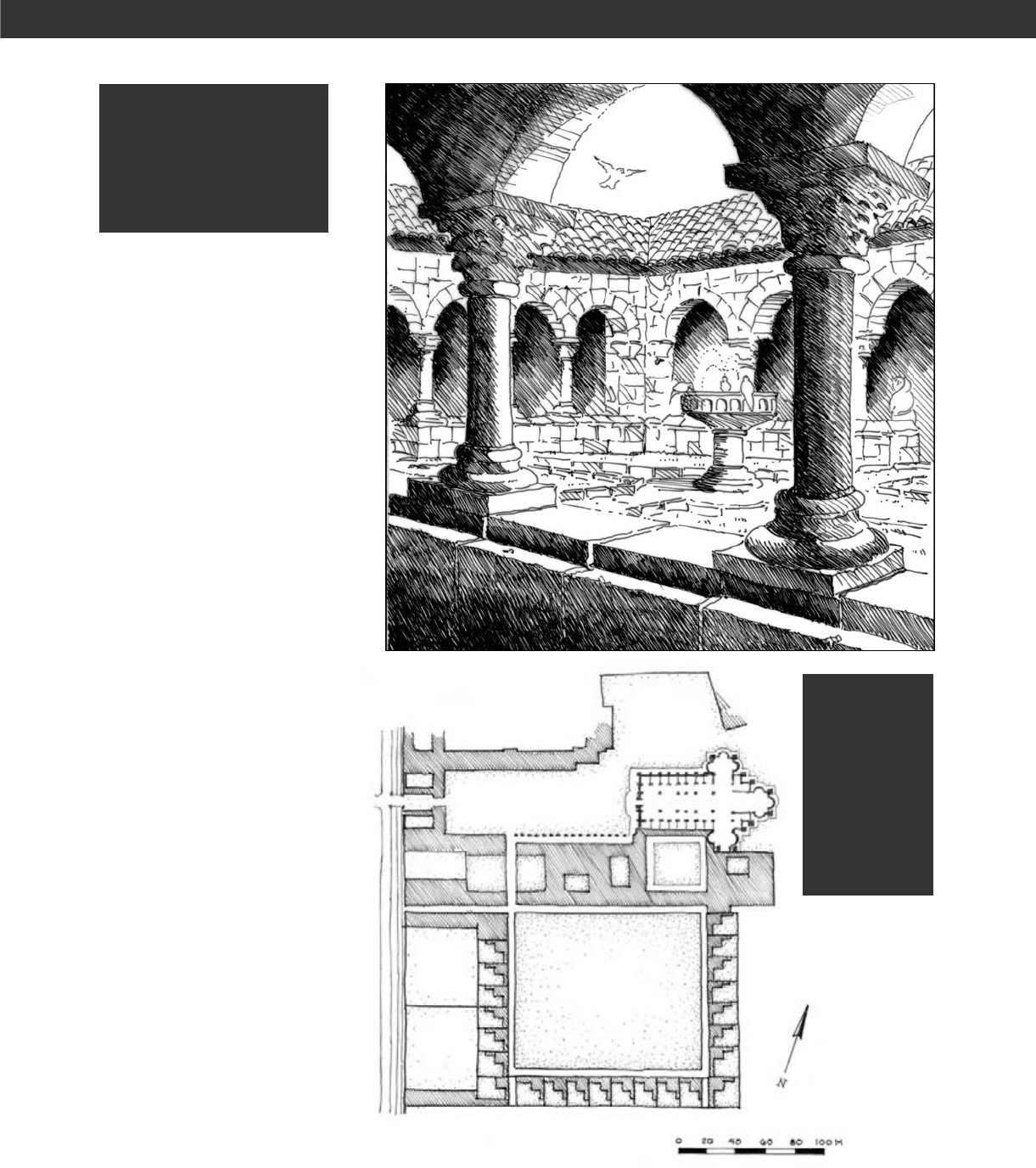
CLOISTER: The cloister gar-
den is similar in form to the
peristyle garden of the Roman
domus—a colonnaded ambula-
tory surrounding a typically
square courtyard with a central
basin or fountain.
MIDDLE AGES / WESTERN EUROPE
HIERARCHY
OF SPACE: The
great cloister at
the Certosa di
Pavia (c. 1396)
is surrounded
by the individ-
ual cells of the
monks, each with
its own small
garden.
24
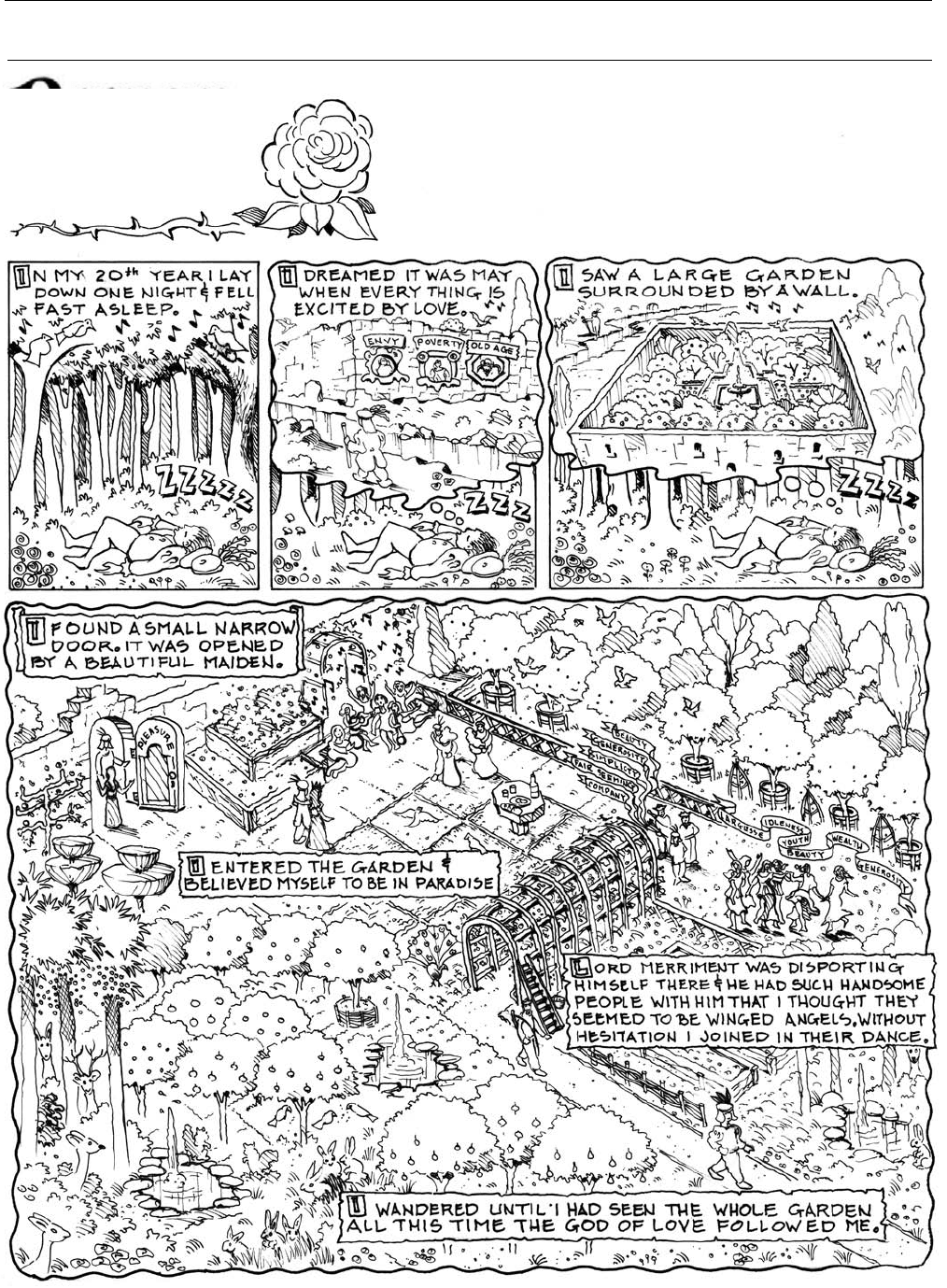
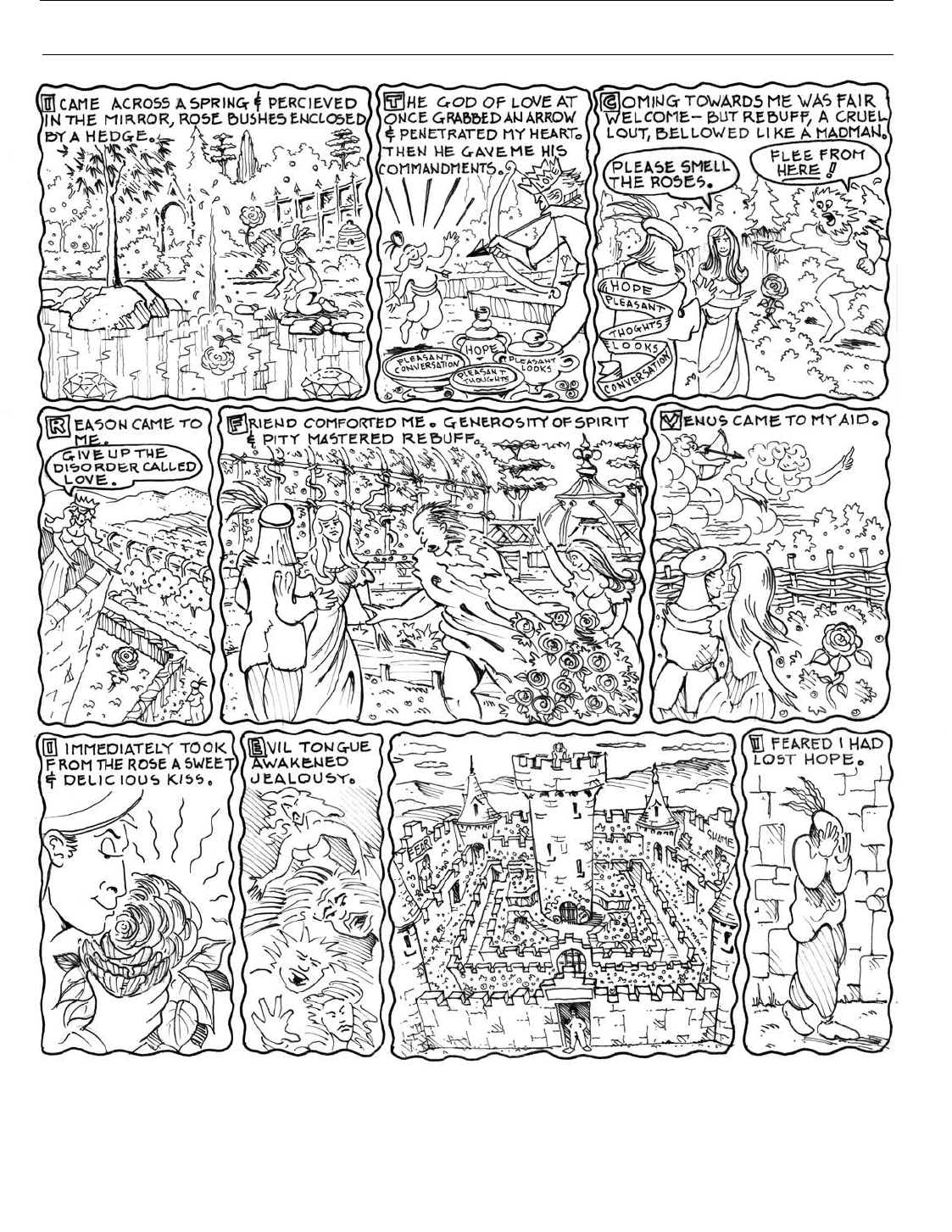
THE ROMANCE OF THE ROSE is a 13th-century allegory of courtly love
begun by the French poet Guillaume de Lorris around 1230 and completed
by Jean de Meun 40 years later. The story of love’s trials and tribulations
was extremely popular—the manuscript was copied for centuries and kept
in print until the 16th century. The illustrations and descriptions of the
story’s setting have continued to be a source of information on all aspects
of medieval life, particularly the form and function of medieval gardens.
VISUAL NARRATIVE
25
VISUAL NARRATIVE
25
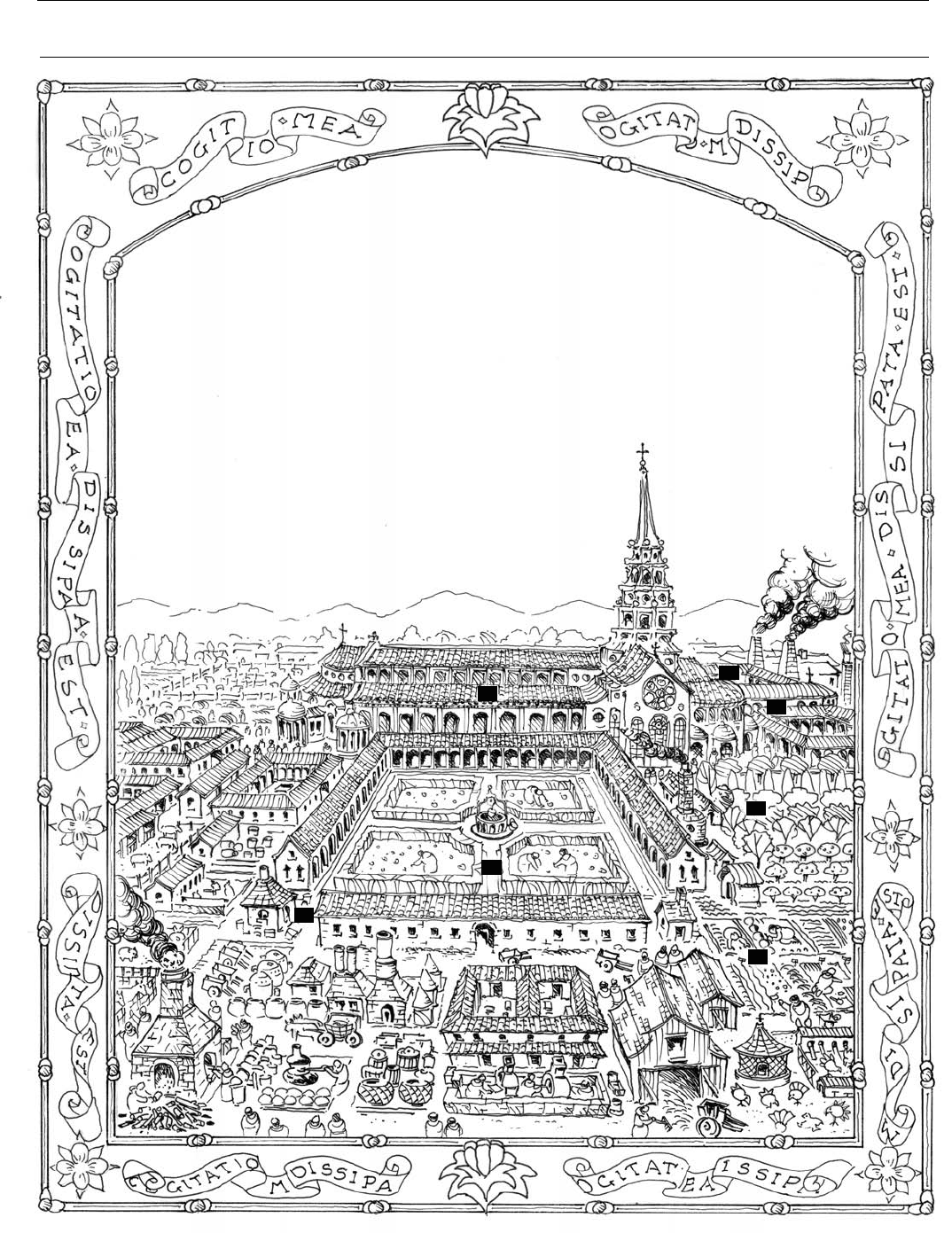
26
CASE STUDY: The Plan of St. Gall
A
B
C
D
E
F
G