
Bowker M., Davies P.R. (Eds.) Scanning Tunneling Microscopy in Surface Science, Nanoscience and Catalysis
Подождите немного. Документ загружается.

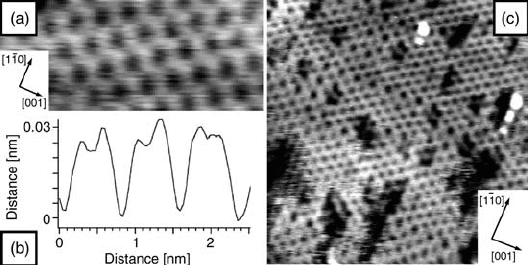
double peak features (see Figure 4.3, in particular the line scan frame (b)). The two
peaks in each feature are reported of the same height and are separated by an internal
distance of about 2.8 Å [18]. Extensive DFTcalculations, varying not only the positions
of atoms but also the chemical stoichiometry of the units, have been performed for
the structure search. The possibility of compressed oxygen is clearly excluded by the
decrease in the adsorption energy when the density is increased. Assuming an
identical number of H and O in one unit cell, the only possible candidate of a double
peak feature is the OH group. However, the simulated STM images of the OH-Rh
(1 1 0) surface are in strong disagreement with the experimental results. Changing
the stoichiometry of hydrogen and oxygen to 3 : 2, two stabilized c(2 2) structures
are obtained. In the first structure, shown in Figure 4.4a, all oxygen atoms adsorbed
at the threefold coordinated sites of the Rh surface, showing a zigzag pattern along
the [1
1 0] direction. In the [0 0 1] direction, the oxygen atoms are in a paired
arrangement, with an OO distance of 2.77 Å. The hydrogen atoms are between two
adjacent O atoms, resulting in a network of planar hexagonal rings above and parallel
to the Rh surface. We call this structure c(2 2)A. The STM simulations on c(2 2)A
are limited by the low current values obtained [64, 65]. In order to make the
simulations comparable between the test configurations, we generated simulated
current maps at identical tip–surface distances. As shown in Figure 4.4b and c, a clear
double peak feature emerges, as the tip approaches the surface. The internal OO
distance in these simulations is in very good agreement with experimental results.
The second stable configuration is shown in Figure 4.5a. Here, the hexagonal
network is formed by OH groups and water molecules. The hydrogen atoms belong
either to OH or to H
2
O but are not equally shared by two adjacent oxygen atoms as
in the structure c(2 2)A. In each of the OH groups, the oxygen atom is close to
the short bridge site of the surface, whereas the hydrogen atom points upward
forming a hydrogen bond with the oxygen atom of the water molecule. In the layer of
water molecules, the oxygen atoms are roughly above the threefold sites of the
Figure 4.3 c(2 2) structure: (a) zoom on the
reaction intermediate structure. Dimensions:
6.0 nm 2.5 nm. Parameters: I ¼0.6 nA,
V
B
¼þ0.6 V. (b) Line profile on the hexa-
gonal structure along [0 0 1]. (c) STM image
of the surface obtained by dosing water up to
saturation at 170 K on 0.35 l O
2
adsorbed at
200 K and annealing the surface at 223 K.
Dimensions: 15 nm 15 nm. Parameters:
I ¼1 nA, V
B
¼þ0.12 V. (Reprinted with
permission from Ref. [18].)
104
j
4 Theory of Scanning Tunneling Microscopy and Applications in Catalysis
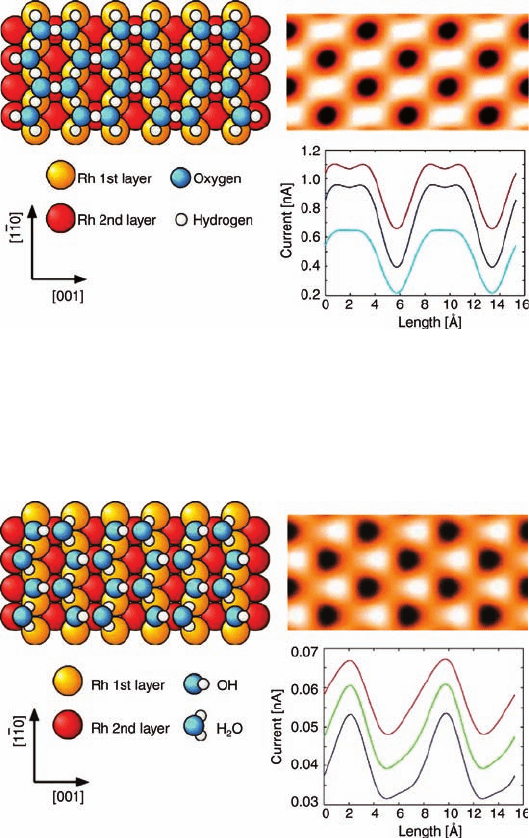
Rh surface, whereas the hydrogen atoms point downward to the on-top sites. We call
this configuration c(2 2)B. The constant height current maps are shown in
Figure 4.5b and c. It can been seen that it is not possible to image the H
2
O þ OH
unit as a double peak.
Figure 4.5 c(2 2)B structure. Left panel: structural model. Right
top panel: corresponding simulated STM image (V
B
¼þ1.30 V,
I ¼0.002 nA). The protrusion maxima correspond to water
molecules, whereas the depressions correspond to Rh atoms.
Right bottom panel: simulated current profiles along [0 0 1] at
decreasing (blue to red) tip–surface distances. (Reprinted with
permission from Ref. [18].)
Figure 4.4 c(2 2)A structure. Left panel: structural model. Right
top panel: corresponding simulated STM image (V
B
¼þ1.30 V,
I ¼0.04 nA). The protrusions correspond to oxygen couples,
whereas the depressions are the hollow sites surrounded by OH
complexes. Right bottom panel: simulated current profiles along
[0 0 1] at decreasing (light blue to red) tip–surface distances.
(Reprinted with permission from Ref. [18].)
4.5 Catalytic Water Production
j
105
Comparing the two c(2 2) structure models, we find that the adsorption energy
per unit cell of c(2 2)B is about 1.5 eV higher than that of c(2 2)A. This means that
under realistic experimental conditions one should always see c(2 2)B, and never
c(2 2)A. However, it is well known that this reaction process inevitably includes
hydrogen atoms or molecules on the Rh surface itself. In general, these hydrogen
atoms are very mobile on transition metal surfaces under ambient conditions.
Although these hydrogen atoms are usually invisible in STM measurements [66, 67],
they may play an important role in the stabilization of surface structures. Even
though this assumption certainly requires additional experimental and theoretical
analysis of the problem, it could solve the riddle why the structure seen in the STM
experiments is not, according to DFT simulations, the structure of lowest total
energy.
On the basis of the experimental details in Re f. [18] and our theoretical
investigations, we p ropos e a pos sible reaction mechanism. In the first step, th e
adsorption of hydrogen occurs on the (2 1)p2mg-O/Rh(1 1 0) surface. Half of the
oxygen is removed due to the adsorption of hydrogen molecules. Because of its
small size, these hydrogen molecules are invisible in the STM measurements. In
the second step, the remaining oxygen atoms are pushed away from the threefold
coordinated sites and moved cl ose t o the short-bridge sites, resulting in the less
condensed c(2 4) structure, shown in Figure 4.2a. Since the oxygen atoms are
chemically bonded to the Rh surface, th e driving force of the formation of th e close-
packed c(2 2) structure should also be the invisible H atoms. Very likely, the c
(2 2)A structure is initiated at some surface defect. The surrounding O atoms a re
then pushed c lose to the c(2 2) isl and and s tabilized by hydrogen bonds. The c
(2 2) i sland expands until all O atoms on the Rh surface are reacted. In the third
step, the H atoms attack the molecular units in the c(2 2) island, leading to water
formation. The produced water molecule s then evaporate, leaving onl y a clean Rh
(110) surface.
4.5.1
TiO
2
: A Catalytic Model System
In the past few years, a large number of experimental and theoretical studies have
focused on metal oxide surfaces with the aim of gaining insight into their catalytic,
photocatalytic, and gas-sensing activity [68]. Owing to its thermodynamic stability
and relatively easy preparation, the rutile TiO
2
(1 1 0) surface has evolved into one
of the key models for metal oxide surfaces. For example, it has been extensively used
in the research of biocompatible materials, gas sensors, and photocatalysts [69].
The rutile TiO
2
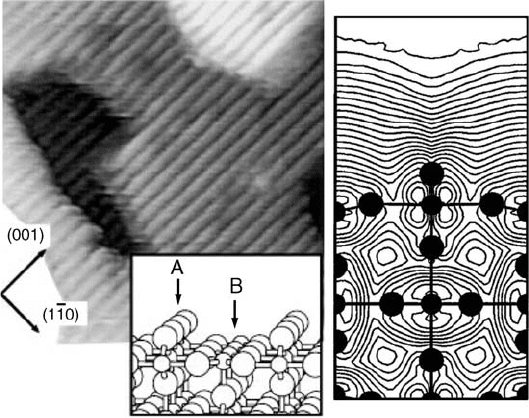
(1 1 0) surface is characterized by alternate rows of fivefold
coordinated Ti (Ti
5c
) and twofold coordinated bridging O atoms (O
br
or, equivalently,
O
2c
) along the [0 0 1] direction (Figure 4.6). Its detailed surface relaxation, determined
from quantitative low-energy electron diffraction (LEED-IV) studies [70], has proved
a very severe test for DFT approaches aiming at reproducing the experimental data.
Only recently has it been possible to clarify the apparent discrepancies between
LEED-IV and first-principles data. In a very detailed DFT study, using films of up to
106
j
4 Theory of Scanning Tunneling Microscopy and Applications in Catalysis
13 OTiO
2
O trilayers and reducing computational approximation errors, Thomp-
son and Lewis [71] have been able to achieve excellent quantitative agreement with
the experimental data. In the same paper, it has alsobeen pointed out that a minimum
of five trilayers slab is required to recover the experimental TiO bond lengths [71].
The STM contrast for TiO
2
(1 1 0) is governed by electronic rather than geometric
properties (see Figure 4.6) [72]. Thus, contrary to expectations from geometrical
considerations, the deeper lying Ti
5c
rows are imaged as the bright rows by STM,
while the bridging oxygen atoms (O
br
) are imaged as the dark rows for physically
meaningful tip–surface separations (see Figure 4.6). However, despite the qualitative
agreement between experiment and constant density contours, the explicit inclusion
of W tips as in the experiment does not yield a quantitative match with the
experiments for the simulated tunneling conditions (see Figure 4.7) [4].
Figure 4.7b shows a close-up of Figure 4.7a, a 300 pA constant I
t
contour, which has
a corrugation of approximately 100 pm and is located approximately 300 pm from the
O
2c
surface atoms. These values disagree quantitatively with experimental STM
results at the same tunneling conditions on two accounts. First, a set point of
I
t
¼300 pA is not a particularly large value for constant current STM imaging, and
Figure 4.6 Left: STM image of a stoichiometric
1 1 TiO
2
(1 1 0) surface, 14 Å 14 Å. Sample
bias þ1.6 V, tunneling current 0.38 nA. The
inset shows a ball-and-stick model of the
unrelaxed 1 1 TiO
2
(1 1 0) surface. Rows of
bridging oxygen atoms are labeled A and
rows of fivefold coordinated titaniums B.
Right: contour plots of [0 1 1]-averaged charge
densities associated with electron states within
2 eV of the conduction band minimum for the
relaxed 1 1 stoichiometric surface. Contour
levels correspond to a geometric progression
of charge density, with a factor of 0.56 sepa-
rating neighboring contours. The noise in
the topmost contours is an artifact of the
periodically repeated slab geometry.
(Reprinted with permission from Ref. [72].)
4.5 Catalytic Water Production
j
107
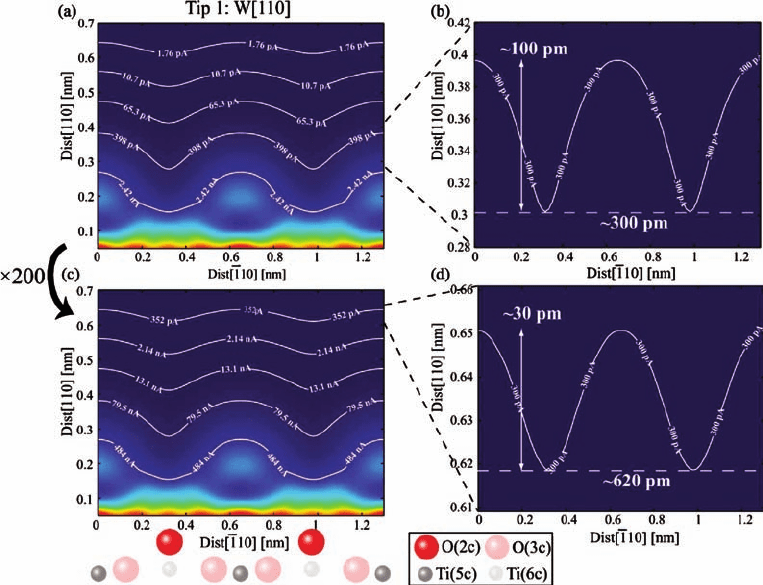
thus one would assume that the tip should be probing the surface at considerably
larger distances than the approximately 300 pm indicated in Figure 4.7b. Second,
the resulting constant I
t
corrugation for the 300 pA contour is much larger than
experimental results for the same tunneling conditions (see Figure 4.8 [3]), where a
30 pm corrugation over the Ti(5c) and O(2c) rows was reported for an I
t
set point of
300 pA. If the initially calculated I
t
values for the atom-ended W(1 1 0) tip are scaled
up by a factor of 200, the agreement is, however, almost perfect as shown in
Figure 4.7c and d. The close-up on the resulting constant contour of 300 pA
(Figure 4.7d) shows that not only has it moved further from the surface and is now
located at a more meaningful 620 pm distance from the surface but also the resulting
corrugation of 30 pm matches the reported corrugation in Ref. [3] almost perfectly.
The origin of the discrepancy can be traced back to several sources. First, the
bSKAN code [6, 33] used for the tunneling current calculation does not allow the
atoms in the tip and surface to relax prior to the evaluation of the I
t
when the surface
Figure 4.7 (a) Calculated I
t
map for the W[1 1 0]
tip (tip 1) taken across the Ti(5c) and O(2c)
rows. (c) Same as (a) only scaled by a factor
of 200. Below (c), a ball model indicates the
position of the different types of atoms in
topmost surface layer. Both (a) and (c) show
five logarithmically equidistant space constant I
t
contours. (b) and (d) Close-up of (a) and (c),
respectively, showing the position of the 300 pA
constant I
t
contour. (Reprinted with permission
from Ref. [4].)
108
j
4 Theory of Scanning Tunneling Microscopy and Applications in Catalysis
model consists of more than one type of atoms [15]. This effect may significantly
increase the measured I
t
. Second, the STM experiments are performed on a reduced
TiO
2
crystal, and states introduced in the bandgap, for example, by Ti bulk inter-
stitials [73], have been shown to increase the overall conductivity of the TiO
2
crystal [74–76]. The theoretical calculations are performed on a stoichiometric
surface model, and it is, therefore, expected that the simulations should result in
underestimated I
t
values.
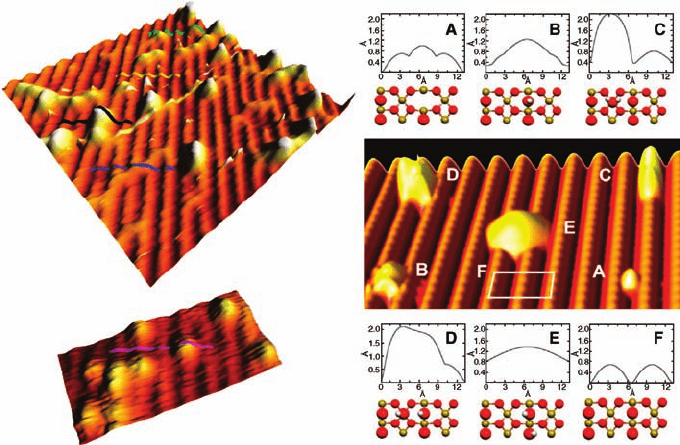
We note also that, experimentally, the STM contrast is found to change as much as
0.5 Å depending on the applied (positive) bias and specific tips.On these grounds, it is
reasonable to expect that different tips would result in scaling factors different from
the ones reported in [4]. In this respect, simultaneous AFM and STM of the surface
acquire additional importance for the identification of experimental tip structures,
and consequently, the scaling factor required to gain quantitative agreement between
Figure 4.8 Left: experimental STM images
(1.5 V; top: 0.3 nA, bottom: 0.59 nA) of
TiO
2
(1 1 0). Features corresponding to O
vac
,
OH
br
, 2OH
br
, and an adsorbed water molecule
are indicated by blue, green, black, and pink
lines, respectively (clean surface: yellow line).
The top image (120 Å
2
) was recorded at room
temperature, whereas the bottom image
(50 Å 20 Å) was recorded at 150 K. Right:
simulated STM images (1.5 V), scan lines and
corresponding ball-and-stick models for
optimized TiO
2
(1 1 0) in the presence of O
vac
,
molecularly adsorbed water molecule, its
pseudodissociated state and final dissociation
product. O, Ti, and H atoms are drawn red,
yellow, and white, respectively. A: O
vac
;B:OH
br
;
C: molecularly adsorbed water molecule on
5f-Ti; D: pseudodissociated state; E: 2OH
br
;
F: clean surface. The picture has been prepared
merging all the individual simulated images
together (evaluated at the same density contour
value, i.e., 0.359 10
7
eÅ
3
) and allowing
an exponential decay of half a simulation cell
toward the clean surface value whenever the
simulation cell has been found too small
to allow a full recovery of the clean surface
baseline. (Reprinted with permission from
Ref. [3].)
4.5 Catalytic Water Production
j
109
theory and experiment [4]. It should be stressed that this feature of STM simulations
on TiO
2
is quite unique and originates not in a problem of transport theory or the
description of tunneling but in problems associated with the description of the
electronic structure of doped semiconductors.
Owing to the surface preparation protocol, which relies on cycles of Ar-ion
sputtering and vacuum annealing to temperatures as high as 1100 K [73], ultra high
vacuum prepared TiO
2
(1 1 0) is inevitably characterized by the presence of oxygen
vacancies O
vac
. Even in very clean UHV conditions, bridging hydroxyls OH
br
are
also present on the surface because of the dissociation of residual water in O
vac
sites [1, 2, 77]. Despite some variations in the thickness and lateral extent of the
simulated slabs, a general consensus has been established concerning the exother-
mic dissociation of water molecule in O
vac
sites [1–3, 42]. Interestingly, it turns out
that most of the surface processes at TiO
2
(1 1 0) are indeed induced and governed
by the presence of these pristine defects [69].
The STM appearance of these pristine defects, namely, O
vac
and OH
br
, is closely
related to the contrast assignment between Ti
5c
and O
br
rows of TiO
2
(1 1 0). This issue
has been a matter of long debate within the experimental and theoretical community.
Initially, bright protrusions on dark rows were assigned to O
vac
[78]. Unfortunately,
not only O
vac
but OH
br
are also imaged as bright protrusions on dark rows [79]. The
main difference in their appearance is their relative extent and apparent height
with respect to Ti
5c
and O
br
rows. Comparison between STM measurements and
simulated images led to the brighter and larger spots being initially assigned to O
vac,
whereas the smaller and darker spots were associated with the presence of OH
br
on the surface [19]. However, recent STM and DFT data [1–3, 77] have provided
compelling evidence that the protrusions associated with O
vac
are less bright
and extended than those associated with OH
b
, an aspect which simulations on
a sufficiently thick slab are capable to recover [3] (see Figure 4.8). Despite the quali-
tative agreement between theory and experiment concerning the simulated STM
appearance of O
vac
and OH
br
, a major disagreement of theory with respect to
the experimentally detected appearance of H
2
O-related products on TiO
2
(1 1 0) is
the overestimation of the simulated apparent height for H
2
O and the dissociation
precursor (OH
br
–OH) [2] with respect to the simulated appearance of O
br
(see
Figure 4.8).
Another major flaw of any DFT study of TiO
2
(1 1 0) relying on a semilocal (GGA)
approximation to the exchange correlation terms (as in Refs [3, 4]) is represented
by the well-known underestimation with respect to the experimental bandgap ofwide
gap semiconductors [34] and an incorrect description of the defect states associated
with pristine surface defects [3]. In fact, different spectroscopic studies suggest that
both O
vac
and OH
br
introduce defect states in the bandgap that are found 1 eV below
the conduction band (CB) onset [80, 81]. It has been recently shown that to correctly
represent the energy localization of these defect states in the bandgap, some exact
HFexchange contribution is required [40] (see Figure 4.9). In fact, hybrid DFT B3LYP
results clearly localize the electronic states associated with O
vac
and OH
br
in the
(slightly overestimated) bandgap in line with the experiment (Figure 4.9). Conversely,
at odds with the experiment and hybrid DFT descriptions, semilocal (GGA)
110
j
4 Theory of Scanning Tunneling Microscopy and Applications in Catalysis
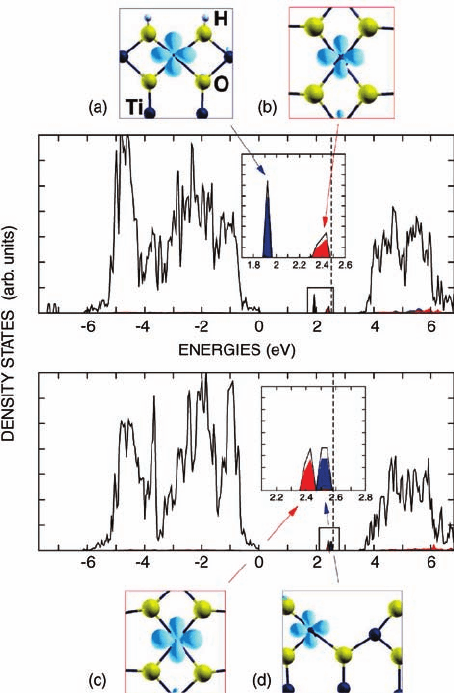
approaches energetically localize the defect states at the bottom of the conduction
band (see Ref. [3] and references therein). Concerning the real-space distribution,
B3LYP provides highly localized solutions for O
vac
and 2OH
br
(Figure 4.9), fully
supporting the proposed electron trap affinity for these defect states [39].
The effects of the incorrect GGA description for the defect states on the simulated
STM appearance has been recently addressed by comparing the simulated appear-
ance for clean TiO
2
(1 1 0), O
vac
, and OH
br
both at GGA and at B3LYP levels [20].
Interestingly, once limitations of the localized atomic basis set with respect to the
Figure 4.9 Total and projected density of states
for the hydroxylated (top) and reduced (bottom)
TiO
2
(1 1 0) surface, calculated using the B3LYP
hybrid functional. The Ti
3 þ
states are localized
on (a) the Ti ion between the two bridging
OH groups, Ti
3 þ
br
-- OH
; (d) the Ti ion nearest to
the oxygen vacancy, Ti
3 þ
br
-- v
; (b), (c) on a five-
coordinated Ti ion, Ti
3 þ
5c
of the surface. Spin
density plots are reported: (a), (d) Ti
3 þ
br
, side
view; (b), (c) Ti
3 þ
5c
, top view. The vertical dotted
line in the PDOS denotes the position of the
Fermi energy. Only the majority spin compo-
nent is reported. (Reprinted with permission
from Ref. [39].)
4.5 Catalytic Water Production
j
111
vacuum decay of the surface states are suitably accounted for [20], it turns out that
the simulated STM appearance of the surface (for positive biases) does not depend
critically on the relative position of the defect states with respect to the (imaged)
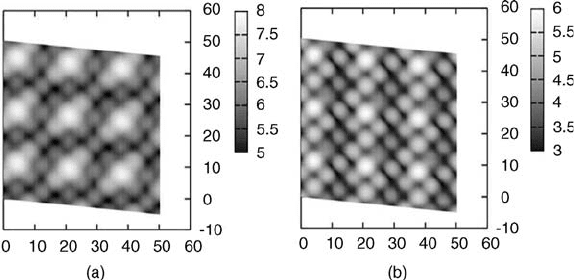
bottom of the conduction band. Consequently, Hybrid DFT results are also fully
consistent with the experimentally detected larger STM appearance for OH
br
with
respect to O
vac
(see Figures 4.8 and 4.10).
Forcompleteness, we report that on the basis of resonant photoelectron diffraction
(PED) measurements, it has been recently suggested that the real-space charge
distribution for the defect states associated with O
vac
is delocalized over several
subsurface sites around O
vac
[82]. While challenging the B3LYP real-space distribu-
tion of the defect states associated with O
vac
(Figure 4.9), the qualitative agreement
between experiment and B3LYP-based simulated STM appearance for positive biases
has to be considered unaffected. This in turn further suggests that the bottom of the
conduction band is ultimately only marginally affected by the description of the
bandgap electronic states associated with pristine defects, that is, O
vac
and O
br
. The
same conclusions would also be valid in the presence of Ti-interstitials immediately
below the surface topmost layer, a possibility that has been recently ruled out on the
basis of [82] and, at the same time, also suggested to explain hydroxylated TiO
2
(1 1 0)
reactivity toward molecular oxygen [83].
Thus, the puzzling scenario that emerges from the theory side is that although
GGA-based approaches fail in reproducing the experimental position in the bandgap
for the electronic states associated with the pristine defects, the onset of the CB edge
is unequivocally well described in terms of real-space localization of the electronic
distribution far from the surface. At the same time, despite excellent agreement with
the experiment about the energy position in the bandgap for the defect states, some
(system-specific [20]) extra tuning is required to account for the experimentally
detected STM appearance on a localized atomic basis set B3LYP.
Figure 4.10 Simulated STM images (sample bias 1V) at constant
density (2.5 10
6
e/B
3
) of the (a) hydroxylated and (b) reduced
(1 1 0) rutile TiO
2
surface (one OH group and one oxygen vacancy,
respectively) obtained with B3LYP localized basis set calculation.
(Reprinted with permission from Ref. [20].)
112
j
4 Theory of Scanning Tunneling Microscopy and Applications in Catalysis
A substantial improvement in the theoretical modeling of this substrate, able to
overcome the drawbacks of both former approaches (standard GGA and localized
atomic basis set B3LYP) is the implementation of the HSE03 [36] hybrid functionals
in a plane-wave formalism.
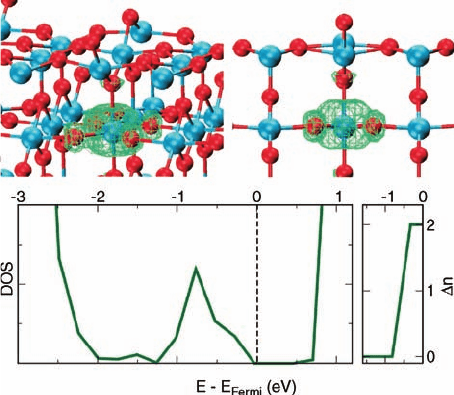
Interestingly, within such an approach, the simulated bandgap of TiO
2
(1 1 0) is
modeled to be in good agreement with experimental value of 3.2 eV [69], and in line
with B3LYP results, both O
vac
and OH
br
are modeled to induce defect states in the
bandgap roughly 1 eV below the onset of the CB (Figure 4.11). As for B3LYP [39],
the most stable modeled solution for O
vac
is a paramagnetic triplet state (Figure 4.11).
For completeness, we note that the modeled HSE03 subsurface delocalization (as
for B3LYP results) is clearly at odds with recent PED data [82] concerning the rather
delocalized nature of the defect-induced electronic states associated with O
vac
.
Concerning the HSE03 simulated STM appearance, it is found to be in agreement
with the experiment, that is, the simulated contrast is modeled to increase going
from O
vac
to H
2
O and OH
br
(Figure 4.12). Although still overestimated with respect
to the experiment, with maximum deviations smaller than 50 pm with respect to
the corresponding experimental value, the overestimation effect on the simulated
contrast is found to be reduced for HSE03-based results by comparison to the
analogous GGA-based data (Figure 4.8).
Leveraging on this positive outcome, we next explicitly consider the effect of the
experimentally used W tips in the experiment. As in Refs [3, 4], the constant current
topographies were simulated by integrating the states in the CB edge from its
Figure 4.11 Bottom: optimized ions HSE03 total density of states
and integrated number of defect states (Dn) for O
vac
. The
integrated charge density corresponding to the defect states is
shown in the top panel from two different perspectives for the
same isocontour value (green: 10
6
eÅ
3
). O: red, Ti: cyan
(unpublished work).
4.5 Catalytic Water Production
j
113